Introduction
When you set out to audit an LED grow light factory, you are taking one of the highest-leverage steps possible before committing thousands of dollars per fixture across a multi-site facility. The line that assembles your grow lights determines how long they hold their output, how uniformly they light a canopy, and how often a bad batch turns into unplanned downtime. Yet most buyers walk a line and come away with impressions instead of evidence.
The problem is that no two audits follow the same route. One tour stops at the shipping dock, another lingers on thermal testing, and neither is comparable to the next. To compare factories apples-to-apples, you need a standardized checklist that maps each station to a verifiable proof — a listing record, a test log, a calibration certificate — rather than a verbal assurance.
This guide gives you that structure. Use it to evaluate SMT and PCBA controls, thermal interface and heatsink validation, reliability and IP sealing, and photometric traceability. Along the way, request the documents that back each claim: NRTL listing records, DLC Qualified Products List (QPL) entries, IEC 62471 reports, LM-79 files, calibration records, and batch-level traceability logs.
The goal is repeatability. A factory that can demonstrate the same controlled process shift after shift, and back it with data, is a lower-risk partner than one that impresses you on a single day. Everything below is organized so you can score each supplier on the same scale and walk away with a comparable dossier rather than a vague impression.
Table of Contents
Compliance and Listings to Verify When You Audit an LED Grow Light Factory
UL 8800 and NRTL scope
Start the tour where most people end it: the certificate. For horticultural lighting installed under the U.S. National Electrical Code (NEC) and the Canadian Electrical Code (CEC), the governing safety standard is UL 8800. As IAEI Magazine’s UL Question Corner explains, UL 8800 expands on UL 1598 for general luminaires and adds requirements for construction and resistance that are specific to a horticultural environment.
A UL 8800 reference only matters if it is a real listing tied to the exact model you intend to buy. Ask for the directory record from the Nationally Recognized Testing Laboratory (NRTL) — typically UL or ETL — and check that the model number, voltage, mounting, and place of manufacture match your quotation and the physical label on the line.
A certificate for a similar family name is not coverage. UL’s horticultural safety standard update also confirms these listings carry a damp or wet environmental rating and include testing at elevated ambient temperatures — both relevant in a humid grow room full of fixtures. For a direct example of how a supplier packages these proofs into a compliance story, SLTMAKS’ UL-certified grow lights breaks down the listing scope behind a horticultural fixture.
DLC Horticulture QPL alignment
Safety listing and rebate eligibility are separate questions. If your project depends on a utility incentive or a procurement spec, confirm the exact fixture identifier appears on the DesignLights Consortium (DLC) Horticultural Qualified Products List (QPL), and that it has not been delisted. The DLC’s testing and reporting requirements for LED-based horticultural lighting note that products must be certified by an OSHA-recognized NRTL or an SCC-recognized body — so the DLC entry and the safety listing should be consistent.
Verify the QPL configuration matches what ships, since a reassignment of diodes or drivers can break the alignment. If you need the reasoning behind this step, why DLC-certified grow lights matter for commercial farms explains how utility programs treat the QPL entry.
Photobiological safety (IEC 62471)
Horticultural fixtures run at high intensity close to workers, so photobiological safety matters beyond electrical safety. The relevant assessment is IEC 62471, which evaluates eye and skin exposure across the 280–1400 nm range. UL Solutions’ horticultural lighting certification covers this evaluation alongside UL 8800. Ask for the report’s stated Risk Group and compare it to the operating distance you actually use. Risk Group 2 and higher require specific warning labels, and the label on the unit should match the report.
SMT/PCBA and ESD Controls on the Line
Solder paste, placement, and reflow control
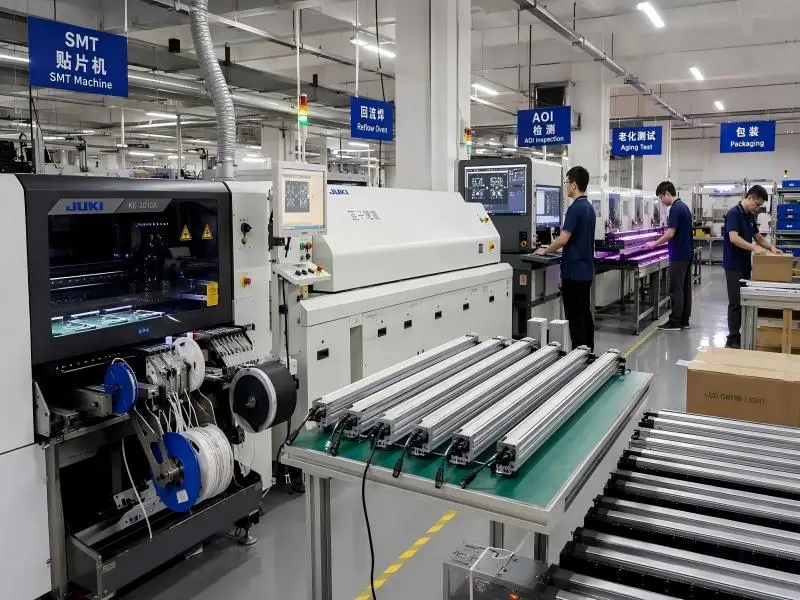
A reliable grow light starts as a properly assembled board. On the SMT line, check how solder paste is stored and applied, how components are placed, and whether a reflow oven has a validated and monitored thermal profile. Ask for the reflow profile and the process-control records showing it stays within window across shifts.
AOI/X-ray inspection and MSL handling
Automated optical inspection (AOI) after reflow catches missing or misaligned parts, but it misses what it cannot see. For solder joints hidden under packages, a factory should use X-ray inspection and be able to show void-rate limits. Moisture-sensitive devices (MSDs) must be handled per their moisture sensitivity level (MSL) — stored with a desiccant, baked before use when required, and tracked so an opened reel is not run past its floor-life allowance.
ESD program per ANSI/ESD S20.20
Electrostatic discharge silently degrades LEDs, and the damage surfaces later as premature failure in your grow room. Verify the factory runs a program consistent with ANSI/ESD S20.20: grounded benches, verified wrist straps, and logged daily checks. Ask how finished units trace back to component lots and test records. At SLTMAKS, operator grounding and lot-level traceability tie every assembled board to its test data for accountability. For a deeper look at how PCBA quality controls, functional testing, and pass/fail limits are structured around grow-room conditions, see SLTMAKS’ PCB assembly quality standards.
Thermal Management and TIM Validation
Heatsink and airflow engineering
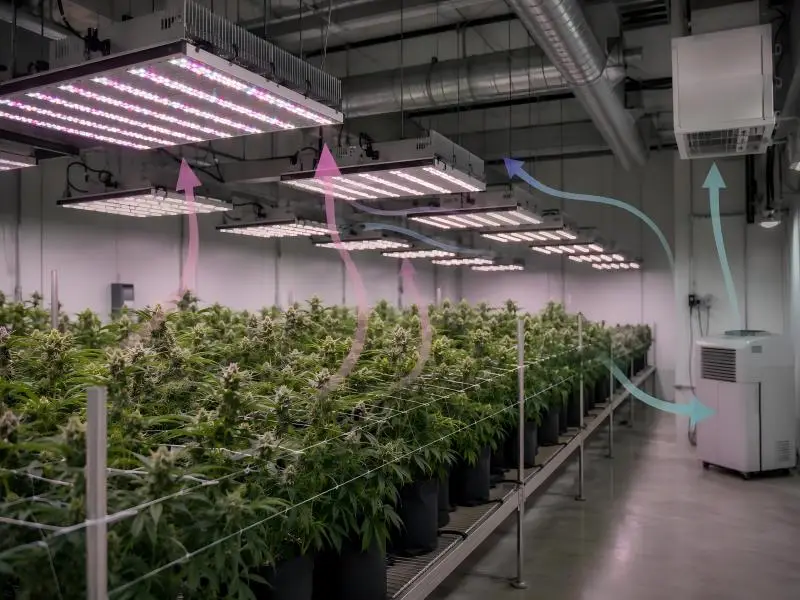
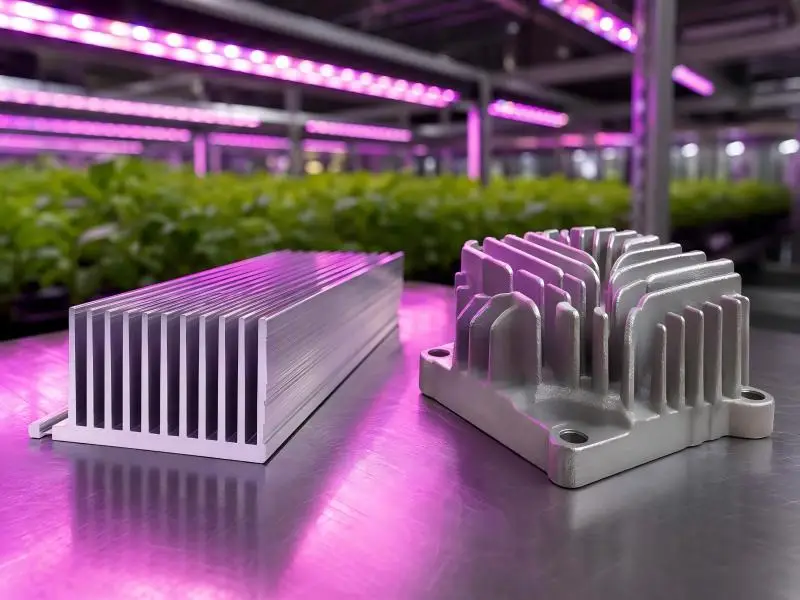
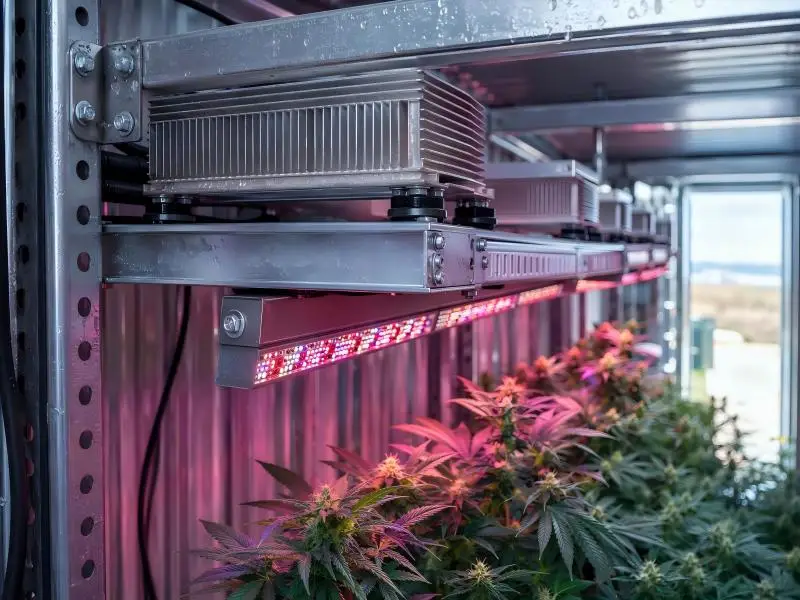
LEDs convert a share of input power to heat, and that heat must move from the junction to the room air. Node-level specs reveal whether the design has margin. For example, SLTMAKS’ industrial grow light engineering targets a maximum LED junction temperature of 85°C at a 40°C ambient, with per-package junction-to-case resistance at or below 0.3°C/W. A passive, extruded aluminum heatsink with generous surface area and clear airflow paths is the preferred profile for commercial environments, because it removes the fan-failure mode entirely.
TIM application and coverage verification
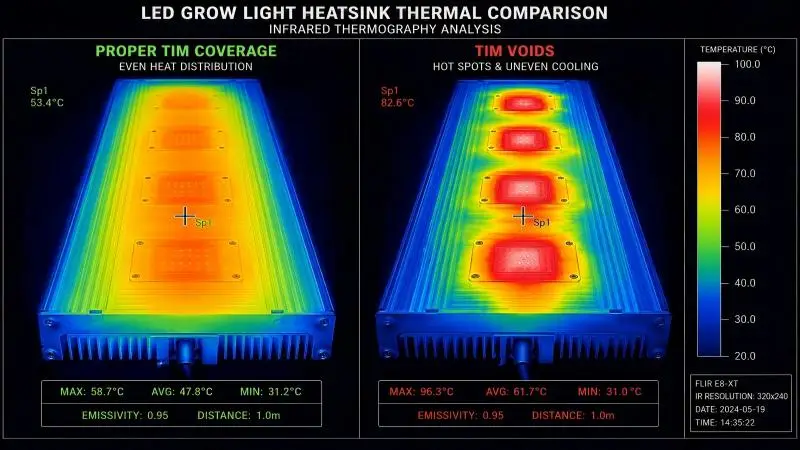
The thermal interface material (TIM) is the thin bridge between the LED circuit board and the heatsink. Its job is to replace insulating air pockets with a conductive layer. Coverage and bond-line thickness are what actually matter. A factory that applies adequate TIM and verifies coverage will show far more even temperature distribution than one with voids.
The thermography below illustrates the difference: uniform heat spreading on the left, and clustered hotspots on the right where the TIM is missing.
Junction-temperature validation methods
Ask how the factory confirms junction temperature rather than assuming it. Look for thermocouple measurements at the LED solder point and driver case during a powered heat soak, plus thermal imaging to catch uneven contact. When a fixture is run at rated power in a controlled ambient and the measured temperatures stay inside design limits, the thermal model is validated. Confirm this matches the profile in your grow room, where ambient and airflow will differ from a test bench. As SLTMAKS’ passive heat dissipation guide notes, the full path from die to room air — junction, TIM, heatsink, and ambient — must be engineered together and verified together.
Reliability, IP Sealing, and Final Test Evidence
Burn-in, power cycling, and failure criteria
A short burn-in screens out early failures before fixtures reach your ceiling. Ask how long units are powered at or near rated output and what failure criteria end a unit or a batch. A meaningful process records the duration, the load, and the outcome for every unit. A 48-hour aging test at the line, with strict optical calibration before packing, is the kind of evidence you want to see rather than hear about — SLTMAKS documents this as part of its zero-defect delivery process.
Thermal cycling, vibration, and corrosion resistance
Grow rooms are stressful environments. Confirm the factory stress-tests fixtures with thermal cycling (powered on and off across temperature swings), vibration checks for shipping and mounted fixtures, and corrosion resistance for humid, high-moisture settings. Each test should have a documented pass/fail threshold, not just a checkbox.
IP rating validation and sealing process controls
An IP rating is only as real as the process that produces it. If a fixture claims IP65 or IP67, the tour should show the sealing controls — gasket compression, cable glands, potting or silicone application, and torque specs on fasteners. Ask how the factory verifies the assembled enclosure holds its rating under exposure, rather than assuming a datasheet value survives assembly.
Photometric Integrity and Traceability
LM-79 lab accreditation and calibration records
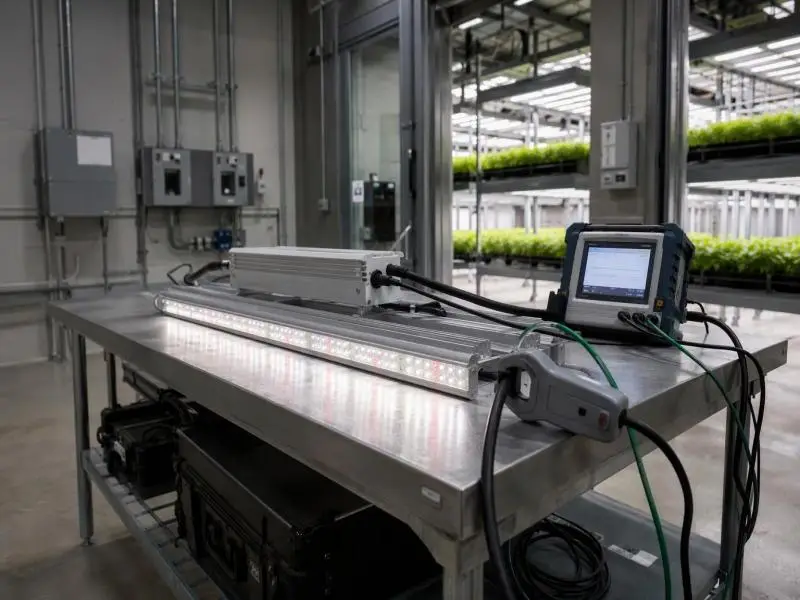
Photometric claims need a traceable measurement. Ask whether the in-house or third-party lab runs LM-79 fixture-level testing, with calibrated equipment and records to prove it. The calibration date and laboratory scope matter more than the printed efficacy number.
PPF/PPE claims vs tested configuration
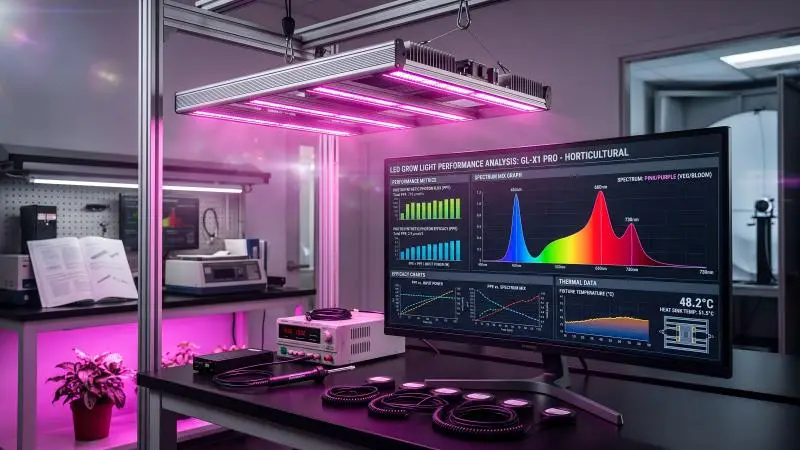
The most honest factory can show that its photosynthetic photon flux (PPF) and photosynthetic photon efficacy (PPE, in μmol/J) figures come from the exact configuration that ships — same drive current, same spectrum mix, same temperature. A claim derived from a different test configuration is not the claim you are buying. Cross-check the tested values against the label and the quoted spec.
LED diode binning and component traceability
Consistency comes from binning. Diodes vary in flux, wavelength, and forward voltage, so a factory that locks LED bins controls both spectrum and output uniformity. Pair that with component traceability that ties each finished unit back to the diode and driver lots it was built from. When an issue emerges later, traceability lets the factory isolate the affected batch instead of guessing across the whole order.
Conclusion
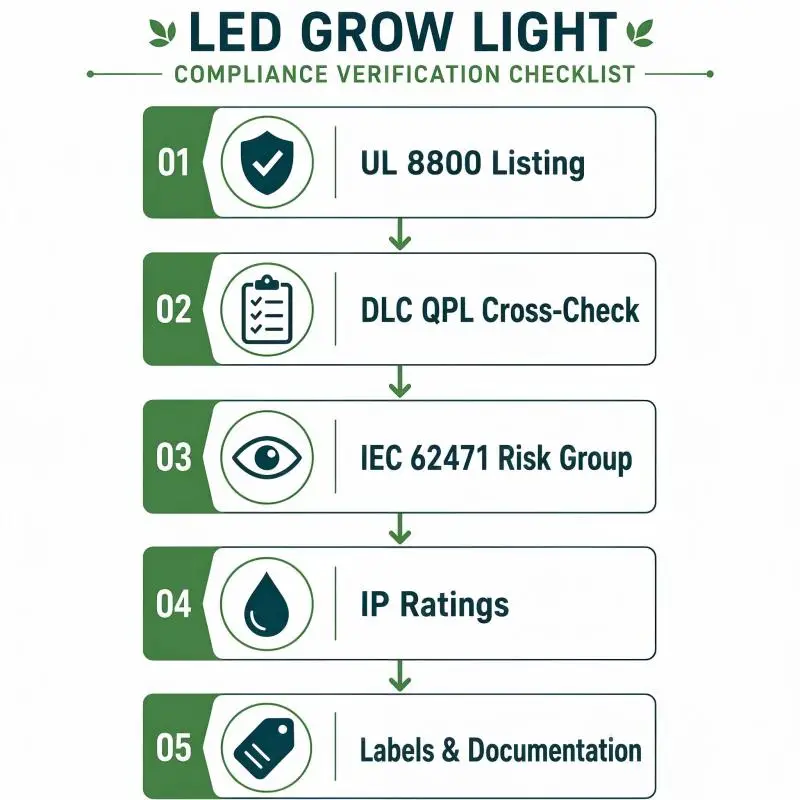
Walking a line with a standardized checklist turns a subjective tour into a comparable audit. The same five domains — compliance listings, SMT and ESD controls, thermal validation, reliability and IP sealing, and photometric traceability — apply to every factory, which is what lets you compare suppliers on the same footing.
An LED grow light is a long-lived asset in a demanding environment. The fixtures that keep a facility running with consistent yield and predictable energy use are the ones built on verified processes, not just on paper claims. Before you sign, ask for the documents behind each checklist item, verify the physical line matches the claims, and confirm the tested configuration is the one that ships.
To reduce downtime and lock in consistent output across sites, standardize this evaluation now — a little rigor on the tour saves far more than it costs once hundreds of fixtures are hanging above your crop.
Next steps: Take this checklist to every factory you evaluate, and request a complete engineering data package — NRTL listing records, DLC QPL entry, IEC 62471 report, LM-79 files, and batch traceability — before you compare pricing.
FAQ
What certifications should a commercial LED grow light have before I buy?
What certifications should a commercial LED grow light have before I buy?
At minimum, for a North American installation, the fixture needs a current safety listing to ANSI/CAN/UL 8800 from an OSHA-recognized NRTL such as UL or ETL, tied to the exact model number and configuration you’re buying. Beyond that, check for an IEC 62471 photobiological safety report, a DLC Horticulture QPL entry if you rely on utility rebates, and LM-79 photometric test files. A logo on a brochure isn’t coverage — verify the listing record in the certifier’s directory.
How do I tell a real grow light manufacturer from a reseller?
How do I tell a real grow light manufacturer from a reseller?
Look for the factory itself, not just a brand. A genuine manufacturer should let you tour the production line — in person or over a live video call — and point to actual SMT assembly, in-house thermal and optical engineering, and its own QC documentation. Verify the manufacturing site named on the certificate matches the facility you’re auditing, and confirm the product warranty is backed by whoever owns the line rather than a trading company.
What does a PPF or PPE spec really tell me, and when should I trust it?
What does a PPF or PPE spec really tell me, and when should I trust it?
PPF (µmol/s) tells you total photon output and PPE (µmol/J) measures how efficiently the fixture converts watts into usable photons. Trust the numbers only when they come from LM-79 fixture-level testing on the exact configuration that ships — the same drive current, spectrum mix, and operating temperature. Ask to see the calibrated lab records, not just the printed efficacy figure on a datasheet.
Why does thermal management matter more than the wattage sticker?
Why does thermal management matter more than the wattage sticker?
Because heat kills LEDs and cuts light output long before the driver burns out. A fixture that runs hot will degrade faster and hold its PPF for less time. On a tour, verify the junction temperature stays inside design limits during a powered heat soak, check that TIM coverage is even across the heatsink (no voids), and confirm a passive, fan-free design so there’s no fan to fail in your grow room.
What should I check inside the LED board itself?
What should I check inside the LED board itself?
Ask about three things on the SMT line: how solder paste is stored, applied, and reflowed within a monitored thermal profile; whether AOI and X-ray inspection catch both visible and hidden solder joints under packages; and how moisture-sensitive devices are handled per their moisture sensitivity level. Also confirm the factory runs an ESD program consistent with ANSI/ESD S20.20, since electrostatic discharge silently degrades LEDs.
Is an IP65 or IP67 rating worth paying for, and how do I verify it?
Is an IP65 or IP67 rating worth paying for, and how do I verify it?
An IP rating is only as real as the process that produces it. The rating tells you the bare enclosure is dust- and water-resistant, but the value depends on whether assembly preserves that seal. On the line, watch for gasket compression, cable glands, potting or silicone application, and torque specs on fasteners. Then ask how the factory re-verifies the assembled unit holds its rating under exposure.
Why is DLC listing important if my fixture is already UL listed?
Why is DLC listing important if my fixture is already UL listed?
UL 8800 covers safety; DLC Horticulture QPL covers performance, energy-efficiency, and market-access eligibility for rebate and procurement programs. The two are independent questions. If your project depends on a utility incentive or a government spec, confirm your exact fixture identifier appears on the QPL and hasn’t been delisted — and that changing a diode or driver hasn’t broken that alignment.
How should I use a factory tour checklist to compare multiple suppliers fairly?
How should I use a factory tour checklist to compare multiple suppliers fairly?
Score every supplier on the same five domains — compliance listings, SMT and ESD controls, thermal validation, reliability and IP sealing, and photometric traceability — and attach a verifiable proof to each item rather than a verbal assurance. Note the actual documents each factory produces (NRTL record, LM-79 file, burn-in log, calibration certificate) and the tested configuration behind every number. That way a strong thermal test log in one factory is weighed against the same kind of evidence in another, and you leave with a comparable dossier instead of scattered impressions.