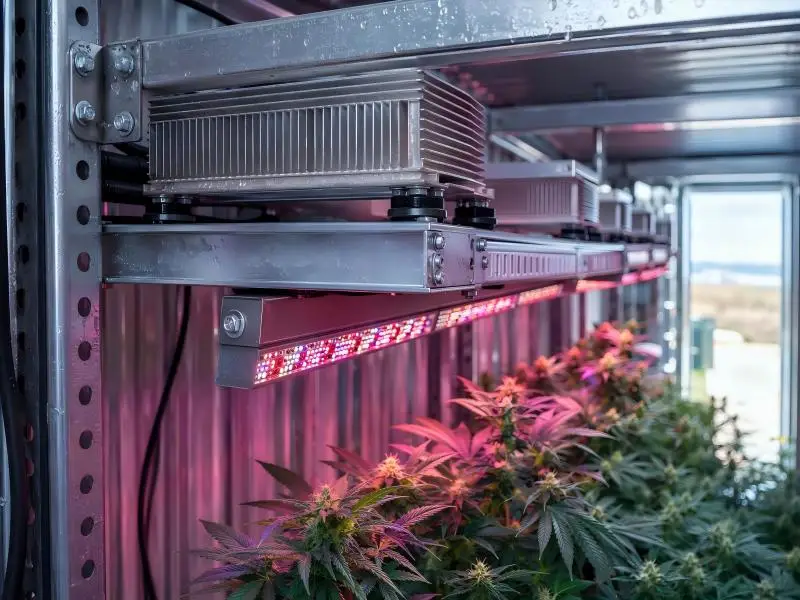
Designing effective vibration resistant grow lights for high-vibration environments comes down to four decisions: the mounting interface, the ingress protection rating, the driver placement, and the fastener locking method. Each one is governed by a different standard, and none of them substitutes for the others.
Transport validation is the clearest place to see the mechanical load a fixture has to survive. The ISTA 3E sequence ends with a random-vibration step at 0.54 Grms overall, after a 42 in/s (1.1 m/s) inclined or horizontal impact and a 200 mm (8 in) rotational edge drop both before and after vibration (Keystone Compliance, ISTA 3E test sequence). That is a transport profile, not an operating one, and it is worth separating the two before you specify anything.
The safety and ingress standards cover less than most buyers assume. Reading the scopes of UL 8800, UL 1598, IEC 60529 and the IP code together, none of them names the mechanical vibration or shock endurance of the finished luminaire; sine and shock endurance only enter when a product standard, a mounting method, or a transport-validation requirement pulls them in (In Compliance Magazine, horticultural lighting considerations).
So the method below walks through specifying and verifying each of the four choices in order, from the vibration and moisture profile through to the listing and inspection path you can hand to a procurement team.
SLTMAKS is a global provider of professional-grade LED grow lights, engineering full-spectrum lighting with advanced thermal management and robust aluminum heat sinks for growers ranging from home hobbyists to commercial operators. Its work on industrial-grade durability and vibration-relevant hardware design is the basis for this guide on LED grow lights in high-vibration environments.
Table of Contents
Define the Vibration and Moisture Profile Before Choosing Vibration Resistant Grow Lights
Write the profile before you compare fixtures, because the two vibration regimes a container build faces are tested by different programmes and neither substitutes for the other. Shipping standards simulate transport hazards, not continuous operational vibration: ISTA defines Procedure 3E for unitized loads shipped full-truckload, and its sequence ends with a random-vibration step at 0.54 Grms, alongside a 42 in/s (1.1 m/s) impact, a 200 mm (8 in) rotational edge drop before and after vibration, and compression at Calculated Test Force × 1.4 (Keystone Compliance). Passing that says the crate survived the road. It says nothing about a fixture bolted above a canopy under fan-induced vibration for years.
Do not reach for IEC 60068-2-6 as the answer either. IEC 60068-2-6 is a sinusoidal test method for finding mechanical weakness and resonant frequencies (Edition 7.0, 2007-12); it does not represent random vibration, transport spectra, drop or shock pulses.
| Programme | What it qualifies | Representative inputs |
|---|---|---|
| ISTA 3E / ASTM D4169 | Packaged load through transport | 0.54 Grms random, 1.1 m/s impact, 200 mm edge drop, 1.4× compression force |
| IEC 60068-2-6 | Component or assembly under sinusoidal sweep | Discrete or swept frequencies, resonance search |
| Installation-specific qualification | Installed fixture under continuous fan duty | Site-measured vibration, washdown method, ceiling clearance |
Record four things in writing for your own shipping container grow light mounting plan: the transport route and carrier, fan duty and mounting distance, the actual washdown method and chemistry, and ceiling clearance above the canopy. Every later step is chosen against that sheet.
Select the Mounting Method and Locking Hardware
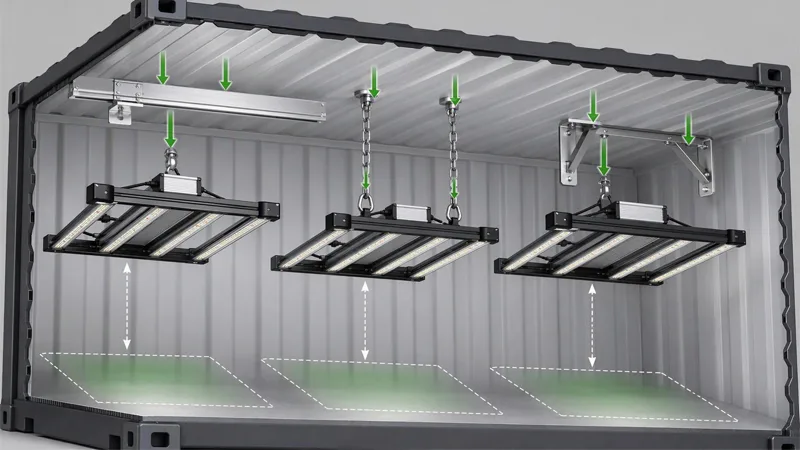
The mounting interface, not the fixture body, is where most container installations fail. Vibration-resistant LED grow light design therefore starts with the load path: how the fixture hangs, how that connection is locked, and how a technician reaches it later.
Three methods dominate shipping container grow light mounting. A rigid rail spreads load across multiple ceiling points and keeps fixtures aligned, but it fixes spacing and complicates reconfiguration. Suspended chain absorbs vibration through the flexible link and allows height adjustment, at the cost of swing that must be damped or braced. A direct-ceiling bracket gives the shortest, stiffest load path and the least clearance for service access.
Whichever method you choose, the fasteners decide whether it survives. Nord-Lock’s Junker vibration test material presents the DIN 65151 / ISO 16130 test as a comparison method for anti-loosening hardware, setting wedge-locking washers against double nuts, plain washers, helical spring washers, check-lock nuts and nylon-insert nuts. This is vendor-owned evidence, and the page is undated, so treat the comparison as a method reference rather than an independent benchmark. The failure mode it addresses is specific: continuous low-amplitude excitation walks fasteners backward until clamp load drops and the fixture falls onto the canopy.
Choose the Ingress Protection Rating for the Actual Washdown Method
A higher IP number is not automatically the right choice for IP-rated grow lights for container farms. The IPX6 jet test uses a 12.5 mm nozzle at 100 litres per minute, and IPX7 means immersion at 1 m for 30 minutes (Castle Compliance). Neither describes a hand-sprayed container aisle. IPX6 adds pressure to the jet test, at 100 kPa (Degson), which a pressure nozzle at close range can exceed.
Match the rating to the cleaning method you actually use. Splash and low-pressure spray sit at IPX4 to IPX5; a directed pressure wash demands IPX6. In North America, grow lights must be rated damp or wet and survive the rain and sprinkler tests of ANSI/UL 1598 Clause 13.4.8, with IP54 or higher marking per IEC 60598-1 and ANSI/CAN/UL 8800 as the primary horticultural safety standard (In Compliance Magazine).
The failure mode is predictable: an IP65 fixture hosed at close range with a pressure nozzle. The seal holds against the rated jet, not against the operator’s habit.
Place the Driver to Balance Vibration Survival Against Thermal Load and Serviceability
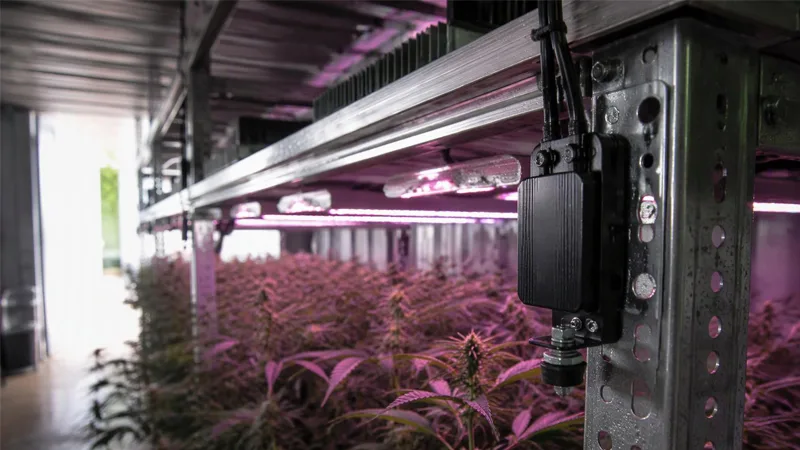
Grow light driver vibration and thermal management is a three-way trade-off, not a single best answer: integrated, remote-in-rack, and remote-in-cabinet placement each win on one axis and lose on another.
Container-farm lighting design assumes a fixed, low interior envelope. Industry layout guidance works in 0.6–1.0 m rack widths with fixture-to-canopy distances of roughly 12–30 cm, and fruiting crops need extended tier heights, so fixture profile thickness and driver placement compete directly with canopy clearance (FYTech Systems layout guide, retrieved 2026-06-26). On a 0.6 m rack, a single centred bar 15 to 20 cm above the canopy is the benchmark for 150–220 µmol/m²/s at 0.82–0.90 uniformity; a dual-bar layout at 20 to 25 cm canopy distance on a 1.0 m rack reaches 220–280 µmol/m²/s (FYTech Systems, “Multi-Tier Lighting Layout Guide for Vertical Farms”, retrieved 2026-06-26). An integrated driver adds thickness exactly where that budget is thinnest.
| Placement | Vibration exposure | Thermal rise | Field serviceability |
|---|---|---|---|
| Integrated in fixture | Highest: driver rides every rack and road cycle | Lowest: driver heat leaves with the fixture body | Hardest: fixture comes down for a driver swap |
| Remote in rack | Moderate: shorter cantilever, still on the moving structure | Moderate: heat sits inside the canopy zone | Moderate: reachable from the aisle |
| Remote in cabinet | Lowest: isolated from rack motion | Highest: cabinet needs its own airflow path | Easiest: swap without touching the canopy |
Potting a driver improves vibration survival but makes field repair harder, and capacitors and inductors are among the cracking-prone classes under cyclic stress (FYTech Systems layout guide, retrieved 2026-06-26).
Validate Solder Joints, Connectors, and Wiring Against Cyclic Stress
Solder interconnects are repeatedly identified as one of the weakest links in LED assemblies under cyclic mechanical and thermomechanical stress, and they are often the first point of failure, with wire-bond fatigue and connector contact fretting following behind. That ranking matters here because a fixture can pass a shipping test and still fail after months of fan excitation: transport validation and in-service durability are separate programmes, and a certificate from the first says nothing about the second.
Run this verification routine before you accept a design:
- Request the fixture’s vibration test report and confirm which standard and which axis profile it used. A report that names only a transport simulation has not tested continuous excitation.
- Inspect the connector retention type. Positive-lock or threaded couplings resist fretting; friction-fit headers do not.
- Confirm strain relief at every cable entry point, including the driver leads and any daisy-chain ports.
- Ask whether the driver and board were potted or conformally coated, and where.
If the supplier cannot produce the report or name the standard, treat the solder joint and connector claims as unverified.
Confirm Listing, Marking, and the Inspection Path Before Installation
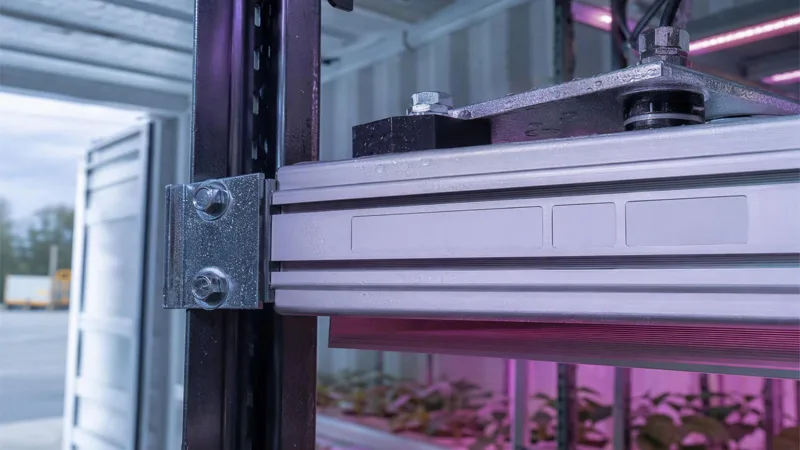
A listed fixture carries an NRTL mark from a lab recognised for that standard, and the exact model, mounting and environment rating must match the listing. The OSHA NRTL program recognises private-sector organisations to certify products against the construction and general industry electrical standards. Each recognised lab holds a defined scope of test standards and its own registered certification mark, and after certifying a product it authorises the manufacturer to apply that mark.
That authorisation is the link most procurement teams skip. The same OSHA page describes the North American chain: the NRTL listing or mark covers the product, the authority having jurisdiction (AHJ) adopts it through the permit and inspection path, and the installed unit must match the listing on model, mounting and environment rating. A fixture mounted differently from its listing, or a substituted driver, breaks that match.
Warning: OSHA recognises testing laboratories; the laboratories certify products. A supplier claim of “OSHA certified” is therefore not a valid statement, and a buyer who accepts it has no listing to point to at inspection.
Request four documents from any supplier before ordering: the listing certificate naming the exact model, the IP test conditions behind the rating, the vibration test standard and profile, and the driver replacement procedure.
Common Mistakes to Avoid
Treating a shipping test as proof of in-service durability. ISTA 3E and ASTM D4169 are transport simulations, and passing one says nothing about a fixture that will vibrate continuously for years. Shipping standards simulate transport hazards, not continuous operational vibration, so a unit can survive the truck and still fail at month eight. Qualify the installed condition separately, with a sine sweep or a documented field measurement.
Reading a higher IP number as better washdown performance. The digits describe different tests, not a ranking. IPX6 is tested with a 12.5 mm stream at 100 litres per minute, which is a directed jet, while IPX7 and IPX8 describe immersion. A fixture rated IPX7 can be the wrong choice for a pressure-washed container deck.
Assuming a safety listing covers vibration endurance. None of UL 8800, UL 1598 or the IP code names vibration endurance. Those standards address equipment safety and ingress, so a listing mark is not a durability claim.
Specifying a fixture without checking the mounting method against its listing. The exact model, mounting and environment rating must match the listing. A listed fixture hung in an unlisted bracket voids the basis of the approval and creates an inspection finding.
Results: What a Verified Container Build Looks Like
A verified container build is one where every decision from the six steps is written down and traceable, not one where the fixtures merely turn on. You should be holding a documented vibration and moisture profile, a mounting method tied to a named locking standard, an IP rating matched to the washdown you actually perform, a driver placement with its thermal and service trade-off recorded, and a listing certificate whose model number and mounting orientation match the installation.
The measurable markers are the ones the layout was designed against. Crop setpoints run from 100 to 200 µmol/m²/s for microgreens up to 600 to 900 µmol/m²/s for peppers and tomatoes, with minimum-to-average uniformity at or above 0.80 across the canopy. Where four to six bars per tier are used to reach DLI 35 to 50 mol/m²/day, those three numbers together confirm the build is doing what the design intended rather than merely running.
One stretch goal worth adding: a scheduled torque check on the mounting fasteners, logged alongside your other maintenance intervals.
Conclusion
Six decisions carry a container build from a fixture on a pallet to a fixture that survives the road. You define the vibration and moisture profile first, because every later choice is measured against it. You pick a mounting method and locking hardware rated for that profile. You match the ingress protection rating to the washdown method you actually use, not the one in the brochure. You place the driver where vibration survival, thermal load, and service access balance. You validate solder joints, connectors, and wiring against cyclic stress rather than assuming they will hold. You confirm the listing, marking, and inspection path before anything is installed.
The value of working in that order is traceability. A build assembled this way can be defended line by line: each mounting, ingress, driver, and listing decision points back to a named standard, and the record shows why the alternative was rejected. That record is what procurement, engineering, and operations can all sign off on.
If you are evaluating LED grow lights for high-vibration environments, request the fixture documentation pack or talk to an expert about a specific container configuration.
FAQ
Is IEC 60068-2-6 testing alone enough to qualify a fixture?
No. IEC 60068-2-6 is a sinusoidal test method: it sweeps a fixture through a frequency range at a defined acceleration, which is useful for finding resonant points in a bracket or housing. It does not represent random vibration or the broadband, low-frequency shaking a container experiences on a truck or ship. A fixture that passes a sine sweep can still fail in service if the qualification never covered the transport spectrum. Treat a sine-sweep report as one input, not as the whole qualification.
When does IEC 60068-2-27 apply instead?
When the risk is a discrete impact rather than ongoing shaking. IEC 60068-2-27 tests shock pulses, not continuous vibration: it applies non-repetitive or repetitive pulses at a specified peak acceleration and duration to reveal mechanical weakness, performance degradation, or accumulated shock damage (IEC 60068-2-27, 1995 edition record). It fits container drops, rail coupling impacts, and handling. It says nothing about long-duration sine-sweep fatigue, so it cannot replace a vibration test.
Does a container farm need both a transport and an installation qualification?
Yes, because they test different hazards. Shipping standards simulate transport hazards, not continuous operational vibration. A fixture can survive the road and still fail from months of fan-induced resonance at a fixed mounting point, or the reverse. Ask for both: a transport profile covering the route, and an operational profile covering the installed condition.
How do I verify a supplier’s vibration claim if the test report is not published?
Ask for the report itself, not the claim. Request the standard number and edition, the acceleration and frequency range, the axis or axes tested, the duration, and whether the sample was mounted as it ships. If the supplier will not release the report, ask for a signed summary on company letterhead naming those parameters. A claim without them is not verifiable, and no independent test data published after 2024 was found for most container-farm fixtures, so the supplier’s own documentation is usually the only record available.