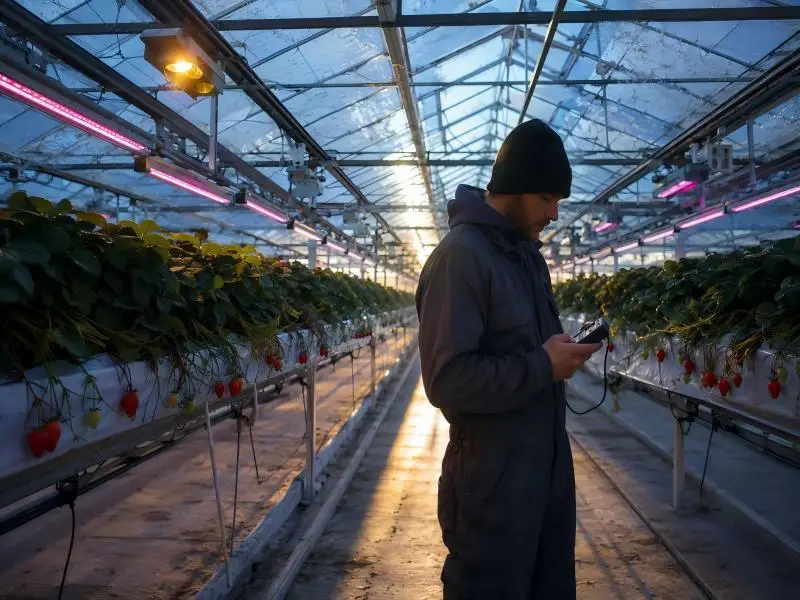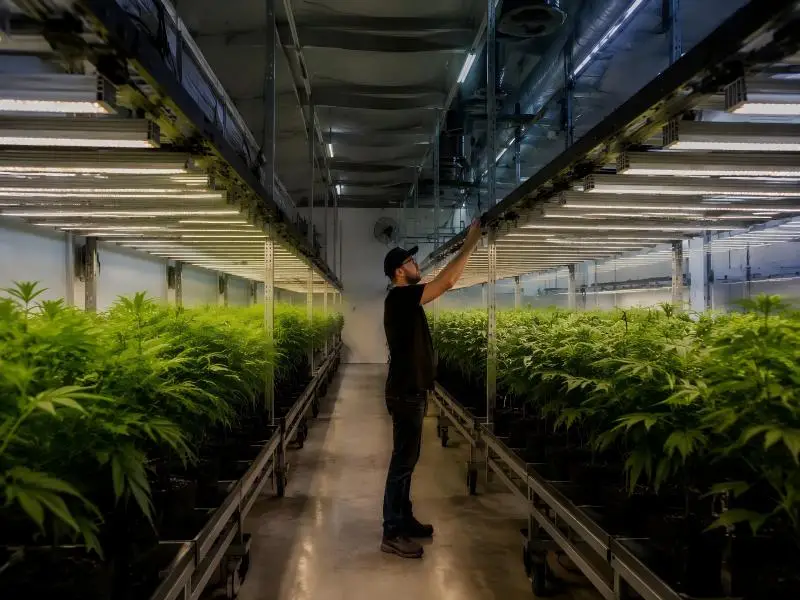
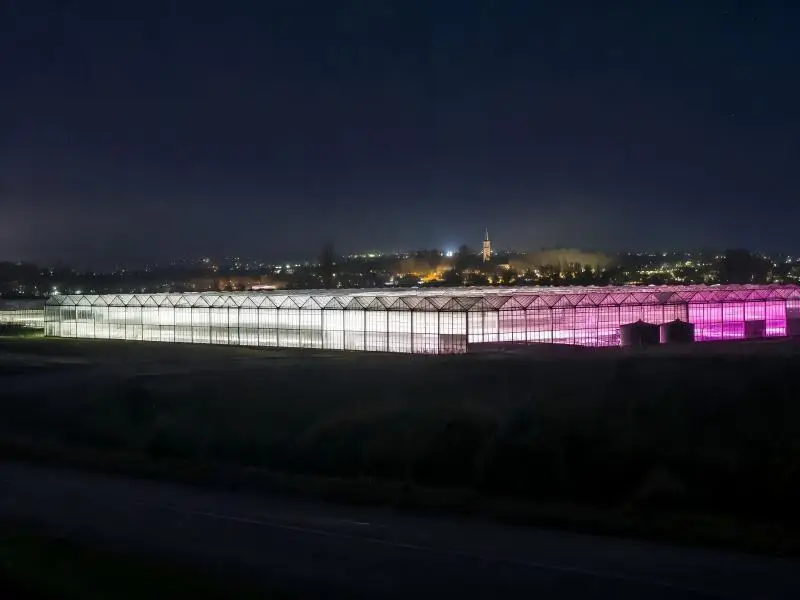
Commercial greenhouse lighting has moved from a neighbourhood annoyance to an enforcement matter. In February 2023, Leamington’s 2023 enforcement round saw 88 by-law charges laid against roughly 12 greenhouse companies after inspections began the previous November, which tells you the risk is regulatory, not just reputational. The practical goal is straightforward: stop light from crossing your property line or reaching nearby windows, which is what DarkSky’s definition of light trespass describes as light falling where it is not intended or needed.
Preventing light pollution from commercial greenhouses at night requires a comprehensive approach. Implementing effective greenhouse light pollution LED strategies comes down to three layers working together: physical containment through curtains and seals, lighting design and scheduling that cut the light you emit in the first place, and monitoring that proves the result. This guide walks through each layer as a set of specifications and checkpoints, so you can document compliance rather than simply claim it.
SLTMAKS is a global provider of professional-grade LED grow lights for growers ranging from home hobbyists to large-scale commercial agricultural operators. Its lighting designs are energy-efficient and eco-friendly, and its in-house work covers spectral science and advanced thermal management. Because light emission from commercial greenhouses at night is a lighting-design question, that work is directly relevant to the topic of this article.
Introduction
Light that escapes a commercial greenhouse at night is a regulatory and community-relations risk, not just a nuisance. DarkSky’s definition of light trespass covers light falling where it is not intended or needed, and the practical compliance goal is keeping it from crossing property lines or shining into nearby windows. Enforcement is real: Leamington’s 2023 enforcement round saw 88 by-law charges laid against about 12 greenhouse companies after inspections began in November 2022. Preventing light pollution from commercial greenhouses at night comes down to three layers working together: blackout curtains and sealing to contain light, LED fixtures with shielding and aiming to control where it goes, and SOPs with monitoring to prove it stays contained.
This guide walks through each layer, the thresholds regulators measure, and how to verify your results.
Table of Contents
Regulatory Baselines
Start with the local cap, because it decides everything downstream: curtain spec, fixture selection, and whether you need a photometric plan at all. Thresholds vary widely between jurisdictions, and so does the method used to test them.
Property-Line Caps and Verification
Ventura County’s Ojai Valley dark-sky rules cap non-essential lighting at 850 lumens generally and 2,600 lumens for security lighting, with dark hours running from 10:00 p.m. or close of business, whichever is later, until sunrise (Ojai Valley Dark Sky Ordinance FAQs, retrieved 2026-06-11). San Bernardino County’s 0.1 foot-candle residential limit and 0.25 foot-candle non-residential limit are measured with a meter oriented vertically or horizontally at the property line (San Bernardino County light-trespass memo, undated).
Draft standards show the same spread. Los Angeles County’s draft standard sets 0.5 foot-candles where adjacent zoning is residential, open space, or agricultural, and 1.0 foot-candle elsewhere, measured at grade with a photometer (LA County Planning revised draft, 2023-06). Calaveras County’s draft limits sit at 0.1 foot-candles, rising to 0.25 where both properties are commercial or industrial (Calaveras County light regulations, 2026-02).
The standard property-line measurement method is illuminance at the boundary or in windows, in lux or foot-candles, read on a horizontal or vertical grid (DarkSky Model Lighting Ordinance, 2011). Orientation changes the number you get, so confirm which one your jurisdiction uses.
Pro Tip: Before you design anything, ask your AHJ for the exact cap, the measurement orientation, and the height at which it is taken. A fixture layout that passes a vertical reading can fail a horizontal one.
Night Closure Windows and Exceptions
Leamington, Ontario shows how quickly a closure window becomes enforceable. The municipality filed eight court applications against greenhouse operators, after five the previous April, under a by-law requiring lights off or curtains fully closed between 8 p.m. and 2 a.m., with fines of $750 per occurrence (CBC News Windsor, 2021-12-23).
By-law 41-22 tightened that window to 5 p.m. through 8 a.m. starting 2022-10-01, and required operators without curtains to show installation by 2023-10-01 or declare they use no lighting. Only two owners filed the required documentation by the deadline (CBC News Windsor, 2023-02-24). Leamington still enforces By-law 41-22, stating it actively implements the by-law and monitors compliance (Municipality of Leamington, retrieved 2026).
Documentation Practices
A typical inspector compliance package contains a photometric plan showing fixture locations, aiming, and predicted boundary light levels; IES photometric files; product data sheets with shielded or full-cutoff detail; and often site photos plus a signed designer declaration (DarkSky Approved Luminaires guidelines, 2025-02-20). Assemble it before the first inspection, not after a complaint.
Engineering Controls
Curtains, vent traps and fixture shielding work as one containment system. Each layer covers a different leak path, and the weakest layer sets the result.
Blackout Curtains and Sealing
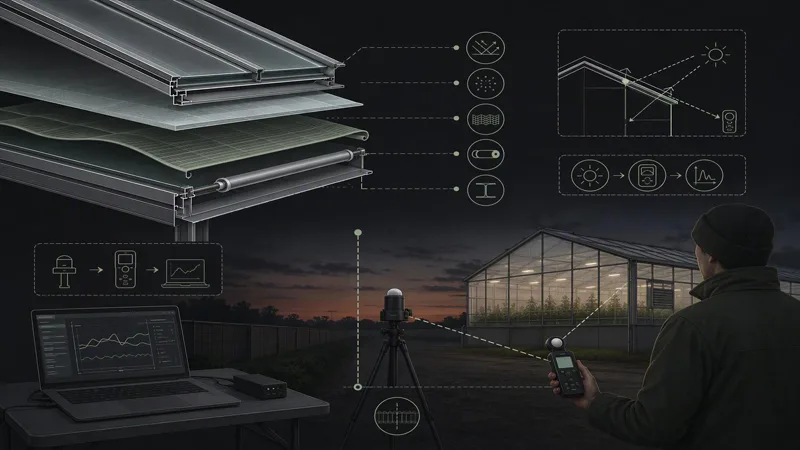
Seal the envelope before specifying anything else. A University of Guelph study that flew drone-mounted sensors over commercial greenhouses found that fully closed light-abatement curtains cut upward emissions by 95% to 99.99%, while gapped curtains leaked roughly in proportion to the open area. A 5% gap is not a 5% problem you can absorb; it is a 5% hole in your compliance case.
The fix is continuous containment across roof, sidewalls and end walls: curtain panels overlapping, seams, edges and pipe penetrations sealed, and the curtain hung above the fixtures near the truss bottom chord so light cannot escape over the top of it. Specify the blackout curtain greenhouse system as a single engineered assembly rather than per-wall panels.
Verify: walk the perimeter at night with the lights on and look for glow at overlaps, end-wall junctions and every penetration.
Vent Light Traps and Airflow
Vents, fans, shutters and louvers are the dominant leak paths in most greenhouses, so greenhouse light abatement depends on treating every air-exchange opening, not just the glazing. Baffled light traps fitted to every vent and fan use a wave design of vanes that passes air while blocking light, and they must be sized to the opening, sometimes with added ducting.
⚠️ Warning: A light trap is a restriction. Expect a static-pressure and airflow penalty, and confirm your fans still deliver the air-exchange rate your crop needs before you commit.
Verify: measure airflow at each opening after fitting and compare it against your ventilation design figure.
Fixture Shielding and Aiming
Follow full-cutoff fixture selection guidance: fully shielded luminaires with high-angle intensity tightly controlled. Choose by PPF, PPE, beam angle and distribution map rather than wattage, aim at the canopy rather than the glazing, and keep installed intensity variation near ±20% across the growing area.
Verify: check the aiming angle and confirm the distribution map matches the installed layout.
Lighting Design with LEDs
Spectrum, uniformity and scheduling decide how much light a facility has to contain in the first place. A layout that spreads light evenly across the canopy needs fewer fixtures at lower drive currents, and a schedule that finishes before the closure window removes the containment problem entirely for part of the night. Fixture selection is where those three levers get locked in.
Reduce Greenhouse Light Pollution LED Strategies
The most direct spectrum lever is colour temperature. Lower-CCT and warm-white sources, widely cited at 3000 K or below and 2200–2700 K where sensitive receptors or dark-sky goals apply, cut the blue-rich emission most associated with skyglow and ecological impact (DesignLights Consortium’s guidance on warmer light, 2022-05-11). CCT is an imperfect proxy for the underlying spectrum, so treat it as a screening criterion rather than a compliance guarantee, and confirm the actual spectral power distribution before specifying.
Key Takeaway: Greenhouse LED light pollution is a design output, not just a shielding problem. Warmer spectra (≤3000 K, or 2200–2700 K near sensitive receptors) reduce blue-rich emission; uniform layouts lower the fixture count and drive current needed; and schedules that end before the closure window cut the hours that need containment at all.
Uniformity and Layout Targets
Uneven layouts are a common cause of over-lighting. When PPFD varies widely across the canopy, growers raise output to lift the weakest zones, which raises total emission and the load on every downstream control. Targeting a minimum-to-average PPFD ratio of roughly 0.8 across the growing area keeps the highest-output fixtures from doing work that a better layout would do at lower power. Verify uniformity with a grid measurement after installation, not from the layout drawing alone.
DLI-Driven Scheduling
Daily light integral targets should drive the schedule, not a fixed photoperiod. Where a facility runs a photoperiod blackout greenhouse regime, the practical sequence is to calculate the DLI the crop needs, deliver it in the longest window that still closes before the local night closure time, and let the controller enforce that window rather than relying on operator discipline. Shifting supplemental lighting into pre-dawn hours is often the simplest way to shorten the lit period that needs containment.
LED Fixture Selection and Control Integration
Selection comes down to documented performance and control compatibility.
Dimmable drivers using 0–10 V or digital protocols, zone separation by bay, row or crop block, and controller-enforced lighting windows with alarm integration are the layered control practice described in Argus Controls’ light and lighting control guide (2017-08-03). Ask suppliers for third-party PPF reports, LM-79 measurement data and safety certifications rather than catalogue claims; SLTMAKS, as one example, publishes ETL, CE and RoHS-class certifications and a 3-year comprehensive warranty, which is the level of documentation worth requesting from any vendor.
Controls, SOPs, and Monitoring
Automation, measurement and a written incident procedure are what turn a design into a defensible compliance record. Each of the three subsections below ends with a checkpoint you can verify before an inspection.
Curtain Automation and Alarms
Automate the curtain schedule on astronomical time, not a fixed clock, so closure tracks sunset through the year. Interlock the curtain controller with the lighting circuit: lights cannot energize unless the curtain reports fully closed.
Add two alarms: curtain position fault and lighting-on-with-curtain-open. Route both to a phone, not just a local panel, because most trespass events happen outside staffed hours.
Verify: trigger a simulated curtain fault and confirm the light circuit drops and the alarm reaches the on-call contact within one minute.
Exterior Measurements and Data Logging
Measure at the property line, at the height and spacing your jurisdiction specifies, using a calibrated lux meter for visible light and a quantum sensor for PPFD where horticultural thresholds apply. Record the meter’s calibration date alongside every reading.
Log continuously rather than sampling on inspection day. A time-stamped record showing light trespass property line readings stayed under the cap across a full season is stronger evidence than a single spot check, and it makes trends visible before they become violations.
For fixture-level claims, DarkSky’s approved-luminaire criteria require an IES or LDT photometric file plus the original lab report per distribution type at highest power, from an ISO 17025 accredited lab, goniophotometer-tested to IES LM-79-2019, EN 13032-1 or EN 13032-4 (DarkSky, retrieved 2025-02-20). Ask suppliers for that documentation before you specify, not after.
Verify: confirm your log covers at least 30 consecutive days with no gaps longer than one hour.
Incident Response and Corrective Actions
Write a short procedure: who inspects, who notifies the authority if required, who corrects the fault, and how the correction is recorded. Log every event with time, cause, reading and fix.
Verify: run one tabletop drill per season and confirm each logged incident closed with a documented corrective action.
HVAC and Microclimate During Blackout
Sealing a greenhouse at night solves the light problem and creates a climate problem. Once curtains close and vents shut, the facility stops exchanging air with the outside, so the heat and moisture your crop produces stay inside. Design the HVAC system for that sealed state, not for the daytime ventilation profile, or you will trade a light trespass complaint for a disease outbreak.
Heat and Moisture Balance with LEDs
Balance the load by separating the two heat sources. LED fixtures convert most input power to light rather than radiant heat, so the sensible load they add is smaller than the HPS equivalent, but the latent load does not shrink with them.
Transpiration continues at night, and every kilogram of water vapor the crop releases carries roughly 2,450 kJ of latent energy that your system has to remove. Size the cooling and air-handling capacity against the sealed envelope, then check it against your own logged temperature and humidity data from a closed night, not against the open-vent design case.
Dehumidification under Sealed Conditions
Dehumidify with equipment that does not reopen the envelope. Mechanical dehumidification, condensation surfaces on the cooling coil, or a closed-loop air handler all remove moisture without venting humid air to the property line.Expect the dehumidification load to rise once passive venting stops, and treat that increase as a real operating cost in the design rather than a surprise in the first sealed week. If you cannot quantify the penalty from your own site data, run one instrumented sealed night and measure it before you commit to a control strategy.
Vent Light-Trap Strategies
Trap the air, not the light. Where code or crop requirements force some air exchange at night, route it through a baffled or labyrinth light trap that blocks direct line of sight from the vent to the outside. Verify the trap after installation: stand at the property line during a sealed night and confirm no direct light escapes through the vent path. This is the checkpoint that closes the loop between your HVAC design and your abatement obligation.
Conclusion
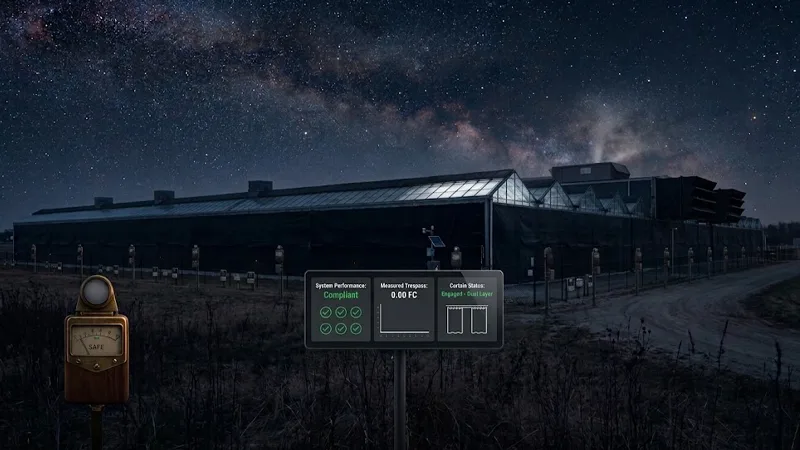
Preventing light pollution from commercial greenhouses at night comes down to three layers working together: verified property-line caps, sealed and shielded engineering controls, and logged proof that the installation performs as designed. Each layer carries its own payback. Sealed curtains and light traps cut trespass complaints and the regulatory exposure that follows them, while LED conversion lowers energy per delivered PPF and gives you the dimming and scheduling control that makes night closure practical. The HVAC penalty of sealed operation is real, but it is a measurable line item you can size during design rather than a surprise after commissioning.
The return is predictable when you treat it as a specification problem. Audit your property-line illuminance and current fixture output, design the curtain, vent and shielding package against the caps your jurisdiction enforces, then instrument the result so you can show compliance instead of asserting it. Energy, dehumidification and nuisance-risk avoidance are the three levers that decide how fast the capex pays back.
Start with a specification review: bring your site drawings, measured baseline and target caps to an application engineer, and size the controls before you commit to hardware.
FAQ
How much light can a commercial greenhouse emit at night?
There is no single global cap, so the enforceable number is whatever your local ordinance sets for the adjacent property’s zoning. Light-trespass limits commonly sit around 0.1 foot-candle at a residential boundary, rising to 0.3–0.5 foot-candle or higher where the neighboring parcel is commercial or industrial, as shown in San Bernardino County’s light-trespass memo and the WRCOG light standards guidance. Some greenhouse-specific bylaws go further and require near-total containment rather than a foot-candle number. Confirm the cap, measurement orientation, and the height it’s taken at with your local authority before you design.
Do blackout curtains really cut light pollution, and by how much?
When they’re fully closed and sealed, light-abatement and blackout curtains typically cut escaped light by about 95% to more than 99%. A University of Guelph study that flew drone-mounted sensors over commercial greenhouses measured 95%–99.99% reductions with curtains fully closed, and sky brightness near the greenhouses dropped when the curtains were down. Sealing matters most: gapped curtains leaked roughly in proportion to the open area, and a 10% ventilation gap is generally considered the practical limit for light abatement. Curtains on the walls and roof both count — light escapes in every direction, so treating only the roof leaves the sidewalls open.
Can I just shield the fixtures instead of installing curtains?
Shielding helps, but it isn’t a substitute for containment. Full-cutoff fixtures and careful aiming control where high-angle light goes, which reduces glare and spill from the source. The problem is that light also bounces off the canopy and floor, and that reflected light is what escapes through glazing and vents. That’s why the practical sequence is curtains first, then vent light traps for every air-exchange opening, then fixture shielding to trim the remaining high-angle output. Each layer covers a different leak path, and the weakest one sets your result.