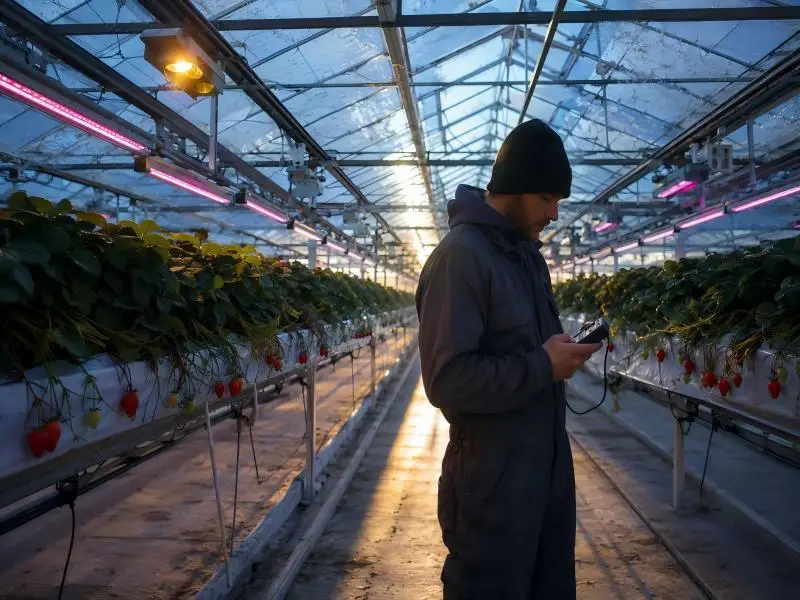
Winter greenhouse strawberry production is an economic bet: the crop occupies the most expensive square meters on the farm during the months when natural light is weakest, and the price premium for off-season fruit only pays if the plants set fruit on schedule and size it properly. Therefore, implementing a highly effective Greenhouse Strawberry Winter Lighting strategy is crucial for success.
Two levers decide that outcome, and they are not interchangeable. Photoperiod is a signal, determining whether the plant perceives long or short days and whether floral induction is permitted at all; DLI is a resource, the total photons per square meter per day available for photosynthesis, yield, and plant balance (OSU Controlled Environment Berry Production). A grower can hold a correct photoperiod and still leave DLI catastrophically low, or push DLI hard while the daylength signal blocks flowering.
This comparison covers the five dimensions that actually separate the two strategies: which lever controls flowering, how much light the crop needs, how night interruption and day extension differ, what glazing and structure remove before the canopy sees any of it, and what each costs to run through a northern winter. The numbers below come from Ohio State and Purdue extension trials and the 2024 Fragaria review, with the OSU floor of 10–12 mol/m²/day as the reference point for the resource side (OSU).
SLTMAKS is a global provider of professional-grade LED grow lights, engineering full-spectrum lighting with advanced thermal management to help cultivators overcome environmental barriers and achieve consistent harvests year-round. Its work in spectral science and phyto-illumination is directly relevant to greenhouse strawberry winter lighting, where photoperiod and DLI decisions determine whether supplemental light performs as intended.
Table of Contents
Comparison Matrix: Photoperiod vs. DLI Side by Side
Photoperiod and DLI are not competing products; they are two separate levers on the same crop, and most winter lighting failures come from pulling one while ignoring the other. The matrix below sets the verdict per row so you can see where each lever applies before working through the criteria.
| Criterion | Photoperiod | DLI |
|---|---|---|
| What it controls | Flowering and the reproductive transition | Total daily photosynthetic energy |
| Intensity range | 2–3 µmol/m²/s extension | 400–500 foot-candles photosynthetic lighting |
| Cultivar classes | Short-day types such as ‘Chandler,’ ‘F-127,’ ‘Radiance,’ ‘Shuksan’ (13–14 h critical) | All cultivars; energy demand is universal |
| Target band | Keep the dark period long enough to hold the 13 h or shorter flowering trigger | 10–12 mol/m²/day minimum, 20–25 target, stress above 30 |
| Cost to run | Low; a 4-hour extension at 2–3 µmol/m²/s draws little power | High; HPS delivers roughly 1.0–1.7 µmol/J against >3.0 µmol/J for high-efficiency LED |
| Can fix | Stalled or delayed flowering under long winter days | Slow growth, low yield, weak fruit set from energy shortage |
| Cannot fix | An energy deficit; 2–3 µmol/m²/s adds negligible DLI | A photoperiod that suppresses flowering |
| Verdict | Wins on flowering control | Wins on yield and growth |
The two levers answer different questions, and the sections that follow take each criterion in turn.
Which Lever Controls Flowering in Greenhouse Strawberry Winter Lighting?
Photoperiod and DLI are not interchangeable, and treating them as one dial is the most common mistake in greenhouse strawberry winter lighting. Photoperiod is a signal: day length decides whether the plant is permitted to initiate flowers at all. DLI is a resource: total photons per square meter per day that fuel photosynthesis, yield, and plant balance. A crop can sit at a perfect daylength and still starve.
For short-day cultivars, that signal has a number. OSU’s controlled-environment berry guidance lists a critical photoperiod of 13 to 14 hours for ‘Chandler,’ ‘F-127,’ ‘Radiance’ and ‘Shuksan,’ with induction occurring at 13 hours or shorter. The same source classifies ever-bearing and day-neutral types as facultative long-day plants that develop more flowers under longer days, so the target is set by cultivar class rather than globally. One qualifier travels with every critical-photoperiod figure: temperature interacts with the induction decision, so a value is only valid at the temperature at which it was determined.
The mechanism explains the asymmetry. In short-day genotypes, long days push axillary buds toward runners and vegetative growth because floral repression stays engaged; in day-neutral types, that repression is relaxed, so long days advance flower-bud initiation at moderate temperatures (CO-FT/TFL1 model in Fragaria).
Key Takeaway: A correct photoperiod with a starved DLI still fails. Set daylength to permit flowering, then verify the photons actually arrive.
How Much Light Does the Crop Actually Need?
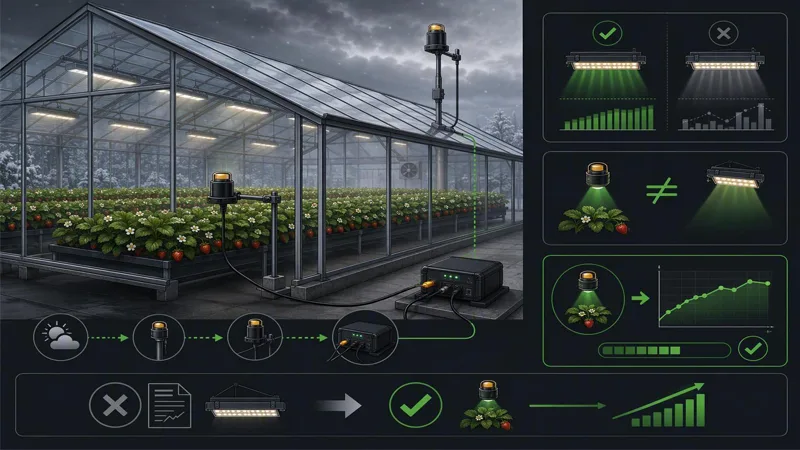
For greenhouse strawberry production, the working DLI targets are 10–12 mol/m²/day as a minimum, 20–25 mol/m²/day for fruiting, and above 30 mol/m²/day as a stress ceiling that calls for shade rather than more light (OSU Indoor Berry, “Photosynthetic lighting”). Those three numbers are a general greenhouse recommendation for strawberry, not a universal constant: cultivar-specific and stage-specific bands differ, and propagation and vegetative stages sit lower than flowering and fruiting (OSU Indoor Berry, “Photosynthetic lighting”).
The arithmetic is what separates the two levers. DLI is an integral, so it equals PPFD × hours × 0.0036. A photoperiodic-level intensity of 52 µmol/m²/s running 12 hours adds roughly 2.3 mol/m²/day, which is a fraction of the 10–12 mol/m²/day floor. Low-intensity photoperiodic light contributes almost nothing to the integral; raising DLI means entering the photosynthetic intensity range (Purdue Extension HO-238-W).
Night Interruption or Day Extension: Which Photoperiod Strategy Fits?
Night interruption is the photoperiodic instrument; day extension is the alternative; high-intensity extension is how you buy day length and DLI in one move. These are three different jobs, and conflating them is the most common wiring mistake in winter strawberry production.
Night interruption places a low-intensity light period in the middle of the dark period so the plant reads a long day at low electricity cost. It is a signal, not a ration of light. Low-intensity night interruption does not meaningfully raise DLI, so if your canopy is short on light, NI alone will not close the gap.
Day extension adds hours before sunrise rather than after sunset, which preserves the far-red-rich end-of-day signal the plant uses to interpret daylength. Ohio State University’s controlled-environment berry guidance describes a four-hour extension at 2 to 3 µmol/m²/s placed around midnight (OSU Controlled Environment Berry Production, “Flowering basics”).
For ever-bearing cultivars, the same source contrasts a 16-hour day reached by extension lighting at high photosynthetic intensity, which raises DLI and daylength together (OSU).
Verdict: choose night interruption when daylength is the only constraint and electricity is the binding cost. Choose high-intensity extension when the canopy is also short on light, because it settles both levers in one schedule.
What Do Glazing, Structure and Measurement Take Off the Top?
The DLI a strawberry canopy receives is not the DLI the sky delivers. Ohio State University’s controlled-environment berry program puts the combined structure and glazing loss at 30-50% of incident DLI, before any fixture is switched on (OSU Controlled Environment Berry Production, undated). That is an aggregate figure for the whole envelope, not a per-material specification.
Per-material PAR transmittance is a separate measurement. The University of Arkansas greenhouse engineering unit lists single-layer glass at 88-94%, double-layer glass at roughly 77%, single-layer polyethylene film at 85-87%, double-layer polyethylene at 74-77%, and polycarbonate bi-wall at about 83% (University of Arkansas, Glazing Materials, undated teaching resource). These are not interchangeable with the OSU range: one describes a whole greenhouse, the other a glazing sample.
Losses compound. Glazing, structure, angle of incidence, screens, dust, condensation, and aging each take a share, and they multiply rather than add. Purdue Extension’s HO-238-W makes the operational consequence explicit: PPF describes what a fixture emits, and only a crop-height quantum sensor logged through the day gives the DLI plants actually receive. One reading is not representative, so log multiple points (Purdue Extension HO-238-W, undated).
| Glazing material | PAR transmittance |
|---|---|
| Single-layer glass | 88-94% |
| Double-layer glass | ~77% |
| Single-layer polyethylene film | 85-87% |
| Double-layer polyethylene film | 74-77% |
| Polycarbonate bi-wall | ~83% |
This criterion applies identically to photoperiod and DLI strategies. Neither lever escapes the envelope.
What Does Each Lever Cost to Run in Winter?
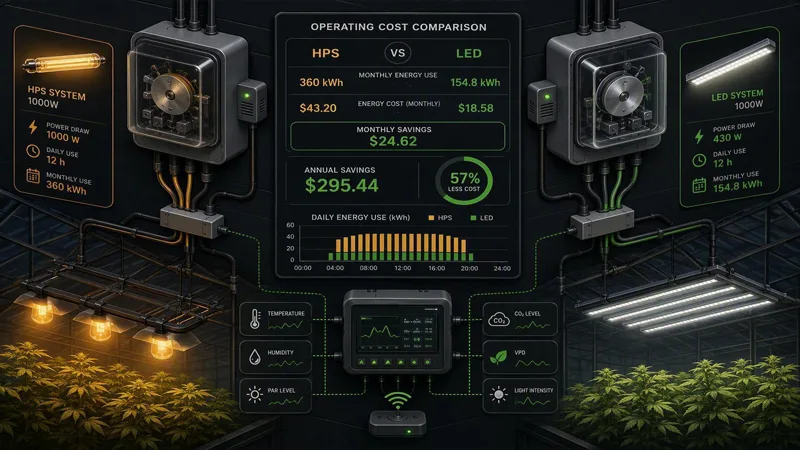
The cheaper lever is almost always the more efficient fixture, not the shorter photoperiod. Electricity cost per delivered mole of light is set by efficacy, so the gap between fixture classes dominates anything you can win by trimming hours.
That gap is large. Ohio State University’s controlled-environment berry program reports that high-pressure sodium fixtures deliver roughly 1.0 to 1.7 µmol/J, while high-efficiency LEDs exceed 3.0 µmol/J, a two- to three-fold gain (OSU Controlled Environment Berry Production). The same source notes that improving photon delivery raised light-based productivity in grams per mole by more than 50%. Because strawberry productivity tracks cumulative light linearly, with the caveat that flush behaviour makes short-cycle slopes differ from whole-cycle slopes (OSU), every extra mole you buy at 1.5 µmol/J costs about twice what the same mole costs at 3.0 µmol/J.
Key Takeaway: Longer photoperiods spread the same daily light integral over more hours, which lowers instantaneous load but raises total run time and often heating demand after dark. Higher PPFD concentrates delivery into fewer hours and shifts the trade-off toward cooling and dehumidification. Price both against your own tariff before choosing.
Two caveats belong in any budget. First, market efficacy for horticultural LEDs is commonly quoted in the 2.6 to 3.6 µmol/J range as a market observation, not a specification you can assume for a given fixture. Second, ask for the compliance and control documentation on whichever option you shortlist: PPF and PPF/W test reports, a PPFD map, NRTL or ETL listing, RoHS and CE declarations, and a dimming or controller interface that accepts your setpoints. Those are buyer checklist items, not brand differentiators.
Who Should Choose Which Lever, and When to Run Both
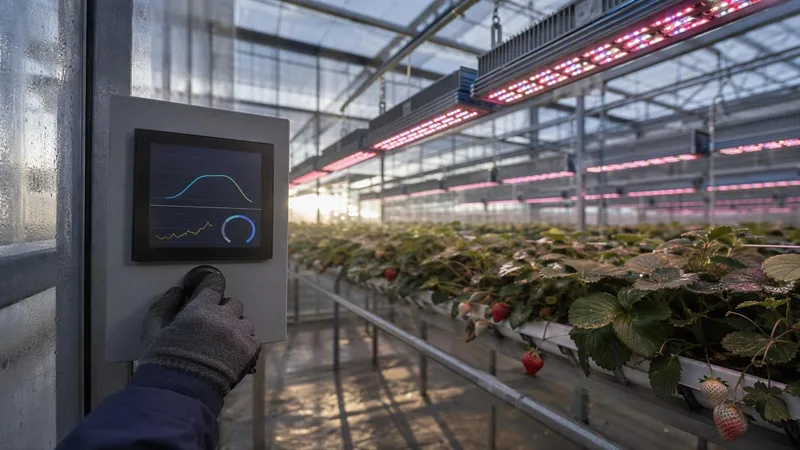
If your greenhouse strawberry winter lighting decision comes down to one rule, use this: photoperiod is the lever for cultivar class; DLI is the lever for yield potential. Most operations end up running both, but at different intensities.
Short-day and June-bearing growers. Your photoperiod lever is the primary one. These cultivars flower on short days and need the 13 to 14 hour critical photoperiod respected, so the goal is extending or interrupting light without pushing the plant into a long-day response it will not reward.
Ever-bearing and day-neutral growers. Long days work in your favor. A 16 hour high-intensity protocol is the documented approach for ever-bearing production, which means photoperiod extension and DLI supplementation pull in the same direction rather than competing.
Operations facing a December DLI gap. If canopy DLI has fallen to 8 mol/m²/day and your target sits at the 10 to 12 mol/m²/day floor, the gap is the constraint, not the photoperiod. Fill the shortfall with supplemental intensity and let the photoperiod follow the cultivar requirement.
The edge case. Neither lever may be your limit. Where glazing transmission, structure shading, or measurement error dominate the losses, adding light hours or intensity addresses a symptom.
A replicable controller workflow: set your target DLI, subtract measured canopy DLI from the sensor, divide the gap by the remaining photoperiod hours, and write the result as a PPFD setpoint. Dimming then holds that setpoint rather than running fixtures at fixed output.
Next step: If you want help mapping your cultivar, canopy DLI gap and controller setpoints into a winter lighting plan, talk to an SLTMAKS lighting specialist.
Conclusion
Photoperiod and DLI are not competing answers to the same question, so the choice between them is really a sequencing decision. Photoperiod is the signal: it decides whether the plant is in a reproductive or vegetative mode, and that decision belongs to the cultivar class, not to the light budget. DLI is the resource: it decides how much assimilate the crop has to fill the fruit that photoperiod has already committed it to.
That gives a two-step rule for greenhouse strawberry winter lighting. Pick the photoperiod strategy from what the cultivar requires, then size the DLI to the gap you actually measured between ambient winter light and the target for that crop. Running the steps in the other order is where most winter programs go wrong: a system sized to a nameplate DLI target, installed on a cultivar whose flowering response was never checked, produces a well-lit crop that flowers on the wrong schedule.
| Criterion | Lever that decides it |
|---|---|
| Flowering and crop mode | Photoperiod, by cultivar class |
| Fruit fill and yield support | DLI, sized to the measured winter gap |
| Strategy choice (night interruption vs. day extension) | Photoperiod |
| Fixture count and energy budget | DLI |
| Glazing and structure losses | Both, as a deduction from delivered light |
The next step is measurement, not procurement. Log the ambient DLI inside the canopy through the darkest four to six weeks of your production window, subtract it from the target, and you have the number a lighting supplier needs to size a system. Without that figure, any quote is a guess about your greenhouse rather than a calculation for it.
FAQ
Can photoperiodic lighting alone hit a strawberry DLI target?
No. Photoperiodic lighting is a timing signal, not a light-dose tool. Low-output fixtures used for night interruption or day extension deliver only a few mol/m²/day of additional integral, far short of the 10–12 mol/m²/day that commercial winter strawberry production typically targets. If your canopy is already below target, extending the day with signal-grade lamps changes when the plant perceives light, not how much total light it receives. Treat photoperiod control and DLI supplementation as separate budgets.
Can a short-day cultivar be pushed with long days?
No, and the attempt usually backfires. Short-day cultivars initiate and develop flowers under long nights; a long-day photoperiod suppresses or delays that response. You can run long days for vegetative vigor, but you cannot convert a short-day cultivar into a long-day one by leaving the lights on. Match the photoperiod strategy to the cultivar’s flowering type, then use supplemental lighting to raise DLI within that photoperiod.
Can night interruption and supplemental lighting run on the same fixtures?
They can share the same fixture hardware, but not the same control intent. A fixture dimmed to a low setpoint for a night-interruption pulse is doing a signaling job; the same fixture run at full output for hours is doing a DLI job. What matters is whether your controller supports separate schedules and setpoints for each function. If it does not, running both from one channel usually means compromising one of the two.
Does the 10–12 / 20–25 / >30 mol/m²/day triple apply to every cultivar and stage?
No. Those bands describe general production targets, not a universal law. Actual requirements shift with cultivar, growth stage, canopy architecture, and the temperature and CO₂ conditions the crop is grown under. A propagation-stage plant and a fruiting plant do not share the same target, and a dense canopy intercepts light differently than an open one. Use the bands as a starting reference, then verify against your own canopy measurements.