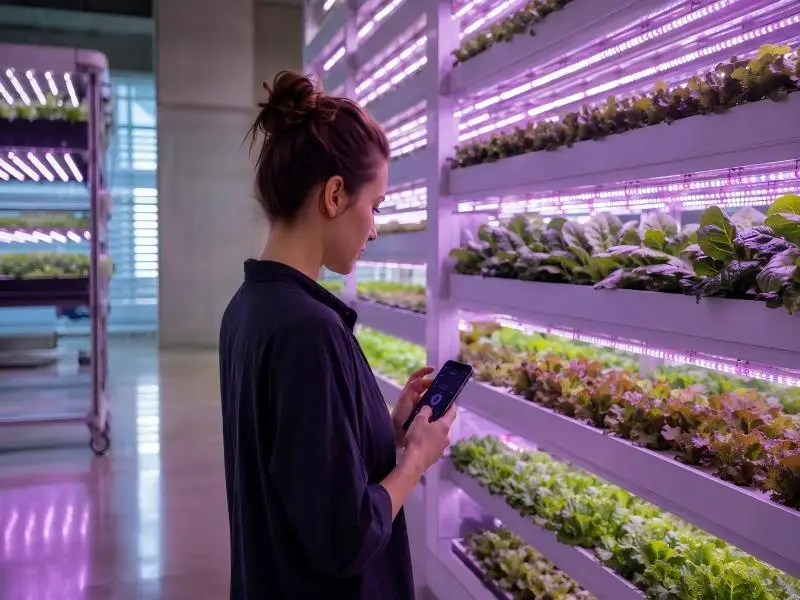
Launching a line of white label smart grow lights is a commercial path with real scale behind it, not a niche experiment. The DesignLights Consortium’s horticultural qualified products list reports more than 1,200 listed products from over 130 manufacturers, and DLC describes that list as covering roughly 90% of the non-residential horticultural lighting market (DLC, March 2026). White labeling here means buying a finished, already-certified luminaire and putting your own brand, app, and support wrapper on it, rather than designing the fixture yourself.
This guide walks the full selection lifecycle in order: choosing between OEM, ODM, and white label, specifying the controls architecture, confirming compliance and certification reuse, running a pilot with thermal and OTA validation, then modeling ROI, warranty, and procurement before you issue an RFQ.
Introduction
White label smart app-controlled LED grow lights let a grower, distributor, or brand owner sell a lighting line under their own name while the manufacturer handles the fixture, the driver, the firmware, and the app layer behind it. The path is real, not niche: the DesignLights Consortium’s horticultural qualified products list carries over 1,200 products from more than 130 manufacturers and, by DLC’s own account, covers about 90% of the non-residential horticultural lighting market (DesignLights Consortium, 2025-03-12).
This guide walks the full lifecycle in the order you will actually spend money on it: selection, controls, compliance, pilot, and ROI. Each stage gets its own evaluation criteria and a verification checkpoint, so you can confirm reliability, certification scope, PPFD uniformity, and energy outcomes before committing to a production run.
Table of Contents
Choose Your Sourcing Path for White Label Smart Grow Lights
Three sourcing routes exist, and they differ in who owns the design, who owns the certification, and how much you can change before the paperwork restarts. Pick the route before you pick the fixture, because the route determines your MOQ, your lead time, and whether your brand name can legally appear on the label.
OEM vs ODM vs White Label
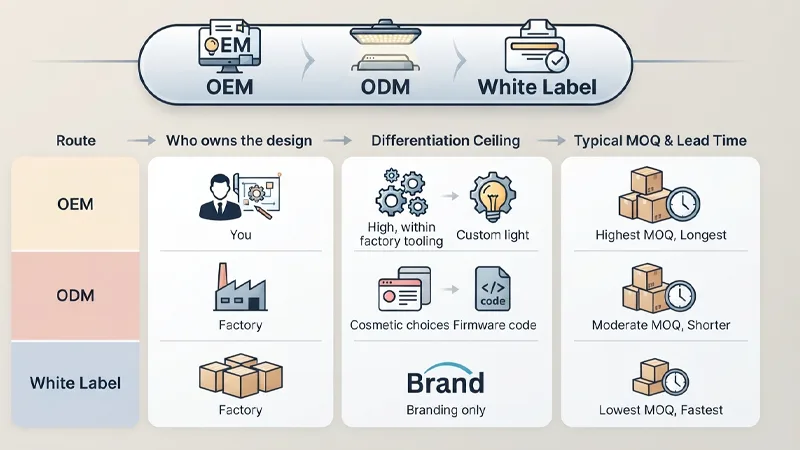
The OEM vs ODM vs white label grow lights decision turns on design ownership. Under OEM, you bring the specification and the factory builds to it. Under ODM, the factory owns an existing design and you brand it. Under white label, you resell a finished product with minimal or no changes. CTT Light describes the trade-offs suppliers themselves draw between these three models, and the pattern is consistent: the less you design, the faster you ship, and the less you control. Treat that as one factory’s stated practice rather than market-wide data.
| Route | Who owns the design | Your differentiation ceiling | Typical MOQ and lead time |
|---|---|---|---|
| OEM | You | High, within factory tooling | Highest MOQ, longest lead time |
| ODM | Factory | Cosmetic and firmware-level | Moderate MOQ, shorter lead time |
| White label | Factory | Branding only | Lowest MOQ, fastest |
Differentiation and MOQ/lead time tradeoffs
Specify what you actually need to change before you negotiate. A new driver, a different diode bin, or a custom spectrum usually pushes you toward OEM and a new tooling cycle. A logo, a housing color, or a firmware preset stays inside ODM. Every change you request moves you left in the table above, and MOQ and lead time move with it.
Certification reuse and model control
Verify whether the factory’s existing safety listings can carry your brand. A Multiple Listing Correlation Sheet is issued by the approved safety organization and cross-references OEM model numbers with private-label model numbers; the base product must already be certified, and the private labeler receives its own listing record tied to the original certification path (DesignLights Consortium and UL, retrieved 2026-02-13). That sheet is the artifact that makes a rebrand auditable, and it is the first document to request.
Key Takeaway: The Multiple Listing Correlation Sheet is what makes a rebrand auditable. Ask for it before you sign, not after.
An ODM pathway can be used to reuse an existing certification base. SLTMAKS is one example: its brand profile states ETL, CE and RoHS certification with a 3-year warranty, which supports a rebrand without a fresh safety submission. Confirm the correlation sheet names your model numbers before you rely on it.
Smart Controls Architecture
The control layer decides whether a white-label line survives scale. A smart grow light controls architecture that works for 40 fixtures in one room often collapses at 400 fixtures across three zones, and the failure is rarely the app. It is the radio, the gateway, or the fallback behavior nobody specified.
Wireless options and scale fit
Bluetooth Mesh suits small rooms where a phone or tablet stays in range. Zigbee and Thread handle denser canopy environments better because they form a mesh with more routing nodes and less contention per hop, a general IoT networking pattern rather than a lighting-specific measurement (Avnet, retrieved 2026-02-12). Ask your ODM which protocol the firmware ships with, how many nodes per gateway it is rated for, and whether the gateway is a single point of failure.
Wired/hybrid: DALI‑2, 0–10V, RS‑485/Modbus
Wired control costs more per fixture and buys determinism. DALI‑2 gives addressable per-fixture dimming and two-way status; 0–10V is cheaper but one-way and zone-level only; RS‑485/Modbus is common where a BMS already speaks Modbus. Hybrid designs run wireless for tuning and wired for scheduling, which is often the practical compromise on retrofits.
BMS integration and fallback behaviors
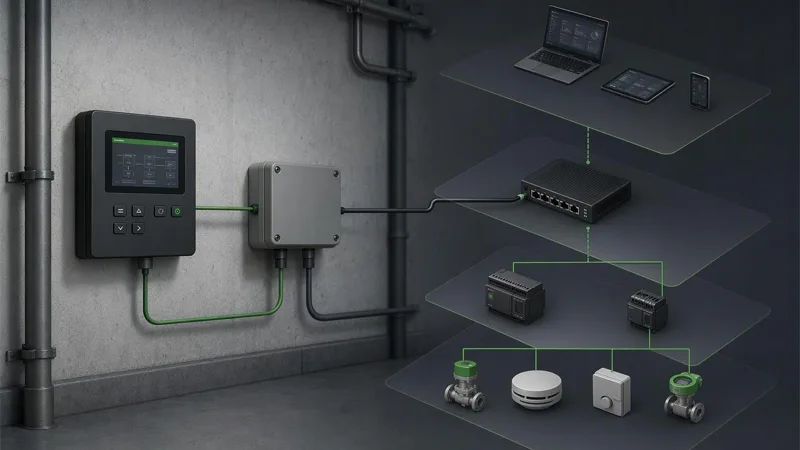
For BMS integration, confirm the gateway exposes BACnet/IP or Modbus TCP and document the register map before you sign. Whatever the protocol, the dimming rule is not optional: DLC requires all DC-powered horticultural products to be dimmable, and AC-powered luminaires at PPF ≥ 350 µmol/s must dim via line-voltage, low-voltage or wireless signal, with manual knob or switch dimming on the fixture rejected without an additional external control signal (DesignLights Consortium, V4.0, effective 2025-04-18).
⚠️ Warning: A gateway is a single point of failure. Specify what happens when it drops: fixtures should hold their last dimming level, not default to full output or darkness. Test that behavior before you commit to a purchase order.
Compliance and Certifications
Certification is where white-label grow light projects stall. A fixture that carries a valid safety listing under the manufacturer’s name is not automatically legal under yours, and a safety listing proves nothing about photon efficacy or utility rebate eligibility. Treat the three layers below as separate workstreams with separate evidence.
UL 8800 multiple listing and markings
ANSI/CAN/UL 8800 is the safety standard for horticultural lighting equipment and systems installed under the NEC in the US or the CEC in Canada. UL developed it because UL 1598 addresses general-illumination luminaires and does not address the grow environment. Its scope reaches beyond the fixture: lampholders, wire harnesses, connectors, LED packages, drivers, lamps, hardware and structures can all fall inside it.
Note what it excludes. Equipment providing broadband white light for general illumination, or whose primary purpose on plantings is aesthetic or merely sustaining life, is not horticultural lighting under this standard.
For a rebranded fixture, UL’s multiple listing route lets an already certified product appear under your company name, file number, tradename and product designation. Both the ML name and file number appear in UL’s online directory and on the product itself. Your RFQ should ask which NRTL holds the file.
OSHA currently recognizes 22 nationally recognized testing laboratories, so “UL or ETL” is not the whole menu. Supplier guides put typical timelines at roughly 6 to 12 weeks for UL and 4 to 8 weeks for ETL, though those figures are undated estimates rather than published service levels.
FCC/CE/UKCA, RoHS, IP/wet location scope
An LED grow light with an electronic driver is an unintentional radiator under FCC Part 15 and must meet conducted and radiated emissions limits. Add Wi-Fi, Bluetooth or Zigbee and the radio becomes an intentional radiator, which generally requires FCC certification for the radio module on top of Part 15B compliance. That distinction matters for app-controlled lines: the control feature you are selling is the feature that adds a certification.
In the EU, CE marking declares conformity with all applicable EU law, which for mains-powered or radio-equipped fixtures includes the Radio Equipment Directive alongside lighting safety frameworks. UKCA is the market-specific marking for Great Britain. RoHS is a restricted-substances requirement, not a safety test, and an IP rating describes ingress protection only. None of them substitute for UL 8800 in North America.
DLC private-label eligibility and documentation
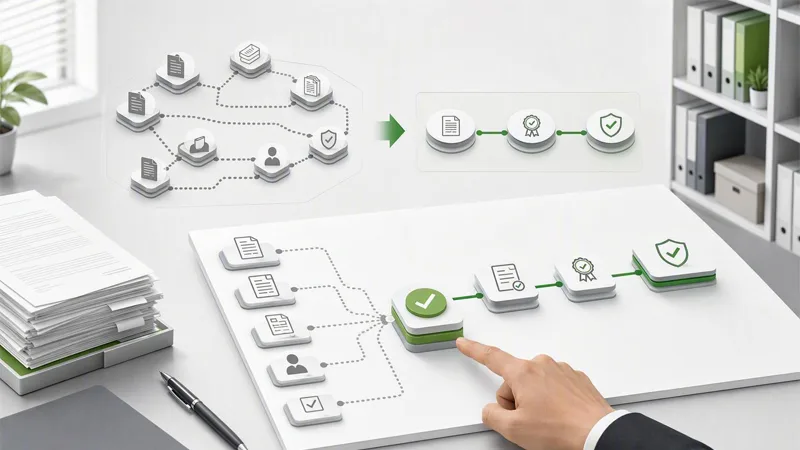
The DLC horticultural technical requirements in force are HORT V4.0, effective April 18, 2025, with V3.0 delisting on January 5, 2026. V4.0 raised the minimum photon efficacy threshold to 2.5 µmol/J, an 8.7% increase that delisted roughly 11% of the V3 qualified products list, and removed the qualification pathway for lamps so only complete fixtures and modules remain eligible.
Private-label listing is a documentation exercise, not a test: you submit the qualified product under your brand with the manufacturer’s authorization. Confirm the underlying model is on the current QPL before you commit to a SKU.
Pro Tip: Record certificate control numbers, listing scope and the QPL model reference in your RFQ pack. A certificate PDF without a control number and a named file holder cannot be verified by your buyer or your insurer.
Pilot, Validation, and Thermal Management
A datasheet tells you what a fixture did on a supplier’s bench. A pilot tells you what it does at your canopy height, in your room, on your power. Run the pilot as a pass/fail test with three exit criteria: a measured PPFD map, a thermal derating curve, and a passed OTA rollback drill. If any one of them fails, you have not finished validating the supplier.
PPFD uniformity and spectrum verification
Verify uniformity with a grid measurement, not a single center reading. Map the footprint at your intended mounting height and report minimum, average, and coefficient of variation across the grid. Commercial rooms commonly target a minimum-to-average ratio above roughly 0.90 and a CV in the low single digits, though these are practitioner targets rather than a published standard: DLC does not set a uniformity ratio, so agree the number with your supplier in writing before the pilot starts.
Measure spectrum with a calibrated spectrometer at the same points, and confirm the delivered red-to-blue ratio and peak wavelengths match the model you intend to private-label. A fixture that hits average PPFD but drops 20 percent at the corners will cost you yield in exactly the canopy edges you paid to light.
Thermal derating, drivers, and IP validation
Ask for the derating curve, then reproduce it. Drive the fixture at rated current in your worst-case ambient and log case temperature, driver temperature, and output power until readings stabilize. Confirm the driver is a named, orderable part with a documented lifetime at your operating temperature, because an unbranded driver is the most common substitution in white-label programs. For IP and wet-location scope, verify the actual rating against the intended mounting position, and pressure-test cable entries and gaskets rather than trusting the label.
OTA, cybersecurity drills, and downtime tests
Test the firmware pipeline before you ship a single fixture. Stage an update, interrupt it mid-transfer, and confirm the fixture returns to the previous firmware without manual intervention. Then run the security drill: rotate credentials, confirm signed firmware is enforced, and check that a failed gateway does not leave fixtures dark. Record downtime in minutes per event, because that number belongs in your warranty conversation.
Key Takeaway: The pilot’s exit criteria are the PPFD map, the derating curve, and a passed OTA rollback drill.
ROI, Warranty, and Procurement
Payback on a smart app-controlled LED line is a modeling exercise, not a brochure number. Build the case from three cost lines you can measure at your own site, then hold the supplier to contract terms that survive year three.
Energy, HVAC, and labor savings modeling
Model energy first, because it is the line you can verify from your own utility data. Cannabis Business Times, in a Fluence-authored piece on retrofit economics, reports the savings ranges utilities and vendors cite for LED conversions (Cannabis Business Times, retrieved 2026-06-11). Treat those ranges as vendor-interested inputs, not neutral outcomes: Fluence sells the fixtures being modeled. Substitute your own kWh rate, fixture count, and run hours before you show a payback figure to anyone signing the check.
HVAC savings follow from the same wattage reduction, since every watt removed from the canopy is a watt the cooling system no longer rejects. Ask for a load calculation rather than a percentage. Labor savings are the softest line and the easiest to overstate: dimming schedules and zone control cut manual adjustment time, but quantify it as minutes per zone per week against your actual staffing.
Warranty scope, SLA, spares, and BOM stability
Warranty scope is where LED programs quietly fail. Specify what is covered (driver, diode module, control board, gateway), what is excluded (surge, water ingress outside the rated IP scope, unauthorized firmware), and how replacement is triggered. A warranty that replaces hardware but not the labor to swap it leaves you paying twice.
Name the SLA in the RFQ: response window, advance-replacement terms, and whether spares ship from a regional warehouse or from overseas. Then freeze the BOM. Component substitution after approval is the most common source of field mismatch, so require written notice and re-approval before any part number changes.
Pro Tip: Freeze the BOM in the RFQ and name the spares lead time in days, not “available on request.”
RFQ checklist and multi-site rollout planning
Send one RFQ that forces comparable answers:
- Fixture efficacy and PPFD map at your mounting height
- Control protocol and gateway capacity per zone
- Certification list with control numbers and file numbers
- Warranty scope, exclusions, and advance-replacement terms
- Spares kit contents and lead time from the regional warehouse
- Firmware update policy, rollback path, and end-of-support date
- BOM change notification and re-approval clause
- Per-site commissioning and training scope
For multi-site rollouts, sequence by site rather than by fixture count. Commission one site fully, including OTA and fallback drills, then replicate the validated configuration. Certification timelines matter here for planning: UL and ETL listings typically run weeks to months depending on scope, so start the compliance track before the first site order.
Conclusion
White label smart app-controlled LED grow lights are only as good as the paperwork and firmware behind them. Across this guide, the path that holds up is the one where you picked a manufacturing model deliberately, matched the control architecture to your site scale, reused certifications you can actually document, and validated thermal and OTA behavior before committing to volume.
Three disciplines carry the rest. Own your data: insist on API access, export rights, and firmware release notes so a gateway vendor change never strands your fleet. Treat reliability as a spec, not a hope: derating curves, rollback-tested OTA, and spares lead times belong in the contract. And keep payback honest by modeling energy, HVAC, and labor together rather than quoting fixture wattage alone.
Your next step is small and cheap: scope a pilot of one zone with a written acceptance test, request the integration documentation for the control layer, and review the integration plan against your BMS. An ODM partner such as SLTMAKS can supply that documentation alongside ETL, CE, and RoHS certification evidence, so the pilot answers your open questions before a multi-site rollout does.
FAQ
How much does it cost to white label a smart grow light?
There is no single number, because the cost tracks how much you change. A pure white-label or ODM route reuses the factory’s existing design, certification and tooling, so your upfront investment is largely branding, packaging and a pilot. A full OEM build is a different order of magnitude: custom tooling, a new spectral or driver design, and a fresh safety submission all land in your budget. Reported figures put white-label and ODM programs at a low five-figure entry versus six figures or more for true OEM development, though these are supplier-side ranges rather than audited market data. The cheaper route buys speed; the expensive route buys exclusivity. Decide which one you actually need before you request pricing.
Do smart app-controlled grow lights need Wi-Fi or a hub to work?
Not always, and the answer changes what you can promise your customers. Bluetooth Mesh runs locally, so the fixtures work from a phone or tablet in range without any internet connection. Zigbee, Thread and most multi-zone systems need a gateway, and remote monitoring from off-site needs the gateway on a network. The failure mode to specify in your RFQ is what happens when that gateway or the Wi-Fi drops: fixtures should hold their last dimming level and schedule rather than defaulting to full output or going dark. Test that behavior in the pilot, not on a customer’s site.
Can I reuse the factory’s UL or ETL certification for my own brand?
Yes, through a multiple listing, but only if the base product is already certified and the manufacturer authorizes the rebrand. The document that makes it work is the Multiple Listing Correlation Sheet, which cross-references the OEM model number with your private-label model number and creates a listing record tied to the original certification path. Without it, a certificate PDF showing the manufacturer’s name does nothing for your brand. Ask your supplier for the correlation sheet, the certificate control number and the named file holder, and confirm your model numbers appear on it before you commit to a SKU. Note that a safety listing covers safety only: DLC qualification and utility rebate eligibility are separate tracks.