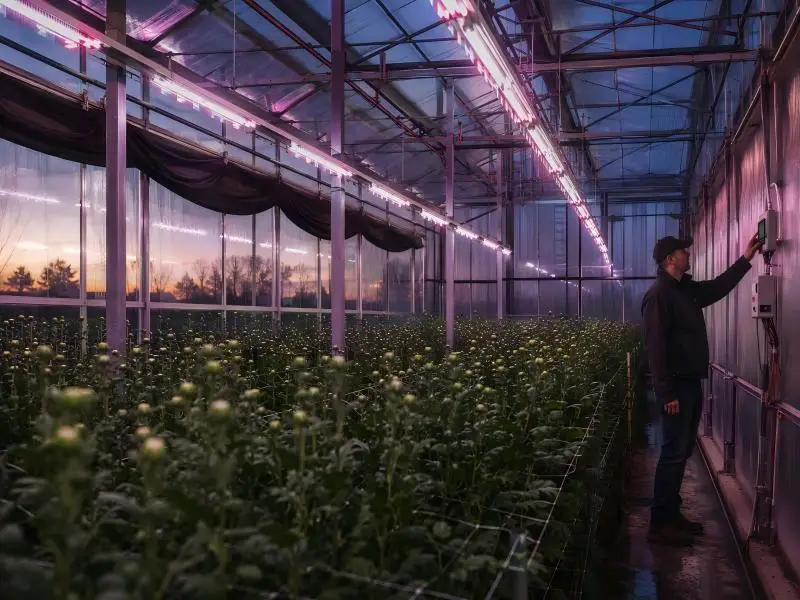
If you need a predictable, uniform flowering window on a scheduled ship date, the method you choose matters less than the setpoints you hold. Photoperiod lighting is signalling, not photosynthesis: it changes how the plant reads day length rather than feeding carbon gain, which is why the numbers sit so far below supplemental lighting targets. Three anchors govern the whole procedure.
Canopy intensity for photoperiodic lighting should reach at least 2 µmol·m⁻²·s⁻¹, or 10 foot-candles, the threshold below which plants may not perceive the signal at all. Night interruption runs through the middle-of-the-night window, 10 p.m. to 2 a.m., and when you shorten daylength instead, what matters is intensity under the blackout material, which must stay under 2 foot-candles. What follows is a validated, logged procedure for holding all three.
Table of Contents
Photoperiod Lighting vs Supplemental Lighting: Which Task Are You Buying For?
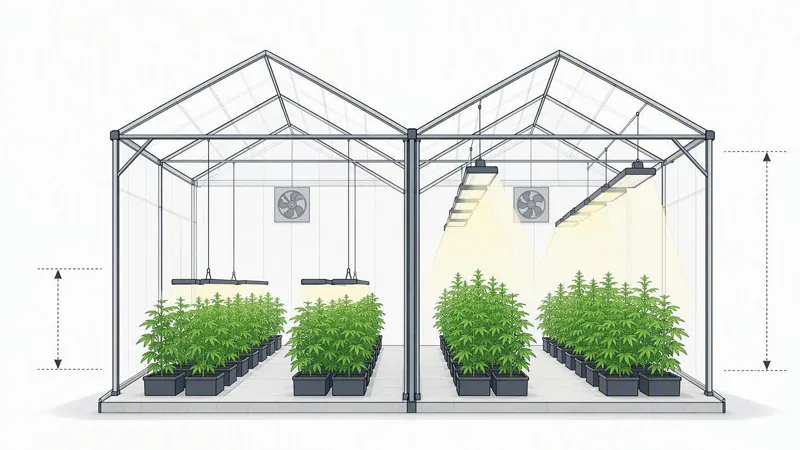
Photoperiodic lighting and photosynthetic lighting are different product categories, and buying the wrong one is the most expensive mistake in a mum house. Signalling fixtures exist to change how the plant perceives day length; DLI fixtures exist to feed carbon gain. The intensity targets differ by two orders of magnitude.
The canopy minimum for signalling is 2 µmol·m⁻²·s⁻¹, or 10 foot-candles; below that, plants may not perceive the light at all and the treatment can fail silently (Greenhouse Grower, 2022). Photosynthetic lighting is specified against a completely different scale. In a controlled study using low-intensity blue light, white LEDs supplied 180 µmol·m⁻²·s⁻¹ during the photoperiod (MDPI Plants 9(12):1694, 2020), and in later work the white base photoperiod ran at 300 ± 5 µmol·m⁻²·s⁻¹, where the night-interruption light lands on the plant matters as much as its intensity (MDPI Plants 13(20):2874, 2024).
The decision consequence is blunt. A fixture bought for DLI will over-light a blackout house, waste energy on photons the crop does not need and complicate cloth timing. A fixture bought for signalling will never build DLI, no matter how long you run it.
Blackout, Day Extension, or Night Interruption: Choosing Your Method
Blackout forcing and night interruption are not competing options for the same decision. One shortens the day, the other lengthens it.
Blackout cloth holds a short day for short-day plant flowering control. Night interruption and day extension do the opposite, holding plants vegetative by extending the perceived daylength. UMass Extension reports that night interruption needs fewer lighting hours than day continuation or pre-dawn lighting, making it more economical and the most-used method for lengthening daylength (UMass Extension, 2017).
| Method | Perceived daylength | Canopy intensity | Hours of operation | Main equipment | Main failure mode | Wrong choice when |
|---|---|---|---|---|---|---|
| Blackout forcing | Shortened to the target short day | Not applicable; the cloth blocks light | Cloth closed for the dark period | Opaque blackout cloth and a pull system | Light leaks at seams, edges, or vents | You need to hold stock vegetative |
| Day extension | Lengthened | Low, sustained across the extension | 4 to 8 h added at dusk or before dawn | LED or HPS fixtures plus a timer | Fixtures run below the response threshold | You want the lowest lighting-hour cost |
| Night interruption | Lengthened | Low, applied in one block | 4 h in the middle of the night | LED or HPS fixtures plus a timer | Interruption window drifts or is too short | You need to force a short-day crop into flower |
The middle-of-the-night window is the commercial standard: Christopher J. Currey sets night interruption lighting from 10 p.m. to 2 a.m. (four hours) because 1 to 2 hours may not ensure a long-day response for nearly all greenhouse crops (Greenhouse Grower, 2022). That window sits inside a 16-hour target daylength (Greenhouse Grower, 2022).
For a mum block, blackout does the forcing work. Night interruption is the recovery tool, run only if the schedule slips.
Prerequisites and Setpoints Before You Pull a Single Cloth
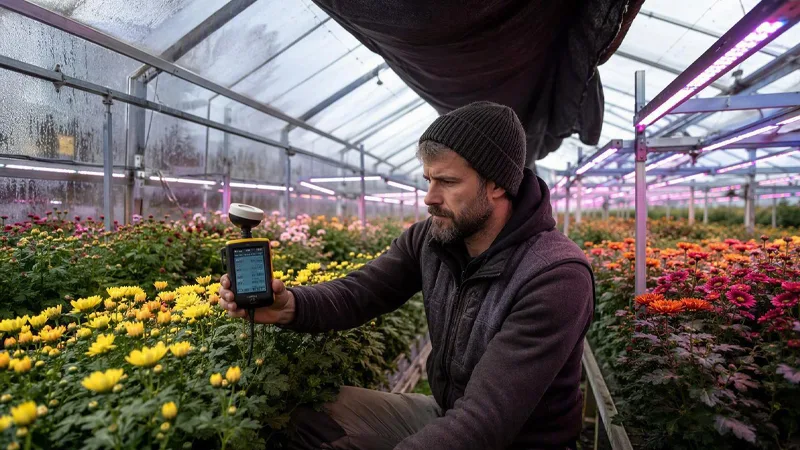
Get these five items in place before the first dark period, because a missing sensor or an unrated cloth turns a photoperiod program into guesswork.
What you need on hand:
- A light-tight structure or blackout cloth rated for full exclusion, not shade reduction. The UMass Extension photoperiod control fact sheet sets the bar at less than 2 ft-c measured under the material when daylength must be shortened, and notes that bright moonlight peaks near 0.02 ft-c, far below the threshold plants read as daylight.
- A quantum sensor for canopy PPFD and a foot-candle meter for under-cloth checks. Two instruments, two jobs.
- Cultivar response-time data from the breeder culture sheet. Response time drives every scheduling decision downstream.
- A controller able to hold a cyclic dark/light pattern, for example, 24 minutes dark and 8 minutes light, without drift.
- A log sheet for setpoints, measurements, and dates.
Starting setpoints, all requiring validation on your crop:
- Canopy intensity during the interruption window: 2 µmol·m⁻²·s⁻¹ minimum.
- Under-cloth intensity: below 2 ft-c.
- Night-interruption window: 10 p.m. to 2 a.m.
Time: 2 to 3 hours to stage and verify. Difficulty: Intermediate. You need working familiarity with PPFD measurement and timer or controller programming, not lighting engineering.
One note on fixtures: this guide stays manufacturer-agnostic. Work from nameplate data and published photometry for whatever fixture you already run, and confirm certifications such as UL or ETL listing before you commit a block to it.
Step 1: Set and Verify Your Canopy Intensity Target
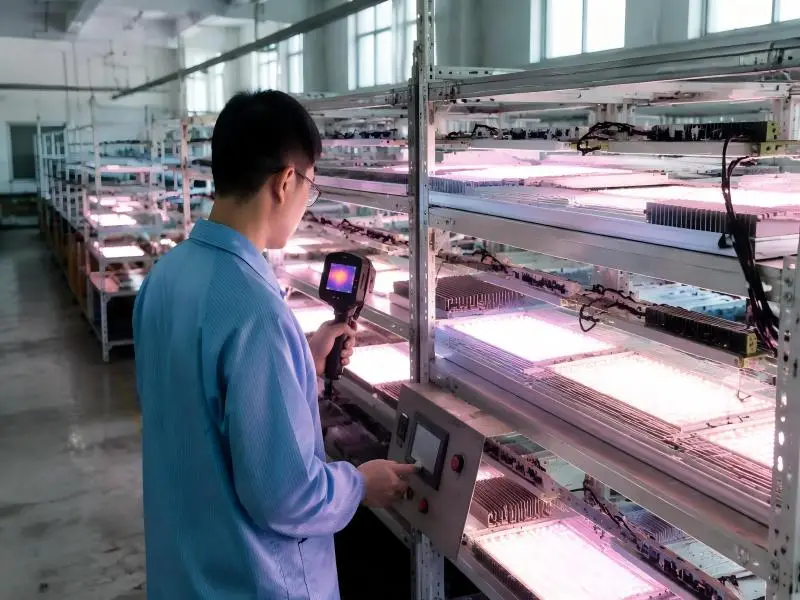
By the end of this step, you have a measured canopy PPFD figure and a yes-or-no answer on whether your fixture clears the signalling minimum. Intensity is the setpoint growers assume rather than measure, and a fixture rated for a 3 m mounting height tells you nothing about what reaches the bench.
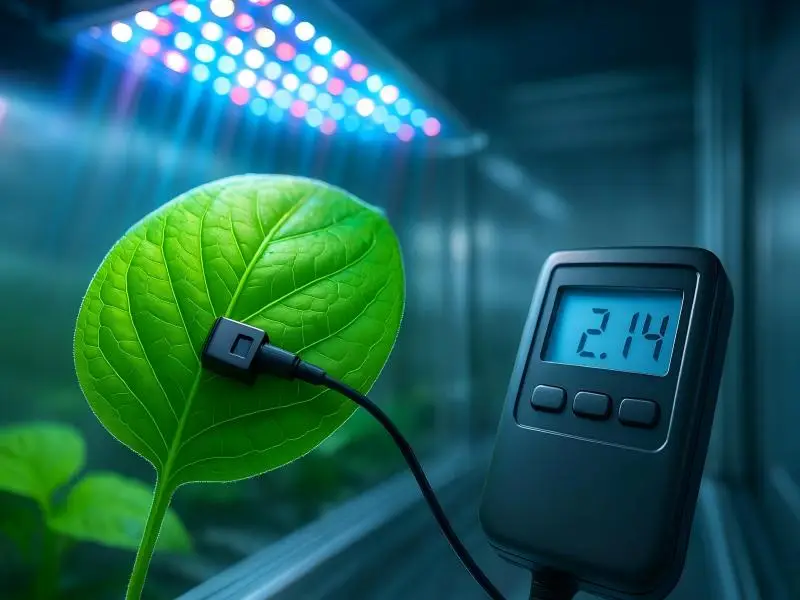
Mount the quantum sensor at canopy height, not at fixture height. Take readings at the bench centre, at both ends, and directly under a fixture. Record the lowest reading, not the average, because the dimmest point on the bench is the point that decides whether the crop perceives the interruption.
The threshold most extension guidance applies is 2 µmol·m⁻²·s⁻¹, described as the minimum intensity required for photoperiodic lighting. Treat that as applied guidance rather than an experimentally derived cutoff; a controlled study using low-intensity blue light ran at 10 ± 3 µmol·m⁻²·s⁻¹. Your verification checkpoint: the lowest canopy reading must clear 2 µmol·m⁻²·s⁻¹, and you should note the spread across the bench before moving on.
Step 2: Build the Night-Interruption Schedule and Duty Cycle
By the end of this step, your controller runs a verified night interruption window with a duty cycle matched to your lamp intensity.
Set the window first. UMass Extension recommends 10 p.m. to 2 a.m. for mums, a four-hour block, because shorter interruptions of one to two hours may not reliably trigger a long-day response (UMass Extension, 2017). Centre it on the middle of the night, not on dusk: the plant reads the dark period either side, so a window that starts at sunset leaves a long dark stretch ahead of it.
Then set the cycle. At 10 ft-c from incandescent lamps, mums need only 20% of 30 minutes, or 24 minutes dark and 6 minutes light. At 20 ft-c, 5% is enough, or 28 minutes dark and 2 minutes light. Commercial operations commonly run 24 minutes dark and 8 minutes light at 10 ft-c, which is a documented commercial pattern rather than a fringe tactic (UMass Extension, 2017).
Confirm the controller actually fires inside the window. A light logger on the bench is the direct check; a phone camera pointed at the canopy works as a crude one, since the interruption is visible as a flicker pattern. What you are verifying is that the dark interval never exceeds the duty-cycle limit for your intensity, and that the window sits in the middle of the night rather than at dusk.
Step 3: Coordinate Blackout Cloth Timing With the Light Schedule
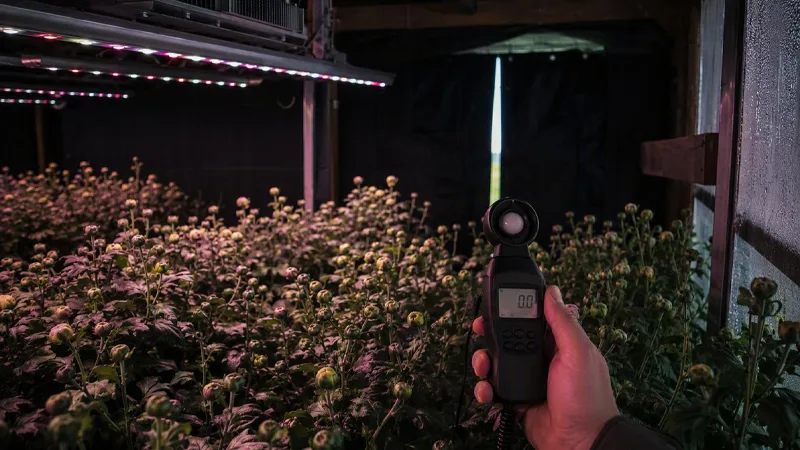
By the end of this step, the cloth closes and opens on measured light, not on the clock, and every bench reads below 2 ft-c while it is closed.
Pull the cloth while the crop is still above the threshold, not at a fixed hour. UMass Extension notes that when daylength must be shortened, intensity under the material has to stay under 2 ft-c, because less than 2 ft-c already inhibits bud initiation in poinsettia (UMass Extension, 2017). For scale: bright moonlight measures 0.02 ft-c, well under the perception threshold, while sunrise and sunset light exceeds 20 ft-c. That spread is why light-tightness has to be judged against a metric with a 100× margin rather than against “looks dark.”
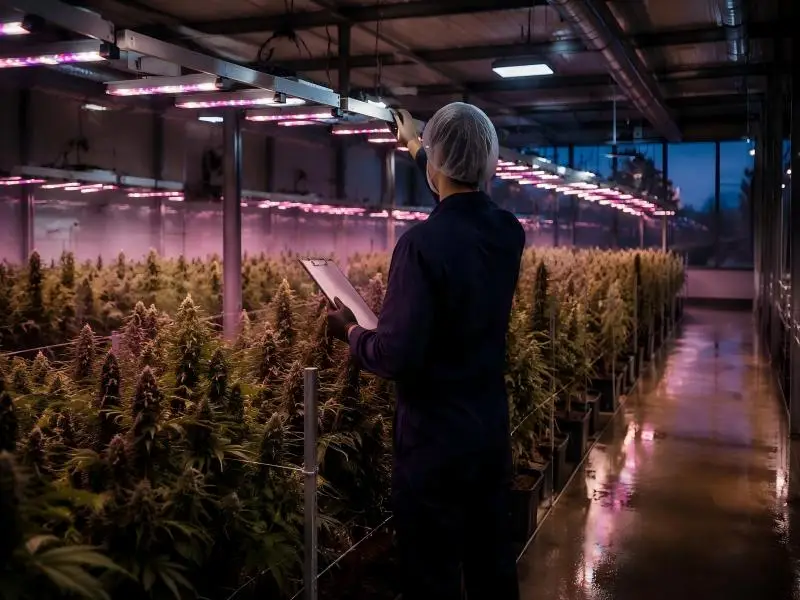
Log pull and open times daily, then walk the house at dusk and dawn with the meter at the crop, not at the cloth. Check seams, end walls, doors and vent gaps. Any bench still reading above 2 ft-c is the bench that stays vegetative.
Step 4: Validate Cultivar Response Time Before Committing the Block
By the end of this step, you will have a measured days-to-flower number for the cultivar in your house, not a catalogue assumption. Response time is a scheduling construct, not a fixed trait: UMass Extension’s mum scheduling guidance splits a regular fall crop at 15 to 16 weeks, flowering September 10 to October 10 depending on cultivar, from a fast crop at 9 to 10 weeks, with covered-greenhouse crops running about two weeks later than outdoor ones. That spread is the operational meaning of cultivar response time, and it is the number your schedule rests on.
Run a sentinel group ahead of the main block:
- Pot 20 to 30 plants of the actual cultivar and start them on the production photoperiod.
- Record the initiation date and the first-colour date for each plant.
- Compare observed days to flower against the breeder culture sheet.
- Shift the main block’s pull-forward date by the difference.
Verification: the sentinel group flowers inside the planned window, or you revise the schedule before the block is committed.
Two limits matter. Mums may initiate buds under photoperiods in excess of 12 hours in spring and summer, so a spring trial does not predict a fall crop. And the UMass page could not be re-read this round; confirm the current numbers against your breeder’s culture sheet before you publish a schedule built on them.
Step 5: Log, Audit, and Fix the Failures That Actually Happen
By the end of this step you will have a short failure-signature list to check against every block. Four problems account for most photoperiod misses.
Light leaks that keep one bench vegetative. Walk the room after dark and confirm no canopy point reads above the threshold you set in Step 3. The diagnostic is the same one used to check a blackout cloth for chrysanthemums: measure intensity under the material, not in the aisle. One unsealed seam can hold back the benches behind it while the rest of the block initiates.
Cloth timing drift after a cloudy week or a manual override. Pull times adjusted by hand rarely return to the timer. Log actual pull and close times daily against the setpoint, not the schedule.
Spectrum and positioning mismatch. Fixtures serving both short- and long-day crops need red and far-red together, because long-day plants carry an additional far-red requirement for induction (Greenhouse Grower, 2022). Positioning matters as much as spectrum: in Chrysanthemum morifolium, four hours of blue night interruption at 30 µmol·m⁻²·s⁻¹ against a 300 µmol·m⁻²·s⁻¹ white base delayed flowering most when aimed at the shoot tip and old leaves (MDPI Plants, 2024).
The assumption that any light at night blocks flowering. At roughly 10 µmol·m⁻²·s⁻¹, every treatment in one study flowered, and four hours of blue at the end of a 13-hour day produced 93% more flowers per plant than the 10-hour short-day control (MDPI Plants, 2020).
Pro Tip: Low-intensity night interruption is not a reliable flowering inhibitor. If your suppression strategy depends on a dim fixture rather than a light-tight dark period, verify the response on a small block before committing the crop.
When you evaluate fixtures for this role, ask for nameplate photometry, dimming range and the certifications your insurer or buyer requires, then confirm mounting height, service access and controller compatibility.
Conclusion
You now control three things that decide whether a chrysanthemum crop flowers on the date you promised: canopy intensity at the bench, the night-interruption window and its duty cycle, and light-tightness under the blackout cloth. Each one is measurable, and each one has a verification step you can run before the block is committed.
The fourth variable is not a setting. Cultivar response time has to be validated on your own crop, because published crop timing by response group gives you a starting range, not a guarantee for your bench, your rooting date, or your finish temperature. Log the first block, compare it against the range, and adjust the schedule from your own data.
If you are specifying fixtures for the next block, check the nameplate and published photometry against two criteria from this guide: whether the fixture holds the minimum intensity required for photoperiodic lighting across the whole canopy, and whether its spectrum supports the response you are targeting. SLTMAKS can be reviewed on those same terms alongside any other option. For deployment logistics, including cloth sequencing and control integration, a specialist conversation is the faster path than another season of trial and error.
FAQ
How long does the night interruption need to run?
Four hours, typically 10 p.m. to 2 a.m., placed in the middle-of-the-night window. One- to two-hour pulses do not reliably hold a long-day response across cultivars. Inside the window, the duty cycle depends on lamp intensity: brighter fixtures can run cyclic night interruption for mums, while low-output lamps usually run continuously.
Can I use day extension instead of night interruption?
Yes, and it fits when you are targeting a 16-hour target daylength or when the middle-of-the-night window conflicts with other house operations. The trade-off is cost: night interruption needs fewer lighting hours than day continuation or pre-dawn lighting, which makes it the more economical option and the most-used method in commercial mum production. Choose day extension for schedule fit, not energy savings.
What should I do if one bench flowers late or not at all?
Measure light under the cloth at that bench, at dusk and again at dawn. When daylength must be shortened, intensity under the material is the first thing to check, and a reading above your target means the blackout is leaking. Then walk the perimeter for door gaps, seam splits, and worn fabric. Finally, confirm the controller fired inside the middle-of-the-night window on that circuit. A missed interruption and a leak produce the same symptom, so rule out both before changing setpoints.
Is 2 µmol·m⁻²·s⁻¹ really enough, or do I need more?
Treat 2 µmol·m⁻²·s⁻¹ as applied extension guidance for the minimum intensity required for photoperiodic lighting, not an experimentally derived threshold. Controlled mum work has used 10 ± 3 µmol·m⁻²·s⁻¹ for day extension and night interruption, and a controlled study using low-intensity blue light found flowering responses at those levels. Validate at the canopy with a quantum sensor.
Does the spectrum of my LED fixture matter for photoperiod control?
It matters twice over. Red alone inhibits flowering in short-day crops, which is why red and far-red are both in commercial LED flowering lamps: long-day plants carry an additional far-red requirement that red-only output does not satisfy. Positioning matters too, because in mums, where the night-interruption light lands on the plant matters, with shoot tips and older leaves responding differently at the same intensity. If one fixture serves both short-day and long-day crops, check the spectrum covers both.