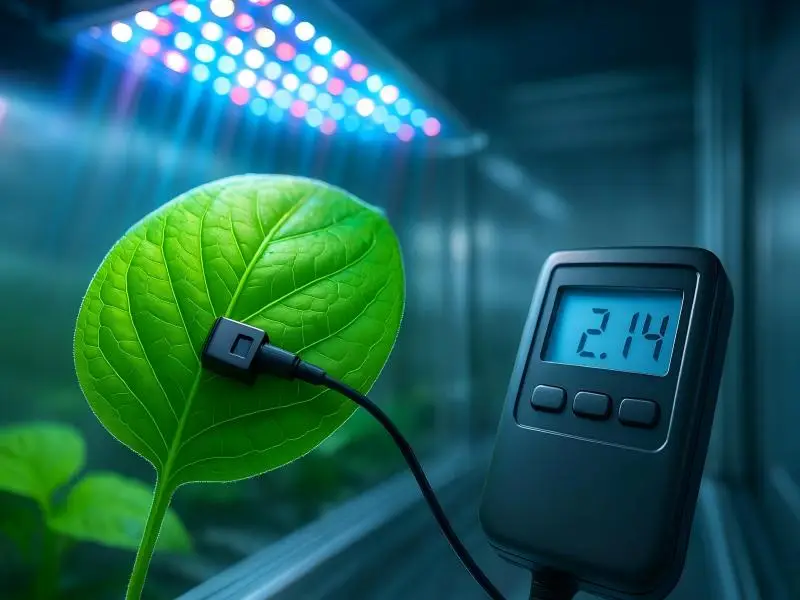
Nitrate reductase (NR) is the cytosolic, rate-limiting entry step of nitrate assimilation in mesophyll cells. When exploring the exact mechanisms, light wavelengths nitrate reductase dynamics keep pointing to the same control point: phytochrome. Red light near 660 nm converts Pr to Pfr and induces NR; a far-red pulse near 730 nm reverses that conversion, and the induction reverses with it. That red/far-red photoreversibility was first demonstrated in etiolated maize, squash, and pea (Plant Physiology, 1988), and it remains the clearest direct photoreceptor link to NR activity in leaves (USDA ARS).
This guide works through which wavelengths raise or lower nitrate reductase activity, where the spectral effects stop being predictable, and how to translate that into leaf nitrate at harvest.
Table of Contents
How Light Wavelengths Influence Nitrate Reductase Activity: The Three Control Layers
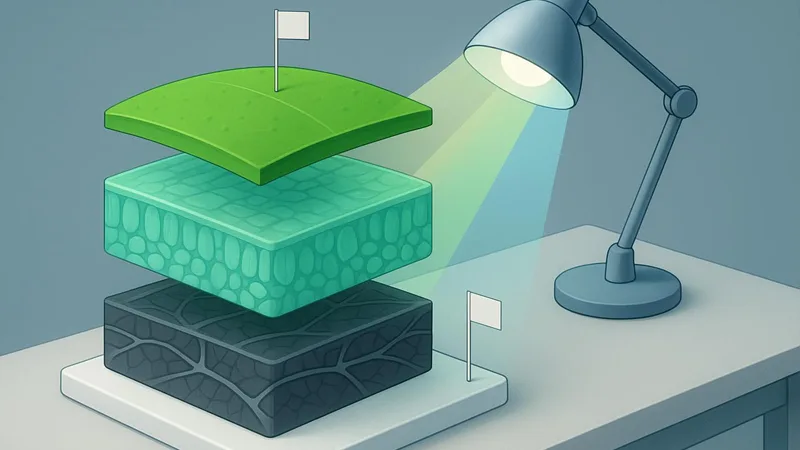
Light regulates NR at three distinct levels, and the nitrate reductase light spectrum touches all three at once. That is why single-wavelength claims mislead.
Layer one is post-translational. NR is switched off by phosphorylation and 14-3-3 binding, which locks the enzyme into an inactive complex in the presence of Mg²⁺ and Ca²⁺; dephosphorylation releases 14-3-3 and restores activity within minutes (Journal of Experimental Botany, 2001).
Layer two is transcriptional. Light induces de novo NR synthesis over hours, yet sucrose alone can mimic light’s induction of NR transcription, so part of the signal is carbon, not photons (Plant Physiology).
Layer three is reductant supply. Cytosolic NR draws on NAD(P)H from photosynthetic carbohydrate metabolism, while chloroplastic NiR runs on reduced ferredoxin from electron transport (Plant Physiology).
⚠️ Warning: MoCo is the catalytic centre, not the on/off switch.
[DIAGRAM: three-layer schematic, light striking a leaf, with layer 1 post-translational activation, layer 2 NR gene expression, and layer 3 photosynthetic reductant supply feeding cytosolic NR and chloroplastic NiR]
Read any nitrate reductase light spectrum claim against all three layers before accepting it.
Red and Far-Red: The Phytochrome Switch That Sets Nitrate Reductase Activity
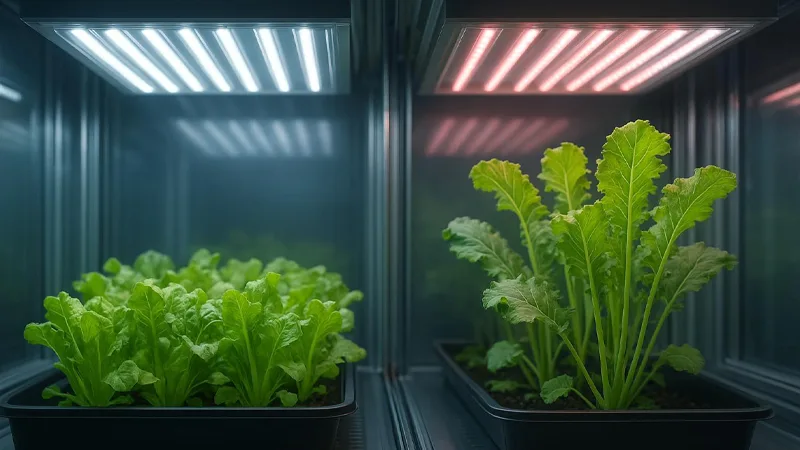
Red light is the most direct spectral control on nitrate reductase activity. In classic red/far-red photoreversibility experiments in squash, maize, and pea, red light at roughly 660 nm converted phytochrome from its Pr form to Pfr and induced nitrate reductase, while a following far-red pulse near 730 nm reversed the induction (Plant Physiology, 1988). That reversal is the mechanism behind far-red light leaf nitrate accumulation: far-red shifts phytochrome toward its inactive form, nitrate reductase is suppressed, and nitrate builds up because uptake continues while assimilation slows (Frontiers in Horticulture, 2026).
The magnitude is not trivial. In a 2026 lettuce-and-kale trial where far-red pushed leaf nitrate up by as much as 69%, lettuce reached +53.6% under white plus red plus far-red and +39.8% under white plus red, both against white LED at 100 µmol m⁻² s⁻¹. Kale moved further still, at +64.8% under white plus far-red and +69.1% under white plus red plus far-red, and it carries a much higher baseline: roughly 85–150 mg/g DW against 30–40 mg/g DW in lettuce.
Blue, Green and Violet: Where the Nitrate Reductase Light Spectrum Gets Complicated
Blue and violet wavelengths clearly reach nitrate reductase, but the direction of the effect is not fixed. Adding 410 nm violet to a red-blue recipe cut NR activity by 35.8% and lowered nitrate significantly versus red-blue alone (Li et al., Frontiers in Plant Science, 2021). Green behaves differently again: green light added to a red-blue recipe raised NR gene expression about 40% and NiR expression 3.07 times, yet GS activity fell 54.3%, and GOGAT dropped 41.9% (Li et al., 2021). In spinach, a blue-green-red recipe lifted NR activity 104% over blue-red alone at high nitrogen (Ramezani et al., 2023).
The reason is that each receptor has its own absorption band. Cryptochrome responds to UV-A and blue near 380 to 500 nm, phototropin to blue near 400 to 500 nm, and both reach NR indirectly through stomatal conductance, chloroplast positioning, and carbon-nitrogen coordination (phytochrome signaling reviews, 2011). So the practical reading of the nitrate reductase light spectrum is this: blue and violet effects vary by species and developmental stage, and they only make sense alongside the rest of the recipe.
UV-A Supplementation: Raising Nitrate Reductase Content and Lowering Leaf Nitrate
Adding UV-A alongside your visible spectrum raises nitrate reductase content and lowers leaf nitrate at the same time. In purple lettuce grown under 380–400 nm UV-A at 20 µmol m⁻² s⁻¹, UV-A supplementation raised nitrate reductase content by up to 72.7%, with increases of 51.01%, 72.67%, and 29.50% under NO₃⁻-N, a 3:1 NO₃⁻: NH₄⁺ mix, and NH₄⁺-N, respectively (Liu et al., Int. J. Mol. Sci., 2023).
The nitrate response moved in the same direction every time. Leaf nitrate-N fell from 0.252 to 0.219 mg g⁻¹ FM under NO₃⁻-N, from 0.214 to 0.178 under the 3:1 mix, and from 0.199 to 0.171 under NH₄⁺-N (Liu et al., 2023). Magnitude varied with nitrogen form; direction did not.
That matters because UV-A and UV-B are not interchangeable in this pathway. UVR8, the photoreceptor most often cited for UV responses, responds to UV-B, not UV-A, and the evidence packet shows no direct NR-regulatory role for it. Treat UV-A as its own channel in the nitrate reductase light spectrum rather than a weaker substitute for UV-B.
Why Red Light Cuts Leaf Nitrate: The Rocket Case
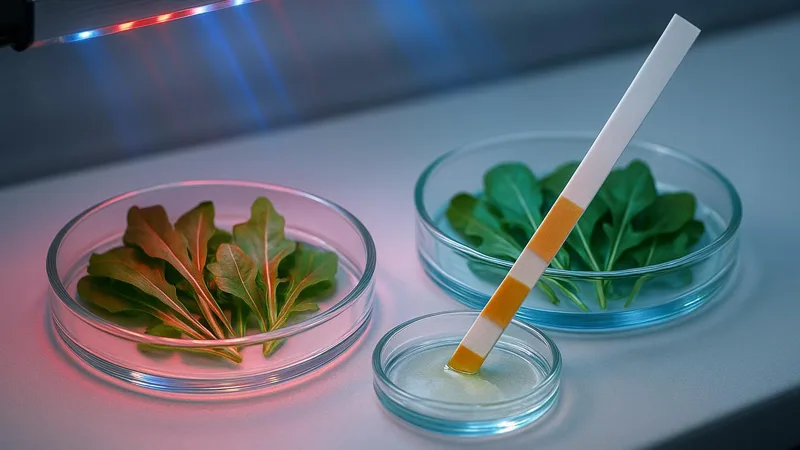
Red light outperformed blue for nitrate reduction in a controlled rocket trial that cut leaf nitrate from 7,100 to 4,270 mg/kg under red light (Signore et al., Frontiers in Plant Science, 2020). The trial grew Diplotaxis tenuifolia under 660 nm red versus 460 nm blue LEDs at 150 µmol m⁻² s⁻¹, a DLI of 7.5 mol m⁻², and a 14/10 h photoperiod over a 66-day cycle. Under red light, nitrate reductase activity ran roughly eightfold higher than under blue at the lower nitrogen level.
The effect also held at higher nitrogen: red light plus higher nitrogen brought Eruca sativa to 5,488 mg/kg FW, which the authors place below the EU limit.
⚠️ Warning: one species under one recipe, not a general red-light rule.
Reading the Contradiction: Far-Red Dose, Species and Nitrogen Regime
The two far-red results are not a contradiction in the science; they are a contradiction in the experimental conditions. A 2021 lettuce trial found no significant nitrate change under 20% far-red even though nitrate reductase activity fell 34.8%, while the 2026 trial found the opposite, with far-red raising leaf nitrate. The mechanism explains why both can be true: far-red shifts phytochrome toward its inactive form, which suppresses nitrate reductase and lets nitrate accumulate, but the size of that effect depends on how much nitrate the plant is taking up in the first place.
Four variables separate the studies, and any one of them can flip the outcome.
| Variable | 2021 lettuce trial | 2026 trial |
|---|---|---|
| Species / cultivar | Lettuce | Lettuce |
| PPFD | 200 µmol m⁻² s⁻¹ | 100 µmol m⁻² s⁻¹ |
| Far-red share | 20% | Reported as a far-red treatment |
| Nitrogen regime | Not the limiting factor | Lower nitrogen availability |
| Observed leaf nitrate | No significant change | Increased |
Species and cultivar set the baseline enzyme capacity. PPFD sets how much reductant and carbon skeleton the leaf can supply. The far-red fraction sets how far phytochrome is pushed toward Pr. The nitrogen regime sets whether there is surplus nitrate waiting to be reduced at all. Change one, and you change the sign of the result.
That is the practical reading of far-red light leaf nitrate accumulation: treat far-red as a dose-dependent modifier of an already nitrogen-limited system, not as a switch with a fixed direction. A spectrum that raises nitrate in a low-nitrogen, low-PPFD crop may do nothing measurable in a well-fed, high-light one.
Timing and Sampling: Why Measured Nitrate Reductase Activity Depends on When You Look
Leaf nitrate reductase (NR) is a light-dependent enzyme, and that single fact decides how you should sample it. NR is switched off by phosphorylation and 14-3-3 binding when the leaf goes dark, and dark inactivation of leaf NR has a reported half-time of about 15 minutes in spinach, with reversal within the first 30 minutes of light (Plant Physiology, PMC59043). The number you get depends on when you take the sample.
For a preharvest lighting leafy greens trial, that means the lighting protocol and the sampling protocol have to be designed together. A sample pulled two hours into the photoperiod and one pulled after 20 minutes of darkness are not measuring the same enzyme state, so any comparison between two spectral treatments is only valid if both were sampled at the same point in the diel cycle.
Pro Tip: standardise sampling time before comparing any two spectral treatments.
Building a Preharvest Lighting Recipe Around Nitrate Reductase
Spectrum alone does not set leaf nitrate, so a workable recipe is a validation loop, not a preset. Light regulates NR at three distinct levels: enzyme activation, gene expression, and enzyme turnover, which is why intensity, photoperiod, developmental stage, genotype, and nitrogen supply all move the measured result.
Fix the nitrogen regime first. Nitrate supply sets the substrate pool, and no spectrum compensates for a feed rate the crop cannot reduce. Choose the red-to-blue ratio second, since red-dominant output is the more consistent lever on nitrate reductase activity. Decide third whether far-red is worth its nitrate cost for the morphology benefit: in the 2026 lettuce-and-kale trial, far-red pushed leaf nitrate up by as much as 69%, so that trade needs a reason. Add UV-A last, and only where the cultivar and N form support it, since UV-A supplementation raised nitrate reductase content by up to 72.7%.
| Wavelength band | Expected NR direction | Evidence strength | Holds when |
|---|---|---|---|
| Red (600–700 nm) | Higher activity, lower leaf nitrate | Strong, replicated | Red-dominant ratio, adequate N supply |
| Blue (400–500 nm) | Mixed; species and stage dependent | Moderate, inconsistent | Cultivar-specific response documented |
| Far-red (700–750 nm) | Higher leaf nitrate | Moderate to strong | Dose is material, not trace |
| UV-A (315–400 nm) | Higher NR content, lower leaf nitrate | Emerging | Cultivar and N form support it |
The controlled rocket trial that cut leaf nitrate from 7,100 to 4,270 mg/kg under red light shows the size of the lever when the other variables are held. Tunable channel control supports this kind of iteration: SLTMAKS fixtures let you adjust red, blue, far-red, and UV-A percentages independently and schedule the photoperiod, so a preharvest lighting leafy greens program can be tested one variable at a time.
Common Mistakes When Reading Wavelength and Nitrate Reductase Data
The most frequent error is treating one wavelength result as a general rule. Studies disagree by species, dose, and nitrogen regime, so a finding from a single trial rarely transfers.
Reading molybdenum cofactor (MoCo) as the regulatory switch. MoCo is the catalytic cofactor, not the control point. NR is switched off by phosphorylation and 14-3-3 binding, so a spectrum that changes MoCo abundance is not necessarily changing NR regulation.
Comparing trials at different PPFDs or far-red fractions as if they were equivalent. Dose differences alone can flip a result. In one trial, adding 410 nm violet to a red-blue recipe cut NR activity by 35.8%, a direction that would be easy to misattribute to the spectrum rather than the setup.
Sampling at inconsistent times of day. Dark inactivation of leaf NR has a reported half-time of about 15 minutes, so morning and afternoon samples are not comparable.
Generalising a spinach or rocket result to lettuce. Species responses diverge sharply. In spinach, a blue-green-red recipe lifted NR activity 104% over blue-red alone at high nitrogen, a magnitude lettuce trials do not reproduce.
Treating fixture specifications as biological evidence. A spectral output chart describes photons emitted, not enzyme response. Only measured tissue data closes that gap.
Frequently Asked Questions
Does Red Light Always Lower Leaf Nitrate?
No. The direction is consistent across trials, but the size of the effect, and sometimes its significance, depends on species, nitrogen supply, and the rest of the recipe. The controlled rocket trial that cut leaf nitrate from 7,100 to 4,270 mg/kg under red light shows what a strong response looks like when red dominates the spectrum and nitrogen is not limiting. Set that against the 2026 lettuce-and-kale trial where far-red pushed leaf nitrate up by as much as 69%, and the practical reading is that red light nitrate reductase activity is a lever, not a guarantee. Treat red as one variable in the recipe and measure the crop in front of you.
How Much Far-Red is Too Much?
The published evidence does not give a threshold. The 2026 trial used a 3:0.5 and 3:1:0.5 W:R:FR ratio and saw nitrate rise, while a 2021 lettuce trial found no significant nitrate change under 20% far-red. Two trials, two different outcomes, so the safe fraction is recipe-specific. Test far-red light leaf nitrate accumulation on your own cultivar rather than importing a number from someone else’s room.
How Long after Changing A Spectrum Should Leaf Nitrate be RLE-Measured?
Allow for the slowest layer to turn over. Light regulates NR at three distinct levels, and the transcriptional layer operates on the order of hours, so a reading taken minutes after a spectrum change reflects the old setting. Standardise sampling time as well: dark inactivation of leaf NR has a reported half-time of about 15 minutes, which means a sample pulled at lights-on and one pulled mid-afternoon are not comparable. Fix the sampling hour, wait at least a full photoperiod, then compare.
Conclusion
You can now read any wavelength claim against the three control layers: phytochrome signalling that sets nitrate reductase capacity, indirect effects that work through growth and nitrogen demand, and timing, which decides what a sample actually captures. That framing is what separates a spectrum recommendation you can act on from one you can only repeat.
The evidence supports a real but conditional effect. Far-red is the clearest demonstration, with a 2026 lettuce-and-kale trial where far-red pushed leaf nitrate up by as much as 69% (Frontiers in Plant Science, 2026), while a controlled rocket trial that cut leaf nitrate from 7,100 to 4,270 mg/kg under red light shows how large the swing can be in the other direction (Signore et al., Frontiers in Plant Science, 2020). Neither number transfers directly to your crop, your nitrogen regime, or your harvest window.
That is the practical limit of the light wavelengths nitrate reductase literature, and it is why preharvest lighting leafy greens protocols should be built from your own sampling data rather than from a published percentage. Compare spectral configurations against your current recipe, or talk to a lighting specialist about which channels your fixture can actually vary. Treat any published range as a hypothesis for your site: validate the change on a small block, sample at the same time of day, and only then lock it into a production protocol.
FAQ
Can nitrate reductase activity be raised without changing the spectrum at all?
Can nitrate reductase activity be raised without changing the spectrum at all?
Yes, and it is often the faster lever. Light regulates NR at three levels, and one of them runs on carbon rather than photons: sucrose alone can mimic light’s induction of NR transcription, so a well-lit crop with poor carbon supply or a stalled nitrogen feed can underperform a modest spectrum. Check PPFD, photoperiod and nitrogen form before you rebuild the recipe. A spectrum change layered onto a carbon-limited or underfed crop tends to produce a smaller response than the trial numbers suggest, because the substrate pool, not the enzyme, is the constraint.
Does a higher nitrate reductase reading mean lower nitrate in the harvested leaf?
Does a higher nitrate reductase reading mean lower nitrate in the harvested leaf?
Not automatically. NR activity is an instantaneous snapshot of enzyme capacity, while leaf nitrate at harvest is the balance between uptake and reduction across the whole cycle. A crop can show high NR activity during the photoperiod and still carry elevated nitrate if uptake outpaces assimilation, which is exactly what the far-red results show: far-red suppresses NR, and nitrate accumulates. Sample both — enzyme activity during the photoperiod and tissue nitrate at harvest — rather than treating one as a proxy for the other.
Do I need to change the spectrum for the whole cycle, or only near harvest?
Do I need to change the spectrum for the whole cycle, or only near harvest?
The preharvest window carries the most weight for leaf nitrate, but the response is cumulative, not a switch. Because the transcriptional layer of NR regulation turns over on the order of hours, a recipe applied for the final days can still move tissue nitrate before cutting. Longer exposure before that generally matters more for morphology and biomass than for nitrate itself. If your goal is nitrate control, tune the nitrogen regime first and treat any spectral change in the final window as a refinement you validate on a small block.