Introduction
This guide is for heads of cultivation, operations directors, and lighting engineers specifying or standardizing custom LED light bars across commercial NFT facilities. NFT (Nutrient Film Technique) channels impose specific geometry constraints — narrow canopy widths, shared rack structures, and high-humidity wet zones — that make a generic hang-and-adjust approach insufficient.
Working through this guide, you will establish PPFD (Photosynthetic Photon Flux Density) targets by crop, optical layouts that reach min/avg uniformity ≥ 0.85, IP and compliance specifications that hold up under Authority Having Jurisdiction (AHJ) inspection, and an energy-load baseline that feeds HVAC planning.
Use this document alongside your facility standards and supplier photometric files (IES/LDT format). The specifications below assume sealed, recirculating NFT systems producing leafy greens and herbs in North American or European commercial facilities. Adjust by crop program, photoperiod budget, and local electrical code as needed.
Table of Contents
Agronomic Targets
PPFD and DLI Bands
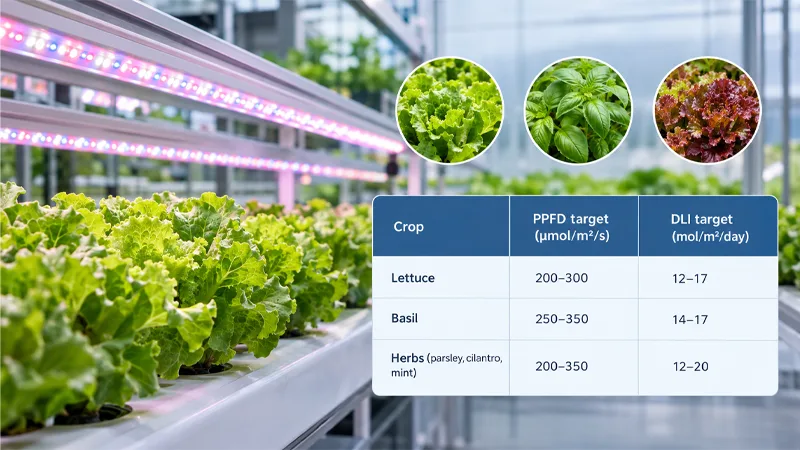
The relationship DLI = PPFD × photoperiod × 0.0036 anchors every downstream specification in this guide. Starting with the wrong Daily Light Integral (DLI) target means no amount of optics refinement or control tuning will produce the crop result you need.
For lettuce and most leafy greens, target 200–300 µmol/m²/s PPFD with a DLI of 12–17 mol/m²/day. Research from Wageningen University (2020) found that 250 µmol/m²/s at a 16-hour photoperiod (DLI ≈ 14.4 mol/m²/day) produced the most consistent fresh and dry biomass improvement for both lettuce and basil under a red:blue ratio of 3:1. For basil and higher-demand herbs, set PPFD at 250–350 µmol/m²/s and target DLI of 14–17 mol/m²/day.
| Crop | PPFD target (µmol/m²/s) | DLI target (mol/m²/day) |
|---|---|---|
| Lettuce | 200–300 | 12–17 |
| Basil | 250–350 | 14–17 |
| Herbs (parsley, cilantro, mint) | 200–350 | 12–20 |
Spectrum for Veg Crops
Broad-spectrum white LEDs are the dominant commercial architecture and remain the lowest-complexity starting point for NFT leafy-green programs. They deliver a balanced energy distribution across the full PAR (Photosynthetically Active Radiation) range without requiring crop-by-crop channel management. Supplement with dedicated red and blue output channels when a specific red:blue ratio is part of your quality specification.
A 2025 Scientific Reports study on LED lighting spectra for vertical farms confirmed that a starting ratio near 11:5 red: blue supports robust lettuce growth; broader commercial programs typically operate in the 3:1 to 6:1 range with comparable results. Basil benefits from keeping blue output at 10–15% of total PPF to maintain compact canopy architecture and stronger essential oil profiles.
Far-red (700–780 nm) is an optional tuning input, not a default setting. Early-stage far-red supplementation can increase lettuce biomass, as demonstrated in Annals of Botany research (2026), but uncontrolled far-red triggers shade-avoidance response and internode elongation in many cultivars. If far-red is specified, keep the FR fraction below 10% of total PPF and evaluate canopy architecture alongside yield-per-unit-area at each adjustment step.
Photoperiod Choices
Sixteen hours per day is the standard commercial default for NFT leafy greens. It produces predictable DLI at moderate PPFD, reduces the risk of tip burn in sensitive cultivars, and simplifies multi-shift facility scheduling. A 14-hour photoperiod suits situations where rack height constrains mounting distance and higher PPFD compensates for the shorter day.
An 18-hour period reduces the instantaneous PPFD needed for a given DLI target but is only warranted when cultivar response, CO₂ supplementation, and VPD management fully support the extended day. Back-calculate required PPFD from your DLI target and chosen photoperiod before selecting fixture output.
Optical and Geometry Design
Uniformity and Optics
For commercial NFT production — where every plant position in the channel carries equal revenue weight — uniformity is a primary specification, not a secondary refinement. The metric is U₀ = minimum PPFD ÷ average PPFD across the measured canopy.
A U₀ of ≥ 0.80 is the minimum acceptable threshold; ≥ 0.85 is the target for standardized multi-site deployments. Below 0.70, edge plants are materially underlit while center plants receive excess photons, producing within-channel size and quality variation that shows up at harvest grading. For a full analysis of what drives uniformity in multi-tier structures, see achieving 90%+ light uniformity in vertical farm racks.
Bare-emission or diffuse-lens bar fixtures are the preferred optic choice for NFT channel spacing. At the 20–25 cm mounting heights typical in NFT rack designs, narrow-beam lenses create hot stripes between bars and underlit edges that no amount of repositioning can fully correct. Diffuse emission allows beam overlap at short throw distances, producing the smooth PPFD transition across channel width that drives high U₀. Reserve lensed optics for situations where the fixture must project to a canopy more than 45 cm below — an uncommon condition in standard NFT rack geometry.
Mounting Height and Spacing
Start at 20–25 cm above the mature canopy for standard NFT rack installations. This height provides adequate clearance for full-grown heads while keeping the beam path short enough for diffuse bars to blend photon fields effectively. For 0.8 m wide racks — the most common NFT bench format — two bars spaced 40 cm apart with 20 cm offsets from each edge achieve 10–20% beam overlap at canopy level and consistently produce U₀ in the 0.83–0.88 range after thermal stabilization.
| Rack width | Bars per tier | Bar spacing | Edge offset |
|---|---|---|---|
| 0.6 m | 1 | — centered | 30 cm each side |
| 0.8 m | 2 | 40 cm | 20 cm each side |
| 1.0 m | 2–3 | 45–50 cm | 20–25 cm each side |
Set mounting hardware at the correct height before commissioning rather than compensating with extreme dimming from a suboptimal position. Fixtures operating well below rated output are thermally inefficient and limit your headroom for future crop adjustments.
Channel Coverage Strategy
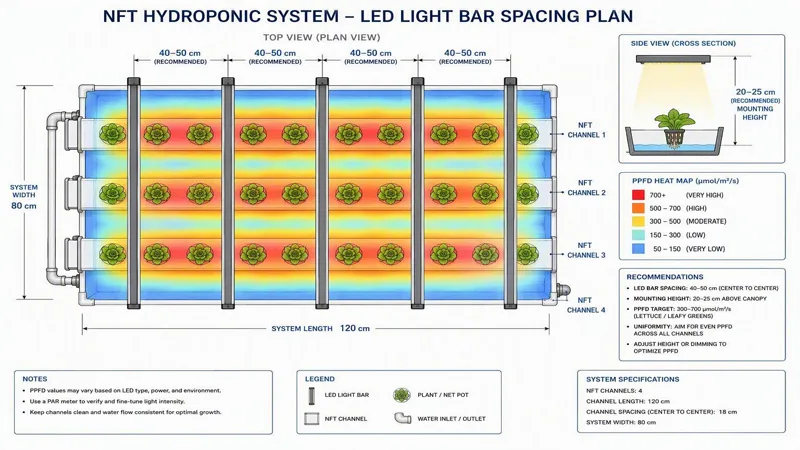
Treat each NFT channel as a discrete PPFD zone when designing bar layout. Orient bars perpendicular to the channel direction so the photon gradient runs transversely across channel width. A single bar parallel to the channel creates longitudinal variation — PPFD higher near the bar midpoint, lower at the channel ends — that cannot be corrected by repositioning.
For bays with four or more channels, plan bar placement so the spacing lands between channel centerlines rather than directly above them. This distributes photons across the channel boundary rather than concentrating them at the centerline, eliminating the dark seams at channel edges where lettuce heads develop.
Thermal, IP, and Compliance
Heat and Drivers
Every watt consumed by a light bar becomes heat in the grow room. For a 100 m² NFT bay targeting 250 µmol/m²/s from fixtures rated at 2.2 µmol/J, total electrical input runs approximately 11–12 kW — all of which flows into the HVAC cooling load. Fixture PPE (Photon Efficacy, µmol/J) is therefore an HVAC specification as much as an energy specification. For context on how aluminum heat-sink geometry affects junction temperature and L90 lifetime, the analysis of passive heat-sink design in commercial grow lights covers the thermal-path mechanics relevant to bar-style fixtures.
Remote-driver architecture — mounting driver electronics outside the wet zone and running low-voltage feed to the fixture bar — is the standard best practice for NFT environments. When driver electronics sit above active channels in the mist, condensation, and periodic washdown zone, thermal and moisture failure rates increase even in IP65-rated assemblies, because every service access breaks the environmental seal.
A remote-driver design removes the highest-failure component from the wet zone entirely. For example, SLTMAKS commercial bar configurations for horticulture pair a remote-driver assembly (located in a dry equipment area) with an IP66-rated bar body carrying ETL listing to the UL 8800 standard — keeping electronics dry while the light-emitting assembly handles the channel environment without service complications.
Waterproofing and IP
IP ratings are defined by IEC 60529, incorporated by reference into UL 8800, the North American horticultural luminaire safety standard. The second digit classifies water protection: IP65 guards against low-pressure jets from any direction; IP66 adds resistance to high-pressure jets and is the minimum credible specification for NFT environments with periodic spray cleaning or pressure washing. IP67 provides protection against full immersion up to one meter for 30 minutes and is appropriate for drain-trough environments or subfloor cable runs.
Do not accept a datasheet IP claim without a corresponding IEC 60529 test report from a recognized testing laboratory. Gasket compression, cable-entry gland ratings, and fastener corrosion resistance must be verified separately — IP ratings govern the enclosure, not ancillary hardware. In NFT environments with persistent humidity at 80–95% RH, unsealed cable glands are the most common ingress path on otherwise properly rated fixtures. See IP ratings for commercial grow environments for a breakdown of what each rating level guarantees and the field verification steps that accompany it.
Safety Listings and Docs
Under the National Electrical Code (NEC/NFPA 70), horticultural luminaires installed in commercial facilities must carry a listing from a Nationally Recognized Testing Laboratory (NRTL) to an appropriate standard. UL 8800 (ANSI/CAN/UL 8800) is that standard in the U.S. and Canada: it covers wet/damp location ratings, IP evaluation, elevated ambient temperature testing, and driver compliance. ETL (Intertek) and UL marks are both recognized NRTL evidence; require the listing certificate and directory entry for the exact model number and voltage configuration, not a generic brand certification.
For utility rebate eligibility, verify the fixture appears on the DLC Horticultural Lighting Qualified Products List (QPL), which requires a reported PPE of ≥ 1.9 µmol/J, LM-79 photometric testing, and device-level lifetime data. The documentation package to require from any supplier: NRTL certificate, IEC 60529 IP test report, DLC QPL entry, IEC 62471 photobiological safety evaluation, LM-79 photometric file, and L90 lifetime projection. Refer to UL and CE standards for plant lights for a practical breakdown of which document an AHJ inspector is most likely to request and what each covers.
Energy, HVAC, and Controls
Efficacy and Loads
Fixtures for commercial leafy-green programs should exceed 2.0 µmol/J PPE; current Samsung LM301H and LM351H diode-based bars reach 2.4–2.8 µmol/J in top-tier configurations. At 2.2 µmol/J, a 100 m² bay at 250 µmol/m²/s average PPFD draws approximately 11.4 kW.
Use active canopy area — not room footprint — for load calculations; aisles and non-lit service zones should not inflate your wattage estimate. Model electrical panel capacity and HVAC tonnage against this figure before finalizing fixture count. A 10% underestimate on electrical load can mean an upgrade to service panels or condensers mid-build — correction costs that dwarf any fixture-price savings.
For detailed guidance on balancing space, heat, and yield in vertical farming environments — including VPD coupling, transpiration heat load, and HVAC interaction — the full operational framework is worth reviewing before setting your facility-wide setpoints.
Dimming and Zoning
0–10V analog dimming is the baseline control interface for commercial bar fixtures and the minimum specification for any NFT installation. It enables zone-level output adjustment, programmed ramp schedules, and PPFD tuning for different crop stages without moving hardware. Require full dimming range data at procurement — specifically the minimum dim level as a percentage of rated output. Some drivers dim only to 20% of rated output; for low-intensity propagation zones requiring 80–100 µmol/m²/s, that minimum matters.
DALI (Digital Addressable Lighting Interface) is appropriate when individual fixture addressability is required — for example, per-channel setpoints in a mixed-crop NFT system running both lettuce and basil in adjacent channels. Wireless controls add retrofit flexibility in facilities where conduit runs are impractical, but require validated RF coverage maps and fail-safe restart behavior verification before production use.
Integration and QA
Log fixture input wattage at commissioning and compare it against the design estimate. A deviation of more than 5% signals a wiring, driver, or configuration problem worth resolving before plant loading. Save control-system zone maps, DALI addresses or analog wiring diagrams, and setpoint records in your facility management system — the commissioning technician who set them up will not always be available when the next crop cycle begins.
Schedule a PPFD re-verification map after the first crop cycle: mature canopy reflectance, plant spacing, and channel-level airflow each shift real-world readings relative to the empty-rack baseline.
Layout Examples and Checks
Two-to-Four Channel Layouts
A two-channel NFT module on a 0.8 m wide rack with 16–20 cm channel centers is the smallest commercially relevant layout for this guide. Two bars per tier, set 40 cm apart and 20 cm from each edge, at 20–25 cm above mature canopy, reliably produce U₀ ≥ 0.85 on 200–280 µmol/m²/s programs. A four-channel bay — the most common production unit in commercial NFT facilities — typically spans 1.2–1.6 m and requires three to four bars per tier depending on rack geometry. At 45–50 cm bar spacing across a 1.5 m wide bay, three bars deliver 10–20% footprint overlap and a U₀ in the 0.85–0.90 range at 22 cm mounting height.
For multi-bay installations where electrical panel capacity is a constraint, phase adjacent bays’ photoperiod start times by 30–60 minutes to reduce peak demand charge without affecting cumulative DLI or crop schedule.
PPFD Mapping Steps
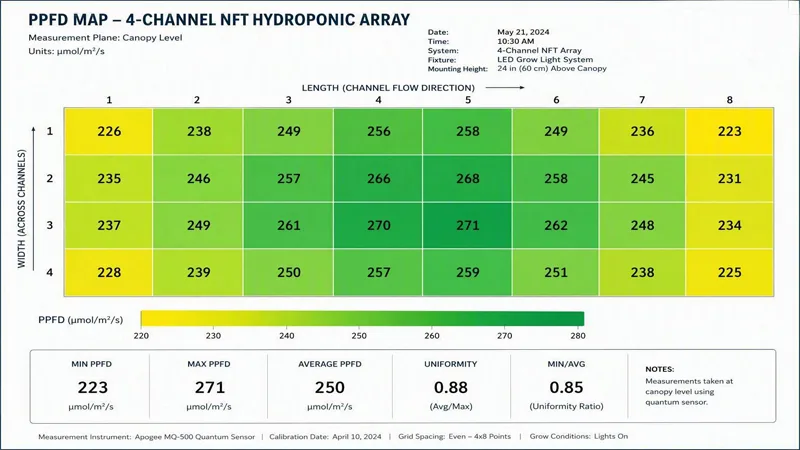
Define the measurement plane at the top of the mature canopy — not the empty channel floor or rack frame. Mark a 9-point grid (3 × 3) over each channel for standard commissioning verification; use a 25-point grid (5 × 5) for detailed documentation or when initial U₀ results are borderline. Warm fixtures for 15–20 minutes at operating temperature before recording any measurements. Calculate average, minimum, maximum, and U₀ for each channel.
If U₀ falls below 0.80, raise mounting height by 3–5 cm and re-measure before changing bar spacing or dimming level. If all grid points are below PPFD target, increase dimmer output; if the center is high and edges lag, a small height increase typically resolves the gap more reliably than repositioning bars.
Commissioning Checklist
- Fixture count, bar orientation, and spacing verified against the approved layout drawing.
- Mounting hardware set at specified height; measured at canopy plane, not fixture bracket or rack frame.
- Line voltage, circuit load, and breaker sizing verified; driver configuration confirmed for the specified control method.
- IP ratings and NRTL certification documentation received and verified against the fixture model number.
- Remote driver located outside the wet zone; cable-entry glands sealed and labelled.
- All zones dim smoothly from minimum to maximum rated output; preset scenes recall correctly after power cycling.
- Power-fail restart behavior confirmed; fixtures return to intended setpoint, not 100% output.
- Input wattage logged per circuit and compared to design estimate; deviation ≤ 5%.
- PPFD grid measurement completed at mature-canopy height; U₀ ≥ 0.85 on all channels before plant loading.
- Measurement records, zone maps, and control addresses filed in facility management system.
- First-crop-cycle PPFD re-verification date scheduled and assigned.
Conclusion
Standardizing LED light-bar design across NFT sites reduces within-channel crop variability, creates a defensible compliance record for AHJ inspections, and builds the documentation baseline needed for DLC utility rebate applications. The specifications to lock in across sites are: PPFD target by crop program, DLI matched to photoperiod schedule, bar spacing calibrated for U₀ ≥ 0.85 with diffuse-emission optics, IP66 minimum for wet-zone bar bodies, remote drivers positioned outside the active wet zone, and a full documentation package covering NRTL listing, IP test report, and DLC QPL entry.
Immediate next steps: build a fixture evaluation matrix using the PPE, uniformity, IP, and documentation criteria above; request LM-79 files and DLC QPL entries from each candidate supplier; commission a pilot bay PPFD map before scaling across the facility; and archive that map with control settings, canopy height, and date as the baseline for every future crop-cycle comparison.
Pro Tip: Archive every PPFD map with the date, fixture model, firmware/software revision, dimming setpoint, and measured canopy height. When production variability appears six months later, this record is the fastest path to diagnosis — and to credible documentation if the cause turns out to be fixture drift rather than a crop management variable.
FAQ
What PPFD and DLI do leafy greens need in an NFT system?
Most NFT lettuce and leafy-green programs run 200–300 µmol/m²/s at the canopy for 14–16 hours per day, which lands a DLI of roughly 12–17 mol/m²/day. That range is echoed across commercial guidance and extension research — Michigan State University Extension, for instance, puts the controlled-environment requirement for leafy greens and herbs at 12 mol/m²/day or more.
If your facility has weaker climate control, stay nearer the low end of the PPFD band to reduce tip-burn risk; well-managed rooms with tight VPD and CO₂ control can push toward 300 µmol/m²/s. Always back-calculate the PPFD you need from your DLI target and chosen photoperiod before ordering fixtures.
What IP rating should LED light bars have in a wet NFT zone?
IP65 is the practical floor for humid NFT racks, since it protects against low-pressure water jets from any direction. For facilities that pressure-wash channels or hose down racks between crop cycles, IP66 is the minimum credible specification — several commercial lighting suppliers now treat anything below IP66 as unsuitable for commercial grow environments. Step up to IP67 only where standing water or drain-trough exposure is plausible. Whatever the datasheet claims, ask for the underlying IEC 60529 test report, and verify gasket compression and cable-gland ratings separately, since ingress usually happens at the glands rather than the enclosure.
How far apart should bars be mounted to hit uniformity ≥ 0.85?
On the common 0.8 m NFT bench, two bars per tier spaced 40 cm apart with 20 cm offsets from each edge, mounted 20–25 cm above the mature canopy, typically produce U₀ in the 0.83–0.88 range once fixtures reach thermal equilibrium. Wider 1.2–1.6 m four-channel bays generally need three to four bars at 45–50 cm spacing. Mounting height is the first lever if uniformity comes in low: raise the fixtures 3–5 cm and re-measure before you touch spacing or dimming. The measurement plane matters too — always map at the top of the mature canopy, never the empty channel floor.
Do commercial NFT lights need a UL 8800 listing?
Yes. Under the National Electrical Code, horticultural luminaires in commercial facilities must carry a listing from a Nationally Recognized Testing Laboratory, and UL 8800 is the applicable standard in the U.S. and Canada. It covers wet/damp location ratings, IP evaluation, elevated ambient temperature testing, and driver compliance. Both the ETL (Intertek) and UL marks count as valid NRTL evidence — but require the certificate and directory entry for your exact model number and voltage configuration, not a generic brand-level certification. If you’re pursuing utility rebates, confirm the fixture also appears on the DLC Horticultural Lighting Qualified Products List.