
A commercial grower signing a factory-direct lighting order is usually focused on the fixture: spectrum, efficacy, price per photon. However, when you plan to import LED grow lights, the order that follows is where the money actually moves — classification, duty stacking, certification evidence, cargo condition, and warranty terms across four different destination regimes. The United States, the European Union, the United Kingdom, and Canada each apply their own tariff line, their own tax treatment and their own conformity pathway to the same shipping carton.
The sequence below follows the order in which commitments become irreversible: classify and cost the goods, choose Incoterms and the importer of record, verify the factory and its model-level documents, inspect before the balance payment, protect the cargo, then write spares and warranty terms into the contract. LED luminaires sit in heading 9405 in every one of these markets, with LED-specific subheadings such as 9405.42 in the US HTS, 9405 42 in the EU and UK tariffs, and 9405.42 in Canada’s Customs Tariff — but the rate, the additional duty programs and the conformity evidence differ by destination.
All duty rates, fee amounts and trade-remedy figures in this article are public values stated with their source and date. They change. Re-check the current official notice — the US HTS and CBP, TARIC or Access2Markets, the UK Trade Tariff, the Canada Customs Tariff — before a purchase order is signed, and treat any figure here as a starting assumption for your broker rather than a quote.
Table of Contents
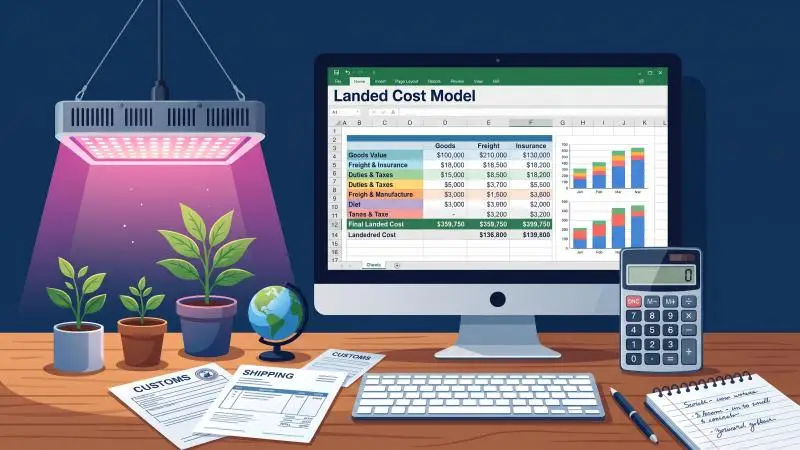
Classify the Fixtures When You Import LED Grow Lights and Build a Landed-Cost Model
Classification is the first cost driver and the one most often left to the freight forwarder. The code determines the base duty rate, whether a Section 301 or anti-dumping layer attaches, and what the broker needs to file. Get it confirmed in writing before you model anything else.
The Code Family, by Destination
LED horticultural luminaires are classified as electric luminaires designed for use solely with LED light sources. The relevant lines as published:
| Destination | Line | Base rate (MFN / third-country) |
|---|---|---|
| United States | HTS 9405.42 (LED luminaires, other) | General rate applies; confirm on hts.usitc.gov |
| Canada | 9405.42.90 | 7% MFN |
| United Kingdom | 9405 42 31 00 | 4.00% third-country duty |
| EU | 9405 42 (LED luminaires) | Confirm on TARIC for the specific eight-digit line |
The Canadian rate is published in the 2026 Canada Customs Tariff, Chapter 94, where 9405.42.90 carries a 7% MFN rate. The UK rate is published on the UK Trade Tariff commodity page for 9405 42 31 00, which shows a 4.00% third-country duty under S.I. 2020/1430. Both pages also state that import VAT is separate from customs duty and may still be due at a 0% duty rate. The US general rate for 9405.42 must be read from the current HTS; this article does not restate it because the additional layers below change the effective rate more than the base does.
The Layers on Top of Classification
Classification tells you the base rate. It does not tell you the effective rate. In the US, Section 301 additional duties on Chinese-origin goods are assessed by HTS subheading, and CBP’s Section 301 FAQ explains how the additional headings (9903.88.01 and related) interact with Chapter 98 entries and sets. Whether your specific 9405.42 line is covered, and at what rate, must be confirmed against the current USTR list and CBP guidance — the rate has changed repeatedly since 2018 and exclusions have expired and been reinstated.
Anti-dumping and countervailing exposure is a separate question: check the current measures in force for the product and origin on the European Commission trade defence pages for the EU and on CBP and ITC sources for the US. Do not assume a luminaire is outside a measure because it is a horticultural product; the scope definitions are product-specific.
Preferential rates are a third layer. Canada’s tariff schedule lists preferential treatments (CPTPT, UKT and others) alongside the MFN rate; whether a Chinese-origin good qualifies depends on the origin rules of the relevant agreement, and Chinese-origin goods generally do not. Confirm origin treatment with your broker rather than assuming the lowest column applies.
The Landed-Cost Worksheet
Build the model line by line. Each line should be a number you can defend to your finance team, not a percentage allowance.
- Goods value. Ex-works or FOB unit price × quantity. Note which Incoterm the price is quoted on — the same factory price means different things under FOB and CIF (see Step 2).
- International freight and insurance. Get a forwarder quote for the actual volume and weight. Grow lights are bulky and light; freight is often a larger share of landed cost than on dense cargo.
- Duty. Base rate plus any Section 301, anti-dumping or countervailing layer, applied to the customs value. US customs value is generally transaction value; the EU and UK assess duty on a CIF basis, so freight and insurance are inside the dutiable value there, while Canada assesses duty on an FOB basis with freight and insurance outside the dutiable value.
- US merchandise processing fee (MPF). For formal entries, CBP’s user fee table lists 0.3464% ad valorem with a minimum of $34.58 and a maximum of $670.86 per entry. The table notes these rates are subject to adjustment; confirm the current figures before filing.
- US harbor maintenance fee (HMF). 0.125% ad valorem of merchandise, per the same CBP table.
- Import VAT or GST. UK and EU VAT is separate from duty and may be due even where duty is 0%. Canada applies 5% GST, with HST at 13% in participating provinces, per CBSA’s guidance on duties and taxes. VAT treatment for a VAT-registered business differs from the consumer-facing rate — confirm recovery or postponement rules with your accountant.
- Broker fees. Entry filing, ISF (US), bonding, and any classification or valuation work.
- Port, terminal and drayage. Charges at the port of entry and the cost of moving the container to your facility.
- Inland delivery allowance. If the grow room is not at the port, this is a real line, not a rounding error.
Run the model at the worst plausible duty rate first, then re-run it when your broker confirms classification and the applicable additional duties. The output you want is a per-fixture landed cost you can put next to a domestic distributor quote on the same fixture specification. If the factory-direct saving disappears at the worst-case rate, that is a decision input, not a modelling failure.
One caution on the US: because the US appraises on a transaction-value basis that generally excludes international freight and insurance, the FOB-versus-CIF choice does not change the US duty base the way it changes the EU, UK or Canadian base. It does change the invoice total and therefore the MPF and HMF calculation. Keep the customs value and the invoice total as separate columns in the model.
Choose Incoterms and Decide Who Is the Importer of Record
The Incoterm decides two things that are often conflated: who pays for each leg, and where risk transfers. For an importer, a third question matters more than either — who files the customs entry. Under Incoterms 2020, the buyer carries out and pays for import clearance formalities under EXW, FCA, FAS, FOB, CFR, CIF, CPT, CIP, DAP and DPU.
Only under DDP does that obligation move to the seller, who must then be able to act as importer of record in the buyer’s country. This allocation is set out in rule B7 for the buyer-side terms and A7 for DDP; a plain-language summary is available from KVK’s Incoterms 2020 guide and from trade-compliance summaries such as this FOB-versus-CIF explainer.
The Trap in DAP and DPU
DAP and DPU are frequently read as duty-paid because the seller delivers to the destination. They are not. The seller delivers to the named place, but the buyer still clears and pays duty. A factory that quotes DAP and describes it as “delivered” is not necessarily misrepresenting anything — but if your procurement team books it as a landed cost, the duty line vanishes from your records until the broker’s invoice arrives.
Why FOB or CIF Is Usually the Right Default for A Grower
For a commercial grower buying five or six figures of fixtures, FOB or CIF keeps the entry in your hands or your broker’s. That matters for three reasons:
- Classification control. The importer of record is the party that files the entry and can request a binding ruling or protest a classification. If the factory files under DDP, you inherit a classification you did not choose and may not be able to challenge.
- Duty visibility. A DDP quote bundles duty into a single number. You need the duty line separately for your own cost records, for any duty-recovery or drawback analysis, and for comparing destinations.
- Record keeping. The importer of record holds the entry summary, which is the document your landed-cost model must reconcile to (see Step 1 and the closing checklist).
CIF has a further consequence in the EU and UK: because those markets assess duty on a CIF value, freight and insurance are inside the dutiable base, so the same cargo sold CIF produces a higher customs value and a higher duty and VAT amount than the FOB price alone. In the US, where the duty base generally excludes international freight and insurance, the CIF/FOB choice changes the invoice total but not the duty base. Model the term you actually intend to contract on.
Risk Transfer Is Not the Same As Cost
Under CFR, the seller pays freight to the destination port, but risk passes to the buyer when the goods are on board at the origin port. Under CIF, the seller also arranges insurance, but the cover is minimum-class, and the buyer is the claimant. If your fixtures are damaged mid-voyage under CFR or CIF, you are pursuing a claim on cover you did not negotiate. That is why Step 5 recommends your own marine cargo policy naming you as loss payee regardless of the Incoterm.
What the Contract Must Say
Name the Incoterm with its 2020 edition and the named port or place — “CIF Los Angeles, Incoterms 2020,” not “CIF.” Then confirm in one sentence who files the entry. If the answer is the factory under DDP, verify that the factory can actually act as importer of record in your country, holds any required registration (for example, an EORI number in the EU or UK), and will provide you the entry documentation after clearance. If it cannot, DDP is not available to you and the quote should be renegotiated on FOB or CIF terms.
Verify the Factory, Its Certifications and the Model-Level Documents
Certification is the step where factory-direct buyers most often accept a logo in place of evidence. A certificate on a factory’s website proves that some model was tested at some point. What you need is a document set in which every model on your purchase order appears by name on a test report from a laboratory whose accreditation scope covers the test.
Request the Certificate and the Test Report Together
Ask for both, for each model you are buying, before any deposit. Then check three things against your quotation and the sample nameplate:
- Model number. The model on the report must match the model on the quotation and the nameplate. Factories frequently list a “series” on the certificate and ship a variant that is not covered.
- Ratings. Voltage, wattage, current, and any environmental rating on the report must match the nameplate.
- Manufacturer name. The entity named on the report must be the entity you are contracting with, or a parent or affiliate you can identify.
The US Pathway: NRTL Listing, Not CCC
Chinese CCC certification to GB 7000.1 and GB 19510 does not transfer to the US NRTL pathway. There is no mutual recognition agreement between the CCC scheme and the OSHA NRTL program. NRTL listing evidence is what US authorities having jurisdiction (AHJs), OSHA-regulated workplaces, retailers and specifiers commonly accept. UL 1598 for luminaires and UL 8750 for LED equipment are common voluntary evaluation routes used by NRTLs — they are not mandatory federal law in themselves; the obligation comes from OSHA workplace rules, adopted electrical codes such as NFPA 70 Article 410, and AHJ or channel requirements.
The OSHA NRTL program page is the authoritative starting point. Plan for evaluation, factory inspection, and follow-up surveillance; timelines commonly run in the range of weeks to months depending on the NRTL and product complexity.
The US EMC Pathway: FCC Part 15B
LED luminaires with switching-mode drivers are unintentional radiators and fall under FCC Part 15B. Compliance is commonly demonstrated through a Supplier’s Declaration of Conformity (SDoC), with the responsible party being a US-based entity — typically the importer. Chinese CCC EMC test reports to GB 17743 do not substitute for FCC testing against Part 15B limits. Confirm with the factory whether an SDoC and test report exist for the exact model, and whether the responsible party is the factory’s US entity or you as importer.
EU and UK Conformity
The EU and UK each require conformity marking under their own regimes. For Great Britain, the GOV.UK guidance on placing UKCA or CE marked products on the market sets out the manufacturer’s obligations and the current recognition rules. The manufacturer is the entity that manufactures the product or has it designed or manufactured and markets it under its own name — which means a grower who private-labels a factory fixture can become the manufacturer for conformity purposes. Confirm the applicable directives for your product and the current marking rules for your destination before ordering.
Photometric Evidence
Where a program or specifier requires IES LM-79 photometric reports from an appropriately accredited laboratory, Chinese CNAS reports to GB/T 31897 do not substitute. LM-79 is not itself mandatory law, but it is commonly specified as evidence for voluntary programs and for commercial specifications. Some Chinese laboratories hold the relevant accreditation for LM-79 testing; ask for the accreditation scope, not just the report.
Commercial Checks Alongside the Documents
- Business licence and the legal entity name that will appear on the contract and the commercial invoice.
- Export history to your destination market — ask for redacted bills of lading or entry summaries from prior shipments.
- A live or recorded video factory audit, or a third-party audit report.
- Reference customers in your market who will take a call.
The verification standard: you hold a document set in which every model on the PO appears by name on a report from a laboratory whose accreditation scope covers the test, and the manufacturer named on the report matches your contracting party.
Commission a Pre-Shipment Inspection Built for LED Fixtures

A generic carton-count inspection does not tell you whether a grow light will survive commissioning. The inspection should be scoped to LED horticultural luminaires and timed before the balance payment and before the container is sealed.
What the Inspector Should Check
Quantity and packing. Carton count against the packing list, and a sample carton opened to confirm the fixture, accessories, and documentation inside match the order.
Nameplate and label accuracy. Model, voltage, wattage, certification marks, and country-of-origin marking. For US entry, country-of-origin marking is required under 19 U.S.C. § 1304; CBP publishes guidance on marking country of origin on US imports. An incorrect or absent origin mark can trigger marking or redelivery demands.
Powered burn-in on a sample. Run a sample of units and check power draw against the spec sheet. Where the inspector has the equipment, spot-check spectrum and output against the published curve. At minimum, confirm the fixture powers on, dims, and holds output without fault.
Driver and heatsink inspection. Confirm the driver model matches the quotation and the certification file, and inspect heatsink fins and thermal interface for damage or voids.
Dimming and controller compatibility. If the fixtures will run on a central controller, test the protocol and the dimming range on a sample with your controller or a compatible one.
IP-rating seal integrity where claimed. Gaskets, cable glands, and lens seals — a claimed IP rating that fails at the seal is a corrosion and safety problem in a humid grow room.
Drop or transit test on the packed carton. A packed-carton drop test gives you evidence about the packaging, not just the fixture.
The Photo Set That Makes the Inspection Useful Later
The inspector should photograph the nameplate of every sampled unit. Those photos are what let you match the shipped goods to the certification file and to the commercial invoice after arrival. Without them, a nameplate mismatch is discovered at installation, when the goods are already in your building, and the leverage is gone.
The deliverable is a signed inspection report with pass/fail per line item and a photo set you can attach to the shipping documents.
Protect Bulky, Low-Density Fixtures in Transit and at Destination
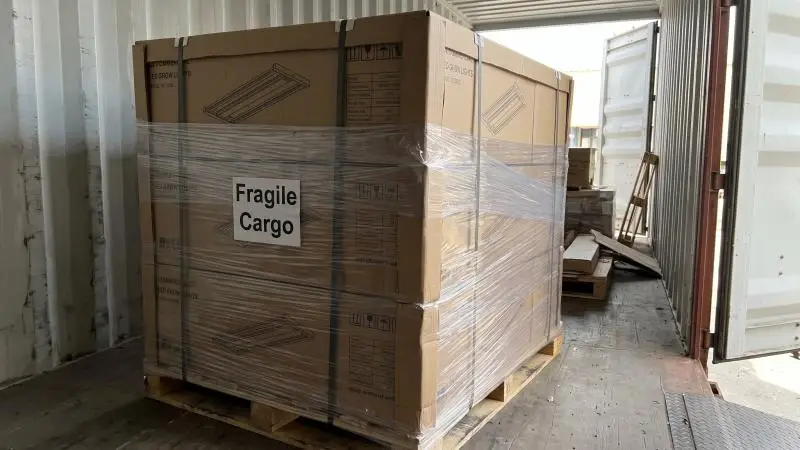
Grow lights are a difficult cargo: high volume, low weight, fragile heatsink fins, and exposed diodes. The freight cost per unit is high relative to the goods value, and the damage modes are specific. Packaging and insurance are where you control that risk.
Packaging Specification
- Individual foam or molded-pulp cradles that hold the fixture off the carton walls.
- Corner protection on the carton.
- Palletization and a container loading plan — a floor-loaded container of bulky cartons is more vulnerable than a palletized one, and the loading plan should be agreed before the container is stuffed.
- Desiccant where humidity is a risk on a long sea voyage.
Ask the factory for the packaging specification and a photo set of a packed pallet before shipment. If the factory has an existing packaging design, review it against these points rather than accepting it unexamined.
Marine Cargo Insurance
Take out your own marine cargo policy valued at CIF-plus and naming the grower as loss payee, regardless of the Incoterm. Under CIF, the seller arranges insurance, but the cover is minimum-class, and the buyer is the claimant — you want a policy you negotiated. The certificate should name the goods, the voyage, the insured value, and the loss payee, and should be in your hands before the vessel sails.
What Happens at Destination If the Documents Do Not Match the Model
The entry can clear while the goods are blocked at installation. Customs release is not the same as acceptance by an AHJ, a retailer, an insurer, or a specifier. If the nameplate on the delivered fixture does not match the model on the listing file or the certification report, the failure surfaces when an inspector, an insurer, or a project reviewer looks at the installed product — after you have paid for the goods and installed them. The failure mode to design out at inspection (Step 4) is exactly this mismatch.
The verification standard: you hold an insurance certificate, a loading photo set, and a document pack in which the model on the nameplate, the commercial invoice, the entry, and the certification report are identical.
Write Spare-Parts, Warranty and Remedy Terms Into the Contract
The commercial relationship becomes enforceable only when it is written into the contract before the deposit. A factory’s stated warranty is only as good as the entity that must honour it, so identify the contracting party precisely — the legal entity name, not a trade name or a website brand.
Spare-Parts Schedule
List the parts you will need over the life of the fixtures: driver, diode board, lens, power cord, mounting hardware. Scale the quantities to the order — a spare-driver allowance per hundred fixtures is a common starting point, but the right number depends on your redundancy requirements. Commit to an availability period after the last production run, so a fixture bought in year one is still serviceable in year five.
Warranty Terms
Specify the length, what it covers, who pays freight on a replacement, and the claim evidence you must supply. A warranty that requires you to ship a failed driver back to China at your cost is worth less than one that ships a replacement from a local warehouse. If the factory holds stock in your region, ask for that to be written into the warranty clause.
Batch Remedy Threshold
A defect-rate threshold that triggers a batch remedy — replacement, credit, or rework — rather than unit-by-unit replacement. Unit-by-unit claims on a batch with a systemic fault consume your maintenance team’s time and leave you with a mixed fleet.
Inspection and Rejection Rights
A pre-shipment inspection clause with the right to reject non-conforming goods, and a post-arrival inspection clause with a defined claim window. Tie the pre-shipment inspection to the balance payment (Step 4).
Payment Milestones
Tie payment to inspection and to bill-of-lading issuance. A deposit, a balance on a passed pre-shipment inspection, and any retention released after arrival and commissioning is a common structure. The point is that each payment is released against a document or an event you control.
Governing Law and Dispute Resolution
Name the governing law and the forum. A clause that sends every dispute to a Chinese court is enforceable but expensive to use; a clause that provides for arbitration in a neutral venue, or for your local courts, is worth negotiating before the deposit rather than after a failure.
The verification standard: the signed contract contains each of these clauses, and you can point to the clause number for each.
Common Mistakes to Avoid
Treating a DDP quote as the landed cost. A DDP price bundles duty into a single number, so the duty line disappears from your records and you lose the ability to challenge the classification. Fix: buy FOB or CIF, or require the factory to provide the entry documentation after a DDP clearance.
Accepting a certification logo without matching the model number to the report. A certificate for a series does not cover a variant that is not named on the report. Fix: request the certificate and the test report together for each model on the PO, and check the model number, ratings, and manufacturer name against the quotation and nameplate.
Assuming Chinese CCC or CNAS documents satisfy US NRTL or LM-79 requirements. There is no mutual recognition between the CCC scheme and the OSHA NRTL program, and CNAS reports to GB/T 31897 do not substitute where LM-79 evidence is specified. Fix: plan for NRTL evaluation and, where required, LM-79 testing from an appropriately accredited laboratory.
Skipping inspection before the balance payment. Once the balance is paid and the container is sealed, your leverage is gone. Fix: commission a pre-shipment inspection scoped to LED fixtures, with nameplate photos, before the balance is released.
Under-insuring or under-packing low-density fixtures. Grow lights are bulky and fragile, and a minimum-class CIF cover leaves you as the claimant on a policy you did not negotiate. Fix: specify the packaging, take out your own marine cargo policy naming you as loss payee, and photograph the loading.
What a Clean Import Looks Like
A clean import is one where the documents reconcile. Before the first container is unloaded, you should be able to confirm each of the following:
- A landed-cost model that reconciles to the entry summary, with the duty line visible and the customs value and invoice total kept separate.
- An entry filed by the named importer of record at the classification your broker confirmed, with any Section 301, anti-dumping, or countervailing layer identified.
- A certification file in which every model on the PO appears by name on a report from a laboratory whose accreditation scope covers the test, and the manufacturer named on the report matches your contracting party.
- An inspection report with pass/fail per line item and a photo set of the nameplates.
- A marine cargo insurance certificate naming the grower as loss payee.
- A contract with spares, warranty, batch-remedy, inspection, payment-milestone, and dispute-resolution clauses, each identifiable by clause number.
The next step is a repeat order or a second destination market. Either way, refresh the landed-cost model before each PO: duty rates, Section 301 coverage and trade-remedy measures change, and a model built for last year’s rate is a decision made on stale inputs. Confirm the current figures against the official sources cited in Step 1 before you sign.
FAQ
Should I Buy FOB, CIF or DDP, and Who Is the Importer of Record in Each?
Under FOB and CIF, you or your broker is the importer of record and files the entry. Under DDP, the seller is the importer of record and must be able to act in that capacity in your country. For a commercial grower, FOB or CIF is usually the better default because it keeps classification control and duty visibility with you. DDP can work if the factory has a genuine importer-of-record capability in your market and will provide the entry documentation after clearance.
How do I verify certification claims before wiring a deposit?
Request the certificate and the test report together for each model on the PO, and check the model number, ratings and manufacturer name against the quotation and the sample nameplate. For the US, confirm the NRTL listing evidence and the FCC SDoC for the exact model; for the EU and UK, confirm the conformity marking and the applicable directives. Ask for the laboratory’s accreditation scope, not just the report.
What should a pre-shipment inspection cover?
Quantity and carton count, nameplate and label accuracy including country-of-origin marking, a powered burn-in on a sample with power-draw and spectrum spot checks, driver and heatsink inspection, dimming and controller compatibility, IP-seal integrity where claimed, and a drop test on the packed carton. The inspector should photograph the nameplate of every sampled unit.
How do I handle freight damage on bulky fixtures?
Specify the packaging before shipment, take out your own marine cargo policy naming you as loss payee, and photograph the loading. If damage occurs, the claim runs on your policy, not on a minimum-class CIF cover you did not negotiate.
What spare-parts and warranty terms should I require?
A spare-parts schedule with quantities scaled to the order and a committed availability period after the last production run; a warranty that states who pays freight on a replacement; a defect-rate threshold that triggers a batch remedy; and a claim-evidence list. Identify the contracting party precisely, because the warranty is only as good as the entity that must honour it.
What happens at destination if the documents do not match the model?
The entry may clear while the goods are blocked at installation by an AHJ, a retailer or an insurer. A mismatch between the nameplate and the listing file is the failure mode to design out at inspection. Rates and rules cited in this article must be confirmed against the latest official notice for your destination before each PO.