Introduction
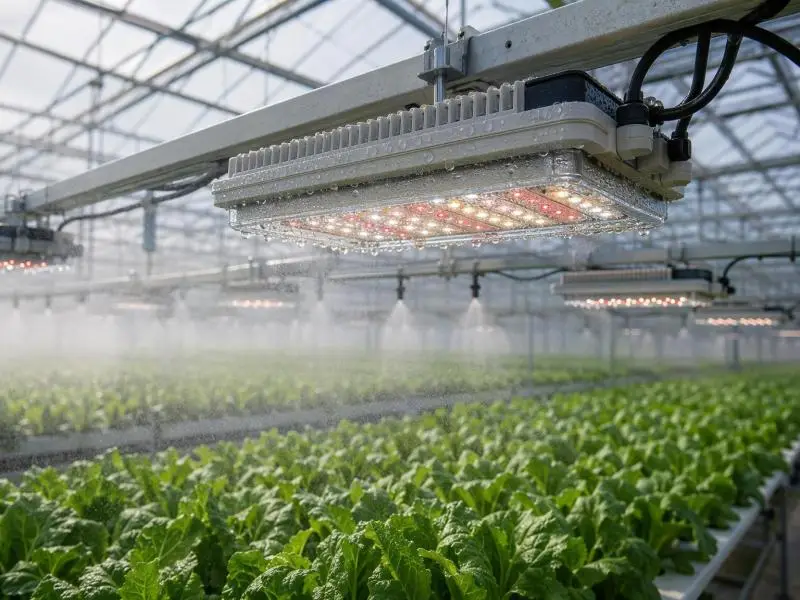
A greenhouse is one of the few places where an ingress protection rating stops being a datasheet formality. Water is not an occasional hazard there; it is the production process. Irrigation lines run above the canopy, gutters and floors get hosed between cycles, propagation benches are misted, and the air itself holds enough moisture that a fixture heating through a photoperiod and cooling at lights-off will cycle through condensation conditions thousands of times over a service life.
That is why the IP number on a grow light deserves more scrutiny than the line it occupies on a spec sheet. The common procurement reflex is to treat IP65 and IP67 as rungs on a ladder and buy the higher one. That reflex is wrong on the engineering, and it can leave a facility less protected than it thinks. IP65 and IP67 are two different tests, not two grades of the same property. A fixture can pass one and fail the other, and a fixture marked only IP67 may be the wrong choice in a room where hoses are used.
This article works through what the two ratings actually test under IEC 60529, how to map greenhouse zones to the exposure each one produces, where the rating stops once the fixture is installed, how condensation and cleaning chemistry interact with seals, and what to demand in an RFQ so the claim is verifiable rather than asserted. It is an evaluation framework built from the standard, test-lab guidance, and materials data — not a lab report on any specific fixture. For a grower running drip irrigation under standard humidity, an IP65 LED grow light is often the correct starting point. It is a starting point, not a blanket answer, and the sections below show where the answer changes.
Table of Contents
What IP65 and IP67 Actually Test — and Why the Higher Number Is Not Automatically Better
The IP code is defined in IEC 60529, Degrees of protection provided by enclosures (IP Code), maintained by IEC Technical Committee 70. The two characteristic numerals answer separate questions. The first numeral covers protection against solid foreign objects and, at the higher levels, against access to hazardous parts. The second numeral covers protection against harmful ingress of water. A rating of IP65 therefore means dust-tight plus a specific jet test; IP67 means dust-tight plus a specific immersion test.
IEC 60529 test water flow rate for the jet tests only. IPX5 and IPX6 are the same quantity under the same clause structure, so they can be plotted together; IPX7 is an immersion test with no flow rate and is deliberately excluded. Neither jet rating implies the other’s counterpart immersion rating, and vice versa.
On the solids side, the 6 numeral is the top of the scale. IP6X is a dust-tight classification, tested in a chamber with talcum powder and, for category 1 enclosures, under a controlled under-pressure of up to 2 kPa (20 mbar) so the enclosure’s internal volume is drawn through with outside air — the test-lab description of the “breathing” effect an enclosure experiences during thermal cycling. The standard’s acceptance condition for numeral 6 is no ingress of dust.
The water tests are where the confusion starts. The relevant conditions from Table 8 of the standard, as reproduced in the SANS publication of IEC 60529 and summarized by Castle Compliance, are:
- IPX5 — a 6.3 mm nozzle delivering 12.5 L/min at a distance of 2.5–3 m, applied for 1 minute per square metre with a minimum of 3 minutes.
- IPX6 — a 12.5 mm nozzle delivering 100 L/min at the same distance and duration. This is roughly eight times the flow of IPX5 and represents a genuinely more severe jet.
- IPX7 — temporary immersion, with the enclosure arranged so the lowest point sits 1 m below the water surface or the highest point 150 mm below it, whichever is deeper, for 30 minutes.
Now the point that matters for procurement. The digits up to 6 build on each other: a product rated IPX6 also satisfies IPX5 and IPX4, and the standard states that an enclosure may only carry a first-numeral rating if it also complies with all lower degrees. But 7 and 8 are a different kind of test. As SCN’s IP ratings guide puts it, surviving still water says nothing about how a product copes with a powerful jet from the side, where water pushes against seals in a completely different way. Castle Compliance states the same point directly: IP67 does not automatically cover IP66, because immersion and water jets are different ingress tests.
Dual markings such as IP65/IP67 or IP66/IP67 exist precisely because both tests had to be run. When a datasheet shows a single numeral, it is telling you which test was performed, not how the product would fare under the other.
The standard also limits its own claim in ways worth carrying into a specification. Tests are conducted with fresh water, so salt, oils, solvents, and cleaning chemistry are outside the test. The standard notes that protection may not be satisfactory where high-pressure cleaning or solvents are involved. And the manufacturer is responsible for stating which parts of the equipment the rating covers — the code classifies an enclosure, not a product family. The IEC webstore listing confirms the current consolidated edition as IEC 60529:1989+AMD1:1999+AMD2:2013 CSV.
Mapping Greenhouse Zones to Ratings
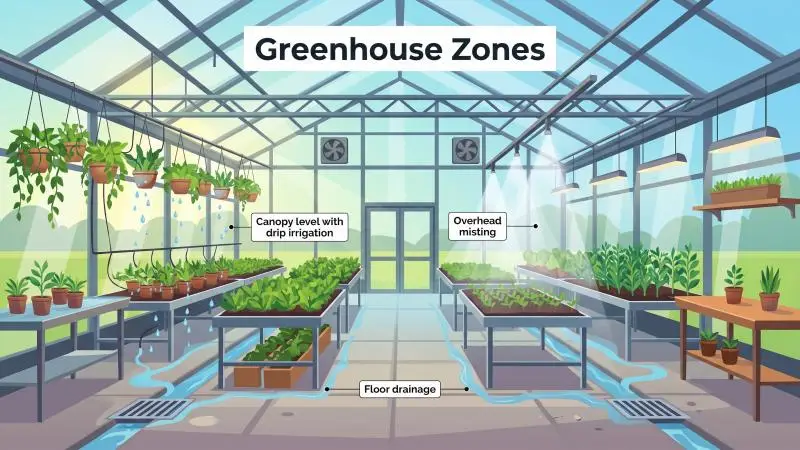
A single rating for an entire facility is almost always a compromise. The workable approach is to divide the greenhouse into zones by the dominant water exposure each one produces, then require the test that matches that exposure. The table below is a reasoning framework, not a regulatory requirement; local electrical codes and the luminaire’s own product standard apply alongside it.
| Zone | Dominant water exposure | Test to require | Rating that does not substitute |
|---|---|---|---|
| Canopy-level fixtures, drip irrigation, normal humidity | Humidity, incidental splash, condensation cycling | IPX5 (within IP65) | — |
| Overhead irrigation, fogging or misting, hose-down of floors and gutters | Directed spray and jets | IPX6 (IP66) | IPX7 alone |
| Low-mounted fixtures, bench edges, drainage paths | Standing water, puddles | IPX7 | IPX6 alone |
| Propagation and deliberate washdown areas | Sustained hose and wand spray | IPX6, or IPX9K if high-pressure hot washdown is used | IPX7 alone |
The logic behind each row is straightforward once the tests are separated. Canopy fixtures in a drip-irrigated house see humidity and the occasional splash from a line or a foliar spray; they do not see a directed jet, and they are not sitting in water. IP65 covers that combination, which is why it is the common specification for overhead greenhouse lighting.
Zones with overhead irrigation, fogging or routine hose-down invert the priority. Here the water arrives with velocity and volume, pushing laterally against lens seals and cable entries. That is the IPX6 condition. A fixture rated IP67 but not IP66 has demonstrated it survives being submerged; it has demonstrated nothing about surviving a hose, and the seal geometry that resists static pressure is not the same as the geometry that resists a jet.
Low-mounted positions — bench edges, fixtures near floor drains, anything in a drainage path — introduce the condition IPX7 addresses. Water can pool around or against the housing, and the relevant question becomes whether the enclosure tolerates temporary immersion. A jet rating does not answer that question.
Washdown areas combine the two: equipment is deliberately hosed, and runoff can pool. These zones usually need dual marking, and where the cleaning regime uses high-pressure, high-temperature equipment, IPX9K enters the conversation — a separate and more severe test discussed below.
One more layer sits alongside the IP code. In North America, horticultural luminaires must be rated suitable for wet environments under ANSI/UL 1598/CSA C22.2 No. 250.0, and ANSI/CAN/UL 8800 adds requirements specific to horticultural use, including UV exposure for polymeric enclosures and components. The IP code and the wet-location rating are different qualifications, and a fixture needs both to be suitable for a greenhouse. Temperature testing is also conducted at the anticipated ambient rating rather than the 25 °C used for general LED luminaires, which matters in a hot house.
Where an IP65 Rating Stops: Connectors, Glands, Drivers and Seals
Everything above describes the enclosure as tested. The installation is a separate assembly, and it can be weaker than the fixture.
The clearest example is the connector. An IP67 sensor or fixture holds that rating only when its connector is mated or capped and correctly tightened. As SCN’s guide states, an M12 connector that is not tightened, or a cable with the wrong gland, lowers the rating of the whole installation. The fixture’s test report does not travel down the cable with the installer.
Cable entries follow the same logic. A gland of the wrong size, a gland that was never torqued, or a cable jacket that does not match the gland’s sealing range all create a path the original test never exercised. Test-lab guidance is explicit that the sample submitted for IP testing is assembled exactly as it will ship, with all covers, glands, and connectors fitted — which means any deviation at installation is outside the tested configuration.
Drivers mounted remotely or in a separate compartment carry their own enclosure rating. If the driver sits in a remote box, that box needs its own protection appropriate to where it is mounted, and the interconnecting cable and its entries need the same attention as the fixture. A fixture datasheet that quotes one IP number for the luminaire does not automatically cover a remotely mounted driver.
Gaskets are the fourth weak point. A gasket compressed unevenly, pinched during assembly, or degraded by UV and chemical exposure loses its seal. The E-Abel enclosure guidance makes the maintenance point directly: gasket surfaces should be clean and undamaged, latches and fasteners secure, cable entries not loosened, temporary openings sealed, and damaged or permanently compressed gaskets replaced with suitable parts.
The practical check is a walk of the installed fixture, not a reread of the datasheet. Every cable entry, joint, accessory, and field-cut opening is part of the water path. Unused openings must be closed with suitable plugs, and an accessory should not be assumed suitable simply because it fits the opening — it needs to be documented for the required rating and installation method.
Condensation Inside a Sealed Fixture — and What Vents Do About It
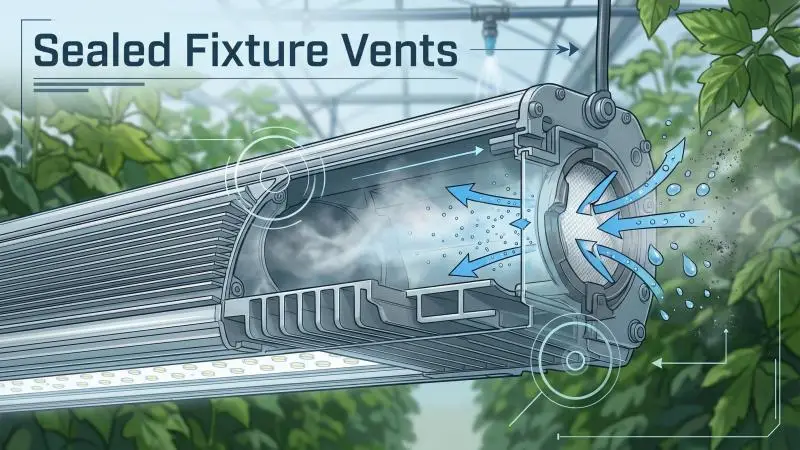
A sealed luminaire in a greenhouse lives through a pressure cycle every day. During the photoperiod, the housing heats and the internal air expands; at lights-off, or when a cold irrigation cycle drops the ambient temperature, it contracts. Without a vent, that pressure differential loads the seals repeatedly. GORE’s pressure-relief guidance describes the mechanism plainly: pressure differentials from rapidly changing temperatures stress seals repeatedly until they fail, after which further imbalances can draw contaminants and liquids into the housing.
The second problem is trapped moisture. Even a well-sealed enclosure can hold moisture from ambient humidity at assembly, from condensation, or from outgassing of internal materials. Rogers Corporation’s vent design guidance notes that over time this trapped moisture can fog lenses, corrode electronics, or degrade adhesives — all of which are failure modes in an optical chamber.
Pressure-equalization vents address both. An ePTFE membrane passes air and water vapour while blocking liquid water, dust and contaminants, so the housing breathes in both directions and the pressure equalizes before it can stress the seals. GORE reports that this bidirectional flow can also reduce the frequency and severity of condensation, and that its vents are tested to temperature-cycling standards including IEC 60068-2-14 across ranges such as −40 °C to 125 °C depending on series.
The scope limit matters as much as the benefit. A vent is a pressure-relief and condensation-management feature, not a substitute for the enclosure’s IP rating. H-O Products states the distinction precisely: the membrane does not have an IP rating; the enclosure does. A vent supplier can describe a membrane as supporting an IP-rated enclosure design, but the assembled enclosure is what passes the ingress test. A datasheet that presents a vent as conferring IP67 should be read with that in mind.
For growers, the design question is which chamber is vented. A fully potted, vented driver compartment and a vented optical chamber are different engineering choices with different implications for serviceability and condensation control. The datasheet should say which is used, and whether the driver is potted, vented, or both.
Do Cleaning Chemicals Degrade the Seals That Provide the Rating?
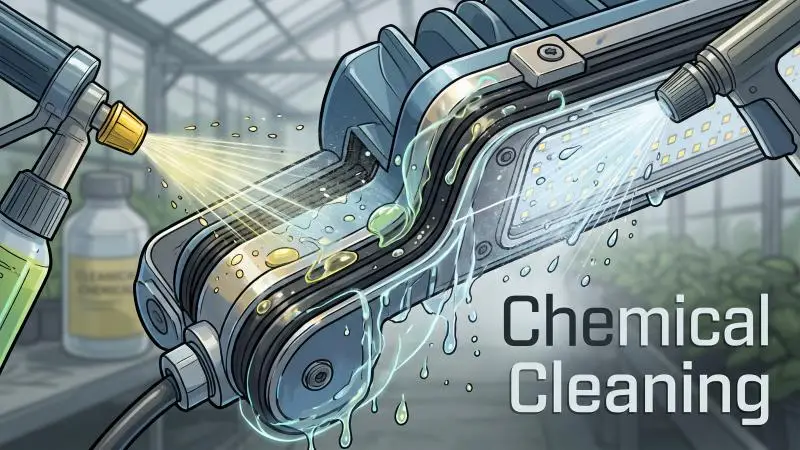
IEC 60529 tests with fresh water. Greenhouse cleaning does not use fresh water. Hypochlorite, peroxides, acids, and alkaline cleaners all contact gaskets, lens seals, and cable glands, and the standard itself warns that high-pressure and/or solvent cleaning may reduce the protection actually achieved.
The variable the operator can control is seal material. Rubber Xperts’ gasket compatibility summary gives a usable comparison across the common elastomers:
| Material | Acids | Bases | Oils & fuels | Water & steam |
|---|---|---|---|---|
| EPDM | Good | Excellent | Poor | Excellent |
| Silicone | Fair | Fair | Poor to fair | Excellent |
| FKM (Viton) | Good | Fair to good | Excellent | Fair |
| PTFE | Excellent | Excellent | Excellent | Excellent |
| FFKM (Kalrez) | Excellent | Excellent | Excellent | Excellent |
The pattern is clear enough to guide a specification. EPDM performs well in water, steam, and many aqueous chemicals but poorly in oils and fuels, which makes it a sensible default for a wet greenhouse environment where the cleaning agents are aqueous. Silicone handles water and a wide temperature range but is only fair against many chemicals. FKM is strong in oils and only fair in water and steam — the wrong priority for a washdown house. PTFE and FFKM are broadly resistant but cost more, which is a real constraint across a large fixture count.
Two cautions belong with the table. Compatibility data is guidance at stated temperatures and concentrations, and materials that resist a chemical individually may behave differently in combination. The Victaulic gasket guide, for example, notes that gaskets may be affected by combinations of chemicals where the chemicals acting individually may not react, and that its ratings assume roughly 22.8 °C ambient and 100% concentration unless stated otherwise. A greenhouse cleaning protocol rarely matches those assumptions.
The practical rule is to match gasket material to the actual cleaning protocol, confirm the pairing with the fixture supplier, and avoid directing high-pressure spray at seals and glands regardless of the rating. The rating tells you what the enclosure survived in a lab; the cleaning protocol tells you what it will survive in your house.
When IP66, Not IP67, Is the Right Answer for Washdown
This is the most common greenhouse misapplication, and it is worth stating as a rule. If the exposure is directed spray from hoses, booms or washdown wands, the relevant test is IPX6 — a 12.5 mm nozzle at 100 L/min from 2.5–3 m for at least 3 minutes. IPX7 immersion does not demonstrate that resistance. A fixture marked only IP67 that will be hosed should be specified as IP66 as well, which in practice means dual marking.
The converse also holds. Where fixtures sit in puddles or in low drainage paths, IPX7 addresses a condition IPX6 does not. A jet rating says nothing about whether the enclosure tolerates being partly submerged for 30 minutes.
The decision rule is therefore short:
- Spray or washdown → require IPX6, or IPX5 for lighter spray only.
- Standing water or immersion risk → require IPX7.
- Both exposures → require dual marking, such as IP66/IP67.
IPX9K sits above this framework and should be invoked only when the facility’s cleaning regime actually uses the equipment it describes. The test applies high-temperature water — around 80 °C in the test-lab summary — at high pressure from close range, and it is a separate, more severe condition aimed at food, pharmaceutical and vehicle-washing environments. A greenhouse that hoses floors with a standard wand does not need IPX9K. A facility that brings in a high-pressure hot-water washer should be having a different conversation, one that includes seal material compatibility as well as the rating.
Specifying and Verifying the Rating: What to Demand in an RFQ
The analysis above converts into procurement language fairly directly. What follows is what to ask for, and why each item matters.
Request the test report, not the datasheet claim. IEC 60529 defines a test, not a certification scheme; what exists is a report from an accredited laboratory on the basis of which the manufacturer declares the rating. Instacertify’s testing explainer notes that any ISO/IEC 17025 accredited laboratory can perform IP testing to IEC 60529 and issue a valid report, and that the report is what a buyer, tender authority or notified body wants to see. Ask for the laboratory name, the standard and edition, and the exact numerals tested.
Confirm the enclosure boundaries. The standard places responsibility on the manufacturer to state which parts of the equipment the rating covers. A report covering the optical chamber does not cover a remote driver box. Ask explicitly whether the rating applies to the complete luminaire as installed, including cable entries and connectors.
Confirm connector and gland ratings when mated. The installation is only as good as its weakest entry point. Ask what connector series is supplied, what its rating is when mated and capped, and what gland range suits the cable specified.
Ask for the seal material and its chemical compatibility. Name the cleaning agents your facility actually uses and ask the supplier to confirm the gasket compound against them. A general statement that the fixture is “chemical resistant” is not an answer.
Ask how the driver is protected. Separately rated compartment, remote mount, or potting — and if a vent is fitted, which chamber it serves and what membrane is used.
Ask for the wet-location rating. Confirm the luminaire’s wet location rating under ANSI/UL 1598 and its compliance with ANSI/CAN/UL 8800 for horticultural use. The IP code does not substitute for either.
Sample RFQ wording: Provide the IEC 60529 test report for the complete luminaire, stating the IP numerals tested, the test laboratory, and the enclosure boundaries covered; confirm connector and gland ratings when mated; state gasket material and chemical compatibility with [list cleaning agents]; confirm the driver enclosure rating and whether a pressure-equalization vent is fitted; and provide the luminaire’s wet-location rating under ANSI/UL 1598 and its ANSI/CAN/UL 8800 compliance.
Acceptance checklist:
- Test report from an accredited lab, naming IEC 60529 and the numerals tested.
- Written statement of the enclosure boundaries covered.
- Connector and gland ratings confirmed for the mated configuration.
- Gasket material named, with compatibility confirmed against the facility’s cleaning agents.
- Driver enclosure rating stated, remote or integral.
- Vent specification, if fitted, with the chamber it serves.
- Wet-location rating and UL 8800 compliance documented.
Suppliers with established certification programs and export experience can usually produce this documentation without a long back-and-forth. SLTMAKS, for example, holds ETL, CE and RoHS certifications and stocks finished grow lights in warehouses in New York, California and Oklahoma as well as in Canada and Germany, which shortens the path from specification to delivered fixture. That is a logistics and documentation point, not a substitute for reviewing the test report against your own exposure profile.
Who Should Specify Which Rating
The zone framework resolves into a short set of conditional recommendations.
Drip irrigation and standard humidity. IP65 LED grow lights are commonly adequate, provided connectors and glands are correctly installed and the fixture carries the appropriate wet-location rating. The exposure is humidity, incidental splash and condensation cycling, and IP65 covers the water condition. The remaining risks are installation quality and condensation management, not the numeral.
Overhead irrigation, fogging or routine hose-down of floors and gutters. Require IPX6 jet resistance, ideally as dual-marked IP66/IP67 so the fixture is qualified for both spray and any standing water. A single IP67 marking is not sufficient here.
Low-mounted or puddle-prone positions. Add IPX7 to whatever jet rating the zone requires. These positions see a condition the jet test does not reproduce.
Aggressive chemical cleaning. Match seal material first, then rating. An EPDM or PTFE seal in an IP65 fixture may outperform a poorly matched seal in a higher-rated one, because the rating was established with fresh water and the cleaning agent is what actually contacts the gasket.
High-pressure, high-temperature washdown. This calls for IPX9K plus a material compatibility review — a different specification entirely, and one that should be scoped with the cleaning equipment in hand rather than assumed.
FAQ
Is IP67 better than IP65 for greenhouse lighting?
No. They test different things. IP67 adds immersion resistance but does not demonstrate jet resistance, while IP65 includes a 6.3 mm jet test. The right choice depends on whether the fixture sees spray, standing water, or both.
Can an IP65 LED grow light handle a greenhouse with high humidity?
Humidity alone is generally within the scope of a properly sealed, wet-location-rated fixture. Condensation from thermal cycling is a separate design issue addressed by venting and potting, not by the IP numeral. Confirm the fixture’s condensation management and installation details.
Can I hose down IP67 fixtures?
Not on the strength of the IP67 marking alone. IPX7 is an immersion test; hose-down requires IPX6, or IPX5 for lighter spray. Specify dual marking if both exposures exist.
Do I need IP66 or IP67 if my greenhouse only uses drip irrigation?
Usually not for the fixture body. IP65 is commonly sufficient where exposure is humidity and incidental splash. The weak points are connectors, glands and any low-mounted positions — inspect those rather than upgrading the whole fixture.
Does the IP rating cover the connector and cable entry?
Only if they are part of the tested enclosure and correctly mated. An untightened connector or wrong gland can lower the installed assembly’s protection below the fixture’s rating.
Verdict: Rating Follows Exposure, Not the Number
| Exposure | Required test | Rating to specify | Common mistake |
|---|---|---|---|
| Humidity, splash, condensation | IPX5 | IP65 | Assuming IP67 is a safe upgrade |
| Directed spray, hose-down | IPX6 | IP66, or IP66/IP67 if water can pool | Buying IP67 alone and hosing it |
| Standing water, puddles | IPX7 | IP67, dual-marked with the jet rating | Assuming IP66 covers immersion |
| High-pressure hot washdown | IPX9K | IPX9K plus material review | Applying a standard rating to a food-grade cleaning regime |
The decision rule is the same in every row: map the greenhouse zone, require the test that matches the dominant water exposure, verify the complete installed assembly and seal materials, and demand the test report. IP65 and IP67 are parallel qualifications, not a ranking. The IP code is one input alongside the luminaire’s wet-location product standard and the facility’s cleaning regime, and it is the interaction between all three that determines whether a fixture lasts a decade or a season.
If you want a second opinion on your specification, share your greenhouse exposure profile and cleaning protocol — zone by zone, with the agents and equipment used — and we can work through which rating each position actually requires.