Introduction
The goal is straightforward: select an ingress protection level that matches your sanitation method and risk, then document it in a way an inspector will accept. That is the practical core of specifying IP rating commercial grow lights.
In a commercial indoor grow, ingress protection is not a spec-sheet nice-to-have. It shows up later as uptime, safety, and total cost of ownership (TCO): fewer nuisance trips, fewer corroded connectors, fewer driver replacements, and less time spent troubleshooting fixtures after sanitation days.
The catch is that “water exposure” isn’t one thing. Some facilities mostly fight humidity swings and condensation. Others do routine washdown with hoses, foaming chemistry, and strict hygiene cycles. Those realities should drive how you specify IP rating commercial grow lights, just like PPFD maps and controls do. When that phrase sounds abstract, read it as a simple question: can your fixtures take the cleaning and moisture exposure your team actually creates?
What you’ll learn here: what IP65, IP66, and IP67 tests actually cover under IEC 60529; how that intersects with U.S. compliance expectations (UL, NEC, AHJ); and a practical way to match ratings to real grow-room scenarios so you’re not paying for protection you won’t use.
Table of Contents
IP Rating Commercial Grow Lights: IP65/66/67 Explained
IP Code Structure and IEC 60529 Scope
IP ratings come from IEC 60529, a standard that classifies how well an enclosure resists the ingress of solids (including dust) and water.
The IP code uses two digits:
- The first digit covers solids and dust.
- The second digit covers water.
For commercial grow environments, you’ll commonly see ratings that start with “6” because 6 means dust-tight. And the standard’s scope covers enclosures for electrical equipment up to a rated voltage of 72.5 kV (well beyond typical luminaires and drivers). For a direct scope reference, see NEMA’s “ANSI/IEC 60529-2020 contents and scope” PDF.
If you need a quick reminder of how the second digit is interpreted in plain language (5 vs 6 vs 7), ANSI’s explainer on “IEC 60529 IP Code Rating Water Protection” is a clear overview.
IP65 and IP66: Water-Jet Test Parameters and Dust-Tight Rating
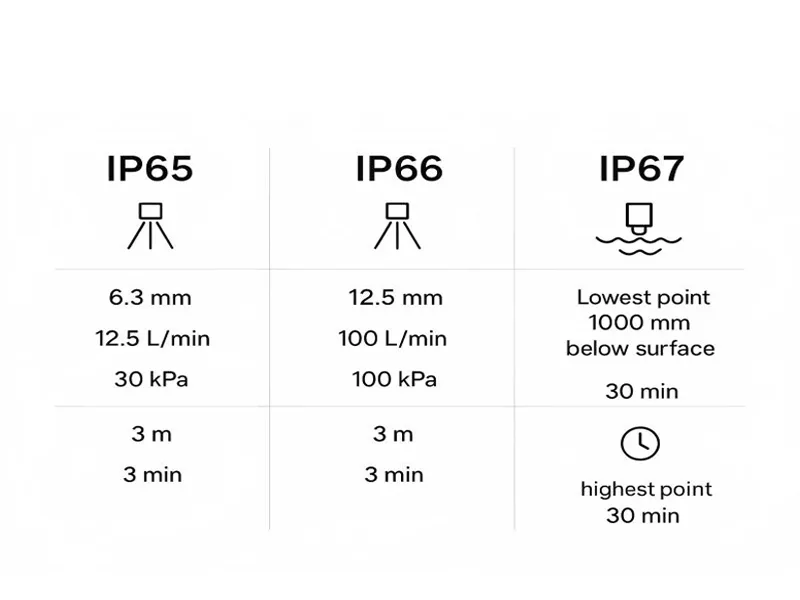
Both IP65 and IP66 are dust-tight. The decision point is how severe the water-jet test is.
- IP65 is typically described as protection against water jets.
- IP66 is typically described as protection against powerful water jets.
IEC 60529 is paywalled in many places, but the commonly cited parameters for these tests (nozzle size, flow rate, pressure, duration, distance) are widely repeated. A single public table that lays out IPX5/IPX6/IPX7 conditions is available in the IEC 60529 IP code test table excerpt. That table is also useful because it shows you the main distinction at a glance: IP66 increases the jet severity materially compared to IP65.
In grow rooms, the practical meaning is simple: IP66 gives you more margin when cleaning behavior drifts from “light rinse” into “someone aimed a hose at it,” or when aerosols and splash patterns are more aggressive than the original SOP assumed.
IP67: Temporary Immersion Parameters and Applicability
IP67 keeps the dust-tight requirement and shifts the water test to temporary immersion under defined conditions.
The key point for specifiers: IP67 is not about daily hose spray. It’s about survivability when water accumulates. Think flood events, drain backups, low-mounted zones where standing water is plausible, or handling/maintenance scenarios where fixtures could be temporarily submerged.
In other words, IP67 rating immersion is a different risk class than IP66 hose-down tolerance.
U.S. Compliance Essentials
UL 8800 and Wet/Damp Location Markings
In the U.S., IP ratings help you reason about environmental exposure, but they don’t replace safety listing and location suitability.
UL 8800 horticultural lighting is the safety standard built for plant-growth environments, and UL highlights environmental considerations like moisture and water exposure as part of horticultural lighting evaluation. A good starting point is UL Solutions’ horticultural lighting services overview.
Separately, your luminaire should be appropriately listed and marked for where it’s installed (for example, damp locations). That marking is what inspectors and installers can verify quickly when they need a yes/no answer in the field.
⚠️ Warning: Treat “IP66” as an environmental test classification, not as proof a luminaire is acceptable for a wet location installation. For U.S. projects, you still want the correct listing and “wet/damp” suitability markings for the installation environment.
NEC/AHJ Expectations and Documentation
AHJs care about evidence they can audit. The field-level questions are usually straightforward:
- Is the luminaire listed and labeled for the intended location?
- Do the installation instructions match how it’s actually mounted and wired?
- Is the system installed so that water cannot enter or accumulate in electrical compartments?
A concise NEC-aligned statement often used in spec discussions is that luminaires in wet locations should be installed so water cannot enter or accumulate in wiring compartments, lampholders, or other electrical parts.
If you want to be “inspection-ready,” the documentation bundle matters as much as the fixture itself:
- Cut sheet showing the exact model number and environmental suitability markings
- Installation instructions (mounting orientation, connector mating, cable entry requirements)
- Maintenance guidance that matches your sanitation SOP
DLC Horticultural QPL Context and Limits
The DesignLights Consortium (DLC) Horticultural Qualified Products List (QPL) is a performance-qualification list widely used in energy-efficiency programs and incentives. The DLC fact sheet describes the QPL program and its purpose, and the lookup entry point is the DLC QPL page.
Two limits to keep straight:
- DLC QPL is not a safety listing.
- QPL listing is model- and configuration-specific.
Map Ratings to Grow Scenarios
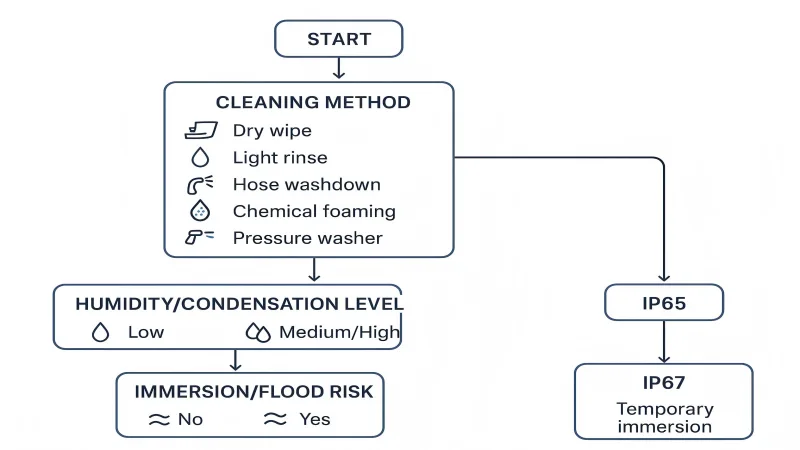
Humidity and Light Rinse: When IP65 is Sufficient
IP65 is often sufficient when the primary exposure is:
- High humidity and condensation cycles
- Occasional light misting or light rinse during surface cleaning
- Aerosolized nutrients or foliar spray drift that does not involve direct hosing
In these rooms, the failures you’re trying to avoid usually aren’t “flooding.” They’re slow ingress at interfaces and seams over time.
IP65 can be a rational choice when your sanitation program is disciplined: cleaning is done with controlled damp wiping, liquids are applied to cloths (not sprayed at the fixture), and connectors are protected from direct wetting.
Routine Washdown and Hose Spray: Why IP66 is Safer
Once hose spray is part of normal operations, the risk profile changes. Water finds the weak points: connector mating surfaces, cable glands, endcaps, and any seam that depends on perfect torque or perfect gasket compression.
IP66 gives you stronger tolerance for water jets than IP65, which tends to match real-world washdown variance better. People change shifts, hoses get swapped, spray angles change, and “don’t spray the fixtures” doesn’t always survive a busy sanitation day.
This is also where construction details matter as much as the headline IP number:
- Connector systems with positive engagement and intact O-rings
- Cable glands that don’t loosen under vibration and thermal cycling
- Gaskets that hold up to repeated exposure to cleaning chemistry
- Corrosion-resistant fasteners and coatings in humid, chemical-rich air
In SLTMAKS’ field practice, the most reliable washdown outcomes come from treating sealing and interfaces as the system—not just the housing. That shows up in how teams manage connector mating discipline, cap unused ports, and avoid cleaning methods that force water past seals. Their practical SOP-style guidance in How to Safely Clean Commercial LED Grow Lights lines up with what maintenance teams see: moisture issues usually start at interfaces.
Pro Tip: If your spec calls for IP66, also specify that the connectors and cable entry points must meet the same rating when mated and installed per instructions. A high-IP housing with a low-IP connector is still a low-IP system.
Submersion or Flood Risk Zones: When IP67 is Warranted
IP67 is warranted in situations like:
- Low-mounted fixtures in areas where standing water is possible
- Drain backups, sump failures, or flood events that have happened before
- Washdown designs that can create pooling above fixture level
- Fixtures stored, transported, or serviced in ways that risk short-term immersion
IP67 is still not a free pass. Immersion tests are defined conditions, and they don’t guarantee chemical resistance, long-term water exposure, or the survivability of every connector a field install might add.
Beyond IP: Construction and Materials
Drivers, Connectors, and Cable Glands: Matching IP at Interfaces
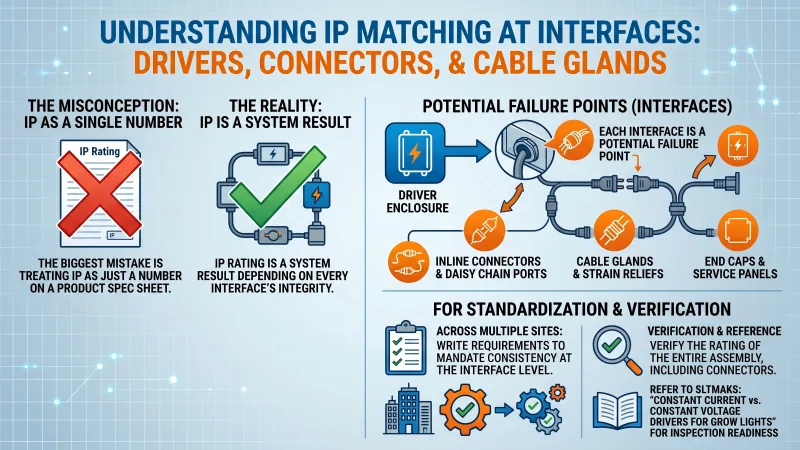
The biggest spec mistake is treating IP as a single number on a cut sheet. In reality, it’s a system outcome, and every interface is a potential failure point:
- Driver enclosures and their cable exits
- In-line connectors and daisy-chain ports
- Cable glands and strain relief
- Endcaps and service panels
If you’re standardizing across multiple sites, write requirements that force consistency at the interface level. For a driver-and-documentation-oriented view of inspection readiness (and a reminder to verify rating for the full assembly, including connectors).
Lenses, Gaskets, and Fasteners: Chemical and Corrosion Resistance
IP tests measure ingress under defined conditions. They do not tell you whether your lens yellows from sanitizers, whether a gasket swells, or whether fasteners pit and seize after months of exposure.
In commercial sanitation programs, you’ll often see quats, peroxide-based disinfectants, foaming cleaners, and repeated wet/dry cycles in nutrient-rich aerosols. That environment demands material choices that are compatible with the chemical stack.
Ask for:
- Gasket material type (and any compatibility guidance)
- Fastener material and corrosion protection
- Lens material and cleaning limitations
Also, avoid practices that defeat even good hardware. A common reliability killer is pressure washing, which can force water past seals and into connectors even when the fixture is marketed as water resistant.
Thermal Design and Lifetime at Real Ambient
Moisture problems rarely show up alone. Heat accelerates them.
A grow room with elevated ambient temperature and high humidity is hard on drivers, potting compounds, and gasket materials. When you evaluate fixtures for an IP level, also look for evidence that the thermal design holds up under your true ambient conditions, not only a lab baseline.
Deployment and ROI
Procurement/Spec Checklist for Multi-site Operations
For multi-site operators, the fastest path to reliability is a spec that is easy to audit and hard to misinterpret. A practical checklist:
- Required IP rating by room type (washdown frequency and method)
- Required wet/damp suitability markings and listing documentation package (what you’d expect for wet location rated grow lights)
- Interface requirements: connectors and cable entry protection matching the fixture rating
- Approved cleaning chemistry and prohibited methods (pressure washing, direct spraying)
- Documentation required per SKU: cut sheet, installation instructions, maintenance guidance
If you want a broader buying framework that includes safety and documentation topics, SLTMAKS’ Best LED Grow Light: Key Features, Specs, and Buying Checklist is a good reference point.
Installation and PM Program to Minimize Downtime
An IP rating won’t save a poor install. The common field failures are simple:
- Connectors not fully seated
- Unused ports left uncapped
- Cable glands not torqued to spec
- Mounting orientation that allows pooling where it shouldn’t occur
Bake IP protection into preventive maintenance: visual checks on connectors and glands, inspections after sanitation cycles, and lockout/tagout (LOTO) procedures before any cleaning.
Modeling Payback with Reliability and Maintenance Deltas
If you’re deciding between IP65 and IP66 across dozens or hundreds of fixtures, the ROI discussion is usually not about the fixture price delta. It’s about avoiding events:
- Maintenance labor (minutes per fixture add up quickly at scale)
- Downtime risk (lost yield opportunities, delayed cycles)
- Replacement cadence (connectors, drivers, entire fixtures)
A simple way to model payback:
- Estimate how many wet cleaning events occur per year per room.
- Estimate the probability of a moisture-related fault per event (even if it’s a rough range).
- Assign a cost per fault: labor + parts + operational impact.
- Compare the expected annual cost between IP65 and IP66 assumptions.
Even conservative assumptions can justify the more protective rating in rooms where hoses are used routinely.
SLTMAKS’s engineering team can quickly provide professional advice to guide you in selecting the most suitable IP rating for the grow lights used in your cultivation project.
Conclusion
Choose IP ratings based on your sanitation method and your tolerance for downtime risk, not on the highest number you can buy. IP65 can be sensible for humidity and requires controlled wipe-down. IP66 is usually the safer choice when hose spray is part of normal operations. IP67 fits edge cases where standing water or temporary immersion is plausible.
For U.S. projects, don’t stop at ingress ratings. Confirm UL 8800 context and wet/damp suitability markings, and bring AHJ-ready evidence to the table early: listing documentation, installation instructions, and a maintenance plan that matches how your rooms are actually cleaned.
FAQ
What does IP65 mean for commercial grow lights?
IP65 means the fixture is dust-tight (6) and protected against water jets (5), making it suitable for humid rooms and light rinsing when fixtures aren’t directly hosed.
What’s the difference between IP65 and IP66 grow lights?
Both are dust-tight, but IP66 withstands more powerful water jets than IP65. IP66 is the safer choice for rooms with routine washdown or accidental direct spray.
Does IP67 mean a grow light is better than IP66 for washdown?
Not necessarily. IP67 focuses on temporary immersion, while IP66 focuses on jet spray. For frequent hose-down cleaning, IP66 is usually more relevant.
Are IP ratings enough for U.S. code compliance in grow rooms?
No. IP ratings describe ingress testing, but U.S. projects still need proper safety listing/labeling and wet/damp location suitability that inspectors can verify.
Can a grow light be “IP66” but still fail in a wet grow room?
Yes. The system is only as strong as its weakest point—connectors, cable glands, endcaps, and unused ports must match the protection level when properly installed and mated.
When should I choose IP65 vs IP66 vs IP67 in a commercial grow?
Choose IP65 for humidity/condensation and controlled wipe-down or light rinse, IP66 for routine washdown and hose spray, and IP67 where standing water or temporary immersion risk is realistic (e.g., flood-prone zones).