Introduction
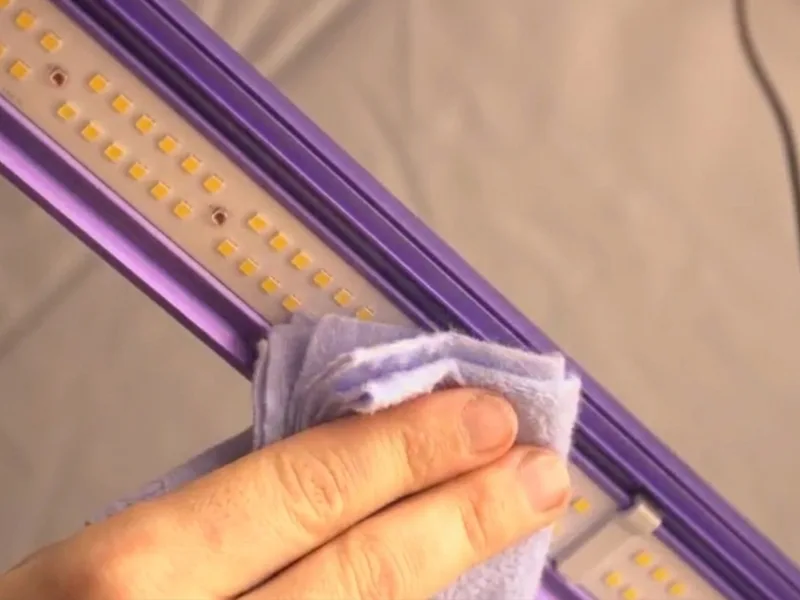
If you’re trying to safely clean commercial LED grow lights (without turning a maintenance day into a failure investigation), the goal isn’t just “make it look new.” It’s to recover PPFD (photosynthetic photon flux density), improve canopy uniformity, and protect long-term reliability.
Dust films, fertilizer aerosols, and sticky residues don’t just block photons—they can shift distribution patterns, create hot spots on optics, and raise operating temperatures over time. In a multi-room facility, it becomes a yield-consistency problem and a scheduling problem.
The catch: LED fixtures are less forgiving than they look. Common “wipe it down” habits can trigger diode damage from electrostatic discharge (ESD), permanently haze lenses with micro-scratches, push liquid into connectors or drivers, and create exactly the kind of evidence that leads to warranty friction.
For commercial facilities, the right approach is a gated LED grow light cleaning SOP anchored to recognized controls:
- OSHA lockout/tagout (LOTO) for hazardous energy control.
- IEC ingress protection (IP) ratings to decide what cleaning methods are permissible.
- UL horticultural construction expectations—UL Solutions notes safety certification commonly uses UL 8800, the Standard for Horticultural Lighting Equipment and Systems
Table of Contents
Safety Prep
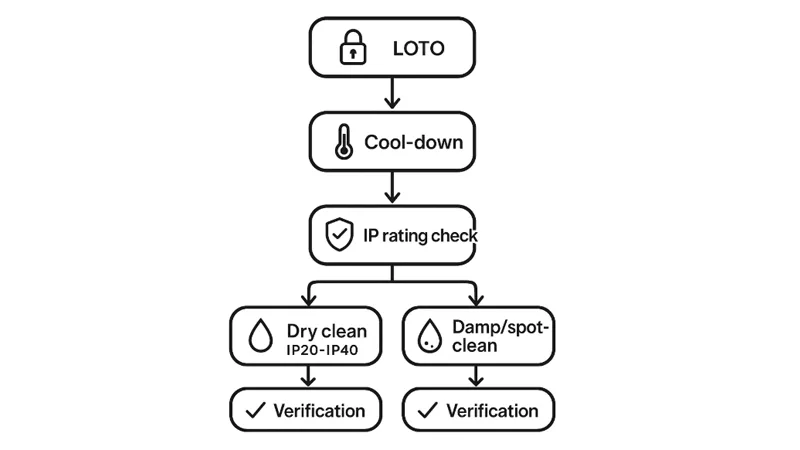
Lockout/Tagout and Cool-down
Treat cleaning like electrical maintenance—not housekeeping—especially when you’re cleaning overhead equipment in active production areas.
- Notify affected personnel (cultivation, facilities, controls) that lighting will be de-energized.
- Shut down and isolate power using your facility’s written energy control procedure.
- Apply LOTO devices at the energy-isolating device(s), not just at a local switch.
- Verify de-energization before touching any fixture wiring or opening any access points.
OSHA’s hazardous energy standard requires documented procedures and explicit steps for shutdown/isolation, device placement and removal responsibilities, and verification—see 29 CFR 1910.147.
Then allow a full cool-down. Even if a fixture is electrically safe, cleaning a warm lens or heat sink invites streaking, rapid solvent evaporation, and thermal shock in some plastics.
⚠️ Warning: Never spray anything onto an energized fixture. De-energize, lock out, verify, and cool down first.
ESD Controls and Handling Zones
LEDs and driver electronics can be ESD-sensitive. If you want to know how to clean LED grow lights without damaging diodes, start here—not with the cloth.
- ESD-safe work zone: designate a staging area for tools and cleaned parts.
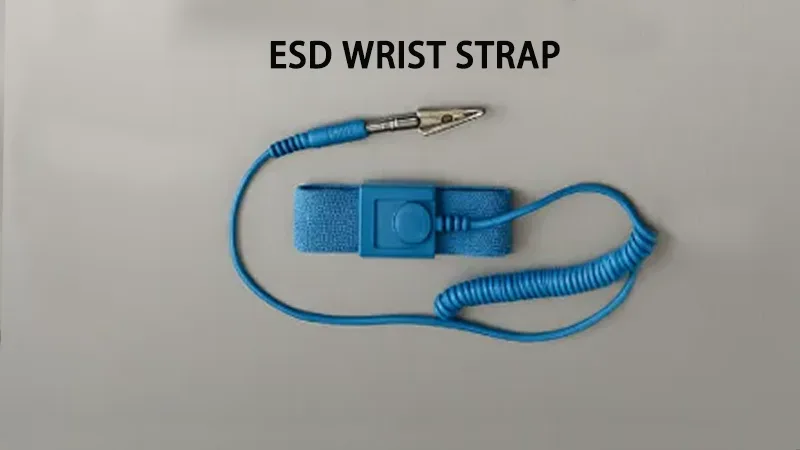
- Grounding: Use an ESD wrist strap where practical; ensure it’s attached to a verified ground.
- Handling discipline: avoid touching diode boards, exposed contacts, and driver enclosures unless the manufacturer’s procedure explicitly allows access.
- Material control: keep plastic bags, dry paper towels, and other static-prone materials away from open electrical areas.
PPE and Access Equipment
Minimum PPE and access controls should match your site’s EHS policy and the task’s risk profile:
- Nitrile gloves (clean, powder-free) to prevent oils from transferring onto optics.
- Eye protection when using compressed air.
- Non-slip footwear and stable access equipment (lifts, platforms, fall protection where required).
- Two-person rule for lifts or overhead work where your policy requires it.
Approved Tools and Agents
IP Rating Check and Material Compatibility
Before you choose a cleaning method, confirm the fixture’s IP rating on the nameplate or manufacturer documentation. This is the “gate” that prevents accidental liquid ingress.
- First digit (solids): dust protection.
- Second digit (water): water ingress protection.
For plain-language interpretation, the IEC 60529 IP code is commonly summarized as:
- IP65: dust-tight (6) and protected against water jets (5).
- IP67: dust-tight (6) and protected against temporary immersion (7).
Reference background: IP code (Ingress Protection) structure under IEC 60529.
Also, check material compatibility:
- Lens material (polycarbonate vs. glass)
- Housing coatings (powder coat, anodized aluminum)
- Seal materials (silicone, EPDM)
If you can’t confirm compatibility, default to the least aggressive method and spot-test in an inconspicuous area.
Allowed Tools and Solvents
Use tools and agents that reduce mechanical abrasion and control liquid exposure:
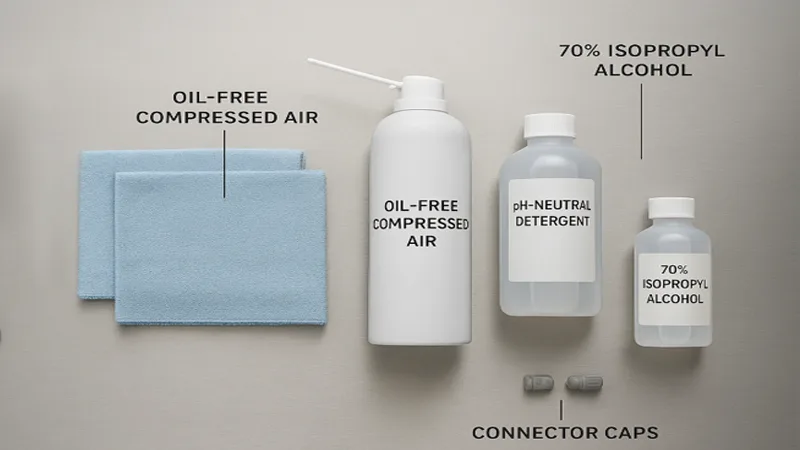
- Microfiber cloths (clean, lint-free; dedicate cloths to optics only)
- Oil-free compressed air (or filtered, oil-free shop air) for dry dust removal
- pH-neutral detergent diluted in clean water for non-solvent residue removal
- 70% isopropyl alcohol (IPA) for spot-cleaning where manufacturer guidance permits
- Connector caps to protect unplugged leads and ports during handling
Key practice: apply liquids to the cloth—not the fixture.
Prohibited Chemicals and Methods
These are common failure modes in commercial environments:
- Abrasives: scouring pads, melamine “magic erasers,” paper towels on lenses
- Harsh solvents: acetone, MEK, toluene, strong degreasers (can craze plastics and damage seals)
- Chlorine/bleach and ammonia cleaners: corrosion risk and residue films
- Pressure washing: even “water-resistant” fixtures can wick water into connectors and cable glands under pressure
- Direct spraying: aerosolizing liquids into seams, optics edges, and driver compartments
Step-by-step Procedure
Dry Method for IP20–IP40 Fixtures
Use a dry-only method for lower-IP fixtures where liquid ingress risk is high. For these units, the safest version of “safely clean commercial LED grow lights” is: remove grit, don’t add moisture.
- Pre-check
- Input: fixture is locked out, verified de-energized, and cool.
- Action: inspect for cracked lenses, missing fasteners, and loose cable glands.
- Done when: any damaged units are tagged for repair, not cleaned.
- Remove loose dust
- Input: clean microfiber cloths and oil-free compressed air.
- Action: blow dust off heat sinks and housings with short bursts; keep nozzle distance to avoid driving debris into seams.
- Done when: visible loose dust is removed without disturbing wiring.
- Wipe exterior surfaces
- Input: dry microfiber.
- Action: wipe housings and accessible lens surfaces with light pressure, using straight passes (not tight circles).
- Done when: no visible haze remains; cloth is not dragging grit.
- Final inspection
- Input: flashlight or inspection light.
- Action: check for streaks, lint, or scratches; confirm labels and IP markings remain legible.
- Done when: fixture is visibly clean and unchanged mechanically.
Pro Tip: If a lens feels gritty, stop. Blow off again before wiping. Most optics scratches come from a single trapped particle.
Damp/Spot-clean Method for IP65–IP67 Fixtures
Higher-IP fixtures can tolerate controlled damp cleaning, but only when you prevent pooling and protect interfaces. This is the practical difference between general cleaning tips and a true IP65 grow light cleaning method.
- Pre-check and protect interfaces
- Input: fixture is locked out, verified de-energized, and cool.
- Action: ensure connectors are fully seated; cap any unplugged ports; verify cable glands are intact.
- Done when: there are no open pathways for liquid.
- Dry, remove loose dust first
- Input: oil-free air + microfiber.
- Action: remove grit before introducing any moisture.
- Done when: surface dust is reduced to a light film.
- Spot-clean residues (detergent first)
- Input: pH-neutral detergent solution; microfiber cloth.
- Action: dampen the cloth (no dripping). Wipe residue in straight passes. Follow with a second cloth lightly dampened with clean water to remove detergent film.
- Done when: residue is gone, and there’s no visible detergent haze.
- IPA for stubborn spots (only as needed)
- Input: 70% IPA; microfiber.
- Action: use sparingly on adhesive smears or oily fingerprints. Keep away from gaskets and printed labels unless known to be compatible.
- Done when: the spot is removed, and the surface is dry.
- Drying and re-check
- Input: dry microfiber; time.
- Action: hand-dry all cleaned surfaces; allow dwell time for any moisture near seams to evaporate before re-energizing.
- Done when: no moisture is present around lens edges, cable glands, or connector backshells.
Optics, Connectors, and Thermal Paths Care
Optics, electrical interfaces, and thermal surfaces are where “cleaning” turns into damage.
- Optics (lenses/diffusers)
- Use the lightest pressure possible.
- If the fixture uses removable optics, don’t remove them unless the manufacturer’s SOP explicitly supports it.
- Avoid solvent flooding at lens edges—capillary action is real.
- Connectors and cable glands
- Never introduce liquids near open connectors.
- Inspect O-rings and gasket seats visually; don’t lubricate unless the manufacturer specifies an approved compound.
- Thermal paths (heat sinks, fins, and contact surfaces)
- Remove dust from fins with oil-free compressed air; dust acts as insulation.
- Don’t bend fins or deform housings—mechanical distortion can reduce thermal performance.
Verification and Documentation
PPFD Spot-checks and Control Baseline
Cleaning only “counts” if you can verify the result. Build a repeatable baseline so you can run PPFD verification after cleaning without arguing about the method every time.
- Establish a baseline: pick a representative zone, fixture group, and measurement height (consistent canopy distance).
- Use consistent settings: dimming level, photoperiod state, and environmental conditions should match the baseline as closely as practical.
- Spot-check grid: take repeatable points (for example, center + corners of a representative tray/bench) to evaluate both PPFD recovery and uniformity.
If PPFD increases but uniformity worsens, it can indicate misalignment, lens haze inconsistency, or a fixture-to-fixture output mismatch that cleaning did not solve.
Maintenance Log, Chemicals Used, and Warranty Notes
Document the job like an auditor will read it:
- Fixture IDs/locations (or rack/row mapping)
- IP rating and method used (dry vs. damp/spot)
- Tools and chemicals (including concentration and dwell time)
- Technician name(s), date/time, and LOTO reference
- Observations: cracks, yellowing lenses, loose glands, corrosion, abnormal noise/heat
- Verification: PPFD spot-check results vs. baseline
- Warranty note: confirm cleaning method aligns with manufacturer guidance and your internal SOP
SLTMAKS teams typically pair UL-aligned maintenance logs with repeatable photometric spot-checks to defend both safety compliance and performance consistency.
Maintenance Cadence and Roles
Intervals by Environment and Workload
Your cleaning interval should be driven by contamination rate, not calendar habit. A mature LED grow light cleaning SOP uses inspection triggers and performance drift—not just “every quarter.”
- High aerosol / foliar / CO₂ enrichment / sticky crops: inspect weekly; clean monthly or as soon as haze appears on optics.
- Typical commercial rooms: inspect monthly; clean quarterly.
- Low-dust, well-filtered vertical farms: inspect quarterly; clean 2–3× per year.
Trigger-based overrides:
- Visible haze on lenses/diffusers
- PPFD spot-check drift beyond your internal threshold
- After construction, rack changes, or HVAC filter failures
Role Matrix and Multi-site Standardization
To standardize across sites, assign clear ownership:
- EHS: LOTO program ownership, training, and annual procedure review.
- Facilities/maintenance: executes cleaning SOP, maintains kit, flags repair candidates.
- Cultivation/ops: defines PPFD baselines, measurement points, and acceptable drift thresholds.
- Procurement/asset management: retains manuals, warranty terms, and approved chemical lists.
Standardization practices that scale:
- One approved kit list (and re-order SKU list) for every site.
- One maintenance log format and version control.
- One PPFD spot-check protocol (same meter model where possible).
Conclusion
A disciplined approach to safely clean commercial LED grow lights is a reliable practice: it reduces downtime, protects diodes and optics, and keeps your facility closer to its original light distribution.
Gate the method by IP rating, treat ESD and liquid ingress as primary hazards, and confirm outcomes with PPFD spot-checks plus complete documentation. If you want, SLTMAKS can provide a site-ready cleaning log template and a validation checklist aligned to multi-facility operations.
FAQ
Why can’t I just wipe down LED grow lights like standard glass fixtures?
LED fixtures are highly sensitive to both physical and electrical stress. Traditional wiping can cause Electrostatic Discharge (ESD), which can permanently damage diodes. Additionally, using the wrong cloth or chemical can cause “crazing” (micro-cracking) or hazing on specialized lenses, which permanently alters the light distribution and reduces photon output.
What is the most critical safety protocol to follow before cleaning begins?
You must implement a strict Lockout/Tagout (LOTO) procedure. This involves more than just flipping a switch; you must physically isolate the power source, apply a lock, and verify de-energization to ensure there is no risk of electric shock. Furthermore, the fixture must be allowed to cool down completely to prevent thermal shock to the components and avoid rapid solvent evaporation.
Can I use a pressure washer on fixtures rated for “water resistance”?
No. Even if a fixture has a high IP rating (like IP65 or IP67), pressure washing can force water past seals, cable glands, and into connector backshells. The safest method for high-IP fixtures is a controlled “damp-wipe” using a microfiber cloth where the liquid is applied to the cloth, not directly onto the fixture.
How do I determine which cleaning method is safe for my specific light?
The cleaning method is “gated” by the fixture’s IP (Ingress Protection) rating:
IP20–IP40: Use Dry Methods only. Remove dust with oil-free compressed air and dry microfiber cloths.
IP65–IP67: Use Damp/Spot-Clean Methods. After removing loose grit with air, you can use a cloth dampened with a pH-neutral detergent or 70% Isopropyl Alcohol (IPA) for stubborn residues.
How can I verify that the cleaning actually improved performance?
The most effective way is through PPFD (Photosynthetic Photon Flux Density) spot-checks. By measuring the light output at specific grid points (center and corners) before and after cleaning at a consistent height, you can quantify the recovery of light intensity. If PPFD increases but uniformity drops, it may indicate inconsistent cleaning or lens damage.
How often should a commercial facility schedule lens cleaning?
Cleaning should be driven by environmental triggers rather than just the calendar:
High-Aerosol/Sticky Crop Rooms: Inspect weekly; clean monthly.
Standard Commercial Rooms: Inspect monthly; clean quarterly.
Clean Vertical Farms: Inspect quarterly; clean 2–3 times per year.
Emergency Triggers: Clean immediately if visible haze appears or if PPFD sensors detect a significant drift from the baseline.