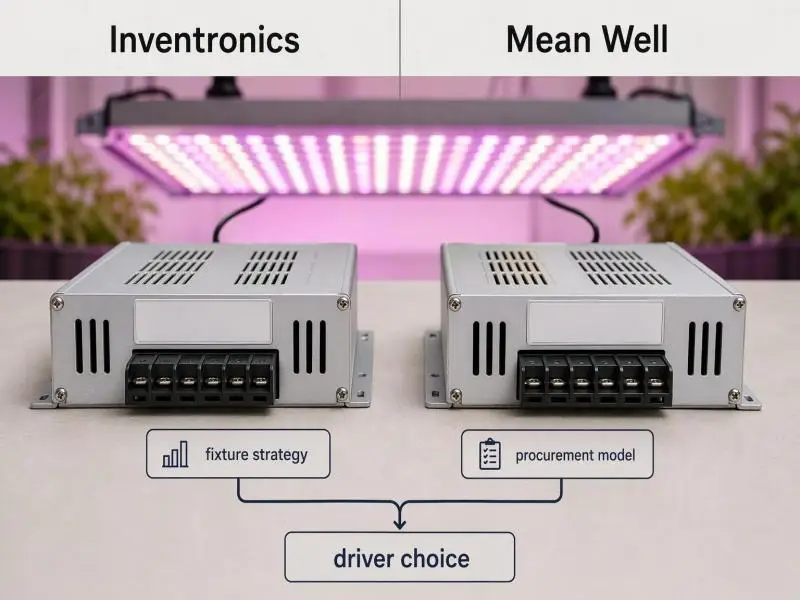

A distributor rarely gets to settle the white label versus private label question in the abstract. It usually surfaces when you are actively sourcing white label grow lights and a fixture arrives with your logo already on the carton artwork, a purchase order waiting for signature, and a sales team that wants a branded SKU on the price list by next quarter. The decision you are actually making is not about the label. It is about how much of the product you are willing to specify, and therefore how much of its performance, certification, and after-sales behavior you are willing to own.
White label is the faster route: you take a supplier’s existing model and apply your logo, label, and packaging. You get a branded SKU without engineering work, but you are reselling a product you did not configure, and your brand carries whatever that configuration does in the field. Private label goes further. The fixture is built to your specification, which may or may not match a stock model, and that specification work buys differentiation and margin protection at the cost of higher minimums, longer lead times, and a certification chain you now manage rather than inherit.
The industry uses both terms loosely, and suppliers sometimes use them interchangeably, so this article applies the definitions above throughout. The comparison is organized around the six criteria a purchasing and product team actually evaluates: customization depth, MOQ, lead time, certification and listing transfer, after-sales responsibility, and differentiation and risk.
It is a framework built from published certification policy, supplier terms, and typical supply-agreement practice, not a hands-on test of specific fixtures. Where a number depends on the supplier or the configuration, it is presented as conditional rather than as an industry standard.
Table of Contents
Quick Comparison: White Label vs. Private Label Grow Lights
| Criterion | White label | Private label |
|---|---|---|
| Best for | Testing a market, filling a catalog gap, first orders with limited commitment | Defending an established brand position where the SKU must be visibly different from competing offers |
| Customization depth | Logo, label and packaging; sometimes plug or cord type | Can extend to spectrum, driver, housing and control protocol |
| MOQ basis | Usually the supplier’s stock-model minimum, quoted per model | Quoted per configuration; rises with each customized parameter because setup costs are amortized over the batch |
| Typical lead time | Compressed early stages; production and freight still apply | Adds sampling, artwork approval and certification confirmation before production |
| Certification and listing path | Relies on the supplier’s existing listing, with a multiple-listing or private-label application to put your name on it | Same mechanisms, but every deviation from the listed configuration raises the question of whether the listing still covers the product |
| Differentiation | Low; competitors can source the same platform | Higher, to the extent the specification is genuinely yours and not a stock variant |
| After-sales exposure | Distributor brand carries the claim, but the factory relationship is simpler | Distributor brand carries the claim and the configuration risk |
| Risk | Quality problems you did not engineer out, and no defensible position if the SKU succeeds | Concentrated in the supplier relationship and in listing continuity |
MOQ and lead-time figures vary by supplier and configuration; treat any single number as a quote, not a benchmark. The one-line decision rule: choose white label to test a market or fill a catalog gap with minimal commitment; choose private label when the SKU must carry defensible differentiation and the volume supports the setup cost.
Customization Depth: How Far Can You Modify White Label Grow Lights?
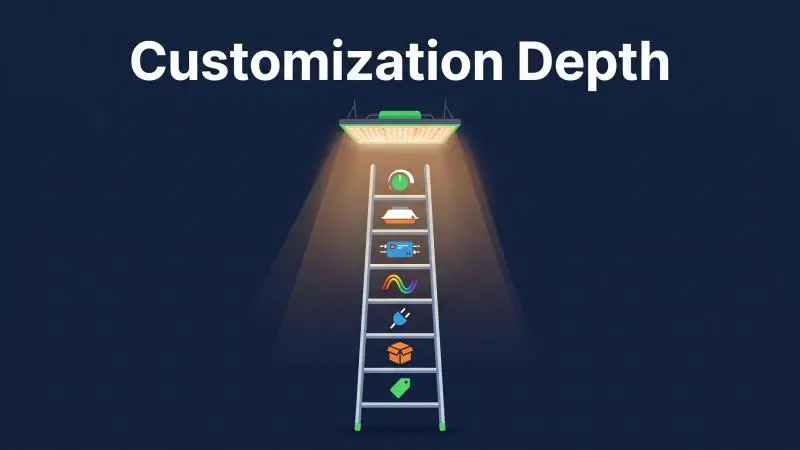
Customization is a ladder, and each rung changes more than appearance. The sequence runs roughly: logo and label, then packaging, then plug and cord type, then spectrum, then driver, then housing, then control protocol. White label typically stops at the first two rungs. Private label can reach the top, but every step up carries a cost in MOQ, calendar time, and certification obligation.
The reason is straightforward. The further you customize, the less the product resembles the configuration the supplier already tested and listed. A new label does not change how the fixture behaves electrically or photometrically. A different driver, a retuned spectrum, or a modified housing does, and that is where the question shifts from marketing to compliance: does the existing listing still describe the product you are asking the factory to build?
A supplier’s willingness to customize a parameter is not the same as that parameter being covered by an existing listing. Sales teams can quote a custom spectrum and a custom driver in the same email; whether the resulting fixture can carry the certification mark, or stay on a qualified products list, is a separate question that has to be answered by whoever holds the listing. Ask for that answer in writing before the specification is frozen, because changing it after tooling and artwork are committed is where schedules break.
For a distributor, the practical test is to write down which rungs the SKU actually needs. If the answer is logo and packaging, white label is doing the job. If the answer includes spectrum or driver, you are in private label territory and should plan for the MOQ, lead time and certification consequences described in the sections that follow.
MOQ: What Is Actually Being Counted, and How Do You Lower the Effective Number?
MOQ is quoted against different bases, and comparing two suppliers’ numbers without knowing the basis produces false comparisons. A figure may be per model, per configuration, or against aggregated project volume across a product family. A supplier quoting 50 units per model and a supplier quoting 300 units per configuration may be describing very different commitments.
The reason MOQ rises with customization is amortization. Setup costs — tooling, print plates for packaging, driver procurement at minimum order quantities, line changeover — are fixed per batch, so the more of them a configuration requires, the larger the batch has to be for the supplier to absorb them. A custom-printed carton needs plates; a non-standard driver needs a procurement commitment; a modified housing may need an extrusion run. None of that scales down gracefully.
The levers a buyer can apply follow from that logic:
- Keep SKUs within one product family and shared platform. Variants that share a base board, driver, and packaging template behave like one order for setup purposes, even when the finishes or color temperatures differ.
- Combine variants into a single purchase order. One changeover serving several SKUs reduces the supplier’s per-SKU cost and gives you variety without meeting a per-SKU minimum on each.
- Pay setup or tooling costs directly. If the plate or tooling charge is what stands between you and a smaller batch, absorbing it as a one-time line item can move the number without changing the per-unit price.
- Stage a smaller trial order against a committed follow-on. A trial run framed as a quality gate before a larger order is a different proposition from a one-off small order, provided the follow-on commitment is real.
Published supplier terms illustrate how much the basis matters. One wholesale grow light supplier lists a standard MOQ starting from 50 units per model, with higher minimums for OEM and private label orders involving logo, packaging or spectrum changes, and quotes samples at 7–15 days and mass production at 15–30 days depending on quantity and customization (iLedGlow wholesale terms). Those figures describe that supplier’s own product lines and should be read as an example of how a quote is structured, not as a market benchmark. Your own MOQ conversation should start by asking what unit the number is counted in.
Lead Time: Where the Calendar Actually Goes
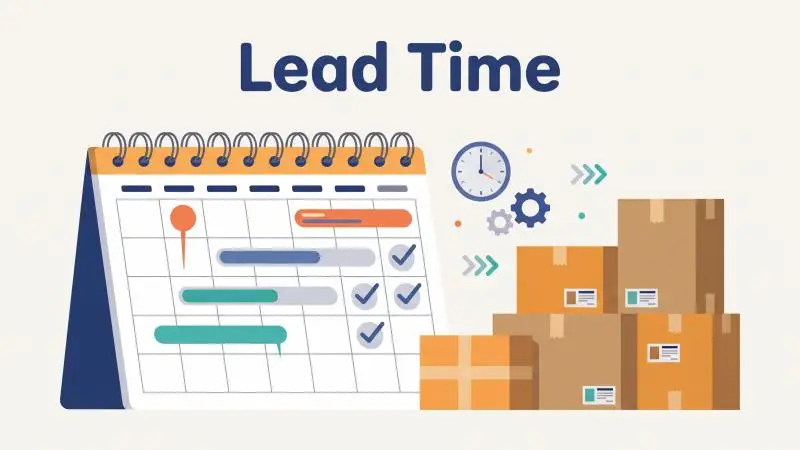
The order-to-delivery calendar has stages, and the two models spend different amounts of time in each. The sequence runs: sampling, artwork and label approval, certification confirmation, production, inspection, shipping. White label compresses the early stages because the product and its artwork already exist. Private label adds them, and a custom spectrum or driver adds a certification confirmation step that can run in parallel with production only if the supplier is confident the configuration is covered.
A lower MOQ does not guarantee a faster delivery. Production scheduling, component lead times, and burn-in and QA all consume calendar time regardless of batch size. A small order can sit behind larger runs in the factory’s queue, and a stocked item can ship in days while a fifty-unit production run with fresh driver procurement takes weeks.
Published supplier guidance puts samples and hand-built pilots at roughly two to eight weeks, and standard production runs at ten to twenty weeks, with the caveat that a stocked small order can leave in days while a larger OEM run can stretch past twelve weeks once tooling, validation, and testing are counted (SLTMAKS wholesale MOQ guide). Those ranges describe one supplier’s experience; the structure of the timeline is what carries over.
Because the calendar is where launch commitments fail, the purchase order should make it enforceable rather than aspirational. Specify approval milestones with dates (sample sign-off, artwork approval, certification confirmation), inspection criteria and who performs the inspection, shipping terms and the port or warehouse of delivery, and which party owns each delay. A lead time without those milestones is a number, not a commitment.
Certification and Listing Transfer: What Carries over to Your Brand?
This is the section that most often decides the choice, because it is where the two models diverge in a way that cannot be fixed later by negotiation. Two distinct mechanisms are involved, and they have different rules.
Safety certification multiple listing. A product already certified by a nationally recognized testing laboratory (NRTL) can be listed under a second company’s name. UL’s multiple listing service terms state that the product for which the service is requested shall not differ from the basic product other than in color, trim, listee identification, product designation, product literature, or other features UL deems, in its discretion, to be superficial; if the basic product is withdrawn, the multiple listing is withdrawn at the same time (UL multiple listing service terms).
Intertek’s ETL multiple listee agreement works on the same premise: the applicant and the multiple listee appear separately in the directory under the same product classification for identical products, and the applicant is responsible for communicating changes to the report or its termination to the multiple listee (Intertek ETL multiple listee agreement). Note also that the multiple listee is not authorized to apply the certification mark itself; only the applicant or its manufacturer, as specified on the authorization to mark, may do so.
DLC qualified products list private-label applications. The DLC’s horticultural private-label pathway requires the OEM product to already be DLC qualified, requires the private-label product to be identical to the originally qualified version, and makes the private-label listing dependent on the OEM listing: if the OEM product is delisted for any reason, all associated dependent private-label products are also delisted, and they can only be re-listed through a new application with new testing (DLC horticultural private-label applications).
The application requires a multiple listing correlation sheet from the approved safety organization cross-referencing OEM and private-label model numbers, and a warranty document from the private labeler covering the private-label models.
Timing matters here. The DLC’s Horticultural Technical Requirements V4.0 took effect for applications on April 18, 2025, and V3.0 carries a delist date of January 5, 2026 (DLC Hort V4.0). As of this writing, that delist date has passed, so any V3.0 listing a distributor intends to rely on should be checked against the current QPL rather than assumed active. V4.0 also raised the efficacy threshold to a minimum of 2.5 μmol × J⁻¹, which the DLC states will delist the least efficacious V3 listed products, roughly 11% of the QPL.
Before signing, request the listing report and control number, the multiple listing correlation sheet, test reports from an accredited lab, a warranty document covering the private-label models, and written confirmation of which model numbers the listing actually covers. A logo change alone does not create a new certification, and a changed driver, spectrum, or housing may fall outside the original listing’s scope. Confirm scope; do not assume transfer.
After-Sales Responsibility: Who Owns What after the Pallet Lands
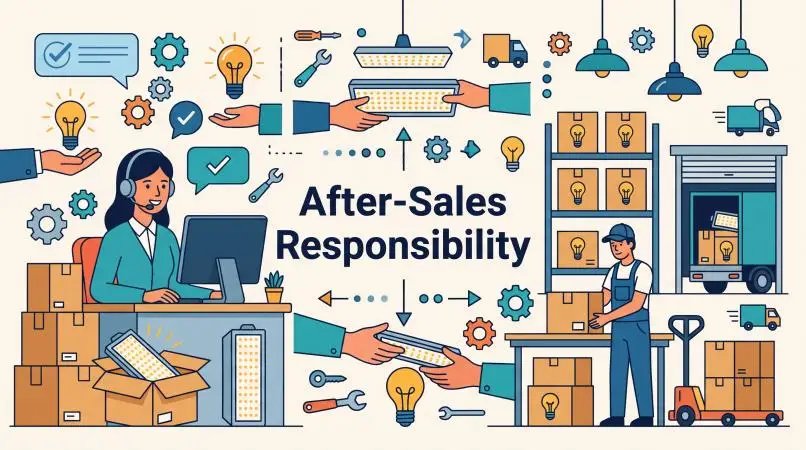
Once the pallet lands, the question becomes who pays for what when a fixture fails. A responsibility matrix agreed before the first order prevents the most common dispute: the end customer calls the distributor, the distributor calls the factory, and each side believes the other owns the freight.
| Item | Factory | Distributor | End customer |
|---|---|---|---|
| Incoming defect inspection | Owns outgoing QC and burn-in | Owns receiving inspection and DOA triage | Reports failures with proof of purchase |
| Repair or replacement | Provides remedy per warranty terms | Administers the claim and the RMA | Returns the unit per process |
| Inbound freight on returns | Negotiable; often customer-paid after an initial window | Passes terms through to the customer | Pays unless the agreement says otherwise |
| Outbound freight on replacements | Negotiable | Passes terms through | Pays unless covered |
| Labor and recommissioning | Not covered unless negotiated | Absorbs or passes through | Bears the downtime |
| Firmware and controls support | Provides technical escalation | First-line support | Requests support |
| End-of-support and spare parts | Commits to a parts window | Stocks spares per agreement | Depends on the distributor |
The DLC’s own requirements stop short of the claim terms. A DLC-qualified horticultural luminaire must carry a manufacturer-provided warranty of at least five years covering the complete luminaire, and the terms must be submitted with the application, but the DLC states plainly that it does not have specific requirements for warranty claim terms such as labor or recommissioning, and does not verify or validate a manufacturer’s terms, conditions, or process for customer warranty claims (DLC Hort V4.0 policy). A five-year listing warranty is therefore a floor on duration, not a statement about who pays for the crew that re-hangs the fixture.
Private label usually shifts more of this exposure onto the distributor, because the end customer sees the distributor’s brand and calls the distributor first. Contract terms that offset it include RMA turnaround times, spare-parts allocation at the approved model count, defect-rate thresholds that trigger corrective action, and a defined response window for the factory’s corrective action plan.
Published warranty comparisons show how widely commercial practice varies on exactly these points — parts versus labor coverage, diode-failure thresholds, and who pays shipping all differ by brand (Growers House warranty comparison). That variation is the reason the matrix has to be negotiated rather than assumed.
Differentiation and Risk: Which Model Protects Your Position?
White label’s commercial advantage is speed and low commitment. Its weakness is defensibility: if the platform is available to you, it is available to competitors, and a successful SKU invites someone else to source the same fixture and undercut the price. The distributor’s brand also carries quality risk it did not engineer out, because the configuration was the supplier’s choice.
Private label inverts the trade. It supports margin protection and a catalog story, since the specification is yours and the SKU is harder to match. But it concentrates risk in two places: the supplier relationship, because the product exists only as long as that factory builds it, and the certification chain, because every deviation from the listed configuration has to be checked against the listing’s scope. A private-label program also ties up working capital in inventory that only you can sell.
The choice is a function of three inputs: order volume, differentiation goals and risk tolerance. Volume determines whether the setup costs amortize. Differentiation goals determine whether white label’s commodity position is acceptable. Risk tolerance determines how much certification and supplier concentration you are willing to carry. The common progression is white label to validate demand, then private label once volume and differentiation justify the setup cost — a sequence that also gives you field data before you commit to a specification.
Where logistics bear on the evaluation, SLTMAKS maintains stocked warehouses in New York, California and Oklahoma in the United States, as well as in major cities in Canada and Germany, and provides ETL, CE and RoHS certification documentation alongside OEM and ODM support (SLTMAKS). For a distributor weighing lead time and certification paperwork, those are the relevant points of contact with the brand; they are not a substitute for confirming that a specific configuration is covered by a specific listing.
Who Should Choose Which
A distributor testing a new category. Start white label. The commitment is low, the product already exists, and the first orders generate the field data you need before specifying anything. Move to private label only when you can name what the stock platform fails to do for your customers.
A distributor defending an established brand. Private label is usually the right answer, because the SKU has to be visibly different from what competitors can source. Budget for the higher MOQ and the certification confirmation step, and negotiate the after-sales matrix before the first production run.
A multi-region distributor managing listing continuity. The deciding factor is listing scope, not customization. A private-label listing that depends on an OEM listing inherits that listing’s risk, so confirm which model numbers are covered in each region and what happens if the OEM product is delisted. Where continuity matters more than differentiation, a white-label arrangement on a stable, already-listed platform may be the lower-risk choice.
A first-time importer. White label, with a small trial order, is the appropriate entry point. The risks that sink first importers — unsold branded inventory, a certification gap discovered at customs, an after-sales dispute with no contract to point to — are all smaller when the product is a stock model and the commitment is a trial.
There is an edge case worth naming: when the required customization exceeds what the supplier’s platform and listings can support, neither model fits. The answer in that situation is a different supplier, not a different label model.
FAQ
Can a white-label fixture later become private label?
Yes, but it is a new arrangement rather than a relabel. Moving from a stock model to a specified configuration changes the product, which means the MOQ, lead time and certification questions in this article apply from the beginning. If the private-label version is identical to the already-listed OEM product, the DLC private-label pathway avoids redundant testing; if it differs, that pathway is not available.
Does an existing ETL or UL listing transfer to a distributor’s brand?
It can, through a multiple listing arrangement, provided the product does not differ from the certified basic product beyond superficial features such as color, trim, listee identification, product designation and literature. The listing is tied to the basic product: if the basic product is withdrawn, the multiple listing is withdrawn at the same time. Confirm the terms with the certification holder for the specific fixture.
Does a DLC-listed product stay listed if the OEM delists it?
No. The DLC states that private-labeled products are dependent on qualification and maintained listing of the OEM product, and that if the OEM product is delisted for any reason, all associated dependent private-label products are also delisted. Re-listing requires a new application with new testing.
How does MOQ change between white label and private label?
It depends on the configuration and the supplier’s basis for counting. Customization adds setup costs that must be amortized, so private-label minimums are generally higher, but the exact figure is a quote, not a rule. Ask what unit the number is counted in — per model, per configuration, or aggregated across a family — before comparing suppliers.
What documents should be requested before signing?
The listing report and control number, the multiple listing correlation sheet, test reports from an accredited lab, a warranty document covering the private-label models, and written confirmation of which model numbers the listing covers. Add the after-sales responsibility matrix and the RMA terms. Anything that depends on the specific supplier or configuration should be confirmed in writing rather than inferred from a catalog page.
Verdict: matching the model to the decision
| Criterion | Usually favors | Condition |
|---|---|---|
| Speed to market | White label | The stock model already fits the target market and its listing is current |
| Customization depth | Private label | The required parameters stay within what the supplier’s platform and listings can support |
| MOQ and working capital | White label | Volume is unproven or the SKU is one of several being tested |
| Lead time certainty | White label | Launch dates are fixed and the early approval stages cannot absorb delay |
| Differentiation and margin protection | Private label | Volume justifies the setup cost and the specification is genuinely defensible |
| Certification continuity | Depends | The listing scope and its dependency on the OEM listing decide it, not the label model |
| After-sales exposure | Depends | The negotiated responsibility matrix decides it, not the label model |
The decision rule holds with the nuance the criteria earn: white label for speed and low commitment, private label for differentiation and margin protection once volume and certification scope support it. The single practical next step is to confirm the certification scope and the after-sales terms in writing before committing to either model — because those two items are the ones that cannot be fixed after the pallet lands.