Introduction
DLC certification in horticultural lighting is a third-party qualification process that results in a fixture being listed on the DesignLights Consortium (DLC) Horticultural Qualified Products List (QPL). For commercial cannabis operators, that listing is more than a logo. It’s often the gatekeeper for utility rebates, and it’s a practical way to reduce risk when you need documentation that stands up to procurement review, energy program admins, and inspectors.
What changed in V4.0 is the bar for efficiency and the reality of version transitions. DLC’s Horticultural Technical Requirements V4.0 set a minimum photosynthetic photon efficacy (PPE) threshold of ≥ 2.5 µmol/J (see the DesignLights Consortium “Horticultural Technical Requirements V4.0” page).
The 2026 transition is not abstract. It affects whether a fixture stays listed long enough for your project to clear pre-approval, purchasing, installation, and post-install verification.
A practical mini timeline from DLC’s published transition guidance:
- April 18, 2025: V4.0 applications opened.
- October 31, 2025: deadline to submit update applications for existing products.
- January 5, 2026: delisting date for products not updated.
(Reference: DLC “Transition to Horticultural Lighting V4.0”.)
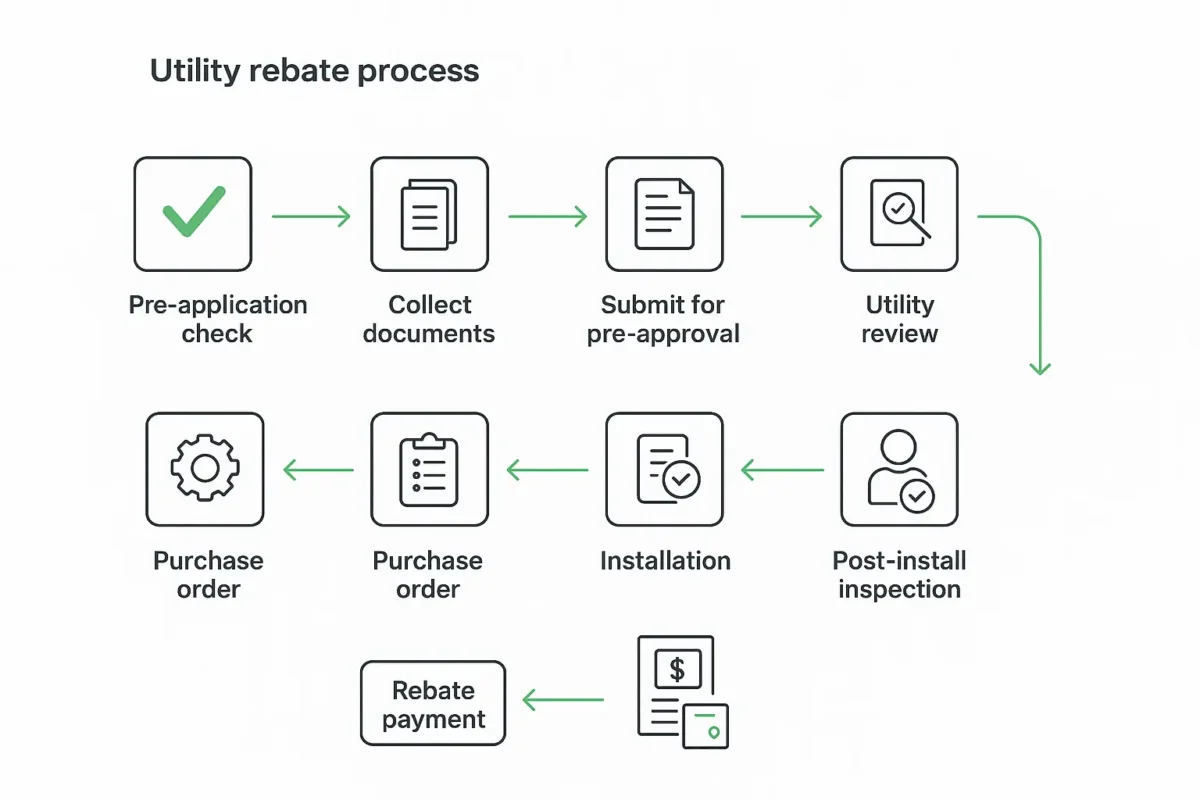
For multi-room and multi-site cannabis operations, DLC certified grow lights influence ROI in three places you can actually measure:
- Energy: higher-PPE fixtures reduce lighting kWh at a given photon target.
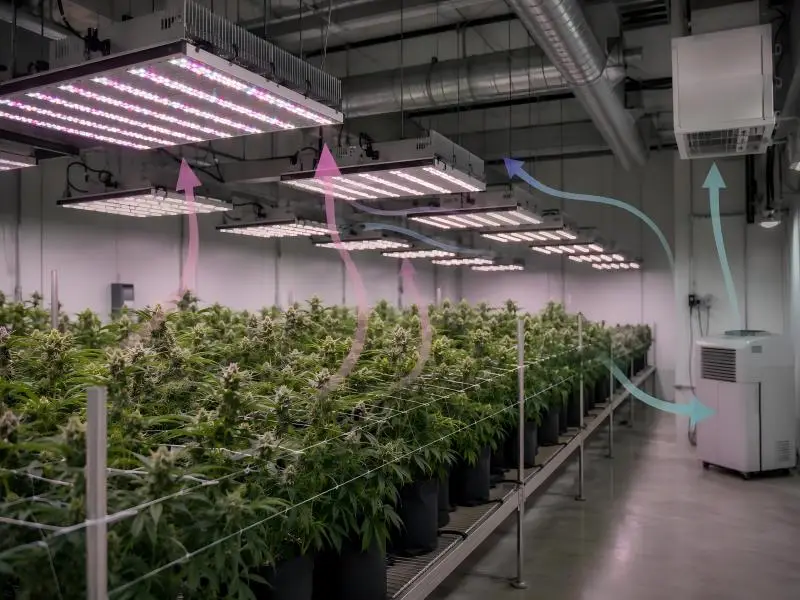
- HVAC and dehumidification interactions: lighting changes heat balance, which shifts how your cooling and latent removal equipment runs.
- Uptime: consistent, verifiable products reduce downtime risk and the operational drag of maintaining a mixed fleet.
Table of Contents
What DLC Certification Means Now
Horticultural QPL and Scope
DLC’s horticultural program produces a Qualified Products List: a public database of products that meet DLC’s requirements and reporting rules. It’s the cleanest “single reference” you can share across engineering, procurement, and rebate stakeholders.
Start from the DLC Qualified Products Lists page, then filter to horticultural lighting.
Two scope rules matter for commercial farms:
- The horticultural QPL is separate from general lighting programs.
- A listing is tied to specific products and identifiers. A vendor claiming “DLC” is not the same thing as your exact model being listed.
Core Performance Thresholds in V4.0
V4.0 raises the baseline and increases the cost of getting this wrong mid-project.
The most visible change is the PPE ≥ 2.5 µmol/J minimum in V4.0. In plain terms, DLC is pushing the qualified set toward higher efficacy fixtures, which is aligned with how many incentive programs filter eligible products.
If you need a precise reference for procurement language, the DLC’s V4.0 documentation is the canonical source, including the DLC “Technical Requirements for LED-Based Horticultural Lighting V4.0” PDF (2025).
When you’re selecting fixtures, treat PPE as a starting point, not the finish line. The next question is whether the product’s documentation makes its performance verifiable and stable over time.
Safety, Warranty, and Reliability Criteria
Commercial cannabis facilities are inspection-heavy, and failure modes are expensive.
DLC listing does not replace electrical safety certification. You still need safety documentation that your inspector (AHJ) and insurer will accept, and you need warranty terms that match your operational risk profile.
Because warranty and reliability terms vary by manufacturer and by program, the most useful approach is to treat them as “must-verify” items in the same selection workflow you use for QPL verification:
- Safety certification documentation appropriate for your market
- Warranty coverage (especially for drivers/power supplies)
- Service process and lead times for replacements
From Listing to Selection: Using the QPL (for DLC certified Grow Lights)
Product Data Fields That Matter
The QPL can look like a wall of specs. For growers and procurement teams, focus on fields that either affect eligibility or affect deployment:
- Model identifier (manufacturer/brand/model number): the anchor for rebates and audits
- Technical requirement version: helps you avoid version-transition surprises
- Electrical characteristics: input voltage range and other power-quality fields that matter to your electrical design
- Performance: PPE and photon output metrics
- Controls/dimming reporting: whether dimming is supported and what control methods are listed
A simple internal rule: if your team can’t point to the exact model identifier on the QPL, the project isn’t ready for pre-approval.
Model Numbers, Private Labels, and Family Groupings
Most rebate failures don’t happen because the lighting design is wrong. They happen because the paperwork can’t be reconciled.
Three practical controls prevent that:
- Ensure the model identifier on the QPL matches what appears on the quote, PO, packing list, and invoice.
- Don’t assume a “family” listing covers every variant you can buy.
- Treat private labels as a verification event. If you can’t match the exact model identifier, assume the utility will not either.
⚠️ Warning: If the installed invoice model identifier doesn’t match the QPL listing identifier, you can lose incentives even if the fixture is technically excellent.
Controls Compatibility and Dimming
Utilities and finance teams want savings that hold up under scrutiny. Controls are often where that savings becomes real, because dimming and scheduling determine actual kWh.
Controls compatibility checklist for commercial cannabis rooms:
- Signal method: confirm what the fixture supports (for example, common analog methods such as 0–10V in many commercial control stacks) and how it’s wired.
- Zoning and daisy-chaining: confirm how many fixtures can be controlled per zone and how linking is implemented.
- Controller interoperability: map fixture requirements to your current controller ecosystem so you don’t discover incompatibilities during commissioning.
- Fail-safe behavior: what happens on signal loss (full output, last state, off) and whether that creates risk.
Now add racking reality. Even “compatible” fixtures can create installation friction if you don’t spec fit:
- bar/linear dimensions and mounting points
- cable routing that doesn’t block aisle access or irrigation
- driver access and serviceability without dismantling a bay
This is where neutral examples help. For instance, SLTMAKS publishes practical buyer-facing notes about control ports, dimming approaches, and selection checks in the Recommended LED Grow Light Guide. The point isn’t that you must choose that brand. The point is to require the same level of documentation from any supplier so your controls and racking plan don’t become a retrofit surprise.
Rebates and Payback Acceleration
Prescriptive vs. Custom Incentives
Most horticultural lighting incentives fall into two buckets:
- Prescriptive: a fixed amount per qualifying fixture.
- Custom: an incentive tied to calculated energy savings (often kWh and sometimes demand).
Custom incentives can be valuable, but they also raise the bar on documentation and verification.
A useful market-level snapshot and checklist of common rebate pitfalls is summarized in BriteSwitch’s “Rebates Bloom as Horticulture Lighting Market Heats Up”. Use it as context, then validate your utility’s exact rules.
Pre-Approval Workflow and Documentation
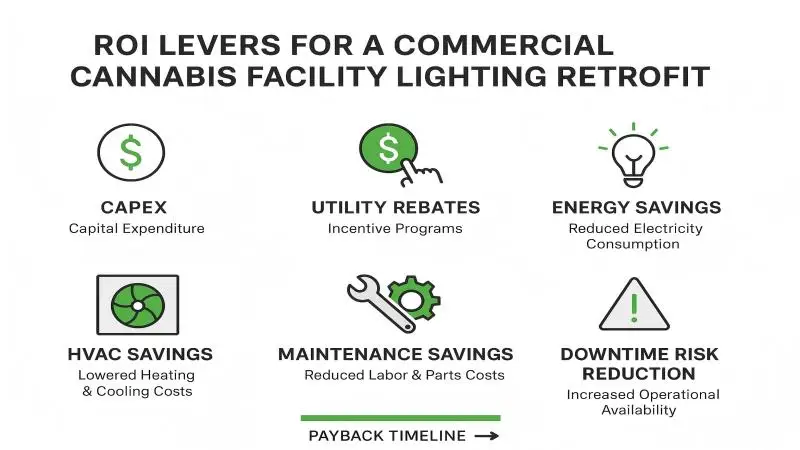
If you want rebates to behave like a predictable capex reduction, treat the process like an SOP.
A tight pre-approval workflow:
- Confirm program eligibility for your facility and crop. Some programs have restrictions for cannabis.
- Verify the exact fixture model identifier is on the DLC horticultural QPL (and not delisted).
- Build a documentation packet before you order:
- QPL listing export with model identifier visible
- Spec sheet with key performance and electrical characteristics
- Controls intent (how dimming/scheduling will be used)
- Baseline vs proposed schedule assumptions (hours, zones)
- Obtain written pre-approval from the program administrator.
- Purchase and install only after pre-approval conditions are met.
- Close out with invoices, photos, and any required inspections/commissioning paperwork.
Typical Values, Timelines, and Pitfalls
Timelines vary by utility and by project complexity. The operational planning rule is simple: don’t schedule a cutover that depends on rebate dollars until pre-approval is in hand.
Common pitfalls:
- Model identifier mismatch between quote/PO/invoice and the QPL
- A version transition that delists a product while a project is in motion
- Missing controls narrative in a custom application
- Program funding changes or funding depletion
Building the Business Case and ROI
Energy, HVAC, and Demand Impacts
In indoor cannabis, lighting is both an energy decision and a thermal decision.
A clean ROI model separates:
- lighting kWh (fixture wattage × hours)
- HVAC interactions (cooling, dehumidification, heating offsets)
- Demand impacts (peak coincident load)
A basic framework you can adapt:
- Lighting energy (kWh/year) = (Total lighting kW) × (Operating hours/year)
- Lighting cost ($/year) = (Lighting kWh/year) × (Electricity rate $/kWh)
- Net project cost ($) = (Fixture + install capex) − (rebates)
- Simple payback (years) = (Net project cost) ÷ (Annual savings)
Where annual savings should include the operational reality of HVAC changes after an HPS-to-LED retrofit.
Standardizing Across Sites with DLC Certified Grow Lights
Standardization is where the QPL becomes an operations tool.
With a small approved set of DLC certified grow lights, you can:
- Reduce purchasing complexity and spare-parts variability
- Standardize controls behavior across rooms and sites
- Reuse documentation packets across multiple rebate applications
A practical way to enforce this is to build a “fixture dossier” for each approved model:
- QPL listing export and capture date
- Safety certification documentation appropriate for your AHJ
- Warranty terms (especially for drivers)
- Controls wiring diagram and supported control methods
- Mounting/racking compatibility notes and photos
If you want a neutral place to host that documentation trail for internal stakeholders, it can live alongside your vendor evaluation materials. Many operators also keep a public-facing reference page for staff and vendors; if you do, link it clearly from your internal SOPs.
Measurement, Verification, and Controls Strategy
If you want savings and performance to be defensible, build a measurement and verification plan that’s lightweight but real:
- Record baseline schedules and power draw
- Verify post-retrofit power draw at representative dimming states
- Use controls logs (if available) to document runtime and dim levels
This is also where “utility rebates for grow lights” become easier to defend on a custom path: you can show not just what you bought, but how it’s operated.
Conclusion
DLC certification matters because it turns lighting from a trust-me purchase into a verifiable, repeatable decision.
Key takeaways:
- Specify V4.0-compliant fixtures and re-check listing status before purchase.
- Verify QPL model identifiers end-to-end (quote → PO → install → invoice).
- Secure pre-approval early, with a documentation packet that includes controls intent and model-number proof.
Next steps:
- Align procurement, controls, and HVAC teams before you pick a fixture.
- Build a standard “fixture dossier” so you can execute rebates and audits without last-minute scrambling.
- If you need a neutral reference for what documentation to request, SLTMAKS publishes buyer-facing checklists you can adapt into your own SOPs (for example, the SLTMAKS LED grow light buyer guide).
And if you’re standardizing across sites, keep internal links to reference materials centralized so the team is always working from the same fixture list and documentation set. A simple starting point is your own vendor library or a curated internal page that links out to approved resources such as SLTMAKS.
FAQ
What does “DLC listed” mean for horticultural grow lights?
It means the exact fixture (brand + model identifier) appears on the DesignLights Consortium (DLC) Horticultural Qualified Products List (Hort QPL), which is a public database of products that have been reviewed against DLC’s horticultural technical requirements. Many utility programs use that listing as an eligibility filter for rebates, so “listed” is more than marketing—it’s a verifiable status you can check in the database.
What is the minimum PPE requirement in DLC Hort V4.0?
DLC Hort V4.0 sets a minimum photosynthetic photon efficacy (PPE) threshold of ≥ 2.5 µmol/J for products to be listed (with DLC’s stated efficacy tolerance described in the policy).
What’s the practical difference between “DLC certified” and “DLC listed”?
In practice, teams usually care about whether a product is listed on the QPL, because the QPL is the “source of truth” program administrators can validate. DLC itself emphasizes that logos can be a first signal, but the QPL is the foolproof validation method—especially for confirming the exact model number/options.
Why do model numbers matter so much for rebates and audits?
Because incentives and audits are paperwork-heavy: a utility reviewer needs to match the manufacturer + model number on your quote/PO/invoice to a specific record on the QPL. DLC explains that the QPL publishes manufacturer/model identifying information and that model numbers must distinguish variations so “the utility and consumer must be able to identify the differences between products from the model number listed on the QPL.”
What are the key transition deadlines for moving products to DLC Hort V4.0?
DLC’s transition guidance states that V4.0 applications opened April 18, 2025, and that products needed to be included in update applications by October 31, 2025, or they would be delisted.
If a product was listed before, is it automatically updated to the new DLC version?
No. DLC explicitly notes that products will not be automatically updated to the new requirements; manufacturers must submit update applications to transition listings. If you’re planning a project during a revision cycle, that’s why it’s smart to re-check listing status right before purchase.