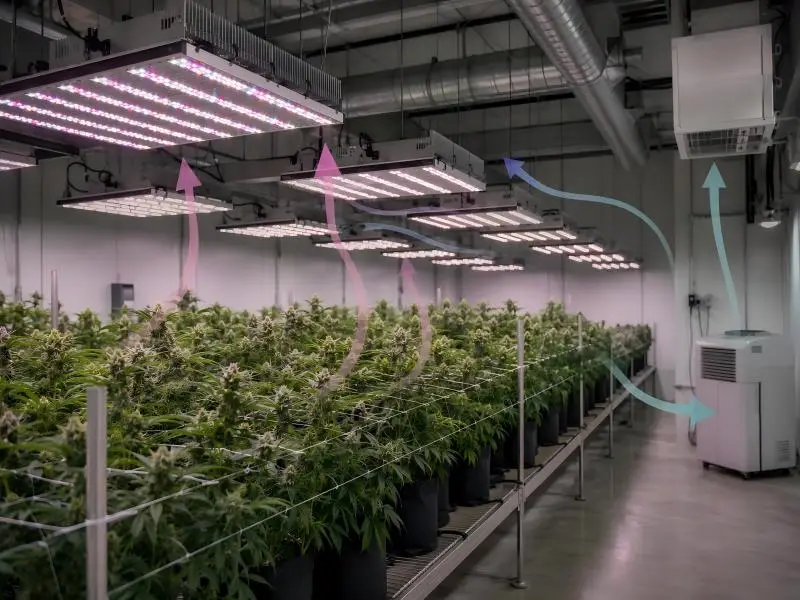
A defensible HVAC size for an LED-lit grow room starts with two numbers, not one, and that’s essential for accurately calculating the total heat load from LED grow lights. Sensible load is the heat that raises air temperature, and latent load is the moisture that plants release as they transpire. A kilowatt of lighting becomes 3,412 BTU/h of sensible heat. The latent side is where most sizing errors hide: ASHRAE Journal calls adding the two together a common design error, because transpiration converts sensible heat into latent heat rather than simply adding to it.
The load chain runs lighting, transpiration, envelope, and ventilation, and it has to be evaluated twice: once with lights on and once with lights off (Greenzone Engineering, undated). The lights-on, full-canopy case usually drives total cooling capacity; the lights-off case drives dehumidifier count and reheat.
This guide works through measurement, conversion, integration, and a full worked example, so you finish with a total-tons figure and the assumptions behind it written down.
Table of Contents
Fundamentals of LED Grow Light Heat Load and Units
Every watt consumed indoors becomes heat, whether from a light, a pump, or a person (H2X Engineering, 1 April 2026). That single principle is why the lighting calculation is a wattage problem before it is a refrigeration problem.
Watts to Btu/h and Why Light Becomes Heat
ASHRAE’s lighting equation multiplies total light wattage by 3.41, then applies a use factor and a special allowance factor for fixtures that are not all on (ASHRAE, 2021). The worked form in that procedure reads (110 W) × 3.41 × 100% = 375 Btu/h. The 3.412 figure used in grow-room practice is the same constant carried to one more decimal place.
LEDs do not escape this. DOE’s thermal-management note has LEDs converting only 15–25% of input power into visible light, with the remaining 75–85% classified as heat moved by conduction and convection (U.S. DOE/PNNL, February 2007). DOE’s later comparison puts a phosphor-converted white LED at about 31% visible radiated light and 69% non-radiated heat loss, with radiated infrared near zero (U.S. DOE, 11 September 2014). The fixture still produces the heat; it just delivers almost none of it as radiant warmth you can feel.
Measuring Real Power at Dim Setpoints
Measure wall-plug wattage at the dim level the room actually runs, not the nameplate rating. A fixture at 60% output draws roughly 60% of full power on a well-behaved driver, and the sensible load scales with it. DLC V4.0 requires fixtures to report input wattage per configuration, along with power factor and current distortion values, data a designer can rely on when measurement is impractical (DesignLights Consortium, released 12 March 2025, revised 1 October 2025).
Driver Placement and Thermal Boundaries
Driver efficiency is LED output power divided by AC input power, and the remainder becomes heat inside the driver (Advanced Energy, 2025). At 95% efficiency, a 1,000 W fixture dumps about 50 W of heat per driver into the room (Advanced Energy, 2025).
Locating the driver outside the environment allows that heat to exhaust outdoors instead of being re-cooled (Advanced Energy, 23 October 2024). Note that this source sells centralized drivers, so the benefit it describes is also the configuration it profits from. Decide the thermal boundary before you calculate: a driver inside the envelope is part of the load, and a driver outside it is not.
Lighting Sensible Load
The lighting sensible load is total measured fixture input watts multiplied by 3.412, plus whatever allowance you carry for drivers, fans, and envelope heat. Grow-room engineers typically carry a 15–20% allowance on the lighting load for those miscellaneous sources (Greenzone Engineering, undated). That allowance is one engineer’s design practice, not an ASHRAE requirement.
Formula, Dimming Behavior, and Input-Watts Selection
Work the arithmetic in fixture counts and watts so the number is auditable. Twenty fixtures at 650 W each is 13,000 W, which converts to 44,356 BTU/h before any allowance. Retail sizing guides total every running watt and multiply by 3.41 BTU/h, then add dehumidifier heat at its full wattage and convert at 1 ton = 12,000 BTU/h (HydroBuilder Learning Center, undated). Use the measured figure rather than the marketing equivalent, because a fixture rated at a 1,000 W equivalent may draw 650 W at the wall.
Distribution Nuances: LED vs. HID and Canopy IR
ASHRAE’s table splits suspended unvented lighting at 67% radiant and 33% convective, and non-recessed luminaires run about 54% radiant and 46% convective (ASHRAE, 2021; DOE/PNNL, November 2023). The convective portion is an immediate cooling load; the radiant portion is absorbed by surfaces and becomes a load later (ASHRAE, 2021).
This is the mechanism behind the retrofit surprise: a retrofit to LED fixtures cuts the heat load by about a third, but it changes the pattern rather than deleting the load, and unless the HVAC system was intended for a varying load, the equipment cycles more rapidly, causing temperature and humidity swings (Resource Innovation Institute, December 2019). If total fixture quantity is increased, heat loads may stay the same or increase (Resource Innovation Institute, June 2022).
Validation: Quick Checks Using 1 W = 3.412 Btu/h
Sanity-check the total against the bare conversion. One kW of lighting is 3,412 BTU/h; add 15%, and it is 3,924 BTU/h; add 20%, and it is 4,094 BTU/h. If your calculated lighting load falls far outside that band per installed kW, find the error before you size equipment. A lighting-only BTU/h figure can hold temperature while humidity drifts, because it says nothing about the moisture the canopy is releasing.
Plant Latent Load
A pint per hour of transpiration adds about 1.1 MBH of latent load while creating the same amount of evaporative cooling (Greenzone Engineering, undated). That evaporative cooling is not a bonus: it converts sensible heat into latent heat, which is why the two loads cannot simply be summed.
Conversions: lb/gal, Latent Heat, Btu per Gallon
Converting pints per day to latent load uses about 1,054 BTU per pound of water, expressed as PPD = BTU/h latent ÷ 1,054 × 24 (HVAC School, 19 January 2024). Water weighs 8.34 lb/gal, and there are 8 pints to the gallon, so one gallon per day is 0.35 lb/h, or roughly 367 BTU/h. Twenty gallons per day is 6.95 lb/h, or about 7,325 BTU/h. Note that the 1.1 MBH-per-pint figure is a design constant as printed, and it runs higher than the strict 1,054 BTU/lb arithmetic; use it as an order-of-magnitude check, not a reconciliation.
Estimating Transpiration by Crop and Schedule
A sealed flower room’s dehumidification target is built from irrigation volume converted to pints per day. Multiply daily gallons by 8 pints, apply a medium factor of 0.4–0.6 for soil and soilless or 0.9–1.0 for hydroponic, then add a 20–30% margin (HydroBuilder Learning Center). A 20-plant operation watering 1 gal per plant per day carries a theoretical 160 PPD load. At facility scale, most 1,000 sq ft flower rooms in full production need 400–700 PPD of dedicated dehumidification capacity (HydroBuilder Learning Center, updated 29 September 2026).
Contractor guidance sizes for peak canopy transpiration, commonly stated as 2–6 L per square metre per day and up to 8 at peak, and notes that 1 lb of water is about 1.36 pints (The Cooling Co., 8 January 2026). Plants absorb 60–90% of delivered water depending on media and irrigation frequency, so the moisture that becomes latent load is the net fraction, not the applied gallons (ASHRAE Journal, April 2020).
Mapping Latent Load to Dehumidifier Capacity
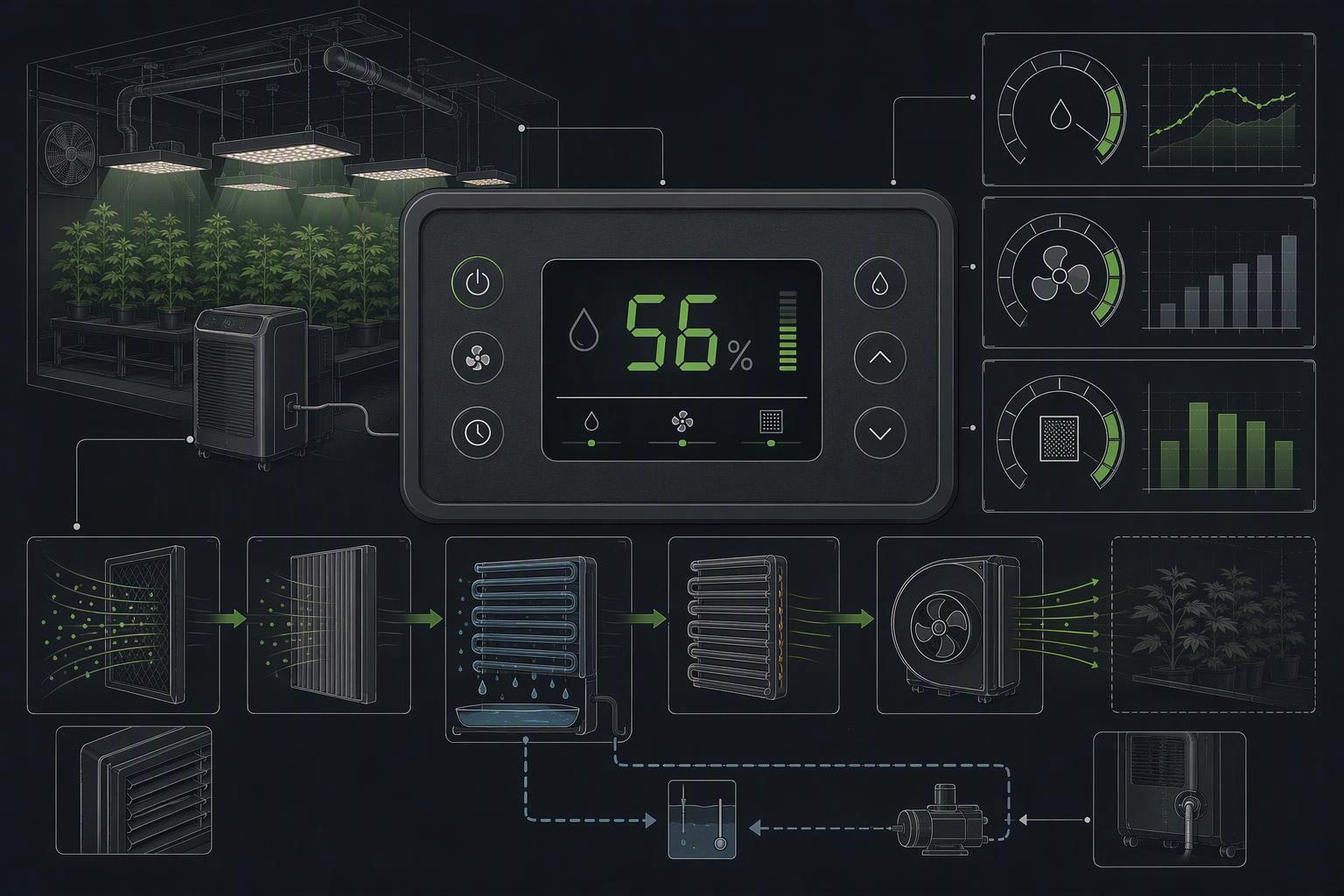
Match the calculated PPD to the nominal dehumidifier PPD, then check the unit’s rating condition. Most units are rated at AHAM 80°F/60% or DOE 73°F/60%, and neither matches a grow room running at 75°F and 50–55%, so nameplate capacity has to be adjusted downward (HVAC School, 19 January 2024). Budget the dehumidifier’s own heat too: nearly 100% of its wattage converts to heat inside the room, and a 700 W unit adds about 2,400 BTU/h (HydroBuilder Learning Center, undated).
A 98 PPD unit can add around half a ton of extra sensible heat the AC must handle (HVAC School, 19 January 2024). That is the feedback loop: AC sizing and dehumidifier sizing cannot be done sequentially, because each changes the other’s required capacity.
Integrating Loads into HVAC Sizing
The total load is not the equipment capacity. In one worked case, the estimated heat load was about 8.9 tons, but roughly 22.6 tons of cooling coil capacity was needed to remove the lights-on latent load at 75°F/55% room air and 50°F leaving air (Greenzone Engineering, undated).
Sensible Heat Ratio and Psychrometric Alignment
Sensible heat ratio is the sensible load divided by the total load, and it falls as latent load rises. ACCA explains that as sensible load falls, the space SHR drops with it, while most air conditioners’ latent capacity cannot track that change (ACCA, 2018). ACCA gives example values of 0.75 falling to 0.65 without stating a cultivation cutoff, so treat any specific SHR figure as illustrative rather than a standard. In grow facilities, latent loads are the driving force, unlike office buildings where sensible drives the total (ASHRAE Journal, April 2020).
Ventilation and Envelope Adders
Open-loop ventilation introduces a load that depends on outdoor temperature, and in a hot climate running 3 ACH it can rival your secondary equipment heat (HydroBuilder Learning Center, undated). Typical grow rooms run 1–3 ACH. Calculate the outdoor-air sensible and latent load rather than assuming a percentage, and evaluate the lights-off case together with winter envelope heat loss (Greenzone Engineering, undated). No retrieved source quantifies envelope and ventilation load as a share of total load for an interior grow room, so this one has to be calculated per project.
Compliance, Safety, and Data Transparency
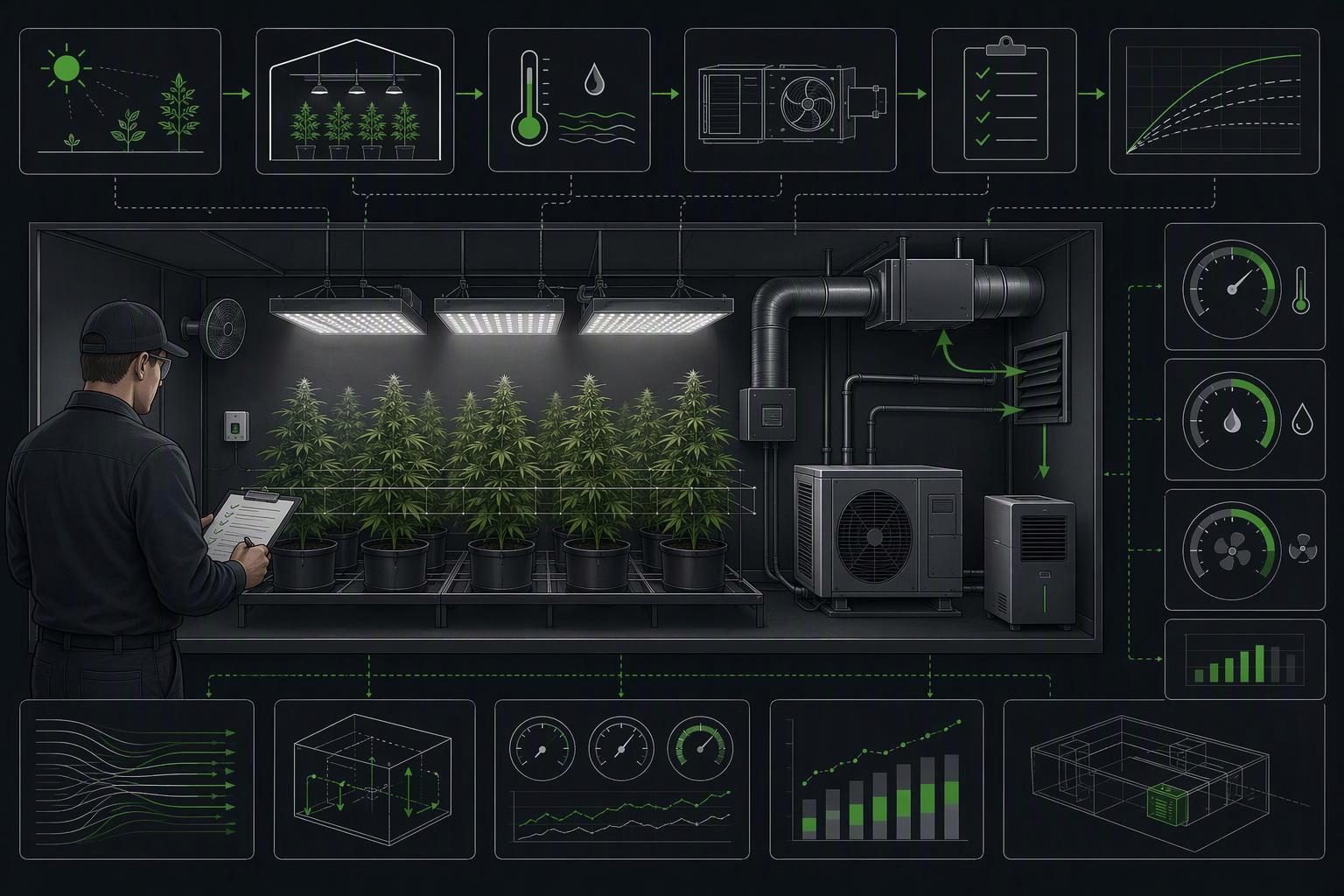
ASHRAE 90.1-2022 regulates horticultural lighting by efficacy, requiring 1.9 µmol/J in large indoor grow buildings and 1.7 µmol/J below the 40 kW threshold, which corresponds to roughly 1,000 ft² of grow space (ASHRAE Journal, September 2023). The standard uses photosynthetic photon efficacy rather than a watts-per-square-foot allowance.
DLC qualification is a performance and reporting qualification, not a safety certification, so confirm NRTL listing and local authority review separately. Document the fixture input wattage, driver losses, and maximum case temperature in the design file, because those are the numbers a reviewer will ask for.
Worked Example (ASHRAE-Style)
This example uses a 640 sq ft canopy flower room with forty 650 W LED fixtures, drivers inside the envelope, and a 0.25 gal per sq ft per day transpiration rate with a 70% lights-on split.
Define Inputs and Assumptions
Installed lighting is 40 × 650 W = 26,000 W. Drivers are inside the room at 95% efficiency. Transpiration is 640 sq ft × 0.25 gal = 160 gal/day. The lights-on split is 70%, so 112 gal/day falls in the lights-on period and 48 gal/day in the lights-off period. Room target is 75°F and 55% relative humidity.
Step-by-Step Calculation to Total Tons
Lighting sensible load: 26,000 W × 3.412 = 88,712 BTU/h. Add the 20% miscellaneous allowance: 88,712 × 1.20 = 106,454 BTU/h. Driver loss is already inside that allowance if you use the 20% figure; if you itemize instead, 26,000 W at 95% efficiency loses 1,300 W, or 4,436 BTU/h.
Lights-on latent load: 112 gal/day × 8 pints = 896 pints/day. Convert to BTU/h with the 1,054 constant: 896 ÷ 24 × 1,054 = 39,349 BTU/h. Lights-off latent load: 48 gal/day × 8 pints = 384 pints/day, or 384 ÷ 24 × 1,054 = 16,864 BTU/h.
Lights-on total: 106,454 + 39,349 = 145,803 BTU/h, or 12.2 tons of load. Lights-off total: 39,349 BTU/h of latent against a negative sensible load, which is the reheat or dehumidifier case.
Sizing Margins and Control Implications
The 12.2-ton figure is a load, not a coil selection. Removing 39,349 BTU/h of latent load at 75°F/55% with 50°F leaving air requires substantially more coil capacity than the load number suggests, which is the divergence the 8.9-ton versus 22.6-ton example illustrates. For a decoupled system, the practitioner rule of thumb is around half a ton of cooling per kW of lighting with transpiration matched in PPD; that comes from one engineering firm and is not a standards-body figure (Greenzone Engineering, undated).
EPA’s moisture guidance is blunt that oversized cooling systems cause humidity problems rather than solving them, because the compressor shuts off before the coil condenses enough moisture (U.S. EPA, December 2013). Manual S limits cooling equipment to no more than 15% above the calculated total load (U.S. DOE Building America, 2012), though that limit is residential comfort guidance, not a cultivation margin. Keep the three numbers separate: the 15–20% miscellaneous allowance, the 20–30% dehumidifier margin, and the 15% equipment oversizing limit.
Pitfalls and Commissioning Checklist
Most sizing errors trace to one of five causes: using nameplate instead of measured wattage, summing sensible and latent instead of integrating them, ignoring dehumidifier heat, sizing on daily average transpiration instead of peak, and oversizing past the calculated load.
Common Mistakes Leading to Sizing Errors
The “LEDs produce no heat” belief is refuted directly by DOE, which states that generated heat does not radiate and must be removed by conduction or convection (U.S. DOE, 11 September 2014). The “just add sensible and latent” error is refuted by ASHRAE Journal, which notes that the total calculated sensible load must be reduced by the sensible cooling the plants provide (ASHRAE Journal, April 2020).
The “bigger AC is safer” instinct runs into the EPA mechanism: a large cooling system removes the sensible load quickly, then compressors shut off before the coils condense enough moisture (U.S. EPA, December 2013). Oversizing a dehumidifier carries the same short-cycling penalty plus a reheat load on the AC (HVAC School, 19 January 2024). Read “size up” as headroom against the calculated peak, never as headroom past it.
Commissioning and Verification Checklist
Verify measured input watts per fixture at the operating dim setpoint. Confirm the driver thermal boundary matches the calculation. Check dehumidifier nameplate PPD against the unit’s rating condition and adjust to room conditions. Confirm the coil can achieve the leaving air temperature the latent load requires. Verify power factor and driver life data against DLC V4.0 reporting. Confirm NRTL listing and authority-having-jurisdiction review before energizing.
Data Logging and Ongoing Optimization
Some growers have measured condensate, which in a grow room without outside-air exchange equals transpiration (Greenzone Engineering, undated). That measurement is the cheapest way to replace an assumed transpiration rate with a real one. Load calculations are an estimation with uncertainty in the actual latent load, the actual equipment performance, and the air mixing in the room, and loads change over the grow cycle and between strains (Greenzone Engineering, undated). Log temperature, humidity, and equipment runtime per room so the next cycle’s calculation starts from measured data.
Conclusion
The calculation reduces to a chain you can defend line by line: measure fixture input watts at the real dim setpoint, multiply by 3.412, add the allowance you have chosen and can justify, convert irrigation volume to pints per day, apply the medium factor and a peak margin, convert to BTU/h at 1,054 per pound, then integrate through sensible heat ratio and convert at 12,000 BTU/h per ton. Every step carries a stated assumption, and the assumptions are the part a reviewer will test.
Two numbers deserve to travel with the result. The first is the lights-off case, which drives dehumidifier count and reheat even though it never drives peak cooling. The second is the gap between load and equipment capacity, which in the worked case above ran from 8.9 tons of load to 22.6 tons of coil capacity once the latent load at 75°F/55% was accounted for.
Then take the completed worksheet to a mechanical engineer who can select equipment against the leaving air temperature your latent load requires, not against the load figure alone.
About the publisher. SLTMAKS is a global provider of professional-grade LED grow lights, including full-spectrum fixtures with aluminium heat sinks and ETL, CE and RoHS certification. It sells lighting hardware, so it has a commercial interest in how growers think about fixture wattage and heat. The guidance above stands on its own and does not depend on its products.
FAQ
How many BTU per hour does a 1,000 W LED grow light produce?
A 1,000 W fixture converts its full input wattage to heat, so the sensible load is 1,000 × 3.412 = 3,412 BTU/h, ignoring driver losses. That matches the ASHRAE constant used across grow-room practice, and DOE notes LEDs still put out their heat even though almost none of it radiates from the fixture. If the driver sits inside the room and runs at 95% efficiency, add roughly 50 W (about 171 BTU/h) for the driver itself.
Do LEDs produce less heat than HID lights?
They produce less total heat per unit of usable light, not less heat per watt. A retrofit to LED typically cuts the heat load by about a third, but it also shifts the radiant-to-convective split: suspended unvented HID lighting runs about 67% radiant and 33% convective, whereas non-recessed LED luminaires run closer to 54% radiant and 46% convective. The load changes pattern, not just size, so unless the HVAC was built for a varying load, the equipment short-cycles and humidity drifts.
How do I convert plant transpiration into cooling and dehumidifier tons?
Turn irrigation volume into latent load at 1,054 BTU per pound of water, or roughly 367 BTU/h per gallon per day. Multiply daily gallons by 8 to get pints per day, apply a medium factor of 0.4–0.6 for soil and 0.9–1.0 for hydroponic, then add a 20–30% margin. Convert the result at 12,000 BTU/h per ton, and remember the dehumidifier adds its own heat: a 700 W unit dumps about 2,400 BTU/h back into the room, so AC and dehumidifier sizing have to be solved together.