If you’re shopping for a 1000 watt LED grow light, you’re probably trying to answer three practical questions: How big an area will it cover, what yield potential is realistic, and how much power (and money) will it actually use. Those are the right questions, because “1000W” on a listing can mean very different things depending on the brand, the driver, and whether the number is true power draw or marketing equivalence.
This guide breaks the topic down in plain English, but with the same metrics commercial growers use—PPF, PPFD, DLI, efficacy (µmol/J), uniformity, and environment balance—so you can choose a 1000 watt LED grow light that performs the way you expect. It also includes practical rules of thumb for tents and rooms, plus simple ways to estimate electricity cost and HVAC load.
Table of Contents
What “1000 Watt LED Grow Light” Really Means

True wattage vs “HPS equivalent” wattage
A common confusion is that “1000 watt LED grow light” sometimes refers to actual wall draw, and sometimes refers to “replaces a 1000W HPS” marketing language. Those two are not the same, and mixing them up is how growers end up with either under-lit canopies or oversized electric bills.
A true 1000W LED fixture (about 900–1100W draw, depending on driver and dimming) is a high-output light typically used for larger flowering areas or higher-light crops. A “1000W equivalent” LED, on the other hand, might only draw 600–750W, and coverage expectations should be adjusted accordingly.
Why wattage alone is a weak buying metric
Watts only tell you how much electrical power is consumed, not how many usable photons reach the canopy. Two fixtures can both draw 1000W while producing very different plant-usable light because of differences in LED efficiency, driver efficiency, optical losses, thermal design, and layout.
That’s why professional horticulture lighting discussions quickly move from watts to PPF (µmol/s) and then to PPFD (µmol/m²/s) at the canopy. Watts matter for operating cost, but photons matter for growth.
A simple sanity check you can use
If a seller claims “1000W” but the spec sheet says the fixture draws 120–200W, you’re not looking at a real 1000W LED grow light. That doesn’t automatically mean the fixture is “bad,” but it does mean you should expect coverage and yields closer to a smaller light.
As a shopper, always look for actual power draw, and treat “equivalent” language as advertising unless it is backed by measured PPFD maps.
The Metrics That Actually Predict Coverage and Yield
PPF: total photons emitted per second
PPF (photosynthetic photon flux) measures how many PAR photons (400–700 nm) the fixture produces each second, expressed in µmol/s. It’s the most direct way to compare “how much plant light comes out” between fixtures of the same class.
If you only remember one number besides wattage, remember PPF, because it anchors coverage estimates much better than watts.
PPFD: photons arriving per square meter per second
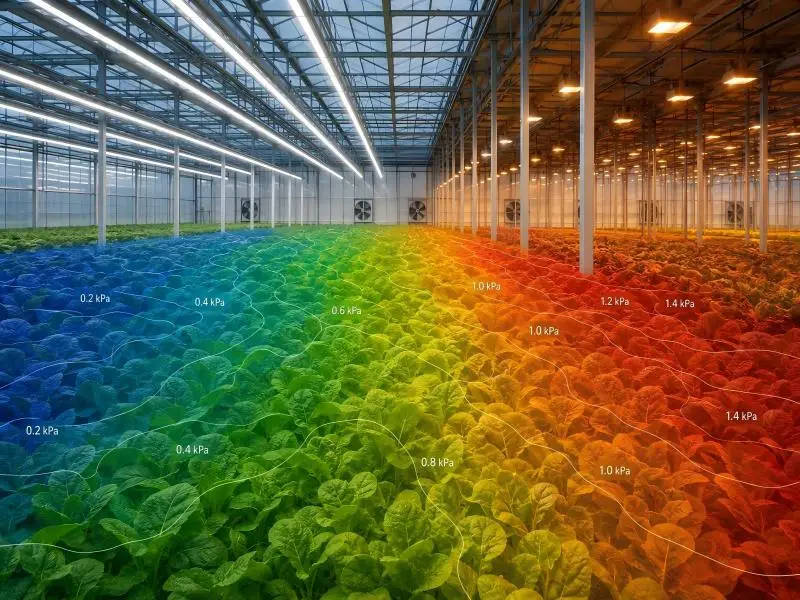
PPFD (photosynthetic photon flux density) is the canopy-level intensity, expressed in µmol/m²/s. PPFD determines how aggressively plants can photosynthesize, assuming CO₂, temperature, water, and nutrients are all in range.
This is also where fixture design matters most, because the same PPF can be spread evenly (great uniformity) or concentrated in a hot spot (risking stress and uneven growth).
DLI: total light per day (the “yield context” metric)
DLI (daily light integral) measures the total number of photons delivered per day, expressed in mol/m²/day. It connects light intensity (PPFD) with photoperiod (hours per day), which is why growers use it for planning crop outcomes.
A common conversion is: DLI = 0.0036 × PPFD × hours of light. Wikipedia
Efficacy (µmol/J): how efficiently watts become photons
Photosynthetic photon efficacy (often written as PPE or simply “efficacy”) is how many micromoles of photons you get per joule of electrical energy, expressed in µmol/J. This is the number that explains why two 1000W fixtures can perform differently even when both are “1000W.”
Higher efficacy generally means more PPF at the same wattage, which improves either coverage, intensity, or both. It also usually reduces heat per delivered photon, which makes environmental control easier.
Coverage: How Much Can a 1000 Watt LED Grow Light Actually Light?
Start with a realistic coverage mindset
Coverage is not a single fixed number because different crops and stages require different PPFD targets. A 1000 watt LED grow light might “cover” a large area for seedlings, a medium area for vegetative growth, and a smaller area for heavy flowering.
If you see one fixed coverage claim with no PPFD map, assume it’s a best-case scenario, and treat it as a starting point rather than a promise.
Typical PPFD targets by growth goal
These ranges are general planning guidelines, and they assume good irrigation/nutrition and a stable environment. They are also intentionally broad, because cultivars and setups vary a lot.
- Seedlings / clones: lower PPFD to avoid stress and stretching. Many growers aim for gentle, even light and adjust height/dimming as plants establish.
- Vegetative growth: moderate PPFD supports strong structure without unnecessary energy waste. A stable photoperiod and uniformity are often more important than chasing the highest intensity.
- Flowering / fruiting: higher PPFD can drive higher yield potential, but it also increases the need for correct temperature, humidity, and sometimes supplemental CO₂.
A practical way to estimate coverage from PPF
If you know (or can estimate) fixture PPF, you can do a quick “physics-based” coverage estimate. The shortcut is: average PPFD ≈ PPF ÷ area, then adjust down for real-world losses and non-perfect uniformity.
For example, if a true 1000W fixture has strong efficacy, it may produce a PPF high enough to support a flowering canopy across a larger footprint. If efficacy is lower or optics are poor, the same wattage may not translate into the PPFD you want at the edges.
Tent and room footprints people commonly pair with this class
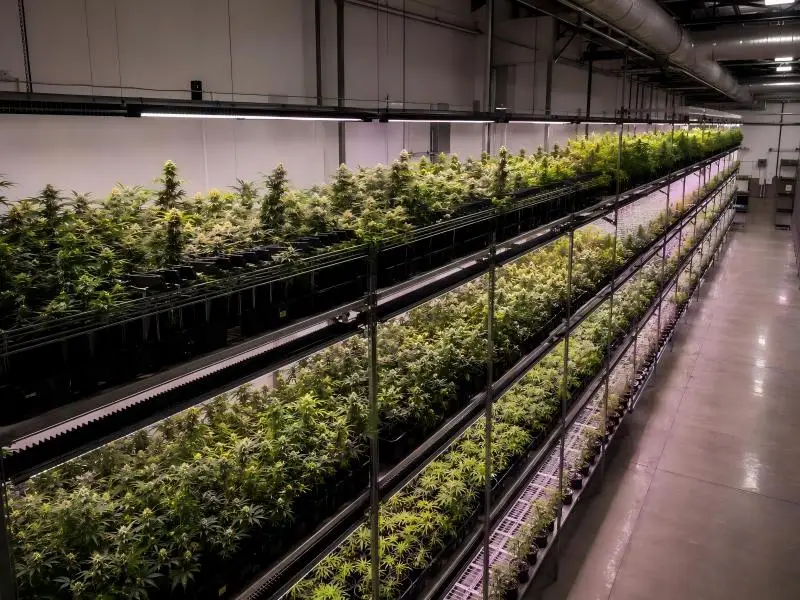
In real grow rooms, a true 1000 watt LED grow light is often matched with footprints like 4×4, 5×5, or similar modular sections, depending on crop intensity goals and whether CO₂ is used. That’s because a well-designed high-output LED can deliver strong canopy PPFD over those areas when hung at an appropriate height.
If you’re trying to push very high intensity without sacrificing uniformity, you may choose a smaller footprint and run the fixture dimmed or higher above canopy. That approach often produces more even results than running maximum power over an oversized area.
Uniformity is the hidden coverage limiter
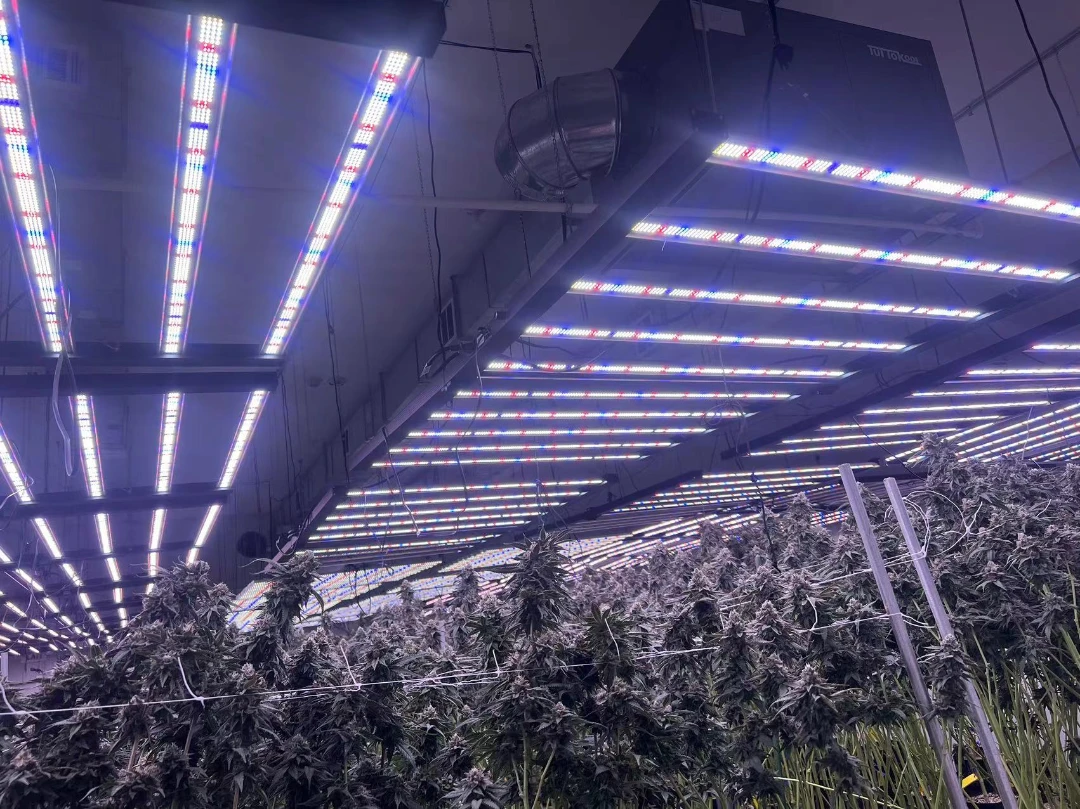
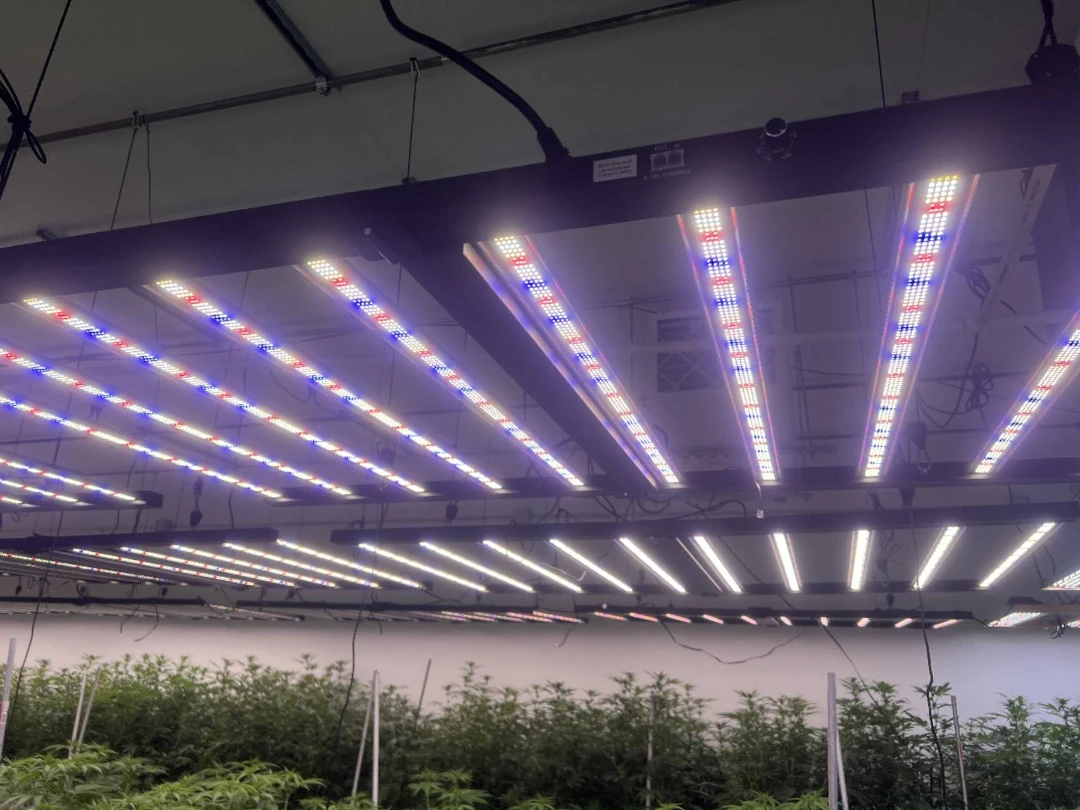
Two lights can have the same center PPFD but very different outcomes because edge PPFD controls whether the perimeter plants finish the same as the center. Uniformity is usually better with bar-style layouts or wide-distribution designs, especially when mounted higher and used with reflective walls or a well-designed room.
When comparing fixtures, look for PPFD maps at multiple hanging heights, and pay attention to minimum and average PPFD, not just the peak number.
Yield Potential: What You Can Realistically Expect
Yield is not “watts → grams” in a straight line
It’s tempting to use a single “grams per watt” number, but yield is driven by a system: genetics, canopy management, nutrition, irrigation strategy, CO₂, temperature, VPD, rooting volume, and harvest timing. Light is a major lever, but it doesn’t work alone.
A 1000 watt LED grow light can create the potential for high yields, but only if the rest of the setup can support the higher photosynthetic rate it enables.
The yield “ceiling” rises with DLI and uniformity
In general, as you deliver more usable photons per day (higher DLI), plants can produce more biomass—until another factor becomes limiting. Uniformity matters because a canopy is only as productive as its lowest-performing sections, and uneven PPFD often produces uneven maturity, uneven flower density, and more trimming waste.
That’s why many high-end facilities emphasize consistent PPFD across the entire canopy, even if it means a slightly lower peak intensity.
Why CO₂ changes the conversation
At high PPFD levels, CO₂ can become a limiting factor in sealed or semi-sealed rooms. When CO₂ is not sufficient, pushing intensity higher can yield diminishing returns, and it can also increase stress signs like leaf edge curling or bleaching in sensitive cultivars.
If you’re planning to run very high intensity from a 1000 watt LED grow light, you should also plan how you will maintain stable CO₂, temperature, and humidity. Even modest improvements in environmental stability often “unlock” more yield than simply adding more watts.
Harvest quality is tied to spectrum and environment, not only intensity
High PPFD can improve density and yield potential, but quality outcomes (aroma, secondary metabolites, visual bag appeal) are also influenced by spectrum balance, plant stress level, and finishing conditions. A fixture with strong uniformity and a well-balanced spectrum can produce more consistent quality across the whole canopy.
If the light is too intense at the top or too hot in the room, quality can suffer even when yield is high, so your goal should be “high light with control,” not “maximum light at any cost.”
Power Usage: What a 1000W LED Grow Light Costs to Run
The basic electricity math (easy, and worth doing)
Operating cost is straightforward once you know actual wattage. The formula is: kWh per day = (watts ÷ 1000) × hours/day, and cost per day = kWh × your electricity rate.
This is why knowing true power draw matters, because a “1000W equivalent” drawing 650W has a very different monthly cost than a true 1000W unit.
Example costs you can adapt
Let’s use a true 1000W draw for simple planning. At 12 hours/day, that’s 12 kWh/day, and at 18 hours/day, that’s 18 kWh/day.
If your electricity rate is $0.15/kWh, that’s $1.80/day at 12 hours and $2.70/day at 18 hours, before considering fans, dehumidification, HVAC, pumps, and controllers. In many real grows, environmental equipment can match or exceed lighting energy, especially in humid climates or sealed rooms.
Dimming strategy can cut cost without sacrificing results
A big advantage of modern LED systems is controllability. If your plants are young, your canopy is not full, or your room runs hot, dimming can reduce power use while improving uniformity and plant comfort.
Many growers get better results by ramping light with plant size and canopy closure, rather than blasting full power from day one.
Understand the “system” power budget
When people say “my room is expensive,” lighting is only part of the story. Dehumidifiers, AC, fans, pumps, CO₂ equipment, and even extra heat in winter all contribute to total operating cost.
A smart way to evaluate a 1000 watt LED grow light is to see how it changes total system efficiency: if better distribution reduces hot spots and humidity problems, you may reduce HVAC load and actually lower total costs.
Heat and HVAC Load: The Part Many Buyers Underestimate
Almost all electrical power becomes heat indoors
In an indoor grow, nearly all electrical energy ends up as heat in the space, whether it’s emitted as light and absorbed by surfaces or lost directly as driver and diode heat. That means a 1000W fixture contributes roughly 1 kW of heat load to your room while operating.
A common conversion used in HVAC planning is 1 kWh ≈ 3,412 BTU, which helps translate electrical load into cooling needs.
Why LED still “feels cooler” than HPS
Even though watts become heat either way, LED fixtures often distribute heat differently than HPS. HPS produces a very intense radiant heat source near the bulb, while LED spreads heat across a larger surface area and often runs with less extreme “hot spot” radiation at canopy level.
That can make leaf temperature management easier, even if total watts are similar, and it can reduce stress in top colas when distance is tight.
Dehumidification is often the real energy monster
High-intensity lighting increases transpiration, which raises humidity load. If you run strong PPFD with a dense canopy, your dehumidifier may work harder than you expect, especially during late flower when plant mass is high.
When planning a 1000 watt LED grow light setup, always think “light + humidity control” as a pair, because yield potential is only reachable when VPD stays stable.
Airflow and canopy temperature are part of “coverage”
Coverage is not only about photons; it’s also about keeping leaf temperature and microclimates consistent. Strong airflow prevents boundary layers, improves CO₂ availability at the leaf surface, and reduces mold risk in dense flowers.
In practice, a fixture that gives even PPFD but causes poor airflow patterns can still produce uneven results, so treat airflow design as part of your lighting plan.
Spectrum and Growth Stage: Making 1000W Work for Your Crop

Full spectrum vs “blurple” and why modern growers prefer balanced white
Most commercial-quality LED grow lights today use a white-light base with added deep red and sometimes far-red. This approach improves canopy visibility, supports broad-spectrum plant responses, and is usually easier to manage across multiple growth stages.
Older “red/blue only” fixtures can grow plants, but many growers prefer full spectrum because it supports more natural plant morphology and easier scouting for deficiencies and pests.
Vegetative growth: structure, spacing, and internodes
In veg, you generally want strong, even light that builds structure without excessive stress. Too much intensity too early can cause reduced growth rate in sensitive cultivars, while too little light encourages stretch and weak branches.
A dimmable 1000 watt LED grow light can be very effective here, because you can cover a larger footprint at lower intensity until plants are ready for stronger PPFD.
Flowering: intensity, uniformity, and finishing
In flower, uniform PPFD matters more than ever because uneven light produces uneven maturity. This is where high-output LEDs shine, especially bar-style designs that spread photons more evenly across the canopy.
If you see bleaching or foxtailing at the top, it often means your canopy is receiving more intensity than the cultivar or environment can support, so adjusting height, dimming, or environment stability is usually the fix.
Far-red and photoperiod nuance
Some fixtures include far-red, and growers use it for specific morphology and photoperiod strategies. Far-red can influence plant responses, but it should be used intentionally rather than assumed as an automatic “yield booster.”
If you’re not optimizing a controlled environment, your biggest wins usually come from uniform PPFD, correct DLI, stable VPD, and good canopy management rather than chasing advanced spectrum tricks.
Installation and Safety: Don’t Let 1000W Create 1,000 Problems
Electrical load: do the amperage math
A true 1000W fixture draws meaningful current, and you should plan circuits correctly. At 120V, 1000W is about 8.3A, and at 240V, it’s about 4.2A, before considering any other equipment on the same circuit.
In real grows, you must also budget for fans, dehumidifiers, pumps, and AC, so treating the lighting circuit as “just the light” is often the safest approach.
Hanging height: intensity and uniformity trade-offs
Higher hanging heights usually improve uniformity and soften hot spots, but they can also reduce PPFD if the room has poor reflectivity or if the fixture’s distribution is narrow. Lower heights increase intensity but risk hot spots and edge drop-off.
A good practice is to start higher than you think, measure plant response for a week, and then lower or increase power gradually until you reach your target canopy behavior.
Measurement beats guessing
If you run a 1000 watt LED grow light without measuring PPFD (or at least using a reliable strategy), you’re effectively guessing at the most expensive input in your room. A quantum sensor or a solid measurement routine can pay for itself by preventing crop setbacks and reducing wasted electricity.
Even if you don’t own a meter, you can use manufacturer PPFD maps as a baseline, then watch plant response and adjust DLI through dimming and photoperiod.
Safety certifications and build quality are not “optional features”
At this power level, you want proper thermal management, stable drivers, strain relief, and safe wiring practices. Certifications and reputable testing processes reduce risk, especially in humid environments where corrosion and condensation can become real issues.
If a fixture has no clear safety claims, vague specs, or poor documentation, it’s not worth the risk in a serious grow.
Choosing the Right 1000 Watt LED Grow Light: A Buyer’s Checklist
Confirm true power draw and controllability
A real 1000W LED grow light should have a clear spec for actual wattage draw and ideally a reliable dimming method. Dimming is not only about saving electricity; it’s also a tool for managing plant stress and improving uniformity across growth stages.
If a fixture lacks dimming, you lose flexibility and may be forced to manage intensity only by changing height, which can be limiting in low-ceiling setups.
Look for PPFD maps and understand what they imply
A serious manufacturer provides PPFD maps at multiple heights and footprints. Those maps let you estimate average PPFD, edge performance, and whether the fixture’s distribution matches your intended canopy size.
If the company provides only a single “max PPFD” value, treat it as incomplete information, because peak PPFD can look impressive while edges starve.
Evaluate efficacy and thermal design as a pair
High efficacy is valuable, but only if the fixture maintains it over time. Thermal design affects how hard the LEDs and driver are pushed, which affects output stability, lifespan, and safety.
A well-cooled fixture tends to hold its performance better, which matters because growers don’t buy 1000W-class lights to replace them every season.
Match fixture style to canopy geometry
For wide canopies, bar-style fixtures usually spread light more evenly. For tighter spaces, compact fixtures can work, but you must be careful about hot spots and corner falloff.
The best choice is the one that delivers consistent PPFD across your canopy shape, not the one with the biggest headline number.
Don’t ignore serviceability and support
At this price and power level, support matters. Replaceable drivers, accessible parts, and clear warranty terms reduce downtime risk, especially for commercial or time-sensitive grows.
A 1000 watt LED grow light is infrastructure, not a disposable accessory, so vendor reliability should be part of your buying decision.
Common Mistakes and How to Avoid Them

Mistake 1: Oversizing coverage and blaming genetics
When coverage is too large, plants at the edges underperform, and the canopy finishes unevenly. Many growers then blame genetics or nutrients, when the real issue is PPFD uniformity and insufficient DLI at the perimeter.
The fix is either reducing footprint per fixture, improving reflectivity, increasing hanging height for better spread, or choosing a fixture with better distribution.
Mistake 2: Running max power without environmental control
High light increases transpiration and nutrient demand. If temperature, humidity, and airflow aren’t stable, plants can show stress even when the light is “good.”
A smarter approach is to ramp intensity with canopy development and only push peak PPFD when the room can hold stable VPD and leaf temperature.
Mistake 3: Ignoring measurement and relying on “looks bright”
Human vision is not a plant-light meter. White LEDs can look dimmer than blurple lights to your eyes while delivering more usable photons to plants, and vice versa.
Using PPFD maps, a meter, or a consistent DLI strategy prevents expensive guesswork and makes results repeatable.
Mistake 4: Forgetting that electricity cost includes more than the light
A 1000W light can trigger extra HVAC and dehumidification usage, especially in late flower. Many growers budget for the light’s kWh but underestimate the “support equipment” energy that comes with higher intensity.
Planning total room load and ventilation strategy early prevents unpleasant surprises on the monthly bill.
FAQ About 1000 Watt LED Grow Lights
Is a “1000 watt LED grow light” always the best choice for a 5×5 area?
It can be a strong match, but it depends on whether the fixture is a true 1000W draw and how intense you plan to run the canopy. Some growers prefer to use a slightly lower wattage with excellent distribution, while others use a high-output light dimmed for better uniformity and headroom.
The key is to plan around target PPFD and DLI, not around the label on the box.
How many plants can a 1000W LED grow light handle?
Plant count depends on training style, cultivar vigor, container size, and canopy management. A few large, well-trained plants can fill the same area as many smaller plants, so “number of plants” is not a reliable sizing method.
It’s better to plan by canopy area and then match PPFD across that canopy.
Will a 1000W LED automatically increase yield compared to a smaller light?
It increases yield potential only if you actually deliver more usable photons to the canopy and the environment can support the increased photosynthesis. If the room runs too hot, too humid, or too CO₂-limited, the yield gain can be smaller than expected.
In many grows, improving uniformity and environment stability produces more consistent gains than simply increasing wattage.
Can I run a 1000W LED on a standard household outlet?
Electrically, it may be possible depending on voltage, circuit capacity, and what else is on the same circuit. Practically, once you add fans, dehumidification, and other equipment, you often exceed what a shared household circuit can safely support.
For safety and stability, many growers dedicate circuits or use higher-voltage setups where appropriate, and they follow local electrical codes.
What’s the fastest way to estimate if my canopy is getting enough light?
Use the DLI relationship and your estimated PPFD. If you know your approximate canopy PPFD and how many hours you run the light, you can estimate DLI using DLI = 0.0036 × PPFD × hours.
That gives you a daily light “budget” you can compare across weeks, strains, and rooms, which is why it’s so useful for repeatable results.
The 1000W LED Is a System Decision, Not a Sticker Decision
A 1000 watt LED grow light can be a powerhouse for high-performance grows, but only when you size it by PPFD, DLI, and uniformity, and when you plan for electricity cost and environmental control. If you treat “1000W” as a guarantee of coverage and yield, you’ll either overspend or underperform.
If you treat it as a photon engine—one you can measure, dim, and balance with airflow, temperature, humidity, and (when appropriate) CO₂—you’ll get the consistent coverage, strong yield potential, and predictable power usage that this class of fixture is designed to deliver.