If you’ve ever searched “grow light distance chart led”, you already know the pain: one chart says “12 inches,” another says “24 inches,” and your plants still stretch, bleach, or taco their leaves. The truth is simple—distance is not a fixed number. It’s a controllable lever that sets the PPFD at the canopy, which then drives photosynthesis, growth rate, and yield.
This guide gives you a practical, real-world grow light distance chart LED approach—starting heights by wattage, then fine-tuning by measured PPFD, plant stage, and canopy conditions. Along the way, you’ll learn what charts usually get wrong, how to read manufacturer data correctly, and how fixture design (optics, thermal management, drivers, and even internal power distribution parts) changes the “right” hanging height.
Table of Contents
Why Hanging Height Matters More Than Most People Think
PPFD at the Canopy Is the Goal (Not “Inches”)
Plants don’t care how many watts your fixture pulls from the wall. What they “feel” is how many photosynthetic photons reach the leaf surface per second, which is exactly what PPFD measures. The Illuminating Engineering Society defines PPFD as photon count per time and area in the 400–700 nm band (PAR), with units of μmol·s⁻¹·m⁻². IES
A distance chart is only useful if it helps you land inside the right PPFD window for your crop and stage. Two fixtures with the same wattage can produce very different PPFD at the same height due to optics, diode layout, efficacy, and driver settings.
Distance Controls Intensity and Uniformity
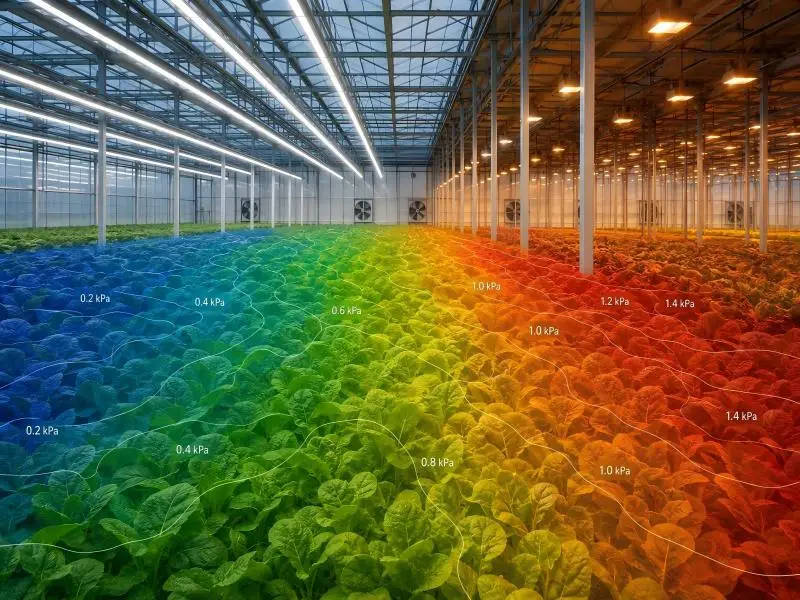
Lowering a light usually increases intensity in the center, but it can also create hotspots and reduce edge coverage. Raising it tends to reduce peak PPFD while improving uniformity across the canopy, which often produces more consistent plant structure and reduces stress.
If your canopy has mixed heights (or you’re in a tent with reflective walls), your “best” distance can change week by week. That’s why this article uses wattage as a starting point—but relies on PPFD as the finishing tool.
Heat and Leaf Temperature Still Matter With LEDs
LEDs radiate less infrared than HPS, but plants can still overheat from high photon density, poor airflow, and warm drivers/heat sinks above the canopy. If leaf temperature climbs while PPFD is high, you can get bleaching, leaf edge curl, or stalled growth even when nutrients and watering are correct.
The Metrics That Make a Distance Chart Actually Useful
PPFD vs PPF vs “Watts”
- PPF (Photosynthetic Photon Flux) is total PAR photons emitted per second by the fixture (μmol/s).
- PPFD is those photons distributed over area at the canopy (μmol/m²/s).
- Watts is electrical input power, which only tells you energy consumption—not how efficiently photons are made or delivered.
For clear terminology, the DLC Horticultural Lighting Resources explain how PAR is commonly reported as PPF and PPFD, and why measurement method matters for comparisons. Design Lights
If you’re choosing a light based on “watts,” treat it as a rough class label (small / medium / high output). For dialing distance, you’ll get far better results using PPFD measurements or reliable PPFD maps.
DLI: The “Daily Dose” That Turns PPFD Into Scheduling
PPFD is intensity “right now.” Plants also respond to how long the light stays on, which is why DLI (Daily Light Integral) matters. Michigan State University describes DLI as the number of PAR photons received in one day. Ag & Natural Resources College
A practical definition is: DLI is the product of PPFD and photoperiod, and increasing either one increases DLI. Produce Grower
You don’t need to be a math person to use DLI. It’s simply how you avoid “too much light for too long” (stress) or “not enough light per day” (stretch and low yield).
Why Trustworthy Charts Reference Standards and Testing
If a brand publishes a “distance chart” without explaining measurement height, grid method, or test standard, it’s marketing—not engineering. For LED fixtures, many reputable manufacturers back performance claims with ANSI/IES LM-79 testing (photometric + electrical performance). Intertek
For horticultural terms and PAR measurement conventions, ANSI/ASABE S640 is widely referenced. A preview of that standard explains PAR (400–700 nm) and clarifies PPF vs PPFD measurement concepts. ANSI Webstore
What Changes When You Raise or Lower an LED Grow Light
The Basic Physics (And Why It’s Not Just Inverse-Square)
People love quoting the inverse-square law, but real fixtures are not point sources. A modern LED grow light is a distributed array with optics and beam shaping, so intensity does not fall off perfectly with distance like a bare bulb would.
That said, closer = higher center PPFD is still a reliable rule. If you drop your light too close, the center spikes while edges lag, which can cause uneven canopy development and localized bleaching.
Optics, Beam Angle, and “Bar vs Board” Layout
Optics can concentrate or spread photons. Many horticultural optics guides show how beam shaping affects uniformity and canopy delivery—especially in multi-bar systems. LEDiL
In practice:
- Board-style fixtures can create a strong central zone at close distances.
- Bar-style fixtures often deliver more uniform PPFD at moderate heights, especially over larger canopies.
So if your chart came from a different fixture style than yours, the recommended height can be misleading.
How to Read a Grow Light Distance Chart LED (Without Getting Tricked)
A Chart Is Only Valid If You Know These 5 Things
A chart is meaningful only if it states:
- Dimming level (100%? 75%?)
- Measurement height (canopy distance)
- Coverage area (2×2, 4×4, etc.)
- Measurement grid (how many points, and where)
- Instrument and method (quantum sensor vs calculated estimate)
If those are missing, treat the chart as a “starting guess.” That’s okay—just don’t treat it as a guarantee.
Look for PPFD Maps, Not Single Numbers
A single PPFD number can hide huge unevenness. A PPFD map (grid) shows whether your canopy gets consistent light, which affects how evenly plants feed, transpire, and develop.
If you sell into professional horticulture markets, DLC requirements can be a useful benchmark for how technical documentation is structured and what performance evidence looks like. Design Lights
Grow Light Distance Chart LED: Starting Heights by Wattage Class
Below is a practical starting chart for common LED wattage classes. These are starting heights, assuming:
- A modern full-spectrum LED fixture with decent efficacy,
- Typical reflective tent or indoor room,
- Normal ambient temps and good airflow,
- You will fine-tune using plant response and (ideally) PPFD measurement.
Important: Wattage alone cannot predict PPFD. Use this as a safe baseline, then adjust.
Quick Starting Chart (General Indoor Growing)
| LED Power Class (Actual Draw) | Seedlings / Clones (start) | Veg (start) | Flower (start) |
|---|---|---|---|
| 100–150W | 18–24 in (45–60 cm) | 14–20 in (35–50 cm) | 12–18 in (30–45 cm) |
| 200–250W | 20–28 in (50–70 cm) | 16–24 in (40–60 cm) | 14–20 in (35–50 cm) |
| 300–350W | 24–32 in (60–80 cm) | 18–26 in (45–65 cm) | 16–24 in (40–60 cm) |
| 450–500W | 28–40 in (70–100 cm) | 20–30 in (50–75 cm) | 18–26 in (45–65 cm) |
| 600–700W | 32–44 in (80–110 cm) | 22–34 in (55–85 cm) | 18–30 in (45–75 cm) |
| 800–1000W | 36–54 in (90–135 cm) | 24–40 in (60–100 cm) | 20–36 in (50–90 cm) |
Each range is intentionally wide because fixtures vary a lot. Start higher if you’re unsure, then lower gradually while watching the canopy over 48–72 hours.
Wattage vs Coverage: A Practical Way to Avoid “Too Close”
The most common mistake is using a powerful fixture over a small area and hanging it “because a chart said so.” If you’re running a high-output fixture over a tight footprint, raise the light and/or dim it until your PPFD is reasonable and your canopy is even.
A high-quality distance chart always pairs wattage guidance with coverage size and PPFD mapping. If your chart doesn’t, treat it as a draft—not the final answer.
Optimal PPFD Targets by Growth Stage (The Numbers That Matter)
Recommended PPFD Windows (General)
As a working baseline for many indoor crops:
- Seedlings / clones: ~100–300 μmol/m²/s
- Vegetative growth: ~300–600 μmol/m²/s
- Flowering / fruiting: ~600–900+ μmol/m²/s (crop-dependent)
For cannabis specifically, peer-reviewed literature and reviews often discuss a sweet spot around 600–900 μmol/m²/s as a balanced range for morphology and performance, depending on conditions and cultivar. PMC
These values are not “magic,” but they’re a strong starting range if you don’t have CO₂ supplementation or perfect environmental control.
When 900+ PPFD Makes Sense (And When It Doesn’t)
Some research shows yield responses at higher intensities, but the win depends on the whole system: CO₂, temperature, VPD, watering strategy, and genetics. For example, controlled studies in cannabis have evaluated performance around 750–900 PPFD and reported yield differences at higher intensity levels. PLOS
If you push PPFD upward without matching CO₂ and environment, you can get stress instead of yield. In that case, raising the fixture slightly (or dimming) often improves quality and consistency more than brute-force intensity.
Converting PPFD to DLI (Simple and Useful)
A handy rule:
- DLI (mol/m²/day) ≈ PPFD × hours × 0.0036
Example:
- 600 PPFD for 12 hours → 600 × 12 × 0.0036 ≈ 25.9 DLI
- 300 PPFD for 18 hours → 300 × 18 × 0.0036 ≈ 19.4 DLI
This is how you decide whether to change distance, dimming, or photoperiod. If DLI is too high, you can reduce any one of those three—often easiest by raising the light slightly.
How to Dial In Hanging Height With Confidence
Use a Real PPFD Meter If You Can
A calibrated quantum sensor is the most reliable tool for canopy PPFD. Standards and industry guidance commonly refer to quantum sensors or spectroradiometer-based methods for deriving PPF/PPFD. ANSI Webstore
If you can’t buy a meter today, you can still apply the method: adjust in small steps, observe canopy response, and keep a consistent watering/feed strategy so you can isolate light effects.
Step-by-Step: The “Grid and Adjust” Method
- Set the light to your intended dim level. This matters because distance charts change with dimming.
- Pick a starting height from the wattage chart above. Start higher if plants are young.
- Measure PPFD (or estimate with a map provided by the manufacturer). Check center and corners, not just one point.
- Adjust height by small increments. Move 2–4 inches (5–10 cm) at a time, then wait 48–72 hours.
- Lock it in once canopy growth is consistent. Then only adjust as the canopy rises or your stage changes.
The key is consistency: a perfect PPFD target is less valuable than stable conditions plants can adapt to.
What Plant Signals Tell You About Distance
- Stretching / large internodes: Usually too low PPFD at canopy, or light too far away (or both). Raise PPFD by lowering slightly or increasing power.
- Bleaching / pale tops: Often too high center PPFD, light too close, or poor airflow/high leaf temp. Raise the light, improve airflow, or dim.
- Leaf taco / edge curl: Often heat + intensity combination. Raise the fixture and improve air exchange.
- Uneven canopy development: Often poor uniformity. Raise the light (or switch to a bar-style distribution) to smooth the map.
Each symptom should be evaluated with environment and watering, but light height is one of the fastest variables to test.
Real-World Distance Examples (Common Indoor Setups)
2×2 ft (60×60 cm) Tent, 100–200W LED
Start around 18–24 inches for seedlings and early veg, then gradually lower to 14–18 inches as plants establish. If flowering in a 2×2, many growers end up around 12–18 inches, but only if uniformity remains acceptable and the canopy isn’t bleaching.
Because the area is small, hotspots happen easily. Raising slightly often improves quality more than chasing maximum center PPFD.
4×4 ft (120×120 cm) Tent, 450–650W LED
A common “stable” zone is 20–30 inches during veg and 18–26 inches during flower, depending on fixture style and dimming. Multi-bar fixtures often perform well at the higher end because they maintain strong uniformity while still delivering adequate PPFD.
If your corners lag, raise the light and consider increasing power rather than dropping closer. This trades a small loss in peak PPFD for better whole-canopy consistency, which often improves total yield.
5×5 ft (150×150 cm) Tent, 700–1000W LED
For high-output fixtures, start high (often 30–44 inches early) and work downward slowly. In flower, many rooms settle anywhere from ~20–36 inches depending on CO₂ strategy and how much uniformity the canopy needs.
If you want professional repeatability, use PPFD mapping and track DLI. That approach beats any “one number” chart once your canopy gets dense.
Why Fixture Construction Changes the “Right” Distance
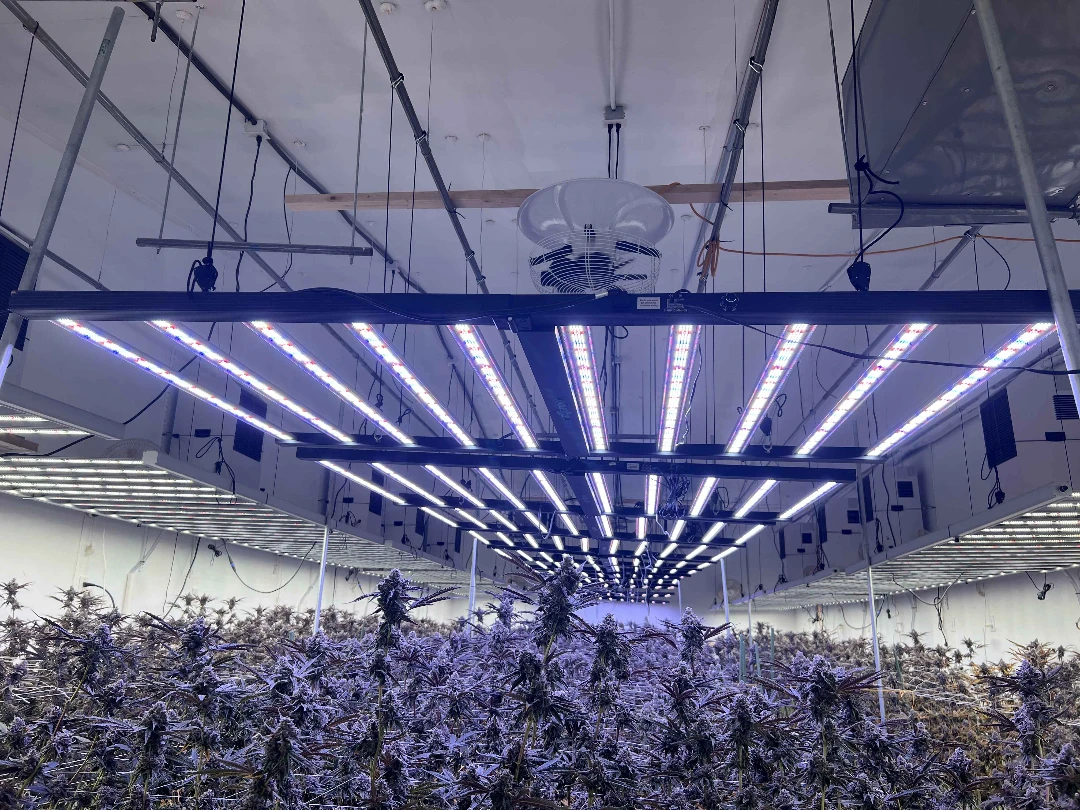
Driver Efficiency and Thermal Design Affect Output Stability
Distance charts assume output is stable. But heat can reduce driver efficiency and change diode performance, which can shift PPFD. Good thermal paths and robust mechanical design reduce those swings, which keeps your hanging-height tuning more consistent over a full cycle.
This is where OEM build quality matters. Performance and safety evaluations for horticultural lighting consider more than just photons—they also look at reliability, operating conditions, and documentation. UL Solutions
Optics and Mechanical Architecture Change Uniformity
As noted in optics-focused horticultural guidance, optical choices strongly influence the distribution pattern. LEDiL
That distribution pattern determines whether “closer” improves your grow—or simply increases hotspot stress.
For Grow-Light OEMs: Electrical Distribution Hardware Matters Too
For brands building LED grow lights at scale, internal electrical design influences real-world performance. High-current paths, low-loss connections, thermal stability, and mechanical repeatability all impact whether a fixture delivers consistent PPFD over time and across production batches.
This is one reason grow-light manufacturers often rely on precision metal parts—such as custom copper busbars, stamped power connectors, and deep-drawn housings—to manage current, reduce resistive loss, and maintain mechanical stability. If you’re developing horticultural fixtures, suppliers like JUMAI TECH support these builds with Precision Copper Busbars, Deep-Drawn Components, and Precision Stamping Dies that help production teams deliver consistent assemblies from pilot runs to volume.
Troubleshooting: Fixing Common Hanging-Height Problems Fast
“My Plants Are Bleaching at the Top”
Raise the fixture 4–8 inches (10–20 cm) and hold settings for 2–3 days. If bleaching slows but plants stretch, you likely need better uniformity (raise + increase power slightly, or use a broader distribution fixture).
Also confirm airflow above the canopy. Bleaching is often “too much PPFD + too much leaf temp,” not PPFD alone.
“My Plants Are Stretching Even at 100% Power”
If your PPFD is low at canopy, the fix is usually closer—but do it carefully to avoid hotspots. Lower 2–4 inches (5–10 cm) and observe internode spacing over the next few days.
If you’re already close and still stretching, your issue may be coverage mismatch (fixture too small), or you’re using a dim setting unintentionally. In that case, raising the fixture won’t help—you need more photons or a better distribution pattern.
“My Canopy Is Uneven and Some Areas Finish Slower”
This is usually a PPFD uniformity problem. Raise the fixture to smooth the map, and consider a layout change (bar fixtures, multiple smaller fixtures, or a different hanging strategy).
Uniformity often increases yield more reliably than pushing a very high center PPFD. A distance chart that ignores uniformity is incomplete.
FAQ: Grow Light Distance Chart LED Questions
Is wattage a reliable way to set hanging height?
Wattage is useful as a rough starting point, but it’s not reliable for dialing height by itself. Two fixtures with equal wattage can deliver very different canopy PPFD because efficacy, optics, and distribution differ. Use wattage to choose a starting range, then confirm by PPFD or plant response.
Should I lower the light as plants grow?
Often yes, but not always. As the canopy fills in, plants can handle more light, yet dense canopies also create hotspots and microclimates. Many grows actually benefit from raising the fixture slightly in mid/late flower to improve uniformity while maintaining target PPFD via dimming or power adjustments.
What’s the best height for flowering?
There isn’t one universal number. A better approach is targeting a flowering PPFD range that matches your crop and environment, commonly discussed around 600–900+ μmol/m²/s for many high-light crops, with peer-reviewed cannabis discussions frequently referencing that band depending on conditions. PMC
Do distance charts apply to every brand?
Only if the chart is based on the same fixture geometry, optics, coverage size, and measurement method. If a chart doesn’t specify those details, it’s a rough guess. The most dependable charts reference proper testing methods or publish PPFD maps.
Use Wattage to Start, PPFD to Finish
A grow light distance chart LED is most useful when you treat it as a two-step system:
- Start with a safe height range based on wattage and coverage.
- Finish with PPFD and DLI, tuning height (and dimming) until plants show stable, healthy growth and uniform development.
If you’re a grower, this approach prevents the classic cycle of “too close → stress → too far → stretch.” If you’re a grow-light OEM, investing in consistent optical design, stable thermal paths, and reliable internal electrical hardware (like precision busbars and stamped power components) makes your performance more repeatable—so your charts become more trustworthy.