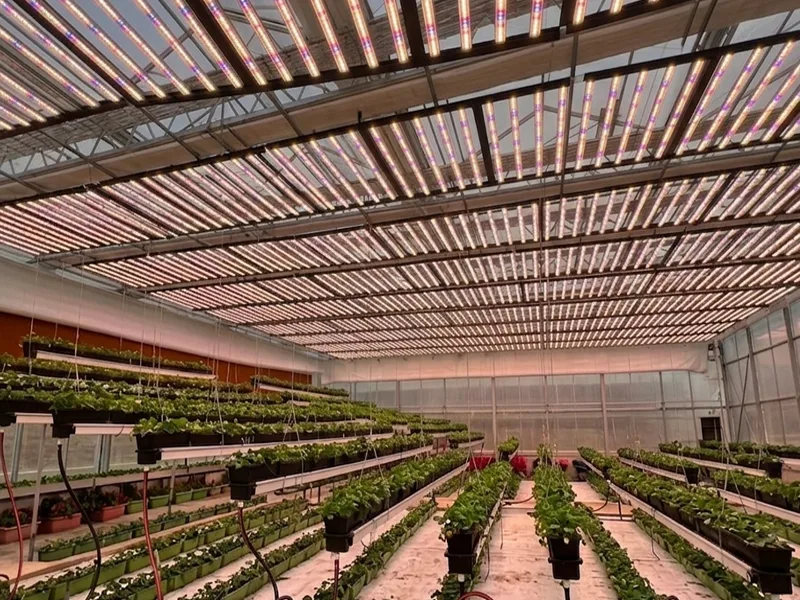
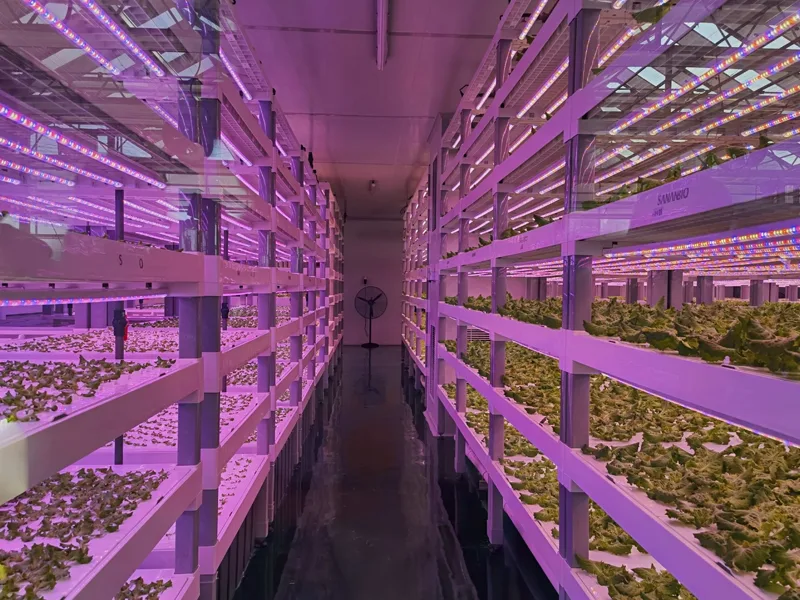
Engineer the perfect light spectrum for optimal plant growth. Boost your yields and cultivate year-round with our energy-efficient LED solutions. Tell us your needs for a customized lighting strategy and quote.
When you type led grow lights near me into a search engine, you are likely driven by one of two things: urgency or the need for tangible assurance. Perhaps your main light just failed in the middle of a critical flowering week, and you are panicking about yield loss. Or, maybe you are a prudent investor who wants to physically inspect the build quality of a fixture before committing thousands of dollars to a commercial setup. These are valid motivations. However, the landscape of horticultural lighting has evolved drastically over the last decade. The best solution is not always the one geographically closest to you; often, it is the one that offers the best balance of technology, support, and price-to-performance ratio.
As the Editor-in-Chief of SLTMAKS, and having spent years in the trenches of R&D and production, I have seen the industry shift from inefficient HPS systems to high-tech LED solutions. I understand the mechanics of photon flux, thermal management, and spectral tuning better than most. While supporting local businesses is noble, the reality of high-end agricultural technology often necessitates looking beyond your local hydroponics shop. In this comprehensive guide, we will explore the nuances of sourcing LED grow lights near me versus partnering with specialized global manufacturers, helping you make an informed decision that benefits your plants and your bottom line.
Table of Contents
The Psychology and Convenience of Buying Locally
When growers search for led grow lights near me, they are often looking for the security that comes with a brick-and-mortar transaction. There is a distinct psychological comfort in walking into a store, talking to a human being, and walking out with a box in hand. This section explores why this option remains popular and where it shines.
The Factor of Immediate Gratification and Emergency Replacements
The single greatest advantage of a local supplier is immediacy. If a driver fails or a capacitor blows in your primary fixture on a Friday afternoon, ordering online—even with expedited shipping—might mean your plants go without optimal light for 48 to 72 hours. In the vegetative stage, this is manageable; in the flowering stage, it can trigger stress, hermaphroditism, or stunted bud development. Local shops serve as crucial emergency rooms for your grow operation. Being able to drive twenty minutes to pick up a replacement fixture can save a harvest. For this reason, we often recommend that even our commercial clients keep a relationship with a local supplier for emergency consumables, even if they source their primary infrastructure from us directly.
Physical Inspection and Build Quality Assessment
Photos on a website can be deceptive. A fixture might look robust in a rendering, but feel flimsy and cheap in reality. When you visit a local store, you can physically lift the unit. You can gauge the weight of the aluminum heat sink—a critical factor in passive cooling and LED longevity. You can inspect the soldering on the board connections and the quality of the hanging hardware. For growers who have been burned by low-quality imports in the past, the ability to see and touch the product is invaluable. However, as we will discuss later, physical appearance does not always correlate with spectral performance or Photosynthetic Photon Efficacy (PPE).
The Value of Face-to-Face Community Support
Local grow shops are often the hubs of the local cultivating community. The staff are frequently growers themselves and can offer advice on local water quality, common local pests, and climate control issues specific to your region. When you buy LED grow lights near me, you are paying a premium, but part of that premium covers this access to local knowledge. However, one must be careful to distinguish between genuine horticultural advice and a sales pitch designed to move stagnant inventory.
The Hidden Costs of “Near Me”: Why Local Isn’t Always Logical
While the convenience is undeniable, the economics of local retail are brutal. To understand why you might be overpaying or under-speccing your grow by shopping locally, we need to look at the supply chain.
The Impact of Overhead on Pricing
A local hydroponics store has significant overheads: rent in a commercial district, electricity, staff salaries, insurance, and inventory taxes. To stay in business, they must apply a substantial markup to every product on the shelf—often between 30% to 50% above the wholesale cost. When you buy a light for $1,000 locally, you might effectively be buying $600 worth of technology, with the rest subsidizing the store’s existence. In contrast, buying from a specialized manufacturer like SLTMAKS or a direct-to-consumer online platform removes several layers of middlemen. This allows you to invest your budget into better diodes (like Samsung LM301H) and better drivers (like Mean Well), rather than paying for the retailer’s air conditioning.
The Limitation of Shelf Space and Inventory
Physical stores have finite space. They cannot stock every model, every spectrum variation, or every wattage. Usually, a local store will carry two or three “safe” brands that appeal to the average hobbyist. They are unlikely to stock specialized commercial fixtures, high-bay replacements, or bars with adjustable UV/IR channels because these are niche products that take up valuable space. If you are looking for a specific spectrum optimized for a specific cultivar, searching for LED grow lights near me will likely yield generic results. You are forced to choose from what is available, rather than what is optimal.
Technology Lag in Retail Environments
LED technology evolves at a blistering pace. The efficiency of diodes improves every six months. A local shop, however, has to sell through its existing stock before ordering new models. This means the “new” light on the shelf might actually utilize technology that is 12 to 18 months old. In the world of LEDs, that is a generation behind. Online manufacturers, who operate on a made-to-order or high-turnover basis, are typically shipping the latest bin of diodes with the highest efficacy ratings.
Comparing Technical Performance: Showroom vs. Factory Direct
This is where my experience in R&D becomes crucial. What you see with your eyes is not what plants “see.” We need to compare how local retailers and online manufacturers present technical data.
Understanding Spectrum and Efficacy Beyond the Eye
Human eyes are sensitive to green and yellow light, which makes a light look “bright.” Plants, however, rely heavily on red (660nm) and blue (450nm) wavelengths for photosynthesis, alongside non-visible UV and Far-Red light for morphological signaling. A light in a local shop might look incredibly bright but lack the specific PAR (Photosynthetic Active Radiation) power required for deep canopy penetration.
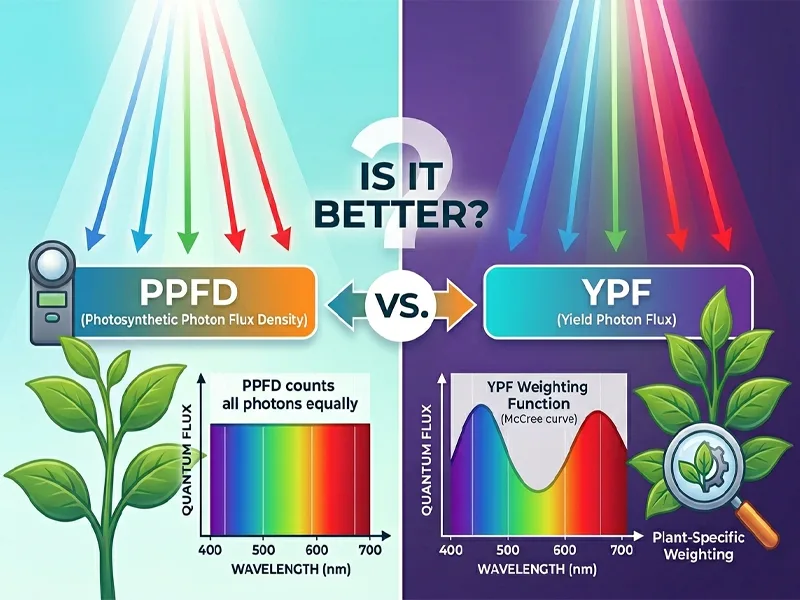
Online manufacturers like SLTMAKS provide detailed spectral charts and PPFD (Photosynthetic Photon Flux Density) maps. We can customize the spectrum. If a commercial client needs a higher ratio of Far-Red to induce the Emerson Effect, we can engineer that. A local store simply hands you a box and says, “This is full spectrum.”
The Data Discrepancy Table
Below is a comparison of what you typically get when buying a standard retail light versus a specialized direct-to-consumer light.
Feature
Typical Retail Store Light
Direct/Online Manufacturer (e.g., SLTMAKS)
Diodes Used
Often unbranded or older generation Samsung
Latest Samsung LM301H / Osram mixtures
Driver Brand
Generic or Proprietary (hard to replace)
Mean Well, Inventronics (Industry Standard)
Efficacy (PPE)
2.3 – 2.5 µmol/J
2.7 – 3.1+ µmol/J
Spectrum
Fixed / Generic Full Spectrum
Customizable (UV/IR channels, tunable)
Dimming
Basic Knob (0-100%)
Daisy-chain capable, RJ14 ports, Controller ready
Certifications
Basic CE/RoHS
UL, ETL, DLC Premium (Crucial for rebates)
Warranty
1-3 Years (Store handling)
5 Years (Manufacturer Direct)
Thermal Management and Lifespan
In a store, lights are rarely turned on for hours at full power. You cannot judge how hot they get. Poor thermal management is the number one killer of LEDs. Direct manufacturers optimize heat sinks using Computer-Aided Design (CAD) simulations to ensure the junction temperature of the diodes remains low. When you search led grow lights near me, you often find consumer-grade plastic or thin aluminum housings. Professional online suppliers prioritize heavy-duty aluminum heat sinks that act as passive cooling systems, ensuring the light maintains 90% of its output (L90) for 50,000 hours or more.
Logistics: The Myth of “Wait Times”
One of the main arguments against ordering online is the wait. “I can’t wait two weeks for a light from China,” is a common refrain. However, the logistics landscape has changed.
Global Warehousing Solutions
Smart manufacturers, including SLTMAKS, utilize global warehousing. We stock popular models in warehouses in the USA, Europe, and Canada. This means that “online” does not necessarily mean “overseas shipping.” Often, an order placed on our website is fulfilled from a warehouse in California or Germany and arrives at your doorstep in 3 to 5 business days. This bridges the gap between the immediacy of LED grow lights near me and the quality of global manufacturing.
Shipping Damages and Insurance
Transporting delicate electronics requires specialized packaging. Local shops receive lights on pallets, which is safe. When you buy a floor model or a box from a shelf, you are transporting it yourself. If you drop it in the parking lot, you are liable. When you order from a reputable online supplier, the shipment is insured. If it arrives with a dented corner or a cracked lens, the manufacturer is responsible for the replacement. We use reinforced foam packaging that has been drop-tested to withstand the rigors of international couriers like DHL, FedEx, and UPS.
The Commercial Grower’s Dilemma: Scalability
For home growers with one 4×4 tent, buying locally is feasible. But what if you are scaling up?
Consistency Across Large Deployments
If you are outfitting a facility with 50, 100, or 500 lights, you cannot rely on local inventory. You need absolute consistency. Every fixture must have the same bin of diodes and the same driver output to ensure a uniform canopy. If you buy 20 lights from a local shop, they might be from different manufacturing batches with slight spectral variances. Ordering direct ensures that your entire batch is manufactured simultaneously, guaranteeing uniformity—a key factor in standardizing SOPs (Standard Operating Procedures) for commercial cultivation.
Volume Pricing and Customization
Searching for led grow lights near me will rarely yield wholesale pricing unless you have a specific B2B relationship with a distributor. Manufacturers operate on volume. If you need 50 lights, we don’t just offer a discount; we offer a partnership. We can print your company logo on the fixture, adjust the cable lengths to fit your ceiling height, and configure the plugs (NEMA, Schuko, UK) to match your facility’s electrical infrastructure without the need for adapters.
How to Vet an Online Supplier (Since You Can’t Visit “Near Me”)
If you decide that the value proposition of online sourcing outweighs the convenience of local shopping, you need to know how to vet a supplier to avoid scams or low-quality products.
Check for Third-Party Lab Reports
Do not trust the numbers printed on the box. Demand an Integrating Sphere Test Report. This is a laboratory test that measures the total light output, spectral distribution, and electrical efficiency. Reputable companies will email you this PDF without hesitation. If a supplier refuses or says “it’s proprietary,” run away. At SLTMAKS, we provide sphere test data for all our flagship models, proving that our PPFD maps are based on reality, not marketing fabrication.
Verify Certifications for Safety and Rebates
In many regions, commercial growers can get cash-back rebates from utility companies for using energy-efficient LED lighting (e.g., DesignLights Consortium or DLC listed products). Local shops may not carry these high-tier certified lights because they are more expensive. Online, you can filter specifically for DLC-listed fixtures. Furthermore, ensure the lights are UL (Underwriters Laboratories) or ETL listed. This is non-negotiable for insurance purposes. If your facility catches fire and your lights were not safety certified, your insurance claim will likely be denied.
For more information on energy rebates, you can visit the DesignLights Consortium (DLC) website.
Analyze the Warranty Terms
A “3-year warranty” from a local shop often means “bring it back to us, and we will try to fix it or send it to the manufacturer.” If that shop goes out of business, your warranty is gone. A manufacturer’s warranty is backed by the company that built the product. Look for terms that include “advance replacement” for commercial accounts, meaning the manufacturer sends a new unit before receiving the broken one, minimizing downtime.
Hybrid Strategy: The Best of Both Worlds
You don’t have to choose strictly between LED grow lights near me and online ordering. Smart growers use a hybrid approach.
Use Local for Consumables, Online for Infrastructure
Buy your soil, nutrients, pH meters, and trellis netting from your local shop. These items are heavy to ship and you need them regularly. Build a relationship with the shop owner. But for your capital expenditure—your lights, your rolling benches, your HVAC—go direct to the source. This maximizes your budget where it counts (technology) while supporting the local economy where it makes sense (consumables).
The “Showrooming” Etiquette
Some growers visit local shops to look at brands and then buy them online for cheaper. This is generally frowned upon and hurts the local community. If a local shop spends time educating you, it is ethical to support them. However, if their product selection is inferior to what you can get from SLTMAKS or other top-tier manufacturers, it is strictly a business decision. You are not obligated to buy inferior technology just because it is nearby.
Making the Right Choice for Your Harvest
The search for led grow lights near me is often the starting point of a grower’s journey, but it should rarely be the endpoint. While the convenience of a local pickup is unmatched for emergencies, the modern grower demands more. You demand specific spectrums, high efficacy, certification for insurance and rebates, and pricing that allows for ROI in less than 12 months.
At SLTMAKS, we bridge this gap. We bring the R&D capabilities of a global manufacturer directly to your doorstep. We offer the transparency of third-party lab data, the reliability of top-tier components like Samsung and Mean Well, and the support of a team that actually understands the science of plant growth. Whether you are lighting a closet or a warehouse, do not limit yourself to what is on the shelf down the street. Expand your horizon, demand the best technology, and let your results speak for themselves.
Frequently Asked Questions (FAQ)
To further assist you in navigating the complexities of lighting selection, we have compiled a list of common questions we receive from customers who are considering local versus online sourcing.
Can I really trust the PPFD charts on a website?
A: You should only trust PPFD charts that are accompanied by test conditions. A chart should specify the hanging height, the reflective environment (tents vs. open room), and the specific instrument used (e.g., Li-Cor sensor). At SLTMAKS, we are transparent about our testing parameters. Be wary of charts that show perfect uniformity without explaining how it was achieved, as they are often theoretical simulations rather than real-world tests.
What happens if an online light arrives damaged?
A: This is a common fear. Reputable manufacturers use heavy-duty, double-walled corrugated cardboard with custom-molded foam inserts. In the rare event of damage, take photos immediately and contact support. A good company will ship a replacement component (like a driver or a light bar) or a whole new unit within 24 hours. Always check the “Shipping & Returns” policy before buying.
Are “USA Brand” lights sold locally actually made in the USA?
A: This is a misconception. The vast majority of LED grow lights, regardless of the brand sticker, are manufactured in China or assembled in the USA using global components. The diodes come from Korea (Samsung) or Germany (Osram), and the drivers often come from Taiwan (Mean Well). “Made in USA” often refers to final assembly. Buying from a direct manufacturer often gives you the same components without the markup associated with the “Brand Name.”
How do I know what size light fits my tent?
A: As a general rule of thumb for high-efficacy LEDs: 2×2 ft area: 100W – 150W 2×4 ft area: 240W – 320W 3×3 ft area: 240W – 300W 4×4 ft area: 480W – 650W 5×5 ft area: 650W – 800W+Local shops might try to oversell you on wattage. More is not always better; too much light without CO2 supplementation can actually damage your plants.
Why are some lights purple and some white?
A: “Purple” or “Blurple” lights are older technology that focused only on the red and Blue bands. While plants can grow under them, they are hard to diagnose plant health under (you can’t see leaf discoloration). Modern “White” full-spectrum LEDs (like those we produce) mimic sunlight. They include green and yellow wavelengths, which penetrate deeper into the canopy and allow you to see your plants in their true colors. We highly recommend Full Spectrum White LEDs for all stages of growth.
Do I need a controller for my LED lights?
A: For a single light, the built-in dimmer knob is usually sufficient. However, if you are running multiple lights or if you want to simulate sunrise/sunset (which reduces stress on plants), a master controller is beneficial. Most professional lights sold online have RJ14 ports allowing them to connect to master controllers (like TrolMaster or generic 0-10V dimmers). Check if the local light “near me” has these ports; many cheap retail models do not.
How much can I save on electricity by switching to LED?
A: If you are switching from HPS (High-Pressure Sodium) to LED, you can expect an energy saving of roughly 30-40% for the light itself. However, the secondary savings are massive. LEDs produce significantly less radiant heat, meaning your air conditioning costs can drop by 50%. A local shop can tell you this, but an online ROI calculator (often found on manufacturer sites) can give you the exact dollar amount based on your local KWh cost.
Are UV and IR really necessary?
A: UV (Ultraviolet) can increase trichome production and potency as a stress response. IR (Infrared) helps with cell expansion and triggers the Emerson Effect for faster photosynthesis. While not strictly “necessary” for basic growth, they are essential for “top-shelf” quality. Many standard lights at local shops lack dedicated UV/IR diodes to keep costs down. Premium online fixtures often include them or have separate switchable channels for them. By understanding these nuances, you move from being a passive consumer searching for LED grow lights near me to an informed procurement officer for your garden. The distance to the supplier matters less than the quality of the photons hitting your canopy. Choose wisely, grow better.