Introduction
If you run (or are about to build) a commercial tomato greenhouse, you don’t need another argument that “LED is the future.” You need a spec you can defend to finance, a climate strategy you can defend to your head grower, and a commissioning plan you can defend to your inspector.
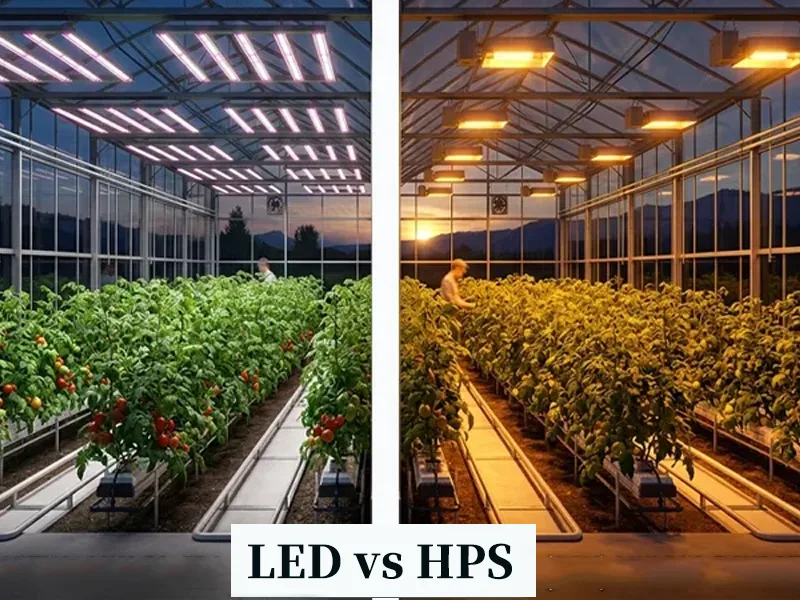
This guide is written for Heads of Cultivation and Operations in tomato greenhouses who are at the decision point: choose LED, choose HPS, or choose a hybrid approach.
What you’ll get is an evidence-led LED vs HPS commercial greenhouse comparison anchored to the KPIs that actually move outcomes in high-wire tomatoes:
- Yield (kg/m²/year or truss yield)
- Fruit quality (especially °Brix, but also dry matter and consistency)
- PPFD / DLI (canopy intensity and daily light integral)
- Energy intensity (practical “kWh/kg” thinking, not just fixture wattage)
- HVAC / climate load (heating, dehumidification, ventilation tradeoffs)
- Uptime (maintenance burden and failure modes)
- ROI / payback (capex vs total cost of ownership)
| KPI | What to measure | Why it matters in LED vs HPS decisions |
| Yield | kg/m²/year, truss yield, fruit count | Confirms whether extra photons translate into sellable volume |
| Fruit quality | °Brix, dry matter, size distribution, consistency | Revenue is often driven by grade/premium, not just kg |
| Light delivery | PPFD maps, total DLI (sun + supplemental) by month | Prevents “paper efficacy” from hiding weak canopy distribution |
| Energy intensity | kWh, kWh/kg, time-of-use exposure | Connects fixture choice to utility cost and margin |
| Climate impact | canopy temp, RH/VPD, dehumidification runtime | Lamp heat changes the HVAC strategy and disease risk |
| Reliability | failures, spare parts lead time, service time | Downtime has a direct crop and labor cost |
| Economics | capex, incentives, payback sensitivity | Avoids oversimplified ROI assumptions and surprises |
Timeframe and sources: The comparison uses a 2021–2026 evidence window and industry guidance. Where claims are research-backed, they’re cited inline; where numbers are modeling assumptions (tariffs, hours, deltas), they’re labeled as assumptions.
How to use this guide: Treat it as a decision checklist for both retrofit and new-build scenarios:
- Set your yield and quality targets (and don’t skip °Brix).
- Set PPFD/DLI targets by season, not as a single annual average.
- Run energy + heating + dehumidification as one combined model.
- Pressure-test reliability, controls integration, and compliance documentation.
- Commission with measurements (PPFD maps, DLI logs, dimming response), then scale.
Table of Contents
Agronomic Outcomes
Yield and Quality Metrics
For tomatoes, the first mistake in the LED vs HPS debates is treating “more photons” as the only lever. In practice, you’re balancing:
- Photons delivered (PPFD/DLI)
- Photon quality (spectrum)
- Canopy temperature and transpiration
- Crop load management and sink strength
- How your climate strategy reacts once lamp heat changes
What the research says (and what it doesn’t):
A useful baseline is the 2021 meta-analysis by Appolloni et al. on supplemental LED lighting in greenhouse truss tomatoes, published in Frontiers in Plant Science (open access via PMC). Across the aggregated studies, supplemental LEDs were associated with higher yield and improved quality metrics versus controls, reporting (in the pooled analysis) higher yield and increases in quality indicators like soluble solids and ascorbic acid in many conditions (“Supplemental LED Lighting… Meta-Analysis” (2021)).
But decision-stage buyers should read that result carefully:
- Many comparisons in the literature are LED vs no supplemental light or LED in a specific configuration (top-light, inter-light, hybrid), not a single universal “LED beats HPS” conclusion.
- Real outcomes often hinge on whether you preserve (or intentionally change) canopy temperature, humidity, and DLI when you switch lamp type.
What this means for your decision:
- If your current HPS system is already hitting an economically optimal DLI, an LED retrofit needs a plan for what you’ll do with the “extra” headroom: run higher DLI at the same electricity spend, push a more uniform distribution, or reduce HVAC penalties and keep yield stable.
- If your current greenhouse underdelivers DLI in winter or shoulder months, LEDs can be a direct lever for yield consistency—provided the climate strategy is tuned for lower radiant heat.
On fruit quality, treat °Brix as a management outcome, not a guaranteed technology outcome. Light affects assimilate production, but °Brix also moves with crop load, irrigation EC, canopy temp, and harvest timing. Use lighting as a control input in a system, not as a standalone promise.
Key takeaway: If you’re buying lighting to “increase yield,” write the target as a DLI plan (by month) plus a climate plan (temperature + humidity + CO₂), then evaluate LED vs HPS against that combined spec.
Spectrum Considerations
HPS has a broad spectral output with meaningful radiant heat in the infrared. LEDs give you spectrum control, but the practical question is: what spectrum is worth paying for in a commercial tomato canopy?
Three spectrum-related points matter in a decision-stage spec:
- Photosynthetic efficiency and leaf physiology. In controlled comparisons, tomato leaf gas exchange and photosynthetic capacity can differ under LED vs HPS depending on the spectrum and intensity. For example, Palmitessa et al. (2021) reported differences in gas exchange and photosynthetic capacity under LED and HPS supplemental light in young tomato plants (“LED and HPS Supplementary Light Differentially Affect Gas Exchange…” (2021)). Don’t over-interpret leaf-level results as automatic yield gains—but do treat them as a reminder that spectrum choices can shift transpiration and plant balance, which then changes how hard your dehumidification has to work.
- Canopy penetration and vertical distribution. Tomatoes are a tall, layered crop. If you’re only top-lighting, a lot of photons are intercepted high and never “pay back” in lower canopy photosynthesis. This is one reason many high-performance installations move toward hybrid strategies (top + inter-light) to even out distribution.
- Quality tuning vs stability: Spectrum “recipes can influence morphology and potentially quality traits, but the operational value is often stability: consistent light quality over time, repeatable dimming response, and predictable interactions with climate controls.
Practical spectrum guidance for decision buyers:
- Avoid chasing exotic spectra unless you have trial data in your cultivar and climate.
- Prioritize fixtures with stable output, consistent binning, and controls that let you execute your DLI strategy without surprise spectral shifts.
PPFD and DLI targets
If you want a tomato yield comparison that you can operationalize, you need targets. Not “high PPFD,” but a DLI plan that respects biology and economics.
A good commercial framing for winter production of high-wire greenhouse vegetables (including tomatoes) is summarized in Greenhouse Canada’s 2023 guidance on “finding the right light recipe,” which discusses typical intensity and DLI bands used in practice (“Finding the Right Light Recipe” (2023)).
As a practical decision framework:
- Start with total DLI (sun + supplemental). In many commercial contexts, operators aim for a workable total DLI and then decide how much supplemental light is economical.
- Translate DLI targets into PPFD + photoperiod. Example: 200–250 µmol/m²/s over 16–18 hours is a common winter supplemental approach in some production contexts, but the right number is site-specific.
A decision-stage way to set targets is to define three bands:
- Conservative DLI plan: maintain yield stability and quality through low-light months.
- Baseline DLI plan: the economic optimum for your tariff and market window.
- Aggressive DLI plan: higher DLI designed for maximum yield—only if CO₂, temperature, and sink strength are managed.
When comparing LED vs HPS for PPFD/DLI delivery, ask these three questions:
- Can you hit your target DLI without overheating the canopy and forcing ventilation losses?
- Can you hit your target DLI without underheating the canopy (which shifts VPD, transpiration, and disease risk)?
- Can you execute seasonal DLI changes smoothly (dimming control, scheduling, and feedback)?
A simple rule: If you cannot measure it, you can’t manage it. Whatever technology you choose, plan for PPFD mapping and DLI logging as part of commissioning.
Energy and HVAC Impacts
Efficacy and kWh per kg
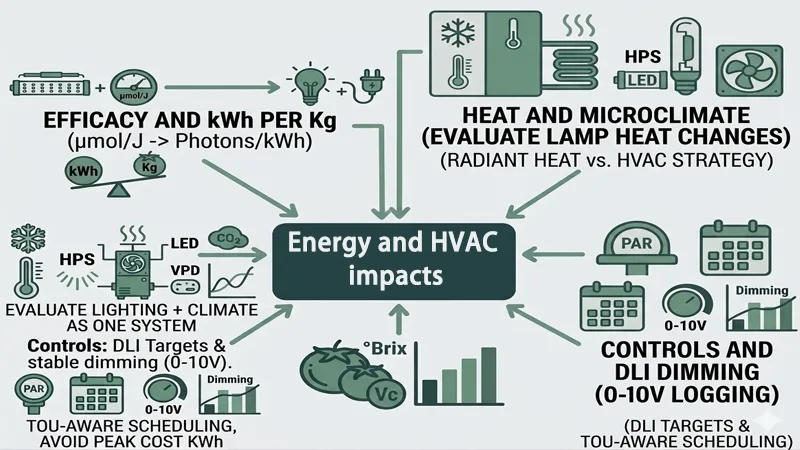
In procurement meetings, efficacy shows up as µmol/J. Operations teams care about kWh/kg and “what did we do to HVAC?” Both are valid—but you need to connect them.
Here’s the decision-stage chain:
- µmol/J (fixture efficacy) determines how many photons you get per kWh.
- Distribution and canopy interception determine how many of those photons become photosynthetic.
- Climate response determines whether additional light translates into additional yield (or into stress).
A practical way to compare systems is to model electricity per delivered photon and then translate to electricity per kg using either your own historical yield response curves or conservative assumptions.
Because you required a California assumption, here’s an illustrative (not universal) framework for CA:
- Electricity tariff assumption (CA): $0.15/kWh (your chosen modeling number)
- Photoperiod assumption (winter): 16 h/day (adjust for your season)
- Seasonal operating days: define the low-light season (e.g., 120–180 days) rather than assuming 365
If you want a sanity check on gas conversions when you add heating, the U.S. Energy Information Administration provides standard conversions: 1 Mcf ≈ 10.38 therms and related unit guidance from its therm/MMBtu FAQ.
What makes LEDs often compelling in CA is not just efficacy; it’s control. Dimming lets you avoid buying peak kWh that doesn’t convert into margin.
If you’re evaluating fixtures and want a neutral way to discuss efficacy, a resource like SLTMAKS’ explainer on efficiency metrics can help align internal stakeholders on what to request in quotes and photometrics (PPE, PPFD maps) — see SLTMAKS Most Efficient LED Grow Lights.
Heat and Microclimate
This is the part that most ROI spreadsheets get wrong.
HPS is not just a light source; it’s also a radiant heater. When you switch to LED, you may reduce electricity, but you also remove a chunk of radiant energy that was helping maintain canopy temperature.
So the right question isn’t “Does LED save energy?” It’s:
- Where does the missing heat come from now?
- What does that do to humidity control (dehumidification/venting) and disease risk?
If you’re in a cool season, lowering radiant heat can:
- Reduce leaf temperature and change transpiration
- Increase time spent in high RH if you don’t compensate with heat + dehumidification strategy
- Shift your VPD management, which can show up as quality inconsistency before it shows up as yield
If you’re in a warm season, removing HPS heat can:
- Reduce the ventilation requirement and allow you to keep CO₂ in the house longer
- Reduce heat stress and blossom-end rot risk associated with microclimate swings
Decision-stage rule: evaluate lighting + climate as one combined system. If your retrofit removes lamp heat, the greenhouse may need a different heating and dehumidification operating strategy to keep fruit quality stable.
Controls and DLI Dimming
Controls are where LED can win even when biology is similar.
A high-performing DLI strategy in CA often means:
- TOU-aware scheduling (avoid peak-cost hours when possible)
- Dimming to maintain a target DLI rather than running fixed output blindly
- Feedback from sensors (PAR sensors, climate computer data) rather than manual switching
California’s rate structures can vary dramatically by time and tariff design; even CPUC materials on dynamic rates illustrate how wide the hourly price spread can be on some pilots (CPUC Vehicle-Grid Integration Forum slides (2024)). You don’t need an exotic rate to benefit from control—basic dimming and scheduling already improve “cost per mol of light.”
If you’re retrofitting, ask vendors (and your controls integrator) a blunt question:
- Can we execute a DLI target with stable dimming and logging?
And if the answer isn’t specific—walk away.
Reliability and Compliance
Maintenance and Lifetime
A commercial tomato greenhouse is not a demo room. It’s a wet, corrosive, high-uptime environment with labor constraints.
Your maintenance comparison should include:
- Lamp replacement cadence (HPS bulbs degrade; LEDs degrade differently)
- Driver failure modes and serviceability
- Cleaning protocol (dust, spray residues, condensation)
- Availability of spares and lead times
A simple but effective decision tool is to price downtime:
- What does one aisle losing supplemental light for 72 hours cost you in yield and quality risk?
- What does a mid-season maintenance event cost you in labor and disruption?
LEDs often reduce routine replacement labor, but only if fixtures are chosen for serviceability and supported with a real warranty.
Safety and Certifications
If you’ve ever had an inspector stall a project, you already know: certifications aren’t “nice to have.” They’re scheduled risk.
At a minimum, your lighting spec should define:
- Recognized safety listing appropriate for your jurisdiction (for the U.S., this is often an NRTL listing)
- Documentation package: installation instructions, electrical ratings, and any declarations required by your AHJ
- Ingress protection expectations for washdown and humidity exposure
This is where a brand mention can be practical instead of promotional: for example, SLTMAKS positions many fixtures around compliance checkboxes such as ETL/CE/RoHS, plus greenhouse-relevant IP65+ environmental protection, which are the kinds of procurement filters that reduce inspection and insurance friction.
If you want a procurement-aligned explanation of what certifications to request and why, see SLTMAKS Recommended LED Grow Light Guide.
Controls Integration
Integration failures are expensive because they show up late—during commissioning, when crews are booked, and the crop is already in.
Your controls checklist should include:
- Dimming method and compatibility: In commercial environments, 0–10V dimming is common because it’s simple, widely supported, and easy to validate with a meter.
- Control granularity: Can you dim by zone, row, or bay to manage DLI and uniformity?
- Fail-safe behavior: What happens on signal loss—full on, full off, last state?
- Logging: Can you export dimming levels and runtime for audit and ROI verification?
A practical note for decision-stage buyers: it’s better to buy a system that integrates cleanly (even if it’s not the “highest µmol/J on paper”) than to buy an efficiency spec that you can’t control reliably.
In this context, it’s reasonable to look for fixtures that support 0–10V, have clear documentation, and come with a 3–5 year warranty backed by a support plan. (For SLTMAKS specifically, these are commonly stated capability targets; validate exact terms per SKU and purchase agreement.)
ROI and Deployment Playbook
Retrofit Modeling Inputs
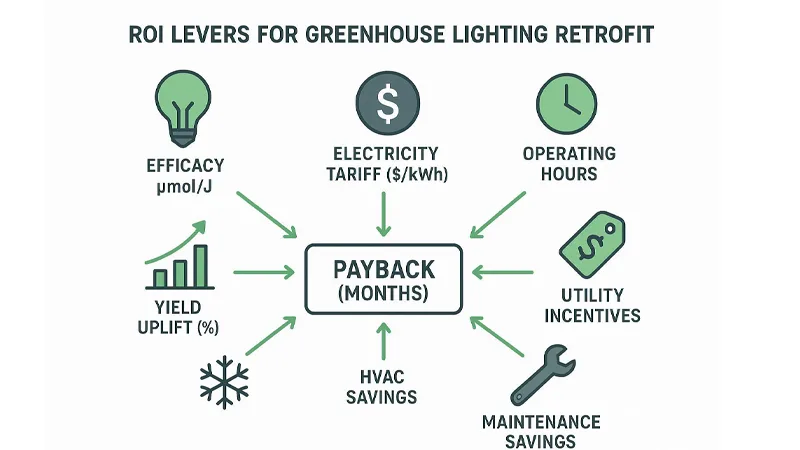
If you want an ROI model that stands up to scrutiny, write the equation as a set of inputs you can replace with your own numbers.
Below is a transparent input set you can use for a California-based retrofit model. Numbers marked “assumption” are illustrative.
A) Lighting and operating assumptions
- Area under supplemental light (m²)
- Target supplemental PPFD (µmol/m²/s) and photoperiod (h/day)
- Operating season length (days/year)
- Fixture efficacy (µmol/J) — quote from vendor with photometric support
- Dimming strategy: fixed output vs DLI target with dimming
B) Energy price assumptions (California)
- Electricity: $0.15/kWh (assumption per your requirement)
- Demand charges: include if applicable (many CA tariffs have meaningful demand components; excluding them understates peak-hour risk)
C) Heating fuel assumption (natural gas)
Because LED removes radiant heat relative to HPS, winter heating can increase.
A clean way to model this is to run a range:
- Natural gas $1.50/therm (low) / $2.50/therm (mid) / $4.00/therm (high) as scenario inputs
If you need unit conversion for integrating gas into an energy model, EIA’s guidance helps keep the math consistent (EIA therm/MMBtu conversions).
D) Outcome assumptions (yield, quality, HVAC)
You can’t responsibly hard-code a yield uplift from “LED” without trials. Instead, build ROI around ranges:
- Yield change: -2% / +0% / +3% (conservative to optimistic, until validated)
- Quality (°Brix consistency): model as value impact (premium, rejection reduction) only if you have your own pack-out data
- HVAC savings: treat separately for cooling season vs heating season
E) Capex and maintenance
- Fixture cost and install labor (including wiring, controls integration)
- Rebate/incentive estimate (utility or state programs)
- Maintenance delta: HPS relamp labor + bulbs vs LED cleaning + drivers
The outcome you’re trying to compute isn’t “LED pays back.” It’s:
- Payback time under your real tariff structure
- Sensitivity to DLI (and thus yield)
- Sensitivity to heating and dehumidification strategy
Layout and Spacing
Layout is where a good LED system turns into a great one—or a disappointing one.
Key layout questions for high-wire tomatoes:
- Uniformity: What’s your min/avg/max PPFD map at the canopy? What’s the coefficient of variation?
- Vertical distribution: Are you relying only on top-lighting, or do you need inter-lighting to avoid a shaded lower canopy?
- Mount height and access: Can crews maintain and clean fixtures safely without disrupting the crop?
- Zoning: Can you control bays independently to manage different cultivars, planting dates, or seasonal light availability?
If you need a practical starting point for greenhouse supplemental lighting concepts (PPFD, DLI, distribution), SLTMAKS’ greenhouse overview is a useful internal reference to align teams on terminology: SLTMAKS Greenhouse LED Grow Lights.
Commissioning checklist
Commissioning is where LED retrofits succeed or fail. Don’t treat it as a paperwork step.
| Commissioning step | What to verify | Proof / deliverable |
| Photometrics verification | PPFD at multiple canopy points; uniformity vs spec | PPFD map + min/avg/max notes |
| Controls validation | 0–10V range, zone mapping, fail-safe behavior | Dimming test log + wiring/zone diagram sign-off |
| DLI execution test | Target DLI is hit over a representative week | DLI log export + schedule settings |
| Climate interaction check | Canopy temp, RH/VPD, dehumid runtime before vs after | Before/after trend charts from climate computer |
| Electrical & safety readiness | listing/certs and install match AHJ expectations | Documentation package ready for inspection |
- Photometrics verification
- Map PPFD at multiple canopy points (top and mid canopy)
- Verify uniformity against spec
- Controls validation
- Verify 0–10V dimming range (min output stability, flicker behavior)
- Confirm fail-safe state on signal loss
- Confirm zone mapping matches drawings
- DLI execution test
- Set a target DLI and confirm the control strategy hits it over a week
- Validate logging and export
- Climate interaction check
- Compare canopy temperature, RH/VPD, and dehumidification runtime before vs after
- Watch for condensation risk and disease pressure changes
- Electrical and safety inspection readiness
- Confirm listing/cert documentation is complete
- Confirm installation matches code and AHJ expectations
- Trial block design (before full scale)
- Run a side-by-side bay trial (LED vs existing baseline)
- Track yield, fruit size distribution, °Brix, and energy (kWh) and climate runtime
Conclusion
For a commercial tomato greenhouse, “LED vs HPS” doesn’t have one winner in every scenario. The winner depends on whether you can turn photons into fruit without creating a climate penalty.
When LED wins vs HPS for tomato yield and total cost
LED is typically the stronger decision when:
- Electricity cost and peak pricing risk matter (often true in California)
- You need controllability (dimming, DLI targeting, zoning) to manage cost per mol of light
- You want to improve uniformity and reduce maintenance burden
- You have (or are willing to add) a climate strategy that compensates for reduced radiant heat (heating + dehumidification plan)
HPS (or a hybrid strategy) can still be rational when:
- You rely on lamp heat as a major part of your winter energy balance
- Your current system is dialed in for canopy temperature and quality, and you don’t want to retune climate controls mid-cycle
- Capex constraints outweigh energy savings within your required payback window
How to phase transitions and validate with trials before scale
- Start with a trial bay and define success metrics: yield, °Brix distribution, kWh, and climate runtimes.
- Run a winter-period trial if your ROI depends on heating changes.
- Use commissioning data (PPFD maps + dimming logs) as your baseline for scale-out.
Next steps: gather data, model ROI, align controls and compliance
- Gather your last 12 months of yield, °Brix/pack-out, kWh, and climate runtime.
- Build a three-scenario ROI model with CA $0.15/kWh and a gas-price range; validate with a trial.
- Align lighting controls with your climate computer, and treat certification (ETL/CE/RoHS where relevant), ingress protection (IP65+), and warranty terms as schedule-risk controls—not marketing details.
If you want a practical procurement shortcut, create a one-page lighting spec sheet that lists your DLI targets, dimming/control requirements, compliance documentation requirements, and commissioning measurements. That single page will do more for ROI than any brochure.
FAQ
LED vs HPS: Which has lower operating cost in a commercial tomato greenhouse?
LEDs often lower lighting kWh and enable dimming, but total operating cost depends on your electricity rate, hours, and whether you need extra heating/dehumidification after removing HPS radiant heat.
Do LED grow lights increase tomato °Brix in greenhouses?
Not automatically. Light can support sugar production, but °Brix is strongly influenced by crop load, irrigation/EC, canopy temperature, and harvest timing. Treat lighting as one input in the system.
Should I use top-lighting only or add inter-lighting for high-wire tomatoes?
Top-lighting can leave the lower canopy shaded. Adding inter-lighting can improve vertical light distribution and help the lower canopy contribute more—especially in dense, tall crops.
What should I ask a grow light vendor for when comparing LED and HPS quotes?
Request fixture efficacy (µmol/J), a PPFD map/uniformity report, dimming/control details (e.g., 0–10V), certifications, warranty terms, and service/spares lead times.