Introduction
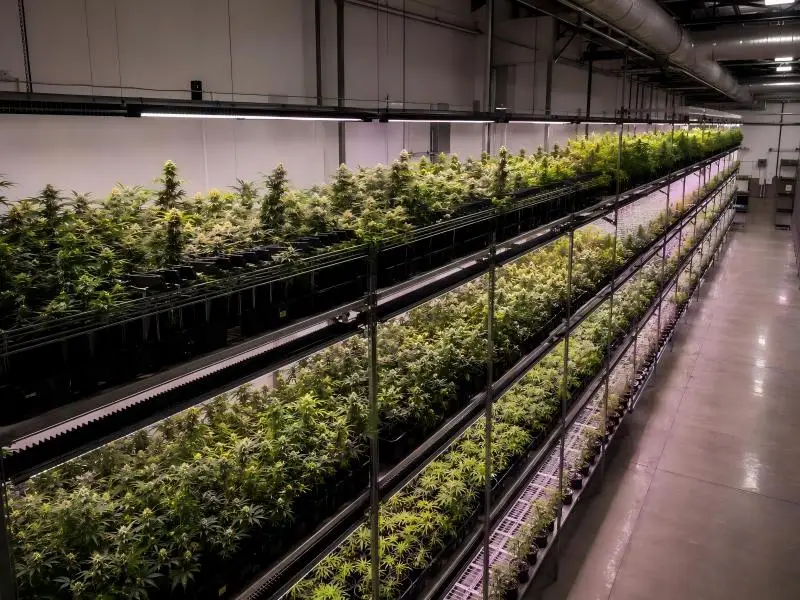
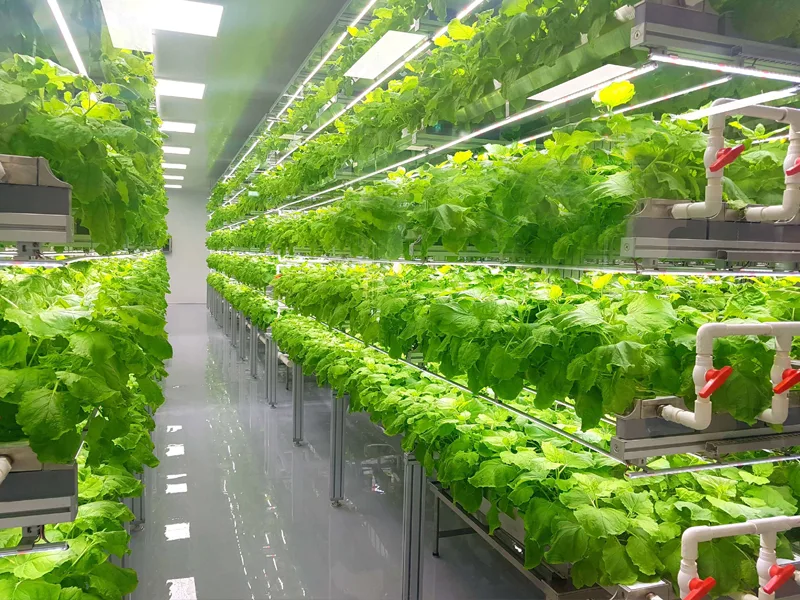
Vertical farming LED lighting is rarely a simple “more photons = more yield” decision. In multi-tier racks, every additional µmol·m⁻²·s⁻¹ competes with three constraints that show up fast in real facilities:
- PPFD and DLI targets (crop dose) that drive growth rate, quality, and uniformity.
- Heat + moisture loads that drive canopy temperature, VPD (vapor pressure deficit), and disease risk.
- Vertical farm HVAC integration decisions that determine whether you can hold setpoints across every tier.
- Limited vertical space that limits fixture form factor, mounting height, and airflow paths.
This guide is built to help cultivation and operations teams make decisions that survive commissioning and scale across rooms. You’ll get practical PPFD and DLI targets, fixture and optics selection criteria for racks, HVAC integration considerations for vertical farms, DLI-based dimming controls, and documentation that supports compliance, rebates, and ROI.
Use it as a workflow: start with benchmarks, validate with photometric files, commission with a measurement grid, then iterate with controls—because the first “paper design” rarely matches the final microclimate in dense stacks.
Table of Contents
Crop Light Targets
Leafy Greens: PPFD/DLI and Photoperiod Ranges
For leafy greens in vertical systems, the most useful way to think about light is dose (DLI) first, then delivery method (PPFD × photoperiod).
In practice, many vertical farms run leafy greens in the neighborhood of:
- PPFD: ~150–350 µmol·m⁻²·s⁻¹ (canopy level)
- DLI: ~15–25 mol·m⁻²·day⁻¹
- Photoperiod: ~14–20 hours
These ranges vary by crop (lettuce vs. basil vs. kale), cultivar, temperature, CO₂, and airflow. The operational point is less “hit one perfect number” and more “pick a target band you can deliver uniformly across every tier.”
⚠️ Warning: If you push PPFD up in a rack without matching airflow, leafy greens can look “adequately lit” but still underperform due to boundary-layer stagnation and localized humidity at the canopy.
Strawberries: Photoperiod vs PPFD for Yield
Strawberries behave differently than leafy greens because you’re balancing vegetative growth, flowering, and fruiting—often in day-neutral (everbearing) cultivars.
Common indoor targets reported for fruiting-phase production cluster around:
- PPFD: ~300–450 µmol·m⁻²·s⁻¹
- DLI: ~17–25 mol·m⁻²·day⁻¹
- Photoperiod: ~12–16 hours
Two practical takeaways matter for racks:
- Photoperiod is a lever, not just a schedule. If you’re limited by heat removal or electrical capacity, you can often deliver the same DLI with lower PPFD and a longer photoperiod—then validate quality and flowering response in your cultivar.
- Past a point, more DLI gets expensive and riskier. OSU’s indoor berry guidance commonly frames ~20–25 mol·m⁻²·day⁻¹ as an “optimum” zone while noting that very high DLI can create diminishing returns and stress risk in some conditions (see Ohio State’s indoor berry lighting guidance).
For an example of how researchers describe intensity effects and yield response, see a peer-reviewed study on strawberry light intensity and production (2023).
Converting DLI↔PPFD and CO2 Context
If you only remember one equation, make it this one:
- DLI = PPFD × photoperiod (hours) × 0.0036
That conversion is explained clearly in Virginia Tech’s DLI introductory guide (2025).
A quick example:
- If your target is DLI 17 at 16 hours, the required PPFD is roughly: 17 ÷ (16 × 0.0036) ≈ 295 µmol·m⁻²·s⁻¹.
CO₂ matters because it shifts how efficiently plants can use higher photon flux. In many commercial rooms, enriching CO₂ (when agronomically appropriate and safely managed) can justify higher PPFD because CO₂ reduces the “bottleneck” at the leaf level. The important operational caution is: CO₂ doesn’t fix poor uniformity or poor microclimate. It tends to amplify whatever you already have—good or bad.
If you’re deciding whether to deliver a DLI via higher PPFD vs. longer photoperiod, it’s worth reading OptimIA’s note on delivering DLI via PPFD vs photoperiod, which discusses how equal DLI can still produce different quality outcomes depending on delivery method.
Fixture Selection for Racks
Efficacy, Spectrum, and Driver Reliability
In vertical racks, fixture selection is mostly risk management:
- Efficacy (PPE, µmol/J) affects both operating cost and downstream HVAC sizing.
- Spectrum affects morphology and crop-specific quality outcomes—but most facilities get more ROI from getting uniformity and environmental stability right than from chasing exotic spectra.
- Driver reliability is not a footnote. In dense stacks, a driver failure can create a tier-level growth defect that doesn’t show up until harvest day.
A practical procurement question set for rack fixtures:
- What’s the rated lifetime of the driver at your expected ambient temperature?
- What’s the dimming method (0–10V, DALI, proprietary) and fail-safe behavior?
- Is the fixture designed for high humidity/washdown conditions (IP rating, gasket strategy, connector selection)?
Optics, Beam Shape, and Slim form Factor
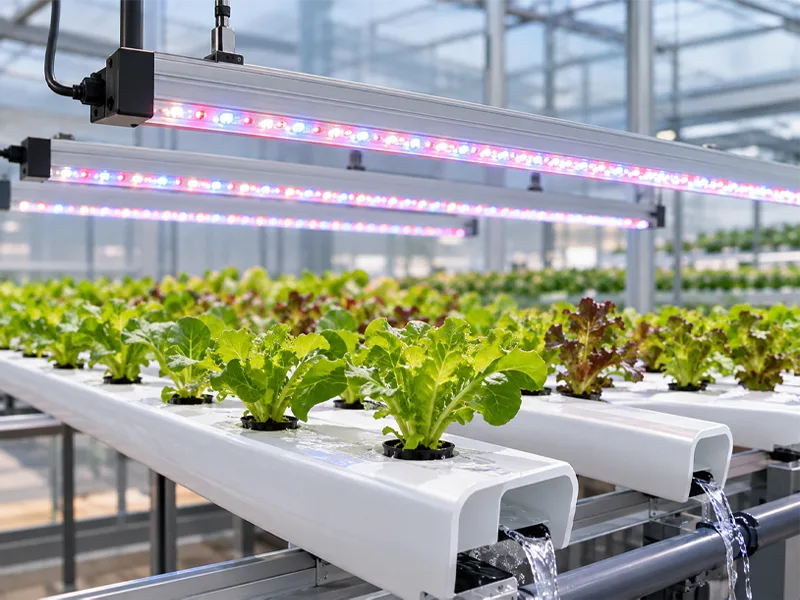
In racks, optics are not “nice to have”—they’re how you buy back usable space.
Because canopy-to-fixture distance is small, bare emitters can create hot spots, edge falloff, and stripe artifacts. The goal is a wide, controlled distribution that keeps PPFD consistent across the crop plane on every tier.
Practical selection criteria:
- Beam shaping is designed for shallow mounting heights (so you’re not forced to lose a tier of vertical clearance just to get uniformity).
- Slim form factor that preserves grow height and leaves physical room for airflow paths and service access.
- Repeatable, modelable distribution: if it can’t be modeled and verified, it’s a gamble.
Pro tip: For racks, design around your worst tier—usually a tier with the tightest clearance, the highest humidity, and the most difficult air return path. If you can make that tier stable, the rest usually gets easier.
Certifications, Photometrics, and IES Files
This is where commercial projects are won or lost.
Certifications reduce inspection and liability risk. In the U.S., many jurisdictions and inspectors (AHJs) expect fixtures and drivers to carry appropriate NRTL listings (for example, UL/ETL as applicable). In the EU, CE marking and RoHS compliance are common procurement requirements.
Photometrics reduces agronomic and financial risk. For racks, request a documentation packet that lets you answer before you buy:
- What PPFD distribution do you get at your mounting height and tier geometry?
- What uniformity do you get across the crop plane?
- What happens at the rack edges and near aisles?
Concretely, ask for:
- IES photometric files (IES) and/or LDT files for modeling
- PPFD maps at multiple heights
- A stated uniformity target (and how it was measured)
A helpful way to frame this—without turning it into an ad—is to look at how manufacturers document commissioning workflows. For example, SLTMAKS publishes a practical checklist-style explanation of what to request and how to validate layouts in SLTMAKS’ layout-and-commissioning checklist. Use it as a reference model for the kind of documentation that makes commissioning faster and less contentious.
If you want a plain-language refresher on terms like PPFD, PPF, and PPE, and how testing standards and rebate programs talk about performance, SLTMAKS’ explanation of PPFD, PPE, and testing terms is also a useful internal reference.
Thermal and HVAC Integration
LED Heat Characteristics vs HPS in Dense Stacks
LEDs typically reduce radiant heat compared to legacy HPS, which is one reason they’re compatible with multi-tier geometry. But the operational reality is more nuanced:
- Less radiant heat can reduce leaf-surface heating.
- Less buoyancy-driven mixing can make microclimates worse if airflow isn’t engineered.
- More tiers per room increases plant transpiration mass and can make latent load (moisture removal) the limiting HVAC factor.
So the question isn’t “Do LEDs run cool?” It’s “What does the lighting choice do to sensible and latent loads in this rack density—and can our HVAC strategy keep every tier in range?”
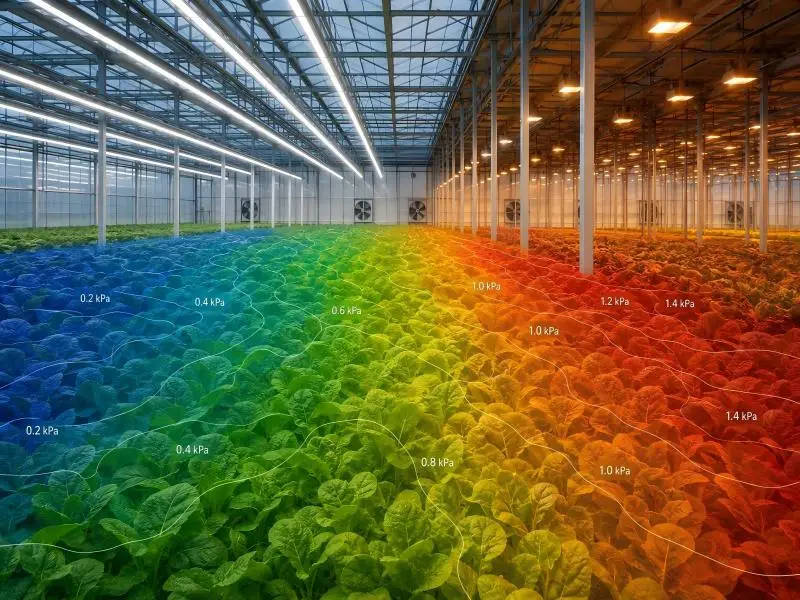
Airflow Design, VPD Stability, and Dehumidification
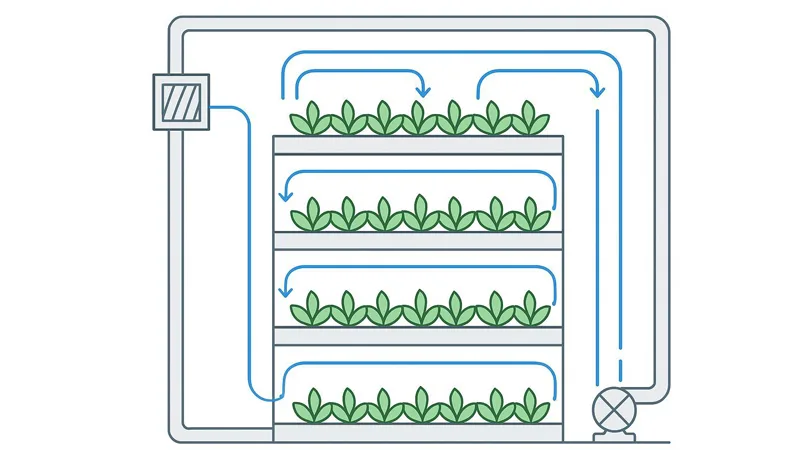
In racks, airflow is doing three jobs at once:
- Managing canopy temperature uniformity tier-to-tier.
- Controlling boundary layer thickness so CO₂ uptake and transpiration are predictable.
- Moving humid air to where your system can actually remove moisture (dehumidification/coil).
A common failure mode is improving one variable while breaking another: you add fans, transpiration increases, and humidity rises because your moisture removal capacity or return path wasn’t designed for the new latent load.
A practical approach:
- Design airflow paths intentionally (supply, canopy sweep, return) rather than relying on random turbulence.
- Treat VPD stability as a system KPI, not a “nice graph.” If VPD swings widely between tiers, you’ll see variability in growth rate and disease pressure.
- Validate dehumidification against your highest-transpiration scenario (crop maturity, photoperiod, and irrigation strategy).
Tier-level Sensing and Environmental Zoning
If you control the room but don’t measure the tiers, you’re flying blind.
At minimum, tier-level sensing should allow you to see:
- Canopy temperature (or a proxy close to the canopy)
- Relative humidity at the canopy
- CO₂ (at least zone-level)
- Light level confirmation at representative points
Then use zoning to make the system tunable:
- Perimeter vs core (edge losses and wall effects are real)
- Top vs bottom tiers (stack effects, return path differences)
- “Problem tiers” with known airflow constraints
The goal is not to create dozens of fragile control zones—it’s to create enough knobs to correct predictable non-uniformities without re-hanging lights or rebuilding ductwork.
Controls and Uniformity (Vertical Farming LED Lighting)
DLI-based Dimming Controls and Sunrise/Sunset Ramps
Controls are where you recover margin.
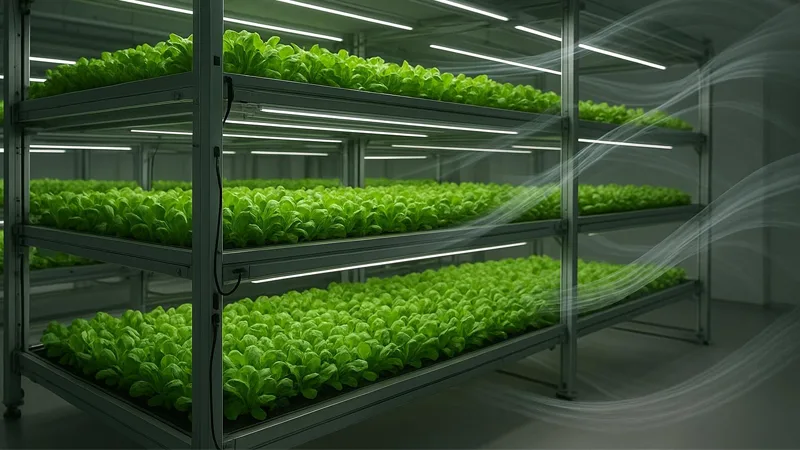
Instead of running a fixed PPFD all year, many facilities manage to a target DLI and let dimming absorb variation in:
- Crop stage
- Cultivar
- Canopy height changes
- Seasonal HVAC capacity differences
A simple, robust approach is:
- Set a DLI target band for each crop stage.
- Use dimming to hit the dose with the least stress and the most stable microclimate.
- Add sunrise/sunset ramps to reduce abrupt transitions that can spike transpiration and momentarily destabilize humidity.
Zoning, Sensors, and Multi-tier Control Networks
Controls only work when they match physical reality.
- Align lighting zones to environmental zones (or at least don’t fight them).
- Ensure sensor placement reflects canopy reality, not just “easy mounting.”
- Specify network and wiring practices that survive washdown and routine maintenance.
If you’re scaling across multiple rooms or facilities, standardize:
- Naming conventions for zones
- Commissioning measurement grids
- Calibration and maintenance SOPs
Commissioning, Mapping, and Ongoing Validation
Uniformity isn’t something you “buy.” It’s something you verify.
A commissioning workflow that scales:
- Validate photometrics in design: request IES/LDT + PPFD maps; simulate your rack geometry.
- Grid-map PPFD at the canopy plane with a calibrated quantum sensor.
- Record conditions (fixture height, dimming %, photoperiod, CO₂ setpoint) so results are repeatable.
- Tune with controls (dimming, zone trims) before you change hardware.
SLTMAKS’ published approach includes practical uniformity metrics and a measurement-grid mindset, which is exactly the kind of documentation you want from any vendor when the goal is predictable commissioning.
Compliance, Rebates, and ROI
Safety Listings, DLC Status, and Documentation
For commercial facilities, procurement should assume you’ll need a documentation packet that satisfies at least three audiences:
- Your internal engineering/ops team
- The installer and inspector (AHJ)
- The utility program (if rebates apply)
Common documentation items include:
- Safety listing evidence (as required in your jurisdiction)
- Cut sheets with electrical specs and environmental ratings (e.g., IP)
- Photometric files (IES/LDT) and layout outputs
- A controls narrative (how dimming is implemented and verified)
- Commissioning reports
If you’re coordinating multi-site procurement, standardizing this packet reduces risk and accelerates approvals.
Utility Incentives and Controllability Expectations
Many utility programs care about two things you can plan for early:
- Eligibility (often tied to qualified product lists or specific testing/documentation)
- Controllability (dimming, scheduling, and the ability to set settings)
Even when a program doesn’t explicitly require advanced controls, controllability often improves your own ROI because it lets you tune dose, reduce waste, and avoid “over-lighting to be safe.”
For a concise internal reference on how certifications (ETL/CE/RoHS) and documentation are typically discussed in procurement contexts, see SLTMAKS’ certification and documentation overview.
Payback Modeling and Risk Reduction
ROI models fail when they ignore the real constraints of vertical farms.
When you model payback, separate:
- Energy savings (lighting kWh, plus HVAC kWh changes)
- Yield/quality upside (often driven by uniformity + microclimate stability)
- Risk reduction (downtime, rework, failed crop cycles, inspection delays)
The most defensible models are transparent about assumptions:
- Operating hours (photoperiod)
- Target DLI and expected dimming profile
- Electricity rate and demand considerations
- HVAC latent/sensible impacts (especially dehumidification)
- Maintenance labor and spare strategy
Conclusion
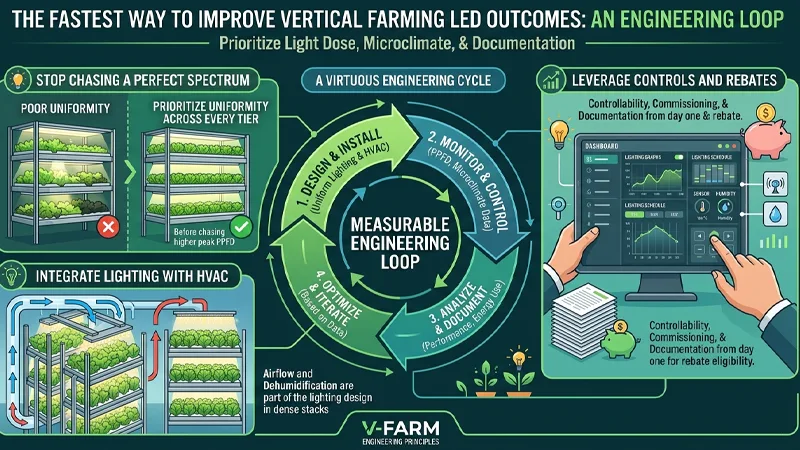
The fastest way to improve outcomes in vertical farming LED lighting isn’t chasing a perfect spectrum—it’s building an engineering loop that makes light dose, microclimate, and documentation measurable.
Key takeaways:
- Prioritize uniformity across every tier before you chase higher peak PPFD.
- Integrate lighting with HVAC: in dense stacks, airflow and dehumidification are part of the lighting design.
- Leverage controls and rebates by planning for controllability, commissioning, and documentation from day one.
Next steps:
- Request IES/LDT files and PPFD maps for your rack geometry.
- Run a layout and define acceptance criteria (uniformity band + measurement grid).
- Model ROI using transparent assumptions (lighting + HVAC, not lighting alone).
- Plan commissioning as a repeatable process—and iterate based on measured tier-level data.
FAQ
What PPFD and DLI should you target for leafy greens in vertical farming?
Most leafy greens in multi-tier racks land in a practical band of ~200–350 µmol·m⁻²·s⁻¹ PPFD and ~15–25 mol·m⁻²·day⁻¹ DLI, then get tuned by cultivar, temperature, CO₂, and airflow limits. Use DLI as the “dose” target, and treat PPFD + photoperiod as the delivery method (see Virginia Tech’s DLI guide for definitions and context).
How do you convert PPFD to DLI in a controlled LED rack?
For constant PPFD during the light-on period:
DLI (mol·m⁻²·day⁻¹) = PPFD (µmol·m⁻²·s⁻¹) × photoperiod (hours) × 0.0036
The 0.0036 factor comes from 3,600 seconds per hour and 1,000,000 µmol per mol. A clear walkthrough is in Virginia Tech’s introductory DLI guide, and Apogee also summarizes the integration math in Instantaneous PPFD to Integrated PPFD Conversion.
What documents should you request from an LED vendor for vertical farm rack projects?
Ask for a documentation packet that helps you model, install, and commission reliably:
IES/LD1T photometric files for your exact fixture model
PPFD maps at your mounting heights
Electrical and environmental specs (including relevant safety listings and IP/washdown suitability)
Dimming/control details (0–10V, DALI, etc.) and fail-safe behavior
These items reduce layout risk and speed up approvals and commissioning.
What’s a realistic PPFD uniformity target for multi-tier racks?
A good operational target is to keep canopy PPFD within roughly ±10% (or better) across the crop plane on each tier, then use dimming trims and zoning to correct edge losses and aisle effects. The key is to define your acceptance criteria before procurement and verify with a commissioning grid.
What documents should you request from an LED vendor for vertical farm rack projects?
Ask for a documentation packet that helps you model, install, and commission reliably:
IES/LDT photometric files for your exact fixture model
PPFD maps at your mounting heights
Electrical and environmental specs (including relevant safety listings and IP/washdown suitability)
Dimming/control details (0–10V, DALI, etc.) and fail-safe behavior
These items reduce layout risk and speed up approvals and commissioning.
How many hours should LED grow lights run in vertical farming?
Most vertical farms set photoperiods based on crop and microclimate limits, commonly ~14–20 hours for leafy greens and ~12–16 hours for fruiting crops. Start from a DLI target, then choose the longest photoperiod your facility can support without creating humidity or temperature instability.