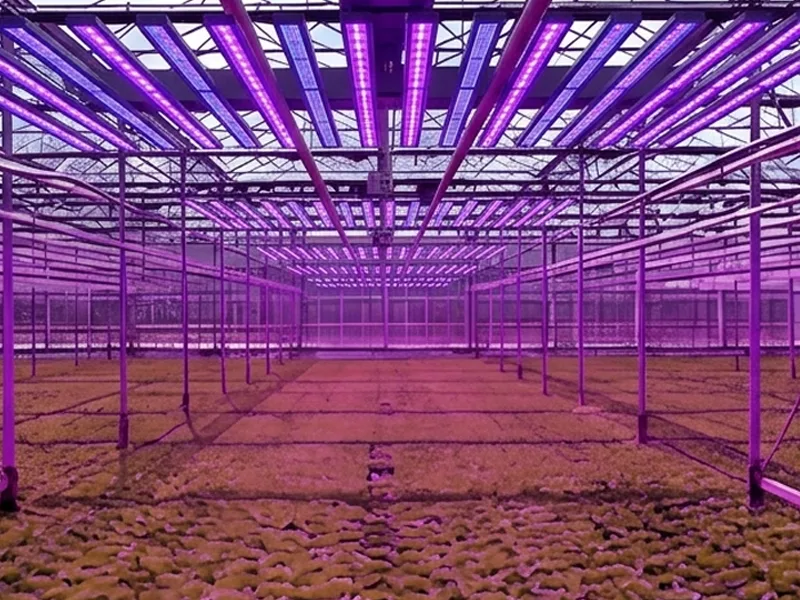
The commercial indoor farming and greenhouse agriculture sectors are experiencing unprecedented growth in 2026. As the global demand for sustainable, high-yield crop production surges, the reliance on advanced horticultural lighting has never been more critical. For commercial growers, facility operators, and lighting distributors, LED grow lights are no longer just an alternative to traditional High-Pressure Sodium (HPS) systems; they are the absolute standard. However, the success of your cultivation facility—and your return on investment (ROI)—hinges entirely on the quality and reliability of the lighting fixtures you deploy.
Sourcing commercial LED grow lights from China is the most logical step for B2B buyers seeking a balance of cutting-edge technology, scalable production, and cost-efficiency. Yet, navigating the sprawling landscape of Chinese suppliers can be a daunting endeavor. With thousands of companies claiming to be “top-tier manufacturers,” how do you separate the genuine, high-capacity factories from the trading companies and low-quality assemblers? How do you avoid the pitfalls of exaggerated specifications, rapid light degradation (lumen depreciation), and catastrophic fixture failures that can ruin an entire crop cycle?
This comprehensive 2026 guide is designed specifically for B2B buyers. We will take a deep dive into the critical technical parameters, stringent factory auditing standards, and supply chain logic required to identify a truly reliable LED grow light manufacturer in China. By the end of this article, you will be equipped with the expert knowledge needed to secure a dependable manufacturing partner that can deliver high-performance, customized lighting solutions for your large-scale projects.
Table of Contents
Why Source Commercial LED Grow Lights from China in 2026?
For decades, China has been the undisputed epicenter of global electronics manufacturing. In 2026, this dominance is particularly pronounced in the LED horticultural lighting industry. Understanding the macro-level advantages of this supply chain is the first step in formulating a successful procurement strategy.
A Mature and Integrated Supply Chain Ecosystem
The manufacturing hubs in regions like Shenzhen, Dongguan, and the broader Pearl River Delta offer an unmatched, vertically integrated supply chain ecosystem. A genuine LED grow light manufacturer in this region has immediate, localized access to every conceivable component required for production. This includes world-class LED chip packaging facilities, advanced driver and power supply manufacturers, and heavy-duty aluminum extrusion plants for heat sinks. This geographical proximity drastically reduces lead times, lowers inbound freight costs for the factory, and allows for rapid prototyping and iteration when developing custom fixtures.
Balancing Technological Innovation with Cost-Efficiency
The outdated stigma of “cheap and low quality” is no longer applicable to China’s leading horticultural lighting manufacturers. Today, top-tier Chinese factories are at the forefront of global technological innovation. They are actively pushing the boundaries of Photosynthetic Photon Efficacy (PPE) and developing highly sophisticated, adjustable full-spectrum solutions. By partnering with a reputable source factory, B2B buyers gain direct access to this state-of-the-art technology without absorbing the massive markups typically applied by Western brands that simply white-label these exact same Chinese-made products. You are paying for pure manufacturing value, engineering expertise, and high-grade materials.
Unmatched Flexibility for OEM and ODM Projects
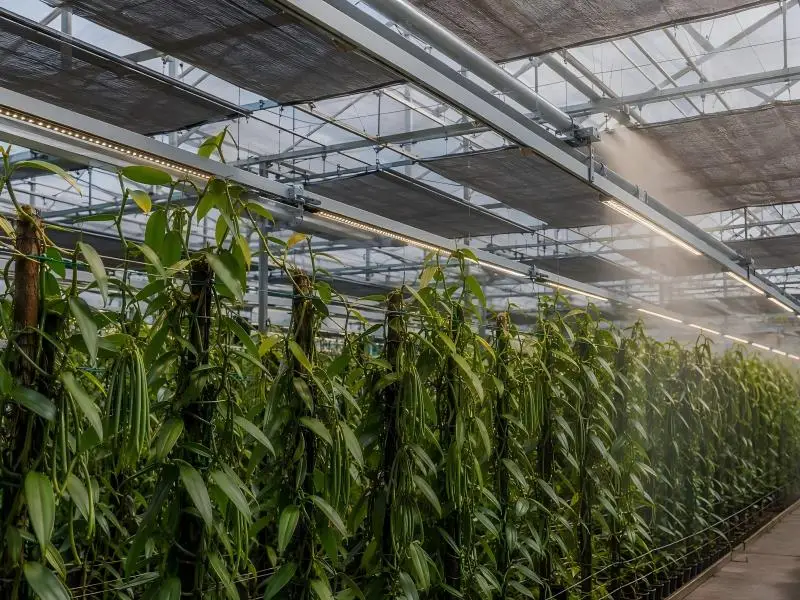
Commercial agricultural projects are rarely one-size-fits-all. A vertical farm cultivating leafy greens requires a fundamentally different form factor, beam angle, and spectral recipe than a massive greenhouse supplementing natural sunlight for vining tomatoes. Chinese manufacturers excel in Original Equipment Manufacturing (OEM) and Original Design Manufacturing (ODM). Whether you need custom housing dimensions to fit a specific racking system, proprietary spectrums developed in collaboration with your agronomists, or integration with advanced central control systems (like RJ14 daisy-chaining or wireless Bluetooth/mesh networks), a true factory has the engineering bandwidth to bring your exact vision to life.
Core Capabilities to Look For in a True Manufacturer
To satisfy your procurement needs and ensure long-term reliability, you must look beyond the glossy marketing brochures and evaluate the foundational capabilities of the supplier. This is where you differentiate a value-added manufacturer from a mere assembler.
Robust R&D and Spectral Customization
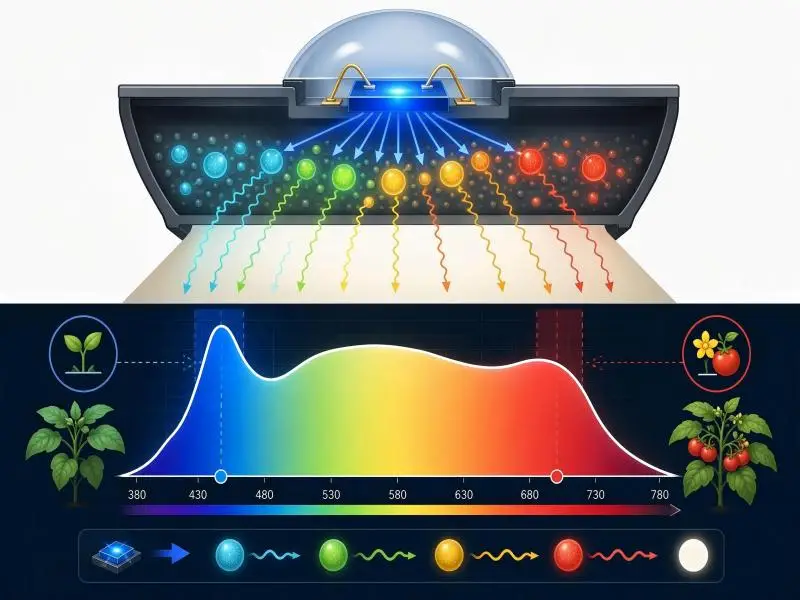
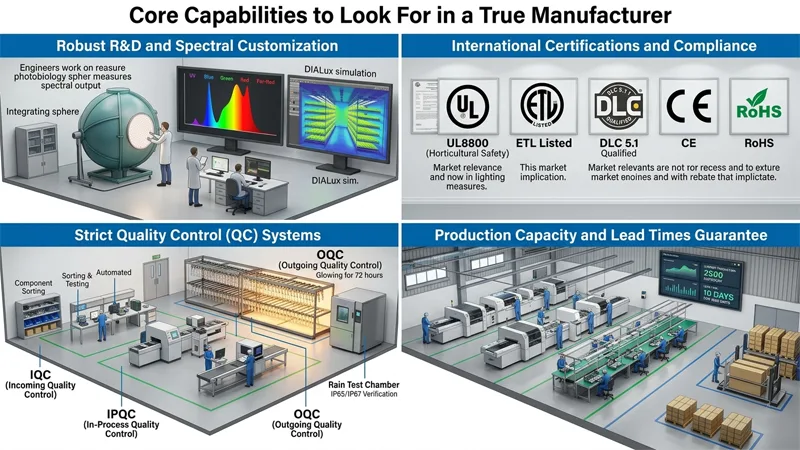
Horticultural lighting is an intersection of physics, engineering, and photobiology. A reliable manufacturer must have a dedicated Research and Development (R&D) team capable of more than just wiring LEDs to a board. Different plant species—and different stages of growth (propagation, vegetative, flowering)—demand highly specific spectral recipes.
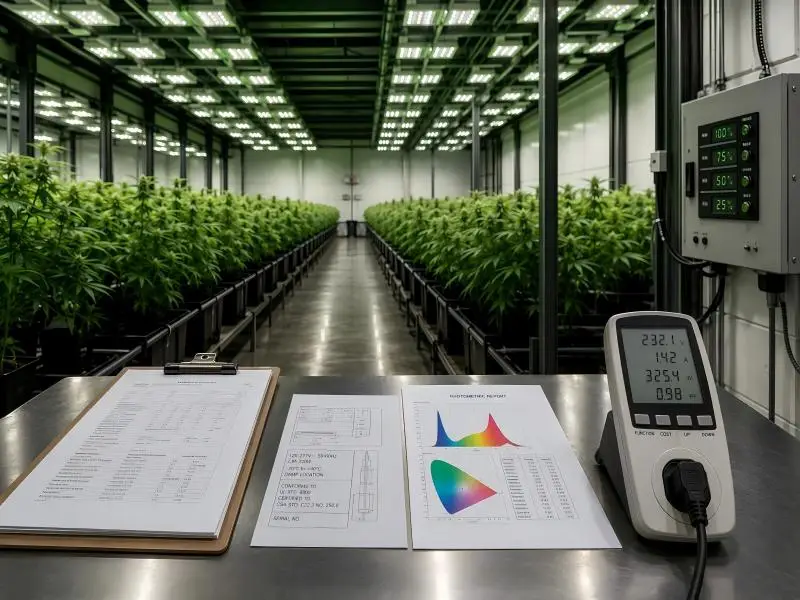
When vetting a supplier, inquire about their R&D infrastructure. Do they possess an in-house integrating sphere to accurately measure total light output, color rendering index (CRI), and exact spectral distribution? Do they use advanced spectroradiometers to generate precise PAR (Photosynthetically Active Radiation) maps? A manufacturer worth your investment should be able to provide detailed, mathematically sound simulations (like DIALux reports) demonstrating exactly how their fixtures will perform within your specific facility’s dimensions.
Strict Quality Control (QC) Systems
For commercial cultivators, high return rates and fixture failures are catastrophic. A dark spot in a canopy means lost yield, which directly translates to lost revenue. Therefore, the manufacturer’s Quality Control system must be rigorous, documented, and transparent.
A top-tier factory will implement a comprehensive Total Quality Management (TQM) approach:
- IQC (Incoming Quality Control): Rigorous testing of raw materials (LEDs, drivers, aluminum housings) before they ever reach the assembly line.
- IPQC (In-Process Quality Control): Continuous monitoring during the SMT (Surface-Mount Technology) process, soldering, and assembly to catch defects instantly.
- OQC (Outgoing Quality Control): The final, critical stage. This must include prolonged Aging Tests—typically running fixtures at maximum capacity for 48 to 72 hours in elevated ambient temperatures to weed out early-life failures. Additionally, for greenhouse environments, verified IP65 or IP67 waterproof and dustproof testing is non-negotiable to ensure the fixtures can withstand high humidity and direct water spray.
International Certifications and Compliance
Compliance is not just about safety; it is a fundamental requirement for market entry and securing valuable energy rebates. A reliable Chinese manufacturer will proactively invest in securing recognized international certifications for their product lines.
- UL / ETL (Specifically UL8800): This is the paramount safety standard for horticultural lighting equipment in North America. It ensures the fixtures are safe for the unique, wet, and high-temperature environments of commercial grows.
- DLC (DesignLights Consortium): The DLC Qualified Products List (QPL) is the gold standard for energy efficiency. In 2026, achieving DLC version 5.1 (or the latest active standard) is essential, as most utility companies in the USA and Canada require DLC certification to grant lucrative energy rebates to the facility operator.
- CE & RoHS: Mandatory for the European market, ensuring safety, electromagnetic compatibility, and the restriction of hazardous substances. When a factory readily provides these verifiable certification numbers, it is a strong signal of their operational maturity and commitment to producing compliant, high-grade equipment.
Production Capacity and Lead Times Guarantee
Large-scale commercial projects often require hundreds, if not thousands, of fixtures delivered within a strict construction timeline. Delays in lighting delivery can halt an entire facility’s launch. When auditing a supplier, you must verify their physical production capacity. How many SMT machines do they operate? How many active assembly lines do they run? What is their standard lead time for a 1,000-unit order, and how do they handle sudden surges in demand? A reliable partner will offer transparent production schedules and realistic lead times, backed by a strong localized supply chain that prevents bottlenecking.
Key Technical Specifications Buyers Must Verify
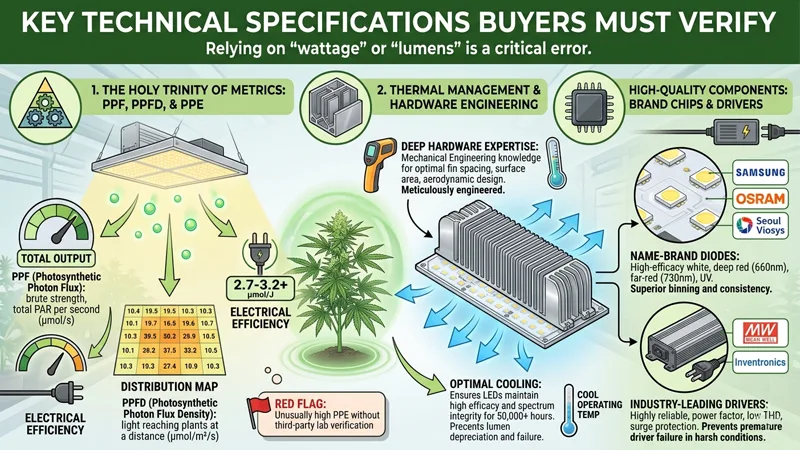
To establish yourself as an informed buyer and prevent being misled by deceptive marketing, you must fluently speak the language of horticultural lighting metrics. Relying on “wattage” or “lumens” is a critical error; these metrics are for human vision, not plant growth.
PPF, PPFD, and PPE (Efficacy)
These three metrics are the holy trinity of grow light evaluation:
- PPF (Photosynthetic Photon Flux): Measured in micromoles per second (µmol/s), this indicates the total amount of PAR (usable plant light) produced by the fixture every second. It tells you the brute strength of the light.
- PPFD (Photosynthetic Photon Flux Density): Measured in µmol/m²/s, this is the amount of PAR that actually reaches the plant canopy at a specific distance. A reliable manufacturer will provide comprehensive PPFD grid maps at various hanging heights (e.g., 12″, 24″, 36″) to prove uniform light distribution.
- PPE (Photosynthetic Photon Efficacy): Measured in µmol/J (micromoles per Joule), this is the ultimate measure of electrical efficiency. It tells you how much plant-usable light is generated per watt of electricity consumed. In 2026, leading commercial fixtures should offer a PPE ranging from 2.7 to over 3.2 µmol/J. If a supplier claims an unusually high PPE without third-party laboratory verification, consider it a major red flag.
Thermal Management and Hardware Engineering
Heat is the enemy of LED longevity. Poor thermal management leads to rapid lumen depreciation, color shifting, and premature diode failure. This is where a manufacturer’s deep hardware expertise becomes vital.
Creating an effective heat sink requires more than just buying off-the-shelf aluminum. It demands profound knowledge of materials science and mechanical engineering. Manufacturers with decades of practical production experience in the machine processing and hardware manufacturing industry hold a massive advantage here. They understand the precise physics of heat dissipation, allowing them to CNC-machine or extrude aluminum profiles with optimal fin spacing, surface area, and aerodynamic design for passive cooling. A meticulously engineered, heavy-duty aluminum heat sink ensures the fixture runs cool, guaranteeing that the LEDs maintain their high efficacy and spectrum integrity over a 50,000+ hour lifespan.
High-Quality Components: Brand Chips and Drivers
The internal components dictate the lifeblood of the fixture. A world-class heat sink cannot save a low-quality LED chip.
- Diodes: Top-tier manufacturers consistently utilize name-brand diodes with proven horticultural track records, such as Samsung (e.g., the LM301H or LM301B series for high-efficacy white light) and Osram or Seoul Viosys (for deep red 660nm, far-red 730nm, and UV spectrums). These brands offer superior binning, ensuring consistency across thousands of fixtures.
- Drivers: The power supply is often the first component to fail in a harsh greenhouse environment. Insist on fixtures powered by industry-leading, highly reliable drivers like Mean Well or Inventronics. These drivers offer high power factors, low total harmonic distortion (THD), and robust surge protection.
Red Flags: How to Spot Unreliable Grow Light Suppliers
The B2B sourcing process is just as much about knowing who to avoid as it is about knowing who to select. Here are the critical red flags that indicate you are dealing with a risky supplier.
Trading Companies Masking as Direct Factories
Platforms like Alibaba are saturated with trading companies (middlemen) posing as direct manufacturers. While traders can sometimes offer diverse catalogs, they inevitably add a 15% to 30% price markup and, crucially, they have zero control over the actual production quality or R&D. How to spot them: Ask for a live video tour of the factory floor right now. If they hesitate, claim “the factory is in another province,” or can only show a small office, they are likely a trader. Furthermore, check their business license; genuine factories will have “Manufacturing” or “Production” explicitly listed in their registered business scope, not just “Sales” or “Trading.”
Exaggerated Specs and “Fake” Certifications
The industry is rife with “spec-sheet inflation.” Unreliable suppliers will often copy the specifications of premium brands and paste them onto inferior products. They might claim a PPE of 3.5 µmol/J on a budget fixture, which defies current physical limitations at that price point. How to spot them: Always demand the official, unedited sphere test reports from independent, third-party laboratories. For certifications, never trust a JPEG image of a certificate. Ask for the certificate number and verify it directly on the official UL database or the DLC Qualified Products List website.
Lack of After-Sales Support and Meaningful Warranty
A commercial grow operation cannot afford to wait weeks for a replacement part if a fixture goes down. Unreliable suppliers will offer a “warranty” but will go silent the moment a container is paid for and shipped. How to spot them: A true manufacturer stands behind their engineering. They should offer a comprehensive 3 to 5-year warranty. More importantly, they should clearly define their RMA (Return Merchandise Authorization) process. Do they have local service centers or replacement part hubs in your country, or will you be forced to ship broken fixtures back to China at your own immense expense?
Why SLTMAKS is Your Trusted LED Grow Light Manufacturer in China
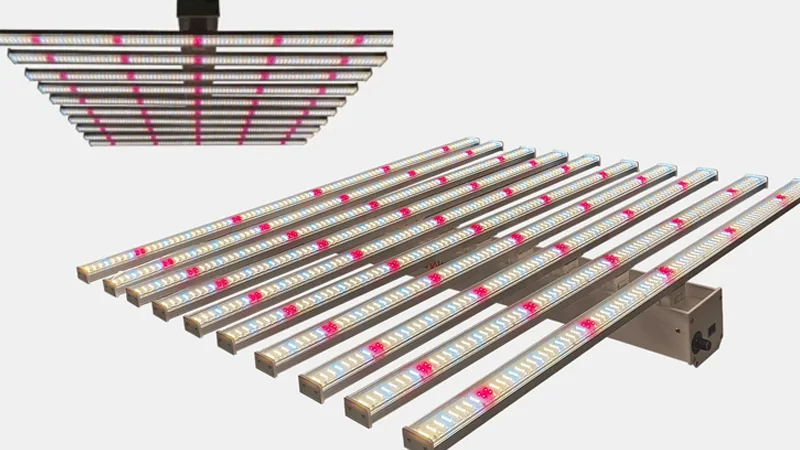
Finding a supplier that checks all the rigorous boxes outlined above is challenging. That is precisely why SLTMAKS has positioned itself as the definitive manufacturing partner for B2B horticultural lighting projects worldwide. With deep roots in hardware manufacturing and a relentless focus on agronomic innovation, we bridge the gap between premium performance and factory-direct economics.
Our Manufacturing Excellence and Heritage
At SLTMAKS, we don’t just assemble; we engineer from the ground up. Our state-of-the-art production facility is equipped with automated SMT lines, advanced photometric testing labs, and rigorous aging racks. Because our core foundation is built upon decades of practical production experience in precision machine processing, we design and manufacture our own highly optimized aluminum heat sinks. This vertical integration allows us to guarantee superior thermal management, exceptional durability, and strict quality control at every stage of the manufacturing process.
Tailored OEM/ODM Solutions for Global Projects
We understand that a 100,000-square-foot indoor cannabis facility requires a vastly different lighting strategy than a high-wire tomato greenhouse. SLTMAKS excels in providing highly tailored OEM and ODM solutions. Our R&D team works directly with your facility managers to develop custom spectral recipes, customized fixture dimensions for specific racking systems, and seamless integration with intelligent 0-10V dimming and centralized control platforms. We turn your precise agronomic requirements into a tangible, mass-produced reality.
Proven Results and Uncompromising Quality
Our fixtures are powered by industry-leading components, including genuine Samsung and Osram diodes, driven by highly efficient Mean Well or Inventronics power supplies. We back our engineering with comprehensive UL, ETL, CE, and DLC certifications, ensuring your facility is safe, compliant, and eligible for maximum energy rebates. When you partner with SLTMAKS, you are investing in proven PPFD uniformity, verified high PPE, and a robust 5-year warranty designed to protect your commercial yields.
FAQ
What is the Minimum Order Quantity (MOQ) for custom OEM LED grow lights?
For standard inventory models, our MOQ is highly flexible to support pilot testing. For custom OEM/ODM projects (involving custom spectrums, laser-etched logos, or specific housing designs), the MOQ typically starts at 50 to 100 units to justify the R&D and setup costs, though we evaluate large-scale projects on a case-by-case basis.
How long is the lead time for a commercial order of 500+ fixtures?
Due to our robust supply chain and in-house manufacturing capabilities, standard production time for a 500-unit order is generally 15 to 25 working days. Custom OEM projects may require an additional 7 to 10 days for initial prototyping and material sourcing.
Can you help me calculate the exact number of fixtures needed for my facility?
Absolutely. Our technical team provides complimentary DIALux lighting simulation services. By providing us with your room dimensions, target crop, and desired PPFD levels, we will generate a comprehensive 3D lighting map detailing exactly how many fixtures you need, the optimal hanging height, and the expected light uniformity.
How do you handle warranty claims for international B2B clients?
We provide a strict 3- to 5-year warranty. Because we use premium components, our failure rate is exceptionally low (under 0.3%). However, if a failure occurs, our process is rapid: upon video/photo verification of the defect, we immediately express-ship replacement drivers or LED boards via DHL/FedEx directly from our factory or regional warehouses, ensuring your canopy experiences minimal downtime.
Conclusion
In the rapidly expanding agricultural landscape of 2026, choosing an LED grow light manufacturer in China requires meticulous due diligence. By demanding verifiable technical specifications, auditing quality control processes, and ensuring deep manufacturing expertise, you can secure a partner that drives your profitability forward.
Don’t leave your commercial crop yields to chance. Partner with a manufacturer that possesses the engineering heritage and production capacity to scale with your ambitions.
Ready to upgrade your commercial growing facility with high-efficacy, reliable lighting? Visit www.sltmaks.com today to explore our 2026 product catalog. Contact our expert engineering team for a free spectral consultation, custom DIALux lighting layouts, and highly competitive B2B wholesale pricing. Let SLTMAKS illuminate your path to maximum yield.