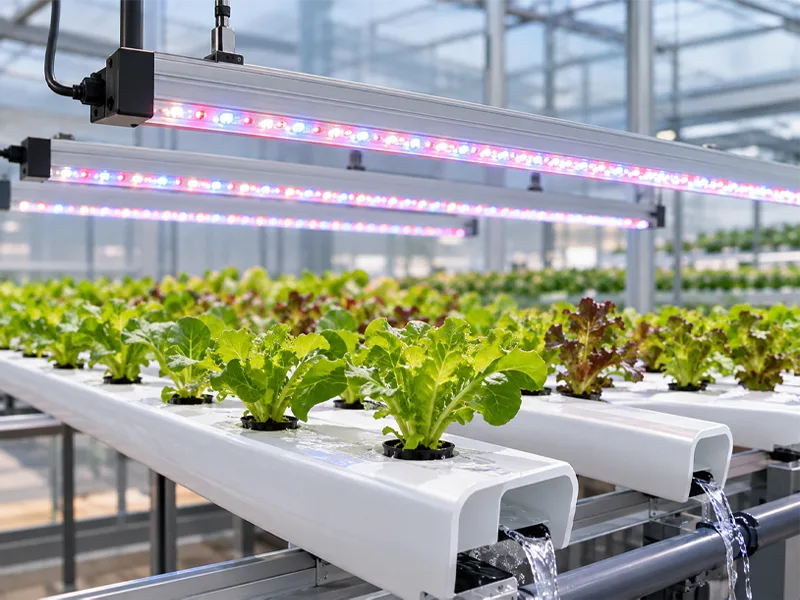
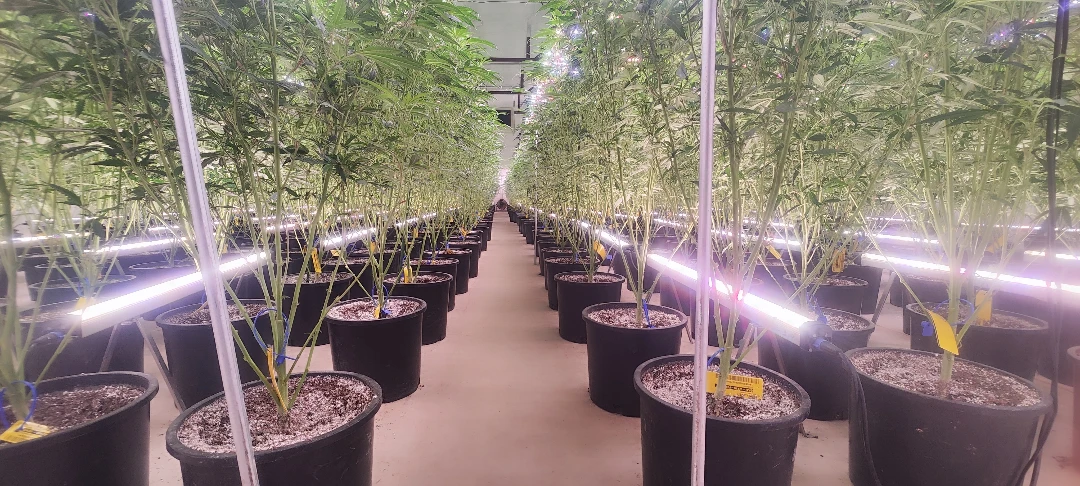
If you’re building a rack system for seedlings, leafy greens, herbs, or high-density propagation, the LED grow light bar is one of the simplest ways to get professional results without bulky fixtures. A bar-style fixture is slim enough to fit between tiers, easy to mount, and straightforward to scale—add more bars to increase intensity, or spread them out to improve uniformity. Most importantly, a good LED grow light bar delivers consistent plant-usable light across the shelf, so every tray grows at a similar pace.
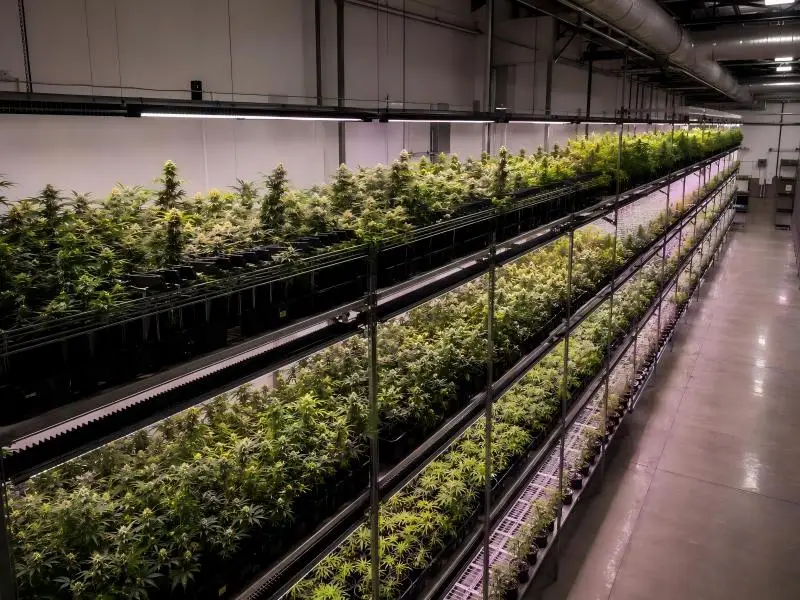
Vertical growing is all about repeatability. When each layer has the same light recipe, you can predict growth time, reduce crop variability, and dial in yield and quality. This guide explains how LED grow light bars work, what specs matter, and how to plan coverage and power for real shelving layouts.
Table of Contents
What Is an LED Grow Light Bar?

An LED grow light bar is a linear horticultural fixture designed to spread photon output along its length. Compared with a square “panel” grow light, a bar distributes light more evenly across long shelves and narrow benches, especially when you use multiple bars per tier. The result is a smoother PPFD map and fewer “hot spots” under the center of a single fixture.
Most bar fixtures are built around aluminum for heat spreading, with LEDs arranged in one or more rows. They’re typically mounted close to the canopy in vertical racks, which improves efficiency because less light is wasted outside the target area. In practical terms, a bar light helps you turn a shelf into a controlled, predictable growing zone.
Why growers choose bar form factors
Bar lights are popular because they fit the geometry of racks and benches. You can mount them parallel to the shelf edges, align them with trays, and tune intensity by changing the number of bars. That modularity is why bar systems dominate many seedling rooms, tissue culture support areas, and multi-tier leafy green racks.
Bar fixtures also simplify service and expansion. If you add one more rack tier or extend a bench line, you can often reuse the same bar model and wiring approach. Over time, that standardization reduces operational headaches.
Typical applications for LED grow light bars
You’ll see LED grow light bars used in propagation, leafy greens, microgreens, herbs, and mother/clone rooms. They’re also common in vertical research racks because uniformity matters for reliable trials. In commercial environments, bar lighting is a practical path to scaling without redesigning your whole facility every time you expand.
Why LED Grow Light Bars Are Ideal for Vertical Growing
Vertical growing depends on tight spacing. Your tiers might be 12–24 inches apart, leaving no room for bulky housings or tall drivers. A slim LED grow light bar is made for this environment, delivering high light output with minimal physical depth.
Bars also allow you to “paint” light across the shelf with multiple sources. Instead of one bright center and dark corners, you use several lower-profile emitters to create a flatter distribution. That’s one of the easiest ways to improve uniformity and reduce stretching on the shelf edges.
Slim design improves usable shelf height
In rack systems, every inch of vertical clearance matters. A low-profile bar fixture lets you keep more distance between the canopy and the LEDs when the crop gets tall, or it lets you add one more tier in the same room height. Either way, you gain more production per square foot of floor space.
Slim fixtures also help with airflow. Better airflow around the canopy reduces microclimates that can cause uneven growth or disease pressure. When lighting doesn’t block circulation, it’s easier to keep temperature and humidity consistent.
Stackable, modular scaling keeps projects flexible
Bar lights scale in a clean, predictable way. If your crops need more intensity, you can add bars or upgrade to higher-output bars without changing the rack structure. If your crops need less intensity, you can dim or remove bars and keep the same mechanical layout.
This modular approach is also useful when you grow multiple crops in the same facility. You can assign different tiers different light levels by bar quantity, dimming, or photoperiod. That’s much harder to do with a few large panel fixtures.
Better uniformity across trays and channels
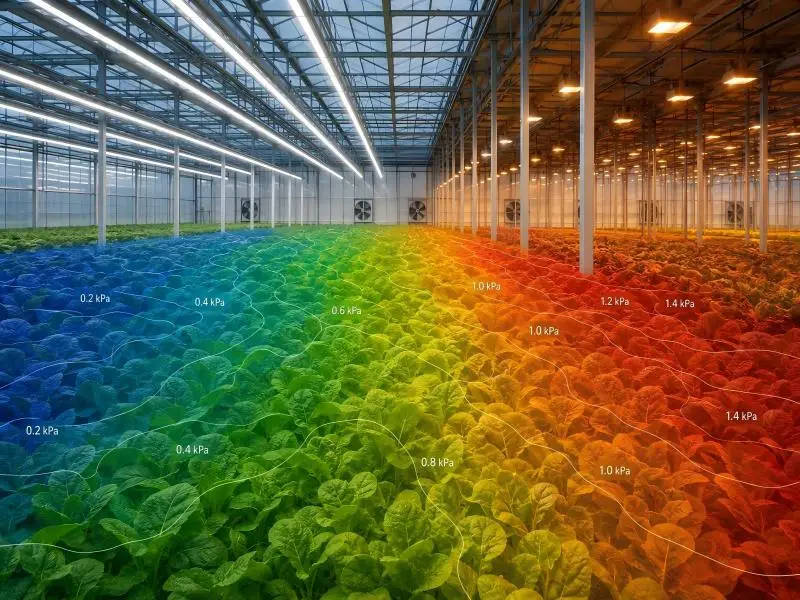
Uniformity is not just a “nice-to-have.” When one section of a shelf gets less PPFD, plants there grow slower and finish later, which complicates harvest planning. Multi-bar layouts typically produce more even PPFD than a single point-source fixture, especially on 2–4 ft wide shelves.
If you want an objective way to discuss uniformity, look for PPFD maps measured at realistic mounting heights. High-quality growers often compare maps at multiple heights because canopy distance changes as plants grow. A bar system usually holds up well across those changes.
Light Metrics That Matter for LED Grow Light Bars
Marketing specs can be confusing, especially when brands mix “watts,” “equivalent watts,” and “coverage claims.” The metrics below are the ones that actually connect lighting to plant performance. If you understand these, you can compare LED grow light bars much more confidently.
For a plain-language overview of plant lighting concepts like PPFD and DLI, Oklahoma State University’s extension fact sheet is a solid reference: LED Grow Lights for Plant Production (OSU). It’s written for growers and explains the terminology without unnecessary math.
PPFD, PPF, and why “brightness” is misleading
PPF (μmol/s) is the total number of photosynthetic photons a fixture emits per second. PPFD (μmol/m²/s) is how many of those photons land on a square meter of canopy each second. PPF tells you fixture output, while PPFD tells you what the plant receives.
Human brightness units, like lumens, don’t reflect plant response well. Plants “care” about photons in the photosynthetic range, not how bright the light looks to your eyes. That’s why horticulture lighting specs focus on PPF and PPFD, not lumen ratings.
PPE efficacy connects output to electricity cost
PPE (μmol/J)—also called photon efficacy—tells you how many photosynthetic photons you get per joule of energy. Higher efficacy generally means lower electricity cost for the same PPFD at the canopy. Over a large facility, small differences in efficacy can become big differences in operating cost.
For projects that pursue rebates, efficacy thresholds, and testing standards matter. The DesignLights Consortium (DLC) provides horticultural technical requirements and maintains a qualified product list used by many incentive programs. You can review the current requirements here.
DLI turns “instant intensity” into a daily growth dose
DLI (Daily Light Integral) is the total amount of photosynthetic light delivered per day (mol/m²/day). It’s often the most useful planning number because it connects lighting, photoperiod, and intensity in one value. Michigan State University explains DLI and why it matters for crop quality and yield in a clear way.
A simple conversion helps you plan:
DLI ≈ PPFD × (hours of light × 3600) ÷ 1,000,000.
This means if you know your target DLI and photoperiod, you can estimate the PPFD you need on the shelf. That makes bar-light planning much more systematic.
Verified testing builds trust in the numbers
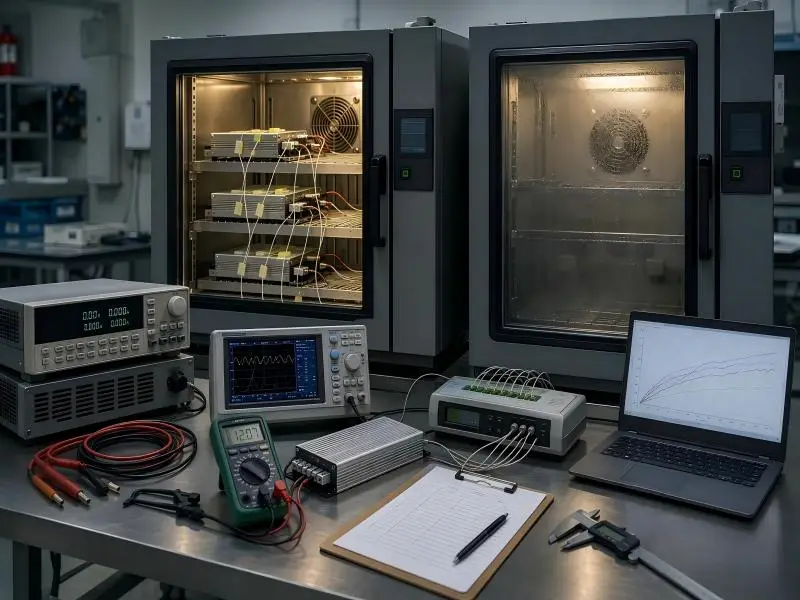
When you’re comparing LED grow light bars, ask how the performance data was measured. For many markets, LM-79 testing is a common way to measure the electrical and photometric performance of LED products under controlled conditions. Intertek provides a useful overview of the LM-79 standard and what it covers.
For long-term reliability, LED component testing such as LM-80 and extrapolation approaches like TM-21 are often discussed in the lighting industry. The U.S. Department of Energy has published guidance that helps explain how these standards relate to lumen maintenance over time: Reading, Understanding, and Applying LM-80 (DOE). Even though horticulture focuses on photons, not lumens, the underlying reliability conversation is still relevant for quality fixtures.
Spectrum Options for LED Grow Light Bars
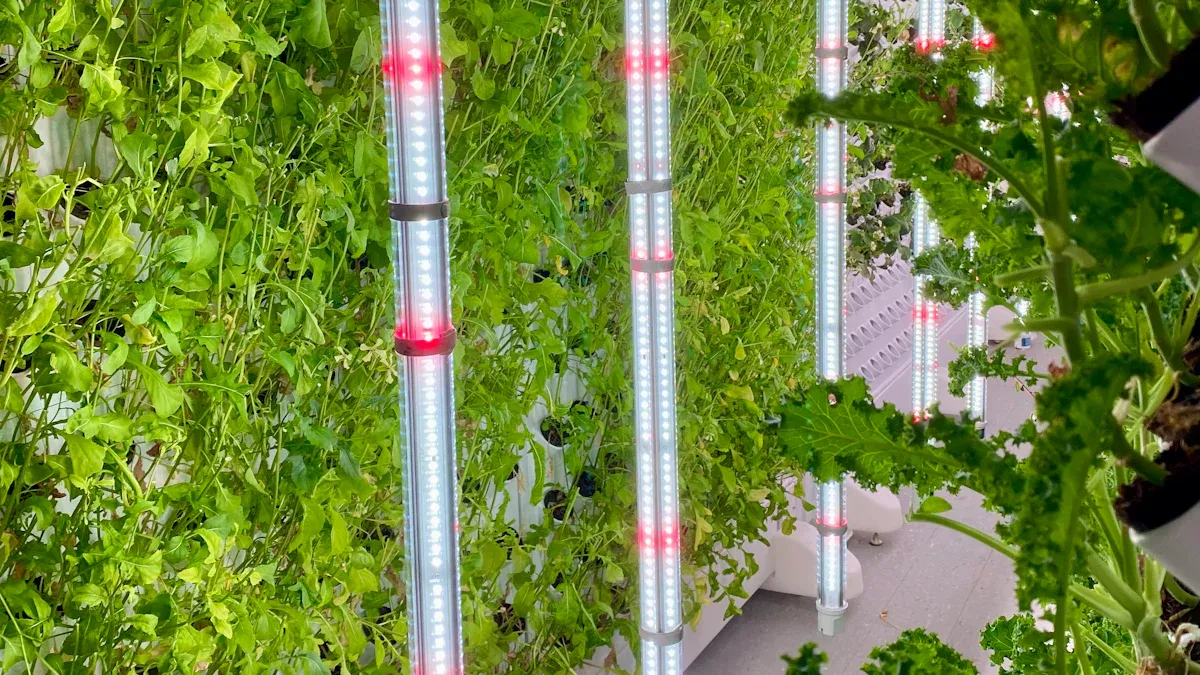
Spectrum doesn’t need to be mysterious. For most vertical rack crops, the goal is consistent growth and predictable morphology, not a “magic color.” A well-designed full-spectrum LED grow light bar can support seedlings through finishing, while specialized spectra can be useful when you want specific plant responses.
Spectrum choices should match your crop and your business goals. If you want a single fixture that works for multiple crops, full-spectrum is usually the simplest path. If you want to push speed, compactness, or specific quality traits, you can consider spectrum tuning.
Full-spectrum for general-purpose vertical racks
Full-spectrum white LEDs (often supplemented with deep red) are popular because they’re easy to work under and they support a wide range of crops. They tend to produce natural-looking foliage and make scouting for nutrient issues simpler because you can see leaf color accurately. In multi-tier operations where staff work close to the canopy, that matters.
Full-spectrum bars are also easy to standardize. If you run mixed crops, you can keep the spectrum constant and adjust PPFD and photoperiod per tier. That reduces complexity while still giving you control.
Red and far-red as tools, not shortcuts
Red photons drive photosynthesis efficiently, which is why many horticultural fixtures include strong deep-red output. Far-red can influence morphology and flowering responses in some crops, but it should be used intentionally. If your facility is focused on uniform compact seedlings, too much far-red can cause stretching.
A practical approach is to treat far-red as a “dial,” not a default. Use it when you have a known reason—like steering morphology or managing crop timing—and verify results with your own trials. What works in one room layout or cultivar may not translate perfectly to another.
UV: Use carefully and verify goals
UV is sometimes used to influence plant secondary metabolites or morphology, but it can also add risk and complexity. In vertical racks where lights are close to workers, UV safety considerations become more important. If you decide to use UV, treat it as a controlled addition with clear goals, not a marketing checkbox.
In many commercial vertical systems, the biggest wins come from getting PPFD, DLI, and uniformity right first. Once those fundamentals are stable, spectrum experiments make more sense. That order of operations reduces troubleshooting and avoids chasing small gains while big issues remain.
Planning Coverage for Shelves and Racks
Planning coverage is where LED grow light bars shine. Because bars are modular, you can design around shelf geometry rather than trying to “force-fit” a large panel fixture. The key is to define your target zone, pick a target DLI or PPFD, then choose a bar layout that delivers uniform light.
If you want a research-backed explanation of how DLI is calculated and applied, Virginia Tech has a straightforward extension publication on the topic: Calculating and Using Daily Light Integral (VT Extension). It’s helpful when you want to explain lighting decisions to a team or customer.
Step 1: Define the real growing footprint
Start with the tray area that actually holds plants, not the shelf frame size. A “4 ft shelf” may only have 44 inches of usable tray width once you account for rails and irrigation lines. If you design lighting based on the wrong footprint, you can end up under-lighting edges or wasting photons outside the canopy.
Measure length and width, then note obstructions like posts, fans, or plumbing. These can create shadows or force you to mount bars slightly off-center. In vertical systems, a small misalignment can repeat across many tiers, so it’s worth planning carefully.
Step 2: Choose a target DLI based on crop stage
Different crops and growth stages often use different DLI targets. Seedlings and cuttings usually need gentler light, while leafy greens and fruiting crops need more. Even within the same crop, the ideal DLI can change between propagation and finishing.
When in doubt, choose a conservative DLI, confirm uniform growth, and then increase in controlled steps. In vertical racks, it’s usually easier to increase intensity later than to fix stretched plants caused by too little light early on.
Step 3: Convert DLI to PPFD using your photoperiod
Once you pick a DLI and photoperiod, you can estimate the PPFD needed at the canopy level. For example, if you run 16 hours per day, you can back-calculate the PPFD required to hit your target DLI. This turns “coverage” into a number you can verify with a meter.
After installation, you can validate the plan using a quantum sensor and measure PPFD across the shelf grid. This is how professional growers confirm they’re getting what they paid for. It also helps you spot issues like shadows, wiring droop, or uneven bar spacing.
Step 4: Choose bar count and spacing to maximize uniformity
A common mistake is using too few bars and running them too bright. That can produce hot stripes directly under each bar and lower PPFD between bars, especially if the mounting height is very close. Adding one extra bar and running the whole tier at lower power often improves uniformity and reduces stress on components.
For a typical 4 ft × 2 ft shelf, many growers use multiple parallel bars spaced evenly across the width. The goal is a smooth PPFD map across the tray footprint, not a high peak in the center. A well-designed bar system makes that achievable.
Mounting Height, Bar Spacing, and Dimming Strategies
Mounting and control are just as important as fixture choice. Even the best LED grow light bar can perform poorly if it’s mounted too close, placed unevenly, or run at the wrong intensity for the crop stage. The good news is that vertical racks are repeatable, so once you find the right setup, you can duplicate it across the room.
A disciplined approach is to start with moderate PPFD, confirm plant response, then adjust. Plants tell you quickly if the light is too low (stretching, slow growth) or too high (bleaching, curling, stress). When your lighting is uniform, these signals become easier to interpret.
Mounting height: close is efficient, but not always better
Mounting closer improves efficiency because less light escapes outside the canopy. However, if the bars are too close, uniformity can suffer, and you can get striping. Very close mounting also increases the risk of splash exposure in hydroponic racks, which makes fixture sealing and cable management more important.
A practical method is to pick a starting height that gives you a good PPFD map, then keep that height consistent across tiers. If the crop grows taller than planned, dimming can be safer than pushing plants into the fixture. Consistent geometry leads to consistent results.
Bar spacing: design for the canopy, not the shelf frame
Spacing should be based on the tray footprint and the beam distribution of the bar. Narrow optics may need more bars or more height to blend the beams, while wide distribution can smooth the map with fewer bars. The best way to choose is to review PPFD maps at realistic heights and widths.
If you don’t have maps, plan to measure after installation. Even a basic grid measurement across a shelf can reveal whether spacing is correct. In vertical farms, small improvements in uniformity can lead to big improvements in harvest consistency.
Dimming and photoperiod: make intensity flexible
Dimming is one of the most valuable controls in a vertical growing system. It lets you run the same hardware for the propagation and finishing stages by adjusting intensity. It also helps you manage heat load and electricity demand during peak pricing hours.
Photoperiod interacts with intensity through DLI. If you extend photoperiod but keep PPFD constant, DLI increases, which can speed growth in some crops. A controlled strategy is to pick a DLI target first, then decide whether you want to reach it with higher PPFD and shorter hours, or lower PPFD and longer hours.
Heat, Humidity, and Durability in Real Grow Rooms
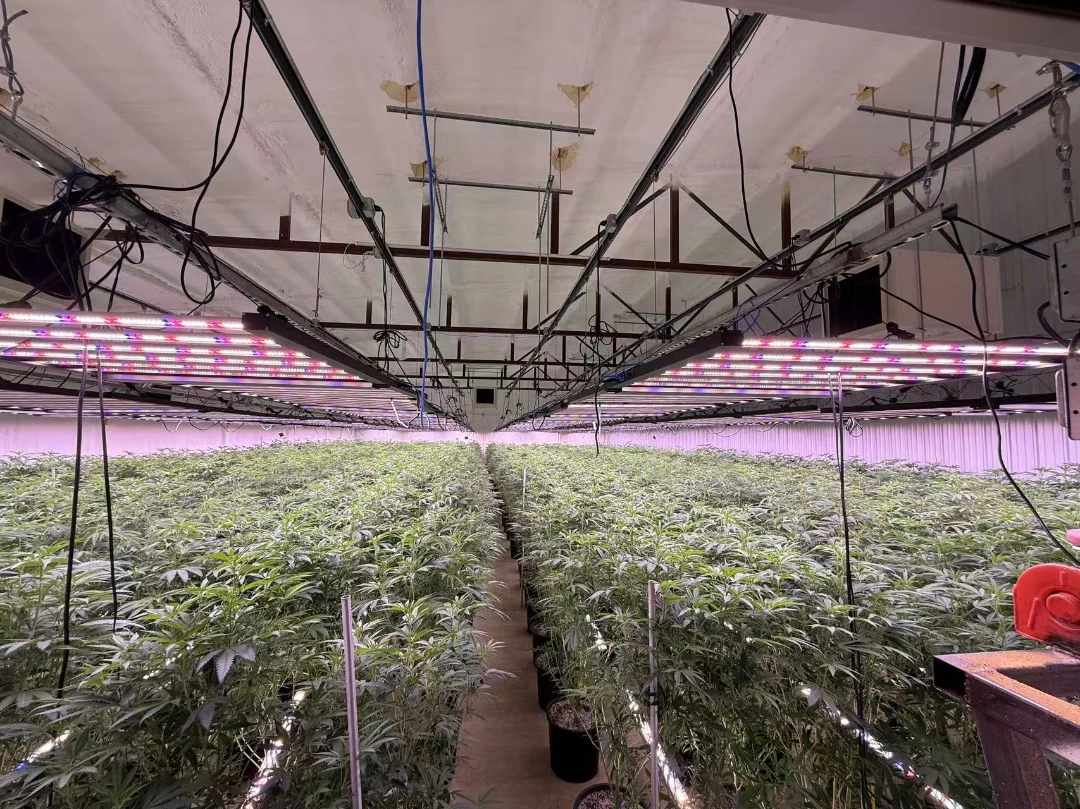
Vertical growing environments can be harsh. High humidity, nutrient solution splashes, frequent cleaning, and tight spaces all stress equipment. A reliable LED grow light bar is designed to handle these conditions without rapid degradation.
Good thermal design matters even if LEDs “run cool” compared with legacy lamps. Heat still exists—it just needs to move away from the diodes and driver efficiently. When heat is controlled, output stays stable and lifespan improves.
Passive cooling and aluminum heat spreading
Most quality bar lights use aluminum as a heat spreader. This keeps LED junction temperatures lower, which supports long-term stability. In racks with limited airflow, efficient heat spreading is especially important because hot air can linger near the canopy.
When comparing fixtures, don’t just look at watts. Look at the mechanical design, weight, and heat-sinking approach, because those often reflect how seriously the manufacturer treats thermal performance. A well-built bar can deliver stable output for years with minimal maintenance.
IP ratings and protection against water and dust
In grow rooms, protection against moisture and dust is often crucial. IP ratings describe how well an enclosure resists ingress of solids and liquids under defined test conditions. The International Electrotechnical Commission provides a clear explanation of IP ratings and the IEC 60529 framework here.
For commercial projects, it’s smart to match the IP rating to your cleaning routine. If you do frequent wet cleaning, a higher ingress protection level can reduce risk. If your environment is dry and you avoid spray, you may prioritize other specs like efficacy and control.
Drivers and connectors: the hidden reliability factors
Drivers and connectors often determine real-world reliability more than the LED chips. In rack systems, frequent adjustments can stress cables and plugs. That’s why strain relief, robust connectors, and clean cable routing matter.
If drivers are integrated into the bars, you want good heat management. If drivers are remote, you gain flexibility and can keep electronics away from the wet zone. Either approach can work well if it matches your facility layout and maintenance style.
Safety and Compliance Considerations
Safety isn’t optional in commercial growing, especially when you have many fixtures operating in a humid environment. Choosing certified products and following safe installation practices protects your team and reduces downtime risk. It also supports insurance and project approvals.
In the U.S. market, safety standards specifically addressing horticultural lighting exist. UL describes UL 8800 as a standard designed for horticultural lighting equipment and systems, and explains why grow environments require specialized consideration.
Electrical loading and daisy-chain planning
One advantage of LED grow light bars is clean wiring, but daisy-chain limits must be respected. Every bar and every cable has a current rating, and exceeding it can create heat and safety issues. Proper planning means calculating total amperage per circuit and verifying connector limits.
A professional approach is to distribute load across circuits, label tiers, and keep cable routing consistent. That makes troubleshooting faster and reduces accidental overload when a technician adds or rearranges racks. In a large room, neat wiring is not just aesthetic—it’s operational resilience.
Safe work environment around bright fixtures
Vertical racks often put lights close to eye level. High-PPFD environments can cause discomfort and may require eye protection during long work sessions. Good facilities consider worker comfort, visibility, and safe access when setting the lighting design.
Using full-spectrum bars can improve visibility compared with strongly colored “blurple” lights. Better visibility helps workers identify plant health issues early. That can reduce crop loss and improve quality control.
LED Grow Light Bar vs Panel Light vs Bulb: Practical Differences
Many growers choose between bar lights, flat panels, and bulb-style fixtures. Each has a place, but vertical racks have special constraints that often favor bars. The best choice depends on your geometry, target intensity, and maintenance preferences.
Bar systems excel when you want even distribution across long shelves. Panels can be strong in open rooms where height is available. Bulbs and simple fixtures may work for small-scale use, but they usually struggle with uniformity and professional control features.
Uniformity and edge performance
A single panel can create strong center intensity but weaker edges on wide shelves. Multiple bars can reduce that gradient by distributing emissions across the footprint. If edge performance matters to your harvest timing, bars often provide a simpler path to uniformity.
Uniformity becomes more important as you scale. When you have dozens of shelves, small differences repeat and become noticeable at harvest. Bar layouts help you standardize output across tiers and racks.
Maintenance and modular replacement
If one bar fails, you can often replace it without taking down the whole tier. That reduces downtime and makes spare parts management easier. With a large panel, a single failure may remove a bigger chunk of your lighting from service.
Bar modularity also supports incremental upgrades. If you improve your facility design later, you can sometimes add bars or upgrade bar models without changing the entire lighting system. That flexibility can protect your capital investment.
Crop-Friendly Light Recipes for Vertical Racks

Growers often ask for a single “best PPFD,” but crop response depends on DLI, photoperiod, genetics, CO₂, temperature, and nutrition. Still, it helps to have practical starting points. The goal is to give you safe ranges you can test and refine in your own environment.
If you want to build your lighting plan around DLI and seasonal conditions, MSU’s resources on DLI and supplemental lighting are useful background reading: MSU light management resources. They show how intensity and photoperiod interact and why growers separate photoperiod lighting from high-intensity growth lighting.
Seedlings and cuttings: stable, gentle intensity
Propagation typically benefits from moderate PPFD and long photoperiods. Too much intensity early can stress tender tissues, while too little can cause stretching and weak stems. A dimmable LED grow light bar is ideal here because you can start low and increase as roots establish.
Uniformity is especially important in propagation because small plants show unevenness quickly. When one area stretches, transplant size becomes inconsistent. Consistent bar spacing and verified PPFD maps help prevent that.
Leafy greens and herbs: balanced intensity and uniform canopy
Leafy greens often thrive with steady, uniform PPFD across the shelf. Consistent DLI supports predictable growth time and uniform harvest size. In many vertical farms, leafy greens become a “process crop” where repeatability matters more than peak intensity.
Herbs can be similar, but aroma and morphology can be sensitive to light quality and intensity. Instead of chasing extreme numbers, many growers focus on stable recipes and careful environmental control. Bar systems support that stability well.
High-value crops in racks: control matters most
For more demanding crops, the biggest advantage of a bar system is precise control. You can tailor intensity by tier, adjust photoperiod by stage, and keep uniformity high. That kind of steering is valuable when crop value is high, and consistency is critical.
If you plan to run high-intensity tiers, confirm that your rack airflow and HVAC can handle the heat load. Lighting is only one part of the production system, and pushing photons without supporting cooling and nutrition can backfire. A balanced design usually wins.
Operating Costs, Efficiency, and ROI
A good LED grow light bar often pays for itself through improved efficiency, better uniformity, and reduced crop variability. Electricity is usually the largest ongoing lighting cost, so efficacy and control features matter. You don’t need complicated finance models to compare options, but you do need consistent assumptions.
If you’re looking at incentives, DLC qualification is often part of the conversation. DLC publishes timelines and policy details for its horticultural program, including effective dates for technical requirement versions: DLC Hort V4.0 policy document (PDF). Even if you don’t apply for rebates, these frameworks encourage transparent testing and performance reporting.
A simple way to estimate electricity cost
Start with the total wattage per tier and the daily runtime. Multiply kW by hours per day to get kWh per day, then multiply by your electricity price. This basic math is enough to compare fixture options and justify investments in higher-efficacy lighting.
If two bar fixtures produce the same PPFD, the one with higher efficacy should use less power. Over thousands of operating hours, that difference adds up. That’s why serious growers compare PPFD delivered per watt, not just fixture wattage.
Efficiency also reduces heat load
Electricity used by the lights becomes heat in the room. Higher-efficacy fixtures deliver the same photons with less power, which means less heat to remove. In vertical systems, where tiers trap warm air, reducing heat load can make climate control easier and more stable.
Better stability improves crop outcomes and reduces stress events. Even small improvements in temperature uniformity can improve quality and reduce losses. This is one of the “hidden ROI” factors that shows up in operational performance over time.
Measurable energy savings at industry scale
For a broader look at LED adoption and energy impact in horticulture, the U.S. Department of Energy has published reports on solid-state lighting in agricultural applications: Energy Savings Potential of SSL in Agricultural Applications (DOE, PDF). It provides context on why LED efficiency matters at scale, even though every facility’s numbers differ.
Reading materials like this can help you communicate project value to stakeholders. It’s easier to get alignment when everyone understands how lighting ties to operating cost. In commercial projects, that alignment speeds up decisions and prevents expensive redesigns.
How to Choose the Right LED Grow Light Bar
Choosing a bar light becomes easy when you turn your needs into a checklist. Your goal is not “the strongest light,” but the right combination of uniformity, control, reliability, and efficiency for your crops and shelves. Once you define those requirements, the best option usually becomes obvious.
A good vendor should also support your planning. That means providing PPFD maps, wiring guidelines, and clear specifications instead of vague coverage claims. In vertical systems, documentation is a real part of product value.
A practical buyer checklist
Start with growing area dimensions, tier height, and target DLI or PPFD. Then confirm that the bar’s length and mounting options match your rack. Finally, check safety, sealing, and control features that match your environment.
Here are the questions that matter most in real projects. Each one should have a clear, written answer, not just a sales promise. If a supplier can’t answer these, you’re taking unnecessary risk.
- Do you have PPFD maps at realistic mounting heights? A map helps you plan uniformity and bar spacing, and it reduces guesswork. A good map should show measurement grid spacing and mounting height clearly.
- Is performance data based on recognized test methods? Look for transparent reporting and third-party testing where possible. Standards like LM-79 help ensure repeatable measurement practices for photometric and electrical data.
- What ingress protection is available, and what does it mean in cleaning routines? IP ratings should match your moisture exposure and sanitation approach. If you use spray cleaning, higher protection is often worth it.
- What control options do you support (dimming, daisy-chain, controllers)? Dimming and clean wiring are critical for rack workflows. You want control that is stable and easy to maintain.
- What is the warranty, and what does it actually cover? Warranty terms should be specific about drivers, LEDs, and operating environments. A warranty is only useful if service is responsive and practical.
Why Choose SLTMAKS LED Grow Light Bars for Vertical Growing

At SLTMAKS, we build lighting for growers who care about repeatability. A vertical rack is a system, not a single fixture, and our LED grow light bar approach is designed to scale cleanly across shelves and rooms. The goal is simple: consistent PPFD, stable output, and reliable operation in real grow environments.
We focus on practical features that matter in daily operations. That includes uniform distribution for trays, slim profiles for tight tiers, and modular expansion as your facility grows. When your lighting system is consistent, your crop planning becomes easier, and your results become more predictable.
Designed for slim racks and stackable expansion
Our bar fixtures are engineered to fit the physical constraints of multi-tier systems. A slim design helps protect vertical clearance while supporting airflow and service access. Stackable layouts make it straightforward to increase intensity by adding bars rather than replacing entire fixtures.
This modular approach reduces your upgrade risk. You can start with a baseline recipe, validate crop performance, and then scale up confidently. That’s a smarter path than overbuilding on day one and struggling to control intensity.
Built for consistency, not just peak output
In vertical growing, uniformity is a productivity tool. If every tray grows similarly, your harvest timing becomes predictable, and your labor planning improves. Our bar layouts are designed to support even distribution across the working footprint, not just high numbers in the center.
We also support dimming strategies so you can run the same hardware across multiple stages. Propagation and finishing don’t need the same intensity, and a flexible system helps you avoid running inefficient one-size-fits-all settings. Better control usually means better crop quality.
Support that helps you plan and scale
Hardware is only part of success. We support customers with practical planning guidance so the lighting system matches the shelf layout, crop goals, and operational style. When your plan is clear, installation is faster, and performance is easier to verify.
If you want, you can share your shelf dimensions, tier count, and target crop, and we can help you map a bar layout and a sensible starting PPFD/DLI strategy. A good plan at the start saves money and reduces headaches later.
Final Thoughts: Make Your Vertical Rack Lighting Simple and Repeatable
A LED grow light bar is one of the most practical tools for vertical growing because it matches the geometry of racks and scales cleanly. When you choose bars based on PPFD, DLI, efficacy, and uniformity—not vague coverage claims—you get predictable growth and easier operations. Add dimming and good mounting design, and you have a lighting system that can evolve with your facility.
If your goal is a slim, stackable lighting solution for shelves, propagation racks, or multi-tier production, LED grow light bars are often the smartest foundation. Build around a clear light recipe, measure your results, and scale what works. That’s how vertical growing becomes a reliable production process instead of a constant experiment.
FAQ
What is the waterproof rating of these LED grow light bars?
The SLTMAKS LED grow light bars feature an IP65 waterproof rating. This dust-tight and water-resistant design makes them ideal for high-humidity environments such as greenhouses, indoor vertical farms, or grow rooms where misting and humidity are common.
Do these light bars support Daisy Chain installation?
Yes, our LED grow light bars are designed with Daisy Chain capability. This allows you to connect multiple light bars using a single power source, significantly simplifying the wiring and installation process for large-scale vertical racking or multi-tier setups.
Is the light output “Full Spectrum”?
Absolutely. These light bars provide a full-spectrum light output that mimics natural sunlight. They include optimized wavelengths of red, blue, and white light (and often IR/FR) to support plants through all growth stages, from vegetative growth to flowering and fruiting.
Are these light bars suitable for vertical farming?
Yes, they are specifically optimized for vertical farming. The slim, low-profile design allows them to fit easily into tight shelving units or multi-layer racks without taking up valuable vertical space, while the efficient heat dissipation prevents heat buildup between layers.
What brand of LED chips are used in these bars?
To ensure maximum efficiency and longevity, we utilize high-quality Samsung LED chips. These industry-leading chips provide high PPFD (Photosynthetic Photon Flux Density) and low light decay, ensuring your crops receive consistent, high-intensity light over the long term.