The horticultural lighting landscape has undergone a seismic shift over the last decade, but 2025 marks a specific turning point in the maturation of the industry. As we look back at the trajectory of agricultural technology, the debate between High-Pressure Sodium (HPS) and Light Emitting Diode (LED) technology is effectively over. The question is no longer if you should use LEDs, but rather which specific configuration will maximize your yield per watt.
Searching for the best LED grow lights 2025 yields thousands of results, ranging from cheap, unregulated imports to high-end, commercial-grade fixtures. As a team that has spent years in the R&D labs and on the factory floor manufacturing these units, we at SLTMAKS know that the “best” light isn’t just about the highest wattage—it is about the precision of the spectrum, the efficiency of the photon delivery, and the longevity of the driver.
In this comprehensive year-in-review and guide, we will dismantle the marketing fluff, analyze the hard data, and explore the top models and technologies that are defining the 2025 grow season. Whether you are a commercial facility manager looking to retrofit a warehouse or a dedicated home grower aiming for a prize-winning harvest, understanding the physics behind the light is the first step to success.
Table of Contents
The Evolution of Horticultural Lighting: State of the Industry 2025
The Push for Higher Efficacy (PPE)
If there is one metric that defined the engineering goals of 2025, it is Photosynthetic Photon Efficacy (PPE), measured in micromoles per joule ($\mu mol/J$). Five years ago, a PPE of 2.5 $\mu mol/J$ was considered cutting-edge. Today, in 2025, that is considered the baseline entry-level standard. The best LED grow lights 2025 are now pushing boundaries exceeding 3.0 $\mu mol/J$.
This leap in efficiency is driven by advancements in semiconductor technology, specifically from diode manufacturers like Samsung and Osram. The latest generation of 3030 and mid-power LEDs allow manufacturers to drive currents lower while maintaining high light output. This “soft driving” technique reduces heat generation, which is the enemy of LED longevity. By reducing the thermal load, we not only increase the lifespan of the fixture but also reduce the cooling costs for the grow facility—a double win for Return on Investment (ROI).
The End of “Blurple” and the Rise of Broad Spectrum
In the early days of LED cultivation, the market was dominated by “blurple” lights—fixtures that emitted only red and blue wavelengths. While plants do heavily utilize red and blue peaks for photosynthesis, research from institutions like Utah State University’s Crop Physiology Laboratory has proven that plants thrive best under a broad spectrum that includes green and far-red wavelengths.
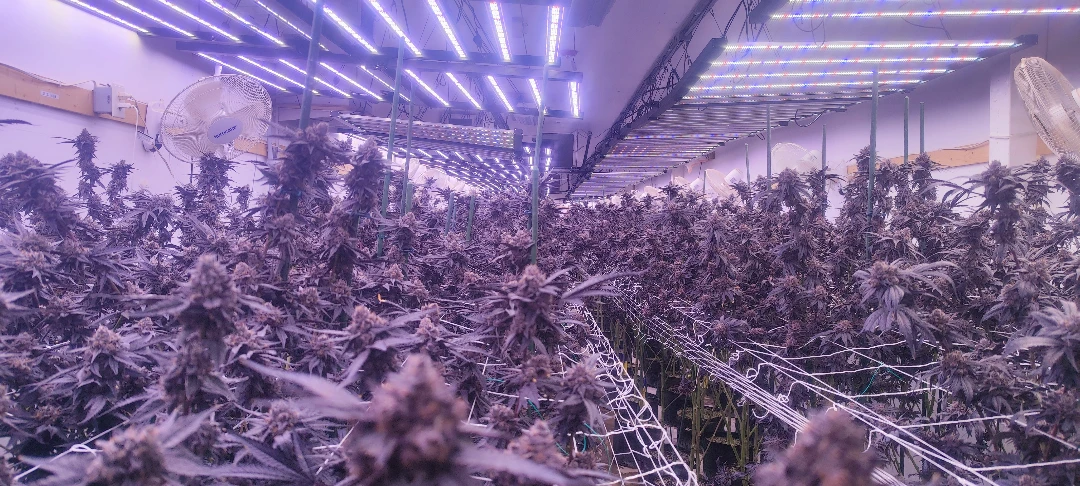
In 2025, the industry standard has firmly settled on “full-spectrum white” light, often achieved by coating blue diodes with advanced phosphor mixes. This mimics natural sunlight, allowing for better canopy penetration (green light penetrates leaves better than red or blue) and making it easier for growers to spot pests and deficiencies without wearing color-correcting glasses.
Smart Integration and IoT Capabilities
The modern grow room is a connected ecosystem. The top-tier models of 2025 are no longer standalone dumb fixtures. They are equipped with RJ14 or RJ45 ports, or even wireless mesh capabilities, allowing them to integrate with master controllers. This allows for features like “Sunrise/Sunset” simulation, where the lights slowly ramp up and down to reduce plant stress, and automated dimming based on temperature spikes in the room.
Decoding the Tech: Key Metrics for Choosing the Best Lights
Understanding PPF vs. PPFD
To choose the best light, you must understand the difference between PPF (Photosynthetic Photon Flux) and PPFD (Photosynthetic Photon Flux Density).
- PPF: This measures the total amount of light (photons) produced by the fixture per second. It is like the horsepower of an engine.
- PPFD: This measures how many of those photons actually hit a specific spot on your canopy. It is measured in $\mu mol/m^2/s$.
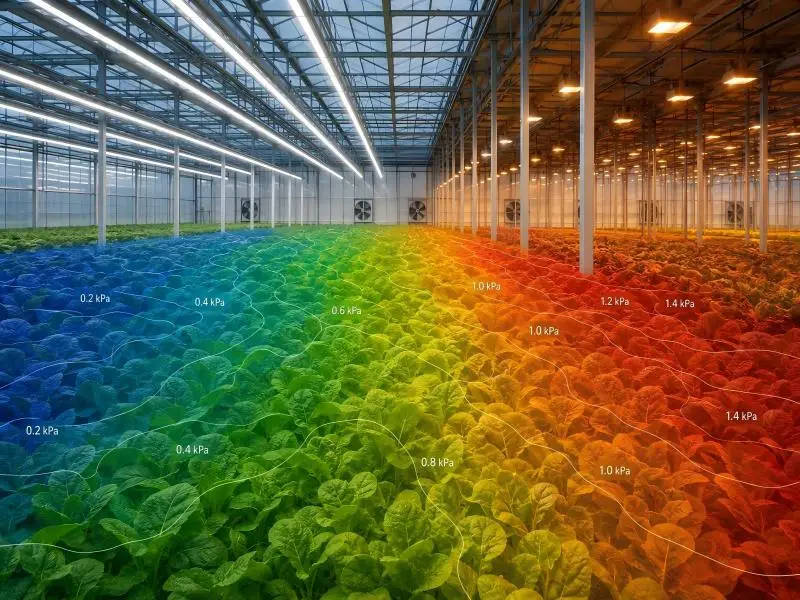
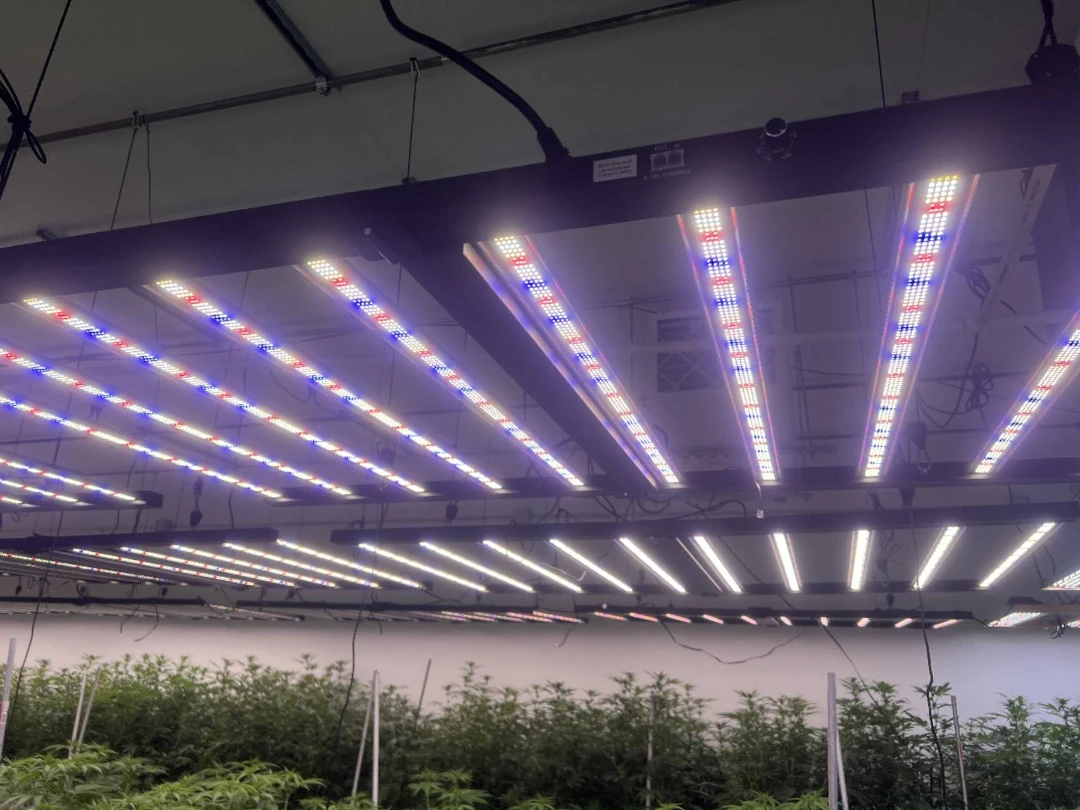
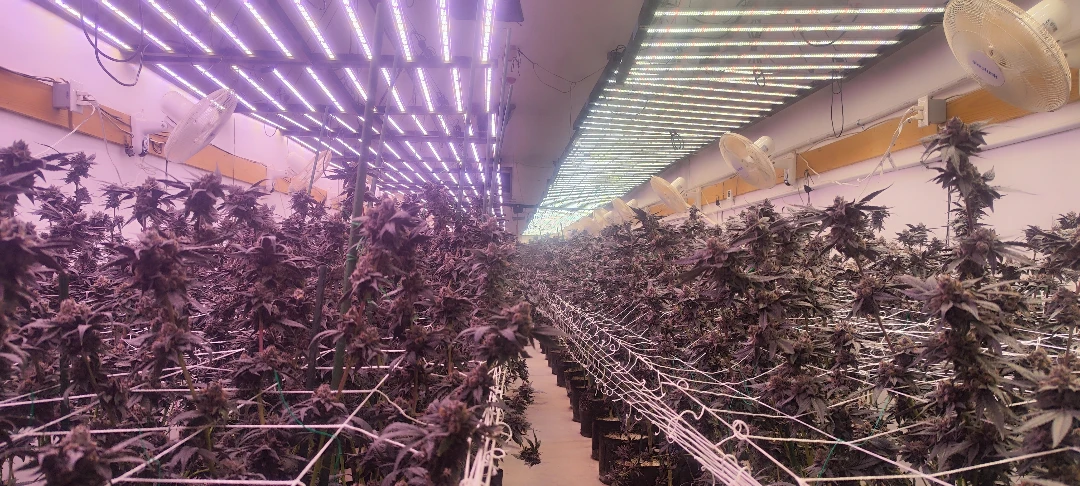
Many manufacturers will advertise a massive PPF number, but if the light lacks proper secondary optics or a wide form factor, that light might be concentrated in a “hotspot” directly in the center, burning the plants directly below while leaving the edges in the dark. The best LED grow lights 2025 feature bar-style designs (often 6, 8, or 10 bars) that spread the light out to ensure a uniform PPFD map.
The Importance of Uniformity
Uniformity is critical for commercial yields. If your center PPFD is 1500 but your corners are 400, your harvest will be inconsistent. You want a light that delivers a “flat plane” of light. In our R&D testing at SLTMAKS, we prioritize optical designs that achieve a uniformity spanning 0.8 to 0.9 (on a scale of 0 to 1), ensuring that the plant in the corner grows just as big as the plant in the center.
Thermal Management: Passive vs. Active Cooling
Heat management remains a critical differentiator.
- Active Cooling: Uses internal fans. These are generally discouraged in 2025 for professional setups. Fans are mechanical failure points, and if a fan dies, the LEDs overheat and burn out.
- Passive Cooling: Uses substantial aluminum heat sinks. This is the hallmark of the best fixtures. By utilizing high-grade aluminum with substantial surface area, heat is dissipated via convection. This results in a silent, maintenance-free fixture with a lifespan often exceeding 50,000 hours.
Table 1: Comparison of Cooling Technologies
| Feature | Active Cooling (Fans) | Passive Cooling (Heat Sinks) |
| Noise Level | High (50dB+) | Silent (0dB) |
| Failure Points | High (Fan motors fail) | Low (No moving parts) |
| Maintenance | Requires cleaning dust | Zero maintenance |
| Lifespan | 20,000 – 30,000 Hours | 50,000 – 100,000 Hours |
| Suitability | Hobby/Small Tents | Commercial/Industrial |
Deep Dive: Spectrum Analysis and the Emerson Effect
The 660nm Red Boost
While white light is the base, the top-performing lights of 2025 almost always include dedicated 660nm Deep Red diodes. This wavelength is the “superfood” for photosynthesis, aligning perfectly with the absorption peak of Chlorophyll A. Adding these diodes boosts the overall efficiency of the fixture and significantly increases biomass production during the flowering stage.
UV and IR: The Secret Weapons
The frontier of lighting in 2025 involves the strategic use of Ultraviolet (UV) and Infrared (IR/Far-Red).
- Ultraviolet (UV-A/UV-B): Used cautiously, UV stress triggers the plant to produce “sunscreen” compounds. In medicinal herbs, this often translates to higher trichome production and increased potency.
- Far-Red (730nm) & The Emerson Effect: The Emerson Effect refers to the increase in the rate of photosynthesis that occurs when lights of two different wavelengths (specifically red and far-red) are exposed to the plant simultaneously. Furthermore, using Far-Red for 15 minutes after the main lights go off can put the plants to “sleep” faster, potentially shortening the flowering cycle by days.
Editor’s Note: Many budget manufacturers claim to have UV/IR, but they often use cheap diodes that burn out in months. The best LED grow lights 2025 use separate control channels for UV/IR, allowing growers to turn them on only when needed (e.g., final weeks of flowering) to preserve diode life.
Top Categories and Models for 2025
1. The Commercial Powerhouse: 8-Bar Foldable Series
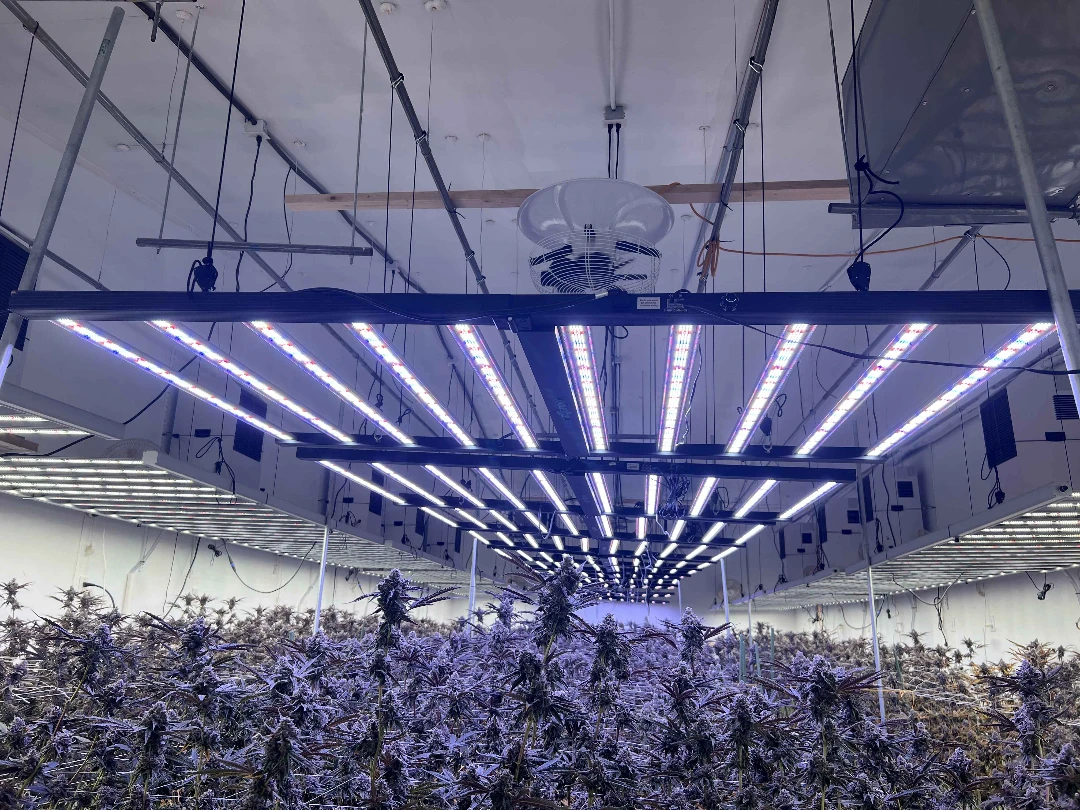
For commercial operators covering 4×4 or 5×5 ft benches, the multi-bar foldable design is the undisputed king of 2025.
- Why it wins: The open-bar design allows for airflow to pass through the fixture, preventing heat buildup around the canopy. The physical layout places diodes directly over the edges of the footprint, creating that perfect uniformity we discussed earlier.
- Target Specs: Look for 600W to 1000W power draw, with a PPE of 2.9+ $\mu mol/J$.
- SLTMAKS Perspective: Our customized solutions in this category focus on modularity, allowing growers to replace individual bars if necessary rather than the whole fixture.
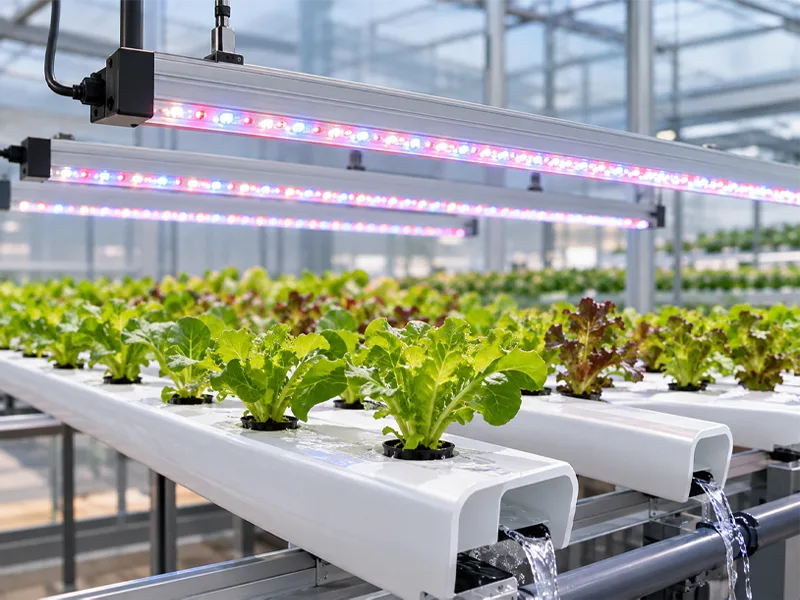
2. The Vertical Farming Specialist: Low Profile Linear Bars
Vertical farming presents unique challenges: heavily restricted vertical space. You cannot use a high-bay light here; you need lights that can operate just 6 inches from the canopy without burning the plants.
- Why it wins: These lights run cooler and use wide-angle optics (120 degrees or more) to spread light immediately.
- Target Specs: 20W to 50W per linear foot.
- Key Trend: In 2025, we are seeing “tunable spectrum” linear bars that can shift from vegetative blue-heavy spectrums to flowering red-heavy spectrums via a controller, saving labor costs in moving plants between rooms.
3. The Greenhouse Hybrid: Top-Lighting Modules
Replacing HPS in greenhouses requires a different form factor—one that casts a shadow as small as possible to let natural sunlight through during the day.
- Why it wins: Slim, linear designs that fit under the truss.
- Target Specs: Extremely high output (PPF > 2000 $\mu mol/s$) to supplement the sun on cloudy days or extend the photoperiod in winter. High IP65 or IP66 water resistance is non-negotiable here due to humidity.
The Economics of Upgrading: An ROI Analysis
One of the most common questions we receive at SLTMAKS is: “Is it really worth replacing my working HPS setup?” The answer lies in the math.
Energy Efficiency
A standard 1000W Double-Ended (DE) HPS fixture actually draws about 1150 watts from the wall when you account for ballast inefficiency. To match the light output of that HPS, you only need a ~650W LED fixture.
- Savings: 500 Watts per fixture per hour.
- Calculation: If you run lights for 12 hours a day, that is 6kWh saved per day, per light. At an average commercial rate of $0.15/kWh, that is nearly $1.00 saved per fixture, per day. Over a year, that is $365 in pure electricity savings per light.
HVAC Savings
This is often overlooked. HPS lights radiate massive amounts of infrared heat toward the canopy. For every watt of HPS lighting, you need substantial HVAC tonnage to cool the room. LEDs radiate much less heat forward. Industry estimates suggest that for every watt of lighting power saved, you save another 0.3 to 0.5 watts in HVAC load.
Bulb Replacements
HPS bulbs degrade quickly. To maintain yields, commercial growers replace bulbs every 9-12 months. LED fixtures in 2025 are rated for L90 at 50,000 hours (meaning they still retain 90% of brightness after 5+ years of continuous use). The cost of labor and bulbs for HPS maintenance over 5 years often exceeds the initial purchase price of the LED.
Installation and Safety: Best Practices
Understanding Voltage and Amperage
Commercial facilities often run on 277V, 347V, or even 480V three-phase power to reduce amperage load on the wires. It is vital to ensure the LED driver is compatible with your input voltage. The best LED grow lights 2025 feature “auto-sensing” drivers that can accept a wide range (e.g., 120V-277V) automatically.
Hanging Heights and DLI
Managing the Distance to the canopy is crucial.
- Seedling: 24-30 inches, dimmed to 25%.
- Veg: 18-24 inches, 50-75% power.
- Flower: 6-12 inches, 100% power (CO2 supplementation is often required to utilize light levels above 1000 PPFD).
DLI (Daily Light Integral) is the total amount of light a plant receives in a day. You can check DLI charts from resources like Purdue University Extension to ensure you aren’t wasting electricity by giving the plant more light than it can physically process.
Why Manufacturing Quality Matters: The SLTMAKS Difference
As a website dedicated to this industry, we must address the “Elephant in the Room”—generic, no-name imports. In 2025, the market is flooded with lights that look like top-tier models but fail internally.
The PCB Layer
The Printed Circuit Board (PCB) is where the diodes sit. High-quality lights use Metal Core PCBs (MCPCB) with thick aluminum or copper backing to draw heat away from the diode. Cheap lights use fiberglass boards that trap heat, causing the diodes to shift color and lose brightness rapidly.
The Driver Quality
The driver is the heart of the system. Brands like Mean Well or Inventronics are the gold standard. A cheap driver will have a poor “Power Factor” (wasting electricity) and high “Total Harmonic Distortion” (dirty power that can damage other electronics). At SLTMAKS, we emphasize that a light is only as good as its driver.
Certification
Always look for DLC (DesignLights Consortium) listing. This not only guarantees performance but is often a requirement to get energy rebates from your local utility company, which can cover up to 50-70% of the fixture cost.
Future Trends: What Lies Beyond 2025?
As we look toward 2026 and 2027, the technology continues to evolve.
AI-Driven Light Recipes
We are beginning to see systems where cameras monitor the plant’s leaf angle and color. If the AI detects stress, it automatically adjusts the spectrum—perhaps reducing blue light or lowering intensity—without human intervention.
Inter-Canopy Lighting (ICL)
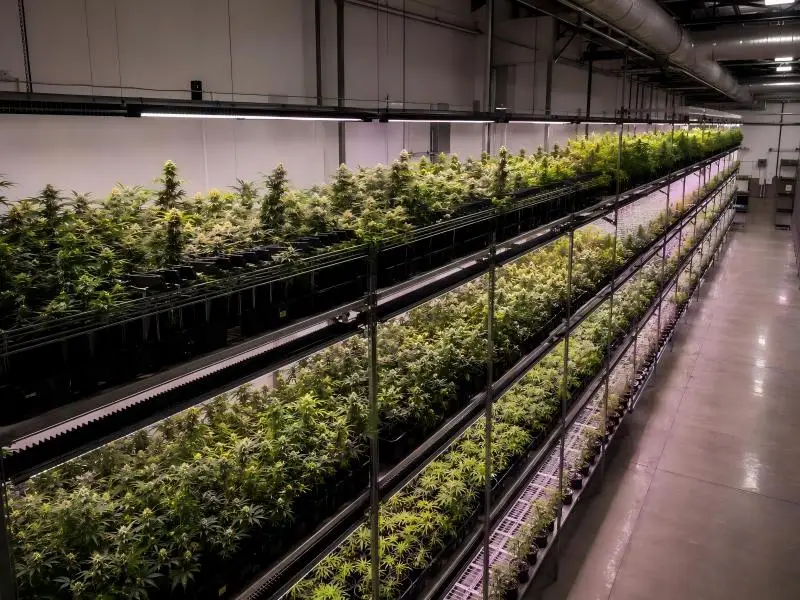
For high-density crops like tomatoes or cannabis, top lighting isn’t enough. ICL involves placing LED bars inside the plant canopy, illuminating the lower leaves that are usually shaded. This has shown to increase yields by 15-20% in preliminary 2025 trials.
Laser Lighting
While still experimental, laser diodes are being tested to deliver incredibly high-intensity light from a remote source via fiber optics, removing all heat from the grow room. While not yet commercially viable for the mass market, it is a technology we are watching closely.
Conclusion
The search for the best LED grow lights 2025 leads us to a clear conclusion: efficiency, uniformity, and spectrum control are the pillars of modern cultivation. The days of guessing are over; data-driven growing is here.
Whether you choose a high-end customized solution from SLTMAKS or another reputable provider, prioritizing high PPE, robust thermal management, and a scientifically backed spectrum will ensure your harvest is successful.
As we move forward, remember that the light is the food for your plants. Feeding them with precision, high-quality photons is the single most impactful investment you can make in your garden or facility.