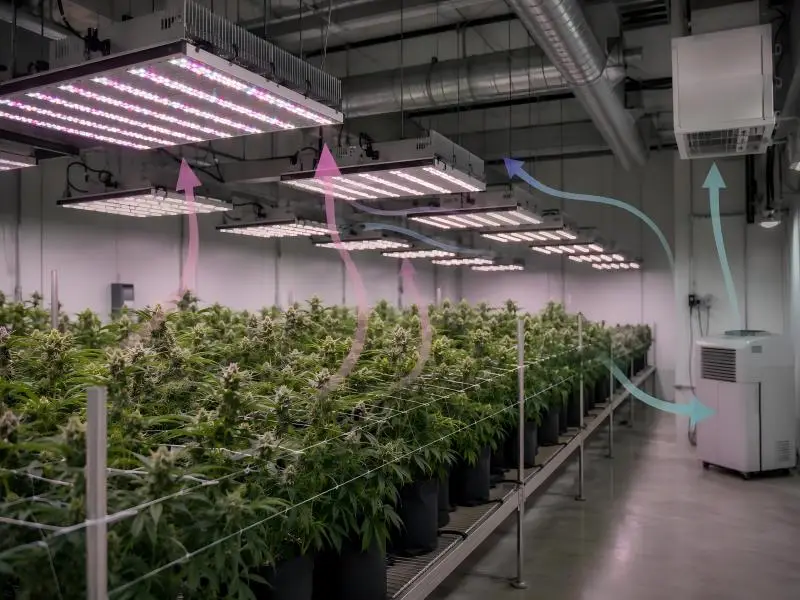
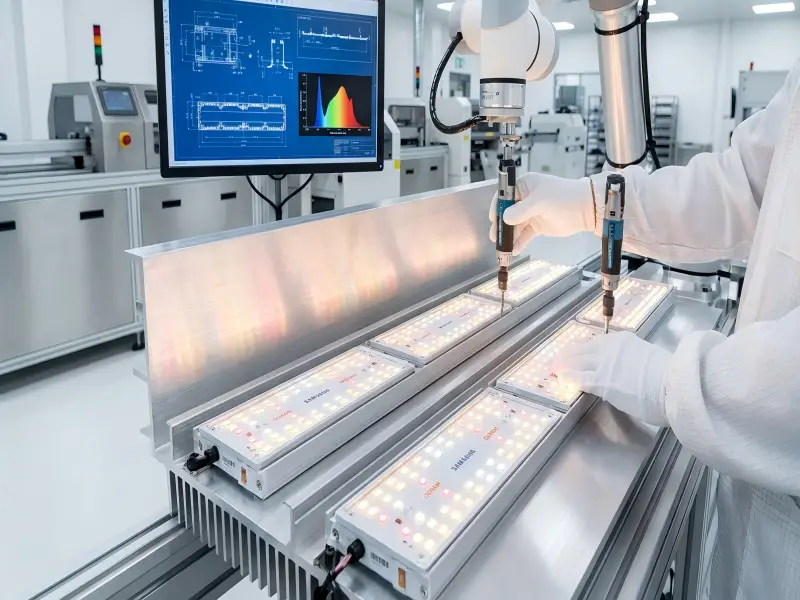
Scaling a commercial LED grow light brand in today’s horticultural market presents a severe strategic dilemma. On one end, attempting to design every component from scratch through a pure Original Equipment Manufacturer (OEM) pipeline requires hundreds of thousands of dollars in Non-Recurring Engineering (NRE) capex, custom injection tooling, and 12 to 18 months of development time. On the other end, sourcing ready-made white-label fixtures from a standard catalog leaves your brand exposed to instant commoditization, price erosion, and zero intellectual property defense.
When ten different distributors sell the same fixture shell, LED arrangement, and driver housing on B2B marketplaces and Amazon, price becomes the only remaining differentiator. Gross margins collapse from 40% down to single digits, and customer loyalty vanishes the moment a competitor offers the same catalog model for $15 less.
To escape this commodity trap while maintaining rapid speed-to-market, leading horticultural lighting brands rely on an exclusive ODM grow light partner. By co-engineering custom spectrums, optical layouts, and thermal architectures on a proven manufacturing platform under strict market exclusivity contracts, grow light brands can build proprietary, high-margin product portfolios without taking on massive R&D overhead.
Table of Contents
The White-Label Commodity Trap: Why Off-the-Shelf Fixtures Ruin Margins
White-label sourcing appears attractive on paper due to zero upfront tooling costs and instant order fulfillment. However, for serious commercial lighting brands targeting large-scale indoor cultivation facilities and greenhouse operators, white-label procurement creates severe long-term liabilities.
Key takeaway: White-label catalog fixtures offer speed at the expense of equity. Without exclusive tooling, custom optical profiles, or proprietary spectrum tuning, your brand is merely reselling a public commodity that your competitors can source from the same factory floor.
1. Market Saturation and Channel Conflict
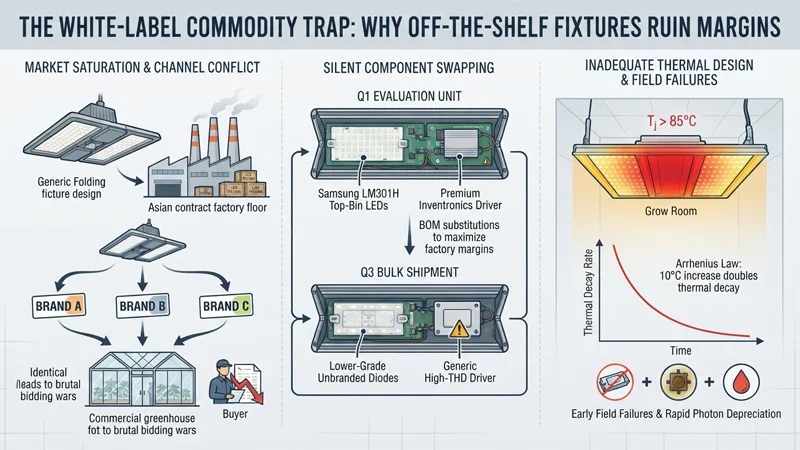
When an Asian contract factory develops a generic 640W or 1000W folding LED fixture, they rarely sell it to a single customer. Instead, they list the identical model across multiple global trading channels. Within months, the market becomes saturated with identical hardware operating under different brand stickers. When commercial growers realize the internal electronics, spectrum output, and fixture architecture are indistinguishable, they force distributors into brutal bidding wars.
2. Silent Component Swapping and Quality Degradation
Standard catalog factories frequently alter their Bill of Materials (BOM) between production batches to maximize their own manufacturing margins. A sample unit evaluated in Q1 might feature top-bin Samsung LM301H white LEDs and an Inventronics driver, while the bulk shipment delivered in Q3 quietly substitutes lower-grade unbranded diodes or secondary drivers with higher electrical total harmonic distortion (THD). Without a dedicated, contractually locked ODM specification, brand owners lack legal recourse when batch quality degrades.
3. Inadequate Thermal Design and Early Field Failures
Generic grow light fixtures are rarely engineered for the harsh realities of commercial indoor cultivation—such as continuous 18-hour photoperiods, ambient humidity exceeding 80%, and chemical sulfur/sanitization spray downs. Off-the-shelf fixtures often skimp on aluminum extrusion mass, resulting in LED junction temperatures (Tⱼ) climbing past 85°C. According to the Arrhenius Law of semiconductor degradation, every 10°C increase in junction temperature doubles the rate of thermal decay, causing rapid photon depreciation, color shifting, and driver failures in the field.
What Makes an Exclusive ODM Partnership Different?
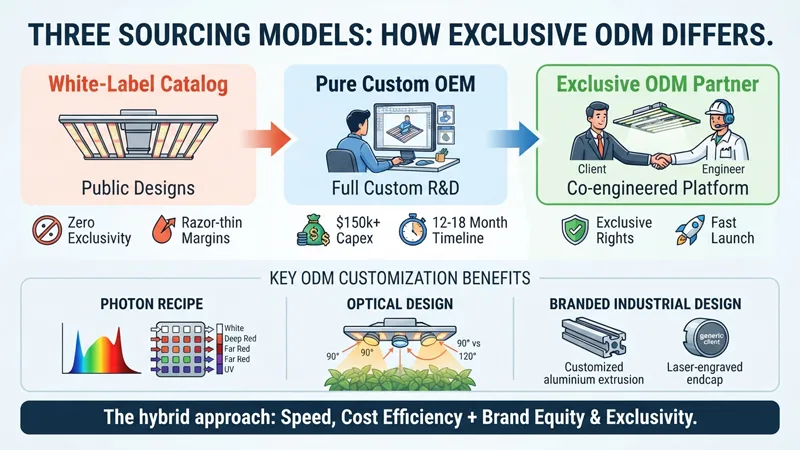
An Original Design Manufacturer (ODM) possesses pre-engineered, fully validated core fixture platforms—including safety-listed electrical architectures, thermal dissipation channels, and driver control systems. However, unlike standard white-label suppliers, an exclusive ODM grow light partner grants your brand exclusive commercial rights to customized iterations of these platforms.
- White-label catalog → Public designs, zero exclusivity, razor-thin margins
- Pure custom OEM
- Exclusive ODM
THREE SOURCING MODELS → Full custom R&D, $150k+ capex, 12-18 month timeline → Co-engineered platform, exclusive rights, fast launch
By working with an exclusive ODM, your product development team collaborates with factory engineers to customize critical performance parameters:
- Proprietary photon recipes: Adjusting diode ratios across white, 660nm deep red, 730nm far-red, and 395nm UV-A channels.
- Custom optical beam angles: Selecting 90° vs 120° optical reflectors or silicone lenses to optimize canopy PPFD uniformity.
- Brand-specific industrial design: Custom aluminum extrusion profiles, laser-engraved endcaps, custom powder-coating colors, and proprietary quick-connect wiring harnesses.
- Market exclusivity agreements: Contractual territorial and market protection ensuring the factory cannot supply your customized fixture configuration or tooling to any other brand worldwide.
This hybrid approach combines the speed and cost efficiency of pre-tested manufacturing platforms with the brand equity and pricing power of a fully custom product line. To understand how this compares with traditional contract manufacturing, explore our in-depth analysis of the OEM vs ODM grow light manufacturing model.
4 Core Pillars of an Exclusive ODM Partnership
To build a defensible market position, your brand’s relationship with an ODM manufacturer must extend far beyond basic logo printing. An exclusive ODM collaboration rests on four technical and operational pillars.
1. Proprietary Spectrum & Optical Co-Engineering
Commercial cultivators no longer buy grow lights based solely on total wattage; they purchase predictable plant responses. Crop-specific spectral tuning allows commercial farms to drive specific morphological outcomes—such as tighter internodal spacing during vegetative growth, increased terpene accumulation in flowering, or accelerated photoperiod responses.
An engineering-led ODM partner provides in-house optical laboratories equipped with high-precision integrating spheres and goniophotometers. Instead of settling for a generic full-spectrum mix, your brand can co-develop proprietary photon ratios.
Pro tip: When evaluating spectrum design, ensure your ODM partner accounts for the full extended Photosynthetically Active Radiation (ePAR) spectrum from 400nm to 750nm. Integrating 730nm far-red photons triggers the Emerson Enhancement Effect, accelerating photosynthetic efficiency when paired with 660nm deep red light.
By pairing tier-1 LEDs (such as Samsung LM301H white chips and Osram 660nm hyper-red diodes) with custom PCB layouts, an exclusive ODM partner helps your brand achieve photosynthetic photon efficacy (PPE) ratings of 2.7 to 3.0+ μmol/J. Learn more about developing custom photon recipes in our guide to custom LED spectrum engineering.
395nm UV-A -> 450nm Blue -> 520nm Green -> 660nm Red -> 730nm Far-Red
Secondary Metabolites
ePAR SPECTRUM (400nm – 750nm) BANDWIDTH Morphology Canopy Photosynthesis Emerson Effect & Stomata Penetration Peak Yield Acceleration
2. Advanced Thermal Management and Strict BOM Locking
Thermal management is the single most critical factor dictating the real-world lifespan and lumen maintenance of an LED grow light. High-power commercial fixtures drawing 600W to 1200W generate substantial heat that must be dissipated without noisy, failure-prone mechanical fans.
An experienced ODM partner utilizes advanced finite element thermal analysis to engineer heavy-gauge, passive aluminum heat sinks. By maintaining diode thermal junction temperatures (Tⱼ) comfortably below 75°C to 80°C under continuous operation, the fixture retains over 90% of its initial light output (Q₉₀) past 36,000 hours.
Furthermore, an exclusive ODM contract enforces a strict Locked Bill of Materials (BOM). Every component—from the thermal interface material (TIM) pad thickness and copper PCB substrate weight (2oz/3oz) to the internal driver inrush current limiters—is explicitly documented. The factory cannot substitute a single capacitor, diode bin, or connector without formal engineering change order (ECO) approval from your brand.
3. IP Protection, Mold Exclusivity, and Channel Isolation
Intellectual property theft and unauthorized design copying remain major concerns when manufacturing overseas. A professional ODM agreement safeguards your brand through three legally binding mechanisms:
- Tooling & mold ownership: Custom aluminum extrusion dies, optical reflector molds, and plastic injection tooling are contractually designated as your brand’s sole property. The ODM factory is legally barred from using your molds for any other customer.
- Geographic & channel exclusivity: The contract defines clear market boundaries (e.g., North America, Europe, Australia) where the ODM partner cannot supply similar derivative fixtures to competing brands.
- Non-disclosure & Non-compete clauses: Comprehensive NDAs cover optical Gerber files, PCB schematics, firmware code, and customer shipping lists, backed by local legal representation in the manufacturer’s home jurisdiction.
4. Accelerated Regulatory Compliance & Utility Rebate Co-Filing
Commercial cultivation operators in North America and Europe cannot install uncertified lighting fixtures. Building inspectors mandate Recognized Testing Laboratory (NRTL) safety marks, while farm owners rely on utility rebates to offset 30% to 50% of their initial equipment capex.
Obtaining safety certifications and energy efficiency listings independently is expensive and time-consuming. An exclusive ODM partner accelerates this process through pre-certified platform architecture:
- Electrical safety co-filing: The ODM holds baseline master safety reports under ANSI/UL 8800 safety standard (for horticultural equipment) and UL 1598/1598B. They submit a simple brand modification file to Intertek or UL, issuing an official ETL/cETLus listing under your brand’s unique model number in 2 to 4 weeks. Review the compliance requirements in our overview of UL8800 and ETL safety standards.
- DLC 5.1 horticultural QPL listing: The DesignLights Consortium (DLC) horticultural technical requirements mandate strict efficacy thresholds (≥2.3 μmol/J), Q₉₀ lumen maintenance data, and power factor standards (≥0.90). An established ODM partner provides verified laboratory integrating sphere reports and TM-21 thermal extrapolation data, enabling fast submission to the DLC Qualified Products List (QPL). Learn how this drives commercial sales in our guide to DLC QPL certification for commercial utility rebates.
Sourcing Model Comparison: White-Label OEM vs. Exclusive ODM
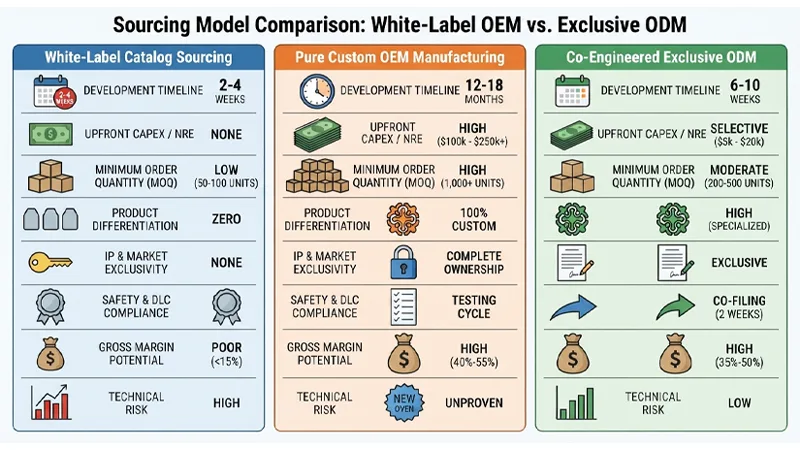
To help your executive team evaluate the strategic trade-offs across manufacturing models, the following matrix compares traditional white-label sourcing, pure custom OEM, and co-engineered exclusive ODM partnerships.
| Evaluation Dimension | White-Label Catalog Sourcing | Pure Custom OEM Manufacturing | Co-Engineered Exclusive ODM |
|---|---|---|---|
| Development timeline | 2 to 4 weeks (Instant catalog) | 12 to 18 months | 6 to 10 weeks |
| Upfront capex / NRE | $0 (No custom tooling) | $100,000 – $250,000+ | $5,000 – $20,000 (Selective tooling) |
| Minimum Order Quantity (MOQ) | Low (50 – 100 units) | High (1,000+ units per run) | Moderate (200 – 500 units) |
| Product differentiation | Zero (Public catalog fixture) | 100% Custom ground-up architecture | High (Custom spectrum, optics, & housing) |
| IP & market exclusivity | None (Competitors buy same model) | Complete ownership | Contractual territorial/channel exclusivity |
| Safety & DLC compliance | Generic or non-transferable | Long multi-month testing cycle | Fast-track co-filing (2 to 4 weeks) |
| Gross margin potential | Poor (<15% due to price wars) | High (40% – 55%) | High (35% – 50%) |
| Technical risk | High (BOM drift & thermal decay) | High (Unproven new design) | Low (Validated base platform) |
How to Evaluate and Audit an Exclusive ODM Partner
Not every contract factory advertising “ODM services” possesses the engineering depth or ethical standards required for an exclusive partnership. Before signing a long-term supply agreement, conduct a comprehensive audit using this 5-step evaluation framework.
Step 1: Verify In-House R&D & Test Labs (Integrating Spheres, FLIR Thermal)
5-STEP ODM EVALUATION CHECKLIST: Step 2: Inspect Supply Chain Integrity & Tier-1 Diode Direct Accounts Step 3: Audit Factory QA Protocols & ISO9001 Batch Traceability Step 4: Validate Legal IP Protections & Exclusive Tooling Contracts; Step 5: Confirm Compliance Co-Filing Speed & Warranty Backstop
1. In-House Photometric & Thermal Test Facilities
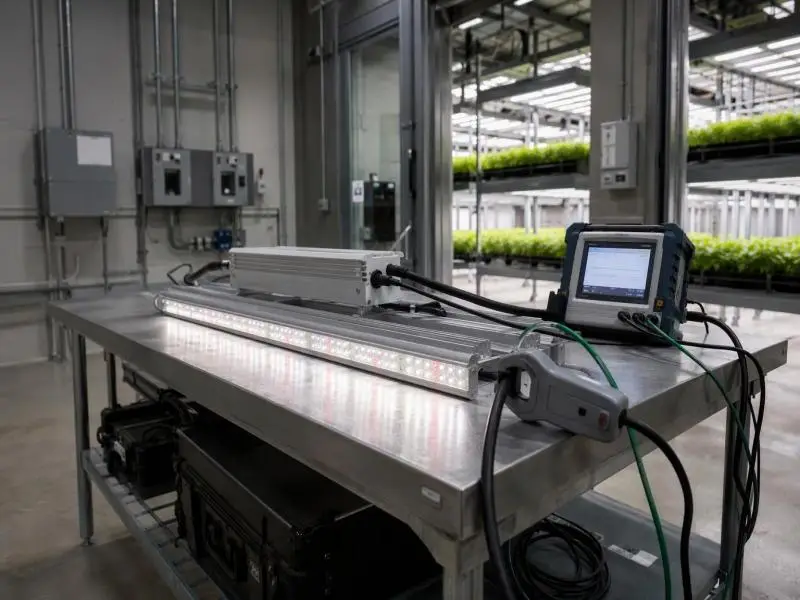
A capable ODM partner must own and operate professional testing equipment, including calibrated integrating spheres, goniophotometers, environmental temperature/humidity test chambers, and FLIR thermal imaging cameras. Request raw IES/LDT photometric files and LM-79 test reports generated in their own lab rather than relying on marketing brochures.
2. Direct Tier-1 Component Sourcing Accounts
Verify that the factory holds direct, authorized supply relationships with tier-1 component manufacturers—such as Samsung LED, Osram Opto Semiconductors, Inventronics, and Mean Well. Factories buying diodes through open-market brokers pose severe risks of counterfeit or lower-bin component contamination.
3. Comprehensive Factory QA Protocols and Traceability
Audit the factory’s quality assurance workflow across incoming raw materials (IQC), in-line SMT surface-mount assembly (IPQC), and 100% full-load burn-in testing (FQC). Ensure every fixture receives a unique barcode tracking the exact PCB batch, driver serial number, and assembly line operator. For a complete audit checklist, read our guide on auditing an LED grow light manufacturer in China.
4. Legal IP and Tooling Isolation Frameworks
Examine the ODM supplier’s track record with international B2B clients. Ensure their legal team agrees to jurisdiction-enforceable NDA terms, mold isolation agreements, and clear non-compete covenants that protect your sales channels.
5. Regional Logistics and Warranty Backstop
A true manufacturing partner stands behind their product reliability with a comprehensive warranty backstop (typically 3 to 5 years). Look for ODM suppliers that maintain regional customer service centers or local warehouses in North America and Europe to handle rapid replacement parts, warranty claims, and buffer inventory management.
Next Steps: Building Your Brand’s Proprietary Lighting Platform
In a commercial horticulture market driven by yield optimization, electrical efficiency, and strict facility compliance, grow light brands cannot afford to compete on generic white-label hardware. Partnering with an exclusive ODM grow light manufacturer provides the engineering speed, thermal reliability, custom spectrum capabilities, and legal IP protection required to build a sustainable, high-margin brand.
At SLTMAKS, we specialize in NDA-backed ODM and OEM manufacturing for commercial horticultural lighting brands worldwide. Powered by direct Samsung and Osram diode partnerships, in-house integrating sphere test labs, pre-certified ETL/UL8800 safety files, and local warehousing in North America and Europe, we help growing lighting brands turn custom spectrum concepts into market-ready, DLC-listed commercial products.
Ready to differentiate your product line? Contact SLTMAKS Engineering today to request our ODM capability deck, review custom optical tooling options, or schedule a confidential spectrum engineering consultation.
FAQ
What is the difference between OEM and ODM grow light manufacturing?
OEM (Original Equipment Manufacturer) involves manufacturing a fixture strictly according to a client’s custom design, blueprints, and tooling from scratch, requiring high capex and 12–18 months of development. ODM (Original Design Manufacturer) utilizes pre-engineered core platforms (drivers, heat sinks, optical base) that are co-engineered and customized—such as spectrum ratios, housing colors, and beam angles—for faster market launch and lower development costs.
How does an exclusive ODM partnership protect my brand’s intellectual property?
An exclusive ODM agreement safeguards your brand through legally binding contracts including mold/tooling isolation agreements (preventing the factory from using your custom dies for competitors), geographic and channel exclusivity rights, and strict non-disclosure/non-compete clauses covering Gerber files, optical layouts, and spectrum recipes.
What is a Locked Bill of Materials (BOM) in LED grow light manufacturing?
A Locked BOM is a contractually locked specification list detailing every core component of your grow light—including diode models and binning (e.g., Samsung LM301H), driver models (e.g., Inventronics), PCB substrate thickness, and thermal interface materials. The manufacturer cannot substitute any component without your formal engineering change order (ECO) approval, preventing silent quality degradation.
How long does it take to launch a custom ODM grow light fixture?
While a full OEM development cycle takes 12 to 18 months, a co-engineered ODM project typically takes 6 to 10 weeks. This covers initial spectrum/optical customization, rapid prototyping, full integrating sphere testing, and fast-track safety co-filings.
Why is thermal management crucial when customizing high-power grow lights?
High-power commercial fixtures (600W–1200W) produce substantial heat. Proper passive aluminum heat sink engineering keeps diode junction temperatures ($T_j$) under 75°C to 80°C. Lower junction temperatures prevent rapid photon depreciation, ensure $Q_{90}$ lumen maintenance past 36,000 hours, and preserve proper color spectrum stability over years of operation.
How can an ODM partner help my fixtures qualify for utility rebates and safety standards?
An experienced ODM partner provides pre-certified core platform architectures under ANSI/UL 8800 and UL 1598 standards, enabling fast 2- to 4-week ETL/cETLus brand co-filings. They also supply certified integrating sphere lab reports and TM-21 thermal extrapolation data required for DLC 5.1 Horticultural Qualified Products List (QPL) submissions, allowing your commercial clients to claim local energy utility rebates.