Introduction
For commercial indoor cultivation, the sourcing model behind your fixtures is more than a procurement detail. It shapes whether multi-site rooms light up on schedule, whether your PPFD maps match what the crop actually sees, and whether reliability issues show up as nuisance RMAs—or as downtime.
The catch is that LED grow lights sit at the intersection of engineering and market access. Electrical safety listings, rebate qualification, and controls integration all create constraints that are hard to “patch” after the fact.
This guide walks through the differences between ODM and OEM LED grow lights using a practical, engineering-led decision framework. The goal isn’t to argue for one model universally—it’s to help you pick the model that fits your differentiation, timeline, and risk profile.
Table of Contents
Sourcing Fundamentals (ODM vs OEM LED Grow Lights)
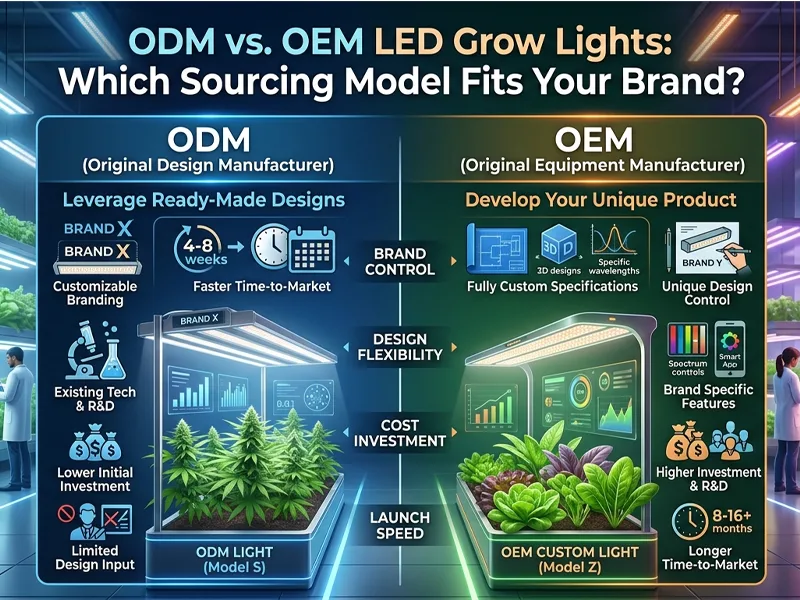
At a high level, ODM vs OEM LED grow lights is a trade between speed (starting from a proven platform) and control (owning the exact configuration you’re deploying and maintaining).
What Does OEM Mean in Horticulture?
In a true OEM model, you (the brand) act as the design authority. You define the fixture requirements—performance targets, electrical architecture, mechanical envelope, controls behavior, and documentation package—and a manufacturing partner builds to that specification.
The reason OEM matters in horticulture is control: you can specify the photometrics you need for your canopy geometry, the thermal behavior you need for your ambient conditions, and the change-control discipline you need for multi-site standardization.
OEM can still include off-the-shelf subcomponents (drivers, connectors, diodes), but the defining feature is that your spec (and your approval process) governs the final bill of materials (BOM) and what counts as an acceptable substitution.
What ODM Means in Horticulture
In an ODM model, the manufacturer owns a base fixture design and offers it as a starting platform. You can usually brand it, select from a limited menu of options, and make bounded modifications.
That bounded scope is why ODM can be fast: the supplier is not starting from a blank page. But it also means there are “hard edges” you’ll feel later—especially when you want a spectrum variant, a different optic, a different driver family, or deeper controls integration.
If you’re evaluating ODM LED grow lights, treat the underlying platform as the product. Your brand sits on top of it, but the platform’s architecture determines what can be changed without breaking certifications, supply continuity, or performance consistency.
IP, Exclusivity, and Customization Scope
IP and exclusivity aren’t abstract legal topics here—they determine whether your differentiation is defensible.
An engineer-focused overview from Wevolver notes that OEM arrangements typically give the buyer much deeper design control and a clearer path to owning core design IP, while ODM models generally leave the base design IP with the manufacturer and constrain customization to smaller changes (Wevolver’s OEM vs ODM manufacturing guide for engineers (2025)).
In practice for horticultural fixtures:
- ODM differentiation tends to be “surface area”: branding, mounting kits, a limited spectrum menu, or enclosure tweaks.
- OEM differentiation can be “architecture”: optic geometry, thermal stack, driver/controls design, and the exact spec/test artifacts you require.
If you need exclusivity, negotiate it as a contract output (e.g., a defined “no-sell” scope for a specific mechanical + optical combination), not as a handshake assumption.
Compliance & Market Access
UL/ETL, CE, RoHS Essentials
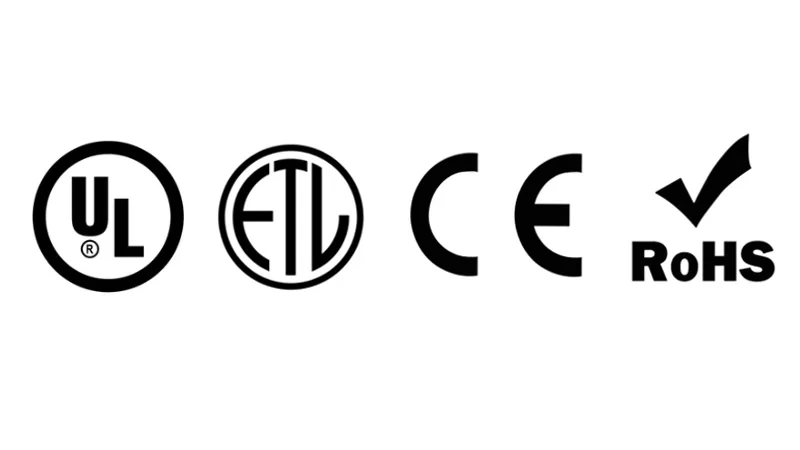
For US deployments, the practical question isn’t whether a fixture is “safe in theory.” It’s whether your inspector and insurer accept it.
Intertek explains that the ETL Listed Mark indicates a product has been independently tested and certified by Intertek—an OSHA-recognized Nationally Recognized Testing Laboratory (NRTL)—and that it’s accepted by regulators, inspectors, and authorities having jurisdiction (AHJs) in the US and Canada (Intertek’s ETL Listed Mark explanation).
For EU market access, CE marking and RoHS compliance are typically table stakes. CE is a conformity mark for EU requirements, while RoHS restricts certain hazardous substances. The operational implication is documentation: declarations, test reports, labeling, and traceability matter when something changes.
DLC QPL V4.0 and Rebate Timing
Rebates create a timeline constraint that can quietly determine your sourcing model.
The DesignLights Consortium (DLC) maintains a Horticultural Lighting Qualified Products List (QPL) intended to provide reliable product specifications and support energy-efficiency programs. DLC’s Hort V4.0 requirements accept applications starting April 18, 2025, with prior-version delistings occurring January 5, 2026 (DLC Horticultural Lighting Technical Requirements V4.0 (effective April 18, 2025)).
For multi-site rollouts, that timing matters because:
- A “rebate-eligible” fixture is often a procurement gate, not a nice-to-have.
- A platform that can’t maintain listing through variant changes can blow up your rebate schedule.
- You may need a sourcing model that supports predictable, documented changes without restarting qualification.
Change Control: OEM Redesign vs ODM Variant
Change control is where many OEM vs ODM decisions are actually made.
DLC listings, NRTL safety marks, and your internal SOPs all dislike uncontrolled variation. Even when a change seems minor (a driver substitute, a connector update, a different conformal coating), it can trigger re-evaluation, document updates, or both.
UL Solutions highlights that certification requirements can change over time and may require re-evaluation depending on what’s updated (UL Solutions guidance on certification requirement changes). That’s a reminder that compliance is not a one-time event—it’s ongoing configuration management.
In OEM, you can design your program around disciplined gates: qualification builds, approved alternates, and a controlled ECO (engineering change order) process. In ODM, you’re often inheriting the supplier’s platform roadmap, which can be fine—if you’ve negotiated how variants are frozen, documented, and communicated.
SLTMAKS can support OEM-capable documentation, certification coordination, and change-controlled rollout planning to help multi-site operators standardize a qualified configuration without repeated re-testing.
Engineering & Performance
Spectrum Strategy and Efficacy Ranges
Spectrum is where “same fixture, different result” becomes very real.
For sourcing, don’t start with marketing names. Start with what you need to control:
- Spectral power distribution (SPD) for the crop and growth stage
- PPF (photosynthetic photon flux) for total output
- PPE (photosynthetic photon efficacy) for energy-to-photon conversion
You’ll see efficacy discussed as a range in the market, but treat any number without test conditions as incomplete. For rollouts, the more useful question is: what SPD files, binning strategy, and substitution rules exist to keep spectral drift under control across lots and sites?
Uniform PPFD, Optics, and Thermal Design
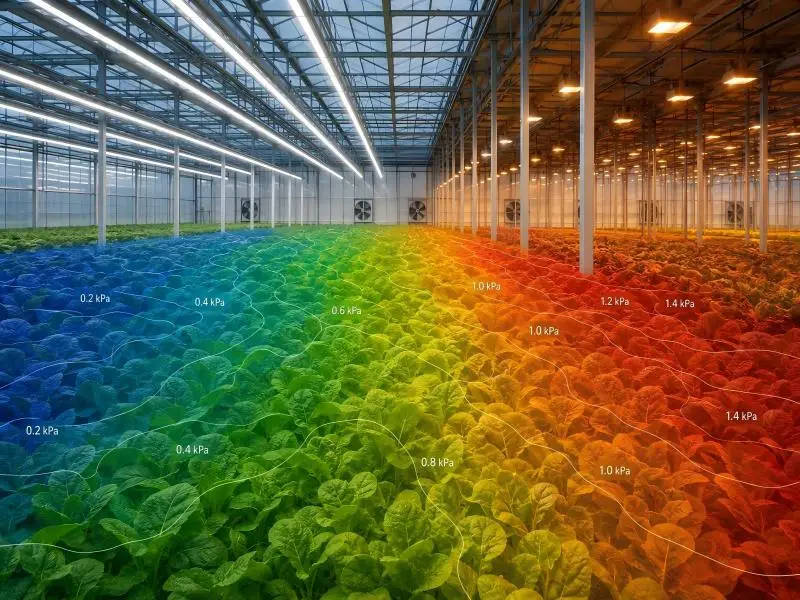
Uniformity is a system outcome: optics, mounting height, bar spacing, and thermal behavior all interact.
When you compare OEM LED grow lights vs ODM LED grow lights, ask what you can actually specify and verify:
- Photometric distribution: Do you get full IES files and PPFD maps at relevant heights?
- Optic choices: Are beam patterns tunable (and locked) for your canopy geometry?
- Thermal stack: What’s the ambient temperature assumption, and how does output shift at higher temps?
⚠️ Warning: If your sourcing model can’t lock the optic + thermal stack, PPFD uniformity can drift between lots even when the nameplate wattage stays the same.
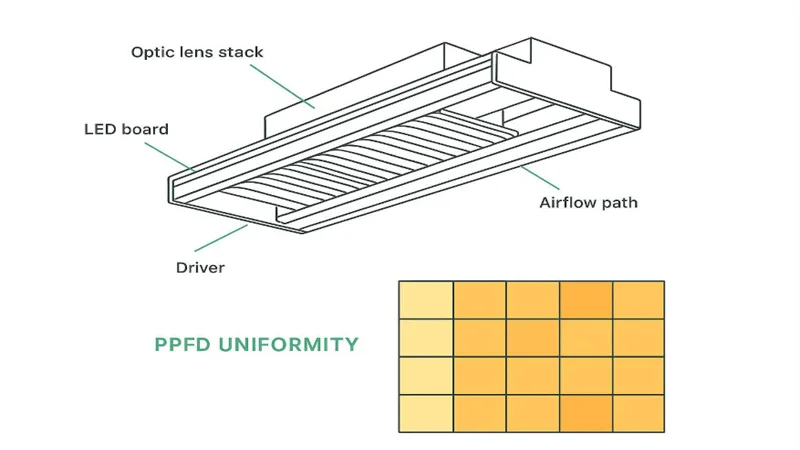
If you want a practical baseline for what uniformity planning should look like, it helps to align your fixture evaluation with a layout-and-measure approach, not a spec-sheet-only approach. (Related: PPFD light matching for yield optimization.)
Controls Integration and Data Packages
Controls are often the hidden driver of OEM vs ODM.
If your facilities standardize on networked controls, your sourcing model has to support:
- A defined dimming interface and behavior (for example, 0–10V curves and low-end stability)
- Documented driver SKUs and approved alternates
- Data artifacts for your engineering file: IES/LDT, SPD, and installation instructions
ODM can work well when the base platform already supports your controls stack and the supplier can provide a consistent data package. OEM becomes more attractive when you need a specific integration behavior across multiple sites—and you want the ability to freeze it.
Operations, Quality, and TCO
Lead times, MOQs, and EVT/DVT/PVT Gates
Time-to-rollout is not just “lead time.” It’s lead time plus risk.
A useful way to map risk is the EVT/DVT/PVT discipline:
- EVT (Engineering Validation Test): Does the engineering concept work as designed?
- DVT (Design Validation Test): Does the design meet spec across conditions and compliance tests?
- PVT (Production Validation Test): Does the factory build it consistently at scale?
ODM often shortens the early stages because a platform exists. OEM can reduce long-run rollout risk because validation is built around your configuration, not a generalized platform.
If you’re evaluating manufacturing readiness, you’ll want to understand how the supplier controls quality at the PCBA and final-assembly levels. (Related: PCB assembly QC and lot traceability.)
Reliability, Warranty, and RMA Logistics
Reliability is less about the warranty length and more about your operational reality:
- How failures are triaged (drivers vs boards vs connectors)
- Whether spare parts are stable across lots
- Whether field swaps create compliance or configuration drift
In ODM, accountability can blur if the “platform owner” and “brand” are different entities in the support chain. In OEM, you can define spares strategy and failure-analysis requirements upfront—but you also own the program discipline needed to keep variants under control.
HVAC Interplay, Downtime Risk, and Lifecycle Cost
TCO in cultivation is rarely just fixture cost or kWh.
Thermal behavior changes canopy microclimate, HVAC load, and maintenance cadence. Even small differences in heat distribution or driver placement can affect room balance—especially when you’re rolling out the same build across multiple sites.
A sourcing model that makes it hard to lock mechanical + thermal details increases the risk of “same part number, different room behavior.” That’s a cost you’ll see in tuning time, labor, and lost consistency.
If you need a buyer-side sanity check on total value beyond price, use a structured evaluation approach. (Related: buyer-side checklist for spotting real fixture value.)
Decision Framework
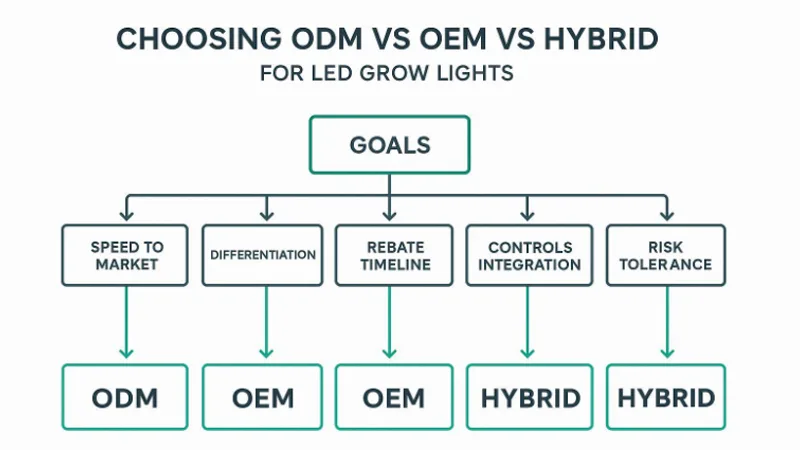
If you’re skimming for the takeaway: ODM vs OEM LED grow lights comes down to what you need to control—platform speed vs configuration ownership, change control, and long-run standardization.
When ODM is the Right Path
ODM is usually the right path when your priority is speed, and your differentiation does not depend on fixture architecture.
Choose ODM when:
- You can accept a platform-based design and mainly need branding + bounded options.
- Your rollout timeline depends on a pre-existing qualified configuration.
- Your control requirements are already supported by the platform.
- Your main risk is execution (getting sites lit up consistently), not technical differentiation.
The non-negotiable is governance: insist on clear variant definitions, frozen BOM rules, and notification requirements for any platform changes.
When OEM LED Grow Lights are the Better Fit
This is where the ODM vs OEM LED grow lights decision tends to land for operators who can’t afford site-to-site drift or surprise compliance work.
OEM LED grow lights are typically the better fit when performance or compliance outcomes depend on specific engineering choices you want to control.
Choose OEM when:
- You need a defined optic + mechanical stack to hit uniformity targets in your exact canopy geometry.
- You want to standardize a configuration across sites and years (not just batches).
- Your controls integration requires specific driver behavior or data artifacts.
- You need clearer IP/exclusivity boundaries to protect differentiation.
OEM doesn’t guarantee success, but it makes the success criteria explicit—and testable.
Hybrid Tactics and Risk Mitigation
A hybrid approach is common and often rational:
- Use ODM as a starting platform to compress timelines.
- Move to OEM on the pieces that create your real differentiation (optics, thermal stack, controls behavior, documentation discipline).
- Lock change control early: define what counts as a “variant,” what requires re-qualification, and how substitutions are approved.
Conclusion
OEM vs ODM in horticultural lighting is ultimately a question of what you’re trying to control.
If your priority is fast deployment with a qualified, stable platform—and your differentiation can live above the fixture architecture—ODM can be the cleanest path. If your business outcome depends on locking uniformity, controlling behavior, thermal performance, and change control across multiple sites, OEM tends to fit better.
Next steps that make either path safer:
- Request a complete engineering data package (IES/LDT, SPD, labeling, and variant definitions).
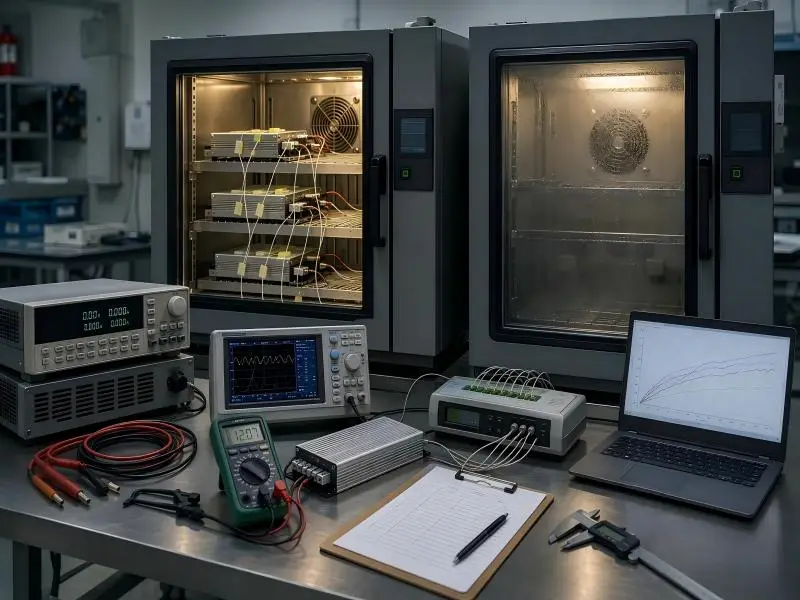
- Run a pilot with a defined acceptance test: PPFD map, power quality checks, thermal conditions, and dimming behavior.
- Build a rollout timeline that explicitly includes compliance and rebate gates, not just production lead time.
FAQ
What is the difference between OEM and ODM manufacturing?
OEM usually means your brand defines the product design/spec and the factory builds to it; ODM means the factory owns a base design and you brand/customize within a limited option set.
Is OEM or ODM better for LED grow lights?
Neither is universally “better.” ODM tends to win on speed and lower upfront engineering, while OEM tends to win when you must lock photometrics, controls behavior, documentation, and change control across multiple sites.
What does “ETL Listed” mean for LED grow lights?
“ETL Listed” means the product has been tested and certified by Intertek (an OSHA-recognized NRTL) to applicable safety standards, and it’s generally accepted by inspectors and authorities in the US and Canada.
What is the DLC Horticultural QPL, and why does it matter?
The DesignLights Consortium (DLC) Horticultural Qualified Products List (QPL) is a verified directory of horticultural lighting products that meet DLC technical requirements. Many utility rebate programs use QPL status as a purchase gate.
What do PPFD, PPF, and PPE mean in grow lighting?
PPF is the total PAR photon output (µmol/s), PPFD is the photon density reaching the canopy (µmol/m²/s), and PPE is efficiency (µmol/J), calculated as PPF divided by input watts.
When did DLC Hort V4.0 start, and when were older versions delisted?
DLC began accepting Hort V4.0 applications on April 18, 2025. Older-version products that weren’t updated were delisted during the transition period, with delistings occurring by early 2026, depending on program rules and product status.