Introduction
Blue light is one of the few spectral levers that reliably shows up in operations: it can tighten morphology, stabilize timing, and reduce the “same room, different result” problem that creeps in when you scale across bays, racks, or sites.
In plant terms, a lot of that leverage comes from two blue-light receptor families. The rest of this guide treats blue light spectrum recipes for CEA as a commissioning problem: define guardrails, schedule the day, then validate with measurements.
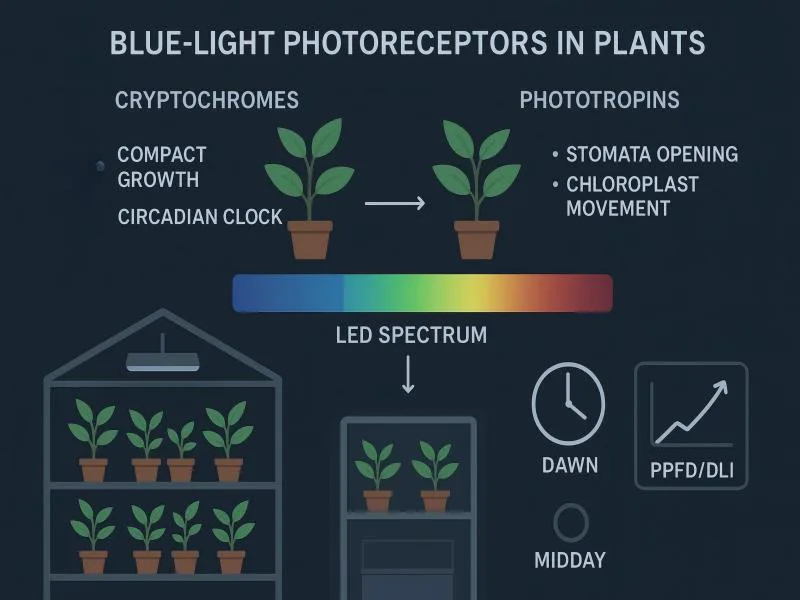
In plant terms, a lot of that leverage comes from two blue-light receptor families:
- Cryptochromes (CRY) are strongly tied to photomorphogenesis (e.g., elongation control/compactness) and circadian entrainment—the internal clock that gates daily physiology and gene expression. A solid review overview is available via the PMC article “Cryptochromes Orchestrate Transcription Regulation of Diverse Blue Light Responses” (2017).
- Phototropins (PHOT1/PHOT2) are the workhorses for blue-light-specific stomatal opening and chloroplast movement, with direct implications for transpiration, CO₂ drawdown, and how quickly plants “wake up” to use light. (A detailed overview is in the PMC review “Blue Light Regulation of Stomatal Opening…” (2017).)
The operator translation is where most facilities get stuck: the mechanisms are real, but what you deploy is the blue fraction, PPFD/DLI, and timing—all within your energy and HVAC constraints. This article turns the biology into guardrails you can standardize, then shows how to validate those recipes with measurements that stand up to internal QA and external scrutiny.
Table of Contents
Mechanism to Outcomes
Cryptochromes: Compactness and Clocks
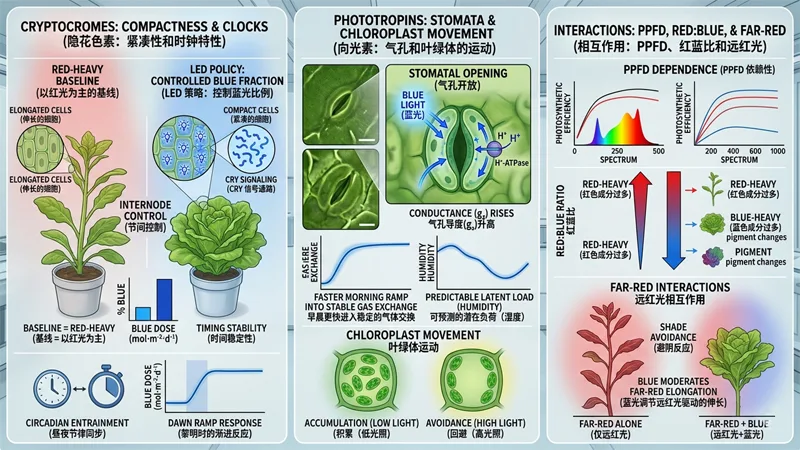
Cryptochromes act like a “blue-present” signal. When blue photons are present, CRY signaling pushes plants away from shade-avoidance-like elongation and toward a more compact architecture—especially important when your baseline spectrum is red-heavy for efficacy. In practice, this is the photobiology behind a controlled blue fraction LED grow lights policy.
Operational outcomes you can expect (and should verify per crop/cultivar):
- Internode control/compactness: If you see stretch under red-dominant spectra, blue is often the cleanest corrective lever because it triggers a distinct signaling pathway rather than just “more photons.”
- Timing stability: CRYs provide blue-light input to circadian entrainment; in practice, the timing of blue (not only the daily total) can change how consistent daily behavior is, including dawn ramp responses.
Pro tip: Treat blue as both an energy input and a signal input. You’ll usually get better repeatability when you specify the recipe in two ways: (1) % blue and (2) blue mol·m⁻²·d⁻¹ (so PPFD or photoperiod changes don’t quietly change your “blue dose”).
Phototropins: Stomata and Chloroplast Movement
Phototropins connect blue light to fast physiology. This is the basis for a phototropin stomatal opening blue light strategy you can test in commissioning:
- Stomata: Blue light activates PHOT signaling in guard cells and drives stomatal opening via plasma membrane H⁺-ATPase activation cascades (summarized in “Blue Light Regulation of Stomatal Opening…” (2017)). When stomata open, conductance (gₛ) rises, which can raise transpiration and change how your VPD setpoints “feel” at the leaf.
- Chloroplast movement: Phototropins also regulate chloroplast positioning (accumulation vs avoidance), which matters for how leaves handle changes in light intensity across the day.
Operational outcomes that show up quickly:
- Faster morning ramp into stable gas exchange when blue is present early.
- More predictable humidity load (latent load) because stomatal state affects transpiration.
Interactions: PPFD, Red: Blue, and Far-red
Blue effects are real—but they’re not isolated. Your observed outcome depends on total intensity and on what other wavebands are doing.
- PPFD dependence: Controlled studies show photosynthetic efficiency and assimilation responses shift with spectrum and PPFD; under higher PPFD, blue light can be less efficient than red/green in some lettuce measurements (see Frontiers in Plant Science “Photosynthetic Physiology of Blue, Green, and Red Light” (2021)). The operator takeaway is not “avoid blue,” but “keep blue inside a band and justify deviations.”
- Red: blue ratio: Very red-heavy spectra can drive elongation and reduce some blue-signaled controls; very blue-heavy spectra can trade biomass for compactness and pigment outcomes.
- Far-red interactions: Far-red is a powerful morphology/development lever (phytochrome pathway), and low blue can amplify shade-avoidance-like responses. Practitioner-facing summaries discuss how blue can moderate far-red-driven elongation under some conditions (e.g., GrowerTalks “LEDs: Blue & Far-Red Light” (2019)).
Spectrum Guardrails
The goal of guardrails is to avoid recipe drift. They should be narrow enough to enforce consistency, but wide enough to handle cultivar and PPFD differences without constant exceptions.
Blue Fraction Ranges (10–20% Baseline)
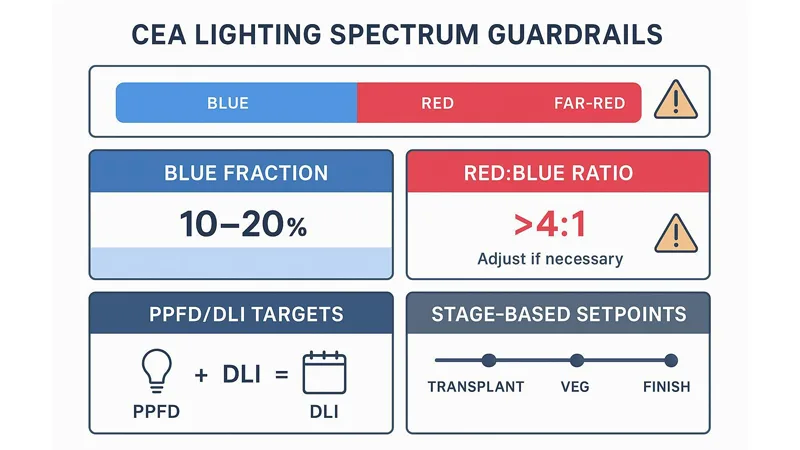
A practical starting point for many commercial environments is a 10–20% blue fraction of total PAR photons.
Why is this range operationally useful:
- It’s typically enough to keep morphology and timing behavior from becoming “all-red” biased.
- It limits the chance that you unintentionally depress production at high PPFD by pushing too much blue as energy rather than a signal.
When you might move up (within controlled trials):
- You need tighter compactness (internodes too long), and you’ve ruled out spacing, CO₂, temperature DIF, and PPFD non-uniformity.
- You’re intentionally targeting pigmentation/quality outcomes late stage, accepting potential mass tradeoffs.
When you might move down (carefully):
- You’re at very high PPFD and seeing diminishing returns, or you need to reduce electrical load without reducing DLI (dynamic strategies can be relevant—see Frontiers in Science “Vertical farming goes dynamic…” (2024)).
Red:Blue Ratio (>4:1) and When to Adjust
As a baseline, keep red: blue > 4:1 for production efficiency, then adjust for control outcomes (a practical red: blue ratio indoor farming guardrail).
Adjustment logic:
- If morphology is too open/stretchy: reduce R: B (i.e., add blue) before increasing total PPFD, because you may fix the architecture without changing DLI.
- If plants are overly compact or leaf expansion is constrained, increase R: B (i.e., reduce blue) or shift the timing of blue rather than reducing daily blue dose.
⚠️ Warning: If you change spectra to solve a morphology problem, confirm you didn’t create a humidity-control problem. A “better-looking” canopy that drives higher transpiration can still be a net negative if your dehumidification system can’t hold VPD without reheat penalties.
DLI/PPFD Targets and Blue mol·m⁻²·d⁻¹
Guardrails should be expressed in two layers (think DLI PPFD blue photons):
- Total photons: PPFD and photoperiod define DLI.
- Blue dose: blue fraction × DLI defines blue mol·m⁻²·d⁻¹.
Useful calculation:
- Blue DLI (mol·m⁻²·d⁻¹) = Total DLI × Blue fraction
Example (for recipe governance, not a universal setpoint):
- If total DLI is 12 mol·m⁻²·d⁻¹ and blue fraction is 15%, then blue DLI is 1.8 mol·m⁻²·d⁻¹.
This matters because two rooms can “both run 15% blue” but deliver different blue doses if photoperiods or PPFD differ.
Time-of-Day Control
Time-of-day strategies are where photoreceptor biology becomes an operations tool. The goal is to get the signaling benefit when plants are most responsive, while keeping heat and latent load within what your HVAC can actually deliver. Think of this section as an operations playbook: define a few time blocks that are easy to standardize, then track whether those blocks actually changed physiology and room load in the direction you expected.
Dawn Blue Enrichment (60–120 min)
A simple recipe that’s easy to standardize is blue enrichment for the first 60–120 minutes after lights-on (a practical dawn blue enrichment stomata circadian control). The point is not to chase “more blue,” but to make the first part of the photoperiod predictable across rooms and shifts.
Why it works (mechanism → ops):
- Blue early in the photoperiod aligns with circadian entrainment inputs and supports a consistent “morning ramp.”
- Phototropin-driven stomatal opening is blue-responsive; a defined dawn block helps you avoid a slow, variable transition into stable gas exchange (see “Blue Light Regulation of Stomatal Opening…” (2017)).
How to deploy (make it commissionable):
- Keep your daily blue dose constant, but shift a portion earlier so you can test timing without changing total DLI.
- Start with one of two easy-to-audit patterns:
- Pattern A (fixed blue block): Hold total PPFD constant, but run a higher blue fraction for 60–120 minutes.
- Pattern B (blue + gentle ramp): Use a modest intensity ramp at lights-on while keeping the blue fraction stable, then compare against a fixed-step lights-on.
- Log the schedule as a named profile (not a tribal-knowledge “operator tweak”): start time, duration, target PPFD during block, blue fraction during block, and the “rest-of-day” spectrum.
What to watch for in the first week:
- Leaf temperature and RH response: a successful dawn block often changes the timing of transpiration load even if daily water use is similar.
- CO₂ drawdown patterns: if you track room CO₂ injection or leaf-level readings, you’re looking for a faster transition into stable demand.
Common failure modes (and what they usually mean):
- You see no change in gas exchange metrics: the blue block may be too small relative to baseline, or VPD/airflow is limiting stomatal response.
- RH spikes and VPD collapses right after lights-on: you created a transpiration step change without the dehumidification/airflow capacity to match.
- Morphology improves, but uniformity worsens: the dawn block may be amplifying existing PPFD non-uniformity (hotspots “wake up” faster).
Midday Tapering to Manage HVAC Load
Midday is when many facilities hit peak thermal and dehumidification demand. Even when total DLI must stay on target, shifting the distribution of light can reduce instantaneous load.
Dynamic control research in vertical farming emphasizes that distributing light intensity over a longer photoperiod (while keeping DLI constant) can reduce electricity cost under variable pricing and manage operational constraints (see Frontiers in Science “Vertical farming goes dynamic: optimizing resource use efficiency…” (2024)).
Operator translation (what you can actually standardize):
- Define a midday constraint window (e.g., the 2–4 hours where latent or sensible capacity is tightest).
- Choose one lever at a time:
- Intensity shaping: reduce PPFD in the constraint window and compensate earlier/later to hold DLI.
- Spectrum shaping: keep PPFD constant but slightly adjust blue fraction (still inside your guardrails) if your objective is to reduce stomatal-driven moisture load.
- Keep the change auditable: do not allow “temporary overrides” to become untracked new baselines.
What to measure (so this doesn’t turn into opinions):
- Room RH/VPD excursions during the window
- Dehumidification runtime (or water removal rate, if measured)
- Reheat events or supply-air temperature swings
- Any yield/quality KPI you already track (to ensure tapering didn’t silently reduce production)
Stage-specific Pulses (Veg, Post-transplant)
Stage-specific pulses are often safer than permanent setpoint shifts because they are easier to evaluate and roll back. Treat pulses like a controlled intervention: short duration, clear success criteria, and a defined end date.
Two common use cases:
- Post-transplant: A short-term blue-forward strategy can help stabilize morphology when plants are most sensitive to environmental transitions.
- Vegetative shaping: Short pulses can steer architecture without committing to a high-blue all-day recipe.
How to run pulses without creating chaos:
- Pre-define pulse length (e.g., a few photoperiods to a week), then revert to baseline and compare.
- Keep the intervention narrow: change only the blue fraction or only the timing, and keep total DLI constant.
- Tag the batch/zone clearly so cultivation and facilities are looking at the same population.
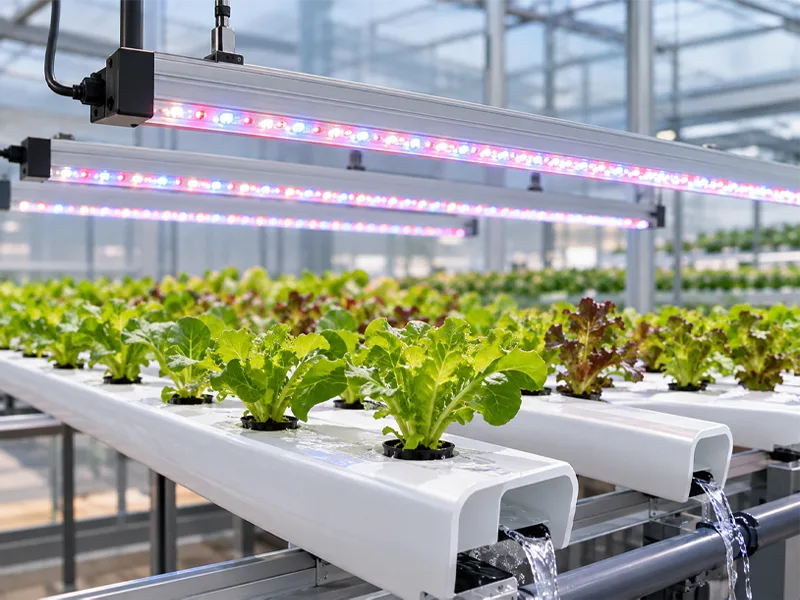
From an execution standpoint, the win isn’t “max out blue.” It’s turning spectrum + timing into a repeatable control strategy: tunable-spectrum fixtures let you run different crop/stage recipes on the same hardware and harden actions like “dawn blue enrichment, midday taper, stage pulses” into the controls layer.
This is also where a brand can matter in a non-promotional, operator-relevant way. For example, SLTMAKS positions around engineered spectra and commercial deployment; if your lighting program comes with clear certification/documentation (e.g., ETL/CE/RoHS as applicable, plus photometric files used for layout and acceptance), it’s easier to govern the same spectrum recipe across sites and pass internal audits and external inspections.
Controls, HVAC, and Uniformity
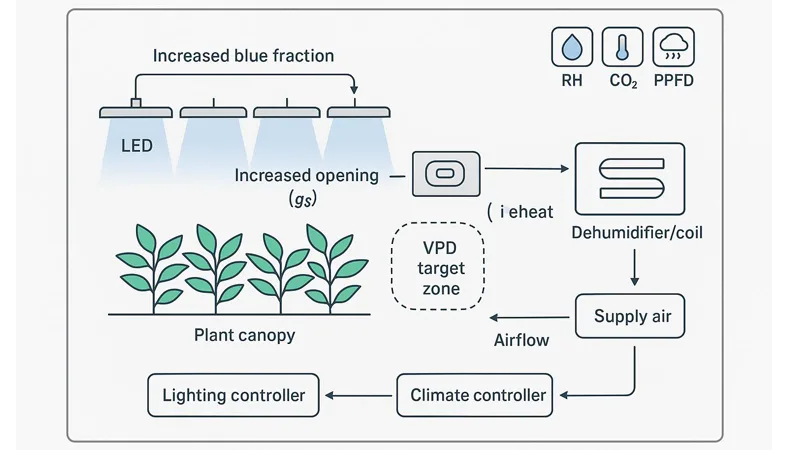
Spectrum is not independent of climate. Once you use blue as a stomatal lever, you’re implicitly changing how much water the crop moves—and that shows up in VPD control and dehumidification energy.
VPD Coordination and Transportation Impacts
Phototropin-mediated stomatal opening means blue can increase conductance (gₛ) and transpiration. If your room can’t remove that moisture, you’ll see either:
- Rising RH (VPD collapse), increasing disease and disorder risk, or
- Aggressive dehumidification + reheat, increasing kWh/kg and operating cost.
Practical coordination steps:
- Treat “dawn blue enrichment” as a joint setpoint between cultivation and facilities.
- Confirm that airflow and dehumidification capacity can hold VPD during the dawn ramp.
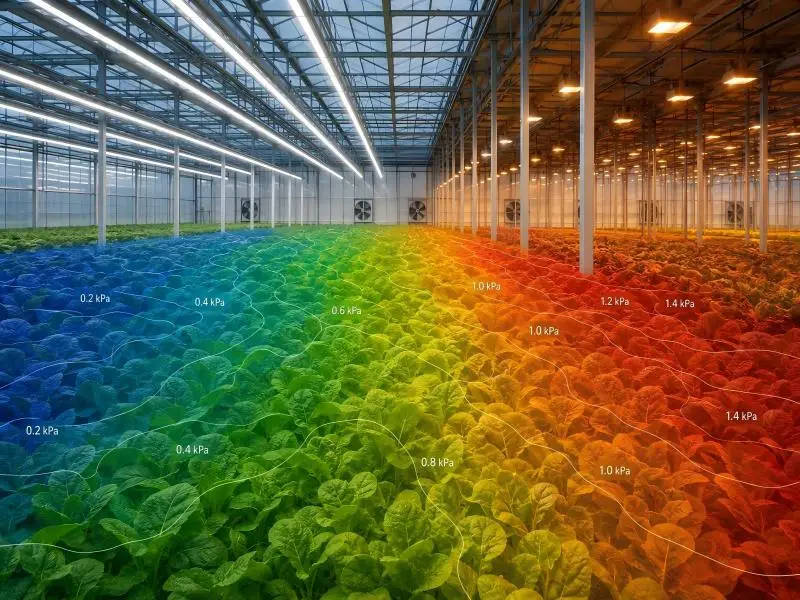
PPFD Mapping and Hotspot Correction
Before you tune the spectrum, confirm you’re not compensating for a distribution problem.
- Map PPFD at canopy height (and by tier, if stacked) and correct hotspots/shadows.
- Re-map after major recipe changes; spectral changes can affect perceived brightness, but you care about photon delivery.
Controls Integration and Safety Compliance
Multi-site repeatability depends on control governance:
- Lock recipes as named profiles (crop + stage + room type).
- Record photoperiod, PPFD setpoint, blue fraction schedule, CO₂ target, and VPD target together.
- Treat compliance as part of commissioning: documentation, wiring practices, and control interlocks should be inspection-ready.
Validation and ROI
Validation is what turns “recipes” into standards. The goal is not to prove that blue light “works” in general—it’s to prove that your specific recipe improved repeatability under your constraints, and that the improvement is large enough to justify operational complexity.
A useful framing is to validate on three layers at once:
- Crop layer (morphology, quality, yield)
- Room layer (uniformity, climate stability)
- Cost layer (lighting kWh and HVAC kWh required to hold targets)
Morphology and Pigment KPIs (Internode, SPAD)
Pick 2–3 KPIs that are cheap to measure weekly and resistant to “cherry picking.” The key is to measure the same way every time.
Core options:
- Internode length/compactness: simple ruler measurements on tagged plants; define the node range you measure (e.g., nodes 3–7) so different teams don’t measure different parts of the plant.
- Leaf area or canopy closure timing: photo-based measurements or simple coverage scoring; pick a fixed camera height and time-of-day so you’re not comparing shadows.
- SPAD as a proxy for relative chlorophyll: use the same leaf position and time-of-day each week, and record cultivar and leaf age.
Make the KPI sheet audit-friendly:
- Tag plants (or trays) and keep the same tags through the trial
- Record date/time, room/zone, cultivar, stage, and recipe version
- Use a small sample that is consistent (for example, the same number of plants per zone each time)
Gas Exchange and Fluorescence Checks (Gs, ΦPSII)
If you have the tools, add one physiological check to de-risk recipe changes:
- Stomatal conductance (gₛ): confirms your “dawn blue” actually moved stomata as intended.
- Chlorophyll fluorescence (ΦPSII): helps catch photochemical stress or inefficient operating points when PPFD and spectrum shift.
Keep measurement discipline:
- Same time-of-day, same leaf position, same CO₂/VPD conditions during checks.
- Compare against a stable control room/zone when possible.
Trial Design, Payback Modeling, and Risk Controls
A pragmatic trial design for multi-site operators:
- Run an A/B across matched rooms (or adjacent zones) with identical crop, CO₂, nutrient, and climate targets.
- Change one thing at a time (e.g., blue timing block) and hold DLI constant.
- Decide success criteria upfront: yield/quality metric, uniformity metric, and an energy/HVAC metric.
Payback framing (keep it auditable):
- Benefits: uniformity (fewer downgrades), cycle-time stability, and quality targets achieved more consistently.
- Costs: lighting kWh, dehumidification/reheat kWh, labor for mapping/QA, and any increased maintenance burden.
Risk controls:
- Define rollback triggers (e.g., VPD excursions, disorder incidence, unacceptable morphology drift).
- Keep recipe versions documented so facilities don’t “average” two different standards over time.
Commissioning Checklist
Before you roll a blue-timing recipe out across bays or sites, make sure the basics are locked:
- Guardrails are explicit: total DLI, blue fraction range, and red: blue ratio are written down as a versioned recipe.
- Time blocks are named: dawn block, midday constraint window, and any stage pulses have start/stop times and target setpoints.
- Uniformity is verified first: PPFD maps are current, and hotspots are corrected so spectrum changes don’t mask a layout problem.
- HVAC coordination is defined: VPD/RH bands and dehumidification expectations are agreed upon between cultivation and facilities.
- Validation is lightweight but disciplined: 2–3 morphology KPIs weekly, plus at least one room KPI (VPD stability, dehu runtime, or similar).
- Rollback triggers are pre-set: you know exactly what will cause a revert, and who is authorized to do it.
Conclusion
Start with a 15% blue baseline and verify with weekly morphology and gₛ checks.
Use timed blue enrichment to support stomata/circadian alignment, then taper at peak load to stay inside HVAC limits.
Coordinate spectrum with VPD/HVAC and controls governance so recipes remain consistent—and reproducible—across sites.
FAQ
What blue light percentage should I use in CEA LED recipes?
Most CEA operators can start with a 10–20% blue fraction of total PAR as a practical guardrail, then adjust based on crop/cultivar and PPFD. If you change photoperiod or PPFD, also track blue dose (blue DLI) so the “blue signal” doesn’t drift.
When should I schedule blue light during the day for best results?
A common, repeatable approach is dawn blue enrichment for 60–120 minutes after lights-on to support a more consistent “morning ramp” in physiology (stomatal opening and circadian alignment). Keep the daily blue dose consistent and treat the timing block as a named, versioned profile so it’s auditable across rooms.
How do I validate whether a blue-light recipe is improving results and ROI?
Validate on three layers: crop KPIs (e.g., internode length, canopy closure, SPAD), room KPIs (e.g., VPD stability, dehumidification runtime), and cost KPIs (lighting + HVAC energy). Run a simple A/B with one change at a time, keep DLI constant, and predefine rollback triggers if climate stability or crop health drifts.