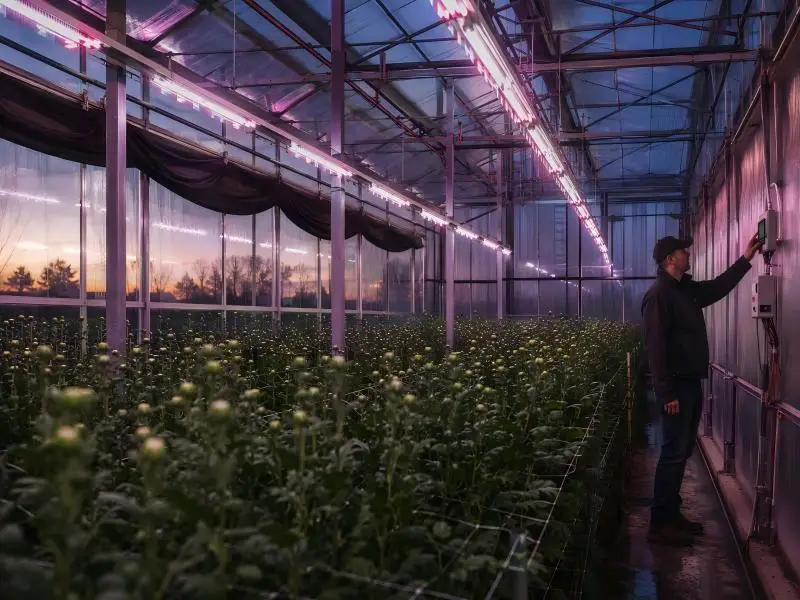
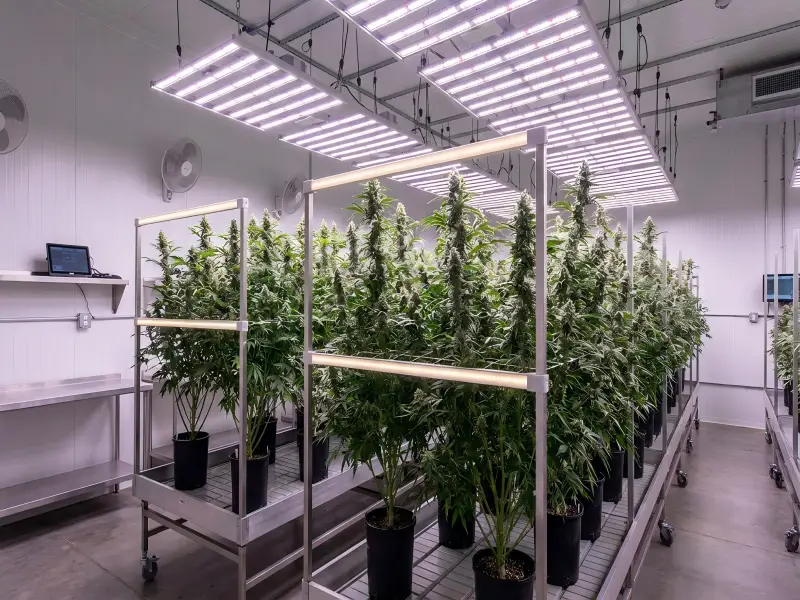
Commercial cannabis cultivators face a persistent biological bottleneck in indoor facilities and multi-tier racks: the top-to-bottom light gradient. Even when deploying top-tier overhead LED fixtures delivering 1,000 to 1,200 μmol/m²/s at the upper colas, the dense leaf canopy absorbs and reflects the vast majority of incoming photons. By the time light reaches the middle and lower branches, intensity drops below the photosynthetic compensation threshold. The result is a substantial portion of the harvest developing as airy, low-potency “popcorn” bud or waste trim.
To overcome this canopy extinction limit, facility managers are adopting cannabis inter-canopy lighting—placing specialized, double-sided LED bars directly inside the plant foliage. Instead of forcing photons through dense upper leaves, inter-canopy lighting introduces targeted photon flux exactly where lower bud sites are light-starved.
This guide examines the agronomic physics of canopy light penetration, quantifies trial-backed yield increases, details optical and spectrum requirements, and provides a commercial deployment framework for commercial operators seeking to maximize grams per square meter without expanding physical room footprints.
Table of Contents
The Physics of Canopy Light Attenuation: Why Top-Lighting Leaves Lower Buds Starved
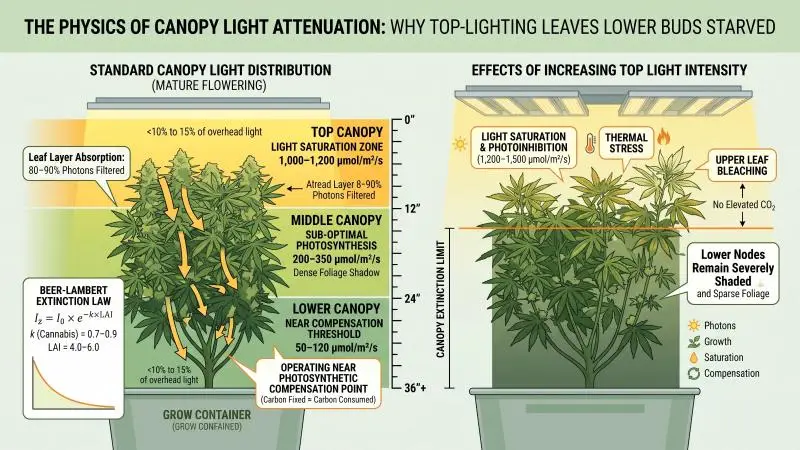
In high-density commercial grow rooms, sunlight simulation from overhead fixtures follows an exponential decay pattern described by the Beer-Lambert extinction law. As photons pass downward through successive leaf layers, light intensity (I z) at depth z drops relative to incident intensity (I₀) according to the equation:
I z = I₀ × e^(-k × LAI)
In this relationship, k represents the light extinction coefficient of the canopy (typically 0.7 to 0.9 for broad-leaf cannabis varieties), and LAI represents the Leaf Area Index.
TOP CANOPY (0–12 inches) – → 1,000–1,200 μmol/m²/s (Light Saturation Zone)
Leaf Layer Absorption (80–90% photons filtered) MIDDLE CANOPY (12–24 inches) – → 200–350 μmol/m²/s (Sub-Optimal Photosynthesis) Dense Foliage Shadow LOWER CANOPY (24–36+ inches) – → 50–120 μmol/m²/s (Near Compensation Threshold)
In a mature flowering canopy with an LAI between 4.0 and 6.0, lower leaves receive less than 10% to 15% of overhead light. At photon densities under 100 μmol/m²/s, lower leaf tissues operate near their photosynthetic compensation point—the level where carbon fixed through photosynthesis barely equals the carbon consumed through cellular respiration.
When top lighting intensity is increased further to drive light deeper, upper leaves reach light saturation (often near 1,200 to 1,500 μmol/m²/s without elevated CO₂), leading to photoinhibition, thermal stress, and upper leaf bleaching, while lower nodes remain severely shaded.
Key takeaway: Overhead lighting alone cannot deliver uniform PPFD through a dense cannabis canopy. Inter-canopy lighting bypasses leaf absorption by placing light sources directly adjacent to shaded lower nodes, restoring active carbon fixation across the entire vertical plant structure.
Adding dedicated inter-canopy LED bars delivers a localized boost of 200 to 300 μmol/m²/s directly to middle and lower foliage. This elevates lower canopy light levels to 350–450 μmol/m²/s, shifting lower leaves from passive maintenance into active sugar production. For more details on calculating photon delivery across canopy zones, consult our guide on managing PPFD and canopy light penetration.
Quantifying the Agronomic Yield Lifts: A-Grade Flower Conversion and Terpene Density
Adding supplemental photons inside the canopy does not merely increase total biomass; it fundamentally reshapes flower development, potency, and market value. Recent empirical studies and commercial cultivation trials demonstrate three primary financial and agronomic benefits.
| Cultivation Metric | Overhead Lighting Only | Overhead + Inter-Canopy Lighting | Net Operational Improvement |
|---|---|---|---|
| Total dry inflorescence yield | Baseline (1.0x) | +20.0% to +29.95% | +20%–30% harvest weight surge |
| A-grade premium flower share | 35%–40% of harvest | 55%–60% of harvest | +27% ratio improvement |
| B/C grade “popcorn” & trim | 45%–50% of harvest | 20%–25% of harvest | -25% trim waste reduction |
| Total terpene concentration | Baseline | +12.5% to +25.0% | Higher aromatic & extract profile |
| Total cannabinoid accumulation | Baseline | Up to +24.4% THC | Uniform potency top-to-bottom |
1. Significant Dry Yield Increase
According to peer-reviewed inter-canopy lighting studies (2025), supplemental inter-canopy LED lighting achieved a 29.95% increase in dry inflorescence yield compared to overhead-only control groups. By redistributing energy into underutilized lower foliage, plants convert available nutrients and root capacity into dry flower weight far more efficiently than pushing extreme overhead PPFD.
2. Upgrading B/C Grade Larf into Premium A-Grade Flower
In standard commercial setups, lower buds receive insufficient PAR to develop dense calyx structures, remaining light, airy, and low in cannabinoid density. Commercial trial data compiled by commercial under-canopy cultivation trial reports indicate that inter-canopy LED bars increase the A-grade flower fraction by 20% to 27% while decreasing waste trim fractions by 25%. Lower nodes develop firm, heavy, trichome-dense buds that match top colas in appearance and bag appeal.
3. Enhancing Terpene and Cannabinoid Profiles
Secondary metabolite production in cannabis—including monoterpenes (myrcene, limonene) and sesquiterpenes (caryophyllene)—is highly light-dependent. When lower calyxes receive adequate PAR, glandular trichomes mature fully across lower branches. Research shows inter-canopy lighting boosts total terpene concentration by 12.5% to 25.0% and drives up to a 24.4% higher total THC accumulation in lower plant tissues.
Cannabis Inter-Canopy Lighting LED Optics and Spectrum Selection
Deploying inter-canopy lighting requires different fixture engineering than traditional overhead top lights. Because fixtures operate inside the canopy within 6 to 12 inches of foliage, thermal management, beam distribution, and spectral recipe selection are critical to prevent localized heat damage.
WIDE-ANGLE BATWING OPTICS (120° x 120°) vs. NARROW SPOTLIGHT (60°)
[ LED BAR ] [ LED BAR ]
(Wide, Even Diffusion) (Concentrated Hotspot) Leaves at 6″ receive uniform PPFD. Leaves at 6″ risk light burn
Optical Beam Distribution
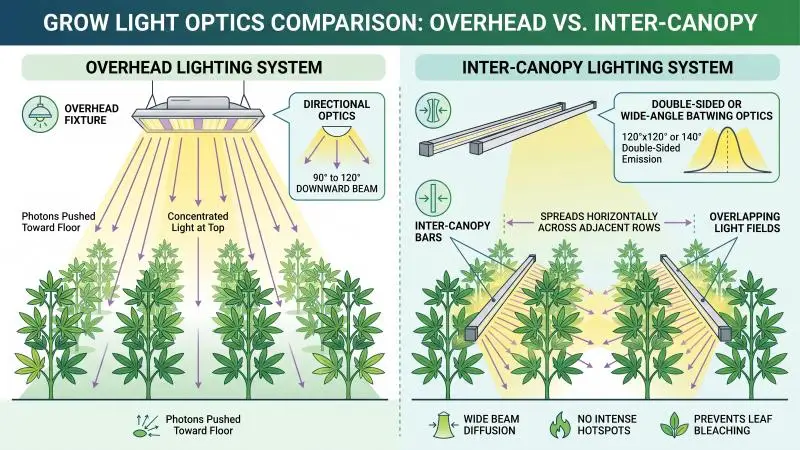
Overhead fixtures rely on directional optics (typically 90° to 120° downward) to push photons toward the floor. Inter-canopy bars require double-sided or wide-angle batwing optical lenses (120° × 120° or 140° double-sided emission). Wide beam diffusion ensures light spreads horizontally across adjacent plant rows, creating overlapping light fields without intense hotspots that could cause leaf bleaching on leaves close to the bar.
Spectral Tuning for Lower Foliage
Lower leaves contain higher concentrations of shade-adapted chlorophyll and photoreceptors designed to respond to scattered light:
- Broad full-spectrum white (400–700 nm): High-CRI white light with balanced green and blue photons penetrates deeper into leaf layers and provides comfortable working light for cultivation staff inspecting crop health.
- Deep red (660 nm) & far-red (730 nm) synergy: Far-red photons drive the Emerson enhancement effect when combined with red light, accelerating photosynthetic rate. However, far-red intensity inside the canopy must be carefully balanced to prevent excessive internodal stretching during early flowering.
- ePAR (400–750 nm) consideration: Including extended PAR wavelengths ensures full utilization of far-red photons for lower calyx swelling.
When selecting fixtures for integrated facility setups, choose high-efficiency options designed for commercial environments. Operators often pair inter-canopy systems with high-efficacy commercial indoor LED grow light systems overhead to ensure balanced, full-canopy photon delivery.
Pro tip: Ensure your inter-canopy fixtures achieve a photon efficacy rating of ≥ 2.5–3.0 μmol/J. High photon efficacy minimizes waste heat generation, allowing fixtures to run cool to the touch even when positioned directly against foliage.
Microclimate Management and HVAC Interplay
Adding electrical equipment inside a dense plant canopy alters local microclimate dynamics. Commercial operations must account for both sensible heat load and increased plant evapotranspiration when sizing environmental controls.
1. Thermal Dissipation and Passive Cooling
Inter-canopy LED bars must feature slim, fanless, heavy-duty extruded aluminum heat sinks. Active cooling fans inside the canopy are prone to failure due to high humidity and foliage interference. Passive aluminum heat sinks radiate thermal energy smoothly into row aisles, maintaining housing surface temperatures low enough to prevent tissue burning upon contact.
2. Transpiration and Latent HVAC Load
Because inter-canopy lighting reactivates stomatal opening on millions of lower leaves, whole-plant transpiration increases significantly. As lower leaves photosynthesize, plants consume more water and release additional moisture into the microclimate.
Inter-Canopy Light Added Lower Stomata Open & Photosynthesis Rises Sensible Heat Output (+5-10%) Latent Transpiration (+15-25%) Aisle Air Velocity Adjustment Dehumidification Capacity Bump
Facility HVAC and dehumidification systems must be sized to handle an estimated 15% to 25% increase in daily water extraction per room. To maintain target Vapor Pressure Deficit (VPD) levels, ensure room dehumidifiers have sufficient pint capacity per day.
3. Preventing Microclimate Pathogens
In unlit lower canopies, high relative humidity combined with stagnant air creates ideal breeding conditions for Botrytis cinerea (gray mold) and powdery mildew. Inter-canopy LED bars generate gentle thermal updrafts that help disrupt localized humidity pockets. When paired with under-bench horizontal airflow fans, inter-canopy lighting reduces lower canopy humidity stagnation, lowering pathogen risk.
Commercial Installation SOP: Mounting, Timing, and Safety Compliance
To maximize return on investment while maintaining worker safety and facility compliance, follow this standardized operating procedure (SOP) when integrating inter-canopy LED grow lights in cannabis systems in commercial rooms.
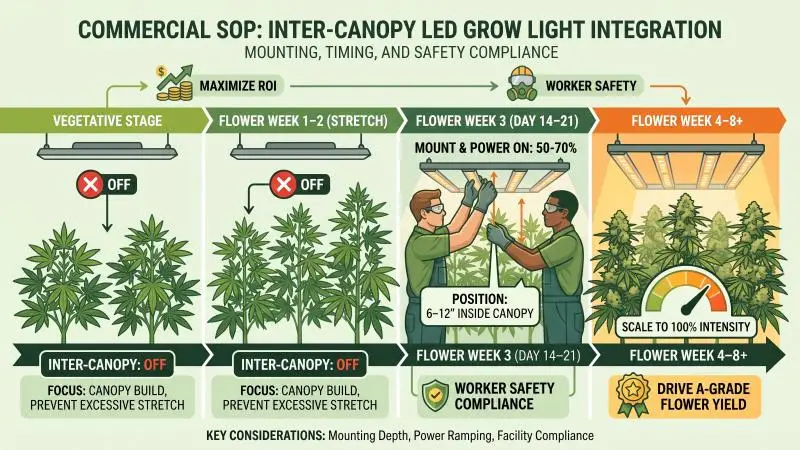
CULTIVATION TIMELINE & INTER-CANOPY LIGHTING PROTOCOL
Vegetative Stage ► Flower Week 1–2 (Stretch) ► Flower Week 3 (Day 14–21) ► Flower Week 4–8+
[Inter-Canopy OFF] [Inter-Canopy OFF] [Mount & Power ON @ 50-70%] [Scale to 100% Intensity]
Focus: Canopy Build, Prevent Excessive Stretch Position 6–12″ Inside Canopy Drive A-Grade Flower Yield
Phase 1: Operational Timing
- Vegetative stage: Keep inter-canopy lights turned OFF. Top lighting provides sufficient PAR for young plants, and early side lighting can induce unwanted bushiness or premature lateral branching.
- Flower weeks 1–2 (stretch phase): Keep inter-canopy lights OFF or dimmed to minimum levels. Allowing plants to complete their vertical stretch naturally prevents stem distortion.
- Flower week 3 (day 14 to 21): Install and energize inter-canopy fixtures. At this stage, vertical stretch slows, crown flower sites form, and lower foliage pruning (lollipopping) is complete.
- Flower weeks 4 through harvest: Run inter-canopy bars at 100% intensity in tandem with top lighting photoperiods (12 hours ON / 12 hours OFF).
Phase 2: Mounting and Positioning
- Height placement: Position LED bars horizontally or vertically within the middle third of the canopy height (typically 12 to 24 inches above the root medium or rolling bench surface).
- Distance to foliage: Maintain a 6- to 12-inch gap between LEDs and leaf tissue.
- Mounting Hardware: Use quick-release stainless steel brackets or custom rack clips attached to rolling bench uprights or vertical rack channels to allow easy height adjustments as plants mature.
Phase 3: Electrical Safety and Washdown Standards
Grow rooms are harsh industrial environments involving daily fertigation, high humidity, and periodic chemical washdowns between harvest cycles.
- IP rating compliance: Inter-canopy fixtures must carry an IP66 or IP67 ingress protection rating, certifying full protection against dust, high-pressure water jets, and direct spray during IPM routines.
- Electrical daisy-chaining: Select fixtures featuring push-lock IP67 trunk cables allowing multiple bars (e.g., 4 to 8 units) to be daisy-chained onto a single power drop, minimizing electrical conduit clutter under benches.
- Safety certifications: Ensure fixtures are ETL, CE, or UL 8800 listed for horticultural lighting, and verified on the DLC Hort QPL (Qualified Products List) to qualify for local utility energy rebates.
For complete technical specifications across commercial fixture categories, explore our catalog of high-efficacy cannabis LED fixtures.
Financial TCO and ROI Framework for Commercial Cultivators
Adding inter-canopy fixtures requires upfront capital expenditure (CapEx) and additional electrical operating expenditure (OpEx). However, because inter-canopy lighting targets high-value flower conversion rather than incremental leaf area, payback periods are among the shortest in commercial horticulture.
SAMPLE FINANCIAL RETURN MODEL (10,000 SQ FT FLOWERING FACILITY)
CapEx Investment: $45,000 – $65,000 (Inter-Canopy LED Fixtures & Mounting)
Utility Rebates: -$15,000 – $30,000 (30–50% DLC Hort Incentive)
Net Equipment Cost: $30,000 – $35,000
Yield Gains per Cycle:
• +22% Total Dry Flower Weight (+110 lbs @ $1,000/lb Wholesale = +$110,000)
• Conversion of 25 lbs Larf to A-Grade (+25 lbs @ +$400/lb Delta = +$10,000)
Gross Revenue Increase / Cycle: +$120,000
Added Energy & HVAC OpEx / Cycle: -$8,500
NET PROFIT LIFT PER HARVEST: +$111,500
PAYBACK PERIOD: LESS THAN 1 SINGLE CROP CYCLE
ROI Calculation Breakdown
Consider a commercial 10,000 sq ft flowering room operating 1,000W top fixtures:
- Equipment & installation cost: Adding inter-canopy lighting averages $4.50 to $6.50 per square foot of canopy space ($45,000 to $65,000 total equipment CapEx).
- Utility rebate offset: Because high-efficacy LED bars meet DLC QPL efficiency thresholds (≥ 2.7 μmol/J), utility energy efficiency rebates frequently cover 30% to 50% of fixture costs, reducing net CapEx to $30,000–$35,000.
- Revenue increase: A conservative 20% total yield lift on a room yielding 500 lbs per cycle adds 100 lbs of marketable flower. At a wholesale price of $1,000 per pound of A-grade flower, gross revenue increases by $100,000 per harvest cycle.
- OpEx impact: Operating 120W inter-canopy bars per 4×4 ft section increases electrical power draw by approximately 10%–12%. At $0.12 per kWh over a 60-day flowering cycle, added electricity costs average $8,500 per room.
- Net financial payback: The net profit gain of over $90,000 per harvest cycle yields full CapEx payback in less than one 8- to 9-week crop cycle.
To evaluate lighting strategies across different growth phases and calculate overall room efficiency, review our detailed guide on cannabis light levels and PPFD targets across growth stages.
FAQ
Does inter-canopy lighting burn lower foliage or flowers?
When using properly engineered LED fixtures with wide-angle double-sided optics (120° × 120°) and photon efficacy ratings above 2.5 μmol/J, fixtures generate minimal radiant heat. Maintaining a distance of 6 to 12 inches from foliage prevents tissue bleaching or thermal burning.
Should inter-canopy lights be used during the vegetative stage?
No. During the vegetative stage, top lighting provides sufficient canopy penetration for young plants. Running inter-canopy lights in veg wastes electrical energy and can cause unwanted lateral branching or distorted nodal growth. Inter-canopy lights should be energized around Day 14 to 21 of flower after vertical stretching subsides.
How does inter-canopy lighting affect lollipopping and pruning labor?
Inter-canopy lighting significantly reduces the need for aggressive “lollipopping” (removing all lower branches and bud sites). Because lower nodes receive sufficient PAR to produce dense A-grade flower, workers only need to remove fan leaves that physically block airflow, saving valuable labor hours during canopy preparation.
Will adding inter-canopy lights overload existing facility HVAC systems?
Adding inter-canopy fixtures increases room electrical load by 10% to 15%. While high-efficacy LEDs produce minimal sensible heat, the increased rate of lower-canopy photosynthesis drives higher plant transpiration. Ensure your HVAC and dehumidification systems have 15% to 20% reserve latent cooling and water extraction capacity before installation.
Does inter-canopy lighting actually increase cannabis flower yield compared to adding more overhead light?
Yes. In dense cannabis canopies, upper leaves absorb up to 90% of overhead light, leaving lower nodes below the photosynthetic compensation threshold. Adding more overhead light often causes upper leaf photoinhibition or heat stress without penetrating lower canopy layers. Commercial trials demonstrate that adding 200–300 µmol/m²/s of targeted inter-canopy light increases overall dry flower yield by 15% to 30% and converts low-value “popcorn” buds into premium A-grade flower by reactivating photosynthesis in lower shaded foliage.
What is the optimal PPFD ratio and timing for commercial inter-canopy LED lighting?
Most commercial setups split photon delivery at roughly 70%–75% overhead light and 25%–30% inter-canopy light during full flowering, targeting an inter-canopy intensity of 200–350 µmol/m²/s. Inter-canopy LED fixtures should remain OFF during the vegetative stage and vertical stretch (Weeks 1–2 of flower) to prevent stem distortion. Activate inter-canopy bars around Week 3 of flower (Days 14–21) after pruning is complete and crown flower sites have formed.