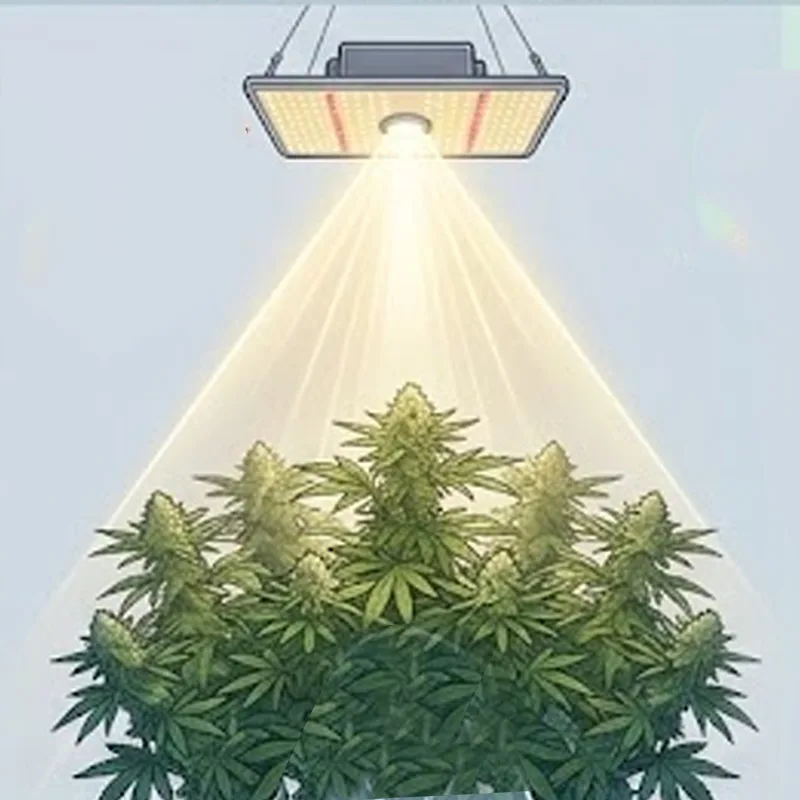
For commercial cannabis cultivators, maximizing yield per square foot is the ultimate metric of success. However, one of the most pervasive challenges in indoor and greenhouse environments is achieving adequate light penetration deep into the plant canopy. When top colas receive optimal light, but the lower branches are starved of photons, the result is an abundance of lightweight, low-value “popcorn buds” that drag down total harvest weight and overall profitability.
Improving canopy penetration is not simply a matter of buying the brightest fixture available. It is a complex scientific interplay between fixture design, precise hang height, and the careful management of Photosynthetic Photon Flux Density (PPFD). As a professional grow light manufacturer, SLTMAKS understands that commercial cultivation requires data-driven, engineered lighting solutions rather than guesswork.
In this comprehensive guide, we will break down the physics of light attenuation, the biological response of the cannabis plant to different light intensities, and the practical strategies commercial facilities can implement to drive explosive lower-canopy growth. Whether you are outfitting a single-tier warehouse or a multi-level vertical farm, mastering and managing PPFD and hang height is your key to unlocking maximum genetic potential.
Table of Contents
The Physics of Light: Why Canopy Penetration is a Challenge
To understand why lower buds often fail to develop, we must first look at how light behaves as it travels through space and interacts with physical objects. In an indoor grow room, light is subject to strict physical laws that dictate its intensity and spread.
The Inverse Square Law in Indoor Grow Rooms
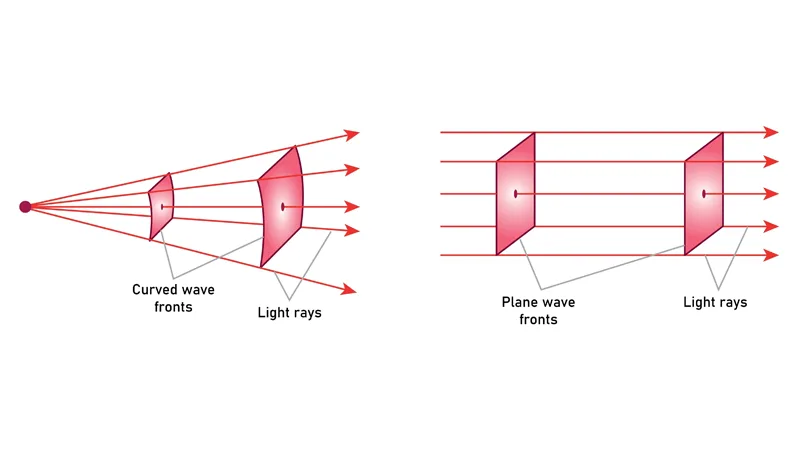
In practical terms, this means that if you double the distance between your LED grow light and the plant canopy, the light intensity does not simply drop by half—it drops to one-quarter of its original strength. If you triple the distance, the intensity drops to one-ninth.
For commercial growers, this physical reality creates a constant balancing act. If the fixture is hung too high to achieve a wider light spread, the photons lose massive amounts of energy before they even reach the top of the canopy, let alone penetrate to the lower branches. Conversely, hanging the light too low can create extreme intensity at the top (causing bleaching or heat stress) while narrowing the overall footprint, leaving the edges of the growing tray in shadows.
Leaf Area Index (LAI) and Light Attenuation
Beyond the physics of distance, we must consider the physical barrier of the cannabis plant itself. The Leaf Area Index (LAI) is a metric used by botanists to quantify the amount of leaf material in a given canopy area. Cannabis, particularly in the mid-to-late vegetative and flowering stages, develops a very high LAI.
The upper leaves act as highly efficient solar panels, absorbing up to 90% of the red and blue spectrums of light for photosynthesis. The light that manages to pass through the top layer is not only significantly weaker in intensity but also altered in its spectrum. The lower canopy receives primarily green and far-red light, which triggers a shade-avoidance response in the plant. This leads to elongated, weak stems and underdeveloped flowers at the bottom of the plant.
Understanding that the canopy acts as a biological light filter is the first step in realizing why high-quality cannabis cultivation lighting solutions must be engineered specifically for deep penetration, utilizing specific diode arrangements and optical designs.
Managing PPFD: The True Metric for Cannabis Yield
When purchasing commercial LED grow lights wholesale, facility managers are often bombarded with acronyms: PAR, PPF, PPFD, and PPE. To effectively improve canopy penetration, we must isolate the metrics that actually matter at the plant level. Managing PPFD is the cornerstone of any successful commercial lighting strategy.
PPF vs. PPFD: What Commercial Growers Need to Know
- PPF (Photosynthetic Photon Flux): Measured in micromoles per second (µmol/s), PPF tells you the total amount of light produced by the fixture. While a high PPF indicates a powerful lamp, it tells you nothing about where that light is going.
- PPFD (Photosynthetic Photon Flux Density): Measured in micromoles per square meter per second (µmol/m²/s), PPFD is the measurement of the actual number of photons hitting a specific area of your canopy. PPFD is the metric that dictates yield. A fixture could have a massive PPF, but if it lacks the proper optics or is hung at the wrong height, the PPFD at the canopy level will be wildly uneven—creating intense hotspots directly under the lamp and dark zones at the edges.
Managing PPFD Across Different Cannabis Growth Stages
To ensure that light penetrates deeply enough to support the whole plant without damaging the upper leaves, cultivators must adhere to strict PPFD targets based on the plant’s life cycle. Effectively managing PPFD means adjusting your light intensity and hang height as the canopy thickens:
- Clones and seedlings (100–300 µmol/m²/s): Young plants have delicate tissue and underdeveloped root systems. They cannot process high volumes of light.
- Vegetative stage (400–600 µmol/m²/s): As the plant builds its structural foundation, increasing PPFD encourages tight internodal spacing, preventing the plant from stretching and creating a bushier, stronger frame capable of supporting heavy colas later.
- Flowering stage (800–1000 µmol/m²/s without supplemental CO2; up to 1500+ µmol/m²/s with CO2): This is the critical phase for penetration. During flowering, pushing high PPFD (along with elevated CO2 levels of 1000-1500 ppm) maximizes photosynthesis. The goal is to hit the top canopy with ~1000 µmol/m²/s so that the light degrading through the leaves still delivers 400-500 µmol/m²/s to the mid-canopy.
The Danger of Light Toxicity and Bleaching
While it might seem logical to blast the plants with the highest PPFD possible to force light to the bottom, this strategy often backfires. When the upper canopy is exposed to PPFD levels exceeding its photosynthetic capacity (a phenomenon known as photoinhibition), the plant must dissipate the excess energy as heat through Non-Photochemical Quenching (NPQ).
If the light stress continues, it leads to chlorophyll degradation. The top colas will bleach (turning stark white) and suffer a severe degradation of cannabinoids and terpenes. The SLTMAKS engineering team designs our high-efficacy LED grow lights for commercial facilities using premium diodes (such as Samsung LM301H and Osram red diodes) to ensure that high photon delivery is achieved with minimal radiant heat, protecting the upper canopy from thermal and photonic stress.
Mastering Hang Height: Finding the Sweet Spot for Penetration
Hang height is the primary operational variable a grower can control to manipulate light spread and canopy penetration. There is no universal “correct” height; it depends entirely on the fixture’s wattage, diode layout, and the facility’s architecture.
High Bay vs. Low Bay Cultivation Setups
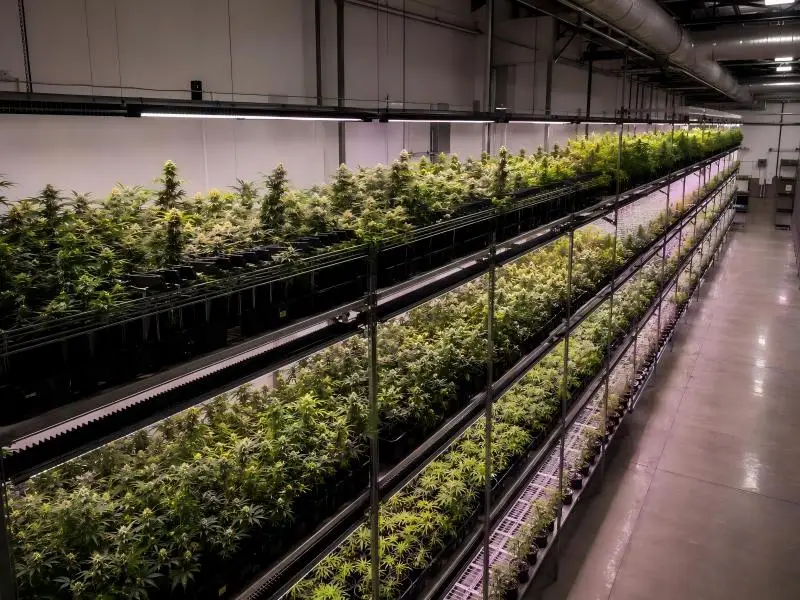
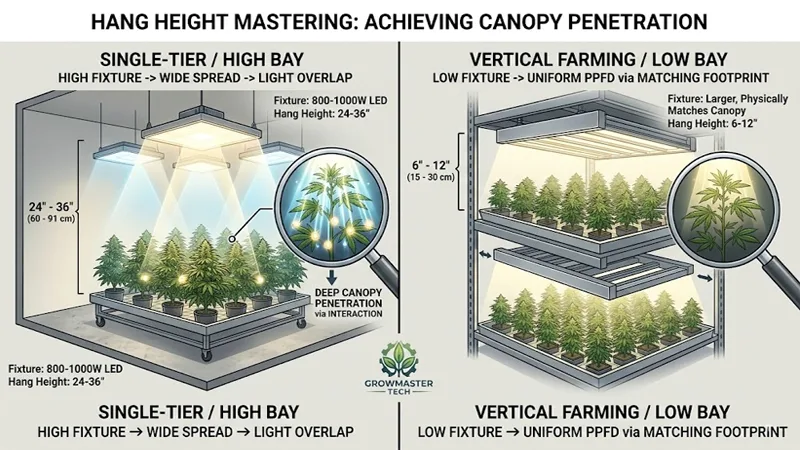
- Single-tier / high bay: In traditional warehouse setups with high ceilings and rolling benches, growers often use high-wattage fixtures (e.g., 800W to 1000W LEDs) hung 24 to 36 inches above the canopy. This higher hang height allows the beam angles from adjacent lights to cross over each other (light overlap). This overlapping effect is crucial for penetration, as light hits the plant from multiple angles, bypassing the top leaves to reach the lower nodes.
- Vertical farming / low bay: In multi-tier racks, vertical space is highly restricted. Fixtures must be mounted very close to the canopy (often 6 to 12 inches away). Because the lights cannot be hung high enough to achieve significant overlap, the fixtures themselves must be physically larger, mimicking the dimensions of the canopy to ensure uniform PPFD.
How Hang Height Impacts Light Spread and Hotspots
Adjusting the hang height by even a few inches drastically alters the PAR map of your grow room:
- Hanging too high: The light spread becomes very wide, but the PPFD drops due to the Inverse Square Law. Furthermore, light spillage occurs—photons hit the walls and aisles instead of the plants, wasting electricity and lowering your grams-per-watt efficiency.
- Hanging too low: The light footprint shrinks. You create a severe hotspot directly under the center of the fixture, risking light burn, while the PPFD at the perimeters of the tray drops sharply. This lack of uniformity results in an uneven canopy and inconsistent harvest quality.
Standard Hang Height Guidelines for Commercial LED Fixtures
While precise heights should always be verified with a PAR meter, here are general guidelines for standard commercial bar-style LED fixtures (600W – 800W):
- Vegetative stage: 24 to 30 inches above the canopy. (Dimmed to 50-70% intensity).
- Early flowering (weeks 1-3): 18 to 24 inches above the canopy. (Gradually increasing to 100% intensity).
- Late flowering (weeks 4-8): 12 to 18 inches above the canopy. (Maintaining 100% intensity, carefully monitoring top colas for light stress).
Note: Always consult the manufacturer’s specific recommendations. As a provider of custom greenhouse lighting, SLTMAKS provides bespoke hang height matrices tailored to the specific fixtures deployed in your facility.
Form Factor Matters: How Fixture Design Influences Penetration
The physical shape and design of the LED fixture play a massive role in how light penetrates a deep canopy.
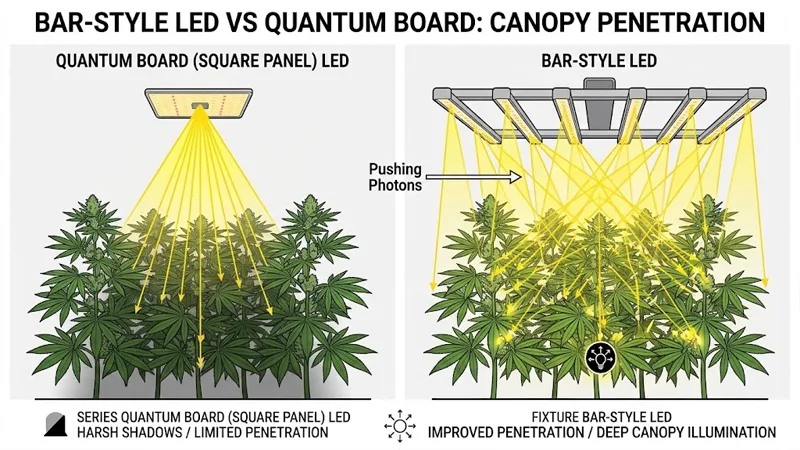
Bar-Style LEDs vs. Quantum Boards
In the early days of LED cultivation, compact “quantum board” styles were popular. While efficient, they acted essentially as a single point source of light, much like traditional HPS bulbs. The light emanated from a small central hub, creating harsh shadows directly beneath the top leaves and limiting penetration.
Today, the industry standard for commercial facilities is the Bar-Style LED fixture (often featuring 6 to 10 distinct light bars spread across a 4×4 or 5×5 frame).
Why bar-style is superior for penetration: Because the diodes are distributed across a wide physical area, light approaches the canopy from hundreds of different micro-angles. If a top leaf blocks a photon coming from the left bar, a photon from the right bar can still bypass that leaf and strike the lower buds. This multi-directional lighting virtually eliminates harsh shadows within the canopy, drastically improving the development of B-buds and C-buds lower down the stalk.
The Role of Optics and Beam Angles
The beam angle of the individual diodes also dictates penetration. Most standard LEDs feature a 120-degree beam angle, providing a wide, diffuse spread ideal for close-proximity vertical farming. However, for higher-bay applications, some fixtures utilize secondary optics or reflectors to narrow the beam angle (e.g., 90 degrees).
A narrower beam angle “pushes” the photons straight down with greater intensity, slightly sacrificing wide coverage for deep canopy penetration. The engineering team at SLTMAKS carefully selects diode beam angles based on the specific architectural constraints of our clients’ grow rooms.
Advanced Techniques to Complement Your Lighting Strategy
Hardware alone cannot solve every penetration issue. Commercial growers must employ biological and environmental techniques in tandem with high-quality LED fixtures.
Strategic Pruning, Defoliation, and Lollipopping
To maximize the efficiency of your lighting, you must remove the biological obstacles blocking the photons.
- Defoliation: Strategically removing large fan leaves, particularly on Day 21 and Day 42 of the flowering cycle, opens up vertical “light shafts” through the canopy, allowing PPFD to reach the mid-tier bud sites.
- Lollipopping: This involves stripping all leaves and underdeveloped bud sites from the bottom third of the plant before flipping to flower. Since light will never reach this zone with enough intensity to produce dense flowers, removing this growth forces the plant to redirect its energy (photosynthates) to the top and mid-canopy colas, resulting in larger, denser, highly marketable buds.
Supplemental Under-Canopy Lighting (Inter-Canopy Lighting)
An emerging trend in commercial cultivation is the use of under-canopy or inter-canopy lighting. This involves hanging specialized, lower-wattage LED strips horizontally or vertically between the plants, underneath the primary top canopy.
By illuminating the lower branches directly, growers can turn what would normally be airy popcorn buds into dense, A-grade flowers, potentially increasing overall room yield by 15% to 20%. SLTMAKS is actively developing tailored solutions for under-canopy integration for our commercial partners.
Reflective Walls and Room Geometry
Light that misses the canopy is wasted money. By utilizing highly reflective materials on facility walls (such as elastomeric white paint or specialized reflective panels), you can bounce escaping photons back into the edges of the canopy. Maintaining a high room reflectivity (above 90%) ensures that edge plants receive adequate PPFD, maintaining canopy uniformity.
Measuring Success: Mapping Your Grow Room’s PPFD
You cannot manage what you do not measure. Guessing hang heights based on visual brightness is a recipe for disaster, as the human eye is highly insensitive to the specific wavelengths that drive photosynthesis.
Why Every Commercial Grower Needs a Quantum PAR Meter
Every commercial facility must invest in a high-quality quantum PAR meter (such as those from Apogee Instruments). These devices specifically measure the number of photons within the Photosynthetically Active Radiation (PAR) range (400-700nm) that strike the sensor.
Creating a Precise PAR Map
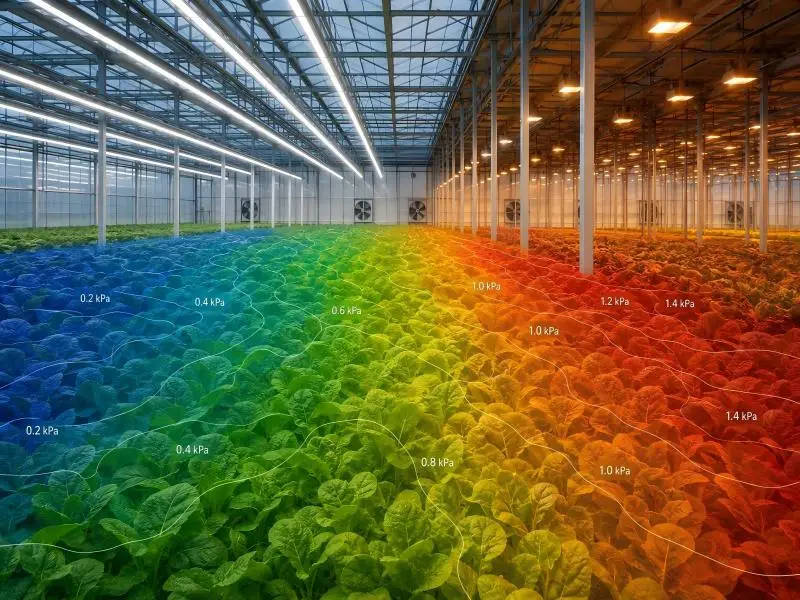
To truly optimize canopy penetration and uniformity, facility managers should create a PAR map for their growing benches.
How to execute a PAR map:
- Divide a standard 4×4 or 5×5 growing footprint into a grid (e.g., 6-inch by 6-inch squares).
- Set your LED fixture at the recommended hang height and 100% intensity.
- Take a PPFD reading at the exact center of each grid square at the intended canopy height.
- Record the data.
Your goal is to achieve a uniformity variance of less than 20% between the dead center of the fixture and the extreme corners. If the corners are reading 400 µmol/m²/s while the center is reading 1100 µmol/m²/s, your fixture is likely hung too low, or the fixture’s design is inadequate for commercial uniformity.
Why Choose SLTMAKS as Your Commercial Grow Light Manufacturing Partner?
Achieving optimal canopy penetration requires a synergy of cutting-edge hardware, physics, and agricultural science. Sourcing lights from generic suppliers who do not understand the nuanced demands of cannabis photobiology will invariably cost you in lower yields and degraded crop quality.
Beyond Just Lights: Engineering High-Yield Solutions
SLTMAKS is not a reseller; we are a professional grow light manufacturer with proprietary engineering, research, and development capabilities. Our fixtures are designed explicitly to solve the challenges of commercial canopy penetration.
When you choose SLTMAKS, you benefit from:
- Unmatched efficacy: PPE ratings of 2.8+ µmol/J, ensuring massive photon delivery with minimal electrical overhead and HVAC burden.
- Optimized form factors: Advanced bar-style layouts engineered for maximum light overlap and sub-canopy penetration.
- Commercial-grade reliability: Rigorous quality control, premium drivers, top-bin diodes, and full certifications (CE/UL/ETL) to ensure your facility operates safely and continuously.
- Direct-from-factory pricing: Because we manufacture our own fixtures, we offer highly competitive pricing for those looking to buy bulk plant grow lights.
We provide more than just hardware; we provide complete lighting strategies. Our team offers complimentary DIALux lighting layout designs for our B2B partners, simulating the exact PPFD maps and hang heights required for your specific facility dimensions before a single light is hung.
Ready to maximize your yield per square foot and eliminate popcorn buds forever?
Upgrade your facility with the industry’s most advanced lighting technology. Visit https://www.sltmaks.com/ today to view our full catalog of high-efficacy fixtures, or contact our commercial engineering team directly to request a custom quote and lighting layout for your next cultivation project.
FAQ
What is the ideal PPFD for different growth stages of cannabis?
Effectively managing PPFD is crucial for maximizing your yield. As a professional grow light manufacturer, we recommend 100–300 µmol/m²/s for clones and seedlings, 400–600 µmol/m²/s for the vegetative stage, and 800–1000 µmol/m²/s during the flowering stage. For commercial facilities using supplemental CO2, PPFD can safely be pushed to 1500+ µmol/m²/s to maximize photosynthesis.
How high should I hang my commercial LED grow lights to avoid hotspots?
Hang height depends on your specific facility architecture. In single-tier high bay setups, hang high-wattage commercial LED grow lights 24 to 36 inches above the canopy to create light overlap. For vertical farming (low bay), fixtures should be hung 6 to 12 inches away. Adjusting hang height correctly ensures uniform light spread and prevents light bleaching at the top colas.
Why are my lower buds underdeveloped, and how can I improve canopy penetration?
Underdeveloped “popcorn buds” occur because the upper plant canopy absorbs up to 90% of the light. To drive explosive lower-canopy growth, you need high-efficacy LED grow lights engineered with specific diode arrangements and optical designs. Properly managing PPFD and optimizing your hang height allows photons to penetrate deeper, significantly boosting your total harvest weight.
What is the difference between PPF and PPFD when buying wholesale grow lights?
PPF measures the total amount of light a fixture produces, while PPFD (Photosynthetic Photon Flux Density) measures the actual usable light hitting your plant canopy. For commercial growers, PPFD is the true metric that dictates yield. A reliable commercial grow light manufacturer will always provide accurate PPFD maps to guarantee even light distribution across your entire grow room.
Can too much light damage my indoor plants?
Yes, pushing PPFD levels beyond the plant’s photosynthetic capacity causes photoinhibition, which leads to thermal stress and bleached top colas. To prevent light toxicity, you should invest in premium cannabis cultivation lighting solutions that utilize top-tier diodes (like Samsung and Osram). This ensures maximum photon delivery with minimal radiant heat, protecting your crops while maximizing yields.