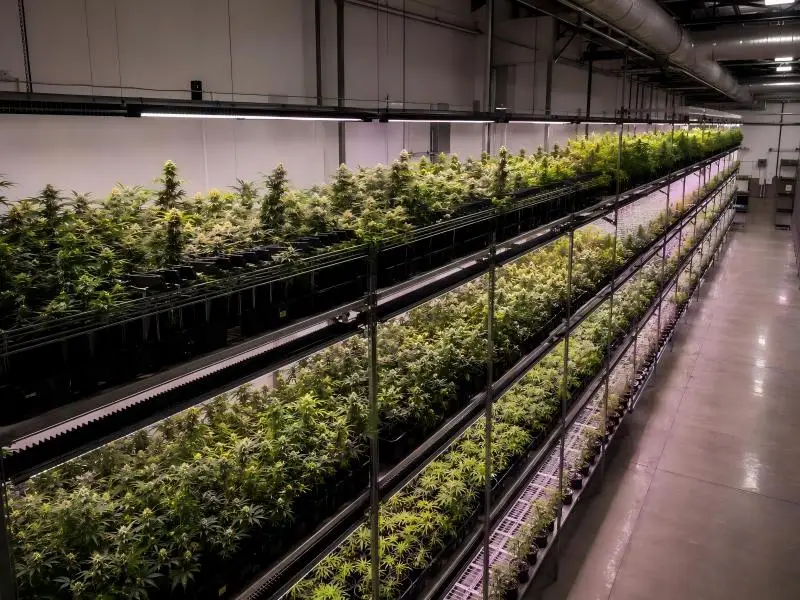
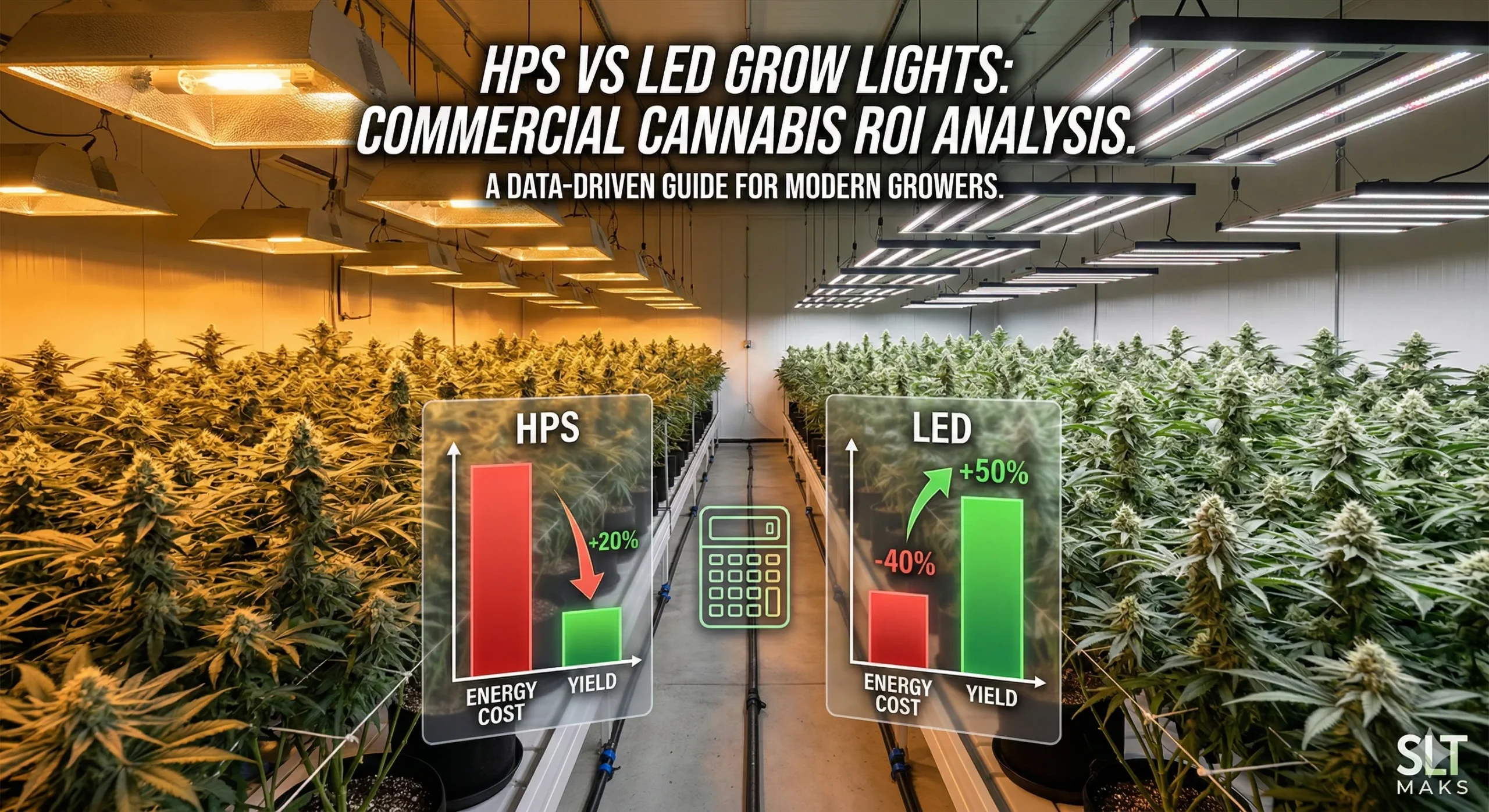
The commercial cannabis industry has entered an era of unprecedented price compression. With wholesale prices stabilizing or dropping in mature markets, the margin for error in facility design and operational expenditure (OpEx) has evaporated. For commercial indoor cultivators, survival and profitability now hinge on aggressive operational efficiency, maximum yield per square foot, and the consistent production of top-tier, high-THC flower.
At the heart of this operational matrix is your lighting system. Historically, High-Pressure Sodium (HPS) fixtures were the undisputed gold standard for the flowering stage. However, the rapid advancement of Light Emitting Diode (LED) technology has forced a paradigm shift. But are LEDs truly worth the substantial increase in initial Capital Expenditure (CapEx)?
In this comprehensive engineering and financial analysis, we move past marketing jargon to provide a rigorous assessment of the ROI of LED vs. HPS grow lights. We will break down the photobiology, thermal dynamics, and electrical infrastructure, and provide a verifiable Return on Investment (ROI) calculation model to help you make the most profitable decision for your commercial facility.
Table of Contents
Photobiology & Technical Deep Dive: The Physics of Light in Cultivation
To understand the financial implications, we must first understand the physical and biological differences between how HPS and LED fixtures interact with Cannabis sativa.
Spectrum Analysis and Secondary Metabolites
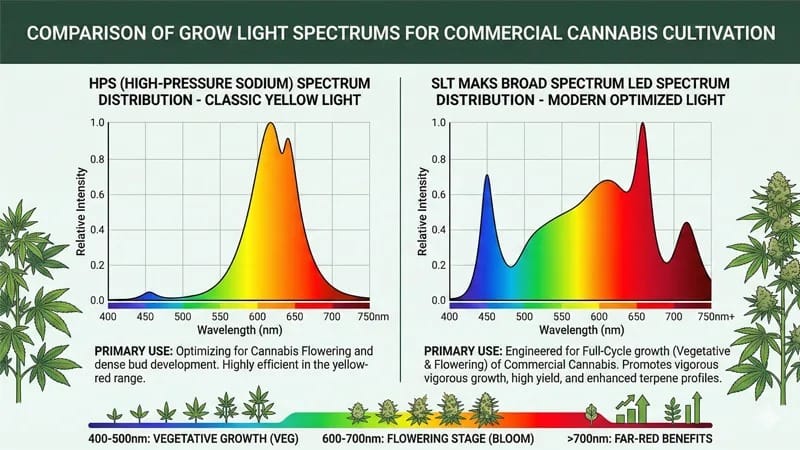
HPS lamps operate by passing a high-voltage pulse through a quartz tube filled with sodium, mercury, and xenon. This produces a massive output of light heavily concentrated in the yellow, orange, and red spectrums (560nm to 700nm). While this is effective for driving biomass during the flowering stage, it is fundamentally an unbalanced, narrow spectrum. HPS severely lacks blue light (crucial for controlling internodal spacing and preventing stretching) and contains virtually zero Ultraviolet (UV) light.
Modern commercial LED grow lights, such as those engineered by SLT MAKS, utilize a sophisticated array of specifically binned diodes (often combining 3000K, 5000K, 660nm Deep Red, and 730nm Far Red, with optional UV/IR channels). This broad-spectrum approach closely mimics natural sunlight.
From a biological standpoint, a full spectrum triggers a wider range of photoreceptors (Phytochromes, Cryptochromes, and Phototropins). The inclusion of specific UV and blue wavelengths induces a mild, positive stress response in the plant, significantly increasing the production of trichomes, which house the highly valuable secondary metabolites: cannabinoids (THC, CBD) and terpenes.
Efficacy: Converting Electrons to Photons
The true measure of a grow light’s efficiency is its Photosynthetic Photon Efficacy (PPE), measured in micromoles per joule (㎛mol/J). This tells us how many photosynthetically active photons are generated for every watt of electrical energy consumed.
- Standard Double-Ended (DE) HPS: Averages 1.7 to 1.9 ㎛mol/J.
- Commercial-grade LED: Currently averages 2.6 to 3.0+ ㎛mol/J.
This means a state-of-the-art LED fixture produces up to 60% more usable plant light for the same amount of electricity. To match the Photosynthetic Photon Flux (PPF) of a 1000W HPS fixture, an LED fixture only needs to draw between 600W and 700W.
Thermal Dynamics: Radiant vs. Convective Heat
Perhaps the most misunderstood aspect of commercial lighting is thermal management. Both HPS and LED lights produce heat, but they distribute it entirely differently.
HPS lamps emit a massive amount of Infrared (IR) radiation. This is radiant heat, which travels through the air without heating it and directly heats the surface it strikes (the plant canopy). This elevates the Leaf Surface Temperature (LST) significantly above the ambient room temperature.
LEDs, conversely, produce very little forward-facing IR radiation. The heat generated by the diodes is transferred to the aluminum heat sinks on the back of the fixture. This is convective heat, which rises to the ceiling and does not directly bake the plant canopy.
Because of this, indoor rooms running LEDs must typically run higher ambient temperatures (e.g., 82°F to 85°F) to achieve the optimal LST and Vapor Pressure Deficit (VPD) for plant transpiration, compared to the cooler ambient temperatures (75°F to 78°F) required to offset the intense radiant heat of HPS.
Capital Expenditure (CapEx): The Initial Investment
When facility planners look at LED, the immediate barrier is the sticker shock. There is no denying that LEDs require a higher upfront capital injection. However, looking solely at the fixture price is a critical miscalculation.
Fixture Costs
- HPS fixture (1000W DE + reflector + ballast + bulb): Typically ranges from $350 to $550 per unit.
- Commercial LED fixture (650W – 800W, dimmable, full spectrum): Typically ranges from $700 to $1,300 per unit.
For a 100-light room, this represents a delta of roughly $45,000 to $75,000 in lighting hardware alone.
Electrical Infrastructure Savings
Because an LED fixture draws significantly fewer amps than an HPS fixture (e.g., a 650W LED draws 2.7 Amps at 240V, while a 1000W HPS draws 4.5 Amps at 240V), the overall electrical load of the facility drops dramatically.
For a commercial build-out, this means:
- Fewer electrical panels and sub-panels are required.
- Lower amperage main service drops from the utility company.
- Thinner gauge wire and smaller circuit breakers.
These electrical engineering and material savings can easily offset 10% to 20% of the increased lighting CapEx.
HVAC System Downsizing
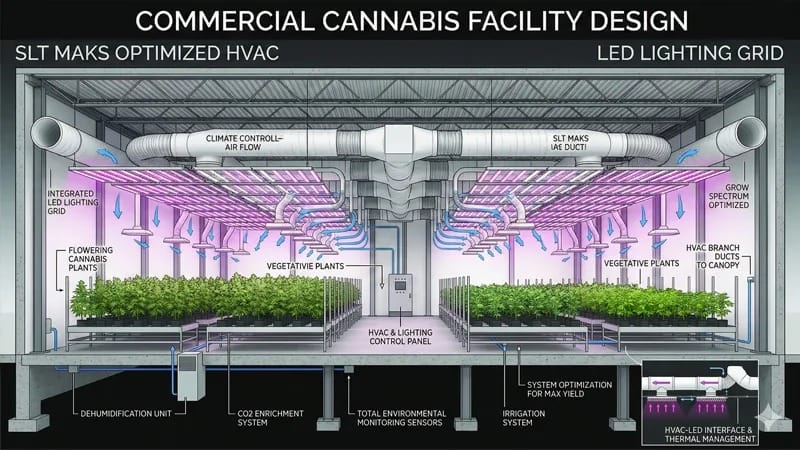
Because a 650W LED consumes ~350 fewer watts than a 1000W HPS, it generates approximately 1,200 fewer BTUs of heat per hour. In a 100-light room, that is a reduction of 120,000 BTUs/hour, which equates to exactly 10 Tons of cooling capacity.
Commercial HVAC and dehumidification equipment is incredibly expensive to purchase and install (often ranging from $2,000 to $3,500 per Ton). By downsizing the HVAC requirement by 10 Tons, a facility can save $20,000 to $35,000 on initial HVAC CapEx, further closing the gap between HPS and LED installation costs.
Operational Expenditure (OpEx): The Hidden Profit Killers
While CapEx is a one-time pain, OpEx bleeds a facility month after month. This is where the physics of LED technology fundamentally alter the financial trajectory of a commercial grow.
Electrical Consumption: Lighting and Cooling
Let’s assume a commercial electricity rate of $0.14 per kWh. In a standard flowering cycle, lights run for 12 hours a day, 365 days a year (4,380 hours annually).
- 1000W HPS (Actually draws ~1050W with ballast inefficiency): * 1.05 kW x 4380 hours x $0.14 = $643.86 per light/year.
- 650W LED: * 0.65 kW x 4380 hours x $0.14 = $398.58 per light/year.
Annual Lighting Savings per fixture = $245.28
Furthermore, because the HVAC system is working less to remove the heat generated by the lights, the cooling electrical costs drop by an almost identical margin. A standard rule of thumb in commercial cultivation is that for every dollar saved on lighting energy, you save roughly $0.40 to $0.60 on cooling energy.
Maintenance and Consumables
HPS bulbs suffer from rapid, severe lumen degradation and spectral shift. To maintain optimal PPFD, commercial growers must replace HPS bulbs every 3 to 4 harvest cycles (roughly every 9 to 12 months).
- High-quality DE HPS Bulb: $60 to $90.
- Labor to clean reflectors and change 100 bulbs: $500+.
- Annual HPS maintenance for 100 lights: ~$8,000.
Commercial LEDs, utilizing high-tier diodes from manufacturers like Samsung or Osram, possess an L90 rating of 50,000 to 100,000 hours. This means the fixture will run for over a decade before losing 10% of its total output. They require zero bulb changes and only basic surface wiping, practically eliminating lighting maintenance from the OpEx equation.
Energy Rebates
In North America, utility companies are aggressively incentivizing the shift to energy-efficient lighting. Facilities that install DLC-qualified (DesignLights Consortium) LED fixtures can receive massive cash rebates, often ranging from $100 to $400+ per fixture. This rebate alone can instantly erase the CapEx delta between HPS and LED.
Revenue Generation: Yield, Quality, and Market Premium
Efficiency saves money, but yield and quality make money.
The Grams per Watt Revolution
Historically, pulling 1.0 to 1.2 grams per watt under HPS was considered the mark of a master grower. Due to the superior light distribution, canopy penetration, and balanced spectrum of modern LEDs, the new industry benchmark has shifted dramatically.
Cultivators transitioning to high-quality LEDs are routinely hitting 2.0 to 2.5+ grams per watt. Even though the wattage is lower (650W vs 1000W), the absolute yield per square foot increases.
- HPS (1000W) yield: 1000W x 1.1 g/W = 1,100 grams (2.42 lbs) per light.
- LED (650W) yield: 650W x 2.2 g/W = 1,430 grams (3.15 lbs) per light.
Canopy Consistency and The Quality Premium
HPS fixtures create a “hot spot” directly beneath the bulb, with light intensity rapidly falling off at the edges. This results in an uneven canopy and a high percentage of “larf” (airy, underdeveloped buds lower on the plant), which sell for a fraction of the price of premium top-collas.
LED fixtures are designed as multi-bar arrays. They distribute light evenly across a 4×4 or 5×5 footprint, ensuring uniform PPFD from edge to edge and driving dense bud formation deeper into the canopy. Furthermore, the enhanced terpene profiles and higher THC percentages driven by the broad spectrum allow cultivators to command a higher wholesale price per pound.
LED vs HPS Grow Lights ROI: The Real-World Calculation Model
Let’s synthesize these variables into a concrete financial model.
The Scenario:
- Facility size: 100-light flowering room.
- Cycles per year: 5 harvests.
- Electricity rate: $0.14 / kWh.
- Wholesale cannabis price: $1,200 / lb (conservative estimate).
Step 1: The Initial CapEx Delta
- 100 HPS fixtures (@ $450): $45,000
- 100 LED fixtures (@ $900): $90,000
- HVAC savings with LED (10 Tons @ $2,500/Ton): -$25,000
- Net CapEx difference: LEDs cost $20,000 more upfront.
Step 2: Annual OpEx Savings (LED)
- Lighting electrical savings: $24,528
- Cooling electrical savings (est. 50% of lighting): $12,264
- Bulb replacement/maintenance savings: $8,000
- Total annual OpEx savings: $44,792
Step 3: Annual Revenue Boost (LED)
- Increased yield per light: 0.73 lbs (3.15 lbs LED – 2.42 lbs HPS).
- Total extra yield (100 lights x 5 harvests): 365 extra lbs per year.
- Value of extra yield (365 lbs x $1,200/lb): $438,000
Step 4: The Break-Even and ROI Formula
To calculate exactly when the LED investment pays for itself, we look at the monthly financial benefit.
- Monthly financial benefit = (annual opEx savings + annual revenue boost) / 12
- Monthly benefit = ($44,792 + $438,000) / 12 = $40,232 per month.
Since the net capEx difference was only $20,000, the LED system pays for its premium in less than one harvest cycle (roughly 15 days of operational benefit).
To calculate the 1-Year ROI of choosing LED over HPS:
5-Year Profit Projection
Over a standard 5-year facility lifespan, choosing a 100-light LED system over an HPS system, assuming consistent market variables, will generate approximately $2.4 Million in additional net profit for the facility through combined energy savings and crop yield increases.
| Metric | 1000W HPS System | 650W SLT MAKS LED System | Difference (LED Advantage) |
| Initial lighting capEx | $45,000 | $90,000 | -$45,000 |
| HVAC CapEx | Baseline | -$25,000 (Downsized) | +$25,000 |
| Annual power Cost (Total) | ~$96,000 | ~$59,200 | +$36,800/year |
| Annual yield (Lbs) | 1,210 lbs | 1,575 lbs | +365 lbs/year |
| Annual revenue ($1.2k/lb) | $1,452,000 | $1,890,000 | +$438,000/year |
| 5-Year net financial impact | Baseline | + $2,399,000 | Massive competitive edge |
Why Partner with SLT MAKS for Your Commercial Build
Navigating the transition from legacy lighting to modern LEDs requires more than just purchasing hardware; it requires an engineering partner. At SLT MAKS, we are not just manufacturers; we are plant biology and thermal management specialists.
When you scale your commercial facility with SLT MAKS, you are guaranteed:
- Engineering-grade components: We utilize only top-bin Samsung and Osram diodes driven by industry-leading, highly efficient drivers, ensuring maximum ㎛mol/J output and minimal thermal decay.
- Custom light mapping: Our engineers provide comprehensive 3D Dialux lighting simulations for your specific floor plan, guaranteeing perfectly uniform PPFD across every square inch of your canopy.
- Optimized thermal designs: Our patented passive cooling heat sinks ensure our fixtures operate at lower temperatures, protecting diode longevity and minimizing your HVAC load.
- DLC certification: Our commercial lines are fully DLC qualified, ensuring you have access to the maximum state and federal energy rebates available to rapidly accelerate your ROI.
Conclusion
The data is unequivocal. While HPS fixtures paved the way for the modern indoor cannabis industry, their inefficiency in light spectrum, electrical consumption, and thermal output makes them a severe liability in today’s highly competitive market.
Upgrading to commercial LED grow lights is no longer an optional luxury; it is a fundamental mathematical necessity for survival. By slashing OpEx and maximizing the grams-per-watt yield of top-tier flower, LEDs provide an ROI that can transform the financial health of your facility within a single fiscal year.
Ready to maximize your yield and slash your energy bills? Do not guess with your facility’s lighting. Let our engineering team do the math for you. Contact SLT MAKS today to receive a free, customized 3D lighting layout and a highly detailed, facility-specific ROI calculation report based on your local utility rates and room dimensions.
FAQ
Are commercial LED grow lights worth the higher initial cost compared to HPS?
Yes. While the initial capital expenditure (CapEx) for LED grow lights is higher, the Return on Investment (ROI) is achieved quickly through massive operational savings. If you choose a reliable commercial LED grow light manufacturer like SLT MAKS significantly reduces electricity consumption, eliminates bulb replacements, and qualifies your facility for energy rebates, ensuring higher long-term profitability.
Do LED grow lights reduce HVAC cooling costs in indoor cultivation?
Absolutely. Unlike HPS lights that emit intense radiant heat and bake the plant canopy, commercial LED grow lights produce convective heat. This allows cultivators to downsize their HVAC equipment tonnage, saving roughly $0.40 to $0.60 on cooling for every dollar saved on lighting energy.
Why do growers achieve higher yields per watt with LED vs HPS grow lights?
High-quality LED grow lights deliver a broader, full spectrum that closely mimics natural sunlight. This balanced spectrum, combined with a higher Photosynthetic Photon Efficacy (PPE of 2.6-3.0+ µmol/J), allows commercial cultivators to increase their yield from roughly 1.0 g/W under standard HPS to over 2.5 g/W under modern LED fixtures.
How does the spectrum of LED grow lights improve plant quality over HPS?
HPS lights are heavily concentrated in the yellow and orange spectrums. In contrast, advanced LED grow light solutions provide a full spectrum, including essential blue and UV wavelengths. This triggers a positive stress response in plants, significantly increasing the production of trichomes, secondary metabolites, and terpenes for a premium harvest.
What is the maintenance cost difference between LED and HPS grow lights?
HPS bulbs suffer from rapid lumen degradation and require replacement every 3 to 4 harvest cycles, costing commercial facilities thousands annually. By partnering with a professional LED grow light manufacturer, you get durable fixtures with an L90 lifespan of 50,000 to 100,000 hours, requiring zero bulb changes and practically eliminating maintenance costs.