In this comprehensive guide, we will dive deep into the science of the veg-to-bloom transition and provide a step-by-step framework to optimise your lighting strategy for explosive floral growth and faster harvests.
Table of Contents
The Science of the Veg to Bloom Transition
To manipulate the plant for commercial gain, we must first understand the biological mechanisms driving its development. Cannabis is generally a short-day (or more accurately, a long-night) plant. Understanding how light interacts with the plant’s biology at a cellular level is the first step in mastering indoor grow lighting science.
Understanding Photoperiodism
Photoperiodism is the physiological reaction of organisms to the length of night or a dark period. In cannabis cultivation, the standard vegetative cycle utilises 18 hours of light and 6 hours of darkness (18/6). To induce flowering, cultivators switch the environment to 12 hours of light and 12 hours of uninterrupted darkness (12/12).
This 12-hour dark period is non-negotiable. During this extended darkness, the buildup of a specific hormone trigger reaches a critical mass. The plant utilises photoreceptor proteins known as phytochromes—specifically Phytochrome Red (Pr) and Phytochrome Far-Red (Pfr)—to measure the length of the night. During the day, Pr rapidly converts to Pfr. During the long night, Pfr slowly reverts to Pr. When the level of Pfr drops low enough due to the 12 hours of darkness, the plant realises that “autumn is approaching” and transitions its energy from structural growth to reproduction (making flowers).
The Shift in Plant Hormones
This change in the photoperiod triggers a massive internal hormonal shift. During the vegetative stage, the plant is dominated by Auxins, hormones responsible for cell elongation and root development. When the 12/12 cycle is introduced, the production of a mobile signal called Florigen is activated in the leaves. Florigen travels through the plant’s vascular system to the shoot apical meristems, effectively telling the plant to stop producing leaves and stems and start producing calyxes, pistils, and trichomes.
For commercial facilities, understanding these biological triggers is why investing in precise commercial cultivation lighting solutions is essential. If your lighting cannot deliver the right spectrum and intensity to support this massive hormonal shift, your harvest timeline will inevitably be delayed.
Spectrum Shifting: Mastering Light Quality for the Flip
It is a common misconception that light intensity is the only factor that matters. In reality, the quality of the light (the spectrum) plays a massive role in how the plant physically develops during the flip.
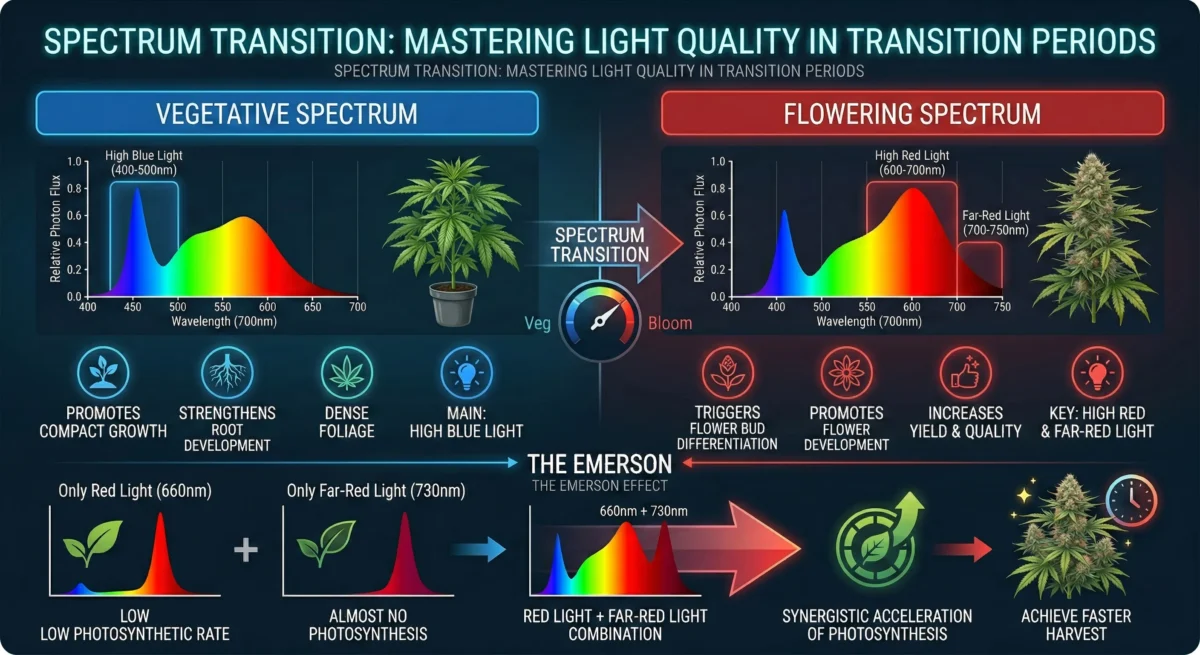
Why Blue Light Remains Crucial in Early Transition
During the vegetative stage, blue light (400-500nm) is essential for keeping plants compact and bushy. When you flip to 12/12, cannabis plants undergo a period of rapid vertical growth known as the “flowering stretch,” where they can double or even triple in height within the first two to three weeks.
While you want to introduce more red light for flowering, completely removing blue light during the transition is a mistake. Adequate blue photons inhibit excessive internodal elongation. By suppressing extreme stretching, blue light ensures that the plant develops thick, sturdy stems capable of supporting the massive weight of the dense colas that will form later.
Red and Far-Red Light: The Powerhouse of Early Bloom
Red light (600-700nm) is the primary driver of photosynthesis and is highly efficient at stimulating flower development. However, the real magic for “Faster Harvests” happens when red light is combined with far-red light (700-800nm).
This is known in photobiology as the Emerson Effect. When plants are exposed to both red and far-red light simultaneously, the rate of photosynthesis is greater than the sum of the individual rates from either wavelength alone. Far-red light also helps accelerate the phytochrome conversion process, essentially helping the plant “go to sleep” faster and transition into its flowering state more aggressively.
The Value of Dynamic Spectrum Control for Commercial Farms
Not all cannabis cultivars respond to the same light recipes. Sativas, Indicas, and modern hybrids have different stretching tendencies and spectral requirements. This is where dynamic spectrum control becomes a game-changer for commercial operations.
Being able to tune the blue, red, and far-red channels independently allows head growers to gently steer the crop through the transition, minimizing stress and maximizing yield. As a leading LED grow light factory, SLTMAKS specializes in providing custom spectrum grow lights that allow commercial cultivators to dial in the perfect light recipe for their specific genetics, ensuring repeatable, heavy harvests every single cycle.
Managing Light Intensity: PPFD and DLI Targets
Transitioning to flower isn’t just about changing the timer settings; it requires a calculated mathematical approach to light intensity. This is where commercial facilities separate themselves from amateur operations.
Ideal PPFD: Late Veg vs. Early Bloom
Photosynthetic Photon Flux Density (PPFD), measured in µmol/m²/s, dictates how many usable light photons are hitting the plant canopy per second.
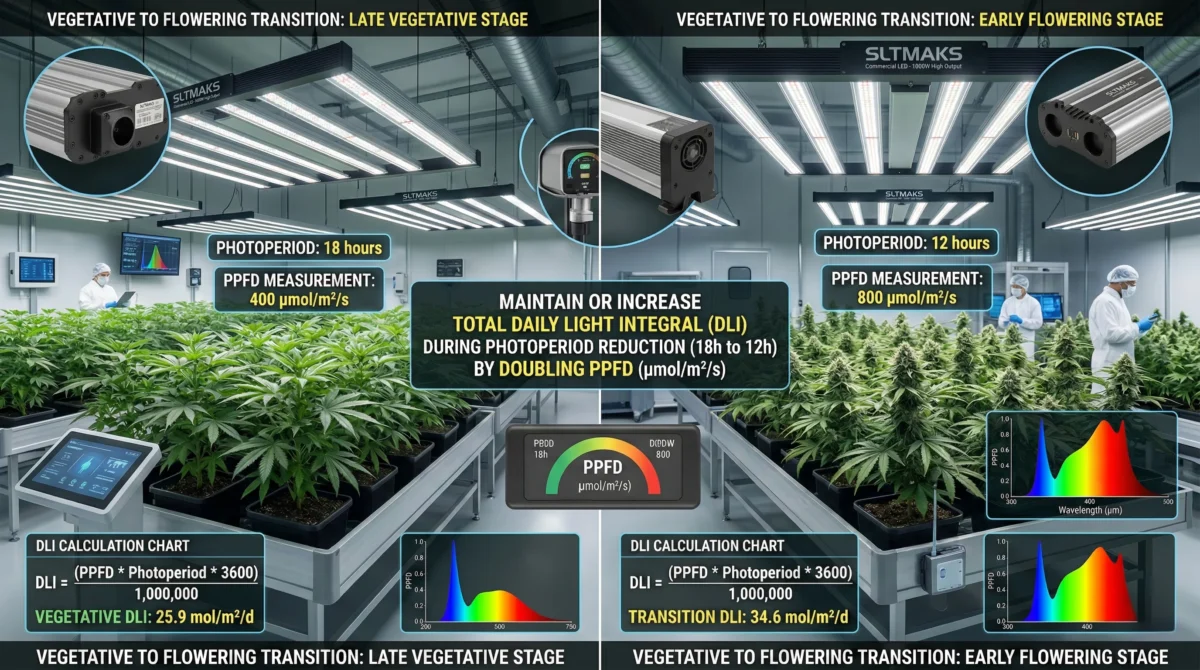
- Late vegetative stage: Plants are typically thriving at a PPFD of 400 to 600 µmol/m²/s.
- Early transition (weeks 1-3 of Flower): The plants require a massive energy boost to fuel the flowering stretch and bud site development. You should incrementally raise the PPFD from 600 up to 800-1000 µmol/m²/s. (Note: If utilising supplemental CO2, PPFD can be pushed even higher, up to 1200-1500 µmol/m²/s).
Precise Calculation of Daily Light Integral (DLI)
The Daily Light Integral (DLI) is the total amount of photosynthetically active radiation (PAR) delivered to the plant over the entire day. Think of PPFD as the rate of rainfall, and DLI as the total amount of rain collected in a bucket over 24 hours.
When you flip from 18 hours of light to 12 hours of light, you are cutting the plant’s feeding time by 33%. If you keep your light intensity the same, the plant’s total daily energy (DLI) drops dramatically.
To maintain momentum and achieve faster harvests, you must increase the PPFD to compensate for the lost hours of light. For example, a PPFD of 600 for 18 hours yields a DLI of roughly 38.9 mol/m²/d. To maintain that same DLI during a 12-hour cycle, you must increase your PPFD to 900 µmol/m²/s immediately upon flipping. Understanding this math is exactly why commercial facilities invest heavily in high PPFD LED grow lights and commercial LED grow fixtures capable of delivering intense power without generating excessive heat.
Avoiding Photoinhibition (Light Stress)
While raising PPFD is necessary, shocking the plant with an immediate 50% increase in intensity can cause photoinhibition—where the plant’s photosynthetic machinery is overwhelmed and shuts down, halting growth.
Cultivators must choose between a “Hard Flip” (immediate light cycle and intensity change) or a “Soft Flip” (gradually reducing hours and incrementally increasing intensity over 3 to 5 days). A soft flip is generally recommended to mitigate stress. Ensure your wholesale plant lights feature advanced dimming capabilities to execute these gradual transitions smoothly.
Step-by-Step Transition Guide for Commercial Facilities
Achieving a perfect veg-to-bloom transition requires synchronising your lighting with your mechanical and environmental systems. Here is a proven checklist for large-scale facilities.
1. Pre-Flip Preparation: Pruning and Defoliation
Before the flip, the plant must be structurally ready. Techniques like “Schwazzing” or heavy defoliation in the final days of veg remove large fan leaves that block light from penetrating the lower canopy.
- The goal: Ensure maximum light penetration. Even the most powerful commercial LED grow fixtures cannot pierce through a jungle of unnecessary foliage. Removing lower, unproductive growth directs the plant’s energy solely to the top colas.
2. Adjusting Hanging Heights and Dimming Strategies
As plants undergo the flowering stretch, they rapidly grow closer to the light source, inadvertently increasing the PPFD at the canopy level.
- Action plan: Raise your light fixtures to maintain the optimal distance to the canopy. Utilise 0-10V dimming protocols or daisy-chain smart control systems to manage hundreds of lights simultaneously. This automation is a standard requirement when working with a top-tier B2B LED grow light supplier.
3. Environmental Synchronisation: Lighting and VPD Control
Light intensity directly impacts leaf surface temperature, which in turn dictates transpiration rates. When you increase your PPFD to push through the transition, you must simultaneously adjust your HVAC and dehumidification systems.
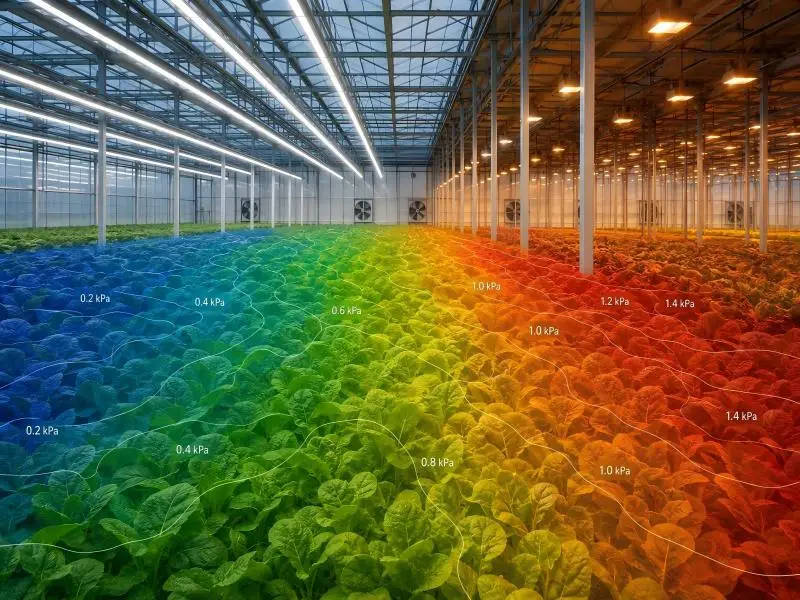
- Vapour Pressure Deficit (VPD): In early flower, aim for a VPD of 1.0 to 1.2 kPa. If you increase light intensity but fail to adjust temperature and humidity, the plant’s stomata will close to conserve water, completely halting CO2 uptake and negating the benefits of your expensive lighting.
Common Lighting Mistakes That Delay Harvests
Even the most sophisticated facilities can fall victim to transition errors. Avoid these pitfalls to keep your harvest cycle on track:
The Fatal Flaw of Light Leaks
During the 12-hour dark period, the environment must be completely pitch black. Even a pinhole of light from an indicator LED on a dehumidifier or a crack in a grow tent can disrupt the phytochrome conversion. Light leaks cause plants to revert to the vegetative stage (revegging) or turn hermaphroditic, potentially ruining an entire room with seeds.
Under-Lighting the Lower Canopy
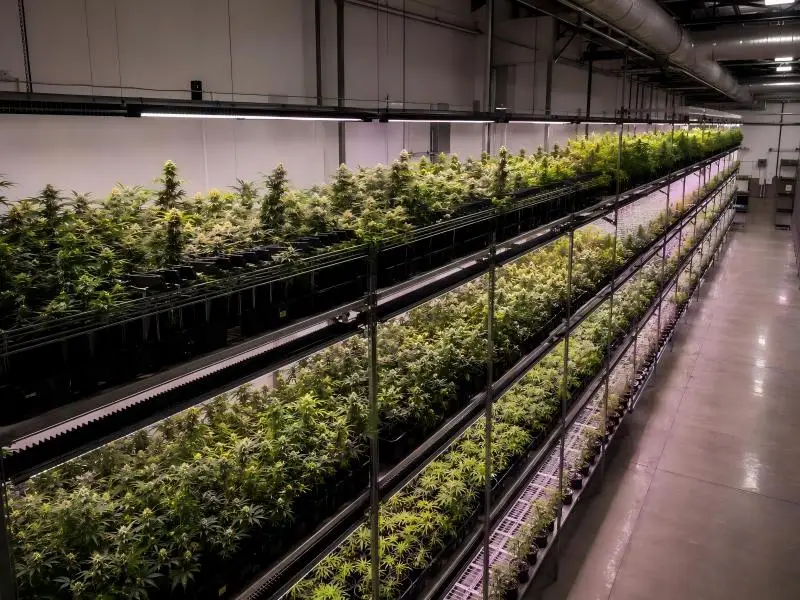
Relying on fixtures with poor diode distribution leads to a lack of light reaching the lower branches. This results in the development of “popcorn buds”—airy, low-density, low-THC flowers that have little to no commercial value. High-quality fixtures utilize specialized optical lenses to push photons deep into the canopy.
Clinging to Outdated or Inefficient Lighting
Many older facilities still rely on High-Pressure Sodium (HPS) fixtures. While HPS produces red light, it lacks the full-spectrum capabilities, efficiency, and precise dimming controls of modern LEDs. Transitioning to LED technology drastically reduces heat loads on HVAC systems and allows for tighter environmental control. Upgrading through a reputable B2B grow light supplier offers an ROI that is often realized within the first two harvest cycles.
Why Top Cultivators Choose SLTMAKS Cannabis Grow Lights
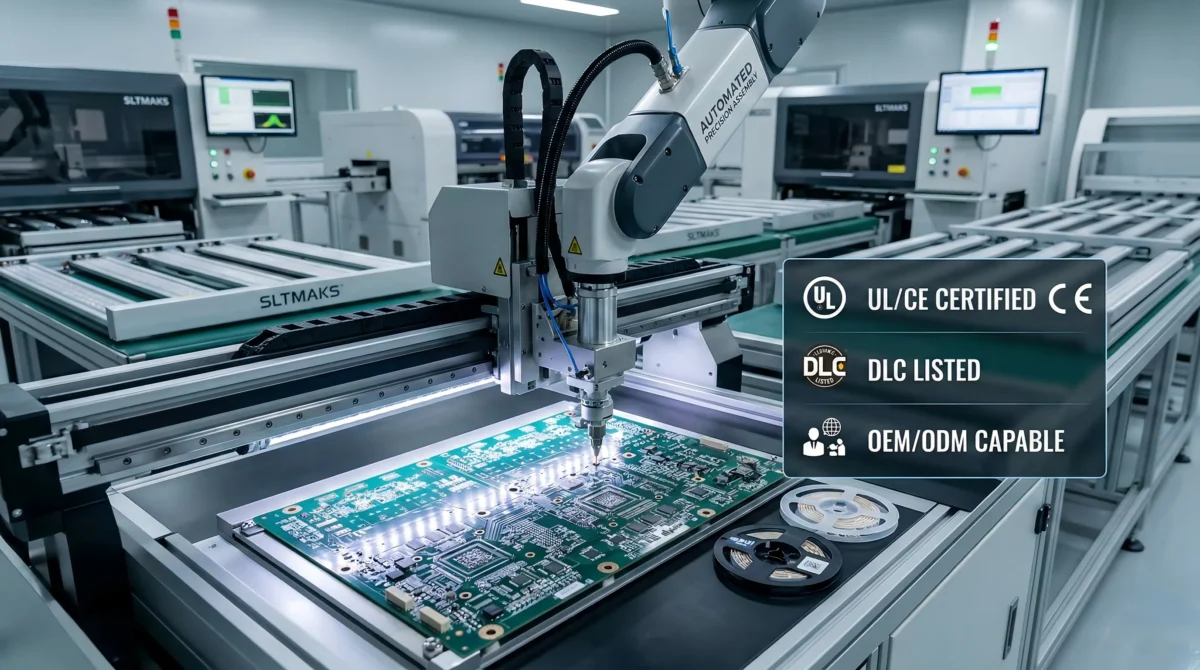
For commercial agriculture, grow lights are not just bulbs; they are the engine of your business. As a trusted grow light OEM ODM and manufacturing partner, SLTMAKS is dedicated to pushing the boundaries of horticultural lighting with verified data and uncompromising safety standards.
Verified Optical Performance: Integrating Sphere & Uniformity Data
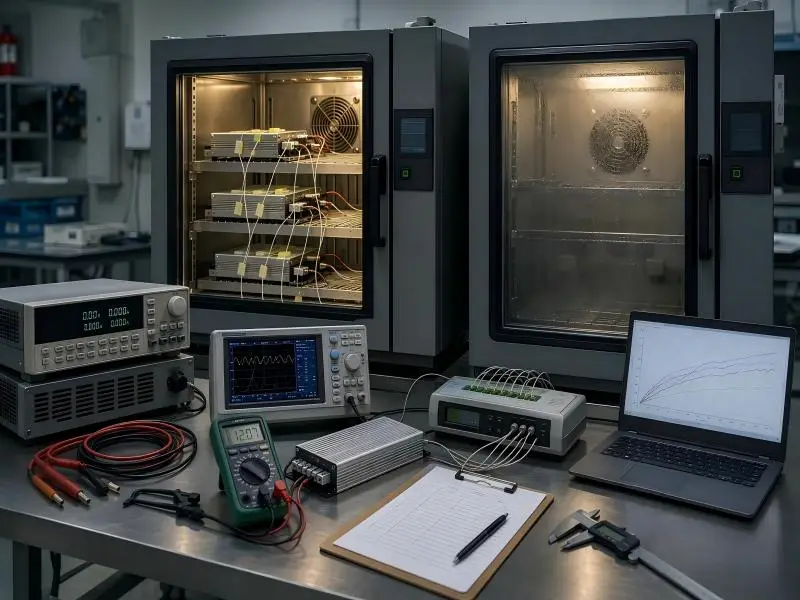
Professional cultivators cannot rely on estimated specs. At SLTMAKS, every fixture design undergoes rigorous integrating sphere testing in our state-of-the-art optical labs. This guarantees that our advertised Photosynthetic Photon Efficacy (PPE) of 2.8+ µmol/J and total PPF output are 100% accurate.
Furthermore, raw power means nothing if it isn’t distributed evenly. Our fixtures are engineered with specialised secondary optics to achieve over 90% light uniformity across the canopy.
This eliminates high-heat “hot spots” in the centre and prevents PPFD drop-off at the edges, ensuring that every plant in your facility yields consistently, regardless of its position on the rolling bench.
Unmatched OEM/ODM Manufacturing Power
Whether you are a distributor looking to brand your own line of lights or a massive commercial farm requiring thousands of customised units, SLTMAKS has the infrastructure. Operating as a direct LED grow light factory, we offer stringent Quality Control (QC) processes and cut out the middleman, providing you with factory-direct pricing without compromising on elite performance.
Strict Electrical Safety & Regional Compliance
Operating a high-power commercial cultivation facility comes with significant risk management responsibilities. SLTMAKS mitigates this risk through uncompromising electrical safety standards. Our commercial fixtures are IP65-rated for superior water and dust resistance, essential for surviving the high-humidity environments of commercial greenhouses. More importantly, they meet strict horticultural lighting safety standards, including UL8800, CE, and RoHS certifications, preventing fire hazards and electrical failures.
- Important Compliance Note: While we provide the technology to maximize your yields, the cultivation of cannabis is heavily regulated. We strongly advise all B2B clients and commercial farm operators to thoroughly verify their regional legality and secure all necessary local agricultural and zoning permits before installing commercial-scale lighting systems.*
Free Commercial Lighting Layout and DIALux Simulations
We understand that B2B clients require engineering support, not just hardware. SLTMAKS offers free, custom lighting layout designs using advanced DIALux software. We will map your specific facility dimensions, calculate the exact number of fixtures needed, and simulate the light distribution to guarantee uniform PPFD across your entire canopy before you spend a single dollar.
Conclusion & Call to Action
The transition from vegetative growth to flowering is a complex biological symphony. By mastering the science of photoperiodism, manipulating the light spectrum, precisely calculating your PPFD/DLI, and maintaining strict environmental controls, you can push your crops to finish faster and yield heavier. However, this level of precision is only possible when you are backed by professional, commercial-grade hardware.
Ready to upgrade your commercial facility for faster harvests, lower energy bills, and heavier yields?
FAQ
How do I adjust light cycles when transitioning cannabis from veg to bloom?
To induce flowering, switch your LED grow lights from an 18/6 (light/dark) cycle to a strict 12/12 photoperiod. This 12-hour uninterrupted dark period triggers essential hormonal shifts. As a professional grow light manufacturer, we recommend using automated controllers to prevent light leaks, which can delay harvests or cause hermaphroditism.
Why is blue light still important during the flowering transition?
While red light drives flower development, maintaining adequate blue spectrum (400-500nm) during the first 3 weeks of bloom is crucial. It inhibits excessive “flowering stretch” and ensures sturdy stems. Our custom spectrum grow lights provide the ideal balance to support heavy colas without structural failure.
What are the target PPFD levels for the early flowering stage?
For optimal results, incrementally increase PPFD from 600 µmol/m²/s in late veg to 800-1000 µmol/m²/s during early bloom. High-intensity commercial LED grow fixtures are necessary to maintain Daily Light Integral (DLI) when the lighting duration is reduced to 12 hours.
How does Far-Red light (700-800nm) accelerate cannabis harvests?
Far-red light leverages the “Emerson Effect,” boosting the overall photosynthetic rate when combined with red light. It also speeds up phytochrome conversion, helping plants transition into the flowering state faster. SLTMAKS, a leading LED grow light factory, integrates far-red chips into our high-efficacy designs for shorter crop cycles.
How can I prevent light stress (photoinhibition) during the “flip”?
Avoid sudden, massive jumps in light intensity. Use the dimming function on your wholesale plant lights to perform a “soft flip,” gradually increasing PPFD over 3 to 5 days. Ensure your HVAC and VPD (Vapour Pressure Deficit) levels are synchronised with the increased light output to prevent stomata closure.
Why should commercial facilities choose LED over HPS for cannabis?
Modern commercial cultivation lighting solutions offer superior PPE (Photosynthetic Photon Efficacy), lower heat output, and precise spectrum control compared to HPS. This results in higher terpene production, reduced cooling costs, and a faster ROI. SLTMAKS provides OEM/ODM manufacturing for high-uniformity LED solutions tailored to large-scale farms.