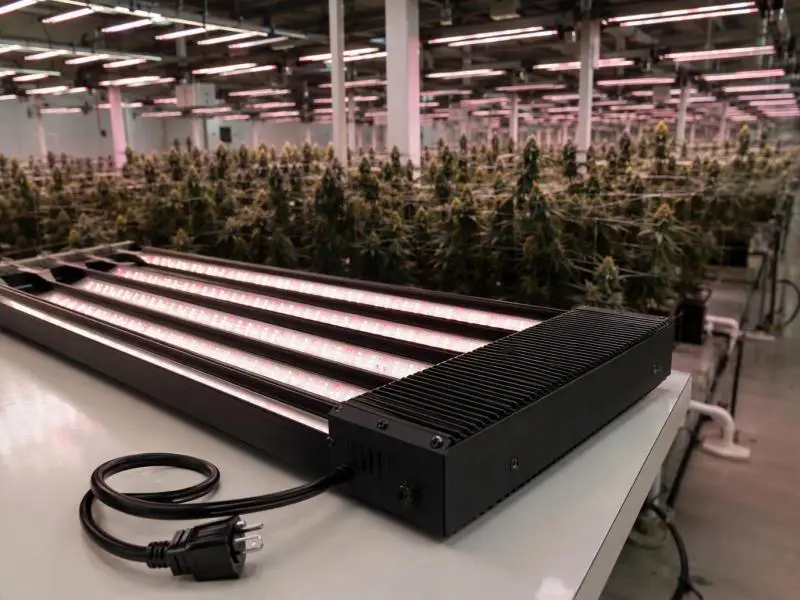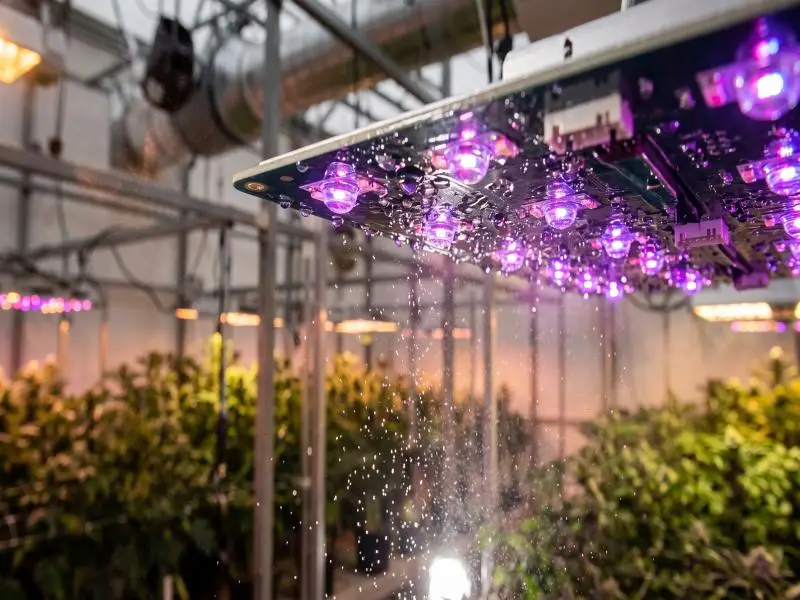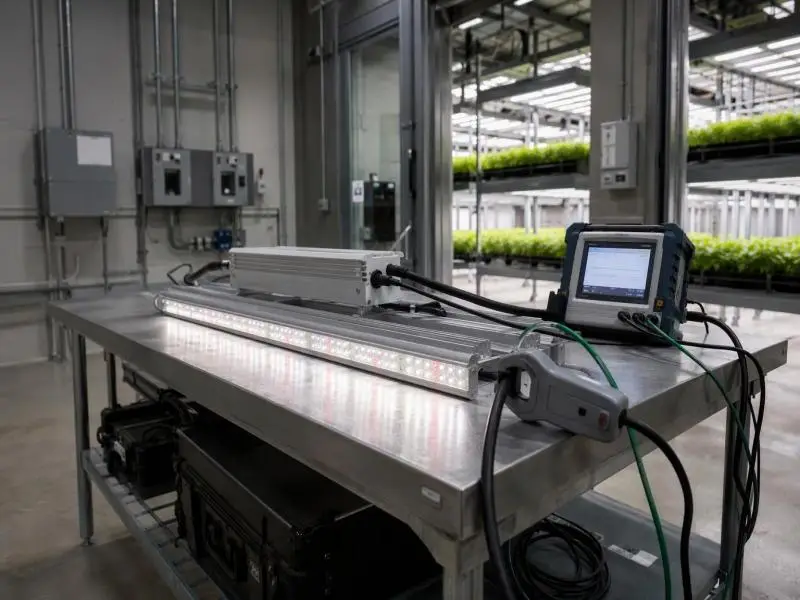
Scaling a commercial indoor farm or greenhouse facility requires precise capital allocation. When retrofitting a legacy high-pressure sodium (HPS) facility or constructing a 10,000+ square foot controlled environment agriculture (CEA) canopy, lighting hardware represents one of the largest single capital expenditures.
However, many operations directors and facility procurement managers model their lighting budgets using factory-gate or Free on Board (FOB) pricing, only to face severe budget overruns at the port of entry.
International trade barriers, customs reclassifications, and shifting geopolitical duties have made LED grow light tariffs a major driver of total landed cost. Importing horticultural luminaires into North America or Europe involves navigating stacked trade remedies, complex Harmonized Tariff Schedule (HTS) codes, and strict electrical safety certifications.
This guide provides a comprehensive operational breakdown of customs classifications, duty stacking mechanics, and supply-chain risk mitigation strategies for commercial cultivation operators in the United States and the European Union.
Table of Contents
Decoding Customs Classifications: HTS and TARIC Codes for LED Grow Lights
Every piece of equipment passing through international customs is categorized under a standardized Harmonized System (HS) code. In the United States, the US International Trade Commission maintains the Harmonized Tariff Schedule (HTS), while the European Union relies on the TARIC (Integrated Tariff of the European Communities) database.
A common pitfall for commercial growers is assuming that “grow light” exists as a single, uniform customs category. Customs authorities classify products based on physical engineering, primary function, and assembly state—not marketing nomenclature.
The 9405 Family vs. 8539 Family
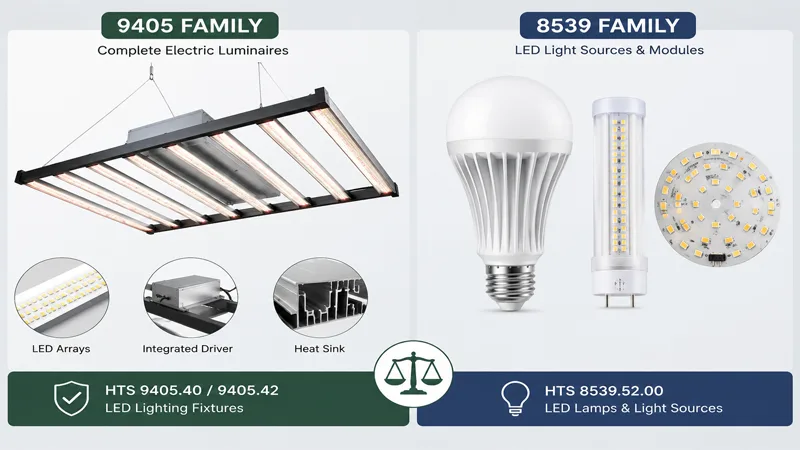
Horticultural lighting products generally fall under one of two primary tariff chapters:
- Complete electric luminaires (heading 9405):
- HTS / TARIC 9405.40 / 9405.42: Covers electric lamps and lighting fittings, including complete LED luminaires, bar lights, and multi-bar foldable fixtures designed for commercial cultivation.
- Subheading 9405.42.84 / 9405.40.80: Standard US and EU classifications for solid-state (LED) lighting fixtures. These subheadings apply to fully assembled fixtures containing integrated drivers, heat sinks, and LED arrays.
- LED light sources & modules (heading 8539):
- HTS / TARIC 8539.52.00: Covers LED lamps, retrofit tubes, and self-ballasted LED light sources designed to replace traditional bulbs in existing sockets.
⚠️ Warning: Attempting to clear complete commercial bar fixtures under light bulb subheadings (such as 8539.52) because of lower base tariffs is classified as misdeclaration by border enforcement agencies.
Why Misclassification Triggers Retroactive Customs Penalties
Customs authorities, such as US Customs and Border Protection (CBP), routinely audit commercial shipments. CBP holds sole legal authority to interpret HTS subheadings under the US Harmonized Tariff Schedule guidelines.
If an importer or freight forwarder misclassifies a shipment—whether accidentally or intentionally—customs agencies can issue redelivery notices, impound cargo at the port, assess administrative fines, and demand retroactive duty payments with interest going back up to five years.
The United States Import Tariff Landscape
For commercial growers importing horticultural lighting into the United States, calculating customs duty involves stacking multiple regulatory layers.
Total US Duty = Base MFN Duty + Section 301 China Tariff + Processing Fees (MPF + HMF)
Base MFN Duties vs. Section 301 China Surcharges
The base duty rate for most goods imported into the US is determined by the Most-Favored-Nation (MFN) rate. For complete LED lighting fixtures under HTS 9405.42.84, the base MFN duty typically ranges between 3.9% and 6.0%.
However, for products originating from China, Section 301 trade actions add a massive secondary layer of duties. According to the USTR Section 301 Tariff Lookup Tool, China-origin goods falling under Heading 9405 are hit with additional trade remedies.
As outlined in official customs notices, entries under Section 301 subdivisions (such as HTS 9903.91.04 and 9903.91.05) incur additional tariffs of 25% to 50%.
| Tariff Layer | HTS Subdivision / Code | Applicable Duty Rate |
|---|---|---|
| Base MFN duty | 9405.42.84 / 9405.40.80 | 3.9% – 6.0% |
| Section 301 China tariff | 9903.91.04 / 9903.91.05 | 25.0% – 50.0% |
| Merchandise Processing Fee (MPF) | Formal Customs Entry | 0.3464% (Min $31.67, Max $614.35) |
| Harbor Maintenance Fee (HMF) | Ocean Freight Only | 0.125% of FOB Value |
| Effective total duty load | Stacked Combined Rate | 29.37% – 56.47% |
Stacking Mechanics in Practice
If a commercial operator purchases $100,000 worth of LED grow lights direct from a factory in Shenzhen on FOB terms, the landed duty burden in a US port is calculated as follows:
- Base MFN duty (3.9%): $3,900
- Section 301 surcharge (25.0%): $25,000
- Customs processing fees (~0.47%): $470
- Total customs burden: $29,370
This represents a 29.37% surcharge over the initial equipment invoice, dramatically altering payback calculations and internal rate of return (IRR) models.
European Union Customs Duties and Import VAT Framework
Navigating import regulations in the European Union presents a different structure. While the EU does not impose a blanket country-wide tariff surcharge equivalent to US Section 301, European importers face strict customs valuation and national Value-Added Tax (VAT) stacking rules.
EU TARIC Base Duty Rates for Horticultural Luminaires
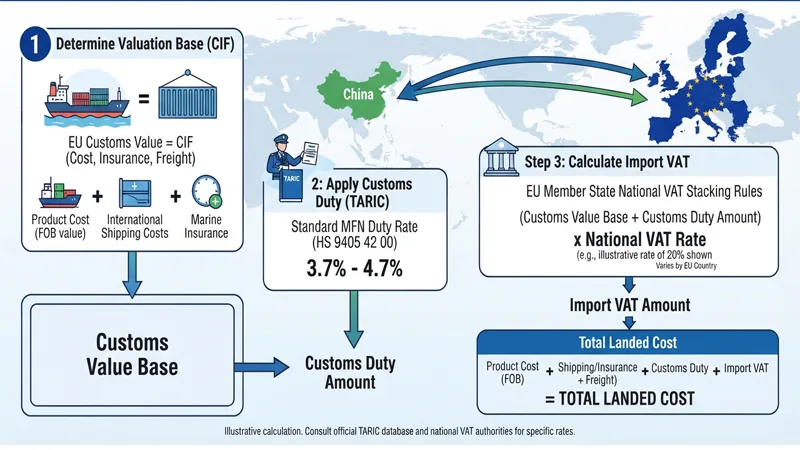
According to the official European Commission EU Customs Tariff (TARIC) database, commercial LED luminaires entering EU member states under code 9405 42 00 carry a standard MFN customs duty rate between 3.7% and 4.7%.
Unlike the US, where duties apply only to the FOB product value, EU customs valuation is calculated on the CIF (Cost, Insurance, and Freight) value. This means shipping costs and marine insurance are included in the taxable base before applying customs duties.
Member-State VAT Stacking and Environmental Compliance
Once customs duty is calculated, national import VAT is applied to the combined total (CIF Value + Customs Duty):
Taxable VAT Base = CIF Value + Customs Duty
Import VAT rates vary across European agricultural hubs:
- Germany: 19%
- Netherlands: 21%
- France: 20%
- Spain: 21%
While commercial entities registered for VAT can reclaim import VAT as input tax, payment must be made upfront at customs clearance. For a large farm expansion, holding capital in VAT refund queues for 60 to 90 days creates real cash flow friction.
Furthermore, products imported into the EU must maintain verified compliance documentation, including CE certification, RoHS (Restriction of Hazardous Substances), and WEEE (Waste Electrical and Electronic Equipment) producer registration.
Comparative Landed Cost Analysis: China Direct CIF vs. Duty-Cleared Local Sourcing
To understand how LED grow light tariffs affect real-world facility budgeting, let us compare three distinct procurement paths for a 500-fixture commercial installation requiring 720W LED units.
Scenario Parameters
- Order volume: 500 units of 720W Commercial LED Fixtures
- Factory FOB price: $280 per unit ($140,000 total)
- Ocean freight & insurance: $8,000 total ($16 per unit)
- Target destination: United States Facility
| Expense Line Item | Direct Import (FOB China) | Direct Import (CIF US Port) | Local Warehoused Stock (SLTMAKS DDP/Local) |
|---|---|---|---|
| Equipment unit price | $280.00 | $280.00 | $380.00 (Duty-Cleared) |
| Freight & insurance | $16.00 | Included | Included / Local Delivery |
| Base customs duty (3.9%) | $10.92 | $11.54 | Included in Unit Price |
| Section 301 tariff (25%) | $70.00 | $74.00 | Included in Unit Price |
| Customs fees & brokerage | $2.50 | $3.50 | $0.00 |
| Port storage/demurrage risk | High ($500–$2,000/day risk) | High ($500–$2,000/day risk) | Zero |
| Total landed unit cost | $379.42 | $369.04 | $380.00 |
| Customs risk & lead time | 45–60 Days + Clearance Risk | 45–60 Days + Clearance Risk | 3–5 Days (In-Stock Buffer) |
Strategic Insight
While direct factory importing appears cheaper on initial quotes, unexpected customs holds, port demurrage fees, and tariff fluctuations frequently bridge the price gap.
Purchasing through established suppliers with local warehousing buffers locks in landed costs, shifts customs compliance risk away from the grower, and eliminates months of shipping lead time.
Strategic Risk Mitigation: How Commercial Growers Eliminate Tariff Volatility
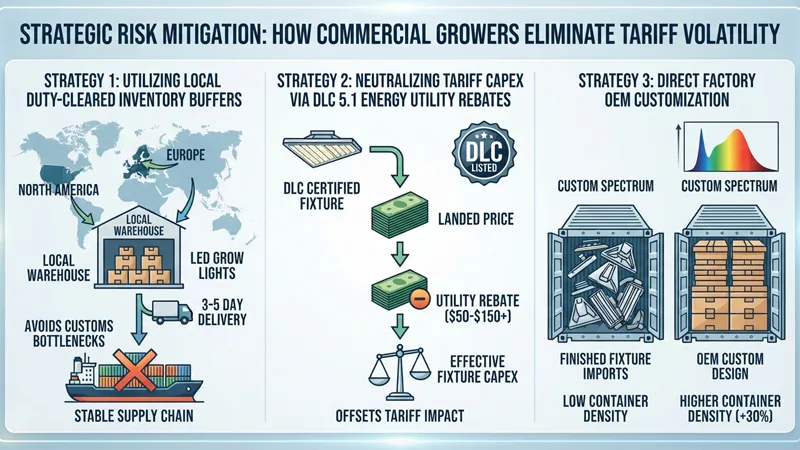
Given the complexity and financial risk associated with LED grow light tariffs, leading commercial operators adopt specific operational strategies to protect their project timelines and capital efficiency.
1. Utilizing Local Duty-Cleared Inventory Buffers
Working with manufacturers that maintain pre-cleared, local inventory buffers in North America and Europe transforms unpredictable procurement into a stable supply chain.
For example, commercial lighting manufacturer SLTMAKS maintains local warehouses stocked with high-output commercial indoor LED grow lights across New York, California, Oklahoma, Canada, and Germany.
By sourcing from local warehouse stock, farm operators obtain duty-cleared hardware with immediate 3-to-5-day transit times. This approach eliminates customs clearance bottlenecks, ocean freight volatility, and surprise tariff audits.
Pro tip: When planning multi-phase facility buildouts, order core fixtures (such as STG-720W commercial LED fixtures) from local warehouse inventory for Phase 1 to guarantee construction deadlines, while coordinating factory-direct container shipments for long-lead Phase 2 expansions.
2. Neutralizing Tariff Capex via DLC 5.1 Energy Utility Rebates
In North America, one of the most effective ways to offset import tariffs is by maximizing energy efficiency incentives. Commercial electric utilities offer substantial capital rebates for facilities deploying verified, high-efficacy horticultural lighting.
Deploying DLC-certified LED grow lights qualified under the DesignLights Consortium (DLC) Horticultural QPL v5.1 standard allows commercial cultivators to claim prescription or custom rebates.
Effective Fixture Capex = Landed Fixture Price – Local Utility Rebate
In many jurisdictions, utility rebates range from $50 to $150+ per fixture (or $0.25 to $0.75 per watt reduced). A $100 per fixture rebate completely neutralizes the financial impact of a 25% Section 301 import tariff.
3. Direct Factory OEM Customization vs. Finished Fixture Imports
For large-scale commercial facilities (over 50,000 sq ft), off-the-shelf fixtures may not deliver the exact spectral ratios or mounting form factors required for specific canopy architectures.
Engaging directly in custom LED spectrum development with experienced horticultural lighting manufacturers enables operators to optimize physical driver configurations, spectrum channels, and packaging efficiency.
Optimizing fixture design for compact flat-pack shipping increases container load density by up to 30%, lowering per-unit freight costs and softening the overall tariff burden.
Sourcing Checklist: 5 Compliance Verification Steps Before Placing Your Order
Before committing capital to an overseas lighting purchase order or signing an equipment contract, run through this five-point compliance checklist:
- Verify the exact 8-digit HTS / TARIC classification:
- Ensure the purchase order and commercial invoice explicitly state the correct subheading (
9405.42.84or9405.40.80for complete LED fixtures). - Reject quotes that attempt to misclassify commercial bar lights as low-duty parts or consumer light bulbs.
- Ensure the purchase order and commercial invoice explicitly state the correct subheading (
- Confirm delivered terms (DDP vs. FOB/CIF):
- Clarify whether the manufacturer quote is FOB (leaving you responsible for import clearance, Section 301 duties, MPF/HMF fees, and customs brokerage) or DDP (Delivered Duty Paid, where the seller handles all tariffs).
- Audit safety and electrical certifications:
- Confirm safety testing to North American standards (ETL, cETLus, UL 8800) and European standards (CE, RoHS, WEEE). Uncertified fixtures risk being turned back by customs inspectors or failing municipal electrical building inspections.
- Validate DLC QPL listing status:
- Verify that the specific model number appears on the active DLC Horticultural Qualified Products List (QPL) to ensure eligibility for local utility rebate programs.
- Evaluate supply-chain redundancy:
- Confirm whether the vendor maintains regional warehouse inventory in North America or Europe to provide replacement units, spare drivers, or emergency expansion fixtures without international shipping delays.
FAQ
What is the HTS code for importing LED grow lights into the US?
Complete commercial LED grow light fixtures are primarily classified under HTS subheading 9405.42.84 (or 9405.40.80 for solid-state lighting). Retrofit LED lamps or single bulbs fall under Heading 8539.52.00. Misclassifying complete bar fixtures under Heading 8539 to lower tariffs can trigger severe customs penalties and back-duty assessments.
How much import tariff is charged on LED grow lights from China to the USA?
The landed duty burden on Chinese LED grow lights typically ranges from 29.37% to 56.47%. This combined rate includes a base Most-Favored-Nation (MFN) duty of 3.9%–6.0%, stacked Section 301 trade surcharges of 25%–50% (under HTS subheadings 9903.91.04/05), plus standard Merchandise Processing Fees (MPF) and Harbor Maintenance Fees (HMF).
How are EU customs duties and import VAT calculated for LED grow lights?
In the EU, commercial LED luminaires under TARIC code 9405 42 00 carry a base duty of 3.7%–4.7%, calculated on the CIF (Cost, Insurance, and Freight) value. Import VAT (19%–21% depending on the member state, such as Germany or the Netherlands) is then stacked on top of the total CIF value plus customs duty.
What is the difference between FOB and DDP terms when sourcing grow lights?
Under FOB (Free on Board) terms, the buyer is responsible for ocean freight, marine insurance, customs brokerage, Section 301 tariffs, and clearance risk. Under DDP (Delivered Duty Paid) or local warehoused sourcing, the manufacturer covers all customs duties, tariffs, and shipping, delivering duty-cleared hardware with transparent landed costs.
How can DLC 5.1 utility rebates help offset import tariffs?
Commercial electric utilities in North America offer cash rebates ranging from $50 to $150+ per fixture for equipment listed on the DesignLights Consortium (DLC) Horticultural QPL v5.1. These energy-efficiency rebates lower total effective capital expenditure, effectively neutralizing the cost impact of a 25% Section 301 import tariff.
Which safety and electrical certifications are required for importing grow lights?
US imports require North American safety testing to UL/ANSI standards (such as cETLus, ETL, or UL 8800). European imports require verified CE certification, RoHS compliance (Restriction of Hazardous Substances), and WEEE registration. Uncertified fixtures risk port rejection or failing local electrical building inspections.
Why should commercial farms source LED grow lights from local warehouse inventory?
Sourcing from local pre-cleared warehouse stock eliminates shipping lead times (reducing 45–60 day ocean transit to 3–5 days local delivery), locks in duty-cleared unit pricing, removes customs clearance bottlenecks, and transfers international supply chain risk away from the grower.
Conclusion & Strategic Action Plan
Navigating LED grow light tariffs requires moving beyond simple factory quotes to analyze true landed costs, regulatory compliance, and supply-chain risk. As international trade policies continue to evolve, commercial indoor cultivation operators must build trade flexibility into their capital plans.
By pairing exact HTS classification compliance with strategic sourcing models—such as leveraging duty-cleared local warehouse inventory from established manufacturers like SLTMAKS and capturing DLC utility rebates—commercial growers can protect their facility timelines, control capital expenditure, and ensure predictable ROI for every harvest.
To explore duty-cleared commercial fixture options or calculate landed costs for your facility layout, consult with the technical sourcing team at SLTMAKS Commercial Lighting Solutions.