Introduction
Daily Light Integral (DLI) is the total amount of photosynthetically active photons your crop receives in a single day, expressed in mol/m²/day. When determining the optimal DLI autoflower cannabis requires, this metric becomes the most useful number for connecting lighting to yield, quality, and uniformity—more useful than a raw PPFD reading because it combines intensity with duration.
The conversion is straightforward: DLI = PPFD × hours × 0.0036. That means you can reach the same DLI with high PPFD over a short photoperiod, or lower PPFD spread across more light hours. Because autoflowers hold a constant long-day photoperiod from seed to harvest, changing that photoperiod shifts the PPFD you need to hit a given DLI.
This guide sets out stage-specific DLI targets, a direct photoperiod comparison, the environment prerequisites that make higher DLI actually usable, and the deployment SOPs — mapping, dimming, and compliance — that deliver consistent DLI across a multi-room or multi-site operation.
DLI Autoflower Cannabis: Core Fundamentals and Growth Outcomes
Why DLI Drives Outcomes
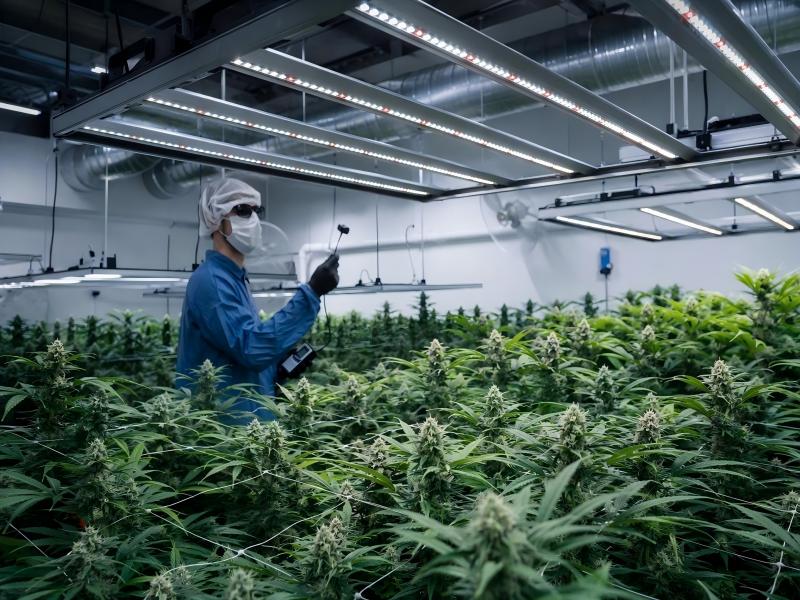
Autoflowers transition from vegetative to flowering on an internal clock, not on a photoperiod switch. They stay under a long light cycle their entire life, which means they can accumulate a continuous daily light dose that photoperiod strains cannot. This is why the autoflowering cannabis lighting guide at Photone lets growers hold DLI levels through bloom that would be inappropriate for a 12/12 crop.
Yield and quality track DLI closely until the crop hits its saturation point. Too little DLI and you leave biomass on the table; too much — delivered faster than the plant can process, or without matching environment — and you trigger photoinhibition, bleaching, and foxtailing. Uniformity matters just as much: a room where the center hits 45 DLI, and the edges hit 20 grows a harvest of mixed quality, so “best DLI” is only meaningful if the whole canopy actually receives it.
Converting PPFD to DLI in Practice
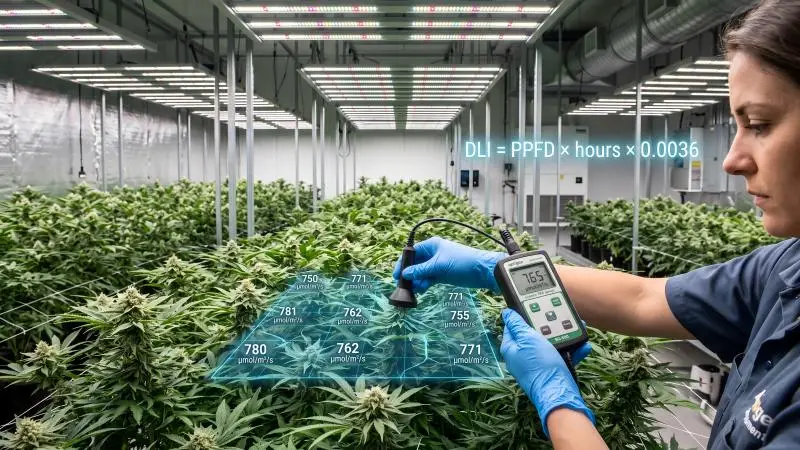
The formula DLI = PPFD × hours × 0.0036 lets you translate a target daily dose into the PPFD you need at the canopy. To reverse it, divide your target DLI by (hours × 0.0036) to find required PPFD. Always measure at the actual canopy plane with a calibrated quantum PAR sensor, then apply the formula to your own grid data rather than trusting a single center reading.
Interplay of Photoperiod and PPFD
Because DLI = PPFD × time, photoperiod and intensity are interchangeable within limits. Choose your photoperiod first as a business decision — it determines energy, heat, and labor rhythm — then solve for PPFD. The Cannabis DLI guide from Thrive Agritech lays out stage-by-stage DLI and the corresponding PPFD at common photoperiods, which is the reference pattern to replicate for your own rooms.
Stage Targets and PPFD Bands
Seedling/Early Veg: DLI 10–15
Seedlings and early veg plants cannot use high light; their root systems and chloroplast density are still developing. Target DLI 10–15, which typically lands at roughly 150–300 µmol/m²/s depending on photoperiod. Failure mode: pushing 40+ DLI here causes leaf curling, bleaching, and stunting that hurt the rest of the run. Ramp intensity gradually as the canopy fills in.
Vegetative: DLI 15–25 (up to 35)
As plants build leaf area, raise DLI to 15–25, and up to 35 on vigorous, well-rooted plants under controlled conditions. This is where photoperiod choice starts to matter for energy. In practice many operators run roughly 350–600 µmol/m²/s across veg, depending on their schedule. The failure mode here is ramping too fast at the flip and stressing the plant just as it should be building structure.
Flower: DLI 30–45 (up to 50)
Flower is where autoflowers pay off the continuous-light advantage. Target DLI 30–45, pushing toward 50 in enriched rooms with matched CO₂, VPD, and temperature. At these doses the crop is light-saturated and, without CO₂ enrichment, will waste photons. The failure mode is assuming a high PPFD reading is equal to a usable DLI — if CO₂ is at ambient levels, much of that light is not being converted.
Photoperiod Comparison: 18/6 vs 20/4 vs 24/0
Calculated PPFD to Hit DLI 15/25/40/50
The infographic below shows the PPFD needed to reach four DLI targets under three photoperiods:
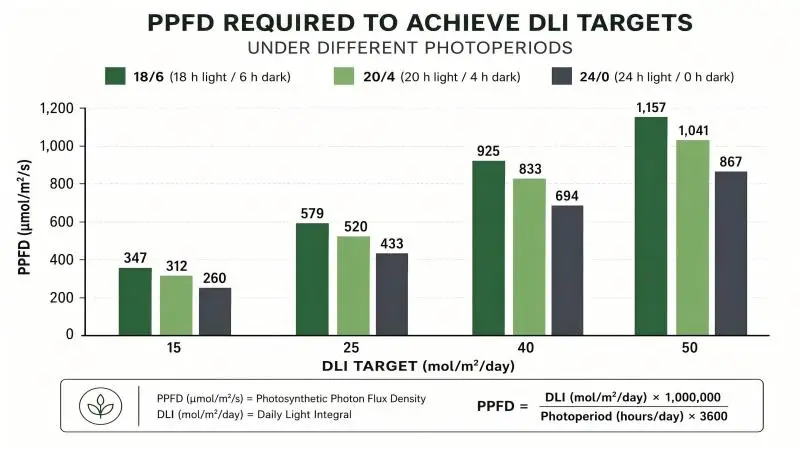
| DLI target (mol/m²/day) | 18/6 PPFD | 20/4 PPFD | 24/0 PPFD |
|---|---|---|---|
| 15 | 231 | 208 | 174 |
| 25 | 386 | 347 | 289 |
| 40 | 617 | 556 | 463 |
| 50 | 772 | 694 | 579 |
The pattern is clear: the longer the photoperiod, the lower the PPFD needed to hit any given DLI. That is the central planning trade-off.
Biological and Operational Trade-offs
18/6 gives plants a daily dark window for respiration and recovery, runs cooler, and uses roughly 25% less electricity than 24/0. It is the easiest schedule to keep stable and the most forgiving across rooms. The trade-off is a slightly lower ceiling for the same PPFD.
20/4 is the common performance compromise — a 4-hour dark window still grounds recovery while extending light hours. It carries a small yield argument but uses about 11% more power than 18/6 and adds heat.
24/0 maximizes light hours and simplifies scheduling to a single state, but removes any dark period, raises energy and HVAC load to its peak, and offers yield gains that are usually modest relative to the added cost and stress risk.
Controls, Uniformity, and Energy/HVAC Impacts
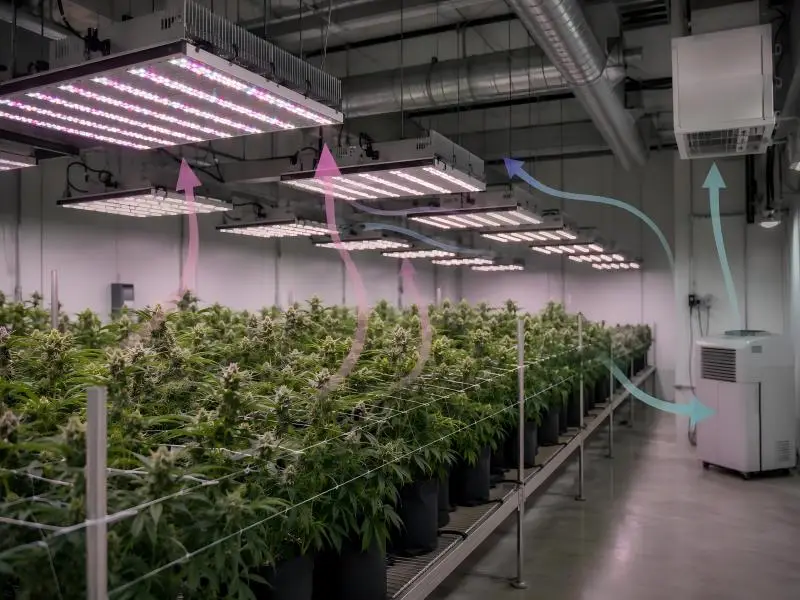
Your choice ripples into controls, HVAC, and energy budgets. Longer photoperiods add heat hours, so the dehumidification and cooling model must be sized to reject that load — a decision documented well in SLTMAKS’ commercial grow light layout guide, which ties PUE, HVAC, and layout together. Dimming and scheduling come into play because a fixed-photoperiod room still needs to step DLI up through veg and flower, which means the control system must reproduce the dimming recipe reliably crop after crop.
Key Takeaway: Pick photoperiod first as an energy and HVAC decision, then solve for PPFD. Most commercial autoflower rooms land on 18/6 or 20/4 because they balance DLI, heat load, and power cost.
Environment Prerequisites for Higher Usable DLI
CO₂ Enrichment Targets and Safety
Above roughly 800–900 µmol/m²/s, cannabis increasingly becomes CO₂-limited. Enriching to 800–1,200 ppm shifts the light saturation point upward and directly raises the DLI the crop can use before diminishing returns. SLTMAKS’ light matching in high CO₂ guide explains that at 1,200–1,500 ppm CO₂, cannabis can actively use much higher PPFD than at ambient levels — but only with matched VPD, fertigation, and temperature. Treat CO₂ levels above ~5,000 ppm as a safety hazard; install monitoring, ventilation interlocks, and service procedures before enriching.
VPD, Canopy Temperature, and Airflow
To convert added photons into biomass, stomata must stay open — which is governed by VPD and canopy temperature. Target roughly 0.8–1.1 kPa in veg and 1.0–1.5 kPa across flower, with enriched high-light rooms running warmer canopy temperatures around 26–30 °C. Airflow across the canopy is non-negotiable: a stagnant canopy runs hotter and locally CO₂-depleted even when the room reading looks fine. Fluence’s cannabis cultivation insights note a practical rule of maintaining roughly 800 ppm CO₂, or 1 ppm per µmol/m²/s of PPFD, whichever is higher — a strong starting point for sizing enrichment.
Spectral Quality and Uniform PPFD Mapping
High DLI is only worth money-in if the photons land where the plant can use them. Spectrum engineering and optical design determine how evenly a fixture distributes light and how deeply it penetrates. Multi-bar LED designs distribute diodes across a wide footprint, which improves edge-to-edge uniformity and lets light bypass upper fan leaves to reach lower sites — the same reason SLTMAKS engineers its fixtures around diode spacing and spectral recipes that are certified to ETL, CE, and RoHS. Uniform PPFD mapping is what turns a promising fixture into a repeatable crop outcome.
Designing for Uniform DLI Across Canopies
Fixture Layout, Mounting Height, and Dimming Strategy
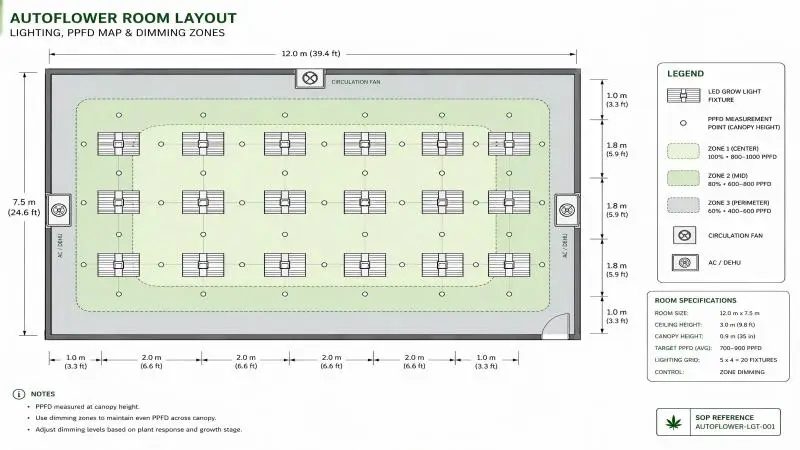
Uniform DLI begins at the drawing board. Model the room with photometric data (IES/LDT) and PPFD maps before installation, set fixture spacing and mounting height to flatten the distribution, and use dimming zones to trim hot spots and lift under-lit edges. Mounting height governs both intensity and beam overlap — too low creates hot spots, too high wastes photons into aisles and walls.
PPFD Mapping, ePPFD, and Variance Control
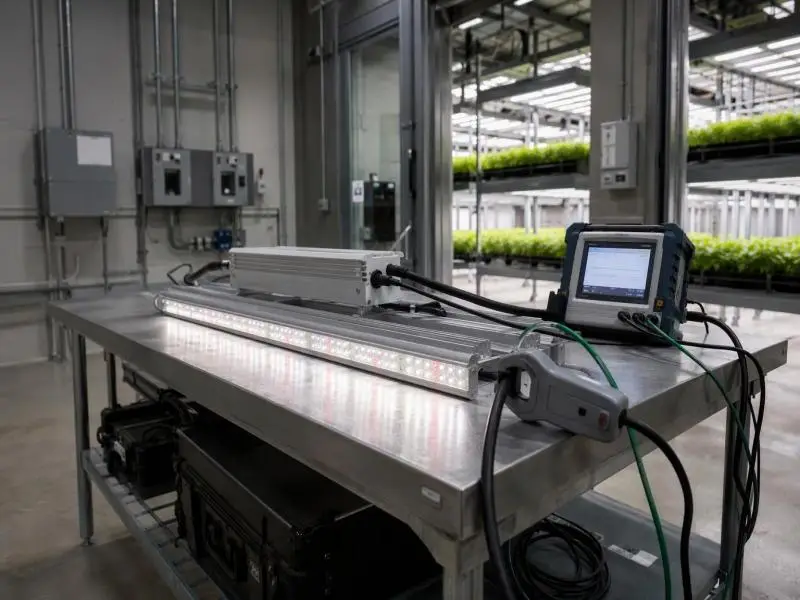
Map the canopy on a repeatable grid at the actual crop plane, then compute uniformity metrics. The PPFD uniformity workflow on vertical farm racks from SLTMAKS is a good reference for the commissioning version of this: lock dim level and height, stabilize the fixtures, measure the grid, and record min/avg and CV. The lighting uniformity guidance from the All Things Lighting Association puts a 10–20% intensity variation as generally acceptable, with tighter targets for plant factories. In practice, aim for a uniformity ratio (min/avg) of 0.75–0.85 or higher and a coefficient of variation at or below 10–20%. Where spectrum extends beyond 400–700 nm, account for ePPFD so that far-red contributions are reflected in your mapping.
Thermal Management and Microclimate Stability
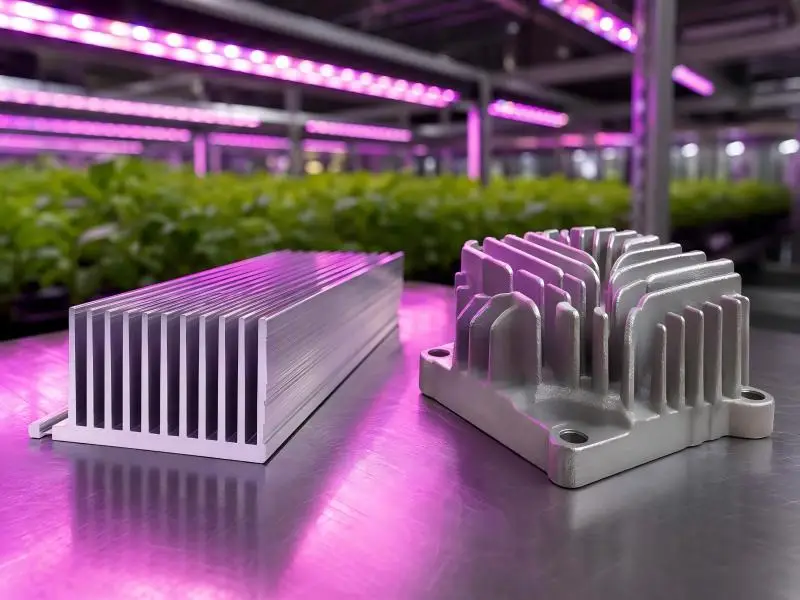
High-DLI rooms reject a lot of heat at the canopy, and how that heat moves determines microclimate stability. Passive aluminum heat sinks on fixtures reduce the convective and radiative load dumped into the crop canopies, which keeps leaf-to-air temperature differentials smaller and protects VPD. The failure mode is a room that can deliver the PPFD but not hold the temperature and humidity the crop needs at that intensity — in which case the DLI you designed for is not actually usable.
Pro Tip: Verify uniformity at the canopy plane, not at empty-shelf height. A center-only reading is a vanity metric; the edges decide whether your harvest is uniform.
Deployment SOPs and Compliance Checklist
Step-by-Step Room Commissioning
- Lock the target DLI for the current stage and the chosen photoperiod.
- Set fixture dim level and mounting height to your modeled recipe.
- Stabilize output, then grid-map PPFD at the canopy plane.
- Compute min/avg and CV; adjust spacing, height, or dimming zones and re-map.
- Record the final map and settings as the baseline for the room.
The layout diagram below shows the standard pattern for fixture grids, measurement points, and dimming zones:
Electrical, Controls, and Certification Readiness
Before energizing, confirm the electrical load, branch circuit sizing, and control wiring match the dimming topology. For inspection readiness, verify fixtures carry the relevant safety certifications for your jurisdiction — ETL in North America, CE and RoHS in many export markets, and DLC QPL listing where utility rebates apply. Keep certification documentation, photometric reports, and wiring diagrams on file for the authority having jurisdiction (AHJ) and for multi-site procurement standardization.
HVAC/Dehumidification Modeling and CO₂ Procedures
Size HVAC and dehumidification to reject the peak heat and moisture load at your maximum photoperiod and DLI — not the average. Model the CO₂ setpoint, monitor with calibrated sensors, and document the enrichment schedule and safety interlocks. Establish a clear procedure for introducing, maintaining, and ventilating CO₂ so enrichment never runs without the guardrails that make higher DLI safe and economic.
⚠️ Warning: Higher DLI is only as good as the environment behind it. Enriching CO₂ or raising PPFD without matched VPD, airflow, temperature, and fertigation delivers light stress and wasted energy, not yield.
Conclusion
For commercial autoflower rooms, the practical DLI framework is: 10–15 for seedlings, 15–25 (up to 35) in veg, and 30–45 (up to 50) in flower, delivered through a photoperiod you choose as a deliberate energy and HVAC decision. Because DLI = PPFD × hours × 0.0036, a longer schedule like 20/4 or 24/0 lets you hit the same dose with lower intensity — but only at the cost of more heat and power.
The DLI you can actually use is capped by your environment: CO₂ enrichment in the 800–1,200 ppm range, controlled VPD and canopy temperature, and airflow that keeps stomata working. It is realized through uniform PPFD mapping, dimming zones, and thermal management that flatten the canopy — and it is protected by passing the compliance checklist before you flip the lights.
Predictable outcomes come from treating DLI as a managed daily dose across the whole canopy, not a peak PPFD stat. Start with your photoperiod, solve for PPFD, verify it with a map, and match the environment — and your autoflower rooms will deliver the uniformity and quality you designed for. To evaluate fixtures against this DLI plan, ask vendors for photometric maps (IES/LDT) at your real mounting height, review the spectrum and light-level engineering guidance on custom LED grow light design, and verify certification and uniformity data before you buy.
FAQ
What is the best DLI for autoflower cannabis?
There is no single number because the right daily dose rises as the plant matures. Use 10–15 mol/m²/day for seedlings, 15–25 (up to 35) through veg, and 30–45 (up to 50) in flower for enriched rooms. Because autos flower on an internal clock rather than a photoperiod switch, you can hold a high DLI from late veg through harvest without a flowering dip.
Can autoflowers run under 24/0 light with no dark period?
Yes. Autoflowers switch to bloom based on age, not darkness, so a 24/0 schedule works from seed to harvest. The trade-off is real, though: removing the dark window raises heat, energy, and HVAC load, and the yield gain over 18/6 or 20/4 is usually modest. Most commercial autoflower rooms pick 18/6 or 20/4 to balance DLI, power cost, and stress risk.
What PPFD do autoflowers need in the flowering stage?
On a typical 18/6 or 20/4 schedule, flowering autos respond well to roughly 600–900 µmol/m²/s at the canopy. The exact number depends on your photoperiod: at 20/4, hitting a 40 DLI target needs about 556 µmol/m²/s, while 24/0 needs only 463. Start near 600 and raise intensity gradually only if the plants show no light stress.
Does my autoflower need CO₂ to run a high DLI?
Not for the standard range. At ambient CO₂, you can safely run most autos up to roughly 40–45 DLI. To push toward 50 or beyond, enriching to 800–1,200 ppm shifts the light saturation point upward — but only if VPD, canopy temperature, and airflow are matched. Without that supporting environment, extra photons turn into light stress and wasted energy rather than yield.
How do I convert PPFD to DLI?
Use the formula DLI = PPFD × hours × 0.0036. To reverse it and find the needed intensity, divide your target DLI by (hours × 0.0036). Measure at the actual canopy plane with a calibrated quantum PAR sensor, and average a grid of readings rather than trusting a single center point.