Introduction
Saffron is the world’s most expensive spice by weight, and one of the few high-value crops where the return on a vertical-farm rack can genuinely justify the kilowatt-hours. Meeting saffron vertical farming LED lighting requirements profitably only works if you treat light as a stage-by-stage engineering discipline rather than a “more light is better” assumption. In a stacked, multi-tier environment, photon dose determines both how many flowers you get and how much crocin ends up in the stigma — the two variables that define a saffron harvest.
The challenge is that saffron is a short-day crop with a physiology unlike leafy greens. Its three distinct phases — corm induction and dormancy, flowering forcing, and vegetative shoot growth with daughter-corm filling — each respond to a different combination of photosynthetic photon flux density (PPFD), daily light integral (DLI), photoperiod, and spectrum. Get the recipe wrong, and you spend the energy without spending it where the crop actually responds.
This guide walks you through the lighting requirements for commercial saffron in vertical farms: the biology that drives each stage, concrete photon recipes you can budget and schedule, the spectrum tradeoffs between starch quality and yield, fixture and layout decisions for uniform multi-tier racks, how lighting couples with HVAC and compliance, and a return-on-investment model you can run on your own power rate. For a grounding in the fundamentals of vertical farm lighting, including the DLI formula we use throughout, see that primer before you commit to a layout.
Table of Contents
Biology and Stages
You can’t write a lighting recipe for saffron without first mapping the crop’s life cycle, because each phase places a different demand on the light system. Saffron is a spring-planted geophyte that is harvested for its stigmas, then carried forward for its daughter corms. The photoperiod, intensity, and spectrum you deliver must follow that biology instead of a single “vegetative” template.
Induction and Dormancy
Flower buds form inside the corm during a dormant or storage phase, largely in response to temperature and darkness rather than high light. Growers typically hold corms at around 25 °C and 85% relative humidity in darkness for 90–120 days to complete flower initiation, a protocol consistent with peer-reviewed practice. During this period, lighting is effectively off, and the main risk is a failure to program the dark window correctly — if ambient light leaks in, you can suppress the very buds you need to force.
Photoperiod regulators matter here through the phytochrome and cryptochrome pathways, but the light duty is minimal. Treat induction as a darkness-first stage and reserve your PPFD budget for the phases that follow.
Flowering Forcing
Forcing is where lighting earns its keep. After bud initiation, growers lower temperature to around 15 °C with an 8-hour light / 16-hour dark cycle to drive flower emergence. Saffron is a short-day plant, so keeping the light window short — roughly 8 to 12 hours — signals the plant to commit to flowering rather than vegetative growth.
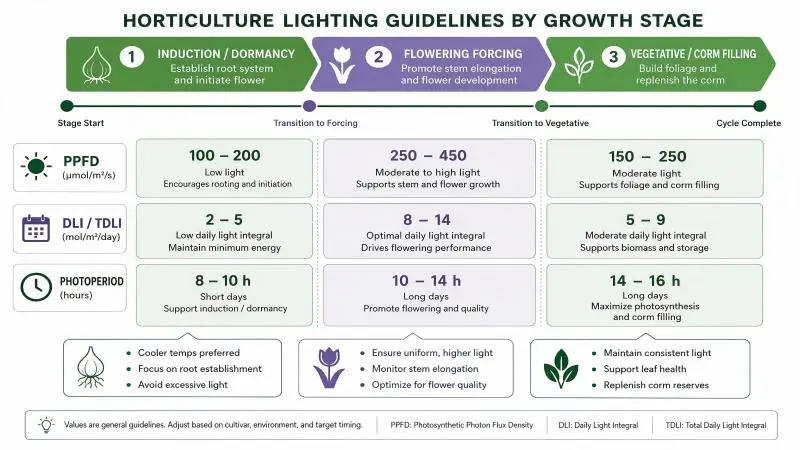
This stage typically runs at a conservative PPFD of about 150–200 µmol/m²/s, with a resulting DLI of roughly 4.3 to 8.6 mol/m²/day. The goal is not maximum photosynthesis but predictable, synchronous bloom with well-developed stigmas, so constancy and timing matter more than intensity.
Vegetative and Corm Filling
After flowering, the plant grows leaves that photosynthesize to recharge the mother corm and produce daughter corms for the next cycle. This is a higher-workload phase: growers extend the photoperiod to roughly 12–14 hours and hold PPFD in the 150–250 µmol/m²/s range, lifting DLI to about 6.5 to 12.6 mol/m²/day.
Good light here compounds your next harvest, because larger, healthier daughter corms carry more flower initials the following season. Skimp on the vegetative window and you trade this year’s yield for next year’s too.
Stage-Wise Saffron Vertical Farming LED Lighting Recipes
A recurring mistake in saffron vertical farming is copying leafy-green setpoints from a general guide. Many vendor posts cite an aspirational DLI of 15+ mol/m²/day or PPFD north of 500 µmol/m²/s, but the peer-reviewed saffron literature clusters in a far more modest band. Reconciling those two worlds is the first job of a defensible recipe.
Photoperiod and PPFD Targets by Stage
The table below condenses the stage-wise targets that most consistently appear across published saffron studies and controlled-environment trials.
| Stage | PPFD (µmol/m²/s) | Photoperiod | DLI target (mol/m²/day) | Spectrum intent |
|---|---|---|---|---|
| Induction/dormancy | ~0 (dark storage) | 0 / 24 h dark | 0 | None (thermal + dark) |
| Flowering forcing | 150–200 | 8–12 h | 4.3–8.6 | Red + blue, red-leaning |
| Flower emergence/bloom | 150–250 | 8–11 h | 4.3–9.9 | Red + blue or white |
| Vegetative / corm filling | 150–250 | 12–14 h | 6.5–12.6 | Broad spectrum, some blue |
These are starting points, not gospel. Trials have reported favorable flowering at a total daily light integral as high as 150 mol/m² where blue and broad-band red were combined, but that is an experimental total dose, not a routine commercial setpoint. For most racks, engineering for the 4–13 mol/m²/day band — and proving it with a PPFD grid — will outperform a paper recipe aimed at an unattainable number.
DLI/TDLI Planning and Dose Control
Budget light as a total daily dose, not just an instantaneous reading. Daily light integral in mol/m²/day equals PPFD in µmol/m²/s times photoperiod in hours times 0.0036. When you plan across a full crop cycle, track the daily dose per stage — some growers express this as total daily light integral (TDLI) summed over the stage — so you can compare energy spend against flower and stigma output.
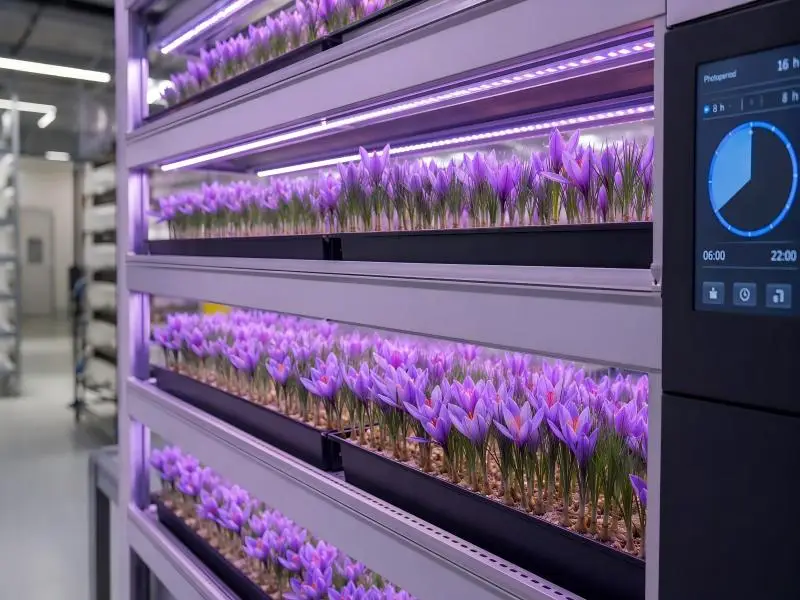
Dose control is what separates a recipe from a claim. Because each tier can hold plants at a different stage, independent dimming and scheduling per shelf let you apply forcing photoperiods on one level while another runs a longer vegetative day. This is the core advantage of per-tier controls in a mixed-staging rack.
Spectrum Mixes for Quality vs Yield
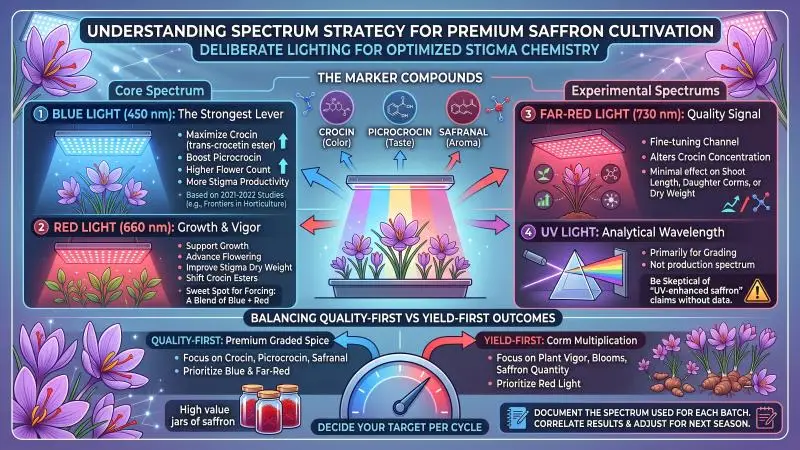
Spectrum is where you decide what matters more in a given harvest. Blue light has the clearest evidence for boosting crocin and picrocrocin content, and it generally improves flower number and stigma weight — a quality-first choice. Red light supports growth, flowering, and stigma dry weight while nudging the crocin profile toward different esters, and a red-dominant mix around a 3:1 red: blue ratio is common during forcing for vigor.
If your buyer contracts on color strength, lean toward a blue-enriched forcing spectrum. If you optimize for harvest weight and corm health across multiple cycles, a balanced red-plus-some-blue broad spectrum is the safer default. Design the fixture’s spectrum to be switchable or dimmable per stage rather than locking one mix for the whole crop.
Spectrum Strategy
Understanding what each wavelength does to the stigma’s chemistry lets you buy a spectrum deliberately instead of trusting a marketing label. The marker compounds that give saffron its commercial value are crocin (color), picrocrocin (taste), and safranal (aroma), and each responds differently to light.
Blue vs Red Impacts on Crocin and Safranal
Blue light is the strongest lever for crocin. A 2022 Frontiers in Horticulture study on monochromatic blue light reported that blue-enhanced plants accumulated more crocin — especially the trans-crocetin ester — and more picrocrocin than other treatments, by upregulating the biosynthetic pathway genes. Additional 2021 work on blue light showed blue light improved flower count and stigma productivity.
Red light is not to be written off. It supports growth, advances flowering, and improves stigma dry weight, while shifting the crocin profile toward specific esters. In practice, a blend that gives you blue’s quality boost without sacrificing red’s vigor is usually the sweet spot for forcing.
Role of Far-Red and UV (Experimental)
Far-red behaves more like a quality signal than a yield driver. Trials in closed chambers found far-red altered crocin concentration in the stigma without meaningfully changing shoot length, daughter-corm size, or dry stigma weight — so treat it as a fine-tuning channel, not a growth engine. UV, meanwhile, is primarily an analytical wavelength in saffron grading rather than an established production spectrum; if you see a vendor selling “UV-enhanced saffron,” press for data rather than accepting the claim.
Balancing Quality-First vs Yield-First Outcomes
The honest tradeoff is that you cannot always maximize both crocin and harvest weight with one recipe. Deciding which target rules for a given cycle — premium graded spice versus corm multiplication — should set your spectrum priority. Document the spectrum used per batch so you can correlate quality results back to the exact ratio and adjust next season.
Fixture and Layout Selection
Once the recipe is set, the fixture and the rack geometry determine whether the photons actually land where corms sit. In a multi-tier environment, uniformity is not a luxury; it is the difference between one even harvest and a rack of uneven flowering.
Uniformity Goals and Rack Geometry
Each tier should be treated as its own uniform light plane. Use multiple narrow bar fixtures rather than a single center source, spaced roughly 20–40 cm apart (30–45 cm for shorter 2 ft bars) so the beam patterns overlap edge to edge. On a standard 1.2 m shelf, two to four bars give even coverage depending on the target PPFD.
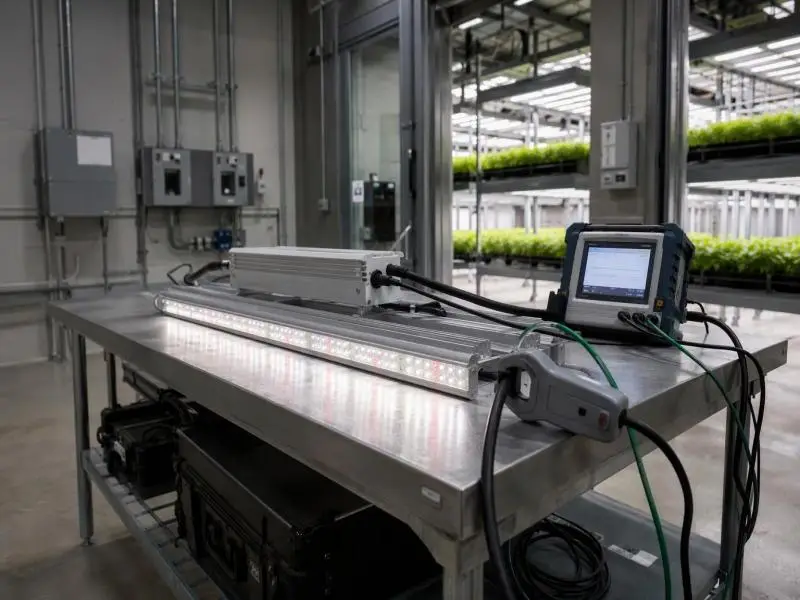
Mount the bars close to the canopy — typically 15 to 40 cm — and set the working PPFD with dimming rather than by chasing heights, which disturbs uniformity. Then verify with a PPFD grid of at least nine points (corners, mid-edges, center) and aim for a minimum-to-average ratio (U₀) of 0.85 or higher, tightening toward 0.9 for premium consistency.
Efficacy, Drivers, and Dimming Interfaces
Photon efficacy matters more than nameplate wattage. A fixture delivering a higher µmol/J means fewer watts for the same PPFD, which also cuts the HVAC cooling load those watts would create downstream. Give equal attention to the driver: high-quality constant-current drivers hold spectrum and efficiency steady across the dimming range, which is essential when you are running staged photoperiods and stepped intensity changes.
Confirm the fixture supports the dimming protocol you plan to control with — common options include 0–10 V and DALI — so your controller can schedule per-tier light without signal-interpretation surprises.
Controls Integration and TDLI Scheduling
Wire the fixtures into a central lighting controller so each tier runs its own photoperiod and dimming profile. Because saffron racks often stage multiple phases simultaneously, per-tier TDLI scheduling — setting each shelf’s daily light budget independently — is the mechanism that turns your recipe tables into an operating reality.
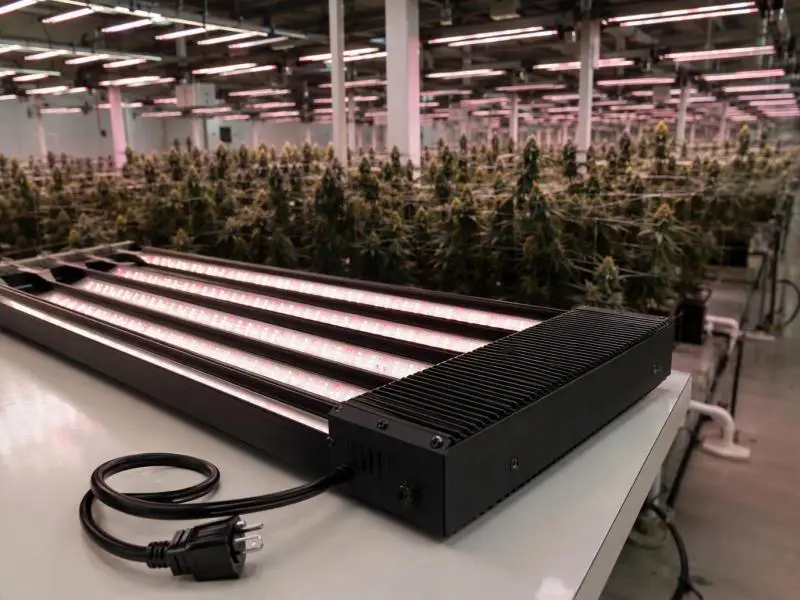
For bar-style fixtures engineered for uniform, close-canopy multi-tier distribution, a fixture such as the SLTMAKS vertical-farm bar series illustrates the layout principles above: edge-dense diode spacing, pass-through airflow, and dimming that supports staged photoperiod control. Its listed safety marks and modular driver design are the kind of documentation you want in front of an inspector, not discovered after a site visit.
Environmental and Compliance Coupling
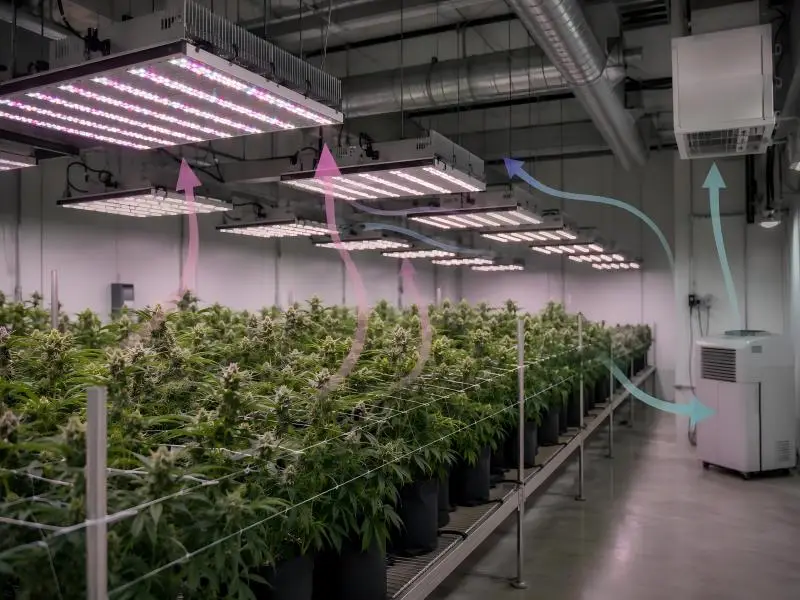
Lighting never operates in isolation. Every watt of light becomes heat, and every transpiring corm becomes moisture, so the HVAC and dehumidification design has to be solved together with the rack.
HVACD with Short Photoperiods
Because saffron runs short photoperiods, the lit window concentrates heat and transpiration into a few hours, and the dark window is where residual humidity must be pulled down. A system that cools and dehumidifies together — heating, ventilation, air conditioning, and dehumidification (HVACD) — handles both the sensible load from the fixtures and the latent load from the crop without the inefficiency of overcooling then reheating. The physics of how LED radiant heat drives HVAC load in stacked racks is worth reviewing before sizing equipment.
Microclimate and VPD Across Tiers
Heat from a lower tier rises and pre-warms the tier above, compounding as you climb the rack. That makes room-average setpoints unreliable; canopy-level vapor pressure deficit (VPD) can diverge markedly between shelves. Install tier-level sensing for canopy temperature, relative humidity near the canopy, and representative light, and control by zone so one shelf does not drift out of the intended microclimate.
Electrical Safety and Inspections
Compliance is a procurement gate, not an afterthought. In North America, the fixture should be listed to the horticultural luminaire safety standard — ANSI/CAN/UL 8800 — and installed per the National Electrical Code (NEC) or Canadian Electrical Code. ETL and UL are both recognized testing laboratory (NRTL) listing marks; CE is a manufacturer’s declaration of EU conformity covering electrical safety and EMC; and RoHS restricts hazardous substances for the EU market.
Verify the exact model, rated voltage, driver, mounting method, and damp-location suitability for the configuration you intend to install. A brand name alone is insufficient — the specific SKU must be the one certified — and final field installation still requires local code review and inspection approval.
ROI Modeling and Risk Management
Lighting is usually the largest energy line in a vertical farm, so the financial case stands or falls on the efficiency and scheduling of the photon delivery.
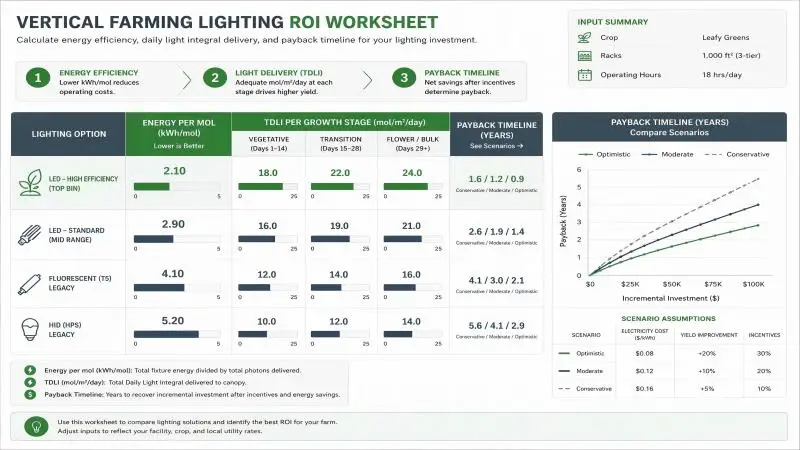
kWh per mol and Utility Incentives
For an apples-to-apples comparison, normalize energy to light delivered. Photon yield in mol/kWh approximates 3.6 × PPF (µmol/s) ÷ power (W) at rated power, and kilowatt-hours per mol is the reciprocal. Purdue Extension’s supplemental-light economics worksheet walks through the mol-per-kilowatt-hour math in practical terms. Higher efficacy at the fixture and efficient drivers both lower your kWh per mol.
Then look at incentives. Rebate programs and DLC QPL-listed fixtures can materially cut upfront cost and shorten payback, so factor available utility incentives into the model rather than assuming full list price.
Payback under Spectrum Scenarios
Model multiple scenarios rather than one best-case number. A quality-heavy forcing recipe that maximizes crocin may carry a higher per-mol cost than a yield-first vegetative spectrum, and either can win depending on your sales channel. Use conservative, moderate, and optimistic cases that vary electricity rate, cooling load, and the yield premium you can realize.
Benchmark data helps anchor the model. One published saffron vertical-farm case cited roughly 46 Wh/m² for lighting at 50% brightness over a 12-hour day, excluding HVAC and pumps, which highlights how modest saffron setpoints can be when tuned correctly — and how much headroom efficiency buys.
Commissioning, Monitoring, and Downtime Mitigation
The paper design rarely matches the finished rack, so budget for commissioning: verify PPFD with a grid, confirm VPD stability per tier, and reconcile actual kWh against the model within the first cycle. Document the whole sequence with a layout-and-commissioning checklist so future sites scale predictably.
Downtime is expensive per gram with a crop this valuable. Choose fixtures and drivers with known reliability records, keep spares on site, and wire monitoring so a driver failure flags before it costs a bloom window. In a multi-site operation, standardizing on one validated fixture and commissioning procedure keeps procurement and maintenance repeatable.
FAQ
How much light does saffron need in a vertical farm?
The short answer is less than you probably think. Saffron is not a light-hungry crop like leafy greens, and the dose matters more than raw intensity. Across published studies and commercial trials, the practical band sits at roughly 150–250 µmol/m²/s PPFD, with the photoperiod doing most of the work. During forcing, you run a short 8–12hour day for a DLI near 4.3–8.6 mol/m²/day, then stretch to 12–14 hours in the vegetative window for a DLI of about 6.5–12.6 mol/m²/day. That’s a far cry from the 15+ DLI figures some vendor posts float, so budget your fixtures around the modest setpoints that the research supports rather than chasing an inflated number.
What color of LED light is best for saffron?
For quality, blue light is the strongest lever. Trials show blue-enriched light upregulates the biosynthetic pathway for crocin and picrocrocin — the pigments that drive saffron’s color and taste — and tends to improve flower count and stigma weight. Red light, meanwhile, supports growth, advances flowering, and lifts stigma dry weight. For forcing, a red-leaning mix around a 3:1 red: blue ratio balances vigor with quality, while a broad spectrum with some blue is the safer default for the vegetative and corm-filling phase. Ideally, buy a fixture whose spectrum you can dim or switch per stage so you’re not locked into one mix for the whole crop.
Does saffron need darkness to flower?
Does saffron need darkness to flower?
Yes, this is the detail that trips up new growers. Saffron is a short-day plant, so flowering is driven as much by the dark window as by the light window. During induction and dormancy, corms are typically held in darkness for 90–120 days to complete flower bud formation — leaky ambient light here can suppress the very buds you’re trying to force. During forcing, you keep the photoperiod short (roughly 8–12 hours on / 16–12 hours off) to signal the plant to commit to flowering. Guard that dark phase in the rack design and scheduling, because it’s cheap to lose and costly to fix.
Conclusion
Lighting a saffron vertical farm is a sequence of deliberate choices, not a single purchase. The crop’s short-day biology splits your photon budget across induction, forcing, and corm filling, and each stage wants a different PPFD, photoperiod, spectrum, and daily dose. Get the recipe right, back it with a uniform, dimmable bar layout, and model the ROI against your real power rate and incentive programs, and saffron’s high value per gram becomes an achievable, repeatable harvest.
For a practical next step, run a pilot: define one stage-wise recipe, prove PPFD uniformity with a measurement grid, and model the payback on your own utility numbers before scaling to the full rack. If you would like help tailoring a lighting spec to your saffron tier geometry or power supply, our lighting engineers can walk you through fixture selection and a commissioning plan that matches your facility and compliance requirements.