The evolution of Controlled Environment Agriculture (CEA) has fundamentally transformed how we produce food and medicinal crops. At the heart of this agricultural revolution is vertical farming—a method that maximizes yield per square foot through high-density, multi-tier cultivation. However, stacking plant canopies introduces a highly complex engineering challenge: microclimate management.
One of the most critical, yet frequently misunderstood, factors influencing these microclimates is LED grow light heat radiation. While light-emitting diodes (LEDs) are celebrated for their energy efficiency and targeted spectrums, the assumption that they do not impact the thermal dynamics of a grow room is a dangerous misconception. For commercial growers and facility managers, failing to account for the precise thermal output of their lighting infrastructure inevitably leads to compromised crop quality, skyrocketing operational expenditures (OpEx), and catastrophic overloads on Heating, Ventilation, and Air Conditioning (HVAC) systems.
In this comprehensive guide, we will decode the thermodynamics of LED lighting, explore its cascading effects on plant biology and indoor microclimates, and demonstrate why integrating scientifically engineered vertical farming lighting solutions is not merely a lighting choice, but a foundational HVAC optimization strategy.
Table of Contents
Decoding LED Grow Light Heat Radiation
To master microclimate management, facility engineers and head growers must first understand the fundamental physics of how LED fixtures process electrical energy and how that energy interacts with the surrounding environment.
The Myth of “Cold Lighting”
In the early days of the transition from High-Pressure Sodium (HPS) and Metal Halide (MH) lamps to LEDs, manufacturers heavily marketed LEDs as “cold lighting.” This marketing term stemmed from a specific physical characteristic: unlike HID lamps, LEDs emit virtually no forward-facing infrared (IR) radiant heat.
When you place your hand under an HPS bulb, you immediately feel the heat; this is radiant heat traveling with the photons. When you place your hand under an LED, it feels cool. However, the laws of thermodynamics dictate that energy cannot be destroyed. An LED fixture drawing 600 watts of electrical power is still introducing 600 watts of energy into the room.
The standard conversion is absolute: 1 Watt = 3.412 BTU/hr. Therefore, a 600W fixture introduces approximately 2,047 BTU/hr of heat load into the facility, regardless of whether it is an HPS or an LED. The critical difference lies not in how much heat is generated, but how and where that heat is distributed.
Where Does the Heat Go? The Role of Thermal Management
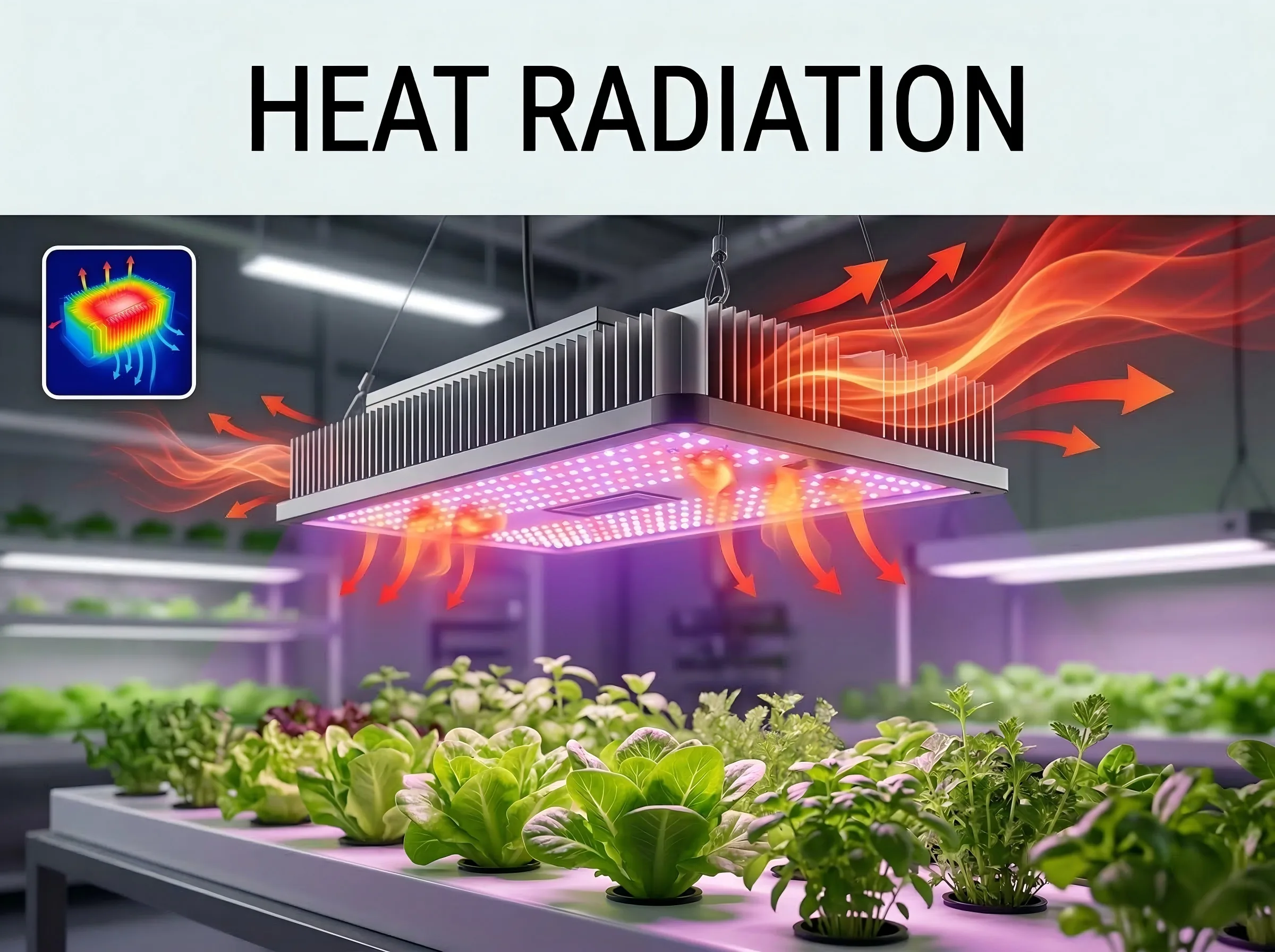
If the heat is not projected forward via infrared radiation, where does it go? In commercial LED grow lights, the thermal energy is a byproduct of the semiconductor’s inefficiency. Even the most advanced LEDs currently convert only about 40% to 50% of their electrical input into Photosynthetically Active Radiation (PAR). The remaining 50% to 60% is converted directly into conductive and convective heat at the diode junction and within the LED driver.
This heat is conducted away from the diodes into the fixture’s printed circuit board (PCB) and subsequently into the heat sink (usually extruded aluminum). From the heat sink, the thermal energy is released into the ambient air of the grow room via convection.
Therefore, LED grow light heat radiation is primarily sensible heat released into the upper strata of the grow rack. If a facility lacks rigorous thermal management and airflow design, this convective heat builds up around the fixtures, creating localized heat zones that disrupt the entire environmental control strategy.
The Domino Effect: How LED Heat Affects Vertical Farm Microclimates
In a single-tier greenhouse, convective heat naturally rises to the ceiling, well above the plant canopy, where it can be handled by exhaust fans or roof vents. In a vertical farm featuring multi-tier racking systems, the rules of thermal dynamics change drastically.
Temperature Gradients in Multi-Tier Racks
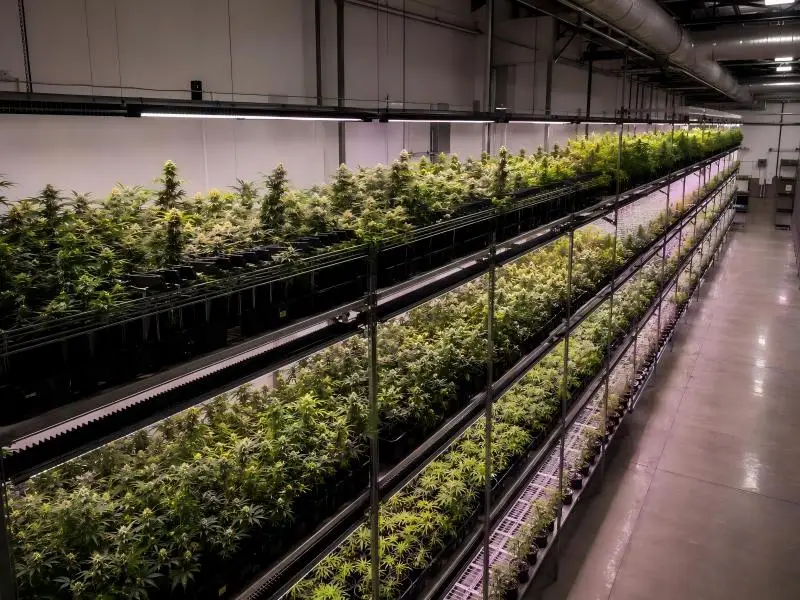
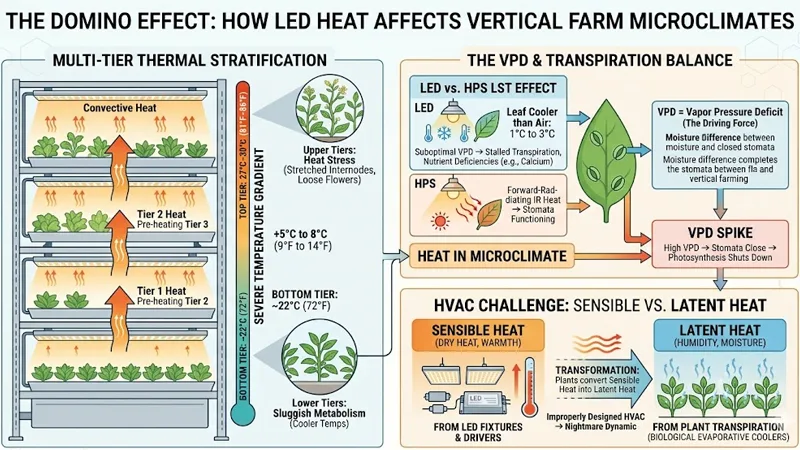
A vertical farm is essentially a stack of isolated microclimates. The heat generated by the LED fixtures on Tier 1 rises, pre-heating the bottom of Tier 2. The fixtures on Tier 2 generate their own heat, which rises to Tier 3, compounding the effect. Without precise vertical airflow and HVAC integration, facility managers often observe severe temperature gradients, where the top tier of a rack can be 5°C to 8°C (9°F to 14°F) warmer than the bottom tier.
This thermal stratification leads to wildly inconsistent crop development. Plants on the upper tiers may experience heat stress, leading to stretched internodes and loose flower structures, while plants on the lower tiers may suffer from sluggish metabolic rates due to cooler temperatures. Consistency is the currency of commercial agriculture; temperature gradients destroy that consistency.
Vapor Pressure Deficit (VPD) and Plant Transpiration
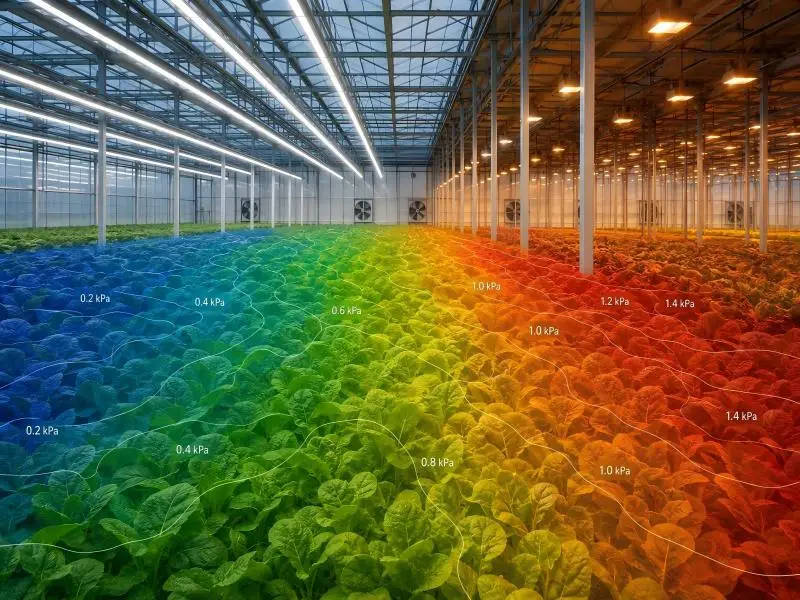
The most critical metric in modern CEA is Vapor Pressure Deficit (VPD). VPD is the difference (deficit) between the amount of moisture in the air and how much moisture the air can hold when it is saturated. It is the driving force behind plant transpiration—the process by which plants pull water and nutrients from their roots and release water vapor from their stomata.
LED grow light heat radiation plays a direct role in manipulating VPD because VPD calculations rely heavily on Leaf Surface Temperature (LST).
Because LEDs lack the forward-radiating infrared heat of HPS lights, the leaf surface temperature under LEDs is typically 1°C to 3°C cooler than the ambient room air. If a grower transitions to Controlled Environment Agriculture (CEA) lighting like LEDs but maintains the same ambient room temperature and humidity targets they used with HPS, the plants will experience a suboptimal VPD. The cooler leaves will transpire less, nutrient uptake (particularly calcium) will stall, and the plants may develop deficiencies or suffer from stunted growth.
Conversely, if the convective heat trapped in the microclimate of a vertical rack excessively warms the ambient air around the canopy, the VPD can spike too high, forcing plants to close their stomata to conserve water, effectively shutting down photosynthesis.
The Latent vs. Sensible Heat Challenge
Understanding the interaction between lights and plants requires distinguishing between two types of heat loads placed on the HVAC system:
- Sensible heat: The dry heat that causes a thermometer’s temperature to rise. LED fixtures and drivers exclusively produce sensible heat.
- Latent heat: The heat energy absorbed or released during a phase change, such as water turning into vapor. When plants transpire, they convert the sensible heat in the room into latent heat (humidity).
Plants act as biological evaporative coolers. The intense light and ambient heat stimulate transpiration. Consequently, while the LED grow light’s heat radiation adds sensible heat to the room, the thriving plants convert a massive portion of that sensible heat into latent heat. This shifting dynamic creates a nightmare for improperly designed HVAC systems.
HVAC System Overload: The Hidden Cost of Inefficient Lighting
The relationship between your lighting choices and your HVAC infrastructure is the most financially consequential dynamic in indoor farming. Overlooking the exact thermal output of your light fixtures during the facility design phase will lead to catastrophic CapEx (Capital Expenditure) and OpEx overruns.
Flawed Calculations in Facility Design
A common pitfall in commercial facility design is relying on standard commercial HVAC contractors who lack specific agricultural experience. They often size the cooling equipment based solely on the total wattage of the lighting, treating the grow room like a server farm.
However, as discussed, plants convert sensible heat into latent heat. Therefore, a vertical farm’s HVAC system must be heavily biased toward dehumidification rather than just dry cooling. If you install lower-tier, inefficient wholesale LED grow lights, you are introducing an excessive amount of sensible heat. This forces the HVAC system to run its compressors continuously to bring the temperature down.
When the lights turn off (the dark cycle), the sensible heat load drops to zero instantly, but the plants continue to release latent heat (transpire) for a period. If the HVAC system is oversized for cooling and lacks dedicated dehumidification capacity, the rapid temperature drop will cause a massive spike in relative humidity, reaching the dew point and causing condensation on the leaves—the perfect breeding ground for Botrytis (bud rot) and Powdery Mildew.
The Energy Nexus: Lighting and Cooling
The energy nexus of a vertical farm is tightly coupled. According to industry analyses, lighting and HVAC account for roughly 80% to 90% of a fully enclosed indoor farm’s total energy consumption.
There is a compounding multiplier effect at play: For every watt of electrical energy you save by using highly efficient commercial greenhouse lighting, you also save the energy required by the HVAC system to remove the corresponding 3.412 BTU/hr of heat.
If a facility utilizes outdated LEDs with a Photosynthetic Photon Efficacy (PPE) of 2.0 ㎛mol/J, a vast amount of electricity is wasted as heat. Upgrading to high PPE grow lights (2.8 ㎛mol/J or higher) means the fixtures generate significantly more photons per watt and substantially less thermal waste. This reduction in ambient heat radiation directly lowers the tonnage required for the HVAC chillers, slashing the monthly utility bill and reducing the wear and tear on mechanical systems.
Strategic Solutions: Synergizing LED Grow Lights with HVAC
Achieving a perfectly balanced microclimate requires treating the lighting and HVAC not as separate entities, but as an integrated mechanical ecosystem. Here are the strategic engineering solutions required for HVAC optimization for indoor farming.
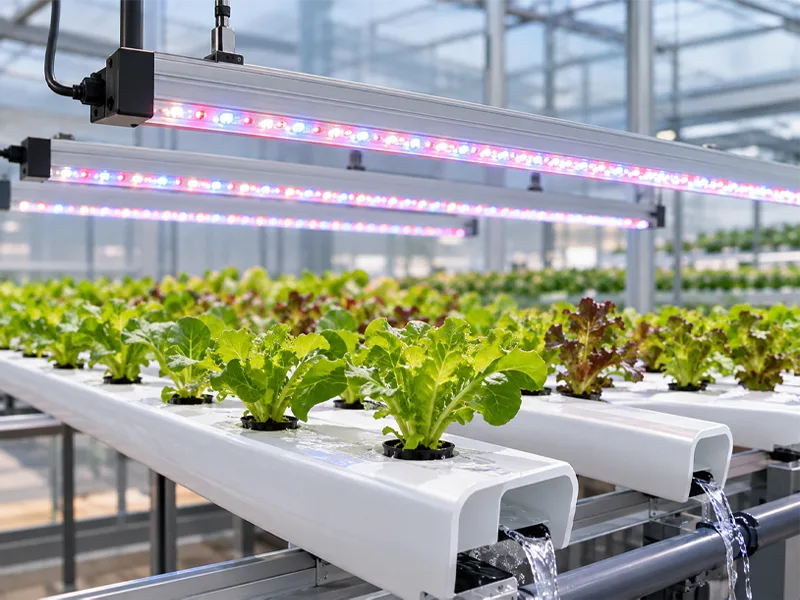
Choosing High-Efficacy Vertical Farming Lighting Solutions
The first line of defense in microclimate management is source reduction. You cannot manage heat you do not produce. When sourcing commercial LED grow lights, the specification sheet must be scrutinized for high efficacy.
A high PPE rating indicates superior diode quality and efficient driver performance. By deploying fixtures that convert a higher percentage of electricity into PAR rather than thermal waste, you inherently lower the sensible heat load on the microclimate. This allows your HVAC system to focus on its primary agricultural duty: dehumidification and maintaining exact VPD parameters.
Innovative Heat Dissipation Designs
Because LEDs generate heat at the diode junction, the physical design of the fixture is paramount. Heat is the enemy of the LED semiconductor; if it is not rapidly dissipated, the diodes will suffer from thermal degradation, leading to a rapid drop in light output (L90/L70 lifespan reduction) and spectral shifts.
Passive heat sinks: The industry standard for high-end fixtures relies on massive, structurally optimized aluminum heat sinks. Extruded aluminum with deep fin designs maximizes the surface area exposed to the ambient air, allowing for rapid convective heat transfer without the need for mechanical cooling fans (which are prone to failure in high-humidity environments).
Remote driver technology: One of the most effective strategies for mitigating LED grow light heat radiation in vertical racks is the use of remote-mounted drivers. The driver (power supply) is responsible for a significant portion of a fixture’s total heat generation. By utilizing fixtures designed with detachable drivers, facility managers can mount the power supplies outside the primary cultivation space, often in a central electrical corridor. This immediately removes up to 15% of the total sensible heat load from the grow room, drastically reducing the strain on the microclimate and the HVAC system.
Optimizing Airflow and Canopy Ventilation
Even with the most efficient fixtures, convective heat will gather around the lights. Breaking the thermal boundary layer around the heat sinks and the plant canopy is essential.
Vertical farms must deploy highly engineered horizontal and vertical airflow strategies. High-velocity, low-volume fans should be integrated into every tier of the rack. This constant air movement serves three critical functions:
- It scrubs the convective heat away from the LED fixtures, allowing them to run cooler and more efficiently.
- It mixes the air within the microclimate, destroying temperature gradients and ensuring uniform ambient temperatures from Tier 1 to Tier 4.
- It removes the micro-layer of high-humidity air that naturally forms directly above the leaf surface, ensuring optimal stomatal conductance and accurate VPD management.
SLTMAKS Advantage: Engineering Lights for Optimal Climate Control
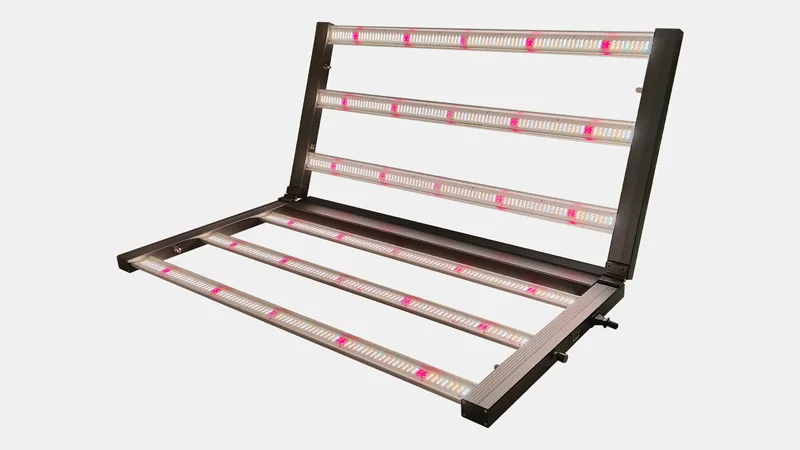
At SLTMAKS, we understand that we are not just an LED grow light manufacturer; we are an integral partner in your facility’s environmental control strategy. We engineer our products with the explicit understanding that every BTU of heat our lights produce must be managed by your HVAC infrastructure.
Why Professional Growers Trust SLTMAKS
Our R&D team approaches fixture design from a thermodynamic perspective. SLTMAKS commercial LED grow lights are built utilizing top-tier, bin-selected diodes that push the boundaries of Photosynthetic Photon Efficacy.
- Aviation-grade thermal management: Our fixtures utilize heavy-duty, meticulously engineered extruded aluminum heat sinks. By maximizing surface area and optimizing the aerodynamic flow through the fixture chassis, SLTMAKS lights dissipate heat rapidly and uniformly, preventing localized heat pooling in your vertical racks.
- Remote driver capabilities: Recognizing the challenges of high-density vertical farming, SLTMAKS offers highly customizable vertical farming lighting solutions with remote driver compatibility. By allowing you to move the thermal load of the power supplies out of the growing environment, we give you unprecedented control over your room’s microclimate.
- Targeted spectrums: By delivering exact light recipes tailored to specific crop stages, our fixtures ensure that zero electrical energy is wasted producing wavelengths that the plants do not efficiently utilize.
A Real-World ROI Scenario
Consider a commercial vertical farm operating 1,000 fixtures.
- Scenario A: The facility uses budget-tier fixtures drawing 600W with a PPE of 2.1 ㎛mol/J. The massive thermal waste requires a 150-ton HVAC system running at 90% capacity to maintain optimal temperatures. Frequent microclimate fluctuations lead to a 10% crop cull rate.
- Scenario B (The SLTMAKS integration): The facility upgrades to SLTMAKS high PPE grow lights drawing only 450W to deliver the same PPFD to the canopy, boasting a PPE of $2.9 ㎛mol/J.
The result: The total electrical draw for lighting drops by 25%. Consequently, the sensible heat load injected into the room drops proportionally. The facility is able to step down its HVAC load, reducing compressor cycling and extending the lifespan of the climate control equipment. The reduction in localized heat pooling inside the racks stabilizes the VPD, accelerating vegetative growth and eliminating the 10% cull rate caused by thermal stress. The ROI on the SLTMAKS upgrade is typically realized within 12 to 18 months solely through utility rebates and reduced electrical consumption, completely separate from the massive boost in crop yield revenue.
Future Trends: Smart Integration in CEA
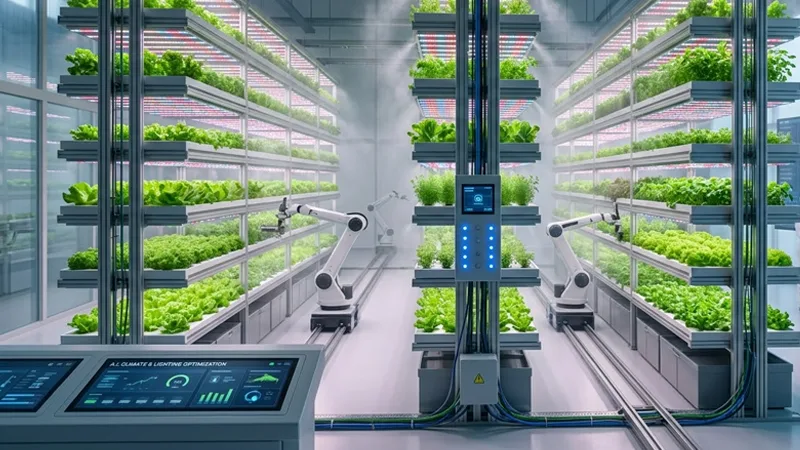
The future of commercial cultivation lies in the seamless integration of lighting, climate control, and artificial intelligence. The next frontier in managing LED grow light heat radiation is dynamic, automated response systems.
IoT and Dynamic Environmental Control
Modern commercial greenhouse lighting is moving towards complete Internet of Things (IoT) integration. SLTMAKS is at the forefront of designing dimmable, spectrum-tunable LED fixtures that communicate directly with a facility’s central environmental control computer (e.g., Priva, Argus).
In these advanced setups, an array of micro-sensors placed within the plant canopy constantly monitors Leaf Surface Temperature, ambient temperature, and relative humidity to calculate real-time VPD. If the HVAC system detects a sudden spike in ambient heat or humidity that it cannot immediately clear, the system can automatically dim the SLTMAKS LED fixtures by 5% to 10%. This instantaneous reduction in sensible heat output gives the HVAC system the necessary breathing room to catch up and stabilize the microclimate, all without the grower lifting a finger.
Conclusion
Managing a commercial vertical farm requires balancing a complex mathematical equation where light, heat, water, and air intersect. LED grow light heat radiation, while fundamentally different from the radiant heat of legacy lighting, remains a massive sensible heat load that dictates the size, cost, and efficiency of your HVAC infrastructure.
Purchasing lighting purely based on upfront capital costs without calculating the long-term HVAC penalty is a recipe for commercial failure. High-quality, scientifically engineered lighting is not merely an operational expense; it is a foundational investment in climate stability. By minimizing thermal waste, you empower your climate control systems to perform efficiently, locking in perfect VPD parameters and guaranteeing consistent, high-yield harvests.
Are you ready to stop fighting your microclimate and start optimizing it? Contact the engineering team at SLTMAKS today. We offer comprehensive lighting layout designs, thermal load calculations, and customized vertical farming lighting solutions tailored to perfectly synergize with your existing or planned HVAC infrastructure.
FAQ
Do LED grow lights get hot enough to affect my HVAC system?
Absolutely. While LEDs do not emit forward-radiating infrared heat like HPS bulbs, they convert roughly 50% of the electricity they consume into sensible heat (conductive and convective heat). A high-density vertical farm with hundreds of LEDs will generate a massive thermal load that your HVAC system must be engineered to remove. Ignoring this heat load will result in immediate cooling failures.
How do I calculate the cooling load for my commercial LED grow lights?
The baseline calculation is rooted in the conversion of electrical watts to British Thermal Units (BTUs). The formula is: Total Wattage of all fixtures × 3.412 = Total BTU/hr of sensible heat introduced into the room. For example, ten 600W LED fixtures will generate approximately 20,472 BTU/hr (6,000W × 3.412). This baseline number must then be provided to your mechanical engineer to size the cooling tonnage, alongside the latent heat calculations based on your daily watering volumes.
Why is managing LED heat radiation crucial for Vapor Pressure Deficit (VPD)?
VPD is the relationship between temperature and humidity, but specifically, it relies on Leaf Surface Temperature (LST). The convective heat pooling around LED fixtures in multi-tier racks can artificially raise ambient temperatures, causing the VPD to spike. When VPD is too high, plants close their stomata to prevent dehydration, which immediately halts photosynthesis and nutrient uptake. Managing the heat keeps VPD in the “sweet spot” for maximum growth.
Can SLTMAKS customize lighting solutions to fit my existing HVAC capacity?
Yes. As a premier LED grow light manufacturer, SLTMAKS specializes in retrofits and facility optimizations. If your current HVAC system is maxed out, we can analyze your canopy area and provide highly efficient, targeted spectrum, high PPE grow lights that deliver the required micromoles of light (PPFD) while drawing significantly less wattage than standard fixtures, thereby dropping your heat load to safely align with your existing HVAC capacity.