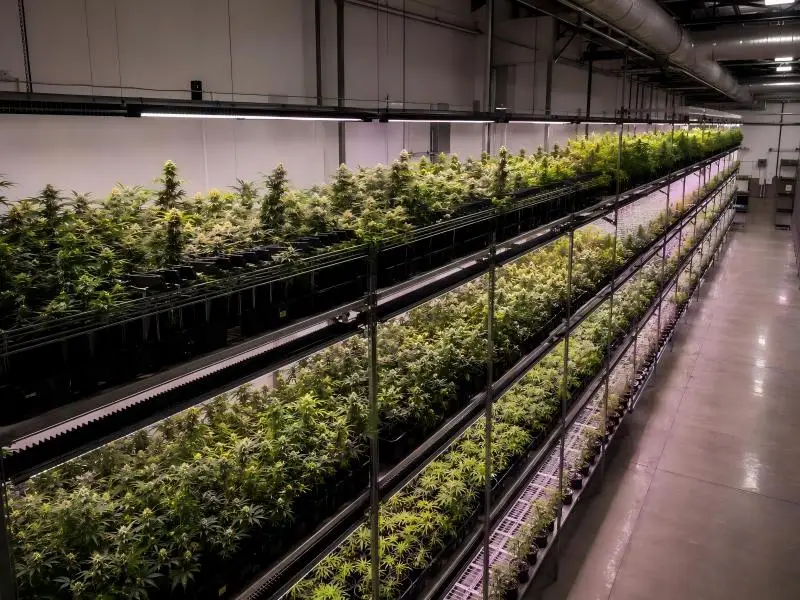
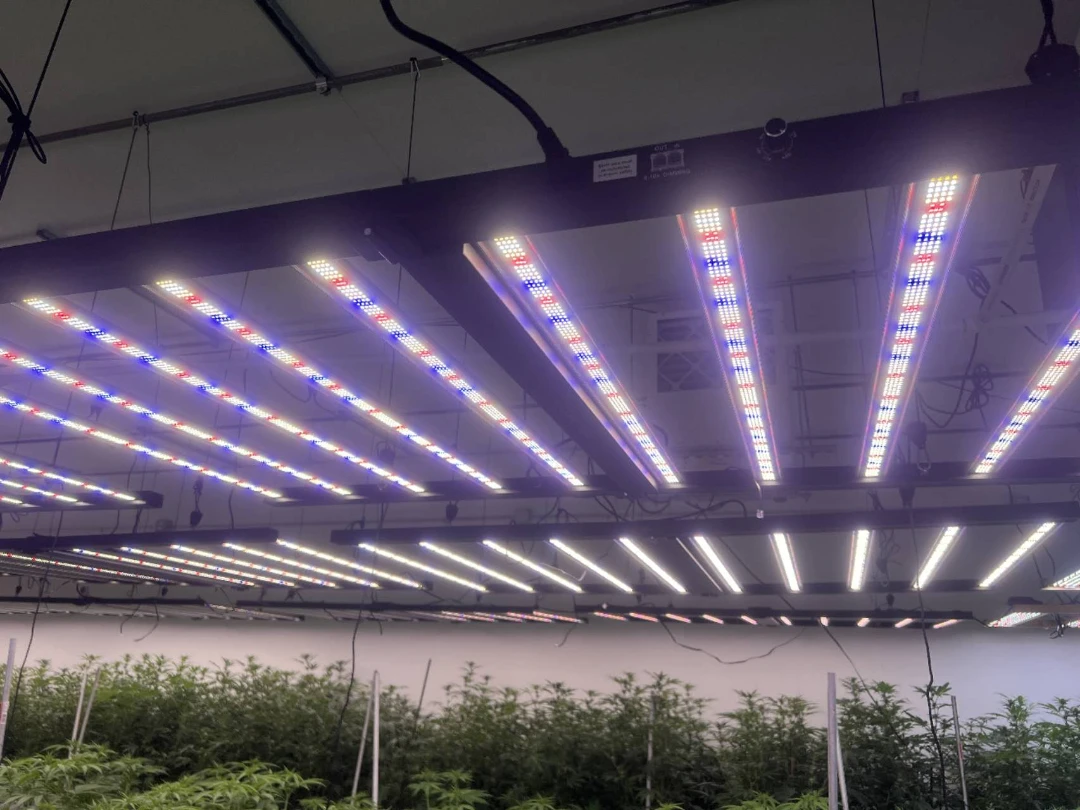
Indoor cannabis is one of the few crops where lighting isn’t just “important”—it’s often the single biggest driver of yield, consistency, and energy cost. Using led lights to grow weed, you’re not limited to one intensity or one spectrum, which is great, but it also means the “best” setting depends on growth stage, canopy shape, CO₂ level, and how well you control temperature and humidity.
This guide walks you through a practical. comical, stage-by-stage method to plan light levels using PPFD and DLI, so you can push photosynthesis without pushing plants into stress. It’s written for growers who want clear targets, simple math, and real-world setup tips that translate to better harvests.
Table of Contents
What “light level” really means for LED cannabis grows
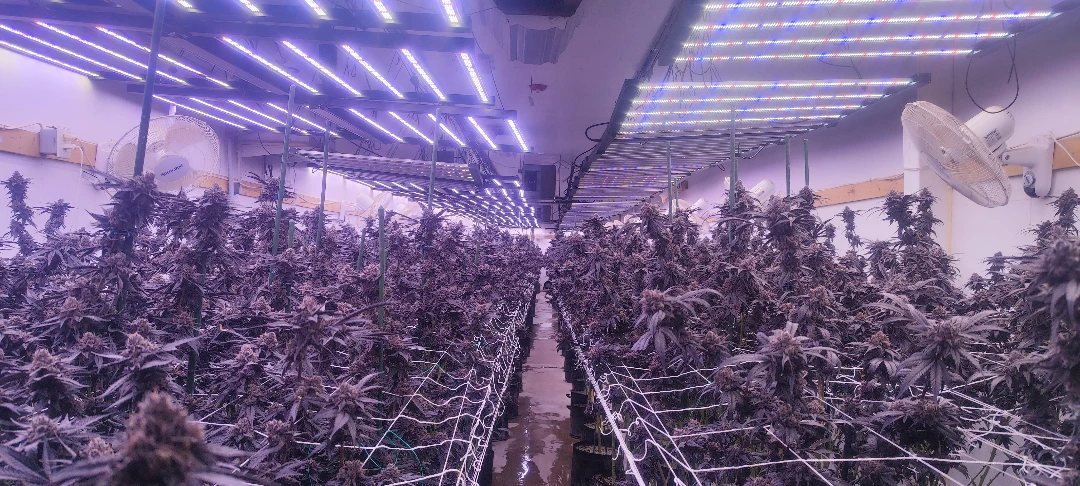
Light planning becomes much easier once you separate fixture specs from plant-level light. Your plants don’t “feel” watts—they respond to photons in the PAR range and the total photons received per day.
PPFD: the intensity at the canopy
PPFD (photosynthetic photon flux density) tells you how many PAR photons hit a square meter each second (µmol/m²/s). It’s the most useful number for setting hanging height and dimming, because it reflects what the canopy actually receives. Illuminating Engineering Society
DLI: the total light per day
DLI (daily light integral) is the total amount of PAR delivered in 24 hours (mol/m²/day). It combines PPFD + photoperiod, which is why it’s the best “big picture” metric for planning stage-by-stage targets. Ag and Natural Resources College
The simple DLI formula (you’ll use it constantly)
If PPFD is stable during the light-on period, you can estimate DLI like this:
DLI (mol/m²/day) = PPFD (µmol/m²/s) × 3600 × hours_of_light ÷ 1,000,000
This relationship is widely used in horticulture lighting planning. Ag and Natural Resources College
Why stage-based light planning works so well with LED cannabis grow lights
Cannabis can respond strongly to higher light when the environment supports it, but that doesn’t mean you should run maximum output from day one. Research and commercial data both show that light intensity influences yield and photosynthesis, and that cannabis can utilize very high PPFD under the right conditions.
The trick is progressing intensity in a way that matches:
- leaf area development (how much canopy you actually have),
- rooting strength and water uptake,
- nutrient demand,
- and your ability to control CO₂, temperature, and VPD.
When you match light to stage, you reduce stunting and bleaching early on, and you avoid leaving yield “on the table” during peak flower.
Stage-by-stage targets for LED cannabis grow lights (PPFD + DLI)
These targets are practical starting ranges for indoor LED grows. Your cultivar, training style, CO₂, and room control can shift them up or down, but the ranges below help you plan safely.
Seedlings and early veg (or rooted clones just after transplant)
At this stage, the plant’s “engine” is still small. Too much light tends to create stress faster than it creates growth.
- PPFD target: 200–400 µmol/m²/s. Start near 200–250 for sensitive seedlings and climb gradually as leaves broaden.
- DLI target: ~10–20 mol/m²/day depending on photoperiod. A longer veg photoperiod means you can hit useful DLI with lower PPFD.
Common warning signs you’re too high: leaf tacoing, pale tops, slowed growth, or a “hard” look to new growth. These symptoms usually mean intensity is outpacing root capacity and transpiration control.
Vegetative growth (established plants building canopy)
Veg is where you build a light-capturing canopy and set up flowering potential. Your goal is strong, even growth without stretching or stress.
- PPFD target: 400–700 µmol/m²/s. Most healthy canopies thrive in the middle of this range with stable environment control.
- DLI target: ~25–40 mol/m²/day. With 18 hours of light, you don’t need extreme PPFD to reach a strong DLI.
Veg is also where uniformity matters a lot. A “hot spot” at 850 PPFD and corners at 350 PPFD will create uneven plant height, uneven nutrition demand, and headaches when you flip to flower.
Transition / stretch (first 2–3 weeks after flip)
The flip is when many growers accidentally create stress. Plants are changing hormones, stretching fast, and building bud sites, so intensity should increase—but not in one sudden jump.
- PPFD target: 600–900 µmol/m²/s, ramped up over several days to a week.
- DLI target: ~25–40 mol/m²/day (because photoperiod drops to 12 hours).
Because you lose photoperiod hours during the flip, many growers raise PPFD to “keep DLI steady.” That logic is correct, but ramping is critical to avoid bleaching tops right when bud structure is being set.
Mid flower (bulk building)
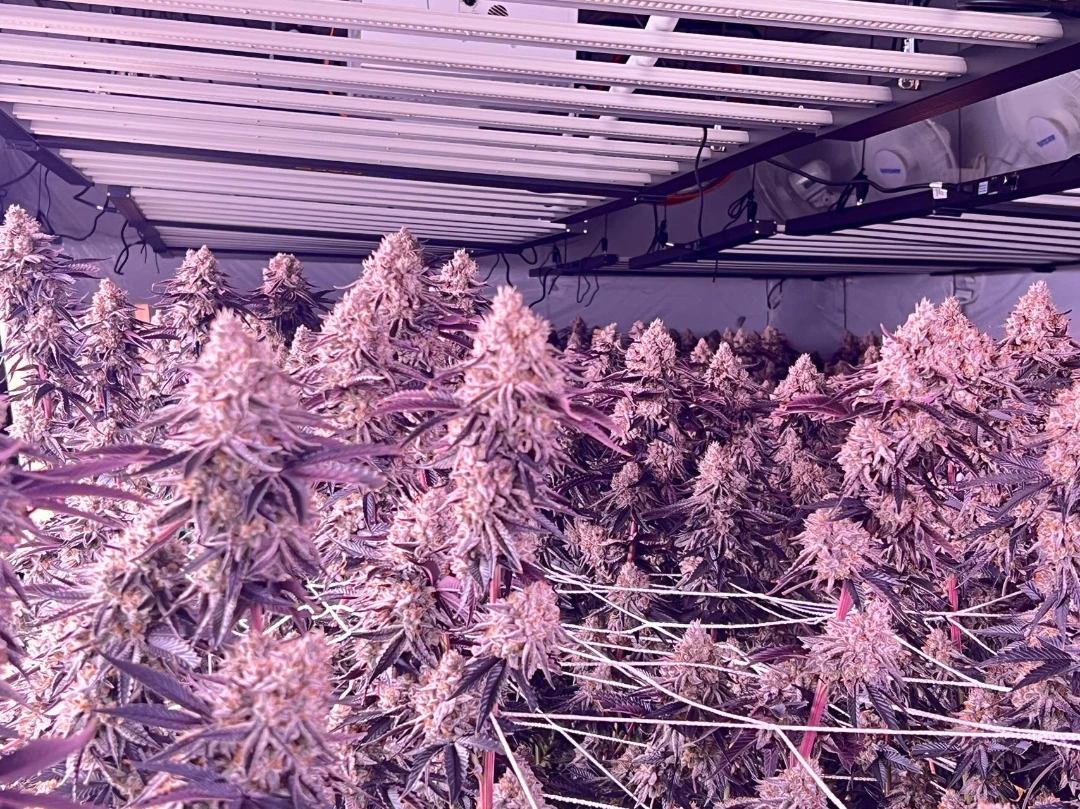
This is where led cannabis grow lights really show their value. When the room is tuned, higher PPFD can translate to more photosynthesis and more dry matter accumulation.
- PPFD target: 800–1100 µmol/m²/s for many grows without aggressive CO₂.
- DLI target: ~35–50 mol/m²/day.
If you run supplemental CO₂ and control leaf temperature and VPD tightly, higher PPFD can be productive. Multiple sources note cannabis can respond positively to high light intensity and may utilize levels around or above ~1500 µmol/m²/s in optimized environments.
Late flower (ripening and finishing)
Late flower is not automatically “less light.” Many growers keep intensity strong but watch for foxtailing, bleaching, or terpene loss from heat stress.
- PPFD target: 700–1000 µmol/m²/s, adjusted based on cultivar behavior and your quality goals.
- DLI target: ~30–45 mol/m²/day.
If a cultivar is sensitive, backing off 10–20% in late flower can protect top quality. If a cultivar is stable and your environment is strong, keeping intensity steady often maintains density and finish.
Quick DLI examples you can copy into your lighting plan
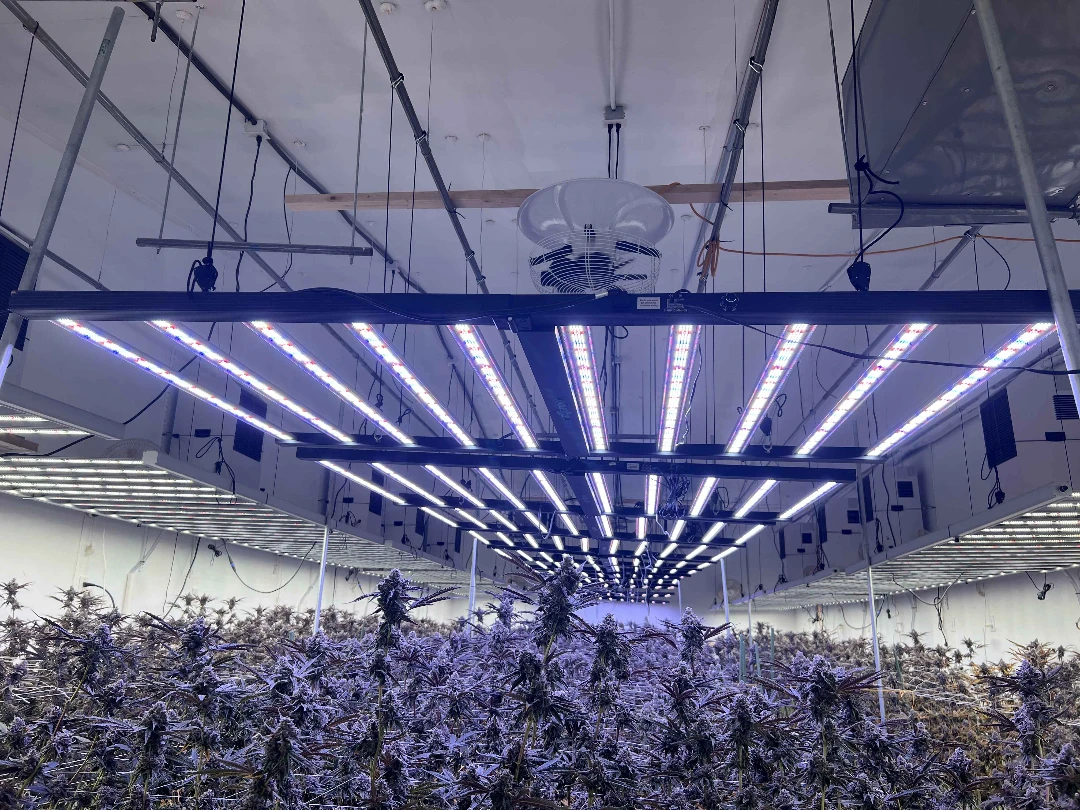
These examples help you translate PPFD targets into “total daily light,” so you can compare stages more accurately.
Example 1: Veg at 18 hours, 500 PPFD
- DLI = 500 × 3600 × 18 ÷ 1,000,000
- DLI = 32.4 mol/m²/day
That’s a strong veg DLI for many setups. It’s also why you shouldn’t blindly push veg PPFD to flowering numbers—18 hours adds up fast.
Example 2: Flower at 12 hours, 900 PPFD
- DLI = 900 × 3600 × 12 ÷ 1,000,000
- DLI = 38.88 mol/m²/day
This sits right in the common mid-flower “productive” DLI range for indoor cannabis lighting plans.
How to dial light levels in the real world: measure, map, then adjust
A grow that “looks bright” can still have poor canopy PPFD. LEDs can create high peaks and low valleys depending on lensing, bar spacing, hanging height, and room reflectivity.
Use a PAR meter (or a calibrated method) and map the canopy
The goal isn’t one number—it’s a map. Measure a grid at canopy height (for example, a 4×4 grid in each light footprint) and look for uniformity as much as intensity.
- If the center is too hot: raise the fixture or dim slightly, then re-map.
- If the corners are too low: add overlap between fixtures or improve wall reflectivity, then re-map again.
Uniformity is what makes feeding and canopy management predictable. It also makes your harvest more consistent across the room.
Don’t forget that canopy height changes your PPFD daily
If your plants stretch 10–20 cm and you don’t raise the lights, PPFD can jump quickly. That “free intensity increase” might sound good, but it can cause bleaching during the most sensitive weeks of flower.
A simple habit helps: re-check PPFD after any major defoliation, trellis adjustment, or stretch surge. Two quick maps per week during early flower can prevent big problems.
Hanging height and dimming strategy that avoids stress
With led cannabis grow lights, dimming is a major advantage. Instead of moving fixtures constantly, you can hold height for uniformity and use dimming for stage control.
A practical ramping approach by stage
- Early stage: hold a higher hanging height for gentler distribution, then raise intensity slowly.
- Veg: lower gradually (or increase dimming) to reach target PPFD while preserving even spread.
- Flip/stretch: increase in steps over several days, watching the canopy tops daily.
- Mid flower: hold steady if the room is stable, and use small changes (5–10%) based on plant feedback.
A good ramp strategy reduces light shock and keeps leaf temperature, transpiration, and nutrient uptake aligned with intensity.
Why “closest possible” is not always better
If you hang LEDs too close, you can create intense hot spots, uneven penetration, and leaf-surface overheating. You often get better whole-canopy performance by hanging slightly higher, improving uniformity, and letting the canopy intercept light more evenly.
This is especially true with wide-bar fixtures designed for spread. Higher and more uniform often beats lower and spikier.
Spectrum notes: what to prioritize for stage planning
Most growers don’t need to micromanage spectrum daily, but understanding the basics helps you avoid the most common mistakes.
Use full spectrum as the foundation
A strong full spectrum LED gives consistent vegetative structure and balanced flowering performance. It also makes your PPFD readings more meaningful across stages because the spectrum isn’t wildly changing.
Red and far-red: powerful tools, easy to overdo
Red photons support photosynthesis and can improve efficiency, but too much red-heavy spectrum can increase stretch and reduce compactness in some cultivars. Far-red can influence morphology and can be used strategically, but it can also trigger stretch if applied carelessly.
If you’re experimenting with spectrum, change one variable at a time. Keep PPFD stable while you test spectrum effects, or you won’t know what caused the outcome.
UV: treat it like a controlled supplement
UV strategies are cultivar-dependent and easy to misuse. If you add UV, start conservatively and monitor stress responses carefully, because UV can damage tissue if you overshoot.
Environmental alignment: your “light ceiling” depends on CO₂, temperature, and VPD
Light is not a standalone input. If you raise PPFD but don’t improve CO₂ delivery and environmental stability, you’ll hit diminishing returns fast.
CO₂ raises how much light cannabis can use
Higher CO₂ can increase photosynthetic capacity and can make higher PPFD more productive—if temperature and VPD are controlled and your leaves stay healthy. This is why some high-intensity commercial strategies pair stronger light with elevated CO₂ and tight HVAC/dehumidification control.
Leaf temperature matters more than air temperature
LED rooms can have cooler air but still run leaves too warm at the canopy tops because photons and boundary-layer effects add heat locally. If your tops bleach while the room “feels fine,” check leaf-surface temperature and airflow.
A simple rule: when you increase light, you often need to increase air movement and adjust setpoints to keep transpiration stable.
VPD keeps uptake stable as light increases
Higher light increases transpiration demand. If your VPD is too low, plants can’t transpire efficiently and nutrient flow can stall. If VPD is too high, they can over-transpire and stress.
You don’t need a perfect chart memorized, but you do need a consistent approach: stable leaf temperature + stable VPD = a higher usable PPFD ceiling.
Common mistakes when planning light levels by stage
Mistakes repeat in almost every new LED cannabis room. Fixing them often unlocks “free yield” without buying more lights.
Mistake 1: Using one PPFD target for the whole cycle
Plants simply don’t need the same intensity at week 1 as week 6 of flower. When you push too hard early, you get stress; when you run too low in mid flower, you lose density and yield.
Stage-based ramping keeps plants accelerating smoothly instead of “stopping and starting” from stress events.
Mistake 2: Ignoring uniformity and chasing peak numbers
A room with a 1200 PPFD hot spot and 500 PPFD edges usually performs worse than a room that’s 850–950 PPFD everywhere. Uniformity reduces microclimates, stabilizes feeding, and simplifies canopy management.
Mistake 3: Forgetting DLI after photoperiod changes
When you flip to 12/12, your DLI can drop sharply if you keep PPFD unchanged. DLI planning is what prevents that accidental “light diet” right when buds are being built.
A simple checklist to plan your LED cannabis grow lights like a pro

Use this workflow at the start of every run. It’s repeatable, measurable, and easy to document.
Step 1: Choose stage targets (PPFD + DLI)
Pick your PPFD target range for each stage, then calculate the DLI. Two sentences of math now can save you weeks of guessing later.
Step 2: Map the canopy and correct distribution first
Before chasing more intensity, make distribution even. Raise fixtures, adjust overlap, and use reflectivity improvements to reduce valleys.
Step 3: Ramp in controlled steps and watch plant feedback
Increase intensity gradually, especially during transplant and flip. If tops bleach or growth slows, back off slightly and stabilize before pushing again.
Step 4: Match environment to intensity
As PPFD rises, re-check leaf temperature, VPD behavior, and CO₂ strategy. Your best lighting plan is the one your room can actually support every day.
Why SLTMAKS LED grow lights fit stage-based cannabis light planning
If your goal is consistent stage control, you want fixtures that can deliver three things: uniformity, reliable dimming, and high efficiency. Those features make it possible to hit your targets without constant re-hanging or fighting hot spots.
SLTMAKS designs LED grow lighting with controlled-environment production in mind. That means stable output, practical form factors for even canopy coverage, and dimming control that supports smooth ramping from early veg through peak flower.
If you’re building or upgrading a room, plan your targets first—then choose fixtures that can hit those targets evenly and efficiently. That’s how you turn lighting into a predictable production system instead of a weekly guessing game.
FAQ
Is higher PPFD always better?
Not always. Higher PPFD can increase photosynthesis and yield when CO₂ and environment support it, but beyond your room’s “support ceiling” it can cause stress and reduce quality.
Should I use PPFD or DLI to control my run?
Use PPFD to set daily intensity and uniformity at canopy height, and use DLI to compare stages and avoid accidental drops during photoperiod changes. In practice, you’ll use both.
How fast should I ramp intensity after flipping to flower?
A common approach is small increases over several days to a week, watching the canopy tops daily. The right pace depends on cultivar sensitivity, canopy density, and whether your environment is stable.
A better way to “set lights” for cannabis
Planning led cannabis grow lights by growth stage is less about chasing one perfect number and more about building a repeatable system: measure PPFD, calculate DLI, ramp stage-by-stage, and keep the environment aligned with intensity. When you do that, plants grow faster with fewer stress events, and your harvest becomes more predictable across cycles.
If you want to improve yields without adding chaos, start by mapping your current canopy PPFD and calculating your DLI by stage. Those two steps alone usually reveal the biggest opportunities.