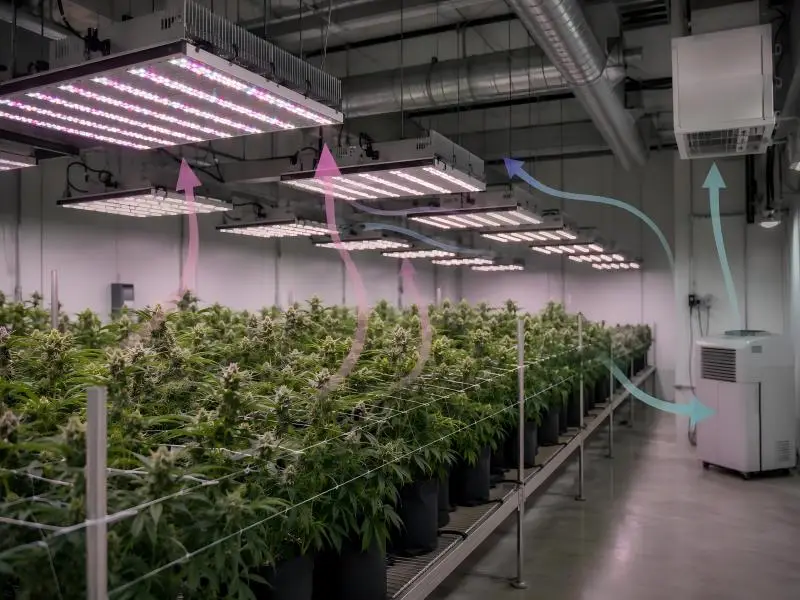
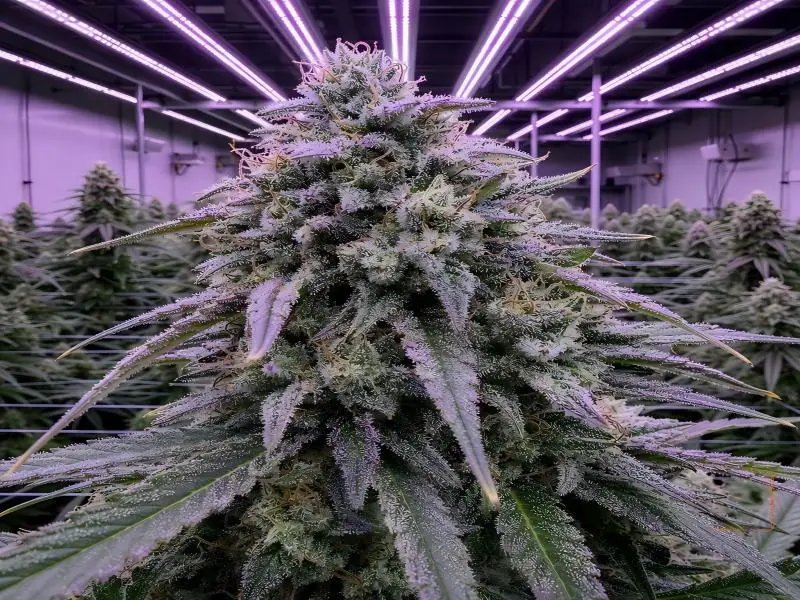
Introduction
If you run a commercial indoor room and have seen UVB fixtures marketed as a shortcut to frostier flower, this guide is for you. The goal is not to claim UVB “boosts potency” — the evidence is more nuanced than that. This is a practical, evidence-led playbook for applying a controlled LED grow light UVB stress technique in the final weeks of flower, dosing it conservatively, measuring it, and pulling the plug before it costs you yield.
We will cover what “UVB stress cannabis” actually means, realistic expectations, dosing and equipment, and the worker-safety procedure that has to accompany any commercial UV installation. By the end, you will know how to run a small, measured UVB trial in late flower and decide — with data, not hype — whether it earns a place in your standard grow.
Internalize this before any experiment: UVB is a stress signal, not a potency booster. The dose that tightens trichome coverage in one cultivar can bleach tips and cut yield in another. Every figure here is a conservative starting point, not a target. Ramp slowly and verify with instruments on your own canopy.
Table of Contents
Fundamentals and Evidence of the LED Grow Light UVB Stress Technique
UVB vs UVA and blue light
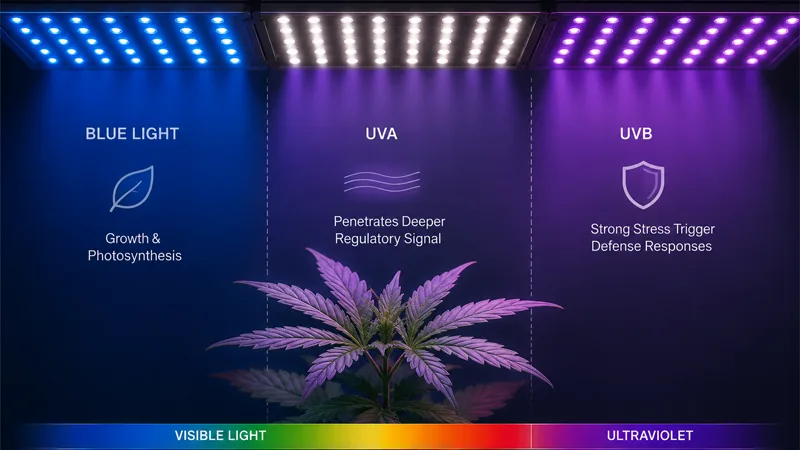
Ultraviolet sits just beyond the blue end of the visible spectrum. UVA (315–400 nm) is lower energy, penetrates plant tissue more readily, and acts mainly as a regulatory signal. UVB (280–315 nm) is shorter and higher energy; it is a far stronger stress trigger and drives the defense responses — resin, trichomes, phenolics — that cultivators associate with UV. Blue light (roughly 400–500 nm) is not UV at all, but because many full-spectrum lights are heavy on blue, growers sometimes conflate a bright blue canopy with meaningful UV output.
It is worth knowing that standard white LEDs emit little to no UVB, so if you want a genuine UVB stress stimulus, you need a dedicated supplemental source — a distinction the SLTMAKS guide on whether plants need UV light lays out plainly.
What studies show about trichomes and cannabinoids
The peer-reviewed picture is more cautious than the marketing. A widely cited Frontiers in Plant Science indoor cannabis UV study (2022) found that high light intensity increased yield, but adding UV did not change inflorescence cannabinoid content at the doses tested — though researchers noted what appeared to be higher trichome density on sugar leaves in the combined UVA+UVB treatment.
A separate Rodriguez-Morrison et al. UVB dose-response study (2021), using short-wavelength UVB LEDs, found no cannabinoid gains and measured decreases in total equivalent THC and CBD as UVB dose increased in one cultivar. A Frontiers study on UV spectra and intensity (2024) similarly concluded that only a low-intensity, UVA-dominant treatment was suitable for commercial use, while heavier UVB or higher intensities produced penalties.
The consistent thread: trichome appearance can shift under UVB, but total potency and yield gains are cultivar-dependent and often absent. That is not a reason to skip UVB — it is a reason to set expectations correctly and dose conservatively.
Set expectations: UVB stress appearance gains vs potency changes
Separating what UVB stress can and cannot do is the difference between a profitable experiment and a costly one. The most repeatable and observable outcome is a denser, more resinous appearance on trichome-rich tissue, particularly in tolerant genetics. Potency changes — measurable shifts in total cannabinoid or terpene concentration — are far less reliable and, in some studies, run in the wrong direction with dose.
For a commercial operation, this matters because a denser-looking flower with no assay-backed potency gain still has limited value, while a yield hit carries a hard cost. Run UVB stress as a controlled trial, assess both the visual result and the lab data, and let the evidence set your standard practice.
Equipment and Room Controls
Fixture types and placement basics
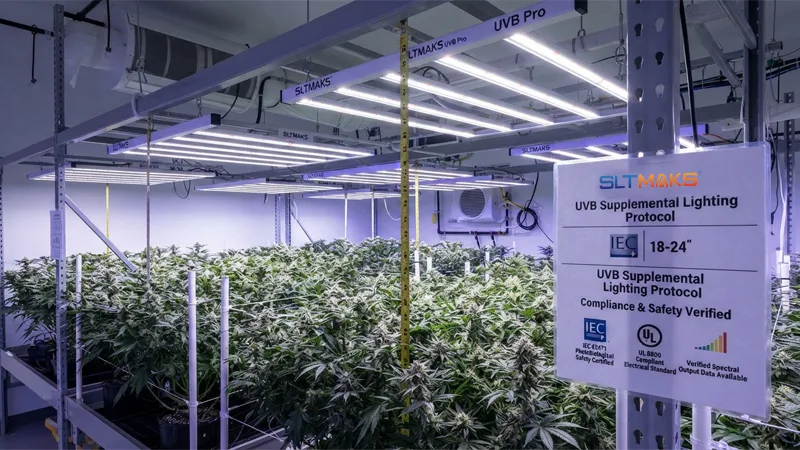
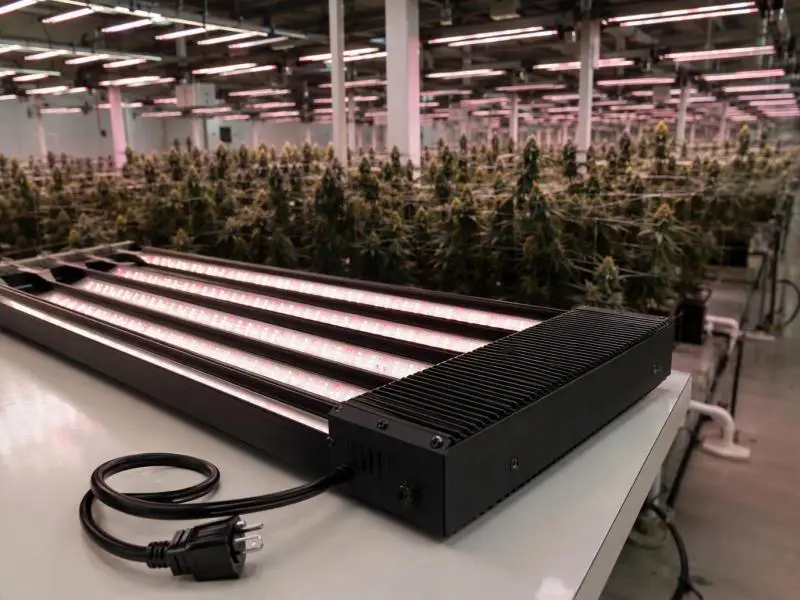
UVB is almost always delivered by dedicated supplemental modules — T5-style UVB tubes or specialty UVB LED bars — rather than by the main visible-light fixtures. These are mounted overhead, typically 18–24 inches above the canopy, with the exact height set by output and the manufacturer’s guidance. Because UVB intensity falls off sharply with distance and is easy to concentrate unevenly, you generally need multiple fixtures spread across the bench rather than one intense source, and you will position them to avoid hot spots and dark corners.
When you evaluate UV-capable LED bars for this role, look for products with verified spectra and recognized safety certifications rather than vague “UV included” claims. For a commercial room, a fixture built to established photosafety and electrical standards — think IEC 62471 photobiological safety classification and UL 8800-style recognized lighting safety — gives your compliance and procurement teams documentation they can actually use. SLTMAKS is one example of a supplier whose UV LED grow light use guide covers spectrum verification, verified spectra, and the certifications operators should ask for before deployment. Keep that verification bar in mind regardless of the vendor you choose: ask for the photometric and photobiological data, not just the wattage.
Independent controls, timers, and interlocks
UVB should never share a naive always-on channel with your main fixtures. Run it on a separate timer or controller channel so it activates only during selected windows of the photoperiod, not all day. In larger facilities, this argues for a control layer that supports independent UV zoning, which is exactly the kind of smart lighting control SLTMAKS describes for commercial cannabis facilities. From a safety and crop standpoint, wire or program interlocks so UVB cannot operate while the room is occupied for routine work, and so door/entry opening kills the UVB circuit. Timer-controlled, interlocked operation also gives your audit trail a clean, reproducible schedule.
Coverage and uniformity over the canopy
Uniformity is where most UV installations quietly fail. Because UV is supplemental and often mounted in bars between primary rows, coverage can easily vary several-fold across the canopy — some plants get too much stress and others almost none. The practical workflow is to map the canopy with the UV fixtures at target height, use enough bars to eliminate edge drop-off, and verify with a measurement pass rather than trusting fixture count alone. The same planning discipline you already apply to your commercial grow light layout applies here: re-check distribution after plant stretch and adjust spacing or height as the canopy moves.
Measurement and Dosing
Intensity units and starting ranges
Before you switch on anything, establish how you will measure UVB. The key units:
- µW/cm² — UV irradiance at canopy. This is the practical number for a UV meter and the one to verify against a target.
- kJ/m²/day — biologically effective dose accumulated over the light period. Good for comparing total daily load across protocols.
- UV Index — a hazard-oriented scale designed for human skin safety, not plant dosing. Useful for worker safety, but not the right tool for setting plant dose.
- PPFD (µmol/m²/s) — photosynthetically active light, which measures PAR, not UVB. Do not treat PPFD as a proxy for UVB dose.
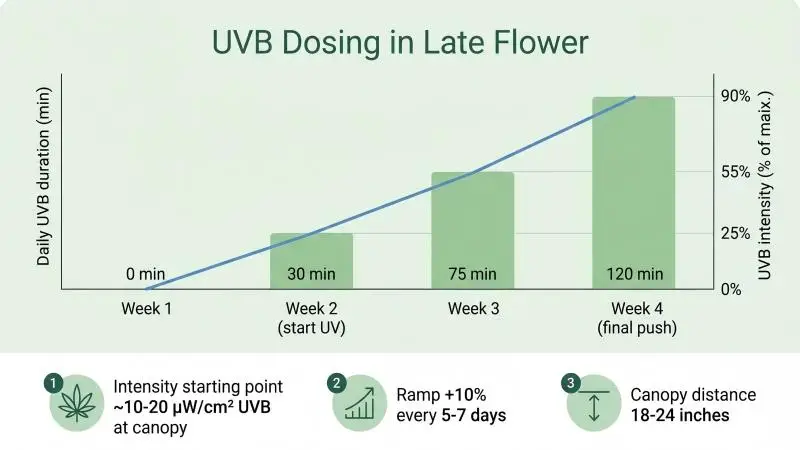
A conservative commercial starting point is roughly 10–20 µW/cm² of UVB at canopy, toward the low end of the 10–40 µW/cm² band common in plant UV research, or an equivalently short daily pulse. Because every fixture and room differs, the number is a launch point, not a rule.
Ramp strategy in late flower
The goal of the ramp is to let the canopy acclimate to a stress it can manage. A widely used pattern is to raise intensity by about 10% every 5–7 days, or to step UVB on over the final weeks from roughly 25% toward 75–100% only if the cultivar shows no damage. Duration follows a mirror path: start near 30 minutes/day at ~25% intensity, extend toward 60–90 minutes at the midpoint, and, only in tolerant genetics, work up to about 2 hours in the final push. Every step is contingent on the plant staying clean — no bleaching, bronzing, or tip burn.
Verifying dose with meters or dosimeters
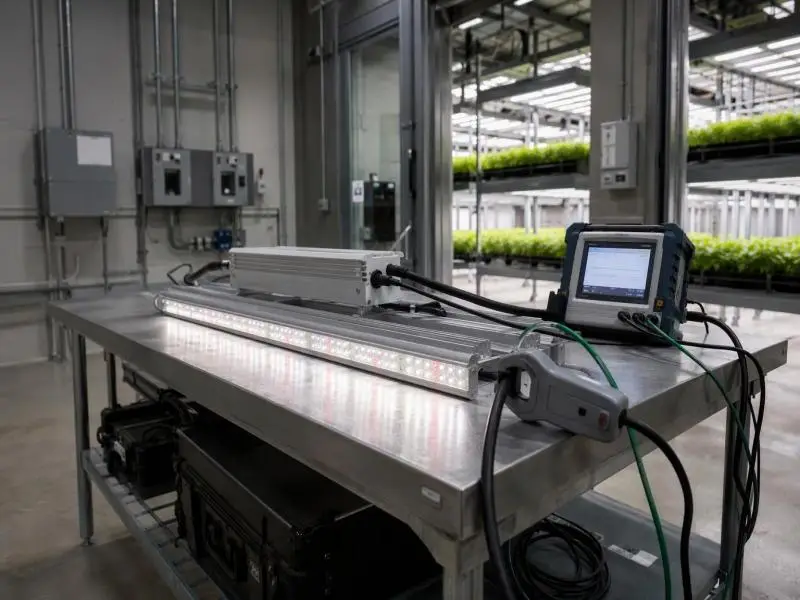
Do not set UVB by fixture count or guesswork. Verify the canopy plane with a UV meter or dosimeter rated for the UVB band, record the µW/cm² reading at several points across the footprint, and log the daily dose in kJ/m²/day. This measurement pass is what turns a UV experiment into an auditable, repeatable protocol — and it is the single biggest credibility gap in most grow-room UV guidance.
Pro Tip: Log both a canopy UV map (µW/cm² at multiple points) and the daily accumulated dose on every trial day. That data is what lets you compare weeks, dial in the ramp, and prove to leadership or a regulator that the protocol was deliberate, not improvised.
Late-Flower Scheduling
Treatment window: final 2–4 weeks
Most structured UVB work is concentrated in the final 2–4 weeks of flower, when resin and trichome development is at its peak and the stress signal has the most tissue to act on. Introducing UVB in the very last week is a common mistake — the plant has no time to respond productively and may react with acute stress instead. Give the canopy a run-up across roughly the final month, and consider stopping the UV 2–3 days before harvest so the flower finishes without an imposed stress load.
Daily timing within photoperiod
Within each lights-on window, schedule UVB during the middle or later portion of the photoperiod, when plants are most metabolically active — rather than at the very start or end. Some growers run short bursts (a few minutes per hour) across the middle of the day; others use a single 1–2 hour block. Either approach is acceptable as long as it is consistent, on its own timer channel, and interlocked against occupancy.
Stop or adjust criteria
Have your exit criteria written down before you start. Any of these is a signal to reduce exposure: leaf whitening or bleaching on young tips, bronzing or purpling beyond what genetics or temperature explain, tip burn or margin necrosis, or new growth that fails to recover between photoperiods. When damage appears, cut duration first, then intensity, and allow several days for recovery before changing anything else. The most expensive failure mode is treating a visible stress sign as “the plant adjusting” and pushing through it.
Safety and Compliance
Human exposure concepts (ACGIH/ICNIRP)
UVB is hazardous to eyes and skin, and the exposure limits are why a commercial UV protocol is a safety project as much as a cultivation one. The ICNIRP guidelines on limits to ultraviolet exposure (2004) set a human eye-and-skin limit of 30 J/m² (3 mJ/cm²) of effectively weighted UV over an 8-hour day, with an additional unweighted ocular limit of 10,000 J/m² (1 J/cm²) for the 315–400 nm band. ACGIH expresses wavelength-dependent Threshold Limit Values (TLV®) for UV, typically cited around 3.4 mJ/cm² near 280 nm, rising to 500 mJ/cm² at 313 nm. For practical purposes, the safest operating position is that workers stay well below these doses by keeping UVB off whenever anyone is in the room.
PPE and safe operations in the grow room
Engineering controls come first, PPE second. Install door/entry interlocks that cut UVB the moment a door opens, use occupancy or key-switch interlocks so UVB runs only when authorized, and keep UVB on the photoperiod timer. When entry during UVB is genuinely necessary — typically for maintenance — require UV-rated eyewear that blocks the specific UVB band, full skin coverage and protective clothing, and head/neck coverage. Ordinary clear safety glasses do not reliably block UVB, so choose eyewear rated for the band you are running.
Documentation, signage, and maintenance
Treat UVB like any other restricted-energy system. Post prominent UV hazard warning signs at every access point stating that UVB can cause eye and skin injury, that the room must not be entered while UVB is on, and what PPE is required. Extend your lockout/tagout program to UV fixture servicing, and keep a maintenance log alongside your measured-dose records. Good documentation does two jobs at once: it keeps staff safe, and it gives inspectors and decision-makers a clear, defensible record that the facility ran UVB deliberately and within limits.
⚠️ Warning: Never work in a room with live UVB fixtures without UV-rated eye protection and skin coverage. Design the room so UVB is off before staff enter, and treat the UV system as a restricted, maintenance-only condition unless a documented hazard assessment says otherwise.
Troubleshooting and Cultivar Variability
Early stress signals and immediate actions
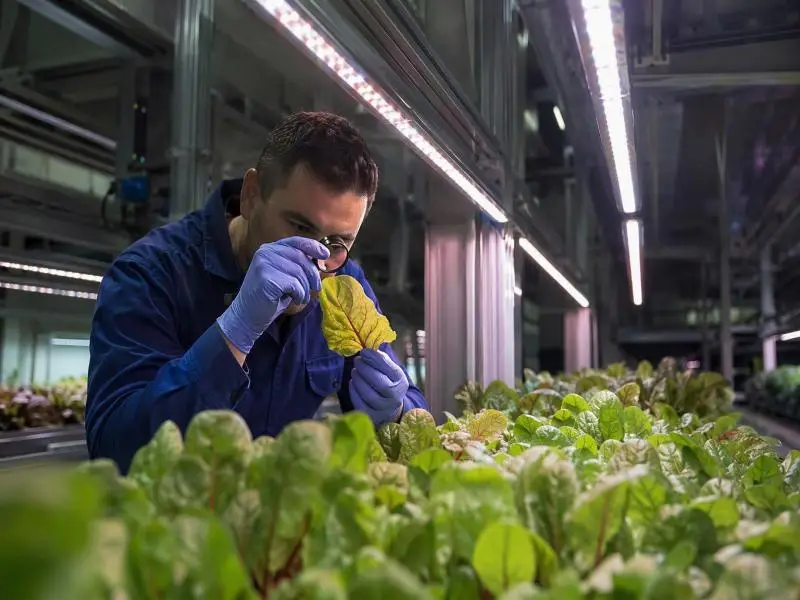
Act on the earliest signs, not the dramatic ones. Leaf whitening on new growth and subtle bronzing on older tissue are your first warning; they appear well before visible tip burn or yield loss. The immediate response is to lower the dose — reduce daily minutes first, then intensity — and give the room a recovery window before reassessing. Keeping a daily visual log of a marked trial plant makes these signals objective rather than a passing impression.
Managing yield and terpene tradeoffs
UVB stress is a trade, not a free lunch. The visible gain when it works is denser trichome coverage; the hidden risk is reduced growth and yield if the dose runs hot. Because high-intensity UVB has been linked to yield penalties in the peer-reviewed literature, the correct posture is that any yield cost must be justified by a measurable, assay-backed quality gain. If the appearance improves but the lab numbers and dry weight do not, the protocol is costing you money.
Validate per cultivar before scaling
Genotype is the single biggest variable. A dose that is ideal for one cultivar can be actively harmful in the next, so never scale a UVB protocol from a single cultivar’s response or a vendor’s generic claim. Run a side-by-side trial on a small, controlled zone of each cultivar you want to treat, measure the canopy UV and the harvested outcome, and only roll the protocol out to the full room once the data justifies it. That validation step is what separates a disciplined tool from an expensive guess.
FAQ
Does UVB light increase trichomes and THC?
It can increase trichome density, but not reliably enough to claim a THC boost. Controlled studies like the 2021 short-wavelength UVB work and the 2024 spectra study found little to no gain in inflorescence cannabinoid content — and in some cultivars, potency actually dropped as UVB dose rose. What UVB does more consistently is trigger a protective stress response that makes trichomes appear denser and more resinous, especially in tolerant genetics. Treat appearance gains as the likely outcome and assay-backed potency gains as the bonus, not the guarantee.
When should I use UVB light during flowering?
The sweet spot is the final 2–4 weeks of flower, after resin development peaks, rather than running UV all season. Starting UVB for the first time in the very last week rarely helps — the plant has no time to respond productively — so give the canopy a run-up across roughly the final month. Many growers run short UVB bursts in the middle of the photoperiod and stop 2–3 days before harvest so the flower finishes without an imposed stress load.
How long and how close should I run UVB lights?
Start conservatively: roughly 30 minutes/day at about 25% intensity, extending toward 60–90 minutes at midpoint and up to about 2 hours only in tolerant, damage-free cultivars. Mount fixtures overhead, typically 18–24 inches above the canopy, spread across the bench to avoid hot spots. The important number is the measured µW/cm² at canopy (a conservative start is around 10–20), verified with a UV meter — never trust fixture count or distance alone.
Conclusion
UVB in late flower is best understood as a controlled stress input that can tighten trichome coverage in tolerant genetics — and quietly cut yield if you overdo it. Start at the conservative end of the dose band (roughly 10–20 µW/cm² at canopy), run UV on a dedicated, interlocked timer across the final 2–4 weeks, and ramp both intensity and minutes only as the cultivar shows it can handle them. Measure the canopy with a UV meter, log the daily dose, and stop at the first real stress signal.
The most common pitfalls are all avoidable: starting too hot, introducing UVB in the last week, treating PPFD as a UVB measurement, or skipping per-cultivar validation. When in doubt, dial it back and extend the exposure window rather than pushing intensity.
Your next step is a small, measured trial. Pick one tolerant cultivar and a small zone, instrument it with the dose table above, document the canopy map and daily dose, and track both the visual trichome result and the harvested quality against control. With measurement and documentation in hand, you can decide with confidence whether UVB earns a permanent place on your bench — and if it does, scale it deliberately.
Do you currently run any supplemental UV or UVB in your flowering rooms? If you are planning a first trial, start with a single cultivar and a UV meter, and document every dose before you add UVB to your standard schedule.