Author: Senior Cultivation Systems Engineer, SLTMAKS
Category: Commercial Cultivation / Energy Management
Reading Time: 12-15 minutes
Introduction: The Margin Squeeze in Commercial Cultivation
The commercial cannabis industry is currently navigating a perfect storm. On one side, wholesale cannabis prices are experiencing historic compression due to market saturation and intense competition. On the other side, Multi-State Operators (MSOs) and large-scale commercial facilities are facing unprecedented hikes in commercial electricity rates across North America and Europe. For large indoor and greenhouse operations, survival and profitability no longer depend solely on yield per square foot—they depend heavily on mastering Operational Expenditure (OPEX).
In an industry where lighting and environmental controls account for the lion’s share of energy consumption, legacy practices are no longer financially viable. Upgrading to commercial LED grow lights is a recognized first step, but the hardware alone is only half the equation. The true paradigm shift lies in the integration of intelligent, automated systems.
This comprehensive guide will explore how large commercial cannabis facilities can leverage smart lighting controls for cannabis to reduce overall energy costs by up to 30%. By moving from static illumination to dynamic, data-driven light management, cultivators can significantly improve their bottom line while optimizing plant morphology, yield, and secondary metabolite production.
Table of Contents
The Energy Crisis in Commercial Cultivation: Analyzing the Cost Structure
To understand the solution, we must first accurately diagnose the problem. The energy profile of a commercial indoor cannabis facility is notoriously intensive. According to recent data from leading cannabis market analysts, indoor cultivation facilities can consume up to 3,000 kWh of electricity per pound of final product.
The Hidden Costs of Legacy HPS Systems
For decades, High-Pressure Sodium (HPS) and Metal Halide (MH) lamps were the industry standard. While capable of producing acceptable yields, these legacy systems suffer from fundamental thermodynamic inefficiencies:
- Inefficient photon conversion: Traditional HID lighting converts a massive portion of its drawn electrical wattage into radiant heat rather than Photosynthetically Active Radiation (PAR).
- The HVAC penalty: Every watt of lighting generates approximately 3.41 BTUs of heat. In a facility running thousands of 1000W HPS fixtures, the sensible cooling load placed on the HVAC system is astronomical. Cultivators are essentially paying twice: once to power the inefficient light, and a second time to aggressively cool the room to maintain optimal Vapor Pressure Deficit (VPD).
- Static Consumption: Legacy systems are binary. They are either 100% on or completely off, offering zero flexibility to adapt to the plant’s actual daily light requirements.
The Impact on the Bottom Line
When utility rates fluctuate—or when peak demand charges are applied by the local utility grid—facilities running static, high-heat lighting systems are left entirely exposed. A mere 10% increase in regional electricity rates can wipe out profit margins for an entire harvest cycle. As a professional commercial grow light manufacturer, SLTMAKS has analyzed hundreds of facility energy audits, consistently finding that intelligent lighting management is the most effective lever for immediate OPEX reduction.
Evolution: From Basic LEDs to Smart Controls
Transitioning to high PPE LED grow lights (Photosynthetic Photon Efficacy) is the foundational step. Modern fixtures can achieve efficacies exceeding 2.8 to 3.2 µmol/J, drastically outperforming the 1.7 µmol/J average of top-tier HPS fixtures. However, simply swapping fixtures one-for-one without implementing a control strategy leaves massive energy savings on the table.
True efficiency requires the evolution from basic illumination to an intelligent, networked ecosystem.
What Constitutes “Smart Lighting Controls”?
A sophisticated wholesale cannabis lighting solution is defined by its ability to react, adapt, and report. Key functionalities include:
- Dynamic dimming & granular control: Unlike the harsh 0/100 binary, smart systems allow facility managers to dim lights in increments of 1% from 0 to 100. This is crucial for hardening off clones or easing plants into the vegetative state without inducing light stress.
- Spectrum tuning (dynamic spectra): Advanced fixtures allow growers to independently control different spectral channels (e.g., dialing up blue light during veg for compact internodal spacing, or pushing deep red/far-red during late flower to bulk up biomass). This means you only pay for the specific photons the plant needs at that exact moment.
- Daily Light Integral (DLI) tracking & daylight harvesting: For commercial greenhouses, integrating greenhouse lighting automation is revolutionary. PAR sensors measure the natural sunlight entering the structure. The central control system then calculates the DLI and automatically dims or brightens the supplemental LED fixtures to hit the precise daily target—ensuring not a single watt is wasted when the sun is shining.
4 Strategic Pillars to Achieve a 30% Energy Reduction
Achieving a 30% reduction in energy costs requires a holistic approach. By implementing SLTMAKS commercial solutions, facility directors can execute these four core strategies:
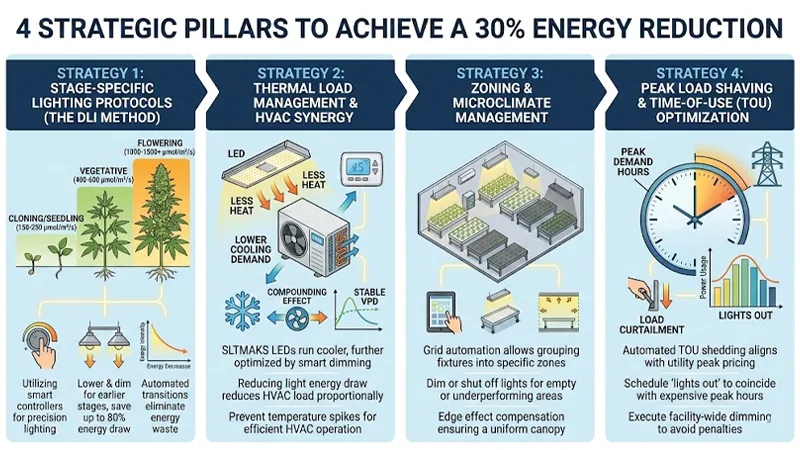
Strategy 1: Stage-Specific Lighting Protocols (The DLI Method)
Cannabis plants do not require maximum light intensity at all times. By utilizing smart controllers, cultivators can map out a precise lighting schedule tailored to the exact week of growth.
- Cloning/seedling stage: Plants may only require 150-250 µmol/m²/s. Running fixtures at 100% and raising them to the ceiling wastes energy. Smart controls allow fixtures to be lowered and dimmed to 20%, saving 80% of the energy draw in that specific zone.
- Vegetative stage: As plants transition, PPFD can be gradually stepped up to 400-600 µmol/m²/s.
- Flowering stage: Only during the peak weeks of the generative phase do plants require the maximum 1000-1500+ µmol/m²/s (often paired with CO2 supplementation).
By automating these transitions, a facility eliminates the massive energy waste of over-illuminating plants during their early life cycles.
Strategy 2: Thermal Load Management & HVAC Synergy
As mentioned earlier, lighting and HVAC are inextricably linked. SLTMAKS LED fixtures run significantly cooler than HPS lamps. When these LEDs are further optimized through smart dimming, the ambient heat load in the grow room drops dramatically.
- The compounding effect: By reducing the lighting energy draw by 20% through smart dimming, you concurrently reduce the HVAC cooling demand by a proportional amount. This synergistic effect is where facilities hit the 30% total energy reduction mark.
- Stable VPD: Smart controllers communicate with environmental sensors to prevent rapid temperature spikes when lights turn on, allowing the HVAC system to operate more efficiently without dramatic power surges.
Strategy 3: Zoning and Microclimate Management
Large commercial facilities often have varying microclimates within a single room, or stages of canopy development that differ from bench to bench.
- Grid automation: Smart controls allow managers to group fixtures into specific zones. If one rolling bench is empty due to a staggered harvest, or if a section is underperforming, the lights over that specific area can be dimmed or shut off entirely without affecting the rest of the room.
- Edge effect compensation: Plants on the edges of tables often receive less reflected light. Smart zoning allows cultivators to run perimeter lights at 100% while dimming center fixtures to 85%, ensuring a uniform canopy without over-powering the entire room.
Strategy 4: Peak Load Shaving and Time-of-Use (TOU) Optimization
Utility companies heavily penalize commercial operations for consuming power during peak demand hours (typically late afternoon to early evening).
- Automated TOU shedding: A smart lighting controller can be programmed to align with the utility’s TOU schedule. For vegetative rooms running 18/6, the system can automatically schedule the 6-hour “lights out” period to coincide exactly with the grid’s most expensive peak pricing hours.
- Load curtailment: In the event of an impending peak demand charge, the smart system can execute a facility-wide 10% dimming protocol. The plants will barely register a 10% drop in PPFD for a few hours, but the facility can avoid thousands of dollars in peak demand penalties.
Commercial Implementation & ROI Analysis
As a leading LED grow light supplier B2B, SLTMAKS understands that Chief Financial Officers (CFOs) and investors require hard data before approving capital expenditures (CAPEX).
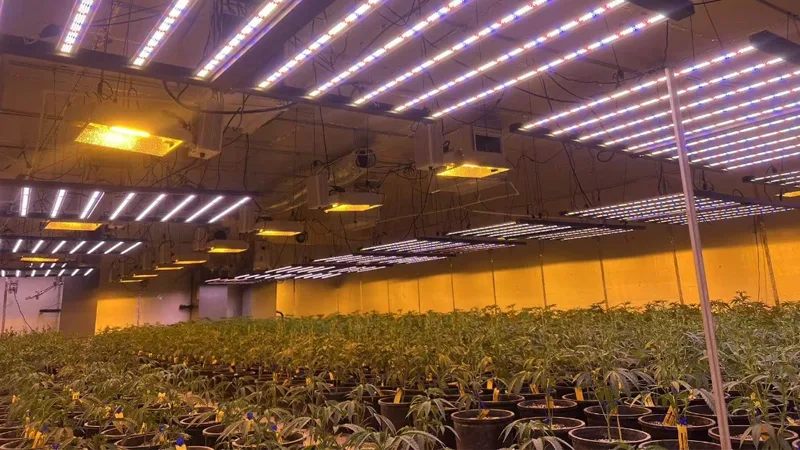
The Economics of Upgrading
While the initial CAPEX for a fully integrated, smart LED lighting system is higher than purchasing basic fixtures, the return on investment (ROI) is rapid and sustained.
Hypothetical ROI Model for a 50,000 sq. ft. Facility:
- Legacy system: 1,000 HPS fixtures (1,000 W each). Annual energy cost (Lighting + HVAC) = ~$1,200,000.
- SLTMAKS smart LED system: Replacing with 1,000 High PPE LEDs (700W each) paired with smart controls.
- Direct energy savings: Dropping from 1000W to 700W saves 30% instantly.
- Smart control savings: Implementing dimming, DLI tracking, and TOU shedding saves an additional 10-15%.
- HVAC savings: Reduced cooling load saves an estimated $150,000 annually.
- Total annual savings: ~$450,000+ per year in OPEX.
- Typical ROI timeline: 14 to 24 months.
Maximizing Utility Rebates
One of the most critical steps in commercial implementation is securing energy rebates. Most local utility providers offer substantial cash incentives for facilities that upgrade to energy-efficient technologies. Because SLTMAKS products are rigorously tested and listed on the Design Lights Consortium (DLC) qualified products list, our B2B clients routinely secure rebates that offset 20% to 50% of the initial hardware purchase price. Our technical team works directly with facility managers to provide the necessary photometric layouts and energy calculations required by utility companies for rebate approval.
Overcoming Implementation Challenges
Transitioning to a smart, automated facility is not without its hurdles. However, partnering with an experienced manufacturer mitigates these risks.
1. System Compatibility and BMS Integration
A common concern among facility engineers is whether new lighting controls will communicate with existing Building Management Systems (BMS) or specialized environmental controllers like Argus, TrolMaster, or Priva. Modern smart lighting solutions utilize standard protocols (such as 0-10V, RS485, or Bluetooth Mesh), ensuring seamless integration. This allows cultivators to manage lighting, fertigation, and HVAC from a single, centralized dashboard.
2. Staff Training and Adoption
Technology is only as effective as the team operating it. Shifting from analog timers to digital scheduling and DLI management requires a learning curve. As a dedicated commercial grow light manufacturer, SLTMAKS provides comprehensive onboarding, standard operating procedure (SOP) templates, and ongoing technical support to ensure your head grower and facility maintenance teams can maximize the system’s potential from day one.
3. Managing Upfront Capital
To overcome CAPEX hesitations, many MSOs are leveraging Equipment Financing or Energy-as-a-Service (EaaS) models. By structuring the purchase so that the monthly loan payments are actually lower than the monthly energy savings, facilities can become cash-flow positive on the upgrade immediately.
Conclusion: The Future is Automated
The era of brute-force indoor cultivation is over. As the cannabis market matures, efficiency is the ultimate competitive advantage. Combating high electricity rates requires moving beyond simple bulb replacements and embracing comprehensive, data-driven light management.
By implementing smart lighting controls—utilizing stage-specific protocols, thermal load management, precise zoning, and TOU optimization—large commercial facilities can aggressively slash their energy costs by 30% or more. This not only insulates the business from volatile utility rates but also dramatically improves the sustainability and profitability of the operation.
Ready to optimize your facility’s energy profile? As a premier B2B manufacturer of commercial LED grow lights, SLTMAKS specializes in outfitting large-scale indoor and greenhouse operations with cutting-edge, high-PPE lighting and automation systems.
Visit www.sltmaks.com today to explore our wholesale cannabis lighting solutions, or contact our engineering team to schedule a comprehensive, no-obligation Commercial Facility Lighting Energy Audit. Let us help you illuminate the path to higher margins.
How can smart lighting controls from a commercial grow light manufacturer reduce energy costs in my cannabis facility?
By utilizing dynamic dimming, Daily Light Integral (DLI) tracking, and Time-of-Use (TOU) optimization, smart lighting controls can reduce your facility’s energy consumption by up to 30%. Partnering with a reliable manufacturer to upgrade to high-PPE commercial LED grow lights also drastically lowers your HVAC cooling demands compared to legacy HPS systems.
Do wholesale cannabis lighting solutions support stage-specific lighting protocols?
Yes. Smart horticultural lighting systems allow cultivators to adjust light intensity precisely based on the plant’s growth stage. You can dim fixtures to 20% during the cloning phase and increase to maximum output during peak flowering, ensuring you only consume energy when the plants truly need it.
Are smart commercial LED grow lights compatible with my existing Building Management System (BMS)?
Absolutely. Top B2B LED grow light suppliers design their smart lighting solutions to integrate seamlessly with major environmental controllers (like TrolMaster, Argus, or Priva). They utilize standard communication protocols such as 0-10V, RS485, or Bluetooth Mesh for centralized, hassle-free control.
What is the typical ROI when upgrading to an automated cannabis grow light system?
While the initial CAPEX is higher, replacing inefficient HPS setups with smart commercial LED grow lights typically delivers an ROI within 14 to 24 months. The rapid payback comes from a direct 30% reduction in lighting wattage, additional savings from automated dimming, and significantly lower HVAC operational costs.
Can an LED grow light manufacturer help my facility secure utility energy rebates?
Yes. Reputable commercial grow light suppliers provide DLC-qualified fixtures and offer comprehensive engineering support, including photometric layouts and energy audits. This documentation is crucial for securing local utility rebates, which can offset 20% to 50% of your initial hardware purchase price.