Introduction
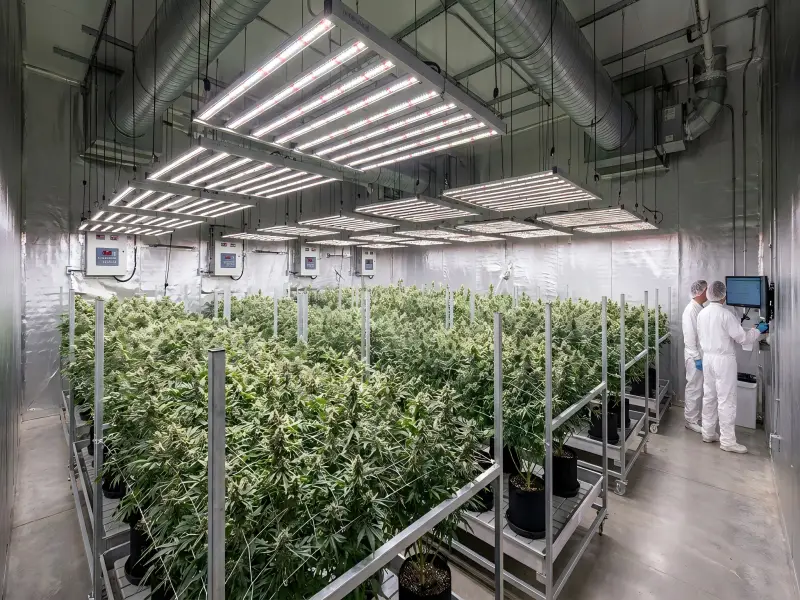
Operating a 1000-light commercial indoor cannabis facility places immense pressure on mechanical environmental controls. When calculating the HVAC load cannabis lights generate at this scale, climate management moves far beyond basic comfort cooling. It becomes a precise thermodynamic balancing act where heat dissipation and moisture extraction dictate crop health, potency, and financial viability.
In smaller or hobbyist cultivation setups, operators often rely on rough rules of thumb—such as allocating “one ton of cooling per four fixtures.” However, applying these simplistic formulas to a 1000-light facility leads directly to operational failure. Comfort-cooling systems designed for office buildings or retail stores are engineered to drop air temperature while handling minimal humidity. In a high-density flower canopy, up to half of the total energy load consists of latent moisture transpired by the plants. When HVAC systems cannot keep pace with this moisture, microclimates form, relative humidity spikes during lights-off transitions, and devastating pathogens like powdery mildew and botrytis destroy entire harvests.
Over-specifying cooling capacity without matching latent moisture removal results in severe equipment short-cycling, sky-high electricity bills, and unstable vapor pressure deficit (VPD) levels. Conversely, under-sizing mechanical equipment risks catastrophic thermal runaway during summer peak ambient conditions.
This guide provides a step-by-step engineering framework for an accurate HVAC load calculation for a 1000-light grow room. You will learn how to quantify sensible heat gain, calculate plant transpiration rates, determine the correct Sensible Heat Ratio (SHR), and specify an integrated climate control system that protects yields while lowering your total cost of ownership.
Table of Contents
HVAC Load Cannabis Lights: Basics for Grow Rooms
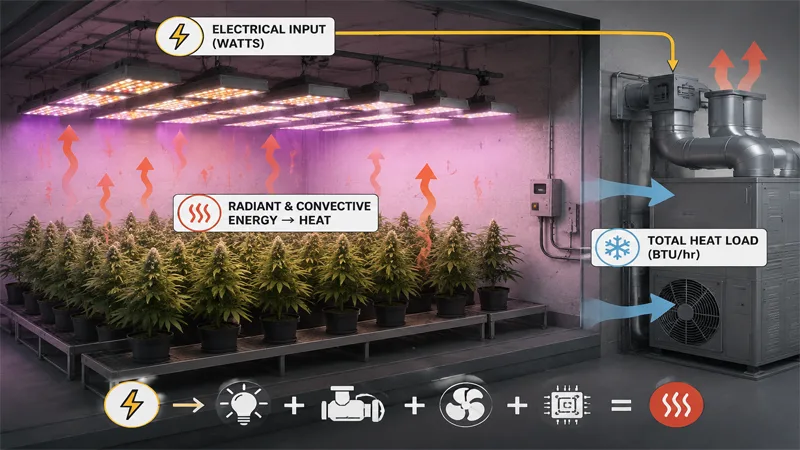
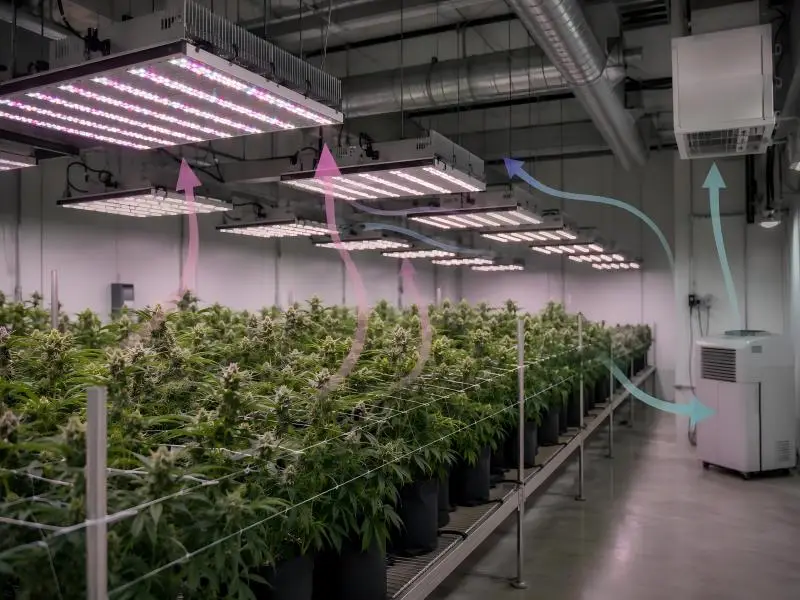
To size mechanical climate systems accurately, you must first understand the thermodynamic principles governing an indoor cultivation room. Every kilowatt of electrical power brought into a sealed grow room stays within that envelope until mechanical systems remove it.
The First Law of Thermodynamics dictates that energy cannot be created or destroyed. Inside a sealed commercial grow room, virtually 100% of the electrical energy consumed by grow lights, pumps, fans, and auxiliary electronics converts directly into heat. Even the light energy (photons) emitted by fixtures is absorbed by plant leaves, benching, walls, and floors, where it converts into thermal energy.
Total Electrical Input (Watts) → Radiant & Convective Energy → Total Heat Load (BTU/hr)
When calculating this thermal burden, you must reference actual wall-draw power rather than nominal marketing wattage. A light fixture marketed as a “1000-Watt replacement” might draw 650 Watts at the receptacle, whereas a commercial High-Pressure Sodium (HPS) fixture with a magnetic ballast labeled for 1000 Watts actually draws approximately 1,060 Watts due to internal ballast losses. Basing HVAC sizing on nominal labels creates an immediate calculation error of 6% to 35% across a 1000-light array.
Sensible Load vs. Latent Load
Cultivation climate engineering splits environmental heat into two distinct categories:
- Sensible heat load: The thermal energy that causes a direct rise in dry-bulb air temperature. You can measure sensible heat with a standard thermometer. Grow lights, fan motors, ballasts, building envelope solar gain, and dehumidifier compressors generate sensible heat.
- Latent heat load: The energy tied up in airborne moisture (water vapor). Latent heat does not directly change dry-bulb air temperature; instead, it changes relative humidity and humidity ratio. In a grow room, latent load is generated almost entirely by plant transpiration.
When plants take up water through their root systems, roughly 95% to 99% of that water is not retained in plant tissue. Instead, plants transpire it through stomata into the room air to cool their leaves and drive nutrient transport. As liquid water transforms into vapor, it absorbs heat from the surrounding air (the latent heat of vaporization).
Water Applied (Gallons/Day) → Plant Transpiration → Airborne Moisture Load → Latent HVAC Capacity Required
Because irrigation water converts almost entirely into airborne vapor during the light period, transpiration turns irrigation volume into a dominant latent load that the mechanical HVACD (Heating, Ventilation, Air Conditioning, and Dehumidification) system must continuously extract to maintain target VPD.
The 1000-Light Load Calculation Step by Step
Calculating total climate load for a 1000-light facility requires analyzing sensible heat and latent moisture in parallel before combining them into a total tonnage requirement.
Converting Lighting Power to BTU/hr
Lighting is the largest single source of sensible heat in an indoor farm. The fundamental physical constant for electrical power conversion is:
1 Watt of Electrical Power = 3.41214 BTU/hr
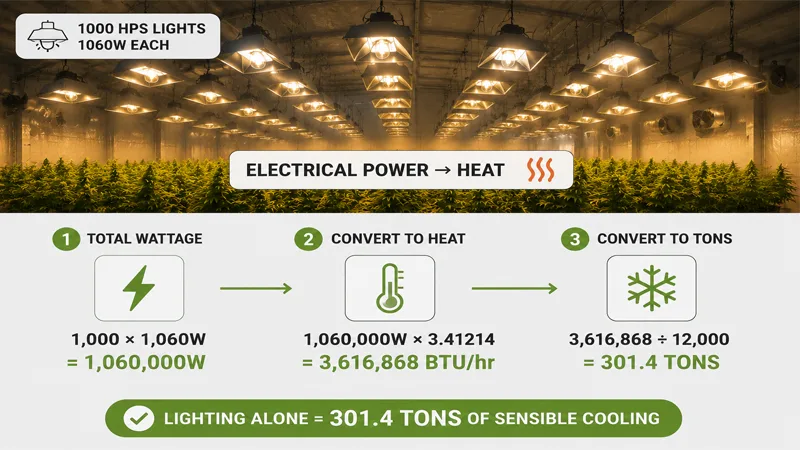
Step 1: Calculate total wattage
For a facility utilizing 1,000 legacy HPS fixtures drawing 1,060 Watts each (including ballast losses):
1,000 fixtures × 1,060 Watts = 1,060,000 Watts (1,060 kW)
Step 2: Convert electrical draw to thermal Heat
Multiply total wattage by the conversion constant:
1,060,000 Watts × 3.41214 BTU/hr per Watt = 3,616,868 BTU/hr of Sensible Heat
Step 3: Convert BTU/hr into nominal cooling tonnage
One nominal ton of cooling capacity equals 12,000 BTU/hr:
3,616,868 BTU/hr ÷ 12,000 BTU/hr per Ton = 301.4 Tons of Sensible Cooling
Lighting alone in a 1000-light HPS facility generates over 300 tons of sensible cooling demand.
Adding latent load and sensible heat ratio
Once sensible heat is established, you must calculate the latent moisture load produced by the canopy.
Step 1: Quantify daily irrigation and transpiration
In a mature flower canopy (weeks 4 through 7 of bloom), 1,000 commercial plants typically receive between 0.35 and 0.50 gallons of irrigation per plant per day. Assuming a conservative irrigation rate of 0.35 gallons per light per day:
1,000 plants × 0.35 gallons/day = 350 Gallons of Water per Day
Since plants transpire nearly all applied water during the 12-hour photoperiod, the system must extract these 350 gallons within that 12-hour window:
350 Gallons ÷ 12 Hours = 29.17 Gallons per Hour (GPH)
Converting gallons per hour to Pints Per Day (PPD)—the standard rating unit for commercial dehumidifiers:
350 Gallons × 8 Pints/Gallon = 2,800 Pints Per Day (PPD)
Step 2: Convert transpiration to latent BTU/hr
Water requires approximately 1,061 BTU per pound to change phase from liquid to vapor. Since one gallon of water weighs 8.34 pounds, evaporating one gallon requires:
8.34 lbs/gallon × 1,061 BTU/lb ≈ 8,849 BTU per Gallon of Transpired Water
To find the hourly latent cooling load:
29.17 Gallons/Hour × 8,849 BTU/Gallon = 258,125 BTU/hr of Latent Load
Converting latent heat into cooling tons:
258,125 BTU/hr ÷ 12,000 BTU/hr per Ton = 21.5 Tons of Latent Cooling
Step 3: Calculate the Sensible Heat Ratio (SHR)
Sensible Heat Ratio defines the proportion of sensible cooling relative to total (sensible + latent) cooling:
SHR = Sensible Heat Load ÷ (Sensible Heat Load + Latent Heat Load)
Applying our 1000-light HPS baseline numbers:
Sensible Load = 3,616,868 BTU/hr
Latent Load = 258,125 BTU/hr
Total Load = 3,874,993 BTU/hr
SHR = 3,616,868 ÷ 3,874,993 ≈ 0.93 (Room-Level Lighting-to-Water Baseline)
As highlighted in the Resource Innovation Institute HVAC Best Practices Guide, as plants evaporate water, they absorb sensible heat from the room air and convert it into latent heat. This process naturally cools the air dry-bulb temperature while driving up humidity.
When accounting for additional equipment heat, standalone dehumidifiers, and lights-off transitions, the space SHR for a commercial grow room drops to 0.50 – 0.60. Standard commercial HVAC units are built for an SHR of 0.75 to 0.85; using them in a grow room causes temperature to drop too fast before sufficient moisture is removed, causing severe humidity spikes.
Accounting for the full heat-load profile
A complete engineering calculation must incorporate secondary sensible and latent heat sources beyond lights and plants:
| Heat Source | Load Category | Calculation Method | Impact on 1000-Light Room |
|---|---|---|---|
| Standalonedehumidifiers | Sensible | 1 kW power draw = 3,412 BTU/hr added to air | +15 to +35 Tons sensible heat (if heat rejected indoors) |
| Circulation fans & pumps | Sensible | Total motor wattage × 3.412 BTU/hr | +8 to +15 Tons sensible heat |
| CO₂ generators (gas) | Sensible & Latent | 1 lb propane burned = 21,800 BTU sensible + 1.5 lbs moisture | +5 to +10 tons of heat + additional moisture |
| Building envelope conduction | Sensible | Wall area × U-factor × (Outdoor Temp – Indoor Temp) | Variable based on climate zone & insulation |
| Personnel & infiltration | Sensible & Latent | ~250 BTU/hr sensible + ~200 BTU/hr latent per person | Minor baseline contribution |
Key takeaway: When using standalone commercial dehumidifiers that reject compressor heat back into the space, every pint of water removed adds roughly 1,000 to 1,200 BTU of sensible heat back into the room. Integrated HVACD systems that reject compressor heat outdoors eliminate this secondary load penalties.
Headroom Safety Margin
Engineers apply a 10% to 15% safety factor to the total calculated load. This safety margin accounts for extreme summer ambient conditions, heat exchanger fouling over time, voltage fluctuations, and rapid moisture spikes during irrigation events.
Total Specified HVAC Capacity = Calculated Total Load × 1.15
LED vs HPS: How Your Lighting Choice Changes the Load
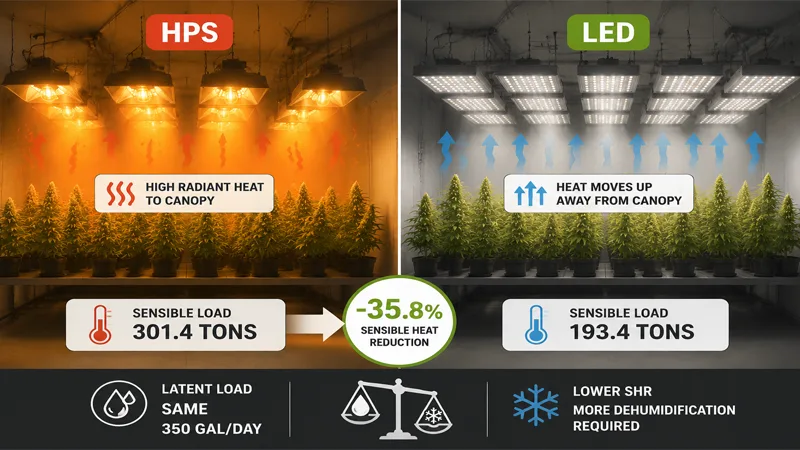
Upgrading from legacy HPS to high-efficacy LED lighting fundamentally alters the room heat profile. While HPS fixtures radiate massive amounts of infrared (IR) energy directly onto the plant canopy, LEDs emit cool light beams while transferring heat upwards through aluminum heat sinks.
| Item | Detail |
|---|---|
| HPS lighting | High radiant IR heat → heavy canopy sensible heat load |
| LED lighting | High efficacy (μmol/J) → 30–40% lower sensible load + same latent transpiration |
When replacing 1,000 HPS fixtures (1,060W actual draw each) with 1,000 high-efficiency LED fixtures drawing 680 Watts while delivering equivalent PPFD:
1,000 LED fixtures × 680 Watts = 680,000 Watts (680 kW)
Sensible Thermal Load = 680,000 W × 3.41214 = 2,320,255 BTU/hr
Sensible Tonnage = 2,320,255 ÷ 12,000 = 193.4 Tons
Switching to LED reduces sensible cooling demand from 301.4 Tons down to 193.4 Tons—a massive 35.8% sensible heat reduction.
| Item | Detail |
|---|---|
| HPS sensible cooling required | 301.4 Tons |
| LED sensible cooling required | 193.4 Tons (-35.8%) |
However, because plant transpiration is driven primarily by Photosynthetically Active Radiation (PAR) photons and VPD, the plants still transpire the same 350 gallons per day (2,800 PPD).
Because the sensible cooling requirement drops significantly while the latent moisture load remains unchanged, the space Sensible Heat Ratio becomes even lower. Deploying high-efficacy fixtures—such as SLTMAKS full-spectrum LED grow fixtures—requires sizing dehumidification in parallel with cooling rather than relying on cooling equipment alone for moisture extraction.
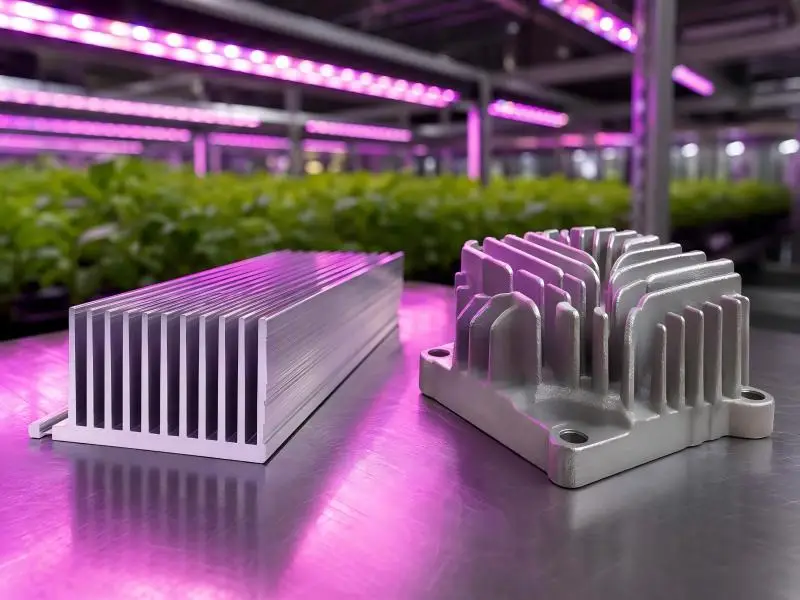
To optimize operational efficiency, operators retrofitting to LED should select light arrays engineered with superior thermal management. Reviewing a commercial LED grow lighting guide helps facility designers balance fixture efficacy (PPF/Watt), thermal dissipation, and HVAC capacity to achieve maximum energy rebates and lower utility bills. Choosing high-efficacy commercial LED grow lights with heavy-duty aluminum heat sinks ensures heat is efficiently transferred away from the canopy into top-room air where HVAC return ducts capture it cleanly.
Avoiding Common HVAC Sizing Mistakes
Miscalculating environmental loads leads to recurring capital and operational penalties. Reviewing HPAC Engineering’s grow room HVAC analysis confirms that the majority of commercial grow facility failures stem from four design errors:
1. Believing the “LED Creates No Heat” Myth
A common misconception is that LED fixtures generate no heat. While LEDs are significantly more efficient than HPS, every Watt of electrical power fed into an LED fixture still transforms into heat inside the space. Ignoring the 193+ tons of sensible heat generated by a 1000-light LED array causes immediate thermal runaway.
2. Oversizing Cooling While Undersizing Dehumidification
Installing standard rooftop AC units sized strictly for peak sensible heat results in rapid cooling cycles. The air conditioner cools the room dry-bulb temperature to setpoint in minutes and shuts off before the cooling coil can condense airborne moisture. Relative humidity skyrockets, causing condensation on leaves and triggering mold outbreaks.
3. Ignoring Synchronized Load Peaks Across Multi-Room Facilities
In multi-room facilities operating staggered photoperiods (e.g., Room A lights-on while Room B lights-off), central plant systems must handle shifting loads. During lights-off transitions, sensible heat drops to near zero within minutes, but plants continue transpiring heavily for 30 to 60 minutes as stomata close. Equipment that cannot modulate reheating capacity will over-cool the room, spiking relative humidity to 90%+.
Lights-Off Event → Sensible Heat Drops Immediately → Transpiration Continues 30-60 Mins → High Risk of RH Spike
4. Rigid Single-Stage Equipment Design
Vegetative plants require higher relative humidity and lower transpiration removal compared to late-stage flowering plants. Sizing HVAC equipment solely for fixed peak conditions without hot-gas reheat, variable-refrigerant flow (VRF), or modulated chilled-water valves creates an inflexible system that struggles during early vegetative and late-flush cycles.
Conclusion
Calculating HVAC load for a 1000-light cannabis facility requires a rigorous, evidence-based engineering workflow:
- Establish true sensible draw: Multiply actual total fixture wattage (plus ballasts/drivers) by 3.412 BTU/hr per Watt.
- Calculate latent transpiration: Convert daily irrigation volume (gallons/day) to GPH, PPD, and latent BTU/hr using 8,849 BTU per transpired gallon.
- Determine space SHR: Recognize that grow room SHRs operate at 0.50–0.60, requiring dedicated latent extraction capacity.
- Account for auxiliary heat & safety margin: Add fan heat, dehumidifier heat rejection, envelope gains, and a 15% engineering headroom factor.
- Decouple cooling and dehumidification: Specify variable-capacity HVACD systems or dedicated commercial dehumidifiers paired with high-efficiency LED arrays.
Navigating these complex psychrometric variables requires close collaboration between cultivation leaders and licensed professional mechanical engineers specializing in Controlled Environment Agriculture. As detailed in Desert Aire’s application note on grow room energy usage, investing in purpose-built climate infrastructure protects crop quality, ensures consistent yield, and delivers the lowest total cost of ownership over the life of your facility.
Explore commercial spectrum-engineered LED fixtures to optimize your facility’s thermal profile and maximize cultivation efficiency.
FAQ
How many tons of cooling are needed for a 1000-light grow room?
A 1000-light cannabis facility typically requires between 220 and 350 tons of total HVAC cooling capacity, depending on lighting technology. Legacy HPS setups generate higher sensible heat requiring around 300+ tons, whereas modern LED fixtures reduce sensible cooling needs to approximately 190–220 tons. However, LED setups require greater dedicated latent dehumidification capacity to handle plant transpiration.
How do you calculate latent heat load from plant transpiration?
To calculate latent heat load, determine daily irrigation volume in gallons, convert it to gallons per hour (GPH), and multiply by 8,849 BTU per gallon (the latent heat required to evaporate water). For example, if 1,000 plants transpire 350 gallons during a 12-hour light cycle (29.17 GPH), the hourly latent heat load is approximately 258,125 BTU/hr, or roughly 21.5 tons of latent cooling capacity.
What is Sensible Heat Ratio (SHR), and why is it critical for grow rooms?
Sensible Heat Ratio (SHR) is the ratio of sensible cooling load (temperature reduction) to total cooling load (sensible + latent). Standard commercial buildings operate at an SHR of 0.75 to 0.85, but indoor cultivation spaces operate at an SHR of 0.50 to 0.60 due to massive plant transpiration. Sizing a grow room with standard comfort HVAC leads to inadequate humidity control, equipment short-cycling, and mold issues.
How much heat reduction do you get by switching from HPS to LED grow lights?
Switching from 1000W HPS fixtures to high-efficacy LED fixtures reduces sensible heat output by 30% to 40%. For a 1000-light array, this lowers sensible heat demand from roughly 300 Tons down to under 195 Tons. However, since LED light drives equivalent PAR photon delivery, plants transpire the same volume of water, keeping the latent moisture load unchanged.
Why do humidity spikes occur immediately after grow room lights turn off?
When lights shut down, sensible heat input drops to near zero instantly. However, plant stomata take 30 to 60 minutes to close completely, causing transpiration to continue into a rapidly cooling environment. Without modulated hot-gas reheat or dedicated dehumidifiers running during lights-off transitions, relative humidity quickly spikes above 90%, increasing powdery mildew risks.
Should grow room dehumidifiers reject heat indoors or outdoors?
Dedicated commercial HVACD systems or split dehumidification units that reject compressor heat outdoors are preferred for commercial facilities. Standalone dehumidification units that exhaust compressor heat back into the grow room add 1,000 to 1,200 BTU of sensible heat per pint of water removed, increasing overall cooling tonnage requirements by 15% to 30%.