Introduction
This checklist is for U.S. indoor farms that need to audit a grow light manufacturer in China while scaling production, expanding to new rooms, or retrofitting legacy HPS—where a grow-light failure isn’t an inconvenience; it’s downtime, labor disruption, and risk.
The goal is simple: turn supplier claims into verifiable evidence. You’ll use a step-by-step audit flow that starts with corporate reality checks, then moves through compliance validation, quality controls, and finally performance proof.
Your primary outcomes are electrical safety, uptime, ROI/TCO, and verifiable compliance. If a manufacturer can’t prove those with documentation you can independently validate, you don’t have a supplier—you have an open risk.
A practical rule: don’t “trust certificates.” Verify them in official directories and cross-check them against model numbers, ratings, and label artwork. Start with official directories and accredited reports whenever possible, because they’re harder to fake and easier to defend during inspection or incident review.
Table of Contents
Verify the Manufacturer (Audit a Grow Light Manufacturer in China)
Business Registration and Export License
Start by confirming the legal entity you’ll be contracting with.
Ask for the business name in Chinese and English, the Unified Social Credit Code, and the export license details. Match the entity name across the pro forma invoice, bank account name, and any certification paperwork.
If the manufacturer won’t provide these basics—or the names don’t match exactly—treat it as a stop signal. It’s hard to enforce warranty, IP, or liability terms when you can’t cleanly identify who “the supplier” is.
Ownership, Address, and Site Reality
Next, verify that the “factory” is real and tied to the entity you’re paying.
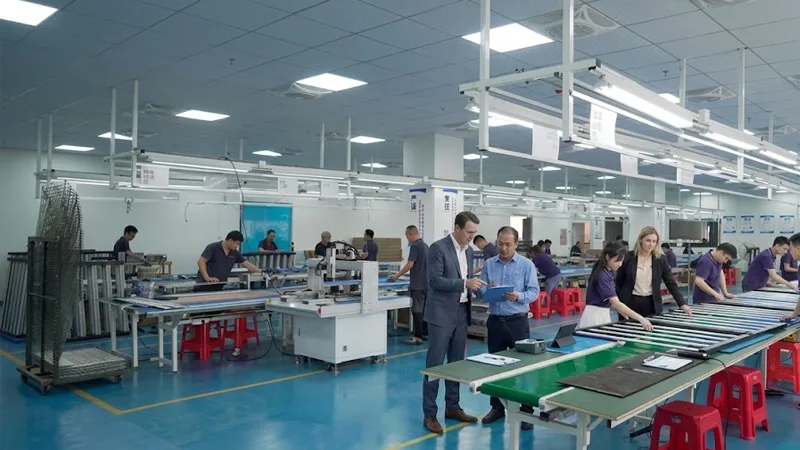
Request a current facility address, production floor photos/videos with date evidence, and a live video walk-through that includes: incoming inspection area, SMT/PCBA (printed circuit board assembly) line if applicable, assembly line, burn-in racks, and end-of-line test stations.
If you can visit, do it. If you can’t, a third-party on-site audit is still better than a supplier-curated tour. Look for consistency between the address, signage, shipping labels, and the location shown in logistics documents.
Capacity, Customers, and Financial Signals
Capacity isn’t just “units per month.” It’s whether the manufacturer can build your exact configuration reliably at scale.
Ask for a capacity statement broken down by: LED board/engine, driver sourcing, heat sink fabrication, assembly labor, and test throughput. Then ask what happens when you double your forecast—do they add shifts, subcontract, or substitute components?
Customer proof can be sensitive, but you can still ask for anonymized references: sample packing lists, typical lead times, and the top 3 failure modes they’ve had to address in the last 12 months. A supplier that can discuss failures and corrective actions credibly is usually more mature than one that only offers perfect claims.
Certifications and Regulatory
U.S. Compliance: NRTL, FCC, DLC
For the U.S., the question is not “Do you have a certificate?” It’s “Can an AHJ (Authority Having Jurisdiction) and your insurer validate the listing for this exact product configuration?”
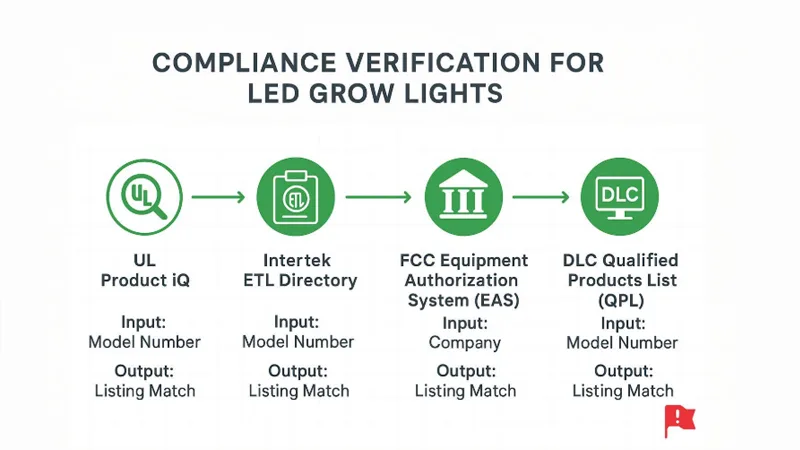
Start with NRTL (Nationally Recognized Testing Laboratory) safety listing evidence. NRTLs are recognized under OSHA’s program; you can confirm the lab’s status via the OSHA NRTL Program list.
Then, validate the listing itself in the issuer’s directory:
- UL listings: search UL Product iQ.
- Intertek listings: search the Intertek ETL Listed Mark directory (or the ETL directory search portal).
For electromagnetic compliance, confirm whether the fixture’s electronics trigger FCC requirements. When applicable, verify the authorization in the FCC Equipment Authorization (FCC ID search).
If you rely on rebates or utility programs, DLC matters. You can validate product qualification in the DLC Qualified Products List (QPL). (Treat DLC as a performance/efficiency qualification pathway—not a substitute for safety listing.)
EU/UK Marks vs U.S. Needs
CE/UKCA documentation can be a useful signal, but don’t let it stand in for U.S. readiness.
The U.S. market typically expects a safety listing that aligns with how inspectors and insurers validate equipment. A manufacturer may legitimately sell in the EU with CE-based documentation while still lacking the directory-traceable listing you need for U.S. deployment.
If a supplier leads with CE/UKCA but can’t show U.S.-verifiable listing evidence (or tries to argue it isn’t necessary), that’s a misalignment you should resolve before you ever discuss price.
Verification Steps and Red Flags
Use a strict match protocol:
- Match the model number exactly (including suffixes for voltage, dimming, spectrum, or driver variant).
- Match the electrical rating on the label (input voltage range, current, frequency).
- Match the certificate holder’s name to the legal entity you are paying.
- Match the label artwork to the listing’s requirements (logos, file number, standard references).
⚠️ Warning: A “real certificate” attached to the “wrong model” is functionally the same as no certificate.
Treat these as high-risk red flags:
- The supplier won’t share directory identifiers (file number, control number, listing report references).
- The listing exists, but the certificate holder is a different company with no clear relationship.
- The listing is for a product family, but your configuration (driver, voltage, enclosure/IP rating) isn’t included.
- The supplier insists the document is “confidential,” but still wants you to place a large deposit.
Quality and Reliability Controls
LEDs, Drivers, LM-80/TM-21/ISTMT
You’re buying a system, but reliability often collapses at the component level.
For LED sources, LM-80 is a standardized way to test lumen maintenance over time for LED packages/modules/arrays. TM-21 uses LM-80 data to project lumen maintenance forward, but it is still a projection method, not a guarantee. ISTMT (In-Situ Temperature Measurement Test) ties that LED source data to the actual temperatures inside the operating fixture.
Ask the manufacturer to provide:
- LED source LM-80 report(s) for the specific LED family used
- TM-21 projections based on those LM-80 report(s)
- ISTMT (or an equivalent temperature justification) showing the operating case temperature in the luminaire
- Driver documentation: model, electrical ratings, protection features, and substitution controls
If you want a quick way to pressure-test driver choices, it helps to understand the difference between constant-current and constant-voltage architectures. For background, see Constant Current vs Constant Voltage driver for Grow Lights.
Process Controls and End-of-line Tests
A serious manufacturer can show you how they prevent defects—not just how they fix them after the fact.
Look for documentation and on-site evidence of:
- Incoming inspection (LEDs, drivers, connectors, fasteners) with pass/fail criteria
- ESD (electrostatic discharge) controls: grounded benches, wrist straps, documented training
- Torque control on mechanical fasteners (especially for thermal interfaces and electrical terminations)
- Traceability: serial numbers tied to key components and test outcomes
At the end-of-line (EOL), request the test summary and acceptance criteria. At a minimum, you want electrical safety checks and a functional test under load. If they run burn-in, ask for the burn-in duration and what constitutes a failure.
Robustness: Surge, ESD, IP, Thermal
Commercial facilities punish fixtures in ways that spec sheets rarely describe: switching transients, humidity swings, washdown procedures, and high ambient temperatures.
Audit for robustness evidence in three areas:
- Surge and transient protection: what protections are designed into the driver and fixture input stage
- ESD (electrostatic discharge) protection and handling controls during manufacturing
- IP (Ingress Protection) rating evidence if the environment demands it (water/dust), including gasket design and test rationale
Thermal management is also uptime management. Ask what the thermal design assumes for ambient temperature, how the fixture maintains safe operating temperatures over time, and what change-control process applies if they revise heat sink geometry or LED board layout.
Photometric and Horticultural Performance
LM-79, IES, PPF/PPE
Treat performance proof as a chain of evidence.
LM-79 is the standard test method for a complete luminaire’s electrical and photometric performance. It’s also commonly used to produce an IES photometric file for lighting design tools.
For horticulture, pay attention to PPF (Photosynthetic Photon Flux) and PPE (Photosynthetic Photon Efficacy, often expressed as μmol/J). But don’t accept a single “PPE” number as proof. Ask for the test conditions and supporting artifacts (test report identifiers, lab accreditation, and model traceability).
If you want a broader buying context on interpreting PAR/PPFD style metrics in spec sheets, SLTMAKS’ buyer guide includes a solid baseline vocabulary in Best Rated LED Grow Lights: Reviews, PAR Output, and Buyer’s Guide.
PPFD Uniformity and Layout
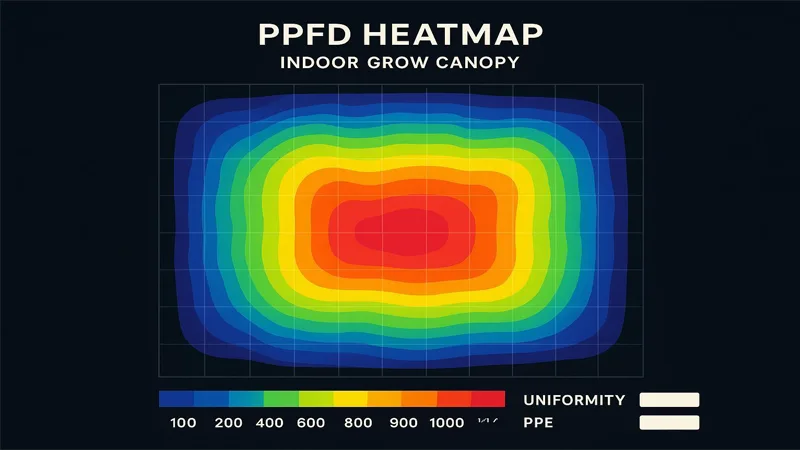
Uniformity is usually where real-world outcomes diverge from brochure numbers.
Ask for a canopy-level PPFD (Photosynthetic Photon Flux Density) map at your target hanging height, with clear spacing assumptions. Then evaluate:
- Minimum vs average PPFD (min/avg is a fast uniformity proxy)
- Edge fall-off in your intended layout
- Sensitivity to mounting height changes
A manufacturer that can supply both PPFD maps and an IES file (from accredited testing) makes it easier for you to model layouts across room geometries and replicate performance across sites.
For a comparison-style view of how suppliers present PPFD evidence, you can reference Top LED Grow Lights: Market Leaders Compared for 2026 as a starting point.
Spectrum Validation by Crop Stage
“Full spectrum” is not a specification. It’s a label.
Ask for a spectral power distribution (SPD) measurement for the exact configuration you’re buying. Then, validate that the spectrum is stable across dimming levels (if dimmable) and across production runs.
If you run different crop stages across rooms, you require a documented approach for spectrum variants (or tunable controls) that includes: how the variant is identified on the label, how it is controlled in production (to prevent mix-ups), and how you can re-order the same spectrum six months later without ambiguity.
Commercial Terms, Service, and IP
Warranty, RMA, Spares
A warranty is only as useful as the RMA process behind it.
Ask for RMA terms in writing: failure definitions, troubleshooting steps, shipping responsibilities, turnaround time, and whether replacements ship before returns are received (critical for uptime). Then ask what spare parts they recommend you stock per site (drivers, connectors, dimming cables, etc.).
If the supplier cannot describe a repeatable failure-triage workflow, assume downtime becomes your problem.
Contracts, Payments, Inspections
Your contract should force auditability.
At a minimum, specify acceptance criteria (documentation + functional tests), packaging and labeling requirements, change-control rules for key components, and inspection rights. Use third-party inspections for first orders or any configuration change.
Here’s a verification-ready documentation pack example you can ask for from any manufacturer (shared here as a neutral illustration of what “audit-ready” looks like):
- Directory-verifiable safety listing identifiers (UL/ETL file or control numbers) and links to the issuer directory entry
- FCC authorization identifiers when applicable (FCC ID/grant references)
- DLC QPL evidence when rebates/incentives matter (product listing link)
- Accredited test reports: LM-79 for the luminaire; LM-80/TM-21 for LED sources; ISTMT (or operating temperature rationale)
- Label artwork files + rating plate photos showing electrical ratings and traceability
- QA artifacts: incoming inspection criteria, end-of-line test checklist, burn-in summary, and sample test records by serial number
- Engineering change control: a simple record of what can change without notice vs what requires written customer approval (driver substitutions, LED binning, PCB revisions)
This kind of pack isn’t “extra paperwork.” It’s what turns procurement into a defensible process.
U.S.-market Readiness and Labeling
Labels are where compliance and field reality meet.
Confirm that the rating label matches the configuration you’re importing: input voltage range, frequency, current draw, environmental rating (if applicable), and the safety mark details required by the listing.
Also, verify practical U.S. readiness items that impact deployment time:
- Wiring/connector standards appropriate for your install environment
- Clear installation instructions and safety warnings in English
- Traceable serial numbers (especially important for multi-site standardization and warranty tracking)
For a broader context on supplier selection and common sourcing pitfalls, you can cross-reference How to Choose a Reliable LED Grow Light Manufacturer in China (2026 Guide).
Conclusion
A good audit ends with decision triggers you can defend.
If you need a simple way to set acceptance ranges without inventing numbers, define them in terms of evidence completeness and mismatch tolerance:
- Compliance: directory-traceable safety listing for the exact model/configuration; label matches listing; no entity-name mismatch.
- Reliability: documented incoming QC + EOL testing + change control; clear RMA workflow and spares plan.
- Performance: accredited LM-79 + PPFD map at your target height/layout; spectrum measurement for the exact configuration.
- Commercial readiness: contract includes inspection rights, acceptance criteria, and substitution controls.
To save time, keep the official lookups bookmarked and attach screenshots/PDF exports to your vendor file:
- UL Product iQ
- Intertek ETL Listed Mark directory
- FCC Equipment Authorization (FCC ID search)
- DLC Qualified Products List (QPL)
- OSHA NRTL Program list
Standardize this audit into a scorecard and re-run it whenever you change anything that matters—driver model, LED source, enclosure/IP rating, or label. That’s how you reduce TCO: fewer surprises, fewer emergency replacements, and fewer compliance scrambles.
FAQ
How can I verify that a manufacturer’s safety certificates (UL, ETL, etc.) are authentic?
Never rely solely on a PDF provided by the supplier. You must perform a “strict match protocol” by searching the official directories (such as UL Product iQ or the Intertek ETL Directory). Ensure the model number, electrical ratings, and the certificate holder’s name match your supplier’s legal entity exactly. If they claim the file is “confidential,” treat it as a major red flag.
Why is an LM-80 report alone not enough to guarantee the lifespan of a grow light?
While LM-80 measures the lumen maintenance of the LED chips, it doesn’t account for how those chips perform inside a specific fixture. To get the full picture, you also need the TM-21 projection (which predicts future lifespan) and an ISTMT (In-Situ Temperature Measurement Test) report. The ISTMT proves that the fixture’s thermal design keeps the LEDs cool enough to actually achieve the lifespan predicted by the LM-80 data.
What should I look for during a remote “virtual” factory tour?
If you cannot visit in person, request a live video walk-through. Do not accept pre-recorded marketing videos. Ask to see the incoming inspection area, the SMT/PCBA lines, the burn-in racks (where lights are tested under load), and the end-of-line test stations. Check that the signage and shipping labels match the company name and address on your contract.
What is the difference between “Full Spectrum” and “Spectral Validation”?
“Full Spectrum” is a marketing label, not a technical specification. For a professional audit, you should request a Spectral Power Distribution (SPD) measurement for the exact configuration you are buying. This ensures the light output matches your crop’s specific needs at different growth stages and remains stable even when the lights are dimmed.
How do I evaluate a supplier’s Quality Control (QC) maturity?
A mature manufacturer focuses on prevention. Ask for evidence of ESD (electrostatic discharge) controls like grounded benches and wrist straps, torque control records for mechanical fasteners, and a documented RMA (Return Merchandise Authorization) workflow. If they cannot describe how they triage and fix failures, assume that downtime will eventually become your financial burden.
Why should I prioritize NRTL listings over CE/UKCA marks for the U.S. market?
CE and UKCA marks are often based on self-declaration and are required for the European/UK markets. However, U.S. inspectors (AHJs) and insurance companies typically require a safety listing from an NRTL (Nationally Recognized Testing Laboratory) like UL or ETL. A manufacturer might legally sell in Europe but still lack the verifiable, directory-traceable listing needed for a compliant and insurable U.S. facility.