Introduction: The Seasonal Threat to Commercial Cultivation
For commercial greenhouse operators, the transition into the winter months and the onset of prolonged rainy seasons present one of the most significant threats to annual profitability. As natural sunlight wanes, cloud cover thickens, and daylight hours shrink, the foundation of crop production—photosynthesis—is severely compromised. When plants are starved of adequate light, the cascading effects are rapid and destructive: morphological abnormalities like stretching (etiolation), delayed harvest cycles, diminished nutritional or medicinal profiles, and ultimately, a drastic drop in yield.
In the highly competitive commercial agriculture sector, relying solely on unpredictable weather patterns is no longer a viable business strategy. Modern cultivation requires absolute environmental control to ensure consistent, year-round production schedules and contracted delivery volumes. To bridge the gap between seasonal darkness and the light requirements of high-value crops, advanced supplemental lighting is mandatory.
This comprehensive guide explores the ultimate solution for winter and rainy season cultivation: High-Efficiency LED Top-Lighting. By implementing modern LED technology and adhering to strategic best practices, commercial growers can not only protect their yields from seasonal light deficits but also achieve unprecedented energy savings, superior crop quality, and a rapid return on investment (ROI).
Table of Contents
Understanding the Low-Light Challenge: DLI and Crop Health
To effectively combat seasonal light loss, growers must understand the fundamental metric of light accumulation.
A Simple look at Daily Light Integral (DLI). Put simply, Daily Light Integral (DLI) is the total amount of photosynthetically active radiation (PAR) that lands on a specific area over 24 hours. If you think of light as rain, PPFD (Photosynthetic Photon Flux Density) is how hard it is raining at any given second, and DLI is the total amount of water collected in a bucket by the end of the day. Every crop has a specific daily “calorie” requirement of light (DLI) to achieve maximum yield.
During peak summer months, a commercial greenhouse might naturally receive a DLI of 25 to 30 mol/m²/day. However, during heavy rainy seasons or the dead of winter, natural DLI can easily plummet below 5 to 10 mol/m²/day. For high-light crops like tomatoes, cucumbers, or medicinal plants that demand a DLI of 20 to 30+ mol/m²/day to produce commercially viable fruit and flowers, this deficit is catastrophic.
The pitfalls of legacy HPS lighting. Historically, growers combated this deficit using High-Pressure Sodium (HPS) fixtures. While HPS lights generate photons, they come with severe operational penalties for modern greenhouses:
- Excessive radiant heat: HPS bulbs emit massive amounts of infrared heat. In winter, while some heat is welcome, it is difficult to control. Furthermore, if growers need to supplement light during a warm, overcast rainy day, HPS lights force the greenhouse HVAC systems into overdrive to prevent crop stress.
- Energy inefficiency: Legacy lighting converts a significant portion of electricity into heat rather than usable plant light, resulting in exorbitant winter utility bills.
- Fixed spectrum: HPS offers a fixed, yellow/orange-heavy spectrum that lacks the necessary blue wavelengths to keep plants compact, often resulting in leggy, weak plants during the winter months.
Why High-Efficiency LED Top-Lighting is the Ultimate Winter Solution
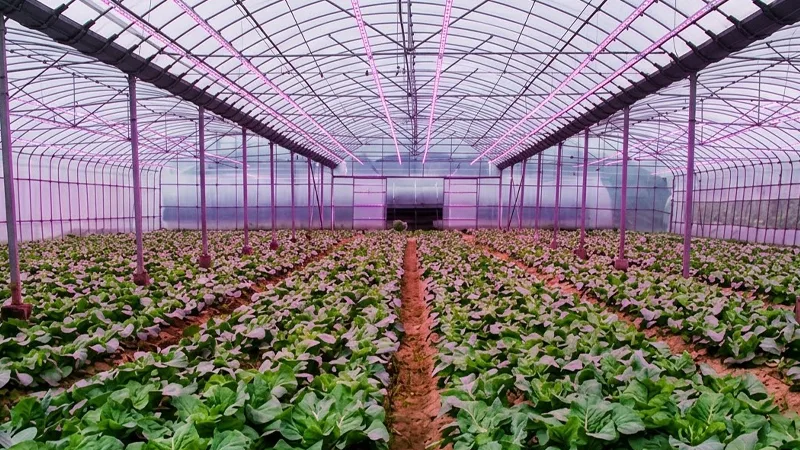
To resolve the physiological and financial pain points of winter cultivation, the industry has aggressively shifted toward High-Efficiency LED Top-Lighting systems. These commercial LED grow lights represent a paradigm shift in horticultural engineering, offering precise control over the greenhouse environment.
1. Unmatched efficacy and energy savings: The core metric of grow light efficiency is micromoles per joule (µmol/J), which measures how many photons are produced per watt of electricity. Traditional HPS fixtures typically hover around 1.7 to 1.9 µmol/J. In stark contrast, industry-leading High-Efficiency LED Top-Lighting systems, such as those engineered by SLTMAKS, can achieve efficacies exceeding 3.0 µmol/J. This means growers can deliver the same amount of light to the crop canopy while cutting electricity consumption by 40% to 50%. During long winter nights, this reduction in energy usage directly protects the farm’s profit margins.
2. Precision spectral control: Unlike the sun, which is obscured by winter clouds, or HPS lights with their rigid spectrum, high-efficiency LEDs offer targeted light recipes. During low-light seasons, a greenhouse lacks natural blue light, which is crucial for regulating plant morphology (preventing stretching) and promoting robust leaf expansion. Modern greenhouse supplemental lighting utilizes tailored spectrums—combining deep red (660nm) for photosynthetic efficiency with broad white and specific blue wavelengths—to mimic the qualities of summer sunlight, ensuring dense, structurally sound plants even in December.
3. Superior thermal management: LED top-lighting systems decouple light generation from heat generation. By utilizing advanced passive or active cooling heat sinks, LEDs direct photons downward toward the canopy while dissipating minimal heat upward. Because they do not project radiant heat onto the plant surfaces, High-Efficiency LED Top-Lighting fixtures can be installed much closer to the crop canopy without risking leaf burn. This proximity drastically improves canopy penetration and photon utilization.
Best Practices for Operating High-Efficiency LED Top-Lighting Systems
Investing in advanced hardware is only the first step. To truly maximize greenhouse yields and energy savings during rainy days and winter, commercial growers must implement rigorous operational strategies. Here are the best practices for managing your LED top-lighting systems.
Practice 1: Dynamic DLI Tracking and Automated Supplementation
Do not run your LED top-lights on a static timer. The most efficient greenhouses integrate their lighting systems with intelligent climate control computers and outdoor PAR/weather sensors.
- The strategy: Set a target DLI for your specific crop (e.g., 25 mol/m²/day for tomatoes). The climate computer continuously measures the natural light entering the greenhouse. As the day progresses, the system calculates the DLI deficit.
- Execution: On a heavily overcast, rainy day, the LED system may run at 100% capacity for 16 hours. On a partially sunny winter day, the system may only turn on during the early morning and late afternoon, automatically adjusting to supply only the missing photons required to hit the exact DLI target. This prevents energy waste from over-lighting.
Practice 2: Utilizing Smart Dimming Controls (0-10V)
High-efficiency LED top-lighting systems must be equipped with smooth 0-10V dimming capabilities. The weather is rarely binary (purely sunny or completely dark); cloud cover fluctuates by the minute.
- The strategy: Link your dimmable LEDs to your light sensors. As a thick rain cloud passes over the greenhouse, the LED lights can automatically ramp up to 80% intensity. As the sun breaks through, they can seamlessly dim down to 20% or shut off entirely.
- The result: This micro-management of the PPFD (intensity) ensures that the plants experience a stable, uninterrupted rate of photosynthesis throughout the day, eliminating the physiological stress caused by fluctuating light levels, while simultaneously minimizing the electrical draw.
Practice 3: Optimizing PPFD Distribution and Fixture Layout
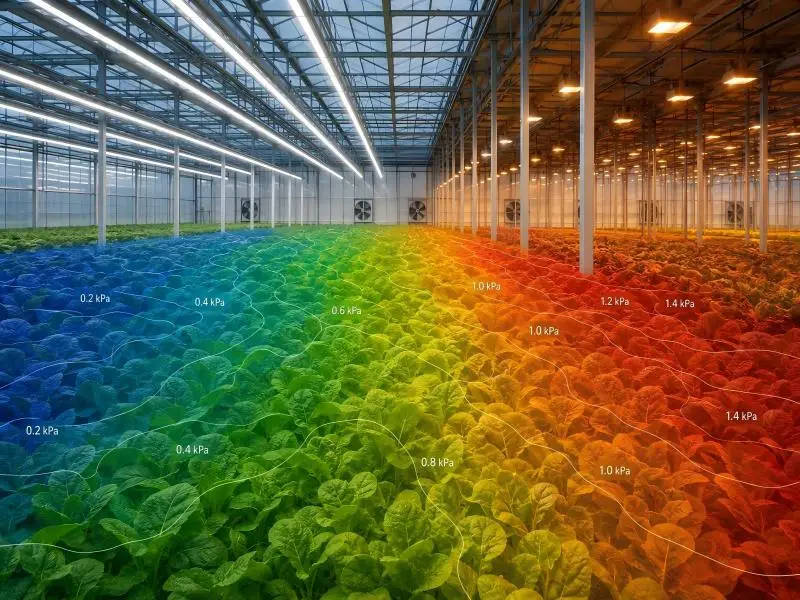
A common mistake in greenhouse supplemental lighting is poor spatial planning, resulting in “hot spots” directly under the fixtures and “dark zones” at the edges of the growing tables.
- The strategy: Uniformity is key to a uniform harvest. Before installation, work with a professional horticultural lighting manufacturer to conduct a 3D light mapping simulation (such as Dialux).
- Execution: Engineers will calculate the exact mounting height, spacing, and beam angles required for your specific greenhouse truss structure. High-quality top-lighting uses specialized optics and lenses to distribute light evenly across the entire canopy, ensuring that a plant on the edge of the row yields the same as a plant in the center.
Practice 4: Synergistic Canopy Management
Light penetration is heavily dependent on how you manage the plant itself. Even the most powerful High-Efficiency LED Top-Lighting system cannot penetrate a chaotic, overgrown canopy.
- The strategy: Align your pruning and defoliation schedules with your winter lighting strategy.
- Execution: Because winter relies heavily on top-down artificial light, it is crucial to routinely remove older, non-productive fan leaves from the lower and middle sections of the plant. This allows the LED photons to penetrate deeper into the lower fruiting sites, increasing the overall usable yield and improving airflow, which is vital for preventing botrytis and powdery mildew during damp, rainy seasons.
Crop-Specific Lighting Strategies for Winter and Rain
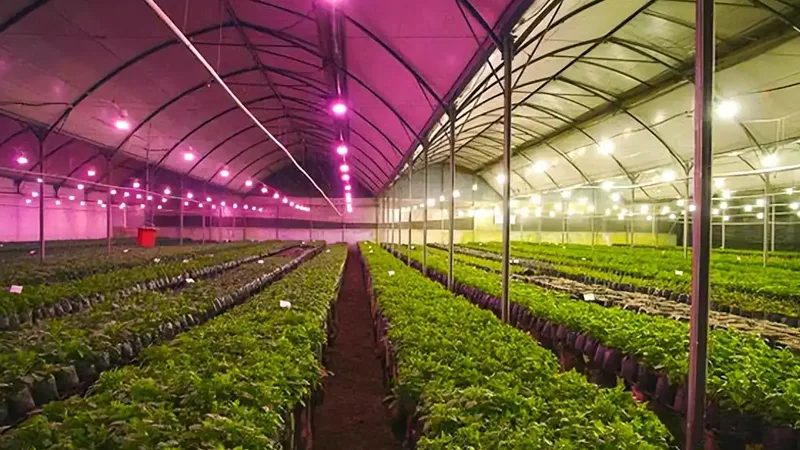
Different commercial crops respond uniquely to supplemental lighting. Tailoring your High-Efficiency LED Top-Lighting approach to your specific cultivar is essential for maximizing output.
1. Vine Crops (Tomatoes, Cucumbers, Peppers)
Vine crops are notoriously light-hungry and feature deep, vertical canopies.
- Strategy: While high-output LED top-lighting provides the heavy lifting for the upper canopy’s photosynthesis, winter yields are maximized when top-lighting is paired with LED inter-canopy lighting (inter-lighting).
- Benefit: This dual-approach ensures that the lower trusses of fruit, which are shaded by the upper leaves, receive direct PAR. This accelerates fruit ripening, increases Brix (sugar) levels, and maintains heavy fruit weight even in the darkest months.
2. Leafy Greens and Culinary Herbs (Lettuce, Basil, Spinach)
Leafy greens have shallower canopies but are highly sensitive to spectrum and temperature.
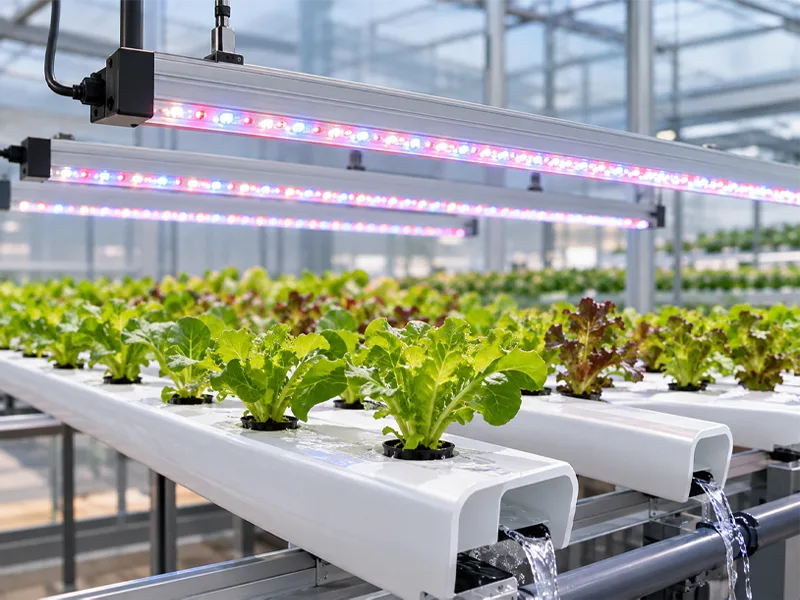
- Strategy: Utilize a broad-spectrum white LED top-light with a higher percentage of blue light.
- Benefit: In winter, low natural light can cause lettuce to stretch, becoming flimsy, and can lead to dangerous accumulations of nitrates in the leaves. The blue spectrum in the LED top-lights drives compact, thick cellular growth, improving the crunch, shelf life, and color (especially in red leaf varieties) of the greens. Furthermore, the cool-running temperature of LEDs prevents “tip burn,” a common issue when using hot HPS lights over delicate lettuce heads.
3. High-Value Medicinal Crops and Cannabis
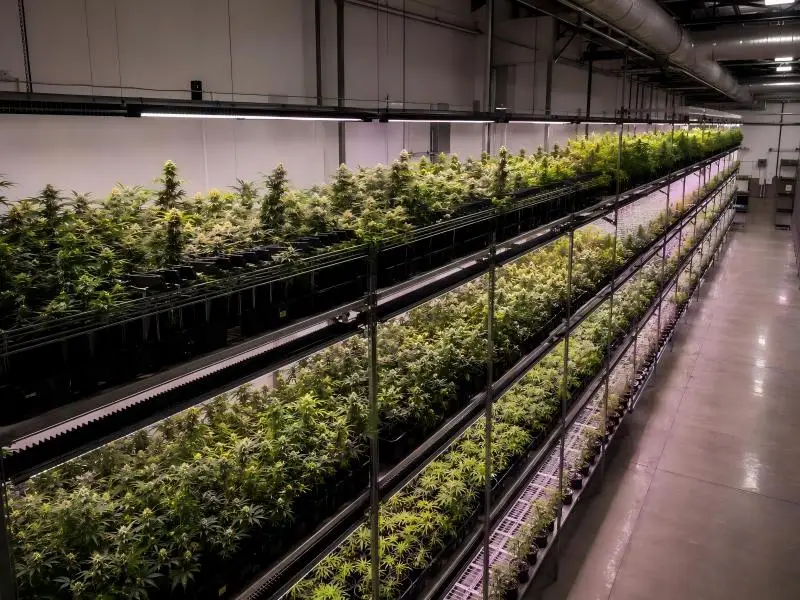
Medicinal crops require intense light to drive the production of secondary metabolites (terpenes, cannabinoids, and flavonoids).
- Strategy: Deploy ultra-high output LED top-lighting capable of pushing 1000+ µmol/m²/s during the flowering stage, combined with a spectrum rich in deep red (660nm) and far-red (730nm).
- Benefit: Maintaining massive DLI levels during winter is the only way to ensure dense flower structure and high active compound percentages. The precise spectrum helps steer the plant through its generative phase faster, maintaining tight internodal spacing and heavy biomass accumulation despite the lack of outdoor sun.
Maximizing ROI and Reducing Operational Costs
Upgrading to or installing a High-Efficiency LED Top-Lighting system is a capital expenditure (CAPEX), but B2B growers must evaluate the equipment through the lens of Total Cost of Ownership (TCO) and operational expenditure (OPEX) savings.
1. Electricity slashing and HVAC synergy: The most immediate financial return comes from the utility bill. By upgrading from 1000W HPS fixtures to 600W High-Efficiency LED Top-Lighting fixtures, a commercial facility immediately cuts lighting electricity costs by 40%. Furthermore, because LEDs emit significantly less radiant heat, the winter load on greenhouse dehumidification and cooling systems (which often have to run simultaneously with HPS lights to manage the microclimate) is drastically reduced.
2. Government rebates and energy subsidies: In many regions, utility companies and local governments offer substantial financial incentives for agricultural operations that adopt energy-efficient technologies.
- Actionable advice: Look for LED fixtures that carry DLC (DesignLights Consortium) Horticultural Certification. DLC-listed products are rigorously vetted for efficacy and lifespan, and utilizing them often qualifies commercial growers for massive cash rebates that can offset the initial purchase price of the LED system by 25% to 50%, accelerating the ROI timeline to as little as 12 to 24 months.
3. Minimal maintenance and L90 lifespan: HPS bulbs degrade rapidly, losing up to 15% of their light output within the first year, requiring expensive and labor-intensive annual bulb replacements. High-quality commercial LED top-lights are engineered for longevity. Look for fixtures with an L90 rating of 50,000+ hours. This means the fixture will run for over a decade of continuous use before the light output degrades by a mere 10%. Combined with IP65 or IP66 waterproof ratings to withstand high greenhouse humidity and direct spraying, maintenance costs are virtually eliminated.
Why Choose SLTMAKS as Your Commercial LED Grow Light Manufacturer?
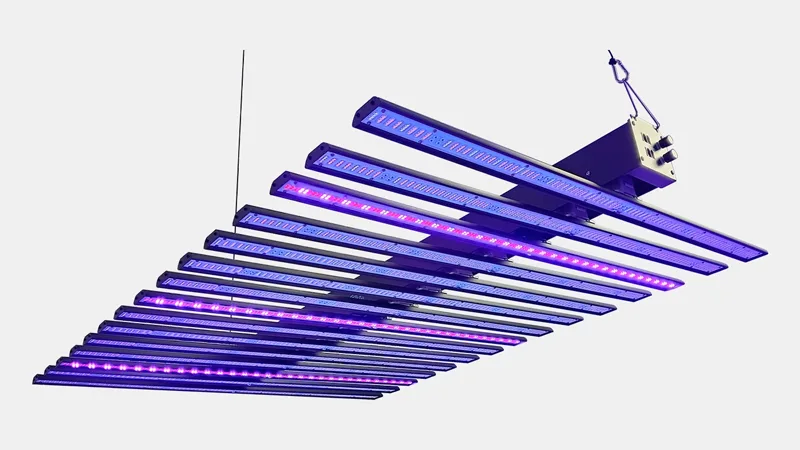
When crop yields and hundreds of thousands of dollars in revenue are on the line, choosing the right equipment partner is critical. SLTMAKS is not just a lighting vendor; we are a dedicated horticultural lighting manufacturer and engineering partner for commercial agriculture.
- Factory-direct engineering: As a specialized manufacturer, SLTMAKS controls the entire R&D and production process. This allows us to utilize top-tier diodes, custom-extruded aluminum heat sinks, and robust drivers, ensuring every high-efficiency LED top-lighting fixture meets strict quality assurance (QA/QC) standards.
- Customized OEM/ODM solutions: We understand that no two greenhouses are identical. We offer bespoke spectral tuning and fixture designs tailored to your specific latitude, crop type, and greenhouse infrastructure.
- End-to-end project support: From the initial consultation to advanced 3D light mapping, DLI calculations, and post-installation support, the SLTMAKS agronomy and engineering teams work alongside your head growers to ensure seamless integration and maximum performance.
- Certified reliability: Built for the harsh, humid realities of commercial greenhouse environments, our products carry the necessary international safety and efficiency certifications (CE, RoHS, UL, DLC), providing total peace of mind for facility investors and operators.
Conclusion
The unpredictability of winter weather and heavy rainy seasons no longer has to dictate the success of your commercial harvest. By transitioning away from outdated technologies and embracing High-Efficiency LED Top-Lighting, growers can seize total control over their crop cycles. Through precise DLI management, tailored spectrums, and massive energy efficiencies, these advanced systems protect your yields, elevate crop quality, and secure your bottom line against the darkest days of the year.
Ready to winter-proof your greenhouse yields and slash your energy overhead? Don’t wait for the next rainy season to impact your harvest. Contact the lighting experts at SLTMAKS today for a free consultation, custom 3D lighting design, and a comprehensive ROI analysis tailored to your commercial facility.
Let SLTMAKS illuminate the path to year-round profitability.
FAQ
Are High-Efficiency LED Top-Lights better than HPS fixtures for winter greenhouse cultivation?
Yes. While traditional High-Pressure Sodium (HPS) lights generate excessive radiant heat and have a fixed, inefficient spectrum, High-Efficiency LED Top-Lighting delivers targeted light recipes and much higher efficacy (often exceeding 3.0 µmol/J). This allows commercial growers to maintain optimal DLI during dark winter months while cutting electricity costs by 40% to 50% and minimizing the strain on greenhouse HVAC systems.
How much energy can a commercial greenhouse save by switching to LED top-lighting?
Upgrading to commercial LED grow lights typically yields direct energy savings of 40% to 50% compared to legacy 1000W HPS fixtures. Furthermore, because high-efficiency LEDs emit very little infrared heat, greenhouses can save significantly on cooling and dehumidification costs. This combination of OPEX savings creates a rapid Return on Investment (ROI), which is often further accelerated by local energy rebates for DLC-certified fixtures.
What is the best LED light spectrum for greenhouse supplemental lighting during rainy days?
The ideal spectrum depends on the specific crop, but a broad-spectrum white combined with deep red (660nm) and targeted blue wavelengths is highly effective for most commercial greenhouses. During heavy rainy seasons when natural sunlight is severely reduced, the added blue light from the LEDs prevents crops from stretching (etiolation), while the deep red wavelengths drive maximum photosynthetic efficiency and yield production.
How do I calculate the right DLI (Daily Light Integral) for my crops in the winter?
First, identify the optimal target DLI for your specific crop (e.g., 20-30 mol/m²/day for tomatoes, 12-17 mol/m²/day for leafy greens). Next, use a climate control system or quantum light sensor to measure the natural winter DLI entering your greenhouse. The difference between your natural DLI and your target DLI is the exact deficit your High-Efficiency LED Top-Lighting system must supplement.
How high should LED top-lighting fixtures be mounted above the plant canopy?
Because High-Efficiency LED Top-Lighting emits minimal radiant heat compared to HPS bulbs, fixtures can be mounted much closer to the crop canopy without risking leaf burn. Depending on the fixture’s wattage, beam angle, and optic lenses, mounting heights typically range from 2 to 4 feet (60 to 120 cm) above the plants. For optimal PPFD uniformity, it is always recommended to have your lighting manufacturer provide a custom 3D light mapping simulation before installation.
How long do commercial LED grow lights last in humid greenhouse environments?
Premium High-Efficiency LED Top-Lighting systems are specifically engineered for the harsh, high-humidity environments of commercial agriculture. High-quality fixtures feature an L90 rating of 50,000+ hours and IP65 or higher waterproof certifications. This means the lights will maintain at least 90% of their original photon output for over a decade of standard use, effectively eliminating the labor and material costs associated with annual bulb replacements.