Introduction
A minimum order quantity (MOQ) is the smallest number of fixtures a supplier will produce or sell in a single order. For wholesale LED grow lights, that number quietly drives three things yoA minimum order quantity (MOQ) is the smallest number of fixtures a supplier will produce or sell in a single order. Navigating the wholesale LED grow lights MOQ quietly drives three things you will feel across an entire deployment: the price you pay per fixture, how long you wait for inventory, and how much risk you carry if the configuration is wrong.
MOQ is not just a purchasing threshold. It determines how far a supplier will go on customization, how much documentation and compliance work is baked in, and how your logistics costs scale once fixtures are on the water or in the air. A commercial operator ordering 15 fixtures is in a completely different conversation than one committing to 200 units per model across three sites.
The operators who avoid expensive mistakes treat MOQ as a planning input rather than an obstacle. Before you commit volumes, model costs and timelines, and that means understanding the tiers, the pricing and engineering levers behind them, and how compliance and freight each shift your per-unit landed cost. This guide walks through all of it so you can line up your volume decision with your rollout plan and lower total cost of ownership.
Defining Wholesale LED Grow Lights MOQ in the Supply Chain
What MOQ Represents in Manufacturing and Procurement
In lighting manufacturing, every order carries fixed costs that exist whether you buy one unit or a thousand: engineering review, PCB setup, solder paste stencils, incoming material inspection, photometric checks, packaging preparation, and scheduling. MOQ is the volume at which a factory can recover those setup and tooling costs at a price you are willing to pay.
From a procurement standpoint, MOQ also sets working-capital and inventory exposure. Buying above a needed quantity to chase a per-unit discount ties up cash and risks holding fixtures in a config that your facility cannot use later. So MOQ is really a trade-off between unit economics and inventory risk, not a rule to fight blindly.
How Suppliers Determine MOQ for Lighting Programs
Factories arrive at a specific MOQ by adding up component commitments, line capacity, and certification burden. Samsung-diode-driven boards and custom drivers carry purchase minimums from the component level up. A semi-standard fixture reusing existing tooling can sustain an MOQ in the low tens, while a fully custom housing with new tooling pushes that number into the hundreds because an injection mold and photometry validation must be paid for.
Lead time moves with the same logic. Samples and hand-built pilots can ship in two to eight weeks; a standard production run typically needs ten to twenty weeks because procurement, burn-in, and QA testing all consume calendar time. That is why a lower MOQ does not always mean a faster product.
When Low vs. High MOQ Makes Sense for You
Choose a lower MOQ when you are still validating a spectrum, a fixture, or a vendor on a live room or a single site. It protects you from committing capital before you have seen real photometric and crop results. Choose a higher MOQ when you have a confirmed rollout plan, you can standardize on one or two models, and you trust the supplier enough to lock component pricing and reserved production slots. The right answer depends less on “what can I get away with” and more on “what does my go-live timeline and site count actually support.”
Practical MOQ Tiers for LED Grow Lights
For commercial cultivation, wholesale grow-light MOQs generally fall into three practical tiers. Each one behaves differently on price, customization, and lead time.
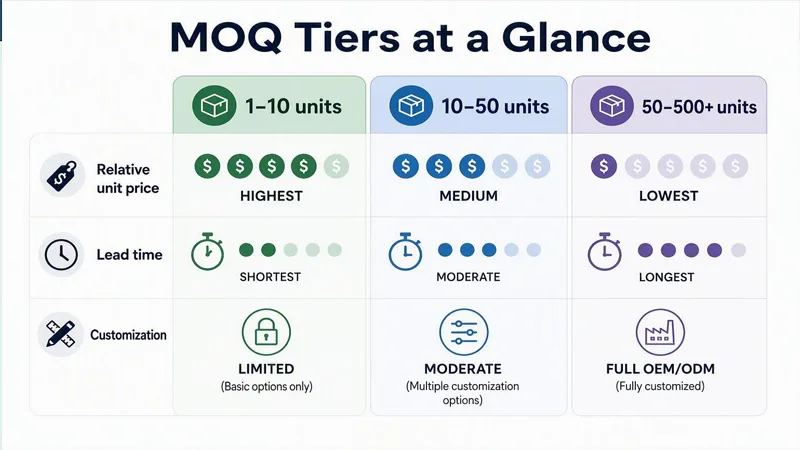
1–10 Units: Stock and Pilot Validation
A one-to-ten unit order is effectively a pilot. You pay the highest unit price because the fixed engineering and setup costs are spread over almost nothing, and any customization is limited to choosing a stocked spectrum and wattage rather than changing the design. Its real value is validation: you can benchmark a fixture’s real-world PPFD uniformity, thermal behavior, and driver reliability in your actual environment before scaling. If you already run fixtures from an approved supplier, this tier also works for restocking spares or trialing a new model head-to-head against what you run today.
10–50 Units: Semi-Custom and Private Label
Between ten and fifty units you cross into semi-custom territory. Suppliers can typically adjust drivers, dimming interfaces (such as 0–10V or DALI), cables, and packaging, and many will add your private-label branding and carton printing at this volume. Unit pricing starts to come down as setup costs are shared across a real batch, and you gain enough fixtures to pilot a full room or a single facility rather than a rack. This is the tier most useful for a first room-scale proof before committing to a site-wide program.
50–500+ Units: Full OEM/ODM Programs
Above roughly fifty units, and particularly into the hundreds, you are in full OEM/ODM program territory. Custom spectra, bespoke drivers and control integration, new mechanical layouts matched to your racking, and tailored documentation packages all become feasible because the volume amortizes the engineering cost. Unit pricing is at its lowest for your configuration since component procurement improves and the factory can reserve dedicated line time.
This tier fits operators standardizing lighting across multiple rooms or rolling out the same model across several sites. The trade-off is longer lead times and a larger financial commitment, so treat it as the point where alignment with your layout, controls, and spare-part strategy really matters.
For a clearer view of how volume translates into cost across these ranges, the tiered chart below maps relative unit price, lead time, and customization scope at each step.
Pricing, Lead Times, and Engineering Scope by Tier
Unit Pricing Dynamics and NRE Amortization
The biggest price drop happens between the smallest tiers. Moving from a hand-built pilot to a small production batch can cut unit cost by ten to thirty percent, with the steepest steps early on and progressively smaller gains once you pass a few hundred units. The driver is non-recurring engineering (NRE) and fixed setup costs being amortized across more fixtures.
Understanding this is the key to not over-ordering: beyond a certain volume, your additional discount shrinks, so buying far past your rollout need rarely pays for itself when you add storage and cash-flow cost. You can see how those fixed costs build up in any realistic unit cost of manufacturing an LED grow light breakdown.
Production Scheduling, Burn-In, and QA Timelines
Every tier also carries a production-scheduling floor. Factories batch orders against component lead times and line capacity, then run burn-in and QA testing before fixtures are cleared for shipment. A stocked five-unit order can leave in days, but a fifty-plus unit production run with fresh driver procurement typically needs six to twelve weeks, and a larger OEM run can stretch past twelve weeks once tooling, validation, and testing are factored in. Build this timeline into your go-live date; certification and freight each add more on top.
Custom Spectrum, Drivers, and Controls Options
Customization scope expands sharply with tier. In the low single digits you are choosing from stocked options. In the semi-custom band you can specify dimming protocols, driver current, cable and connector types, and add branding. In a full OEM/ODM program you can define target spectra tuned to a crop or stage, select drivers and control protocols to integrate with your environment controller, and request the mechanical and photometric work needed to match your racking and canopy. The more you customize, the more engineering and validation time you should expect before production begins.
Compliance and Documentation for US/EU Deployments
UL 8800/ETL/UL and DLC Requirements (North America)
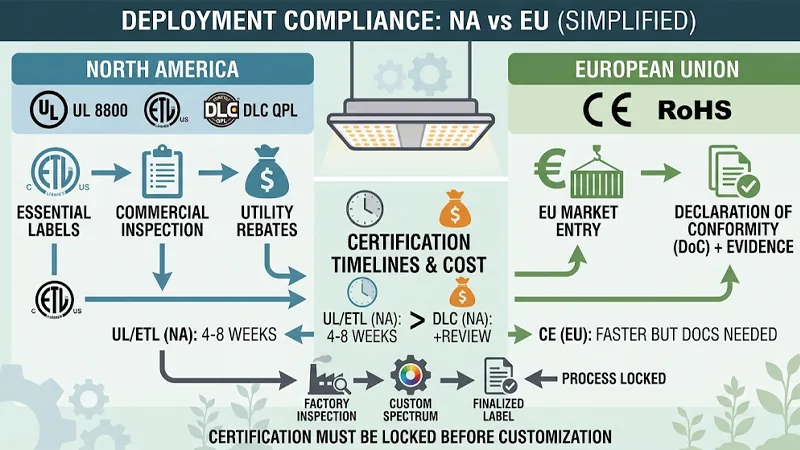
In North America, UL 8800 and the DLC horticultural requirements set the bar. UL 8800 is the primary safety standard for horticultural lighting equipment, tested by an OSHA-recognized, nationally recognized testing laboratory (NRTL) such as UL or ETL (Intertek).
DLC maintains a horticultural Qualified Products List (QPL); a fixture qualifies only after it carries an NRTL safety listing to UL 8800 and meets DLC performance criteria for photosynthetic photon flux (PPF), far-red output, and spectral distribution. Listing matters beyond marketing: many utilities and jurisdictions require ETL- or UL-listed equipment for commercial inspection and insurance, and DLC QPL status unlocks energy-efficiency rebates.
CE and RoHS Conformity (European Union)
For EU deployment, CE marking and RoHS conformity are essential. CE is a manufacturer’s declaration of conformity covering the Low Voltage Directive (electrical safety) and EMC, supported by a technical file rather than a standalone third-party certificate. RoHS restricts hazardous substances in the fixture’s electrical and electronic components. In practice you should ask for the EU Declaration of Conformity and the test evidence behind it alongside the CE mark, not just the mark itself.
Certification Timelines, Costs, and Label Readiness
Certification adds real calendar time and money to any program. An ETL listing typically takes four to eight weeks per model, including factory inspection; a DLC horticultural qualification adds its own review and photometric-report cycle on top. CE work is usually faster but still requires completed test documentation before product can be labeled for market.
Because certification is per model and configuration, it must be locked before you finalize a custom spectrum, and label placement and mark wording should be agreed with the supplier so fixtures arrive inspection-ready. Suppliers that carry listings on certified fixtures, such as SLTMAKS, can shorten this path when you standardize on models that are already ETL/CE/RoHS compliant with enterprise warranty terms.
Logistics and Landed Cost Planning
Air vs. Sea Freight: Speed, Cost, and Use Cases
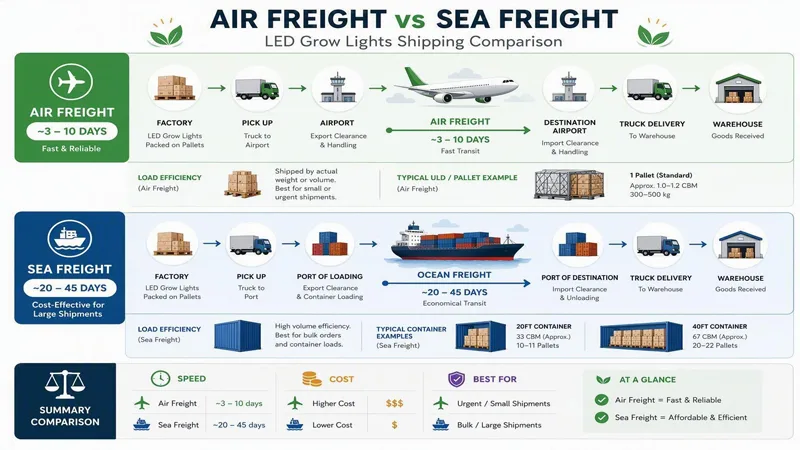
Freight is where MOQ thinking meets logistics reality. When you order a full production tier, you almost always go by sea because the per-unit cost difference is large. Full-container loads (FCL) from China to the US West Coast typically run in the range of 20 to 45 days door-to-door at a fraction of air cost, and less-than-container loads (LCL) add consolidation time.
Air freight reaches the US in roughly three to ten days but is priced per kilogram, and bulky LED fixtures are billed on volumetric weight, which makes it expensive at volume. Use air for pilots, launch-critical rollout gaps, or urgent spares; use sea for bulk inventory where you can plan the timeline. Our guide on comparing sea versus air freight from China walks through the exact trade-offs.
Carton Density, Palletization, and Container Fill
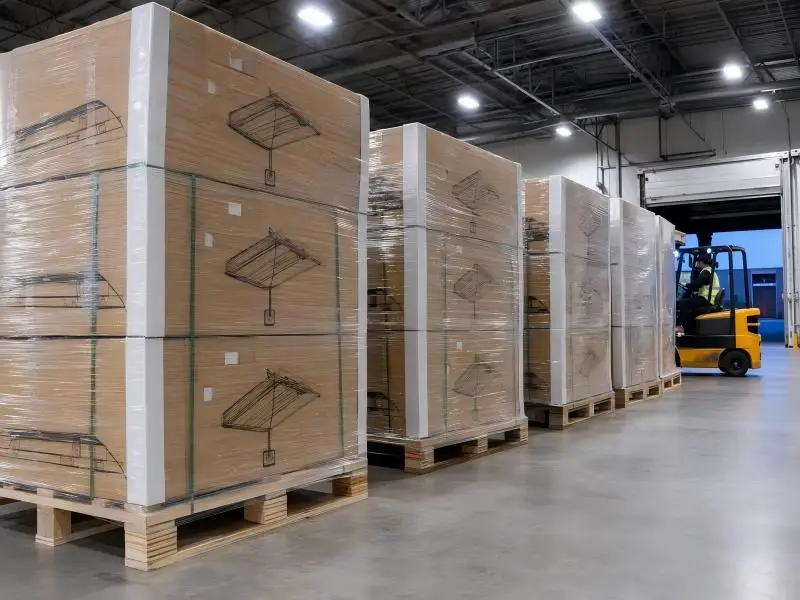
Per-unit freight cost depends heavily on how densely fixtures package. Carton dimensions, pallet configuration, and whether you fill a full container determine how many units ride in each shipment. Tall, foldable fixtures pack more efficiently onto a pallet than bulky rigid housings, which is one reason many commercial models are designed to fold for shipment. The more you can fill each pallet and each container, the lower the landed cost per fixture and the fewer touches the cargo goes through.
Modeling Landed Cost per Unit at Different MOQs
To compare tiers fairly, model landed cost per unit rather than just the factory price. Start with the unit price at your candidate MOQ, add per-unit NRE and certification amortization and freight by mode, then divide total shipment cost by the number of usable units. Because spare fixtures, installation losses, and future certification of each model all sit on top, a small per-unit saving at a higher tier can be erased by carrying unsold or unusable stock. Model across your realistic rollout quantities before you commit.
Procurement Playbook: Negotiation and Deployment
Phased Deliveries and Mixed SKUs to Meet Go-Live
A single large PO is rarely the smartest way to hit a go-live date. Ask suppliers whether they can split an MOQ into phased deliveries so you land fixtures in waves matched to room-by-room commissioning. Mixing SKUs within one program — top lights for one zone and inter-canopy for another, for example — lets you standardize on a supplier while keeping each fixture type at its appropriate quantity, so you do not over-order one configuration just to reach a per-model MOQ.
Documentation and Due Diligence Requests
Before you commit, request the documentation that protects you: photometric reports (IES/LDT), datasheets, certification listings and marks, the EU Declaration of Conformity where relevant, and clearly stated warranty and replacement terms. Confirm what “compliant” means for your target jurisdiction and that labeling will arrive inspection-ready. Treat missing or vague documentation as a red flag, because you will need it for insurance, AHJ review, and energy-rebate applications.
Aligning MOQ with Facility Layout, Controls, and Spares
The most expensive MOQ mistake is buying a quantity that later does not fit the facility. Lock your layout, racking pitch, control protocol, and canopy targets before you commit so every ordered fixture is usable. Include a small spares buffer for drivers and optics at your approved model count, since a multi-site rollout will need replacement units without waiting on a full production cycle. When the MOQ, layout, controls, and spares all align, the per-unit price you negotiated actually translates into the ROI you modeled.
Conclusion
Wholesale LED grow light MOQ is best understood as a tiered decision rather than a single number to negotiate down. Pilot tiers (1–10 units) validate fixtures at the highest per-unit cost but lowest risk; semi-custom bands (10–50 units) support private labeling and room-scale proof; full OEM/ODM programs (50–500+ units) deliver the best unit economics and deepest customization in exchange for longer lead times and larger commitments.
Across every tier, the same four factors decide whether you win: how unit pricing and NRE amortize at your volume, how production and verification timelines fit your go-live, whether your fixtures carry the US and EU certifications your jurisdiction and rebates require, and how freight, palletization, and container fill shape landed cost per unit. Realize that no single factor stands alone — a great unit price on the factory floor can be undone by slow freight, an uncertified configuration, or a volume you cannot actually deploy.
Before you commit volumes, model the costs and timelines you can actually use. Build a landed-cost estimate at each candidate MOQ, align it with your rollout plan and spare strategy, and confirm the documentation and compliance your inspectors and utilities expect. That is how you turn a wholesale minimum order from a threshold you must meet into a program that lowers total cost of ownership across your facility.
FAQ
What is a typical MOQ for wholesale LED grow lights?
There is no single answer, but a common pattern holds across most factories. Stocked, standard fixtures typically start around 50–100 units per model, semi-custom and private-label runs often land between 100 and 500 units, and a fully custom OEM program with new tooling can climb to 500 units or more. The right target depends on how much engineering and setup your configuration requires.
Can I order samples or a trial batch below the MOQ?
Yes. Most suppliers accept a pilot of roughly 1–10 units below their wholesale MOQ so you can validate a spectrum and fixture in your own environment before scaling. Expect to pay the highest per-unit price on that pilot, because the fixed engineering and setup costs are spread over only a handful of fixtures rather than a full production batch.
Does a custom spectrum or private label raise the MOQ?
Usually, yes. Custom spectra, new mechanical housing, and branded packaging each add tooling and setup work that must be recovered across volume, which pushes the MOQ higher than a plain stock order. When your design is truly custom, plan for a program-level commitment in the hundreds so the factory can amortize the engineering and molds.
How can I negotiate a lower MOQ?
A few practical levers help. You can accept a higher unit price on a first order, allow a longer lead time, start with white-label stock instead of full customization, combine several SKUs into one larger order, or offer a higher deposit to de-risk a smaller trial batch. Suppliers lower MOQs most readily when the added risk is clearly offset.