Walk into almost any modern commercial cultivation room and the fixtures overhead are throwing a broad, warm-looking spectrum that reads as “white” to the eye. Behind that even white glow sits a deceptively elegant physical trick found in every phosphor conversion white LED: a pump LED that emits short-wavelength light, and a layer of phosphor that absorbs part of it and re-emits it at longer wavelengths. This process is why these horticultural lighting systems can deliver high PPFD over large floor areas with far fewer SKUs than a room wired for discrete narrow-band diodes.
For a Head of Cultivation or an Operations Director planning scale, the science behind a phosphor conversion white LED is not an academic detail. It determines how efficiently electricity becomes usable photons (PPE), how stable the spectrum stays across tens of thousands of hours (Δu′v′), how much heat your HVAC system must pull out, and whether a fixture can clear the documentation your auditor and utility rebate expect.
This guide explains the mechanism beneath that white glow, the material advances that landed between 2023 and 2026, and how packaging and testing translate into PPFD, reliability, compliance, and ROI decisions for large facilities.
Table of Contents
How a Phosphor Conversion White LED Works
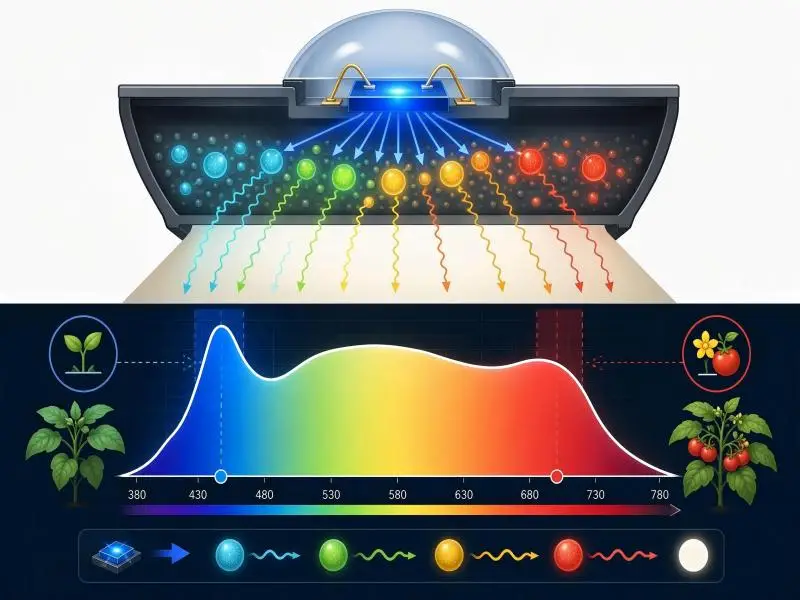
A phosphor-converted white LED combines a semiconductor chip with a down-converting material. A GaN blue chip peaks near 450 nm; a portion of that blue passes straight through the phosphor, while the rest is absorbed and re-emitted across broader green, yellow, and red bands. Mixed, the transmitted blue and the converted “yellowish” light land in the eye as white. Add more red-emitting phosphor and the source shifts warm; shift the ratios, and you reshape the whole spectral power distribution (SPD) within the PAR range.
Pump Choices and Energy Paths
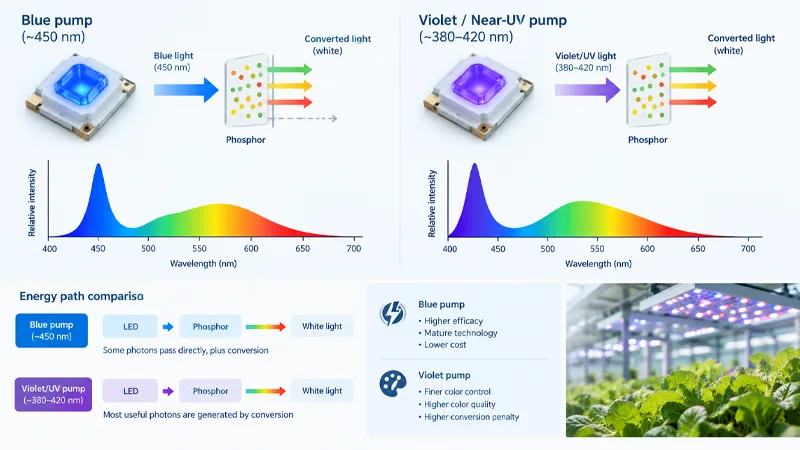
The pump is the engine, and its wavelength dictates everything downstream. Most commercial white LEDs use a blue pump near 450 nm because it is efficient, mature, and cheap to drive. Some designs use a violet or near-UV pump, which lets a manufacturer drive fuller red-green-blue phosphor conversion for finer spectral control or higher color quality — but at a cost: nearly every useful photon must then be generated by down-conversion rather than passed straight through, so a violet-pump system carries a higher conversion penalty than a blue-pump one.
For horticulture’s preoccupation with photons-per-watt, the blue-pump pc-LED tends to win on sheer efficacy, while violet-pump variants earn their place when the recipe demands precise color-point control rather than peak PPE.
Stokes Shift, IQE, and Reabsorption Losses
None of that conversion is free. When a phosphor absorbs a high-energy photon and re-emits a lower-energy one, the energy difference is lost as heat — the Stokes shift. This is why higher-CCT (cooler, bluer) white LEDs are electrically more efficient than warm ones: less of the emission has to pass through a down-conversion step, so fewer photons pay the penalty. Even so, Horticulture Research’s energy-efficiency analysis from Nature portfolio notes that while bare blue LEDs can approach 93% efficiency, the white pc-LED that results from conversion lands closer to 76% — the difference is largely Stokes and package loss.
Three separate numbers describe how cleanly that energy survives:
- IQE (internal quantum efficiency) is the fraction of absorbed photons the phosphor successfully re-emits. A high-IQE powder can still disappoint if thermal quenching or extraction losses eat the gain at operating temperature.
- Reabsorption happens when emitted photons are absorbed by another phosphor or the same layer before escaping the package. Broad yellow and red emission bands overlap, so a poorly tuned blend can quietly swallow its own output and distort the final spectrum.
- Stokes loss is the fundamental thermal tax on each down-converted photon.
Together they explain why a fixture’s published LED efficacy and its real, in-fixture PPE can diverge: phosphor loading, particle concentration, layer thickness, and operating temperature all shift the efficiency of the converter, not just the chip underneath it.
Extraction, Scattering, and Thermal Implications
The phosphor layer is not a transparent filter — it is a scattering medium. Particles scatter and redirect light, which affects how much escapes the package and how uniformly the beam spreads. Because the conversion itself generates heat from Stokes losses, the phosphor sits at a spot on the thermal map that packaging engineers watch closely. As a practical rule, phosphor conversion is why “white” horticultural modules carry a real heat budget of their own, separate from the diode junction’s heat — and why thermal management of that converter becomes a durability problem, not just a comfort one.
Phosphor Families and Recent Advances
The workhorse materials define the boundaries of what a white pc-LED can deliver, and they have not stopped evolving.
Garnets, Oxynitrides, and Nitrides (YAG: Ce, Green/Cyan Fillers, Red Nitrides)
The classic converter is YAG: Ce, a cerium-doped yttrium aluminum garnet that produces efficient yellow emission under a blue pump. YAG is stable, cheap, and easy to package — which is why it dominates general lighting. Its weakness for horticulture is that its yellow output carries relatively little deep-red content. That gap is why real grow-light white LEDs rarely stop at plain YAG.
PhosphorTech’s horticultural lighting work is representative of the mainstream answer: blend complementary converter families. Red-emitting nitrides (typically Eu²⁺-activated) can be added to strengthen long-wavelength output, because their emission from roughly 550 nm to 750 nm overlaps well with plant pigment absorption. Oxynitrides and sialons step in when designers want to tune green and cyan fill rather than push the red edge.
Narrow-Band Reds and Improved Greens (2023–2026)
The 2023–2026 window has been defined by narrowing and targeting the bands that plants actually absorb. On the red side, Mn⁴⁺-activated fluoride hosts (the KSF/PFS family) remain the benchmark for extremely sharp red emission, and recent literature has focused on making them manufacturable and robust rather than merely efficient. On the green side, researchers have been pushing beyond the old “green gap” by engineering thermally stable, blue-excitable garnets — such as the cyan-emitting CLAGSO: Ce³⁺ garnet reported in 2024 with an internal quantum efficiency above 85% — that fill the otherwise-empty green region of an SPD.
Multi-Activator Hosts and Cyan-Gap Solutions
A recurring limitation of tricolor blue-green-red conversion is the cyan gap, a spectral cavity around 480–520 nm between the blue chip and the yellow YAG peak. It not only hurts color rendering in general lighting; for horticulture, it represents usable PAR and a slice of the McCree curve being left on the table. The 2023–2026 answer is a shift toward multi-activator and site-engineered hosts — single lattices co-doped or cation-substituted so one phosphor spans a wider, smoother emission range.
Broadband Ce³⁺ cyan-green garnets and Eu²⁺ site-occupancy systems now bridge that gap commercially, letting a phosphor blend produce a richer, sun-like envelope instead of discrete, spiky peaks. The review of cyan-emitting phosphor development in Frontiers in Chemistry catalogs exactly how the field matured from “nice-to-have” fillers to essential components of full-spectrum pc-LEDs.
Packaging Architectures and Color Stability
How a phosphor is physically mounted matters as much as what it is made of. The same blend can drift dramatically in color, or hold its point for decades, purely depending on packaging.
On-Chip vs Remote Phosphor Converters
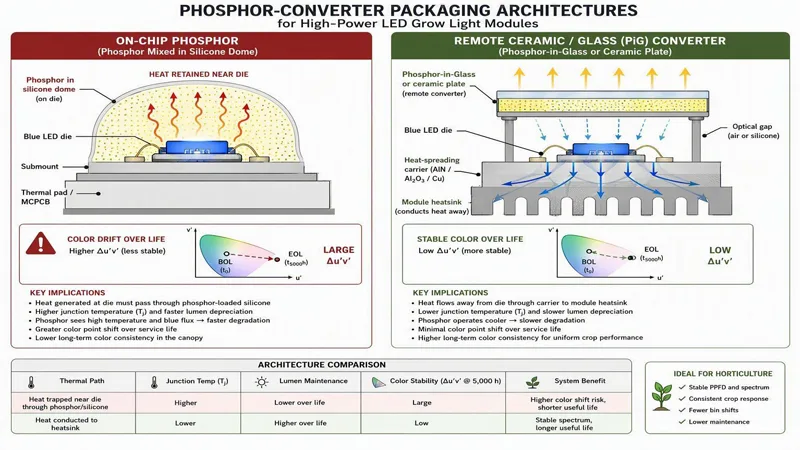
The two dominant architectures could not be more different in their thermal logic. On-chip conversion mixes phosphor into a silicone dome deposited directly on the die — compact and cheap, but the converter sits in the hottest part of the package, sharing the die’s thermal load.
That elevated temperature accelerates thermal quenching, mechanical degradation of the silicone binder, and chromaticity drift. Remote conversion separates the phosphor plate from the die, so the converter runs cooler and stays color-stable far longer. The trade-off is that the remote plate still needs its own thermal path; a poorly designed carrier can trap heat and wipe out the advantage.
Ceramic, PiG, and Composite Matrices under High Flux
At commercial flux densities, silicone is not the only binding option. Ceramic phosphor converters and phosphor-in-glass (PiG) plates embed the powders in an inorganic matrix that conducts heat far better than polymer and resists the browning and moisture ingress that degrade silicone over years of humid operation. Under very high blue flux, these inorganic converters hold their spectrum and transparency far longer — which is exactly the reliability profile a multi-site operator wants before signing a maintenance contract.
Thermal Management and Δu′v′ over Lifetime
Color shift over life is captured by Δu′v′, the chromaticity-stability metric measured in the CIE u′v′ color space. Thermal quenching of a phosphor changes the blue-to-converted ratio as the emitter heats, so a hotter converter drifts its color point more. Lower converter temperatures yield a smaller Δu′v′ over 50,000 hours — meaning the spectrum a grower validated in year one is still the spectrum they are running in year five. SLTMAKS keeps converters cool via passive aluminum heat sinks, holding Δu′v′ tight over fixture life.
Translating Spectra to Horticultural Outcomes
A stable, well-blended broad-spectrum white source is rarely the whole answer by itself — it is usually the foundation on which a facility layers targeted red and far-red control.
White Base Plus Deep Red/Far-Red Strategies
Most modern full-spectrum fixtures start from a phosphor-converted white base and then add discrete channels — commonly deep red near 660 nm and sometimes far-red near 730 nm. The white base supplies the broad, even PAR envelope; the added narrow-band channels steer morphology, flowering, and canopy responses. This hybrid matters because phosphor red and discrete 660 nm red are not interchangeable: the discrete die lets operators control that band independently, while the pc-LED white keeps the middle of the spectrum filled.
PPFD Uniformity and Multi-die Optical Mixing
Broad-spectrum white also simplifies optical mixing. Because a single pc-LED already emits a smooth blend, far fewer discrete colors need to overlap and homogenize to avoid banded or patchy light. Facilities chasing a minimum-to-average PPFD uniformity around 0.8:1 around the canopy often find that a white-base array achieves even coverage with simpler optics than a room of closely spaced single-color dies, and it makes per-fixture dimming and control much less prone to color hotspots.
Spectrum Choice vs PPE (µmol/J) and Crop Responses
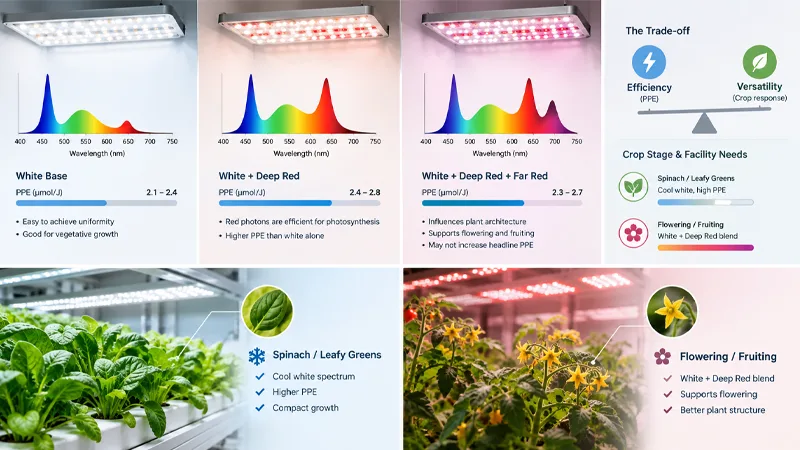
There is a genuine trade-off between versatility and peak efficiency. A white base alone is relatively easy to make uniform, but adding deep red normally raises PPE — red photons are efficient for photosynthesis and effectively inside the core photosynthetically active range — while far-red additions can alter plant architecture and flowering without necessarily improving the headline PPE number. In practice, the right split depends on crop stage and facility constraints. A spinach rack may want a cool, high-PPE white base; a flowering room often wants the warmer white-plus-deep-red blend that supports both morphology and photon efficiency.
Reliability, Testing, and Compliance
Spectrum claims mean nothing without test data a procurement team can file for inspection. Phosphor-converted fixtures, precisely because they hold a color point, are evaluated with a distinct documentation stack.
LM-80, TM-21, ISTMT, and Δu′v′ Reporting
LM-80 measures lumen or photon maintenance of an LED package over time at controlled temperatures; TM-21 projects that data into a maintenance-life estimate. But a projection is only valid under the thermal conditions the LED actually sees, which is where ISTMT (in-situ temperature measurement testing) comes in — it measures the hottest LED’s real operating temperature inside the assembled fixture. Together they tie the claimed lifetime to reality, and Δu′v′ reporting shows how far the white or mixed spectrum drifts in chromaticity over that life. For phosphor-converted white sources, Δu′v′ is the difference between a spectrum you can budget around and one that quietly cools or reddens out of spec.
UL 8800, ETL/CE/RoHS, and Documentation Expectations
UL 8800 is the dedicated safety standard for horticultural lighting equipment, covering the unique hazards of installation and operation in plant-growth environments. An ETL or UL listing means an NRTL (nationally recognized testing laboratory) evaluated the fixture against it; CE and RoHS cover EU conformity and hazardous-substance restriction. None of these is a performance proof on its own — they are safety and market-access markers, and an AHJ or insurer will want to see them regardless of efficacy.
Color Stability vs Maintenance Intervals and Downtime Risk
There is an operational angle to color stability that rarely appears on a datasheet. A fixture whose red band decays faster than its blue band does not just change color — it changes the crop’s light recipe, forcing you to either re-tune, re-measure, or accept drift between maintenance intervals. Because phosphor thermal management directly gates how fast that red-to-blue ratio drifts, the packaging decisions described above translate into how often a facility must recalibrate its lighting program and how much unplanned downtime risk it carries.
Procurement and ROI Modeling
When a procurement team finally ballots several phosphor-converted designs, the decision is rarely a single spec. It is a balance across four interacting variables.
Balancing CCT/CRI, PPE, and HVAC Load
For horticulture, CRI and CCT are secondary to the SPD’s usefulness to plants — but they still flag how the phosphor blend was tuned and how much conversion loss was baked in. A higher PPE usually means less conversion loss and, all else equal, fewer input watts per delivered PPFD. Because every unconverted watt becomes heat your HVAC must remove, PPE improvements compound: a fixture that reaches target PPFD with fewer watts shrinks both the electrical bill and the cooling burden.
Controls, Racking, and System Integration Considerations
Phosphor-converted white pairs naturally with dimming and control because a single-channel white array scales cleanly across racks without color-balance complexity. But the value only materializes if Δu′v′ stability holds under dimming and across fixtures from different manufacturing lots. Multi-die mixing and phosphor-blend consistency from bin to bin matter when you are populating thousands of square feet from more than one order.
Rebates and DLC Horticultural V4.0 Readiness
Finally, compliance is an ROI lever. The DesignLights Consortium Horticultural V4.0 program — effective in April 2025 — is the de facto gate for many utility rebates and tenders. It requires a minimum PPE of 2.5 µmol/J, accredited-laboratory testing, LM-80/TM-21 (or LM-84/TM-28) maintenance evidence with ISTMTs, and UL 8800 safety certification. A fixture that clears DLC Hort V4.0 not only proves spectrum and stability claims under audit but can unlock rebate dollars that materially shorten payback.
Conclusion
Phosphor conversion is the quiet engine underneath most broad-spectrum white LED grow lights — and understanding it turns a marketing label into an engineering decision. The mechanism (blue or violet pump, Stokes shift, IQE, reabsorption) sets the theoretical ceiling on efficacy. The phosphor families and their 2023–2026 advances decide how well that ceiling can be shaped toward real plant absorption, including closing the cyan gap. Packaging then decides whether that carefully tuned spectrum survives heat and time, held in check by Δu′v′ and L90. And the whole design is only as bankable as its test documentation, from LM-80/TM-21 and ISTMT through UL 8800 and DLC Horticultural V4.0.
For a scale operation, an action checklist crystallizes the vendor questions worth asking:
- Demand an SPD from an accredited lab, not a screenshot, and confirm where the cyan gap and red edge actually sit.
- Request PEI-independent PPE (µmol/J) and ask how much conversion loss the white base carries.
- Verify Δu′v′ reporting over the rated life, plus LM-80/TM-21 data matched to an ISTMT of the hottest LED.
- Confirm UL 8800, ETL/CE/RoHS documentation and DLC Horticultural V4.0 listing for rebate eligibility.
- Ask how phosphor thermal management keeps converter temperature stable — and how that affects maintenance intervals and downtime risk.
An experienced lighting partner can walk each answer back to a photometric report and a thermal design you can audit. On the spectrum engineering and packaging reliability side, SLTMAKS works with commercial indoor growers to match phosphor-converted white bases to crop, stage, and facility constraints — and to back the spectrum with the compliance and thermal evidence an operator’s budget review can stand behind.
FAQ
What is phosphor conversion in LED grow lights?
What is phosphor conversion in LED grow lights?
Phosphor conversion is the process behind most “white” LEDs. A short-wavelength pump chip — typically a blue GaN diode peaking near 450 nm — emits blue light, and a phosphor layer absorbs part of that blue and re-emits it at longer green, yellow, and red wavelengths. When the transmitted blue and the down-converted light mix, the eye perceives white, and the result is a broad spectral power distribution inside the PAR range. In grow lights, this matters because it lets a single fixture type deliver even, high PPFD coverage without wiring a room full of discrete narrow-band colors.
Are phosphor-converted white LEDs less efficient than discrete red and blue LEDs?
Are phosphor-converted white LEDs less efficient than discrete red and blue LEDs?
Not necessarily — it depends on the pump and the phosphor blend. Every down-converted photon pays a small thermal tax called the Stokes shift, which is why a violet-pump white system usually carries a higher conversion penalty than a blue-pump one. A well-tuned phosphor-converted white can still reach high photon efficacy (µmol/J), and many fixtures layer discrete deep red (near 660 nm) or far-red (near 730 nm) channels on top of a white base. Because that discrete red lets operators control the band independently while the white keeps the middle of the spectrum filled, the hybrid often beats a pure single-color array on both uniformity and flexibility rather than raw peak efficacy alone.
How long does a phosphor-converted LED grow light hold its spectrum?
How long does a phosphor-converted LED grow light hold its spectrum?
That color stability is measured with Δu′v′, a metric that tracks how far the white or mixed spectrum drifts in chromaticity over life. The main driver of that drift is heat: thermal quenching changes the blue-to-converted ratio, so a converter running hot cools or reddens out of spec faster. Packaging choices matter a lot here — remote or ceramic/phosphor-in-glass converters that stay cool, or passive aluminum heat sinks, hold a small Δu′v′ over 50,000 hours. That is why procurement teams ask for Δu′v′ reporting alongside LM-80/TM-21 maintenance data and an ISTMT reading of the hottest LED, so a spectrum validated in year one stays the one a facility runs in year five.