Introduction
Why Nitrate Control Matters for Lettuce Quality and Compliance
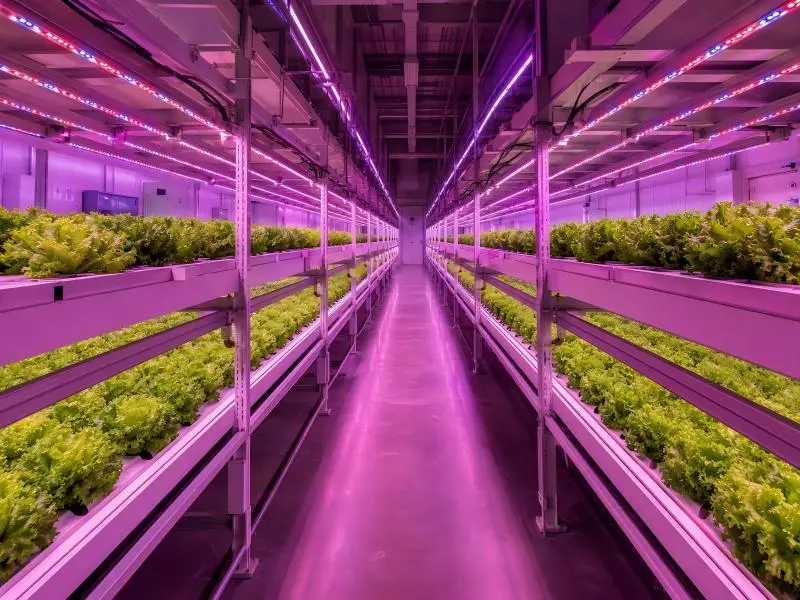
For commercial growers, implementing a blue light nitrate lettuce reduction strategy is becoming an essential industry standard. Nitrate (NO₃⁻) is the form of nitrogen that hydroponic lettuce absorbs most readily, and under low-light or heavily fertilized conditions, a large share of it stays stored as free nitrate in the leaves instead of being built into protein. That matters for two reasons. First, buyers and regulators in major markets set hard limits on nitrate in fresh lettuce and leafy greens, so an out-of-spec batch is a compliance and revenue problem, not just a nutrition footnote. Second, elevated leaf nitrate is accompanied by softer tissue and shorter shelf life, which undercuts the quality signals that justify premium fresh-cut pricing.
Table of Contents
How a Blue Light Nitrate Lettuce Strategy Reduces Accumulation While Preserving Yield
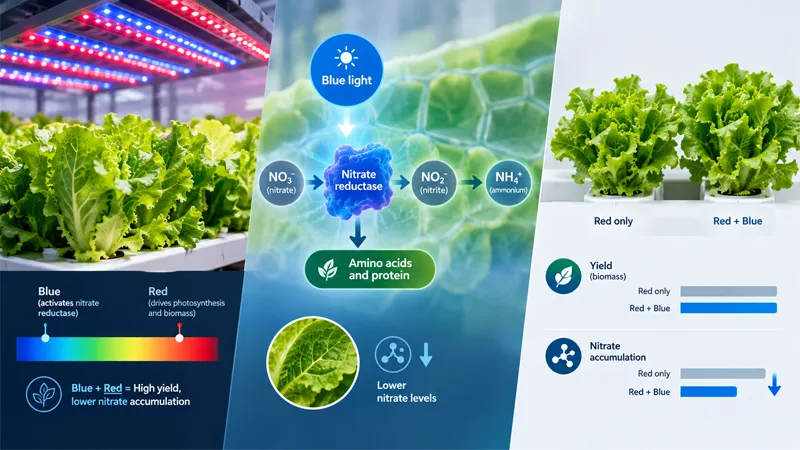
Nitrogen metabolism is light-driven, and the spectrum you deliver controls how completely the plant reduces nitrate into amino acids and protein. Blue light is the most direct lever: it activates nitrate reductase, the rate-limiting enzyme that converts nitrate into nitrite and then onward into assimilable nitrogen. The practical insight for a production facility is that you can add blue light to a red-dominant spectrum without the yield penalty you might expect, because red keeps photosynthesis and biomass accumulation high while blue cleans up the nitrogen balance.
What You’ll Get: Actionable Spectra, PPFD, Photoperiod, and Preharvest Playbooks
This guide gives you a ready-to-validate recipe set for commercial lettuce: a main-crop red: blue starting point, canopy-level PPFD and uniformity targets, photoperiod and daily light integral (DLI) guidance, and a 24–72 hour preharvest continuous-lighting (CL) protocol that measurably lowers nitrate without sacrificing fresh weight. It also walks through EU compliance thresholds and a lab-backed QA workflow so you can prove the result on paper, not just in the crop.
The Problem and Context
Nitrate Risk and Market Limits
Free nitrate in leafy greens is regulated because of health concerns tied to dietary exposure. In the European Union, the enforceable maximum for fresh non-iceberg lettuce is set by season and growing method: 5,000 mg NO₃/kg for protected (under-cover) lettuce harvested from October to March, 4,000 mg/kg for under-cover lettuce harvested from April to September, and 3,000–4,000 mg/kg for open-air lettuce depending on the window, under Commission Regulation (EU) No 1258/2011. Iceberg-type lettuce carries lower limits still. For any grower supplying European retail or food service, staying under these thresholds is a gate-keeping requirement.
Hydroponic Drivers of Nitrate Buildup
Hydroponics aggravates accumulation for a structural reason: nitrate is continuously available in the nutrient solution, and in winter or under insufficient light the plant takes up more nitrate than it can reduce. When photosynthesis and carbon skeleton supply fall short, nitrogen assimilation slows, and the excess nitrate is shunted into the vacuole as an osmoticum. Short photoperiods, low DLI, and over-supplied nitrogen in the feed all push leaf nitrate up.
Energy and Compliance Pressures
Reducing nitrate with more light seems straightforward, but blanket intensity increases real-world costs in electricity and HVAC load. The efficient answer is to use the spectrum that already exists: red light keeps building biomass, while a targeted blue fraction and a short, low-cost preharvest continuous-lighting window deliver the nitrate reduction when it counts. That is the difference between a compliance fix that destroys margins and one that fits inside a normal production cycle.
How Blue Light Lowers Nitrate
Enzymes and Carbon–Nitrogen Balance
The decisive enzyme is nitrate reductase (NR), which catalyzes the first committed step of nitrate assimilation — the reduction of nitrate to nitrite. Its activity rises and falls with light. Blue light both promotes NR synthesis through the cryptochrome–HY5 signaling chain and rapidly activates existing NR protein, so leaves convert nitrate into amino acids more efficiently. At the same time, stronger photosynthesis under a red-dominant background supplies the carbon skeletons and reductant the plant needs to sink that nitrogen into protein, leaving less free nitrate stored in the vacuole. This is why blue plus red outperforms either color alone.
Photoreceptors: Blue–Red Signaling Synergy
The spectrum works through photoreceptors and their downstream targets. Blue light is captured by cryptochromes and phototropins, which drive stomatal opening and the upregulation of nitrate-uptake and reduction machinery, while red light is absorbed by chlorophyll and works through phytochrome to sustain carbon fixation. In practical terms, red maximizes the energy pipeline that produces yield, and blue steers the nitrogen assimilated from that energy toward protein rather than accumulation. A red-only spectrum suppresses NR expression toward baseline, so some blue is effectively mandatory for nitrate control.
Timing Effects and Diel Rhythms
Nitrate metabolism is not constant across the day. NR activity climbs during the light period and falls at night, which is exactly why a dark period is the moment of maximum nitrate accumulation. Continuous light at the end of the crop removes that dark dip, keeping NR active around the clock and steadily drawing down stored nitrate in the final days before harvest.
Production Recipe (Main Crop Phase)
Spectrum: R:B ≈ 3:1–4:1 Starting Point
For the main growth phase, a red-dominant spectrum with a meaningful blue fraction — roughly a red: blue ratio of 3:1 to 4:1, or about 20–25% blue of total PAR photons — is a sound starting point. This band preserves strong biomass accumulation while keeping enough blue to hold nitrate in check throughout the cycle. A review of soilless lettuce production converges on roughly 75–80% red and 20–25% blue as effective for growth and quality, which corresponds to that 3:1–4:1 range. Treat this as your baseline and validate against your cultivar rather than tuning blind.
PPFD and Uniformity at Canopy
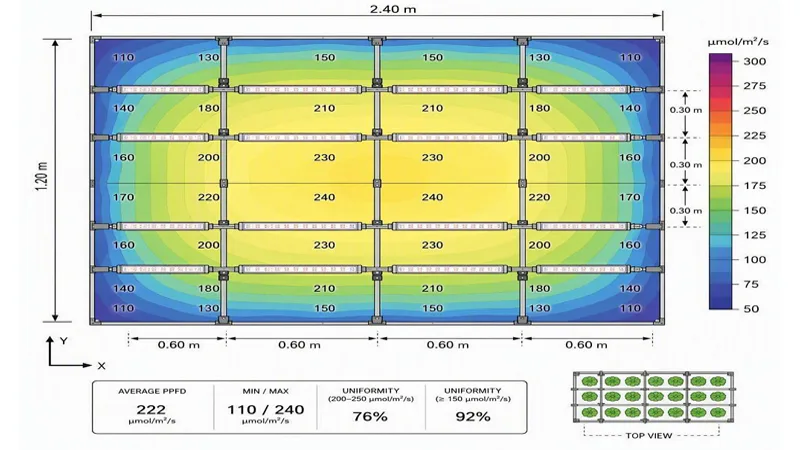
Run the canopy at roughly 200–250 µmol/m²/s at bench level during the main phase, delivered consistently across the growing area. Uniformity is as important as the average: hot and cold spots create uneven nitrate reduction and harvest timing. Aim for a uniformity ratio that keeps PPFD variation tight across the bench so the preharvest protocol produces a repeatable, batch-consistent result.
Photoperiod and DLI Targeting
A 16-hour photoperiod at 200–250 µmol/m²/s delivers a daily light integral in the productive 12–17 mol/m²/day band for commercial lettuce. If your scheduling pushes toward 20 hours, drop PPFD accordingly to hold the same DLI. The goal is a stable DLI that keeps photosynthesis and nitrogen assimilation in balance throughout the crop — the precondition for a clean preharvest drawdown.
Preharvest Nitrate-Reduction Protocol
24–72 h Continuous RB Lighting
The most effective tool is a short run of continuous red-blue light in the final 24–72 hours before harvest. During this window, running the same red-blue spectrum without a dark period keeps nitrate reductase active around the clock and drives leaf nitrate down while preserving fresh weight. Wageningen research on nitrate control using LED lights reports that a 2–5 day continuous preharvest light treatment significantly reduces nitrate in lettuce, and controlled studies using continuous red-blue LED light before harvest cut measured nitrate content substantially within the first 24 hours. Confirm the stopping point with a nitrate test rather than assuming a fixed duration.
Optional Nitrogen Taper Integration
Where your feed system allows it, combine the continuous-lighting window with a modest nitrogen taper in the last few days. Reducing the nitrate concentration in the nutrient solution for 2–3 days before harvest, alongside continuous light, lowers leaf nitrate further without the fresh-weight loss that a longer restriction can cause. Adding the taper on top of CL gives you more compliance headroom when a cultivar or a low-light winter run tends to run high.
Monitoring Stress, Microclimate, and Quality
Continuous light changes the energy balance of the room, so watch your microclimate while it runs. Excess heat can push tip burn, and altered transpiration can shift humidity. Monitor canopy temperature, vapor-pressure deficit, and any leaf-edge stress signs, and pull a fresh-weight sample so you confirm that yield protection is holding. The protocol should reduce nitrate without introducing a new quality defect.
Compliance and QA
EU Nitrate Thresholds for Lettuce
Anchor your target to the enforceable limits, not a comfortable guess. For non-iceberg fresh lettuce, the EU caps are 5,000 mg NO₃/kg for protected lettuce in winter (October–March), 4,000 mg/kg for protected lettuce in summer (April–September), and 3,000 mg/kg for open-air lettuce in summer, per Commission Regulation (EU) No 1258/2011. Iceberg lettuce has lower caps. Design your CL protocol to land comfortably below the relevant seasonal threshold so a natural run-to-run spread never edges you into a compliance failure.
Sampling and Lab Analysis Workflow
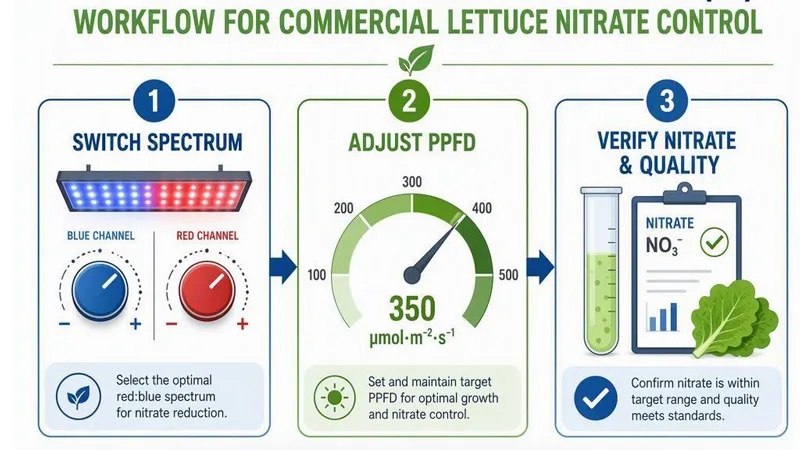
Build sampling into the harvest routine. Take representative leaf samples from multiple benches in the same batch, following a consistent time of day, freeze or refrigerate them correctly, and send them to an accredited lab for nitrate analysis using an accepted method. Record the results per batch and tie them to the lighting recipe and harvest date so you can trace any out-of-spec result back to its cause.
On-Farm Screening and Documentation
For faster turnaround between lab runs, add on-farm nitrate test strips or a portable meter as a screening step at harvest. Use lab results to calibrate the quick screen, then keep a documented log per batch that pairs the nitrate value with the spectrum, photoperiod, DLI, and preharvest CL settings. That documentation is what a buyer or inspector will ask for, and it turns a one-off compliance pass into a repeatable, auditable process.
Deployment and ROI
Controls, Dimming, and Channel Stability
Putting a red-blue CL protocol into practice depends on fixtures that can switch spectra and dim reliably on a schedule. Modern grow lights, such as SLTMAKS commercial LED grow lights, support independent red/blue channel control over 0-10V, PWM, or DALI protocols with one-click switching between growth-phase and preharvest recipes. That lets you hold a stable R:B ratio during the main phase and switch to the continuous preharvest window in the final days without manual rewiring or drift. Reliable channel stability matters here because a fixture that loses its blue fraction over time silently erodes the very nitrate control you are counting on.
Reliability, Safety, and Interoperability
A preharvest protocol that runs 24–72 hours continuously adds thermal and electrical duty, so hardware durability and safety certification are not optional. Look for certified fixtures (ETL, CE, RoHS) with robust passive cooling and a documented lumen-maintenance profile, ideally an L90 rating that keeps output — and therefore the blue dose — stable across thousands of operating hours. Fixtures must also interoperate with your facility control computer so the CL schedule can be triggered automatically rather than by hand.
Payback Drivers and Risk Mitigation
The economics of nitrate control are favorable because the added blue light is a small, short-duration increment rather than a full-crop intensity raise. You avoid rejected batches and margin loss from out-of-spec product, reduce the risk of a costly recall, and often extend shelf life, which strengthens retail relationships. De-risk the rollout by piloting the recipe in one zone, measuring nitrate reduction, fresh weight, and energy cost against a control, then scale the validated settings across the facility.
Conclusion
- Blue light is the on-switch for nitrate reduction: it activates nitrate reductase and steers assimilated nitrogen into protein, while red keeps photosynthesis and yield high. Run a red-dominant spectrum with a 20–25% blue fraction (R: B ≈ 3:1–4:1) as your main-phase baseline.
- Target 200–250 µmol/m²/s across the canopy over a ~16-hour photoperiod to hold a 12–17 mol/m²/day DLI, with tight uniformity so the whole batch reduces nitrate evenly.
- Apply a 24–72 hour continuous red-blue preharvest lighting window, optionally paired with a short nitrogen taper, and confirm the result with a lab-backed nitrate test at harvest.
- Anchor your target to the EU seasonal nitrate limits for fresh lettuce, screen on-farm, and document the batch record so compliance is provable.
Validate your recipe in a single zone first: run the CL window, check nitrate, fresh weight, and energy cost, and only then scale the settings across the facility. With spectrum control, uniform PPFD, and a repeatable preharvest protocol, you can hold the line on nitrate without sacrificing the yield that pays the bill.
FAQ
Why does hydroponic lettuce build up so much nitrate?
Why does hydroponic lettuce build up so much nitrate?
Hydroponic lettuce takes up nitrate from a solution that keeps it continuously available, and accumulation happens when uptake outruns the plant’s ability to convert that nitrate into protein. Low light, a short photoperiod, and an over-supplied feed all widen that gap, so the surplus is shunted into the leaf vacuole as free nitrate. That is exactly why the same cultivar routinely tests higher under cover in winter or in a vertical farm with an under-lit DLI than in a bright spring greenhouse.
What does blue light actually do to the nitrate molecule?
What does blue light actually do to the nitrate molecule?
Blue light switches on nitrate reductase, the rate-limiting enzyme that converts nitrate into nitrite and then onward into assimilable nitrogen. It does this two ways at once: it raises expression of the enzyme through the cryptochrome–HY5 signaling chain, and it activates existing nitrate reductase protein almost immediately. Red light, meanwhile, keeps photosynthesis and carbon-skeleton supply high, giving that enzyme the energy and building blocks it needs. That is why a red-dominant spectrum with a real blue fraction outperforms either color alone for both yield and nitrate control.
How long should the continuous preharvest light run?
How long should the continuous preharvest light run?
A 24–72 hour window is the practical target, with three days as the most reliable default where you need strong nitrate reduction without giving up fresh weight. Trials on butterhead and red oak leaf lettuce using three days of continuous red:blue light cut nitrate substantially while holding fresh weight, and a three-day red-LED treatment reduced leaf nitrate by roughly 44–65%. If your schedule is tight, even a single overnight low-light pass measurably lowers nitrate, but treat that as a minimum and confirm with a nitrate test rather than assuming a fixed target.
Will more blue ruin the yield I’m trying to protect?
Will more blue ruin the yield I’m trying to protect?
Not at the fractions recommended here. Moderate blue — about 20–25% of total PAR — generally helps or is neutral, and a red:blue ratio near 3:1 has been shown to maximize fresh yield while increasing chlorophyll and nutrient uptake. Problems appear only when blue becomes a dominant share of the spectrum, which shrinks leaf size, biomass, and marketability even as it deepens color. So keep the blue fraction inside that band and you protect yield; push it much higher and you start trading biomass for pigment.
What nitrate ceilings do I have to hit?
What nitrate ceilings do I have to hit?
For non-iceberg fresh lettuce the enforceable EU caps depend on season and growing method: 5,000 mg NO₃/kg for protected lettuce harvested October–March, 4,000 mg/kg for protected lettuce harvested April–September, and 3,000 mg/kg for open-air lettuce in summer, per Commission Regulation (EU) No 1258/2011. Iceberg and baby-leaf lettuces sit lower still. Design the preharvest window to land comfortably under the relevant threshold so run-to-run spread never edges you into a compliance failure.
Can I confirm compliance on the farm without waiting on a lab?
Can I confirm compliance on the farm without waiting on a lab?
Yes, but use the lab as the referee. Handheld nitrate meters and test strips give you a fast at-harvest screen, and the key is to calibrate that quick reading against accredited lab results for the same batch. Keep a documented record per batch that pairs the nitrate value with the spectrum, photoperiod, DLI, and continuous-lighting settings, so the fast screen stays honest and the lab report becomes repeatable, auditable proof.