Introduction
Most growers size greenhouse lighting around a fixed photoperiod and a target light level, then run fixtures hard for a set number of hours. That instinct costs money. By transitioning to a day-extension lighting greenhouse approach, operators growing long-day crops can deliver the same or better results at a lower total cost of ownership. This well-designed strategy changes the economics at the systems level, not just the fixture level.
The reframing is to think of lighting as a daily light integral (DLI) problem rather than a wattage-and-hours problem. Plants respond to the total moles of photosynthetically active radiation (PAR) they accumulate in 24 hours. Once you set a target DLI for the crop and subtract what the sun already supplied, the question becomes: how cheaply can electric light close that remaining gap? Extending the photoperiod at a lower intensity usually closes it with fewer fixtures, fewer peak-load kilowatts, and more off-peak runtime.
This article walks through what you need to model before committing capital: ROI drivers and assumptions, a DLI-centric scheduling method, the tariff and demand-charge levers that reshape the monthly bill, and the agronomic limits that keep the plan safe. Each section builds toward one outcome: a defensible payback number you can take to finance. If deficit-based sizing is new to you, our greenhouse supplemental lighting calculation guide walks through the math by latitude.
ROI Drivers and Assumptions
ROI for day-extension lighting never comes from a single variable. It stacks several levers, and each one shifts the payback timeline independently.
Baseline vs. Proposed Scenarios
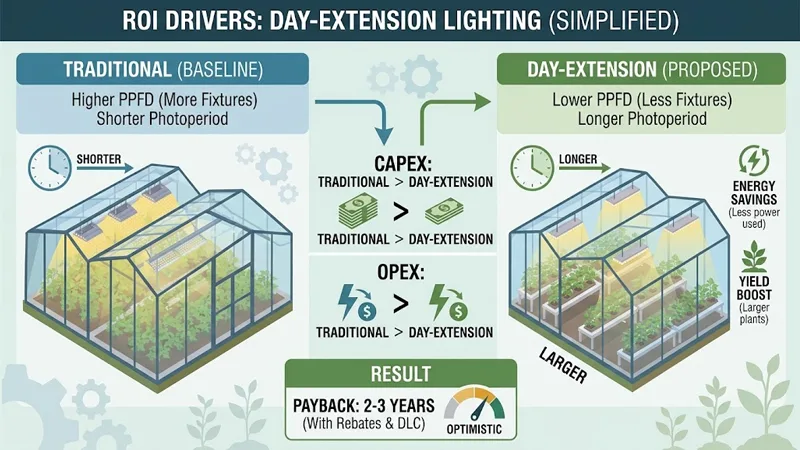
Start with a baseline that reflects how you light today: a higher installed PPFD running a shorter photoperiod, sized to hit a target DLI through the darkest hours you expect. The proposed scenario extends the day, trims PPFD, and reshapes when the fixtures run.
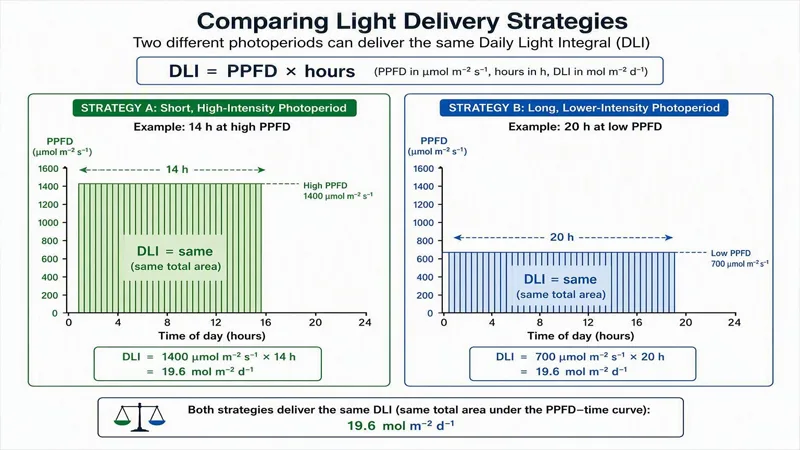
Hold total delivered DLI constant while comparing them. DLI is the product of PPFD, photoperiod, and a conversion factor, so no single PPFD is “right”. A 150 µmol·m⁻²·s⁻¹ fixture running 16 hours delivers the same daily dose as a 220 µmol one running about 11 hours. The economics differ sharply: the lower-PPFD, longer-day option needs less installed capacity per square meter, which lowers fixture count, wiring, and racking.
Model three columns: upfront capex, annual operating cost, and the value of the extra or stabilized yield. In winter, when the natural-light deficit is largest, a long-day strategy often means fixtures idle on low output during off-peak hours rather than saturating a short dark window, which is where the savings concentrate.
Capex, Rebates, DLC Compliance
The capex column shrinks when longer photoperiods let you buy fewer fixtures. But the biggest upfront variable you control is whether the hardware qualifies for utility incentives. Most agricultural programs pay prescriptive rebates per fixture, and many territories require the fixture to sit on the DesignLights Consortium (DLC) horticultural Qualified Products List (QPL).
Rebate figures vary, but the pattern is consistent. Hydro-Québec pays $40 to $500 per greenhouse fixture that uses natural sunlight, tiered by photosynthetic photon flux. Ontario’s Save on Energy program offers up to $180 per LED grow light and separate incentives for advanced lighting controls. New Jersey Clean Energy pays roughly $50 to $250 per fixture depending on greenhouse versus indoor use. Xcel Energy ties horticultural rebates to its DLC-qualified tiers.
Run your own utility’s numbers before modeling payback, because a prescriptive rebate can cut 20% to 40% off net project cost. Compliance matters beyond the rebate: listed fixtures carry tested electrical safety and performance data, which also matters to an authority having jurisdiction. DesignLights Consortium’s horticultural Qualified Products Lists are a common eligibility gate, and Hydro-Québec’s efficient farming program shows how greenhouse fixtures are rebated by light output.
Payback, Sensitivity Factors
Simple payback is net project cost divided by annual net benefit. Net cost is capex minus rebates and tax treatment. Net benefit is energy savings plus demand-charge reduction plus the value of output you did not lose to a DLI shortfall.
Run at least three scenarios: conservative, moderate, and optimistic. The variable that moves payback most is electricity price per kilowatt-hour, especially your off-peak rate, because day-extension shifts runtime into cheaper hours. Second is fixture efficacy in µmol/J: a higher-efficacy LED delivers more photons for the same watt, which compounds across thousands of hours. Third is how responsive the crop is to added DLI, which sets the top of the benefit column. Research across fruiting and leafy crops consistently links added daily light to added yield, and Michigan State’s discussion of daily light integral is a good reference for how the value of extra moles is estimated.
Across published retrofit data, greenhouse LED conversions with rebates commonly land in a two- to three-year payback range. Day-extension specifically shortens that timeline when the facility has a genuine winter DLI deficit and a utility rate structure that rewards off-peak operation. A modeling study in Applied Energy comparing greenhouse lighting strategies found that lowering light intensity while extending the photoperiod improved both energy use and yield, which is the mechanism a payback model should capture.
DLI-Centric Scheduling Strategy
Day-extension is best implemented as a scheduling plan anchored to DLI rather than to sunrise or sunset. The goal is to fill the crop’s light budget at the cheapest cost per mole, within the crop’s photoperiod tolerance.
Set DLI, Choose Photoperiod Window
Begin with the crop’s target DLI, then measure or estimate the natural DLI the greenhouse actually delivers. Transmission losses through glazing and structure mean delivered indoor DLI is a fraction of outdoor DLI. The supplemental requirement is simply target minus natural.
That accounting runs day by day. Because greenhouse DLI swings with weather, a control strategy that fixes total DLI and lets the electric dose float upward on dull days and fall to near zero on bright days keeps every day at target without overshooting. Our intelligent DLI control explainer covers how that closed-loop logic works in practice.
Choose the photoperiod window by working backward from the crop’s limits. For a fruit crop such as tomato, extension guidance on tomato lighting flags leaf injury beyond roughly 18 hours, so the effective window is capped well before continuous light. Flowering of many long-day crops needs a dark period shorter than about 10 hours, which is why a 16-hour “long day” is a common, conservative setting, as Purdue’s managing photoperiod guide notes. Decide the photoperiod first from the crop, then compute the PPFD that closes the deficit within that window.
PPFD Modulation and Carryover Logic
Within a fixed photoperiod, PPFD no longer needs to sit at a single setpoint all night. On a bright morning, the control system can carry over some of the solar dose and dim accordingly. On overcast stretches, it may run closer to full output. This is where a long-day approach pays for its flexibility: because fixtures have hours of off-peak runway, the system can run a modest, steady intensity to finish the day’s DLI rather than spiking to hit a target in a compressed window.
That steadiness is what makes the load profile attractive at the meter, and it flattens the crop’s daily light curve, which smooths uniform growth. The control rule is to maximize off-peak runtime first, then fill any remaining deficit at the edges, rather than running a blunt timer. Where these closed-loop DLI concepts are new, our smart greenhouse supplemental lighting guide shows the scheduling logic in more depth.
The cap on all of this is photoperiod injury, not the controller. Set the DLI and photoperiod bounds before you optimize the schedule, and treat anything beyond the crop’s safe window as out of bounds regardless of price.
Controls and Interoperability
A strategy this schedule-dependent lives or dies on how well lights talk to the environment. You need fixtures that accept standard control signals and drivers that dim cleanly across a wide range, because day-extension constantly moves PPFD up and down to follow the sun. Compatibility with your existing climate controller, quantum sensor network, and utility demand-response logic matters more than any single hardware spec.
This is where certified, interoperable hardware simplifies the build. A fixture that is both DLC-listed and ETL/CE/RoHS-compliant, with 0-10V dimming that tracks a DLI controller cleanly, can drop into an existing greenhouse control architecture without rewiring your whole facility. On the engineering-compatibility side, manufacturers such as SLTMAKS build greenhouse LEDs around that requirement: DLC-listed output that qualifies for rebates, electrical safety certification for inspection, and control-signal compatibility so the day-extension schedule runs through the same chain as sensors and HVAC rather than as a separate, bolted-on timer.
Buy against an interoperability checklist, not a spec sheet alone: what protocol does the fixture’s driver accept, does it hold stable low-end dimming, can the controller read live solar accumulation to adjust PPFD, and does the vendor’s photometry file (IES/LDT) line up with your layout? Each of those answers determines whether the savings you modeled in the ROI section actually show up at the meter.
Tariffs, Demand, and Load Shaping
The agronomy gets you to the right strategy; the tariff determines whether that strategy is worth the capital. Two rate-structure features do most of the work: time-of-use (TOU) pricing and demand charges.
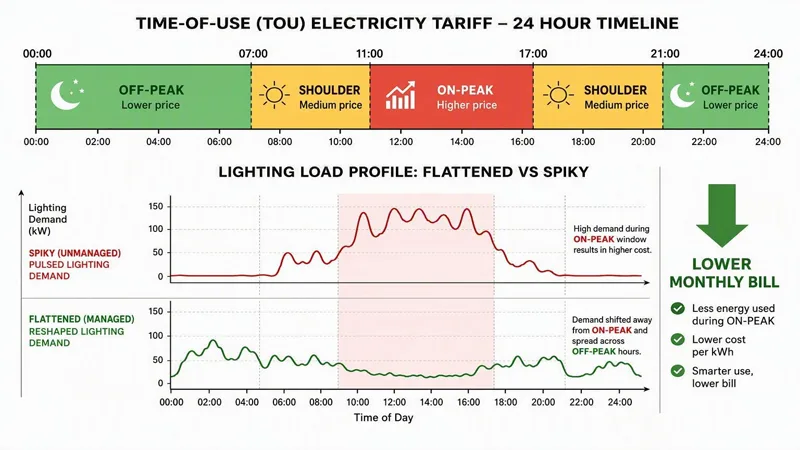
TOU Optimization and Off-Peak Runtime
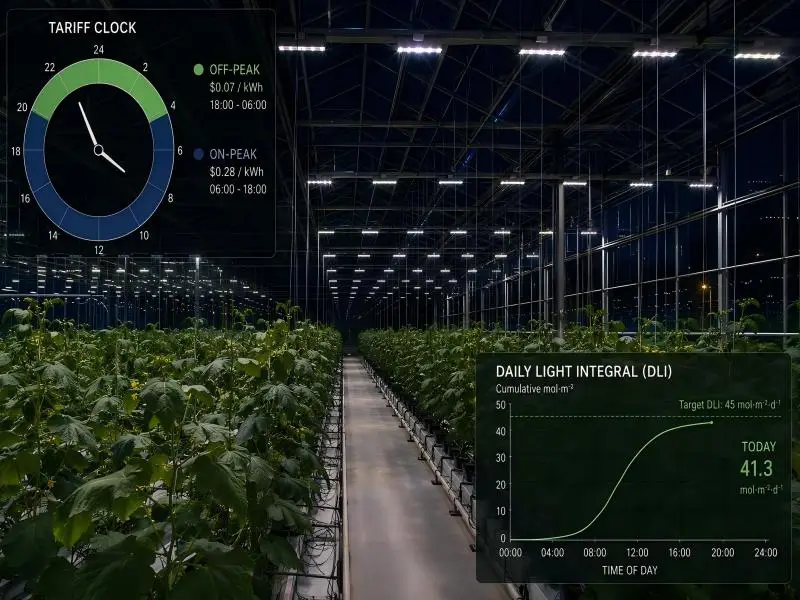
Under a time-of-use tariff, the cost per kilowatt-hour can roughly double or more during on-peak hours compared with off-peak, and peak-demand charges often run $10 to $25 per kilowatt based on your highest draw. Day-extension lighting is unusually well suited to this because the extra hours land when power is cheapest. A schedule that pushes a meaningful share of daily DLI into the overnight band can cut the energy line item without cutting light. This greenhouse energy-cost analysis describes how TOU and demand charges compound a lighting schedule’s cost.
The lever is straightforward: within the crop’s photoperiod window, prefer off-peak hours for the bulk of supplemental runtime, use shoulder hours for topping off, and avoid on-peak running unless the DLI deficit is unavoidable. When a bright forecast means little supplemental light is needed, schedule those sparse hours fully off-peak and skip the on-peak window entirely.
Remember that photoperiod in horticulture is measured by the uninterrupted dark period, so you can insert lighting flexibly inside a long night as long as you preserve the critical dark length. That flexibility is exactly what lets a DLI controller exploit a cheap-power window.
Demand-Charge Mitigation Tactics
Demand charges are based on your single highest kilowatt draw in the billing period, not your total energy. A short, high-intensity lighting spike can set the month’s peak and raise the bill for every kilowatt-hour after it. This hidden cost punishes a compressed, high-PPFD strategy. 360 Energy’s explanation of demand charges notes that even an hour of supplemental lighting can incur them.
A long-day, load-spread approach is inherently demand-friendly because it distributes the same DLI over more hours at lower instantaneous load. To push further, stagger fixture ramps so the whole house does not switch on at once, dim during on-peak demand intervals, and coordinate with your utility’s demand-response program if one exists. When many rooms run on one service, sequencing zone starts prevents a surge that would inflate the facility’s peak number.
Pairing DLI scheduling with load-shaping controls often delivers savings on both bills at once: fewer peak kilowatts on the demand line and more energy priced at the off-peak rate on the usage line.
HVAC Interactions at Night
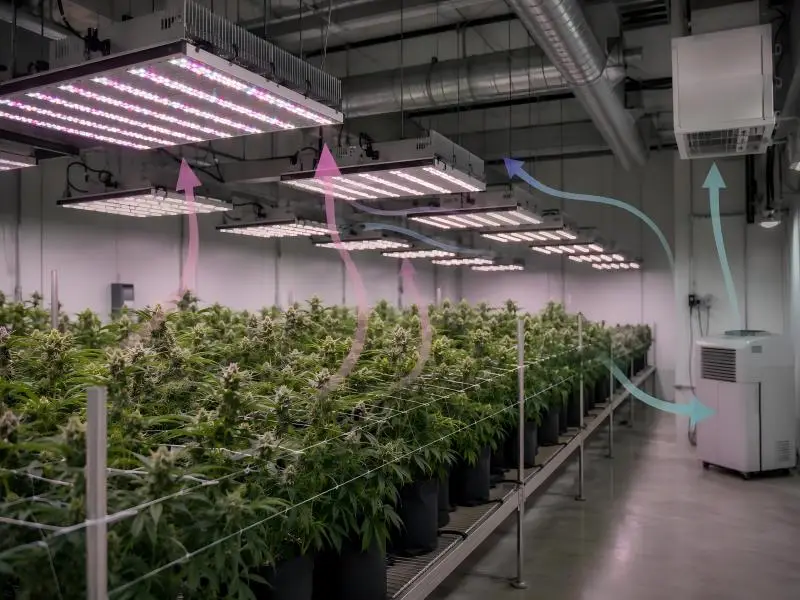
Lighting and climate are not independent loads. LED fixtures convert electricity into light and heat, and every hour they run shifts the greenhouse heat and moisture balance. Because day-extension adds hours of nighttime illumination, the HVAC interaction deserves explicit modeling rather than an assumption.
The trade is double-edged. Fixture heat is a small substitute for heating on cold nights, which trims heater load. But added light also raises transpiration, so humidity climbs and dehumidification may have to work harder. If lights are off and the space cools, relative humidity can spike and latent load rises instead. The net effect depends on your climate, your crop, and your HVAC strategy.
The practical answer is to integrate the lighting schedule with climate control rather than running them on separate timers. Model the enthalpy change of running fixtures at night and check whether dehumidification capacity is adequate before committing to a long-day regime, particularly for crops that transpire heavily. A control system that reads sensor data and adjusts lighting, heating, and dehumidification together keeps the two from fighting, which is where unmodeled cost tends to hide.
Agronomy Limits and Risk Control
The economics only hold if the crop tolerates the strategy. Photoperiod is not free, and extending it blindly past a crop’s tolerance turns a cost-saving plan into a yield-losing one.
Photoperiod Tolerance by Crop Class
Tolerance to long days is species-specific. Leafy greens and some vine crops adapt to extended light; certain fruiting crops are sensitive. Tomato shows leaf injury and lost productivity past roughly 17 hours, and pepper can show injury beyond about 20 hours. A research overview of continuous lighting (PMC9564221) notes that lowering intensity while extending photoperiod is often more economical, and that injury risk depends heavily on crop class. Lettuce, cucumber, and several leafy greens tolerate long photoperiods far better, which is why day-extension economics favor those crops.
For long-day floriculture crops, the priority is different: you are using photoperiod to drive flowering, and what matters is keeping the dark period shorter than the critical length, usually under about 10 hours, rather than maximizing DLI. Match the strategy to your crop class before you optimize the schedule.
Avoid Continuous-Light Injury
Pushing toward continuous light is where the risk concentrates. In sensitive crops, continuous light reliably produces interveinal chlorosis, depressed photosynthesis, and reduced yield rather than incremental gain, because the plant is missing the dark period it needs to process the day’s light. The fix is not necessarily an absolute maximum photoperiod but a dynamic one: some research shows alternating intensity or spectrum between day and night lets crops tolerate longer photoperiods without injury.
For a commercial operator the safer route is a photoperiod ceiling per crop, then DLI optimization inside that ceiling. Treat “continuous” as out of bounds unless you have trialed it on your own crop and cultivar, and even then validate it across a full season before scaling.
Pilot, M&V, Quality Checks
Do not commit an entire facility to a new lighting regime on a spreadsheet. Run a pilot bay first, side by side with your current practice, and measure before and after. Decide your monitored metrics before the pilot starts: delivered DLI at canopy, kWh and peak kW per cycle, plant quality markers, and yield or finish time.
Measurement and verification (M&V) turns the ROI model into an audited claim rather than an estimate. Confirm the control system actually hits target DLI, confirm the demand profile stayed flat, and confirm the energy ledger matches the off-peak rate you assumed. Watch quality through the pilot: uniform growth across the bay, no chlorosis, no flowering that you did not intend. Only after the pilot clears those checks should you scale the strategy facility-wide.
Conclusion
Day-extension lighting is an economic strategy before it is a lighting one. The payoff comes from treating greenhouse lighting as a DLI problem, choosing the longest photoperiod the crop tolerates at the lowest PPFD that still closes each day’s deficit, then scheduling those hours into the cheapest, flattest part of your tariff.
The decision framework is the same across crops and climates. Model the baseline against the proposed scenario with transparent assumptions. Size the system to DLI but bound it by photoperiod tolerance. Qualify fixtures on a DLC-listed, ETL/CE/RoHS-compliant basis, so rebates apply, and inspection is clean. Optimize runtime against TOU windows and demand charges. Integrate lighting with HVAC and dehumidification. Then validate with a pilot before you scale.
A practical deployment checklist ties it together:
- Confirm your facility’s natural DLI deficit by month and the crop’s target DLI.
- Set the photoperiod window from the crop’s tolerance, not from habit.
- Size fixtures to close the deficit at the lowest PPFD that fits that window.
- Verify fixtures are DLC QPL listed and ETL/CE/RoHS compliant for rebates and inspection.
- Confirm dimming and control interoperability with your existing sensors and climate controller.
- Model energy and demand savings across conservative, moderate, and optimistic TOU scenarios.
- Account for night lighting’s effect on heating, humidity, and dehumidification load.
- Run a pilot bay, define M&V metrics up front, and scale only after outcomes clear the bar.
Done well, day-extension converts a facility’s highest operating cost into a priced, manageable input: you decide how many moles you need, what the crop can safely take, and when the cheapest power can deliver them. That is the whole economics of the decision, and it is worth modeling before you spend.
FAQ
How much supplemental DLI does my greenhouse need?
How much supplemental DLI does my greenhouse need?
Subtract what the sun gives you from what the crop wants: set the target DLI, measure the DLI the greenhouse actually delivers through its glazing and structure, and the difference is your electric dose. That accounting runs day by day, because the deficit grows on dull days and disappears on bright ones.
Does day-extension at low intensity beat running high PPFD for fewer hours?
Does day-extension at low intensity beat running high PPFD for fewer hours?
Usually, yes. Flooring the same daily DLI over a longer photoperiod at lower PPFD needs fewer fixtures, less installed capacity per square meter, and more off-peak runtime. The result is lower upfront capex, a flatter demand profile, and cheaper energy per mole.
How long can lights run before plants get hurt?
Cap it by crop. Tomato shows leaf injury past roughly 17 hours and pepper past about 20, while lettuce, cucumber, and most leafy greens tolerate far longer days. For long-day flowering crops, keep the dark period shorter than about 10 hours. Trial any aggressive schedule on your own cultivar before scaling.
Why do time-of-use rates and demand charges change the math?
Time-of-use pricing makes off-peak kilowatt-hours cheaper, and demand charges bill your single highest draw rather than total energy. Day-extension spreads the same DLI across more off-peak hours at lower instantaneous load, which trims both the usage line and the peak that sets the monthly demand figure.