Introduction
When a grow-light fixture fails mid-cycle, the cost is never just the fixture. You lose a light you paid for, sure. But you also lose the uniformity that keeps a canopy consistent, the schedule that keeps flowering predictable, and the crew hours spent swapping hardware while crop stress climbs. For commercial indoor cultivation operators, fixture durability sits directly beneath total cost of ownership (TCO), which is why investing in high-quality SMT LED grow lights has become essential for long-term success.
Surface Mount Technology (SMT) is the assembly method behind most modern LED grow lights. Instead of pushing component leads through drilled holes, SMT solders small packages directly onto the surface of the board. That difference is not cosmetic. It changes how heat moves, how solder joints hold together, and how the whole assembly survives years of thermal cycling, humidity, and vibration in a grow room.
Older assemblies, built around larger through-hole parts and hand or wave soldering, carry higher thermal resistance, weaker mechanical anchoring of hot components, and more process variation. SMT LED grow light durability flips that: shorter thermal paths, tighter process control, and a lower-profile mechanical footprint. This article explains the engineering mechanisms behind those gains, the compliance evidence you should ask for, and how to standardize durable fixtures across a multi-site operation.
How SMT LED Grow Lights Maximize Thermal Performance with MCPCBs
Heat is the quiet killer of LED grow lights. Elevated junction temperature (Tj) accelerates LED lumen depreciation and slowly degrades the phosphor and driver electronics. SMT matters here because a Surface Mount LED sits on a metal-core PCB (MCPCB), an assembly that does far more than support components.
Shorter heat paths lower junction temperature
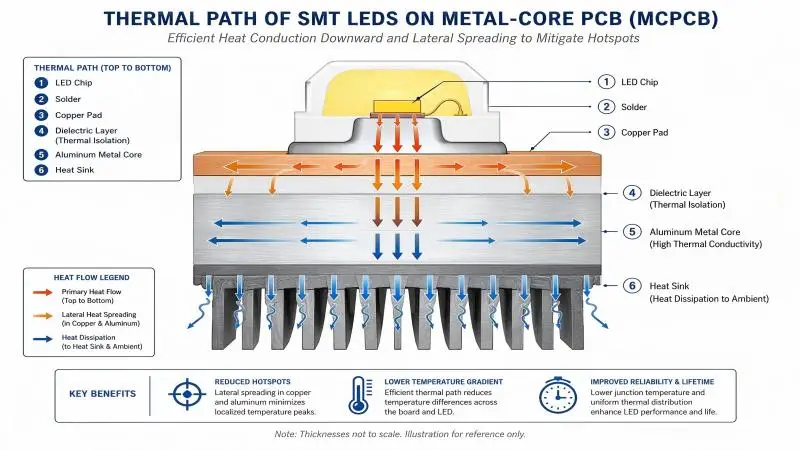
In an SMT design, the LED’s thermal pad connects directly to a copper layer on the board, which sits on the metal core. A metal-core PCB uses an aluminum or copper base—around 200 W/m·K for aluminum—to pull heat away from the die fast. Compare that with a conventional FR-4 board, where heat struggles through a low-conductivity glass-epoxy substrate. As JLCPCB’s design guide on metal-core PCB materials notes, the dielectric layer is usually the biggest thermal bottleneck, which is why selecting the right dielectric and keeping it thin matters as much as the metal core itself.
A shorter, lower-resistance heat path means the LED die runs cooler at the same drive current. Lower Tj slows lumen depreciation and reduces the risk of early failure. For a fixture running 12 to 18 hours a day, that margin compounds into real runtime and output retention.
Heat Spreading Reduces Hotspots and Gradients
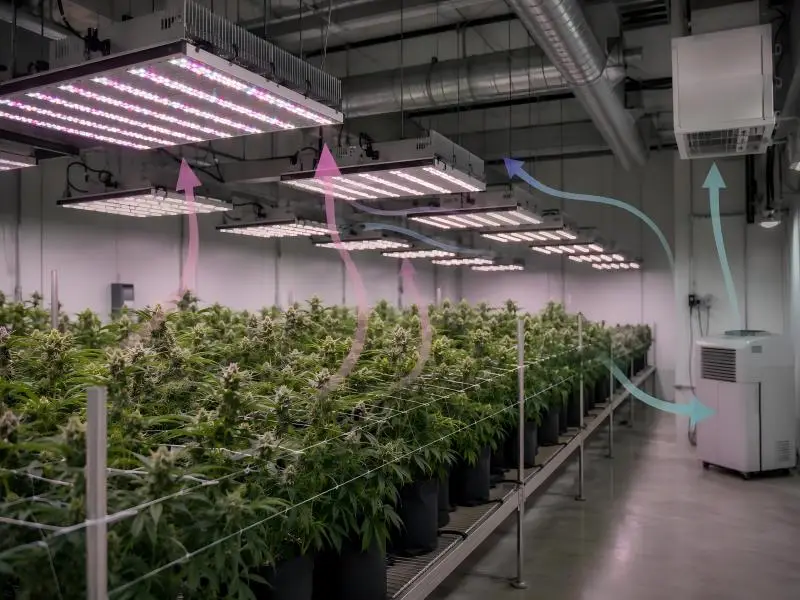
Metal-core PCBs also spread heat laterally. Rather than concentrating heat directly under each LED, the metal core distributes it across the board and into the heat sink. That reduces hotspots and smooths the temperature gradient.
This even temperature distribution matters for soldering reliability. Components, solder, and the board expand at different rates as temperature cycles. When hotspots concentrate expansion mismatch in one place, it concentrates stress there. By flattening the gradient, MCPCBs reduce the localized cycling burden that drives solder fatigue and delamination. The board stops behaving like a heat trap and starts acting like a heat spreader.
Driver and Component Longevity under Controlled Temps
The same thermal discipline protects the rest of the assembly. A cool, uniform board keeps the driver, capacitors, and control components inside their rated temperature windows. Components that run hot age faster; allowing a driver to ride near its thermal limit shortens its service life and raises mean time between failures (MTBF) concerns.
Key Takeaway: Durability in an LED grow light starts with keeping the whole board at a controlled, uniform temperature. That is exactly what an SMT design on a metal-core PCB delivers—lower junction temperature, fewer hotspots, and longer-lived components. For a broader look at how conduction, convection, and radiation work together, see our guide to heat dissipation in passive LED grow lights.
Solder Joint Integrity and Process Control
A solder joint is the physical and electrical bridge between a component and the board. Its quality determines whether a fixture stays connected through thousands of on-off and temperature cycles. In the context of SMT LED grow light durability, robust soldering is where process discipline converts good design into years of dependable runtime.
Reflow Consistency vs. Hand/Wave Variability
In SMT, a stencil deposits a precise volume of solder paste onto each pad, the component is placed by machine, and the entire board passes through a reflow oven that melts every joint at once. The result is repeatable paste volume, consistent wetting, and uniform heating across the board.
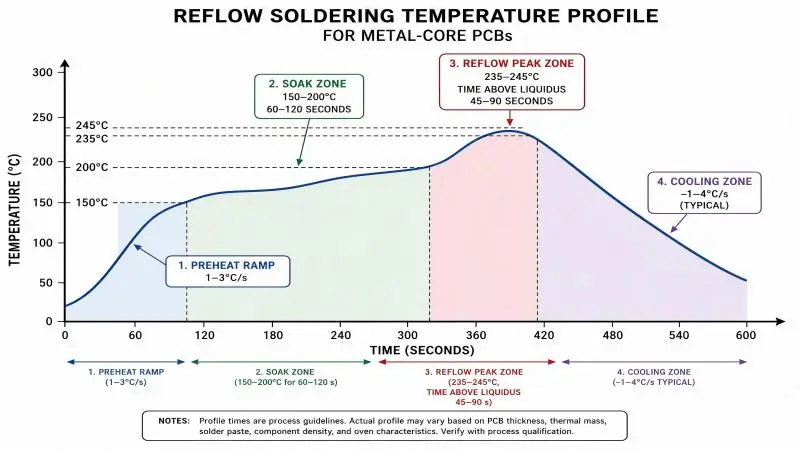
Hand soldering and wave soldering introduce operator and positioning variability. A hand iron can overheat one pad while under-heating its neighbor, creating cold joints, bridging, or uneven fillets. Wave soldering applies heat to the whole assembly but can leave shadowing and uneven exposure. Reflow removes most of that operator-dependent scatter, which is why it produces far more consistent joints at scale. ams OSRAM’s guidance on lead-free reflow soldering of LEDs recommends limiting peak temperature to about 240°C and holding time above liquidus to roughly 30–90 seconds so joints form properly without over-growing intermetallic phases.
Thermal Cycling and Vibration Resilience Improvements
Grow lights cycle thermally as they turn on, ramp up, dim, and shut down. Each cycle expands and contracts the solder, the LED package, and the board at different rates. Over time, that thermo-mechanical stress fatigues the solder fillet and can crack it.
Because an SMT joint on an MCPCB runs cooler and sees a flatter temperature gradient, it endures smaller stress swings per cycle. Lower stress per cycle means more cycles to failure. Combined with the low-profile bond that tightens the joint under the component, SMT joints are also inherently stiffer and more resistant to the grazing vibration from fans and nearby equipment.
Common Failure Modes Mitigated by SMT Practices
A few classic failure modes explain why process control matters:
- Cold joints — solder that never fully melted or wetted, leaving a weak, high-resistance connection. Reflow’s controlled peak temperature eliminates these.
- Bridging — solder shorting between adjacent pads. Stencil-controlled paste volume and placement accuracy reduce this.
- Tombstoning — a small component standing up on one end during reflow. Balanced heating and correct paste keep components flat.
- Pad lift — the copper pad peeling from the substrate, often driven by overheating or excessive thermal cycling. MCPCB thermal management mitigates the cycling that causes it.
A manufacturer that controls these variables with a documented reflow profile and inspection gates produces joints that stay intact. That discipline is one of the clearest differentiators between a fixture built to last and one built to fail. If you are qualifying a supplier, our guide to how to evaluate an LED grow light manufacturer walks through the inspection and certification prompts that verify process control in production.
Mechanical and Environmental Robustness
Durability is not only about heat. A grow light hangs above a humid, sometimes vibrating canopy and may be washed down between cycles. The way components physically attach to the board determines how well the assembly holds up.
Low-profile Components Reduce Leverage and Stress
SMT components sit flush against the board, giving them a low center of gravity and a short lever arm. When a fixture vibrates, swings, or is bumped during servicing, a low-profile joint experiences far less bending stress than a tall through-hole lead would. Less leverage means less chance of the joint cracking or the component tearing loose.
This is especially important for LEDs themselves, which are often the most densely packed and heat-sensitive parts on the board. A flush SMT bond keeps them anchored and cool at the same time.
Conformal Coating and Sealing in Damp/Wet Rooms
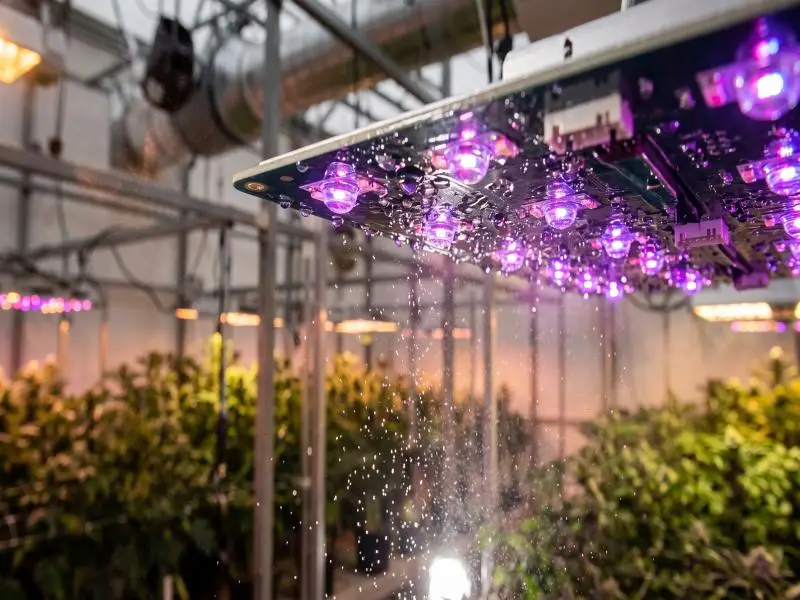
Grow rooms are hard on electronics: humidity swings, foliar spray drift, and washdown water all threaten bare boards. SMT boards are well suited to conformal coating—a thin, process-controlled polymer layer that seals the assembly against moisture, dust, and corrosive salts.
Conformal coating is not “paint.” It requires correct surface prep, controlled application thickness, and inspection to confirm full coverage. When applied properly, it keeps humid-air condensation away from solder joints and component leads, protecting against the corrosion and electrical leakage that quietly kill uncoated boards.
Hybrid SMT/THT Design for Heavy Mechanical Loads
Some components are genuinely better as through-hole (THT) parts. Connectors, transformers, screw terminals, and large capacitors carry mechanical load, heavy cable strain, or repeated plug/unplug force. A through-hole lead that passes through the board and is soldered on both sides holds these parts far more firmly than a surface-mount pad alone.
A well-designed fixture uses both. SMT handles the high-density, heat-sensitive LED and driver electronics, while THT anchors the load-bearing connectors and high-stress power components. That hybrid approach gets the best of both: the thermal and density advantages of SMT where they matter, and the mechanical strength of through-hole where it matters.
SMT vs Through-Hole: A Balanced Approach
No single assembly method is right for every part of a luminaire. The strongest fixtures make a deliberate choice about where each technology belongs.
Where SMT Delivers the Most Value in Luminaires
SMT is the clear winner for the LED board itself. It enables high component density, a short thermal path to the MCPCB, automated high-volume assembly, and the low-profile joints that resist thermal cycling. For any part that generates heat or must pack tightly—LEDs, driver ICs, bus bars, control electronics—SMT is the durable choice.
When Through-hole Anchoring is the Right Choice
Through-hole earns its place where mechanical strength and serviceability dominate. Modular cable connectors, dimming ports, and power terminals that get plugged and unplugged repeatedly need the extraction resistance and strain relief that THT provides. Large capacitors and transformers, which are heavy and prone to mechanical resonance, also benefit from the anchoring of a through-hole joint.
Integrating Both for Serviceability and Durability
The most practical designs integrate the two. SMT does the thermal and density-critical work; THT anchors the parts that face mechanical abuse or that a technician might replace in the field. This split improves serviceability—a failed connector or driver can be swapped without scrapping the whole LED board—while keeping the heat path efficient. For procurement, it means asking manufacturers not “SMT or THT?” but “where does each technology belong in this fixture, and why?”
Compliance and Procurement Discipline
Engineering design only translates into durability if it is verified and documented. Certification is the evidence trail that separates engineering claims from proven reliability.
UL 8800, UL 1598, IEC 62471, IEC 60598 Essentials
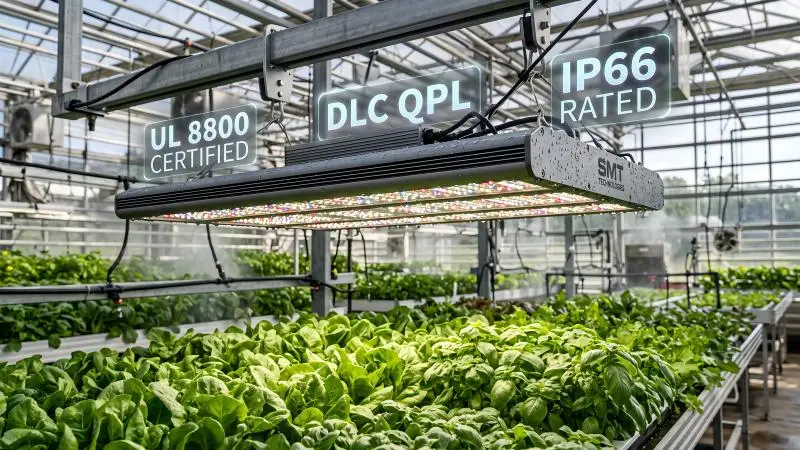
For North American commercial installations, the horticultural benchmark is UL 8800, the standard dedicated to horticultural lighting equipment (product category IFAU). It builds on UL 1598, the general luminaire standard, and adds plant-environment-specific evaluations: photobiological eye and skin safety per IEC 62471, damp/wet location suitability, weather-resistant polymer ratings, and flexible wiring and strain relief. IEC 60598 is the broader international luminaire standard, which now distinguishes horticultural luminaires because of their photobiological and environmental factors. UL Solutions’ horticultural lighting services frame UL 8800 as the benchmark for horticultural equipment and a requirement for DLC QPL listing.
For a buyer, the practical issue is not just “is it certified” but “is it certified for the right standard.” A general-luminaire listing alone does not prove a fixture was evaluated for the wet, high-humidity realities of a grow room. That is why UL 8800 matters.
DLC Horticultural QPL, TM-33, and Utility Incentives
Beyond safety, durability and performance meet at the DesignLights Consortium (DLC) Horticultural Qualified Products List (QPL). The DLC requires safety certification to ANSI/UL 8800 and machine-readable spectral and spatial data submitted as a TM-33 XML document per ANSI/IES TM-33. Recent DLC technical requirements set minimum photosynthetic photon efficacy thresholds—for example, 2.5 μmol/J in the V4.0 policy—so QPL listing is both a performance and a compliance signal, as detailed in the DLC’s horticultural technical requirements.
QPL listing is also the gateway to utility rebates that can offset 20% to 50% of upfront fixture capex. That turns durability documentation into a direct financial lever, not just a compliance checkbox.
Wet-location/IP Ratings and Documentation You Should Require
An ingress protection (IP) rating describes how well a fixture resists dust and water, but it does not by itself prove a fixture is accepted for a wet location—that depends on the product being properly listed and marked for the actual installation environment. For high-humidity and washdown rooms, buyers commonly specify IP65 or IP66.
Require documentation that ties every claim together: the model’s listing and file number, its wet/damp location marking, its IP rating, its photobiological risk-group label, and its TM-33 data. A compliance package that matches the exact SKU you are buying is one of the strongest durability signals available.
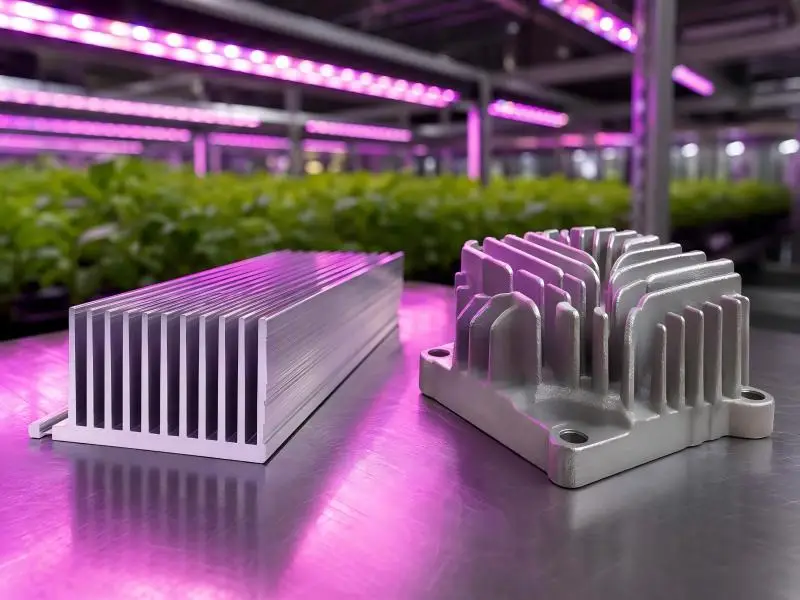
SLTMAKS, for example, builds its fixtures around UL 8800 compliance and heavy-duty passive aluminum heat sinks, publishing UL-certified grow light documentation so buyers can verify the wet-location, photobiological, and thermal-validation story behind an SMT design. That transparency is exactly the kind of evidence to request from any vendor.
Deployment Guidance for Multi-Site Operations
Once you have selected durable, compliant fixtures, the job shifts to deploying them consistently across facilities. Standardization is where durability becomes a managed outcome rather than a hope.
Verify Listings and Exact SKUs before Standardizing
Before rolling out a fixture fleet-wide, verify that the safety listing, DLC QPL entry, and IP rating are tied to the exact SKU and revision you are standardizing on. Certifications attach to specific models, not to a brand. A listing on a different revision does not carry over. Confirm the file number in the public certification directories and match it to your purchase order before you commit.
Commission Thermal Validation and Controls Compatibility
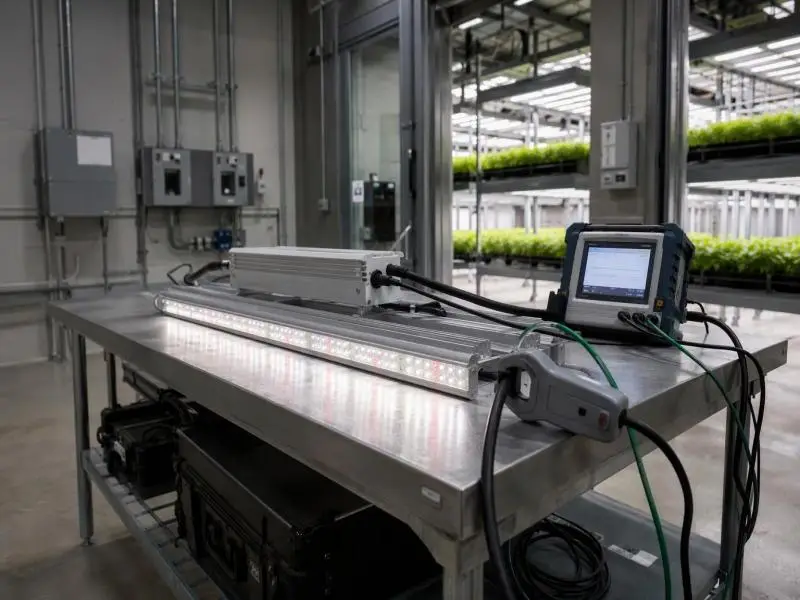
Durability is confirmed in the field, not just on a datasheet. Commission a thermal validation on a sample in your real operating environment: measure board and junction temperatures at your actual drive current and ambient conditions, and confirm the fixture stays within its design window. Also verify controls compatibility—dimming protocols, communication, and inrush behavior—so the installed system behaves predictably and does not stress components during normal operation.
BOM Standardization, Spares Strategy, and Maintenance Planning
Standardize the bill of materials (BOM) across sites so that drivers, connectors, and LED boards are interchangeable. Keep a defined spares strategy for the parts most likely to need replacement, and pair it with a maintenance plan that includes periodic cleaning, inspection of seals and coatings, and verification that any service swaps match the certified configuration. When every site uses the same parts and the same checks, a single durable design yields predictable uptime everywhere.
Conclusion
The importance of SMT in grow-light durability comes down to engineering fundamentals. Surface-mount LEDs on metal-core PCBs shorten the heat path and flatten thermal gradients, protecting junction temperature and extending component life. Reflow soldering brings the process control that keeps solder joints intact through thousands of thermal cycles. Low-profile mounting, conformal coating, and a balanced SMT/THT mix add mechanical and environmental robustness. Certification to UL 8800, DLC QPL listing, and documented IP ratings turn that engineering into verifiable claims.
The practical next step is to evaluate durability the same way you evaluate yield: with evidence. Ask for the reflow and thermal-validation records, verify the exact SKU’s listings and TM-33 data, and standardize on fixtures whose SMT design has been proven in your operating conditions. Do that across your sites, and you reduce failures, protect ROI, and turn your lighting from a maintenance burden into a dependable asset.
FAQ
How long do LED grow lights last?
How long do LED grow lights last?
Quality LED grow lights are typically rated for 50,000 to 100,000 hours of operation—roughly 5 to 15 years under normal indoor growing schedules, depending on your photoperiod and build quality. That rating is based on L70, the point where a fixture’s light output drops to about 70% of its original value, not a sudden burnout. What actually shortens that life is heat; every 10°C rise in operating temperature can roughly halve component life. An SMT design on a metal-core PCB helps here by keeping junction temperature lower and more uniform, so the fixture holds its rated output longer. Driver quality, dust buildup, humidity, and power surges matter too, which is why a well-built SMT fixture with a good driver and passive cooling outlasts a cheap one with the same LED chips.
What is SMT in LED grow lights and why does it matter?
What is SMT in LED grow lights and why does it matter?
SMT, or Surface Mount Technology, is the assembly method where LED chips and small components are soldered directly onto the surface of a printed circuit board instead of being pushed through drilled holes like older through-hole parts. It matters for durability because it changes the physics of the assembly: surface-mount LEDs sit on a metal-core PCB that pulls heat away fast, reflow soldering creates far more consistent joints than hand or wave methods, and low-profile components resist vibration and thermal cycling better. In short, SMT is the foundation that lets a grow light survive years of on-off cycles, high humidity, and heat without degrading.
How does heat affect LED grow light durability and lifespan?
How does heat affect LED grow light durability and lifespan?
Heat is the main threat to LED longevity. High junction temperature accelerates lumen depreciation, degrades the phosphor and driver, and fatigues solder joints through repeated expansion and contraction. The crossover number to remember is that each roughly 10°C increase in operating temperature can cut expected life by about half. SMT designs counter this by giving heat a short, low-resistance path: the LED’s thermal pad connects to a copper layer on an aluminum or copper metal-core PCB, which spreads heat laterally and dumps it into the heat sink. Lower and flatter temperatures mean smaller stress swings per thermal cycle and longer-lived LEDs, drivers, and solder joints.
What certifications should a durable grow light have?
What certifications should a durable grow light have?
For a durable fixture, ask for the certifications that tie engineering to evidence. In North America the benchmark is UL 8800, the safety standard dedicated to horticultural lighting, which builds on UL 1598 and adds plant-environment checks like damp/wet-location suitability, photobiological eye and skin safety per IEC 62471, and weather-resistant materials. For performance and rebate eligibility, look for DLC Horticultural QPL listing, which requires UL 8800 safety certification plus machine-readable spectral and spatial data submitted as a TM-33 file. A durable fixture’s compliance package should match the exact SKU you’re buying: its listing and file number, wet-location marking, IP rating, photobiological risk-group label, and TM-33 data.