For serious indoor cultivators, the transition from hobbyist experimentation to professional-grade results often hinges on a single, crucial upgrade: the lighting system. At sltmaks.com, we have spent years engineering, testing, and refining horticultural lighting solutions. Through our extensive R&D experience, one category has consistently emerged as the “sweet spot” for both high-yield home grows and scalable commercial facilities: the 600w led grow light.
This fixture class represents the perfect balance of power, coverage, and efficiency. It is powerful enough to saturate a standard 4×4 or 5×5 flower footprint with high-intensity photons, yet efficient enough to slash electricity bills compared to legacy HID systems. Whether you are replacing old High-Pressure Sodium (HPS) lamps or setting up a new facility, understanding the mechanics of a 600W fixture is essential. In this comprehensive guide, we will dismantle the technical specifications, explore the science of Photosynthetic Photon Flux Density (PPFD), and provide you with the setup tips necessary to maximize your yield.
Table of Contents
Understanding the True Power of a 600W LED Grow Light
When we discuss a 600w led grow light, it is imperative to first clarify what “600 watts” actually means in the modern LED market. In the early days of LED technology, manufacturers often used “equivalent wattage” to market their products, confusing customers by claiming a light was “600W” when it only drew 120W from the wall.
Wall Draw vs. Marketing Claims
At SLTMAKS, when we refer to a 600W fixture, we are talking about true wall draw. A high-performance 600W LED fixture should consume approximately 600 to 650 watts of electricity at full power. This power is driven through high-efficiency drivers into thousands of light-emitting diodes (diodes).
If you encounter a light on a marketplace that claims to be a “1000W LED” but is sold for a suspiciously low price and fits in a shoebox, check the actual power consumption. True 600W fixtures are substantial pieces of equipment, often featuring large heat sinks or bar-style designs to dissipate the thermal energy generated by high-output operation. For professional results, you must ensure that your light provides the raw power necessary to drive photosynthesis at high rates.
The Shift from HPS to LED
For decades, the 1000W Double-Ended (DE) HPS bulb was the gold standard for indoor flowering. However, a premium 600w led grow light is designed to not just match, but outperform a 1000W HPS. How is this possible with 40% less electricity? The answer lies in Efficacy.
HPS lights emit light in all directions (360 degrees), meaning reflectors are needed to bounce trapped light back down, leading to significant intensity loss. Furthermore, HPS bulbs generate massive amounts of infrared heat (radiant heat) which stresses plants but does not directly drive photosynthesis. LEDs, conversely, are directional. Every photon generated is directed downward toward the canopy. By removing the wasted heat and directing the light, a 600W LED can deliver higher usable light levels to your plants than a 1000W HPS, while reducing your HVAC cooling load significantly.
The Metrics That Matter: PAR, PPF, and PPE
To truly evaluate a 600w led grow light, you must look beyond watts and understand the language of photonics. Wattage tells you what you pay the electric company; it does not tell you what the plant receives. In our lab at SLTMAKS, we focus on three core metrics: PAR, PPF, and PPE.
Photosynthetic Active Radiation (PAR)
PAR refers to the range of light wavelengths (400nm to 700nm) that plants are capable of using for photosynthesis. Humans see light in “lumens,” which is biased towards green/yellow light that our eyes are sensitive to. Plants, however, care about photons in the blue and red spectrums. Therefore, buying a grow light based on “lumens” is a critical mistake. You must look for fixtures optimized for PAR.
Photosynthetic Photon Flux (PPF)
PPF is measured in micromoles per second ($\mu mol/s$). This number tells you the total amount of PAR light produced by the fixture each second. A top-tier 600w led grow light should produce a total PPF output in the range of 1600 to 1850 $\mu mol/s$.
If a manufacturer does not list the PPF, it is a red flag. This total light output is the engine of your grow; the higher the PPF, the more potential yield you have, provided you can distribute it effectively.
Photosynthetic Photon Efficacy (PPE)
Efficiency is the ratio of output (PPF) to input (Watts). This is expressed as $\mu mol/J$ (micromoles per Joule).
- Legacy HPS: ~1.7 $\mu mol/J$
- Budget LED: ~2.2 $\mu mol/J$
- Premium 600W LED: ~2.7 to 3.0 $\mu mol/J$
A fixture with a PPE of 2.8 $\mu mol/J$ will produce significantly more light for the same electricity cost compared to one with 2.2 $\mu mol/J$. Over a standard 3-month grow cycle running 12 hours a day, the difference in efficiency translates directly to your bottom line.
Spectrum Analysis: Why Full Spectrum is Non-Negotiable
In the early days of LED technology, “blurple” (blue and red only) lights were common. While plants can grow under this spectrum, they often suffer from structural issues, difficulty in diagnosing nutrient deficiencies (because the leaves look purple), and lower terpene production. Modern 600w led grow light technology has shifted almost exclusively to Full Spectrum white light.
The Role of White Light Diodes
High-quality fixtures typically utilize Samsung or Osram diodes. A mix of 3000K (warm white) and 5000K (cool white) diodes creates a sun-like spectrum.
- Blue wavelengths (400-500nm): Crucial for vegetative growth. It keeps internodes tight and encourages strong root development and stomatal opening.
- Green wavelengths (500-600nm): Once thought to be useless, research now shows green light penetrates deeper into the canopy than red or blue, driving photosynthesis in lower leaves that would otherwise die off.
The Deep Red Boost (660nm)
While white diodes are excellent, flowering plants crave extra energy in the red spectrum. Most premium 600W fixtures incorporate dedicated 660nm Deep Red diodes. This specific wavelength aligns perfectly with the absorption peak of Chlorophyll A and B. Adding 660nm diodes boosts the “Emerson Effect,” enhancing photosynthetic rates and signaling the plant to produce large, dense flowers.
UV and IR Supplementation
Some advanced 600w led grow light models also include UV (Ultraviolet) and IR (Infrared) diodes.
- UV (380-400nm): Mild stress from UV triggers the plant to produce “sunscreen” in the form of trichomes and secondary metabolites (terpenes/flavonoids).
- IR (730nm+): Far-red light helps trigger the shade-avoidance response (stretching) if used incorrectly, but when balanced, it helps bulk up flowers and can shorten the flowering cycle by putting plants to “sleep” faster after lights out.
Table 1: Spectrum Efficacy on Plant Growth Stages
| Spectrum Range | Color | Primary Function | Importance in 600W Fixture |
| 400-500nm | Blue | Vegetative structure, root growth | High (Base White Light) |
| 500-600nm | Green | Canopy penetration, human visibility | Medium (Base White Light) |
| 600-700nm | Red | Biomass production, flowering | Critical (Base + 660nm Boost) |
| 730nm+ | Far Red | Flowering onset, cell expansion | Moderate (often supplementary) |
PPFD Maps and Coverage Areas
Perhaps the most technical aspect of selecting a 600w led grow light is understanding the PPFD map. The PPFD (Photosynthetic Photon Flux Density) measures how many photons land on a specific square meter of canopy per second ($\mu mol/m^2/s$).
The “Hot Spot” Problem vs. Uniformity
Old-school Quantum Boards often suffered from a “hot spot” in the center, where the PPFD might be 1500, while the corners dropped to 400. This causes uneven growth; the middle plants burn, and the corner plants stretch.
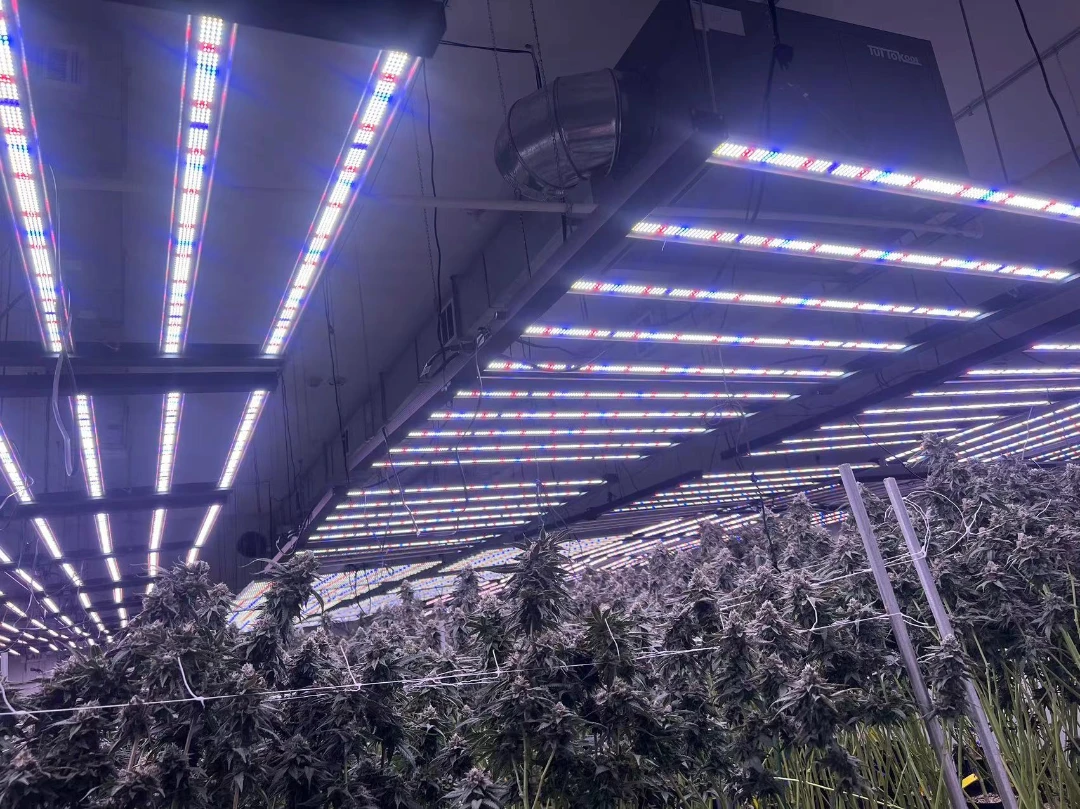
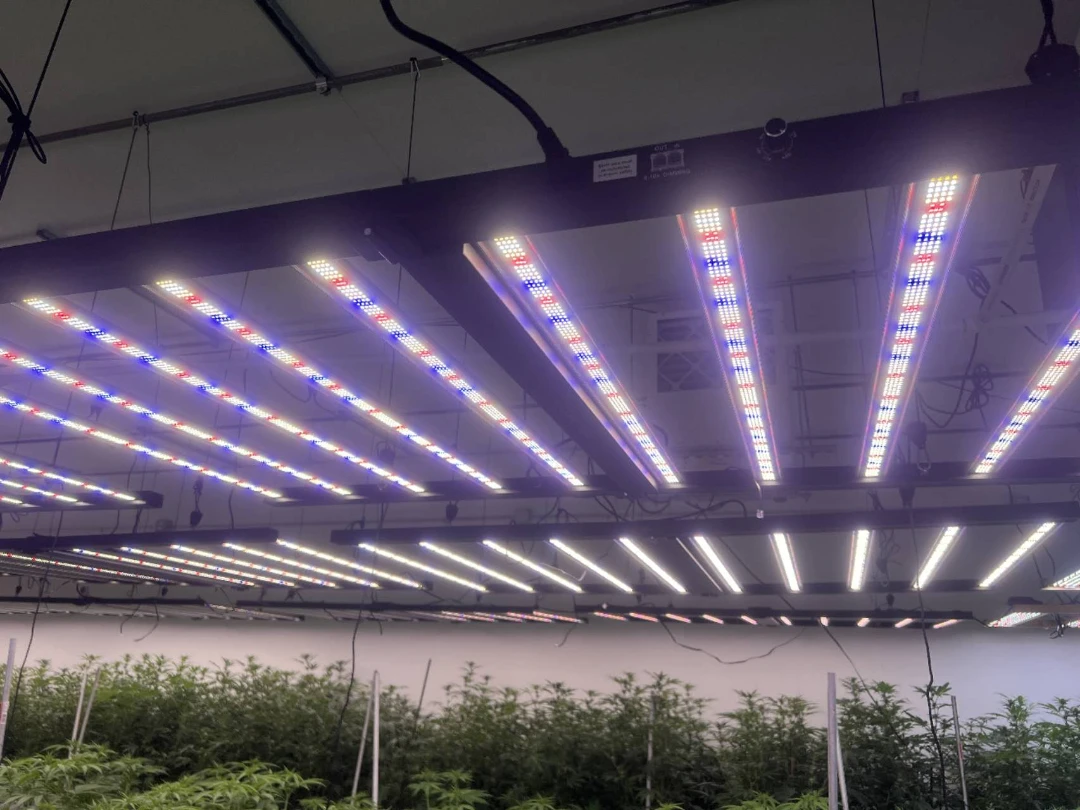
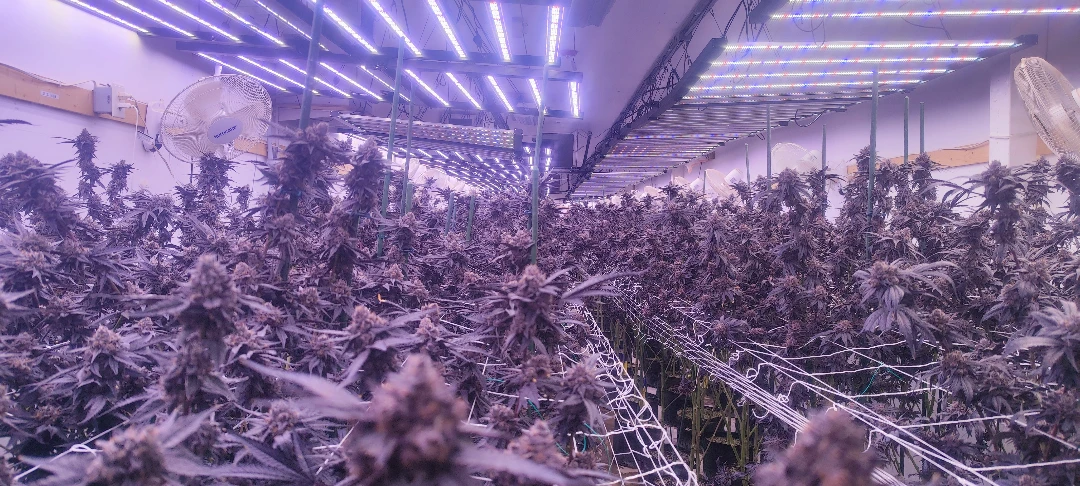
Modern 600W fixtures, especially the Bar-Style (Multi-Bar) designs we advocate for at SLTMAKS, spread the diodes out over a larger physical area. This ensures that the PPFD is distributed evenly. You want a map that averages 800-1000 $\mu mol/m^2/s$ across the entire canopy during bloom, with no spot exceeding 1200 (unless using CO2) and no spot dropping below 600.
4×4 ft vs. 5×5 ft Coverage
A 600W LED is typically rated for:
- Vegetative Coverage: 6×6 feet. During veg, plants need less light intensity, so you can hang the light higher, spreading the footprint.
- Flowering Coverage: 4×4 feet to 5×5 feet.
- In a 4×4 tent: A 600W light will provide “high intensity” production levels (CO2 supplementation recommended).
- In a 5×5 tent: A 600W light will provide excellent coverage to the edges without light bleaching the center.
For more information on light measurement standards, you can refer to the DesignLights Consortium (DLC) Horticultural Lighting Requirements, which sets the benchmark for efficiency and reporting in our industry.
Thermal Management: Why Cool Runs Efficient
One of the greatest misconceptions is that LEDs produce “no heat.” While they are far cooler than HPS, a 600w led grow light is still converting 600 watts of energy. Roughly 60-70% becomes light, but 30-40% becomes heat. That means you have about 200-250 watts of thermal energy to dissipate.
Passive Cooling vs. Active Cooling
- Active Cooling: Uses internal fans to blow air over heat sinks. Avoid these. Fans are the first component to fail in a humid grow room environment. If the fan dies, the LEDs overheat and burn out.
- Passive Cooling: Uses thick aluminum heat sinks or the surface area of the bars themselves to dissipate heat via convection. This is the standard for professional fixtures. It is silent, reliable, and maintenance-free.
Driver Placement
The LED driver (the power supply) is a significant heat source. A premium setup allows you to detach the driver and mount it outside the grow tent or room. Removing the driver from the grow space can lower the ambient temperature inside the tent by 3-5°F (1-2°C), further reducing the strain on your ventilation and air conditioning systems.
Installation and Setup Tips for Maximum Yield
Owning a high-performance 600w led grow light is only half the battle; setting it up correctly is the other half. Here are practical tips from our engineering team to ensure you get the most out of your hardware.
1. The Hanging Height Rule
The inverse square law applies to light: doubling the distance reduces intensity by 75%. However, LEDs are intense. Hanging them too close can cause “light stress” or bleaching, even without heat.
- Seedling Stage: 24-30 inches above canopy, dimmed to 25-40%.
- Vegetative Stage: 18-24 inches above canopy, dimmed to 50-75%.
- Flowering Stage: 12-18 inches above canopy, at 100% power.
Note: Monitor your plants daily. If leaves are “praying” (pointing sharply upwards), they are happy. If they are drooping or the edges are curling up (tacoing), the light is too close or too intense.
2. Utilizing the Dimmer
Never run a 600W light at 100% power on seedlings. You will stunt them. A 0-10V dimmer knob is a standard feature on quality lights. Use a Lux meter or a PAR meter app on your phone to establish a baseline. While phone apps aren’t 100% accurate, they are better than guessing. Aim for:
- Seedlings: 200-300 PPFD
- Veg: 400-600 PPFD
- Flower: 800-1000+ PPFD
3. Daisy Chaining for Scale
If you are running multiple lights (e.g., in a commercial room with 10+ lights), look for fixtures with RJ11/RJ14 ports. This allows you to “daisy chain” the lights together and control them all from a single master controller. This ensures that sunrise/sunset simulation and dimming are uniform across your entire crop.
4. Cable Management
A 600W fixture is heavy (often 20-30 lbs). Ensure you are using heavy-duty ratchet hangers rated for at least 50 lbs per pair. Never hang a light directly from the frame of a cheap tent without verifying the weight limit. Cross-bars or additional support may be needed to prevent the tent roof from bowing.
Economic Analysis: ROI of a 600W LED
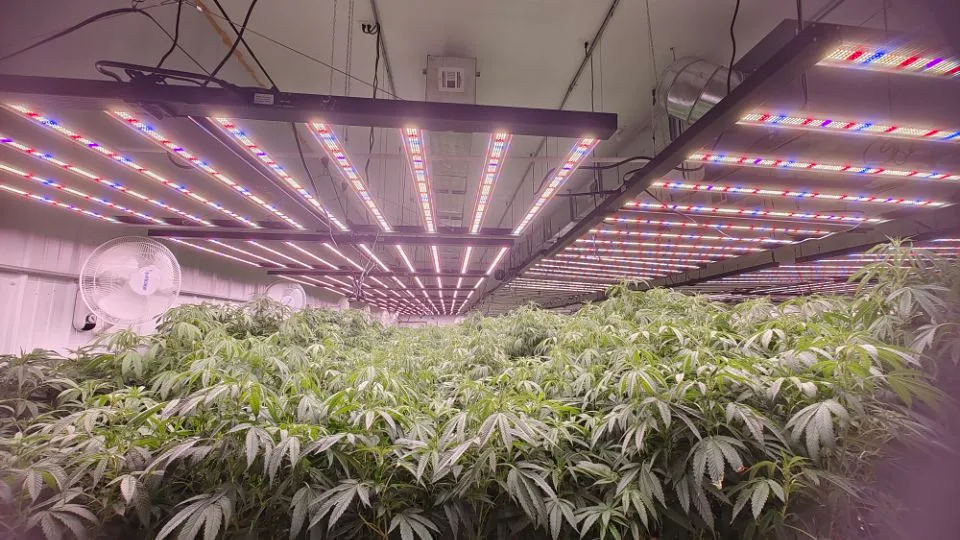
The initial investment for a high-quality 600w led grow light is higher than a cheap HPS setup. However, the Return on Investment (ROI) is rapid.
Let’s do the math based on a standard US energy cost of $0.15/kWh.
Scenario: 1000W HPS (Magnetic Ballast draws ~1100W) vs. 600W LED
- HPS Daily Cost (12 hours): 1.1 kW * 12h * $0.15 = $1.98 per day.
- LED Daily Cost (12 hours): 0.6 kW * 12h * $0.15 = $1.08 per day.
- Daily Savings: $0.90.
- Annual Savings: $0.90 * 365 = $328.50.
This calculation only accounts for the light. It does not account for the massive savings in bulb replacements (HPS bulbs need changing every 9-12 months, costing $50-$80 each) or the reduced air conditioning costs. Over a 5-year period—the typical warranty of a quality LED—the 600w led grow light saves thousands of dollars, paying for itself multiple times over.
Furthermore, yield consistency adds to the ROI. LED-grown products often test higher for terpenes and cannabinoids due to the preservation of volatile compounds that HPS heat would otherwise degrade.
Troubleshooting Common Issues
Even with the best equipment, growers encounter variables. Here are common issues related to 600W lighting and how to solve them.
“My Plants are Stretching”
If your plants are growing tall and spindly with large gaps between nodes, they are not getting enough light.
- Solution: Lower the light fixture by 2-3 inches or increase the dimmer intensity. Ensure your environment isn’t too hot, as high heat can also induce stretching.
“The Leaves look Bleached/White at the Top”
This is light burn. The chlorophyll is being destroyed by excess photon energy.
- Solution: Raise the light immediately. Even if the temperature is cool, the light intensity is too high for the plant’s metabolism to handle. Check your nutrient strength and CO2 levels; plants need more “food” and CO2 to process high light levels.
“The Light Won’t Turn Off Completely”
Sometimes, when connected to a timer, cheaper LEDs might glow faintly.
- Solution: This is often due to a poor neutral wire connection in the timer or building wiring. Ensure you are using a high-quality digital timer or a dedicated lighting controller.
The Future of 600W Lighting
The technology behind the 600w led grow light is not stagnant. At SLTMAKS, we are constantly observing the horizon of horticultural science. We are seeing a trend towards “Spectral Tuning,” where growers can adjust the ratio of red-to-blue light via an app throughout the day. We are also seeing efficiency boundaries pushed closer to 3.5 $\mu mol/J$.
However, the core physics remains the same: plants need photons. The 600W form factor remains the king of versatility because it fits the geometry of human spaces (rooms, tents, benches) perfectly while delivering the intensity of the sun.
Making the Right Choice
Choosing a grow light is a commitment to your garden’s future. A generic, underpowered light will yield airy, disappointing flowers. A powerful, scientifically engineered 600w led grow light will provide the engine for dense, resinous, and heavy harvests.
At www.sltmaks.com, we pride ourselves on transparency. We don’t just sell lights; we sell the result of years of testing and engineering. When you select a fixture, look for the markers of quality we discussed: high PPF (1600+ $\mu mol/s$), high efficacy (2.7+ $\mu mol/J$), robust thermal management, and premium diodes.
Your plants are living organisms that rely entirely on you for their energy source. By investing in a high-efficiency 600W system, you are ensuring that every watt of electricity is converted into maximum plant growth. Whether you are a commercial facility manager looking to optimize operational costs or a home grower chasing that “magazine quality” harvest, the 600W LED is your most valuable tool.
Ready to upgrade your cultivation space? Browse our selection of premium LED fixtures and see the difference that professional-grade lighting makes in your garden. If you have specific questions about hanging heights or mapping your specific room, our support team is always ready to assist fellow growers.
Frequently Asked Questions (FAQ)
To further assist you in understanding the capabilities of these fixtures, we have compiled a list of the most common questions we receive at SLTMAKS regarding the 600w led grow light.
1. Do I need CO2 with a 600W LED?
Answer: It depends on the space. In a 5×5 area, a 600W light provides excellent PPFD (~800 average) which plants can handle without extra CO2. However, if you put a powerful 600W light in a smaller 4×4 area, PPFD levels can exceed 1000 $\mu mol/m^2/s$. At this intensity, ambient CO2 (400ppm) becomes the limiting factor. Supplementing CO2 to 1200-1500ppm will allow the plants to utilize that extra light and grow significantly faster.
2. Can I use a 600W LED for the entire lifecycle?
Answer: Yes. This is the beauty of dimmable LEDs. You can use the same fixture for seedlings (at 25% power), vegetation (at 50-75% power), and flowering (100% power). This eliminates the need to move heavy plants between “veg rooms” and “flower rooms” if you are growing in a single tent.
3. How long do 600W LED lights last?
Answer: Most quality LEDs are rated for 50,000 to 54,000 hours to L90. “L90” means that after 50,000 hours of use, the light will still emit 90% of its original brightness. If you run your light 12 hours a day, that is over 11 years of reliable operation. Compare this to HPS bulbs, which degrade significantly after just 6-9 months.
4. Is the electricity bill difference really that noticeable?
Answer: Absolutely. As calculated in our Economic Analysis section, saving ~$300+ per year per light is standard. If you run a small commercial operation with 20 lights, that is $6,000 in pure profit added to your bottom line annually, simply by switching from HPS to 600W LEDs. This does not even factor in the savings from reduced air conditioning requirements.
5. What is the difference between “Purple” and “White” LEDs?
Answer: “Purple” lights are older technology. They use only red and blue diodes. While efficient in a strict physics sense, they make it impossible to inspect plants for mold, pests, or deficiencies. “White” full-spectrum LEDs (like the ones we manufacture) utilize a phosphor coating to create a spectrum that mimics natural sunlight. This results in better plant morphology (shape), better terpene production, and a much more pleasant working environment for the grower.
6. How high should I hang my 600W LED?
Answer:
- Germination/Clones: 30 inches @ 25% power.
- Veg: 24 inches @ 50% power.
- Bloom: 12-18 inches @ 100% power.
- Tip: Always start higher and lower it slowly. It is easier to fix a plant that is slightly stretching than one that has been bleached by light burn.
7. Do 600W LEDs emit UV light?
Answer: Most standard commercial LEDs focus on the PAR range (400-700nm). However, high-end “Pro” models often include dedicated UVA bars or diodes. UV light degrades plastic and can be harmful to human eyes, so it is typically used cautiously. If your light has UV, ensure you wear protective eyewear.
8. Can I replace a 1000W DE HPS with a 600W LED?
Answer: Yes, this is the standard 1-to-1 replacement in the industry. Because the LED is directional (pointing down) and has a tailored spectrum, a 600W LED delivers roughly the same usable light to the canopy as a 1000W DE HPS, but with far less heat and energy waste.
By understanding these fundamentals, you are well on your way to mastering the art of indoor cultivation with modern LED technology. Visit www.sltmaks.com for more insights and to view our latest product lines.