Introduction
UVA vs UVB grow lights aren’t a “nice-to-have” tweak for commercial rooms—they’re a risk-managed input that can either sharpen quality or quietly erode yield, consistency, and worker safety.
Three realities matter if you’re running multi-room or multi-site production:
- UV effects are rarely universal. Modern cultivars don’t respond the same way, and the response can differ by tissue type (flower vs sugar leaf).
- The upside is more plausible for terpenes than cannabinoids. The best recent studies don’t support a consistent “UV boosts THC” narrative in flower.
- Execution is everything. If you can’t measure dose at the canopy and control exposure like any other process variable, you’re guessing.
This article translates the recent evidence into a practical playbook: how UVA and UVB differ, what studies from 2020–2026 actually show, how to calculate and schedule dose, and how to deploy UV without creating an occupational hazard or a yield regression.
Table of Contents
Spectrum Fundamentals: UVA vs UVB Grow Lights
UVA vs UVB Grow Lights
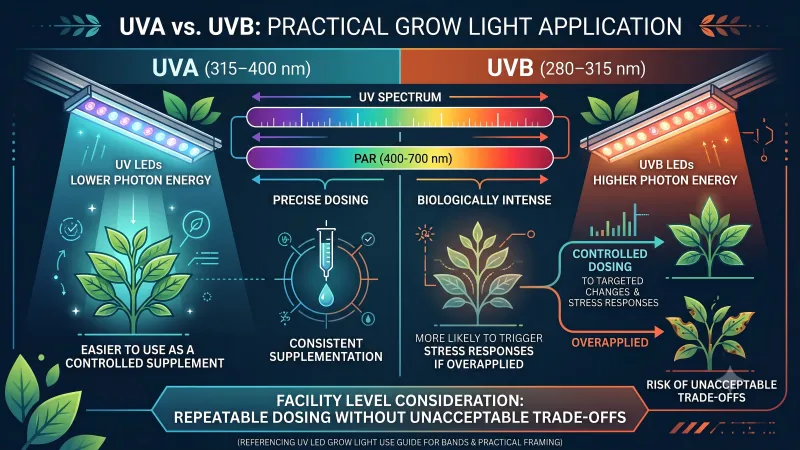
Ultraviolet light sits below the photosynthetically active range (PAR, 400–700 nm). It’s commonly divided into:
- UVA (315–400 nm): Lower photon energy than UVB; generally easier to use as a controlled supplement.
- UVB (280–315 nm): Higher photon energy; biologically intense; more likely to trigger stress responses if overapplied.
At the facility level, UVA vs UVB is less about “which is stronger” and more about which one you can dose repeatably without unacceptable trade-offs.
If you want a quick internal refresher on bands and practical framing, the UV LED grow light use guide is a useful starting point.
From UV to Trichomes and Terpenes
UV is not a yield driver. It’s best understood as a signal/stressor that can shift secondary metabolism and surface traits—sometimes in your favor, sometimes not.
Mechanistically, UV can:
- Increase production of protective compounds and pigments
- Change leaf morphology and canopy microclimate (which indirectly affects quality)
- Influence timing-related cues that may change trichome maturity (e.g., senescence signals)
For operators, the important point is practical: you’re not buying “more trichomes.” You’re buying a chance of quality modulation—if dose, timing, and genetics cooperate.
Risks and Trade-offs by Band
UV risk isn’t theoretical. The trade-offs show up in places you already track:
- Morphology and growth: Leaf curling, reduced leaf area, reduced plant size—more common as UVB share or intensity rises.
- Yield: UV can be neutral at low doses but becomes a penalty quickly when it’s too aggressive.
- Chemical stability: Some studies report shifts in cannabinoids/terpenes that go the wrong direction at higher exposure.
⚠️ Warning: In the recent literature, UVB-heavy or high-intensity UV regimens are more likely to deliver visible stress and yield loss than consistent quality gains.
What the Evidence Shows (2020–2026)
The headline for commercial rooms: UV is not a reliable lever for increasing inflorescence THC/CBD, and any terpene upside is dose- and spectrum-dependent.
Terpene Modulation under Low-dose UVA
One of the more operationally useful findings is that low-intensity UVA-dominant UV can shift certain terpenes without dragging yield.
A 2024 paper in Frontiers in Plant Science tested multiple UVA: UVB ratios and intensities and found that only a low-intensity, UVA-dominant treatment was practically suitable for commercial production, with increases reported in specific terpenes (including linalool) while maintaining yield and cannabinoid profile (see Frontiers study on UVA: UVB ratios and terpene shifts (2024)).
Two operator takeaways from that result:
- UVA-first is a rational default when you’re trying to protect yield.
- “More UV” is not a strategy. In the same study, higher intensity regimens reduced growth or flower weight.
Cannabinoids: Limited, Genotype-dependent Response
If your goal is higher inflorescence cannabinoids, the best recent evidence is blunt.
A 2022 indoor study in Frontiers in Plant Science tested UVA and UVA+UVB protocols and reported no significant UV effects on inflorescence cannabinoid concentrations (and no terpene changes in flower), concluding there were no commercially relevant benefits of adding UV under their conditions (see the Frontiers in Plant Science indoor cannabis UV study (2022)).
A 2021 Frontiers in Plant Science UVB dose-response study (287 nm peak) similarly found no cannabinoid gains, and reported decreases in total equivalent THC/CBD in one cultivar with increasing UVB exposure (see Rodriguez‑Morrison et al. UV‑B dose‑response (Frontiers, 2021)).
The commercial implication is not “UV never works.” It’s: don’t budget UV based on a guaranteed potency uplift. Treat potency response as cultivar-specific R&D, not an assumption.
Yield and Trichome Maturity Effects
Across recent studies, yield outcomes are a consistent filter:
- UV can be neutral at lower doses.
- As UV becomes more biologically aggressive (higher UVB share or higher intensity), growth suppression and yield penalties show up.
The 2024 UVA: UVB ratio study reported visible stress and reduced yield in UVB-heavier treatments, and reduced main flower weight at higher UVA intensity (again, see the Frontiers study on UVA: UVB ratios and terpene shifts (2024)).
On trichomes specifically, some experimental observations include shifts toward more “brownish” (senescent) trichomes under certain UV treatments in that study—an operational reminder that UV can accelerate stress/aging signals.
The practical way to interpret “trichome maturity effects” is not as a promise of more resin, but as a warning: UV can move maturity—and potentially degradation—faster than your harvest window can tolerate.
Dosing and Scheduling
UV dosing is where most UV programs fail—not because the math is hard, but because teams skip measurement, assume fixture output equals canopy dose, and never verify uniformity.
Starting Ranges and Daily Dose Math
For commercial operators, two rules keep you out of trouble:
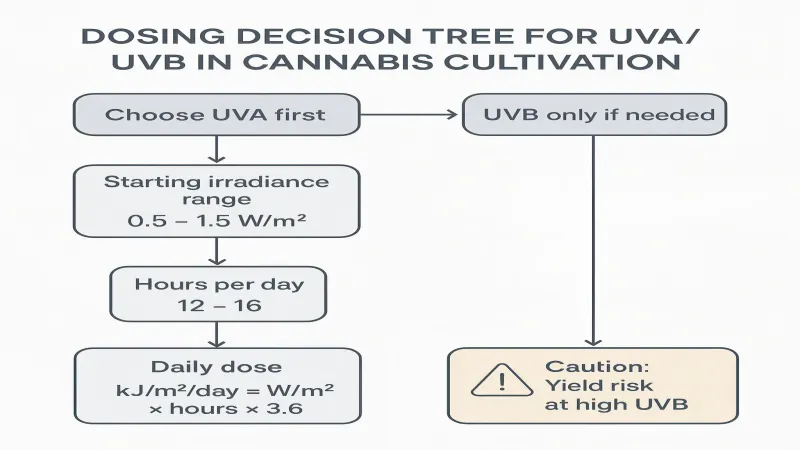
- Start with UVA, not UVB.
- Start low and step up only with measured outcomes.
A common way to express dose is energy per canopy area per day.
- Daily dose (kJ/m²/day) = Irradiance (W/m²) × Hours per day × 3.6
Example:
- 2 W/m² for 2 hours/day → 2 × 2 × 3.6 = 14.4 kJ/m²/day
In the 2024 Frontiers study, the UV treatment flagged as practically suitable for commercial use was a low-intensity, UVA-dominant condition (UVA: UVB 99:1 at 1.81 W/m²) with a reported daily dose on the order of ~100 kJ/m²/day in their setup (see details in the Frontiers study on UVA: UVB ratios and terpene shifts (2024)). Don’t copy that number blindly—use it as a reality check that “low intensity” can still accumulate meaningful daily dose depending on runtime.
Timing Windows in Flower
From an operations standpoint, UV is most often treated as a flower-phase input, because that’s when quality outcomes are judged and when stressing vegetative structure can be costly.
Two timing strategies show up in practice and in recent study designs:
- Longer, low-dose UVA during flowering (more controllable; less likely to cause acute damage)
- Shorter “late flower” windows (attempting to avoid vegetative penalties while targeting late-stage chemistry)
The 2022 Frontiers indoor study applied UVA for the full flowering window and also tested a limited late-flower UVA+UVB exposure, finding no inflorescence cannabinoid or terpene changes. That result supports a conservative operational stance: if you can’t detect a benefit, don’t extend dose or add UVB—tighten your measurement and trial design first.
Measurement and Canopy Mapping
If you take only one process lesson from this post, take this: canopy dose is not fixture spec.
For UV programs, measurement discipline should look like your PPFD discipline:
- Measure irradiance at the canopy plane, not at fixture height.
- Map multiple points per zone (center, corners, edges) and record min/avg/max.
- Re-map after canopy height changes, pruning events, or layout changes.
If your team already runs uniformity checks for PAR, extend the same workflow to UV zones; the commercial grow light layout guidance aligns with that “measure at the plane that matters” mindset.
Safety and Compliance
UV isn’t just a crop variable—it’s an occupational exposure concern. Treat it like any other hazard: engineered controls first, PPE second, training always.
Worker Exposure Limits and TLVs
Most facilities need an internal policy that answers:
- Who can enter UV-enabled rooms while UV is active?
- Under what conditions (duration, PPE, lockout)?
- How is exposure tracked and enforced?
Even if you don’t quote numeric limits in a SOP, you should align your safety program with recognized exposure-limit concepts (e.g., TLVs/ELs) and document the basis for your controls.
Risk Groups (IEC/EN 62471) and UL 8800
Two standard families often show up during fixture evaluation and safety review:
- IEC/EN 62471: photobiological safety of lamps and lamp systems (risk groups, labeling, exposure guidance).
- UL 8800: safety for horticultural lighting equipment (important for US deployments alongside appropriate NRTL listings).
The operational point: UV features increase the burden of documentation and control. Your procurement and EHS teams should expect more questions, not fewer.
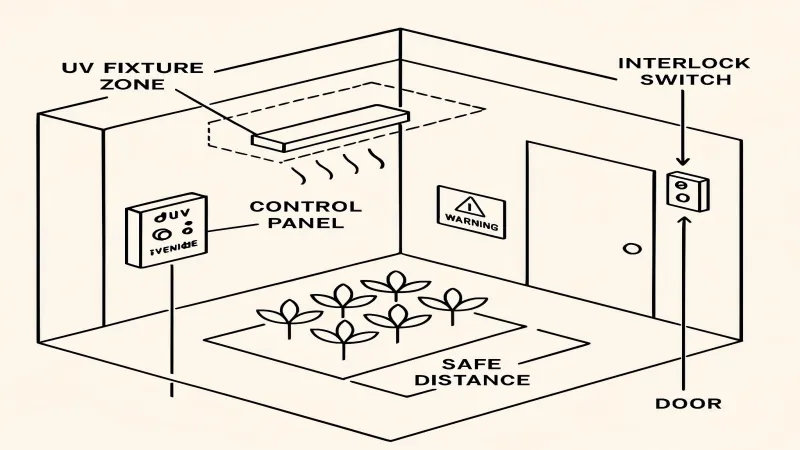
PPE, Signage, and SOPs
Your SOP should make it hard to do the wrong thing:
- UV enable/disable logic that’s visible and logged
- Door interlocks or occupancy-based disable
- Posted warning signage at entry points
- Required PPE when UV might be active (eye/skin protection appropriate to the band and fixture output)
Deployment, Controls, and ROI
A UV program only pays for itself if it’s controllable, repeatable, and measurable—and if terpene gains (if any) show up without yield loss.
Controls, Interlocks, and Zoning
Treat UV as a separate channel with its own rules:
- Zone UV to the rooms/rows where you can measure and validate
- Gate UV enable behind interlocks (door/occupancy/timer)
- Log runtime so you can connect dose → outcome
If you’re standardizing controls across facilities, the smart lighting controls for commercial cannabis facilities are relevant context for how operators think about channel-level control (PAR channels, UV channels, schedules, and zoning).
Trial Design, Analytics, and Go/no-go Gates
Run UV like a process change, not a superstition.
A practical pilot design:
- Side-by-side rooms or split-zones matched for cultivar, fertigation, and PAR
- Fixed baseline (no UV) vs UVA-only treatment
- A single step-up after 1–2 cycles only if the first pass is yield-neutral
Define go/no-go gates before you start:
- Go: measurable terpene increase (lab-verified), no yield loss, no increase in crop risk signals
- No-go: yield regression, canopy damage, or quality changes that don’t translate to sellable outcomes
Fixture Selection and Integration
When UV becomes part of a commercial spec, the “best” fixture is the one that can be deployed safely and validated.
Evaluation criteria that hold up under scrutiny:
- Documented UV channel behavior (including dimming/control resolution)
- Ability to validate what’s actually delivered at the canopy (not just nominal diode spec)
- Compliance documentation suitable for inspectors and procurement
This is where a neutral brand mention is appropriate: SLTMAKS positions its offering around certified ETL/CE/RoHS UV‑controllable fixtures and SPD validation support, which is exactly the kind of implementation detail that matters when UV is treated as a controlled process variable rather than a marketing add-on.
For teams building a compliance packet, the grow light PCB assembly quality and standards page is a useful reference point for how manufacturers document build quality and standards alignment.
FAQ
Does UVA or UVB increase THC in cannabis flower?
Based on the best recent controlled indoor studies, you shouldn’t assume a reliable THC increase from UV. Research from 2021–2024 reports limited or no significant changes in inflorescence cannabinoid concentrations under several UVA and UVB protocols, with responses that can vary by cultivar and dose. Treat any potency effect as cultivar-specific R&D, not a guaranteed production lever.
Is UVA safer and easier to run than UVB?
Generally, yes—UVA is typically more forgiving as a supplement because it carries lower photon energy than UVB. In practice, UVA is often the better starting point when your priority is protecting yield and avoiding visible stress (leaf damage, reduced growth) while you evaluate whether there’s any terpene benefit.
How do I calculate a practical daily UV dose?
A simple operational method is:
Daily dose (kJ/m²/day) = Irradiance (W/m²) × Hours per day × 3.6
For example, 2 W/m² for 2 hours/day equals 14.4 kJ/m²/day. What matters is the dose at the canopy, so you’ll want to measure irradiance where the flower tops actually are, not at fixture height.
When should UV be scheduled during flowering?
Many operators treat UV as a flower-phase input and keep it conservative:
Longer, low-dose UVA across flower if you want the most controllable approach
Short late-flower windows only if you have strong measurement and a clear trial plan
If your first cycle doesn’t show a measurable benefit, the next move usually isn’t “more UV”—it’s tighter measurement, better controls, and clearer trial gates.
What’s the biggest safety mistake facilities make with UV?
The most common failure is treating UV like a normal light channel and skipping occupational exposure controls. UV can create real eye/skin risk, so facilities should implement clear SOPs: access rules, interlocks/disable logic, signage, training, and PPE requirements appropriate to the band and output. In other words: engineer the hazard out first, then rely on PPE as a backstop.
Conclusion
UVA vs UVB grow lights shouldn’t be framed as “which one boosts potency.” For commercial rooms, the decision is simpler and stricter:
- Start with UVA if you want the most controllable path to potential terpene modulation.
- Validate per cultivar because genotype response is real and non-trivial.
- Protect yield and people with canopy-dose measurement, controls, and compliance-first SOPs.
Pilot with side-by-side trials, and adopt only if you can show measurable terpene gains without yield loss—and without creating unmanaged UV exposure risk.