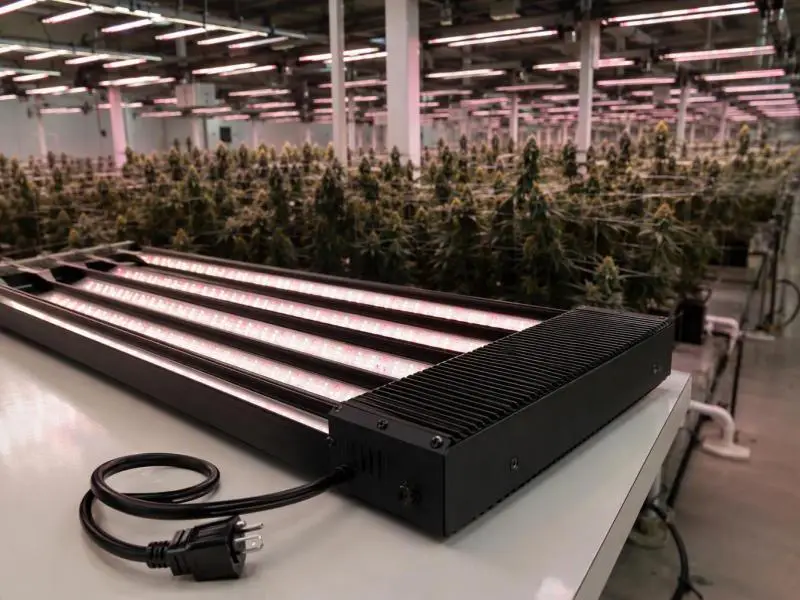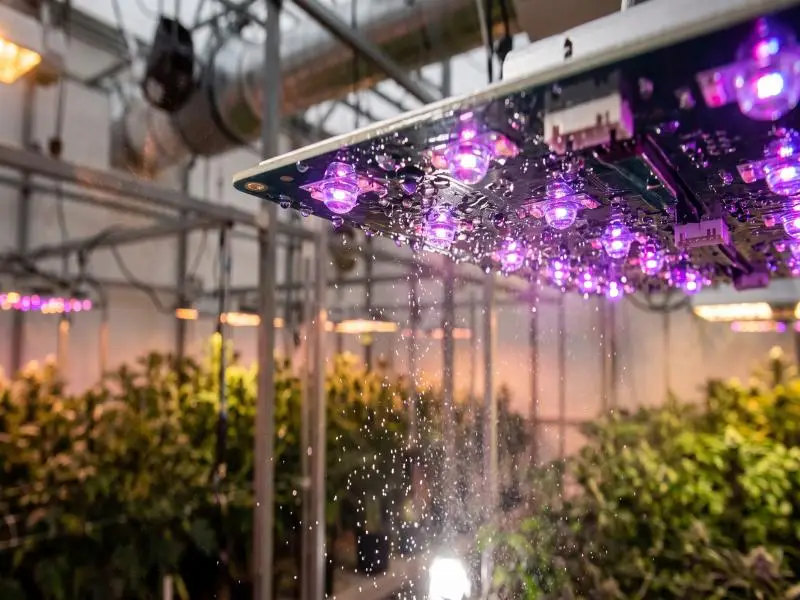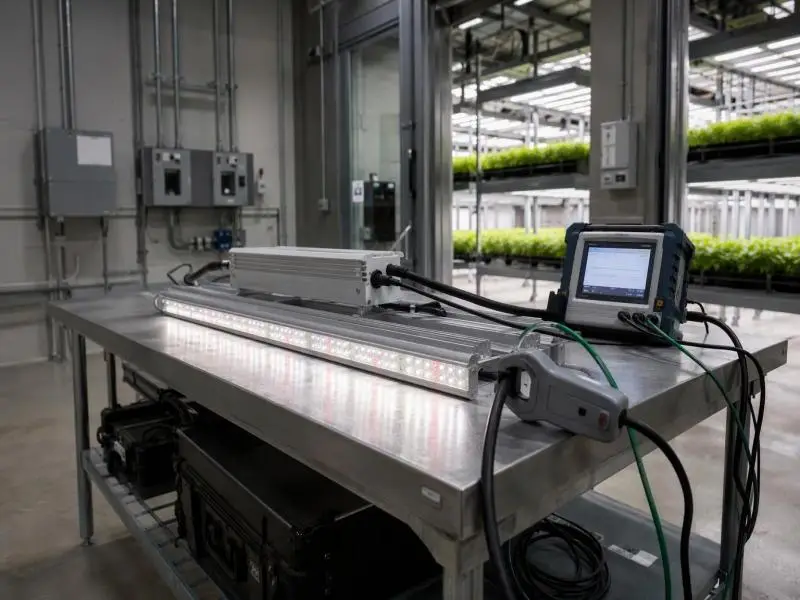
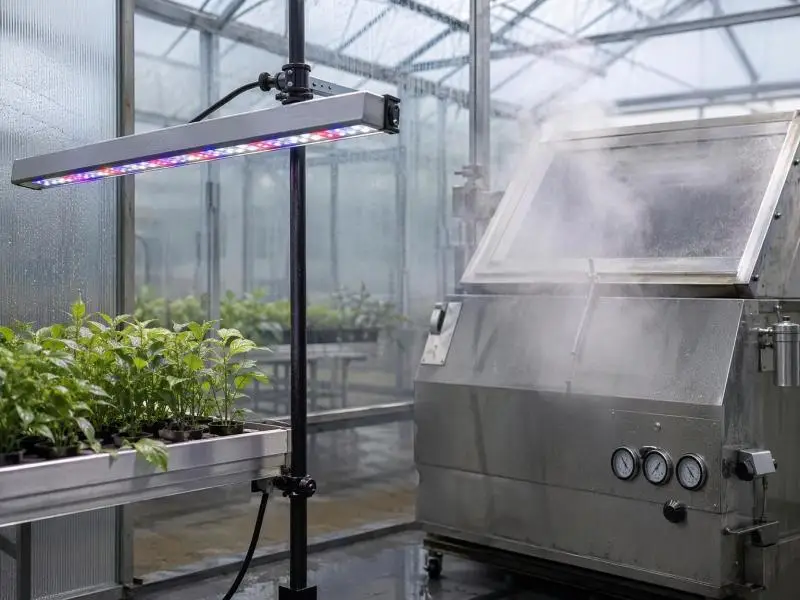
Salt spray testing LED lights is a comparative quality-control method, not a service-life forecast. Manufacturers expose luminaire housings, brackets, fasteners, and driver enclosures to a controlled saline fog, then rate the corrosion that appears. The test exists because a greenhouse is a chemically active, permanently humid environment: irrigation runoff, fertigation salts, condensation on cold fixtures, and airborne ammonia from organic fertilizer all attack unprotected metal.
For an operator comparing vendors, the useful question is not how many hours a fixture survived, but which standard was run, on what specimen, under what recorded chamber conditions, and against what acceptance criteria.
The governing documents set the environment and stop there. ASTM B117-19, the current edition of the practice, covers “the apparatus, procedure, and conditions required to create and maintain the salt spray (fog) test environment” and explicitly does not prescribe the specimen type, the exposure period for a product, or how results should be interpreted (ASTM B117-19, 2019). ISO 9227 defines the three salt-spray methods and their operating windows, and likewise leaves specimen dimensions, exposure time, and interpretation to the product specification (ISO 9227:2017, 2017).
That division of labour is what makes vendor claims hard to compare. Two suppliers can both report “1,000 hours” while testing different specimens, different acceptance limits, and different inspection intervals. Reading a report properly means separating what the standard fixed from what the vendor chose, and judging the second half.
Table of Contents
Purpose and Limits of Salt Spray
Salt spray is a screening tool for coating integrity and a comparative tool for quality control. It is not a durability guarantee, and the standards say so in their own text.
What Salt Spray Tells You
ASTM B117’s stated scope is narrow: it produces relative corrosion resistance information for metal and coated-metal specimens exposed in a given chamber (ASTM B117-19, 2019). ISO 9227 defines the three salt-spray methods and their operating windows, and notes that the tests are particularly useful for detecting discontinuities such as pores and other defects in metallic, organic, anodic oxide and conversion coatings (ISO 9227:2017, 2017).
In practice, this means a salt spray run answers a specific question: does this coating system, on this substrate, with these cut edges and fasteners, develop rust, blistering, or creep from a scribe within the exposure window? That is a real and useful answer for LED luminaire corrosion resistance, because it catches thin powder coats, untreated cut edges, mixed-metal contact, and poor pretreatment.
Why Salt Spray Hours ≠ Field Years
The standard’s own caution is that salt spray results “seldom” predict natural-environment performance when used as standalone data, and that correlation should be considered only where corroborating long-term atmospheric exposures exist (ASTM B117-19, 2019). ISO 9227 goes further: it states there is seldom a direct relation between salt spray resistance and corrosion resistance in other media, because protective-film formation and other factors vary greatly with conditions, and that results should not be treated as a direct guide to service performance (ISO 9227:2017, 2017).
A federal laboratory report reaching the same conclusion examined mechanically fastened roofing, where industry adopted an accelerated sulfur dioxide/water vapour test while the relationship between test performance and long-term field performance remained unknown (NIST IR 88-4008, 1988). The report also notes the test was useful for checking coating integrity on carbon steel fasteners but did not address coating adhesion or abrasion resistance, and was not designed to evaluate galvanic corrosion, chloride pitting or chloride stress corrosion cracking.
There is no universal salt-spray duration. The required number of hours follows from the product specification and the corrosion resistance of the coating system, not from the test standard (ASTM B117-19, 2019). Conversion multipliers that circulate in vendor content, such as equating one cyclic loop to a fixed number of salt spray hours, have no mathematical basis and should be discarded (Torontech, 2026).
Where Salt Spray Fits in a Reliability Plan
Salt spray belongs early in a test sequence, as a coating and assembly screen, before the slower environmental tests that reproduce greenhouse conditions.
ISO 12944’s corrosivity categories, from C1 to CX, give the vocabulary for describing the target environment rather than the test duration: C3 covers production halls with humidity and some air contamination, C4 covers chemical plants and similar aggressive interiors, and C5 covers buildings and areas of almost constant condensation and high contamination (Hempel ISO 12944 brochure, October 2023). A commercial greenhouse with continuous irrigation and fertigation sits well above C1 or C2, which is the argument for specifying a category before specifying hours.
⚠️ Warning: salt spray hours are a comparative signal, not a service-life guarantee. No standard, and no government laboratory report reviewed here, supplies a defensible conversion from chamber hours to field years.
Standards and Test Setup
A valid salt spray run is defined by recorded chamber conditions, not by the number printed on the certificate. These are the parameters to demand before accepting any series.
Core Standards for Salt Spray Testing LED Lights
ASTM B117 is a Standard Practice, not a specification: it fixes the environment, not the specimen or the pass/fail line (ASTM B117-19, 2019). The ASTM B117 salt spray test therefore tells you the cabinet was controlled, not that a luminaire passed. ISO 9227 neutral salt spray is the international equivalent, and it also describes the method used to evaluate the corrosivity of the test cabinet environment itself (ISO 9227:2017, 2017).
IEC 60068-2-11:2021, Test Ka salt mist, independently specifies the same operating values and adds a requirement that specimens be tested in their normal operating positions unless the relevant specification says otherwise (IEC 60068-2-11:2021, 2021).
Apparatus, Solution, and Controls
The 5% NaCl solution the standard specifies is prepared by dissolving 5 ± 1 parts by mass of sodium chloride in 95 parts of Type IV water, and the collected solution must measure 5 ± 1 mass percent (ASTM B117, B117-11 text; current edition B117-19). The pH window the standard requires is 6.5 to 7.2 in the solution collected after atomisation at the 35 °C chamber temperature, which itself is held to 35 ± 2 °C.
The collection rate that proves the fog is right is 1.0 to 2.0 mL per hour per 80 cm² of horizontal collection area, determined over an average run of at least 16 hours. The specimen orientation the standard prescribes is 15 to 30 degrees from vertical, with specimens not touching one another and not contacting wick-like material.
ISO 9227 sets the same neutral salt spray concentration at 50 g/L ± 5 g/L with humidification water at no more than 20 µS/cm conductivity (ISO 9227:2017, 2017).
The nozzle pressure the standard leaves to the chamber design is not a fixed ASTM value; chamber operators commonly work in a band around 0.7 to 1.4 bar depending on the atomiser and cabinet (Presto Group, undated). ISO 9227 gives the atomising overpressure as 70 kPa to 170 kPa, typically 98 kPa ± 10 kPa, with saturation-tower water temperature set by the pressure used.
Specimen Prep and Documentation
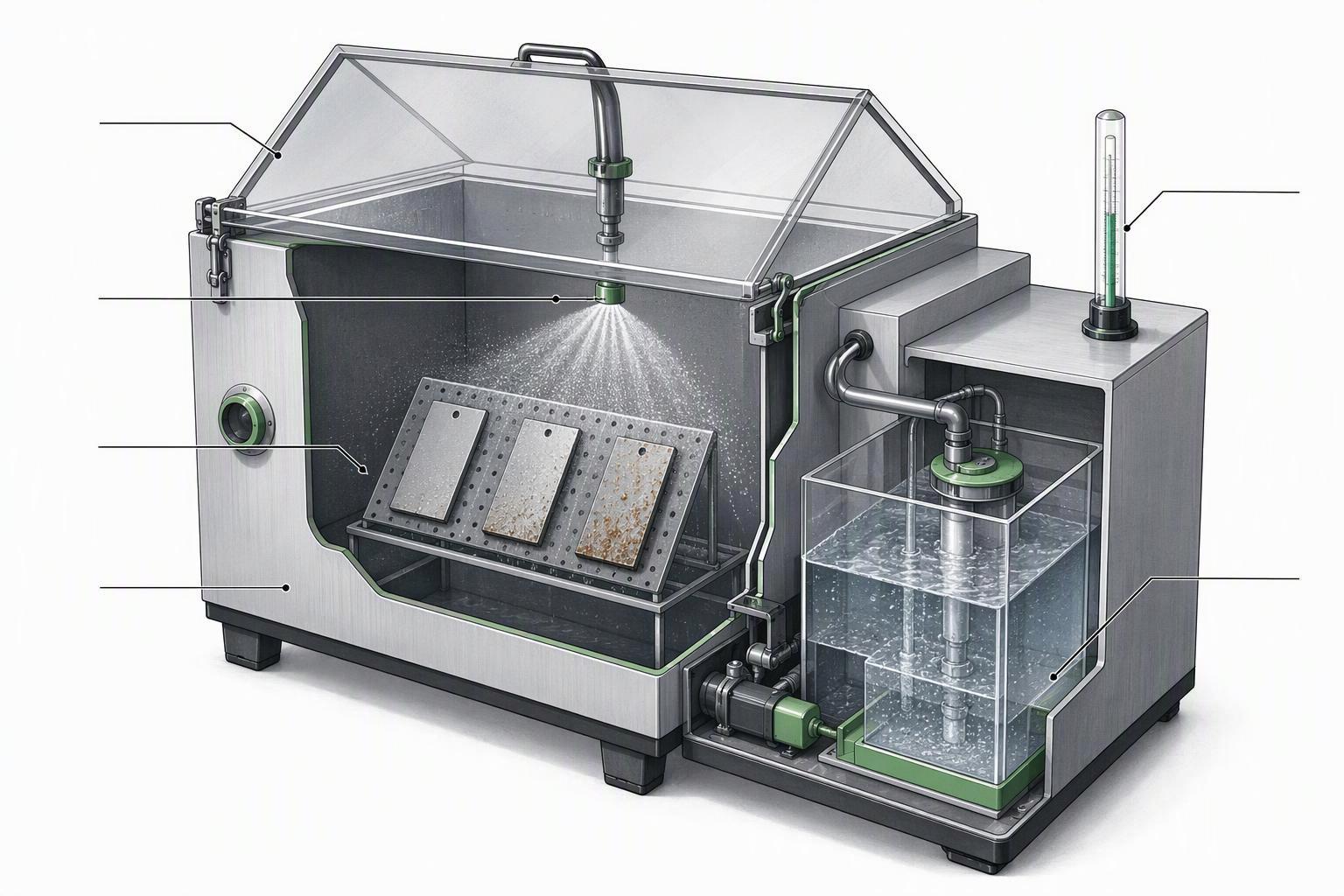
What the standards deliberately leave to the product specification is the specimen itself, the exposure period, and the interpretation of results (ISO 9227:2017, 2017). That is where a procurement specification earns its value, and where LED luminaire corrosion resistance is actually decided.
A defensible package records the salt and water type, all temperature readings in the exposure zone, the volume collected per fog-collecting device, the concentration or specific gravity of the collected solution with its measurement temperature, the pH of the collected solution, the specimen description and dimensions, the method of support, the exposure period, any interruptions and their cause, and the results of all inspections (ASTM B117, B117-11 text).
Pro Tip: ask for the chamber records before accepting any series: temperature uniformity, fog settlement per collecting device, nozzle performance, air pressure and solution condition. A certificate without the log is an assertion, not a result.
Procedures and Acceptance Criteria
Acceptance criteria are where most vendor data packages are thinnest. A pass/fail statement without the rating scale, the inspection intervals and the post-exposure electrical checks cannot be compared across suppliers.
Exposure Durations and Inspection Intervals
Because no standard fixes the duration, the checkpoints have to come from the specification. Common practice in published coating and equipment programmes uses multiples of 24 hours as the usual reporting points, and ASTM B117 itself suggests exposure periods in multiples of 24 hours as a matter of convenience (ASTM B117, B117-11 text).
What matters for comparison is that the vendor states the interval at which the panels were inspected and photographed, because a single end-of-test rating hides the difference between a coating that failed at 200 hours and one that failed at 950.
Visual Ratings: Rust, Blister, Scribe Creep
Three rating scales cover the defects that matter on a luminaire housing. The scribed-panel method that turns creep into a number is ASTM D1654, which measures mean creepage from a scribe through the coating to the substrate and maps it to a 0 to 10 rating, where 10 is zero creep and 0 is 16.0 mm or more (Henkel Corrosion Evaluation Legend, undated working table).
The rust-percentage scale inspectors use is ASTM D610, which evaluates the degree of rusting on a zero to ten scale based on the percentage of visible surface rust and classifies distribution as spot, general, pinpoint, or hybrid rust (ASTM D610-08(2019), reapproved 2019). D610’s zero-to-ten rust scale explicitly excludes rust propagation around a scribe, which is why a complete report needs both D610 and D1654 numbers.
Blistering uses the two-part blister notation of ASTM D714: a size numeral, where 10 means no blistering and lower numbers mean larger blisters, combined with a frequency code of F for few, M for medium, MD for medium dense, and D for dense, reported in a form such as 6MD (Henkel Corrosion Evaluation Legend, undated working table).
D714’s photographic reference standards are the basis for the size scale, and when the standard is used as a performance specification, the permissible degree of blistering is agreed between purchaser and seller (ASTM D714-02(2017), reapproved 2017). That clause is the one to write into an RFP, because it makes the acceptance limit a negotiated number rather than a vendor default.
One caution on comparability: the same physical creep can score differently depending on the measurement convention. ASTM D1654 measures from the scribe to unaffected paint, while other automotive conventions measure across the scribe from unaffected paint to unaffected paint, or add maximum creep on both sides, or divide creepage by two (Henkel Corrosion Evaluation Legend, undated working table). Ask which convention produced the number.
Post-Exposure Electrical Safety Checks
A corrosion rating says nothing about whether the luminaire still works, and an IP rating says nothing about corrosion. IEC 60529 states outright that corrosion and condensation are outside its scope, listing both among the external influences the classification does not address (ANSI/IEC 60529-2020, 2020). The IP code’s ingress-only scope means a fixture rated IP65 before salt spray cannot be assumed to hold that rating afterwards, because the standard’s own materials confirmation covers only the tests it performs.
The post-exposure electrical retest limits come from the luminaire’s own safety standard and construction, not from the corrosion test. A complete data package therefore pairs the visual ratings with a dielectric withstand test, an insulation resistance measurement and a bonding continuity check performed after exposure, with the acceptance values taken from the applicable luminaire safety standard.
The share of vendor claims made on coupons or housings rather than complete production-representative luminaires is not quantified in any source reviewed here, but at least one marine-lighting supplier states that coupon testing is inadequate for real service and specifies complete assembled fixtures including housing, lens and gasket assembly, and cable entry (Kingseng marine lighting guide, undated).
Key Takeaway: acceptance criteria must combine visual ratings with post-exposure electrical and IP re-verification. A corrosion rating alone does not establish that the luminaire is safe or sealed.
Greenhouse Relevance and Complementary Tests
Salt spray alone does not reproduce a greenhouse. The environment adds sustained humidity, condensation cycling, ammonia from organic fertilizer and irrigation water chemistry, and pressure washing or overhead irrigation that drives water at gaskets. For greenhouse LED grow light reliability, those four inputs matter more than chloride loading, and each one needs its own test.
Humidity, Condensation, and Thermal Cycling
Damp heat covers steady-state humidity exposure: chambers hold specimens at elevated relative humidity for a defined duration, with condensate from chamber walls kept off the specimen so the test measures moisture uptake rather than dripping water. The severity comes from the combination of temperature, relative humidity, and total duration, not from any single setpoint.
The thermal-cycling test that salt spray cannot replace is IEC 60068-2-14:2023 Test Na, which determines the ability of components, equipment, or other articles to withstand rapid changes of ambient temperature and is explicitly not intended to show effects caused by low or high temperature exposure (IEC 60068-2-14:2023, 2023). In a greenhouse, that cycling is what opens gaskets and pulls condensation into driver compartments, a failure mode salt fog will not surface.
Ammonia, Fertilizers, and Chemicals
Ammonia is the greenhouse-specific corrosive that salt spray misses entirely. Ammonia and water form an alkaline film that destabilises protective films and enables electrochemical corrosion, and ammonia’s well-documented appetite for copper and zinc makes brass fittings and galvanized steel the first components at risk (Interscan Corporation, 2026).
Aluminium is attacked more slowly, but documented agricultural exposure has corroded aluminium frames, and polymers including PET, PBT and PC are severely attacked, with field failures including loss of junction-box adhesion and subsequent arcing (PV International / TÜV Rheinland ammonia-corrosion paper, undated legacy reference).
Ammonia exposure test designs used on agricultural PV modules give a usable starting point for specifying a luminaire test: a preliminary module test at up to 2,000 ppm NH₃ at 70 °C and 70% relative humidity for 840 hours, a DLG design at 750 ppm for 1,500 hours under the same temperature and humidity, and a DIN 50916 design at 7,250 ppm at 30 °C and 100% relative humidity for 672 hours.
Against a reference scenario of 20 years of outdoor exposure in Central Europe with a worst-case 50 ppm ammonia (PV International / TÜV Rheinland, undated). These are PV-module programmes, not luminaire requirements, but the concentration, temperature, humidity and duration combinations are the shape of a defensible ammonia specification.
Irrigation chemistry is a separate input. Greenhouse extension guidance on ammonium in irrigation water puts the acceptable ammonium-nitrogen range below 10 ppm, and advises that ammonium plus urea should not exceed 50% of total nitrogen in soilless growing media because excess ammonium can injure most greenhouse crops (UMass Greenhouse BMP Manual, undated current edition). That is a water-quality figure, not an airborne concentration, and it should not be conflated with the ppm values in an ammonia chamber test.
IP Ingress and Cyclic Salt/Fog
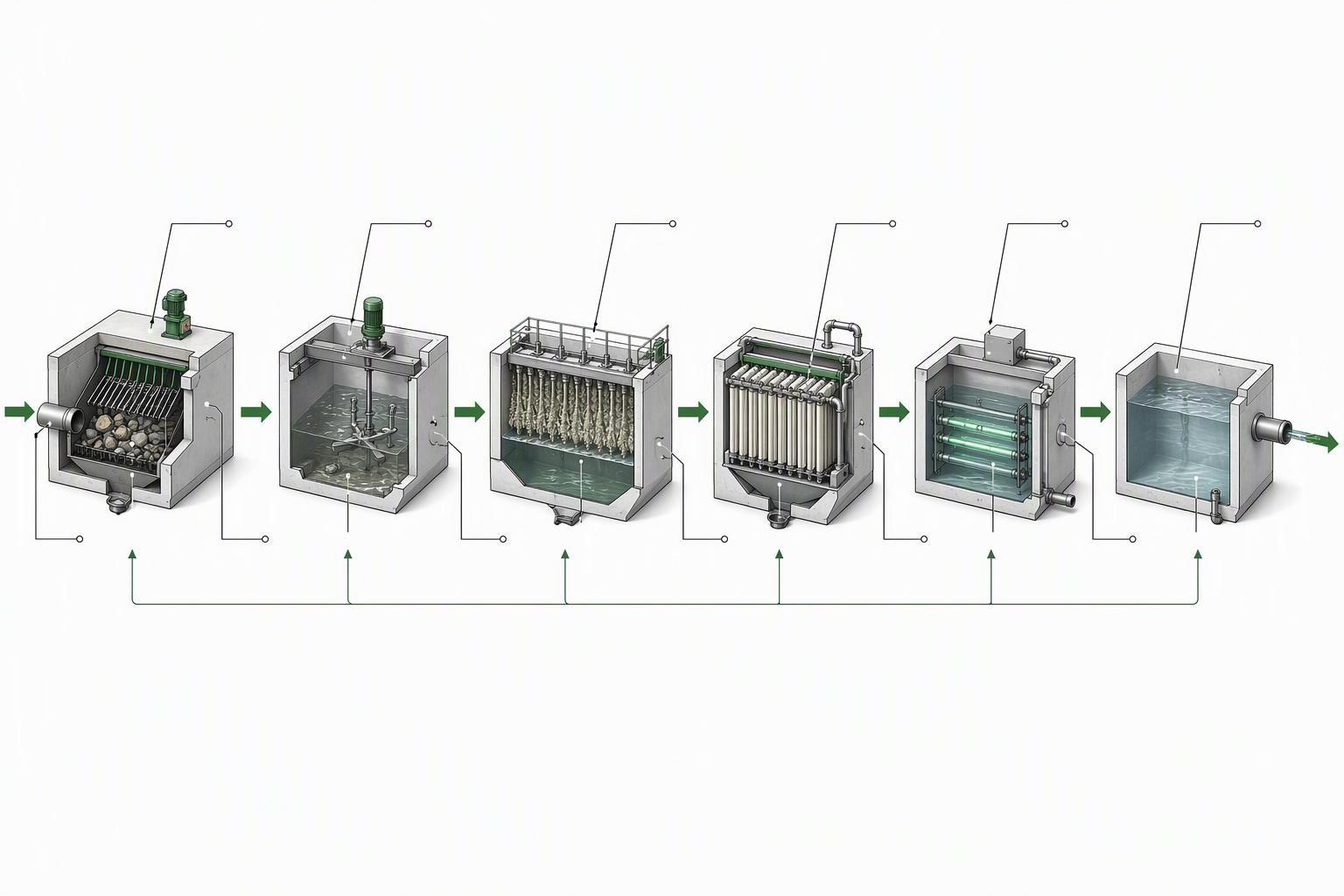
Where neutral salt spray is too mild to discriminate between coating systems, the modified salt-spray practice that adds acid, SO₂ and wet-dry cycling is ASTM G85, whose annexes run from acetic acid salt spray at pH 3.1 to 3.3 for 144 to 240 hours, through cyclic acidified salt spray at pH 2.8 to 3.0, to SWAAT synthetic sea salt at 49 °C for certain aluminium alloys (ATC Test Lab, current page). These are more aggressive screens, and they are worth specifying only when the neutral test fails to separate candidate suppliers.
The IP code’s ingress-only scope is the reason the sequence has to end with a re-check rather than a pass on paper: IEC 60529 states outright that corrosion and condensation are outside its scope (IEC 60529, current edition). A fixture can hold its IP rating and still lose LED luminaire corrosion resistance after a season of ammonia and condensation.
The sequence that covers a greenhouse fixture is neutral salt spray first, then damp heat, then thermal cycling, then an ammonia exposure where the facility uses organic fertilizer, and finally a re-verification of IP and electrical safety on the exposed assembly. Each stage tests something the previous one cannot.
Specifying and Interpreting Results
The test matrix is the deliverable. Everything above becomes useful only when it is written into a specification that two vendors can be held to identically.
Build a Defensible Test Matrix for RFPs
A workable matrix names the standard and edition, the specimen, the duration and inspection intervals, the rating scales with their acceptance limits, and the post-exposure checks. On the specimen, require complete assembled fixtures rather than coupons or housings alone, because a coupon cannot reveal a gasket, a cable gland, or a dissimilar-metal joint.
On the environment, name the ISO 12944 category that matches the facility, since C3, C4, and C5 describe materially different interiors (Hempel ISO 12944 brochure, October 2023). On the duration, remember that there is no universal salt-spray duration and that the number follows from the product specification (ASTM B117-19, 2019).
| Element | What to specify | Why |
|---|---|---|
| Standard | ASTM B117-19 or ISO 9227:2022, plus IEC 60068-2-11:2021 if a European test house is used | Fixes the environment and the operating values |
| Specimen | Complete assembled luminaire, including housing, lens, gasket and cable entry | Coupon results do not represent the assembly |
| Duration | Multiples of 24 h, with stated inspection intervals | No standard fixes the duration |
| Visual acceptance | D610 rust grade, D714 blister notation, D1654 creep rating, with numeric limits | Makes the pass/fail line negotiable and comparable |
| Post-exposure | Dielectric withstand, insulation resistance, bonding continuity, IP re-check | Corrosion and condensation are outside IEC 60529’s scope |
| Records | Chamber log: temperature, collection rate, pH, concentration, interruptions | Separates a valid run from an assertion |
Interpreting Vendor Claims and Data Packages
Vendor duration tiers exist and are worth reading as market practice, not as requirements. One supplier’s published C3-to-CX duration table maps C3 to 500 hours, C4 to 720 hours, C5-M to 1,000 hours or more, and CX to 1,000 hours plus an SO₂ test, with the caveat that acceptance limits come from the project specification (GOTO Electrical, undated). A marine-lighting supplier’s own duration tiers run from 480 hours for indoor marine C3 to 1,500 to 2,000 hours for offshore, with the splash-zone figure specified on the complete fixture assembly (Kingseng marine lighting guide, undated). Neither mapping is an ISO 12944 requirement.
Claims that convert hours to years should be treated as marketing. One seaport-light vendor runs a 1,000, 2,000 and 3,000 hour claim tier and asserts that natural-environment corrosion can take up to a year while artificial simulation produces similar results in 24 hours (Aiko LED, 29 March 2021). No measured acceleration factor supports that ratio, and the standards decline to supply one.
Practical Materials and Design notes for LED Luminaires

The corrosion results point to a short list of design decisions. Keep copper and zinc out of exposed hardware where ammonia is present, since both are attacked and brass fittings and galvanized steel are the usual casualties (Interscan Corporation, 2026). Protect cut edges and scribed areas, because B117 requires cut edges of coated materials to be protected unless otherwise specified, and unprotected edges are where creep ratings collapse (ASTM B117, B117-11 text).
Avoid dissimilar-metal contact that creates a galvanic couple in the presence of chloride. Specify the polymer families used for junction boxes and cable insulation with the ammonia mechanism in mind, since PET, PBT, and PC are severely attacked and junction-box adhesion failures have been documented in agricultural service (PV International / TÜV Rheinland, undated).
A test sequence that combines the ASTM B117 salt spray test with damp heat, ammonia exposure where the facility warrants it, and post-exposure electrical and IP verification supports a more complete picture of luminaire corrosion resistance than salt spray alone. Coupon-only programs leave the assembly untested, and a single-chamber run cannot show how a gasket or cable gland behaves after the coating has been attacked.
Conclusion
Salt spray testing LED lights answers a narrow question well: whether a coating system, on a given substrate, with its edges, fasteners and joints, resists a controlled saline fog. It does not answer how long a luminaire will last in a greenhouse, and no standard or government laboratory report reviewed here supplies a conversion from chamber hours to field years. The NIST roofing study documents an industry that adopted an accelerated test while its relationship to field performance remained unknown (NIST IR 88-4008, 1988).
The practical consequence for procurement is that the test report matters less than the specification behind it. Two vendors reporting 1,000 hours can be running different specimens, different acceptance limits and different inspection intervals, and the number alone will not separate them. What separates them is a matrix that names the standard and edition, requires complete assembled fixtures, fixes the rating scales and their numeric limits, and pairs the visual result with post-exposure electrical and IP checks.
For a facility with continuous irrigation and organic fertilizer, salt spray is one stage of a sequence, not the whole programme. Damp heat, thermal cycling and an ammonia exposure each surface failure modes the salt fog cannot reach, and the sequence is what turns a certificate into an engineering judgement.
The next step is to request the full test-data package from each shortlisted vendor, including the chamber log and the post-exposure electrical results, and to compare them against the matrix above rather than against the headline hour count. Where a vendor cannot supply the log, the claim is unverifiable, and that is itself a procurement answer.
FAQ
How many hours of salt spray testing should a greenhouse LED light pass?
There is no universal number, because neither ASTM B117 nor ISO 9227 fixes a duration for a product (ASTM B117-19, 2019). Published market tiers give a rough sense of scale: inland or lightly exposed fixtures are often specified around 240 to 500 hours, heavily irrigated greenhouses with fertilizer mist and chemical cleaning are commonly pushed toward 480 to 1,000 hours, and coastal or marine-grade work is frequently written at 1,000 hours (ACELED Lighting, 2026). Treat those tiers as procurement practice rather than a standard. The more useful question is what was tested: a fixture-level run on a complete assembled luminaire, with the corrosion rating stated, tells you far more than a headline hour count from a coupon.
Does salt spray testing predict how long a greenhouse LED fixture will last?
No, and both standards say so themselves. ASTM B117 notes that salt spray results “seldom” predict natural-environment performance when used as standalone data, and ISO 9227 states that salt spray resistance seldom directly relates to corrosion resistance in other media (ISO 9227:2017, 2017). A greenhouse is not a salt chamber: it adds condensation cycling, ammonia from organic fertilizer, irrigation chemistry, and pressure washing, none of which the fog reproduces. You also can’t convert hours into years with a multiplier — no standard or government laboratory report supplies one. Read a salt spray result as a comparative signal between coating systems, not a service-life forecast.
Is salt spray testing the same as an IP rating?
They measure different things, which is why a greenhouse fixture usually needs both. IP ratings under IEC 60529 cover dust and water ingress only, and the standard explicitly excludes corrosion and condensation (ANSI/IEC 60529-2020, 2020). Salt spray, meanwhile, tests the corrosion resistance of housings, coatings, fasteners and joints. That gap matters: a fixture can hold its IP65 rating and still lose corrosion resistance after a season of ammonia and condensation, and it cannot be assumed to keep the rating after the coating has been attacked. A complete qualification therefore pairs corrosion testing with damp heat, thermal cycling, ammonia exposure where the facility uses organic fertilizer, and a post-exposure re-check of IP and electrical safety.