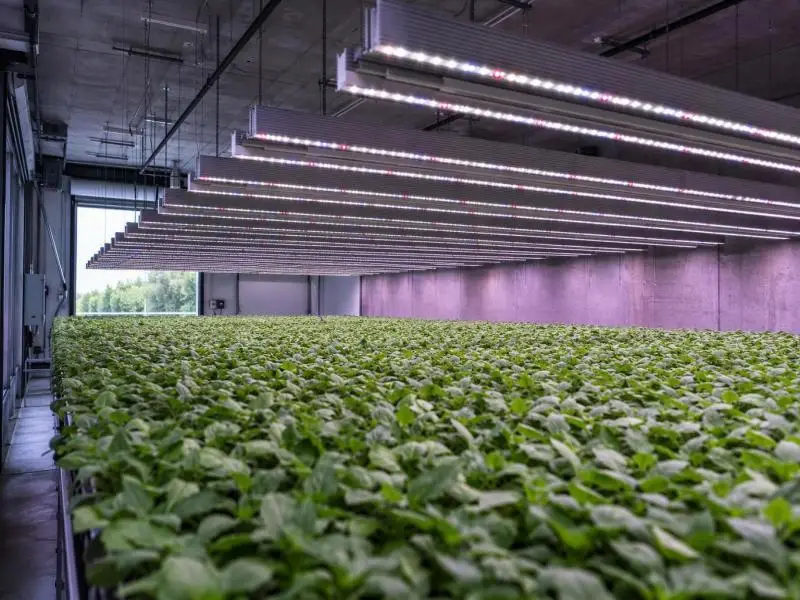
Selecting the right mother plant grow lights involves decisions that are usually made once and then inherited by every cutting cycle that follows, so the targets need to be defensible in units a procurement team can audit.
PPFD (photosynthetic photon flux density, µmol·m⁻²·s⁻¹) sets the instantaneous intensity at the canopy, and DLI (daily light integral, mol·m⁻²·d⁻¹) sets the daily total, as defined in ANSI/ASABE S640. On an 18/6 photoperiod, a mother room runs a vegetative program, and the operating objective is marketable cuttings per m² and per kWh rather than maximum biomass.
This guide gives PPFD and DLI bands with their measurement conditions, a conversion method for 18/6, and the commissioning and control procedures that hold those targets across rooms and sites.
Table of Contents
PPFD and DLI Fundamentals for Mother Plant Grow Lights
The working rule for a mother room is that DLI is the target and PPFD is the delivery mechanism: at 18/6, every 1 µmol·m⁻²·s⁻¹ of canopy PPFD adds 0.0648 mol·m⁻²·d⁻¹, so a band expressed in mol converts to a fixed PPFD window once the photoperiod is locked.
What PPFD and DLI Mean
PPFD measures the photon flux density arriving at a canopy each second within the 400–700 nm waveband, while DLI integrates that flux across the full day, and PPE (photosynthetic photon efficacy, µmol·J⁻¹) expresses photon output per joule of electrical input (ANSI/ASABE S640, current edition JUL2017, reaffirmed 2022). The distinction matters operationally because two rooms can report the same PPFD at a single sensor and deliver different daily totals if their photoperiods or dimming schedules differ. A single PPFD number is therefore a setpoint for a fixture, not a target for a crop.
Convert PPFD to DLI on 18/6
The conversion is arithmetic: DLI = PPFD × 3,600 × operating hours ÷ 1,000,000, the formula published in this Virginia Cooperative Extension guide to DLI. At 18 hours, the multiplier is 0.0648, which produces the following working table.
| Canopy PPFD (µmol·m⁻²·s⁻¹) | DLI at 18/6 (mol·m⁻²·d⁻¹) |
|---|---|
| 100 | 6.48 |
| 150 | 9.72 |
| 250 | 16.2 |
| 350 | 22.68 |
| 500 | 32.4 |
The extension guide’s own worked example, 200 µmol·m⁻²·s⁻¹ over 16 hours, yields 11.5 mol·m⁻²·d⁻¹ and is described there as sufficient for seedlings and bedding plants but insufficient for most fruiting crops (Virginia Cooperative Extension). Read against the 18/6 table, that means a mother room running 250 µmol·m⁻²·s⁻¹ is already above the guide’s seedling-and-cuttings band of 5–10 mol·m⁻²·d⁻¹ (Virginia Cooperative Extension’s propagation DLI table).
Recommended PPFD Bands for Mothers
Published bands for stock plants sit above propagation bands, and the floriculture reference range is wide: 40–600 µmol·m⁻²·s⁻¹ and 2–30 mol·m⁻²·d⁻¹ for floriculture crops generally (RII’s lighting best-practice guide). For vegetative cannabis specifically, the same 2021 indoor trial ran its two-week vegetative phase at approximately 425 µmol·m⁻²·s⁻¹ on an 18-hour photoperiod, which equals 27.5 mol·m⁻²·d⁻¹.
| Stage | DLI band (mol·m⁻²·d⁻¹) | PPFD at 18/6 (µmol·m⁻²·s⁻¹) | Source and condition |
|---|---|---|---|
| Unrooted cuttings, callus to root initiation | 4–5 | 62–77 | Extension propagation guidance, greenhouse trials |
| Rooting, roots to cell edge | 6–8 | 93–123 | Extension propagation guidance, greenhouse trials |
| Rooted cuttings to transplantable liner | 8–12 | 123–185 | Extension propagation guidance, greenhouse trials |
| Vegetative mother stock | 10–12 | 154–185 | Research review of stock-plant DLI |
| Vegetative cannabis reference | 27.5 | ≈425 | 2021 indoor trial, 18 h photoperiod |
The 10–12 mol stock-plant figure comes from a research review reporting shoot number within a stock-plant canopy rising 64% as DLI increased from 2.8 to 21.0 mol·m⁻²·d⁻¹, with cutting yield following (Faust’s DLI research review). No source in this set states a cannabis-specific mother-room DLI recommendation, so the 27.5 mol operating point is a documented trial condition rather than a published target. Measurement practice for any of these bands is set out in ANSI/IES RP-45-21, the ANSI-approved IES recommended practice for horticultural lighting.
Spectrum Guidance for Mother Plants
Spectrum decisions in a mother room are morphology decisions: blue controls elongation, far-red trades rooting percentage against stem height, and the balance between them determines whether cuttings arrive at the propagation bench compact or stretched.
Blue and Red Balance for Morphology
Raising the blue share relative to red compacts stock plants. In tomato seedlings, stem length at a blue: red ratio of 1.0 was shorter than at 0.1, and a second experiment holding blue constant while varying red from 25 to 75 µmol·m⁻²·s⁻¹ found elongation unchanged, which led the authors to conclude that stem elongation depended on blue light quantity (the ISHS blue: red stem-elongation work). The practical reading for a mother room is that blue is the brake on internode length and red is largely a photosynthetic contributor.
| Spectral variable | Documented effect | Evidence and species | Caution |
|---|---|---|---|
| Blue: red ratio 0.1 to 1.0 | Shorter stems at higher blue | Tomato seedlings, ISHS Acta 956(29) | Species-specific; no universal blue percentage |
| High blue (120 µmol·m⁻²·s⁻¹) | Suppresses far-red and DIF-driven elongation, preserves far-red biomass benefit | Arugula and lettuce, 2025 Frontiers study | Not tested on cannabis |
| Far-red added to red or red:blue | Higher rooting percentage, strongly increased height | Cannabis cuttings, Wageningen trial | Trial is on cuttings, not mother plants |
| Far-red for first 7 days only | Higher rooting percentage without the height penalty | Cannabis cuttings, Wageningen trial | Timing is the trial variable |
Managing Far-Red for Internode Control
Far-red is the variable with the clearest rooting signal and the clearest height cost. In cannabis cuttings, adding far-red to red, or to red: blue in stonewool, significantly increased the percentage of rooted cuttings and strongly increased plant height, while blue percentage (0 versus 12%) did not affect rooting (a Wageningen trial on far-red and cannabis rooting). The same trial found that far-red applied only for the first 7 days raised rooting percentage without the height penalty.
The interaction with blue is documented separately. Under 120 µmol·m⁻²·s⁻¹ of blue, the far-red × DIF interaction on elongation disappeared while far-red’s benefit to leaf area and biomass was preserved (a 2025 Frontiers study on blue light and far-red). For a mother room, that suggests treating blue and far-red as a paired setting rather than tuning either alone.
Validate with Cultivar-Specific Trials
No source in this set provides a cultivar-specific spectrum recipe for mother stock, and the far-red rooting evidence comes from cuttings rather than from the mother plants that produce them. The defensible approach is a controlled comparison per cultivar: hold DLI and photoperiod constant, vary one spectral variable at a time, and measure internode length at severance, cuttings per plant per week, and rooting percentage in the propagation room. Record the fixture’s spectral quantum distribution from its LM-79 report so the trial is reproducible when fixtures are replaced.
Layout and Uniformity Engineering
Uniformity is a layout property, not a fixture property: the same bar at the same height produces different canopy PPFD depending on spacing, mounting distance, and whether bench edges are modelled.
Fixture Types and Mounting Geometry
The published spacing guidance is specific. Fixtures installed less than 3 ft from canopy should be spaced no more than 12 in apart, and fixtures mounted higher can go up to 24 in apart, with consistent spacing in both X and Y directions (RII’s lighting best-practice guide). The same guide notes that continuous runs of linear LED fixtures can improve uniformity compared with grids of traditional HID fixtures, and that racked vertical arrangements suit LED fixtures mounted within 12 in of the canopy.
Mounting height carries a trade-off the extension literature states plainly: moving lights closer to plants raises PPFD but reduces the overall uniformity of light distribution, because fewer plants are effectively illuminated (Virginia Cooperative Extension). In vertical systems with less than 16 in between plants and lights, the guide warns that plants growing toward the fixtures can reach damaging PPFD.
Commissioning: Sensor Grid and Metrics
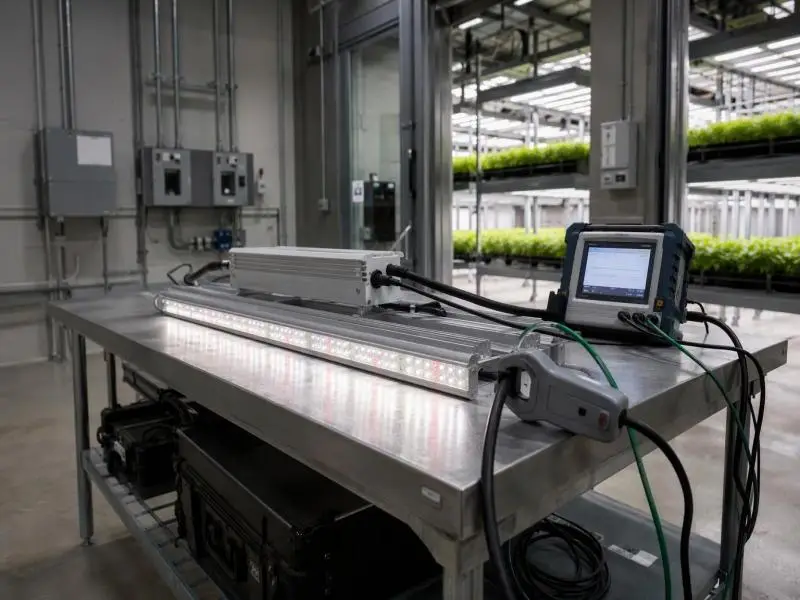
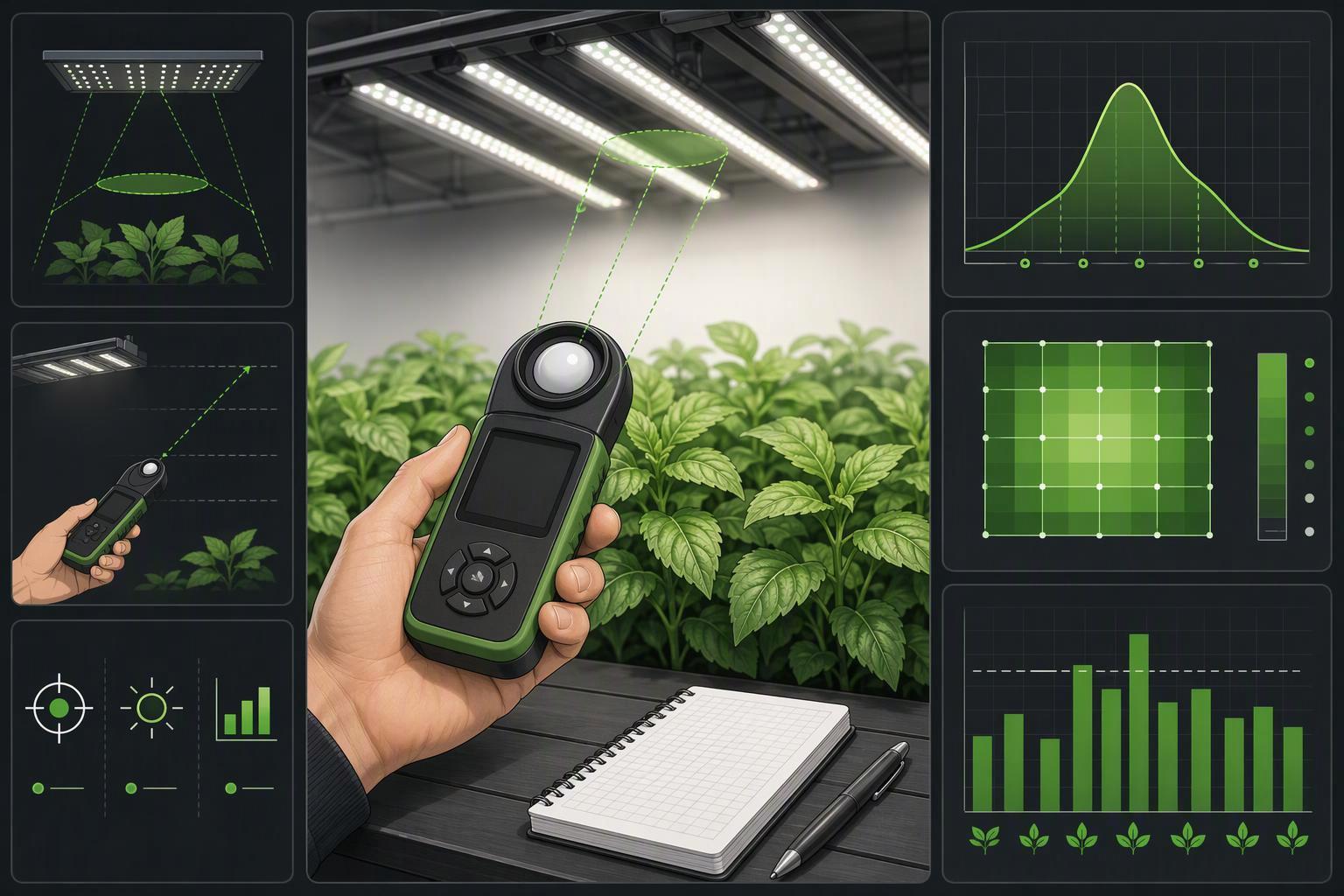
Commissioning should produce a point-by-point PPFD map at finished canopy height, not a single reading under a fixture. The RII guide recommends asking manufacturers for point-by-point light level values at consistent spacing rather than peak PPFD alone, and notes that some manufacturers model PPFD on 6-inch grids (RII).
| Metric | Definition | How to record it |
|---|---|---|
| Grid density | Sensor spacing across the bench | 6 in grid, stated in the report |
| Mean canopy PPFD | Average of all grid points at finished canopy height | µmol·m⁻²·s⁻¹, with photoperiod |
| Minimum PPFD | Lowest grid point, usually a bench edge or aisle-adjacent row | µmol·m⁻²·s⁻¹ |
| Uniformity ratio | Minimum divided by mean, or maximum divided by minimum | State which ratio and the grid used |
| Edge loss | Mean PPFD at the outer row versus the bench centre | Percent |
No standards body in this source set publishes a numeric uniformity target; the ratio figures in circulation are vendor-authored, so a specification should state the ratio and the grid density it was measured on rather than citing a standard. Measurement practice for the map itself follows ANSI/IES RP-45-21.
Avoid Scalloping and Edge Losses
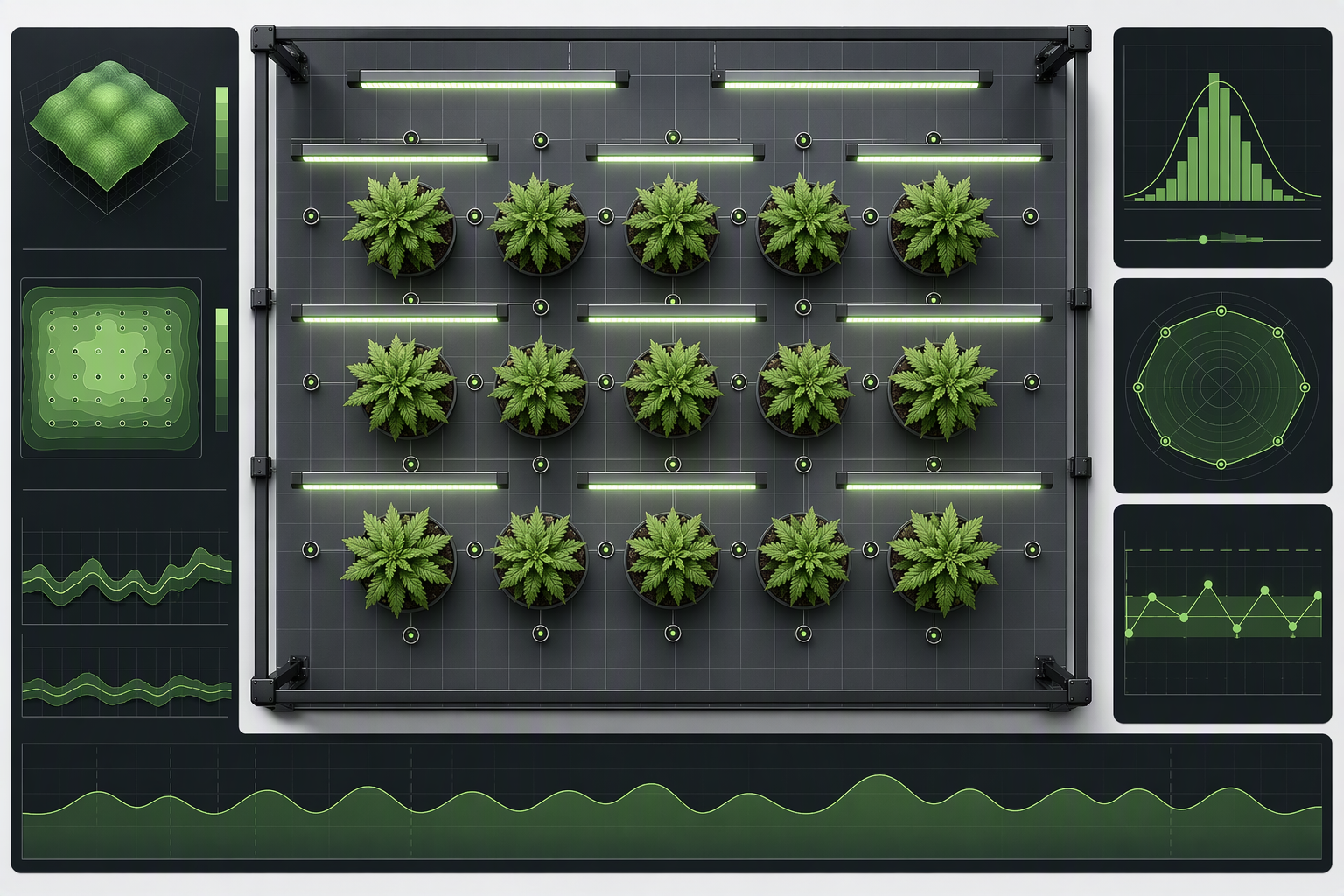
Scalloping, the periodic bright and dim banding under discrete fixtures, is controlled by spacing relative to mounting height and by using continuous linear runs where the rack geometry allows. Edge losses are controlled by modelling the bench perimeter explicitly: the RII guide advises considering how fixture placement and layout affect light levels on the edges of benches (RII). Higher uniformity trades against fixture count and capital, so the layout decision should be made against the cuttings-per-m² target rather than against a uniformity figure in isolation.
Controls and Operations
A mother room’s lighting setpoint is only as good as the control loop that holds it: closed-loop PPFD/DLI control, zoning, and a documented remap procedure after every canopy change keep the delivered DLI aligned with the target.
Closed-Loop PPFD/DLI Control
LED output is linearly related to PPFD, so a fixture delivering 100 µmol·m⁻²·s⁻¹ at full power delivers 50 µmol·m⁻²·s⁻¹ at 50% power, and that relationship can be determined for any fixture (Virginia Cooperative Extension). That linearity is what makes closed-loop control practical: a controller reads canopy PPFD, integrates it over elapsed hours, and dims to hit the daily DLI target rather than holding a fixed output.
The buyer cautions that a fixture’s rated output and its in-use output are different numbers. The DLC requires dimming capability to be reported or required depending on product attributes, along with dimming range and control methods (the DLC Horticultural Technical Requirements V4.0). A procurement specification should therefore state the dimmed operating point at which the DLI target is met, not only the full-output PPE.
Zoning and Sunrise/Sunset Ramps
Zoning follows bench geometry and cultivar grouping rather than fixture rows, because a zone is the smallest unit a controller can dim independently and the smallest unit that can carry its own DLI record. Ramps at lights-on and lights-off reduce the instantaneous step at the canopy and let the controller absorb small DLI deficits early in the photoperiod rather than at the end. Each zone should log delivered DLI, dimming percentage, and any override, so that a cuttings-per-kWh figure can later be attributed to a lighting schedule.
Remap after Pruning and Spacing Changes
Any change to canopy height or plant spacing invalidates the previous PPFD map, because the map was taken at finished canopy height. The RII guide is explicit that PPFD should be modelled at finished canopy height and that bench edges should be included (RII). The remap trigger checklist below should be a standing procedure, not an ad hoc response.
- Pruning or tipping that changes canopy height by more than the sensor grid spacing
- Re-spacing of mother plants or a change in plants per m²
- Canopy re-fill after a cutting harvest that removes a significant share of the canopy
- Fixture replacement, re-hanging, or a change in mounting height
- Any change to photoperiod or dimming schedule
After each trigger, re-run the sensor grid at the new canopy height, record the new mean and minimum, and file the map against the zone record so the DLI history stays traceable.
Compliance, Efficacy, and Safety
Procurement in this category is a documentation exercise: the fixture must clear a DLC efficacy threshold, carry a listing to the horticultural safety standard from a recognized body, and arrive with test reports that an electrical inspector will accept.
PPE Benchmarks and DLC Listings
The DLC Horticultural Technical Requirements V4.0 set a minimum photosynthetic photon efficacy of 2.5 µmol·J⁻¹ over 400–700 nm, an 8.7% increase over V3.0, with an absolute −5% tolerance so test reports of 2.38 µmol·J⁻¹ or higher are accepted (the DLC Horticultural Technical Requirements V4.0). The same document requires a power factor of at least 0.90 at any reported input voltage at full output or non-dimmed state, with a 3-point tolerance, and total harmonic distortion of current at or below 20% (the same DLC V4.0 policy).
| Threshold | Value | Source |
|---|---|---|
| DLC V4.0 minimum PPE | 2.5 µmol·J⁻¹ (400–700 nm) | DLC V4.0 |
| Accepted test report floor under −5% tolerance | 2.38 µmol·J⁻¹ | DLC V4.0 |
| Power factor | ≥0.90 | DLC V4.0 |
| Total harmonic distortion, current | ≤20% | DLC V4.0 |
| California Title 24 minimum PPE, indoor | 1.9 µmol·J⁻¹ from January 2023 | RII lighting guide |
| California Title 24 minimum PPE, greenhouse | 1.7 µmol·J⁻¹ from January 2023 | RII lighting guide |
| Common utility incentive threshold | ≥2.0 µmol·J⁻¹ | RII lighting guide |
The DLC threshold sits above the California code floors, so a fixture can be code-compliant in California and still fall short of DLC listing (RII). The DLC’s announcement of the V4.0 update reports that the Horticultural Qualified Products List comprised more than 1,200 products from over 130 manufacturers as of February 2025 (the DLC’s announcement of the V4.0 update).
UL/ETL Safety and CE/RoHS Roles
DLC listing requires certification by an OSHA-recognized Nationally Recognized Testing Laboratory or an SCC-recognized body to ANSI/CAN/UL 8800, with ANSI/IES LM-79-19 or newer required for new applications (the DLC V4.0 certification requirements). UL 8800 is a safety standard and says nothing about PPFD or DLI; it covers photobiological safety assessed at 20 cm, damp location ratings, and installation instructions for National Electrical Code and Canadian Electrical Code installations (UL 8800, the horticultural lighting safety standard). UL 1598 covers general-illumination luminaires, not horticultural fixtures.
For European sites, CE marking and RoHS compliance are separate declarations from the North American listing, and a fixture sold in both markets should carry both document sets. A procurement file should hold the DLC QPL listing, the NRTL mark and certificate, the LM-79 test report, the photometric file used for the layout model, and the CE declaration of conformity where applicable.
Electrical Load Planning and Inspections
Electrical load planning starts from the fixture’s reported input wattage at the operating dim level, not its nameplate maximum, and aggregates across zones to the panel. The DLC’s power factor and harmonic distortion requirements exist because those values determine how much upstream capacity a lighting circuit consumes (the same DLC V4.0 policy). California Title 24’s horticultural provisions are triggered by new construction and major renovations and apply to greenhouses and indoor farms with more than 40 kW of total connected horticultural lighting load (RII), which makes connected load a design-stage number rather than an afterthought. Inspections should be scheduled against the authority having jurisdiction’s requirements for the NRTL mark and the installation instructions, both of which UL 8800 addresses.
Climate Coordination at Higher PPFD
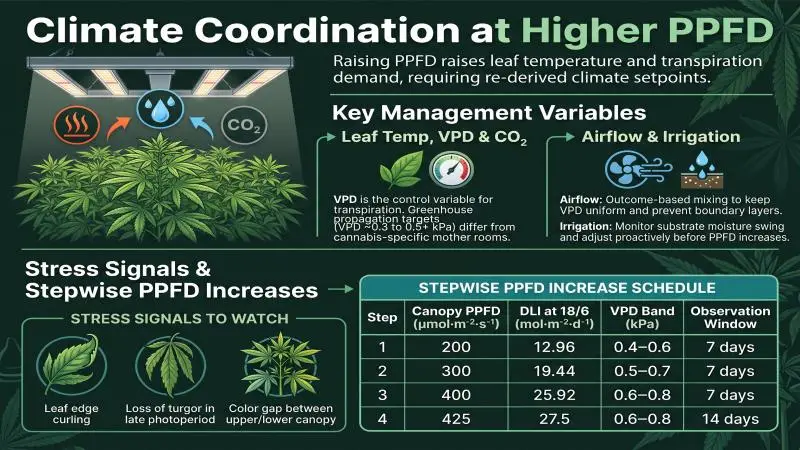
Raising PPFD raises leaf temperature and transpiration demand, so the climate setpoints that worked at a lower intensity need to be re-derived rather than assumed.
Leaf Temperature, VPD, and CO₂Ranges
Vapor pressure deficit (VPD), the difference between the water-holding capacity of saturated air and its actual moisture content, expressed in kPa, is the practical control variable for transpiration. Extension guidance for cuttings places VPD at approximately 0.3 kPa while cuttings are rooting and above 0.5 kPa once they are finishing, especially under a dense canopy (MSU Extension’s VPD guidance). Those figures are greenhouse propagation targets, not cannabis-specific mother-room setpoints, and no source in this set gives a CO₂ range for mother rooms.
The light-response evidence sets an upper bound on useful intensity. In the 2021 indoor trial, projected canopy-top saturation occurred at a local PPFD of approximately 1,532 µmol·m⁻²·s⁻¹ in week 5, and the maximum treatment was 1,370 µmol·m⁻²·s⁻¹ (the 2021 indoor cannabis study). Mother rooms operate far below that, and the floriculture context band of 2–30 mol·m⁻²·d⁻¹ shows how wide the published range is (RII).
Airflow and Irrigation Adjustments
No source in this set provides a numeric airflow target in m/s or a leaf-to-air temperature delta for mother rooms, so airflow should be specified by outcome: sufficient mixing to keep VPD uniform across the bench and to prevent a still boundary layer at the canopy. Irrigation scheduling follows the same logic. Higher PPFD raises transpiration, and the substrate moisture swing between irrigation events should be monitored as intensity steps up, with the irrigation setpoint adjusted before the next increase rather than after a stress event.
Stress Signals and Stepwise PPFD Increases
Increases should be stepped, with an observation window at each step, so that a stress response can be attributed to the change in intensity rather than to an unrelated event.
| Step | Canopy PPFD (µmol·m⁻²·s⁻¹) | DLI at 18/6 (mol·m⁻²·d⁻¹) | VPD band (kPa) | Observation window |
|---|---|---|---|---|
| 1 | 200 | 12.96 | 0.4–0.6 | 7 days |
| 2 | 300 | 19.44 | 0.5–0.7 | 7 days |
| 3 | 400 | 25.92 | 0.6–0.8 | 7 days |
| 4 | 425 | 27.5 | 0.6–0.8 | 14 days |
The DLI values in the table are calculated from the extension conversion formula (Virginia Cooperative Extension), and the top step matches the vegetative condition used in the 2021 trial (PMC8144505). Stress signals to watch at each step are leaf edge curling, loss of turgor in the late photoperiod, and a widening gap between upper and lower canopy leaf colour, which the trial recorded as a chlorophyll content index difference between canopy positions.
KPIs and Continuous Improvement
Two numbers carry the business case: marketable cuttings per m² per year and kWh per marketable cutting. The first is measurable directly from harvest records. The second is built from installed watts per m², operating hours and fixture efficacy, divided by cuttings harvested over the same window, because no published benchmark for kWh per cutting exists in this source set.
Per-plant and per-area productivity pull in opposite directions. In a 12-month tea tree trial, stock plants at 30 per m² produced 8.9 cuttings per plant per month against 5.6 at 200 per m², while area productivity rose from 3,204 to 13,440 cuttings per m² per year (a 2022 stock-plant density study in Plants). Those are tea tree figures in potting mix, not cannabis benchmarks, but the direction of the trade-off is the point: density and DLI should be optimized jointly against the per-area target.
For the light comparison itself, run an A/B trial at 400, 500 and 600 µmol·m⁻²·s⁻¹ on 18/6, holding spectrum, photoperiod and climate constant, and measure internode length at severance, cuttings per plant per week, rooting percentage in the propagation room, and kWh per marketable cutting. The 27.5 mol·m⁻²·d⁻¹ vegetative condition from the 2021 indoor trial is a reasonable reference operating point for the middle arm.
Solution Example for Uniformity and Control
A certified LED bar system addresses the mother-room problem in three places: the fixture’s listed efficacy and dimming behaviour, the layout and control integration around it, and the commissioning record that proves the installed result.
How a Certified LED Bar System Meets Needs
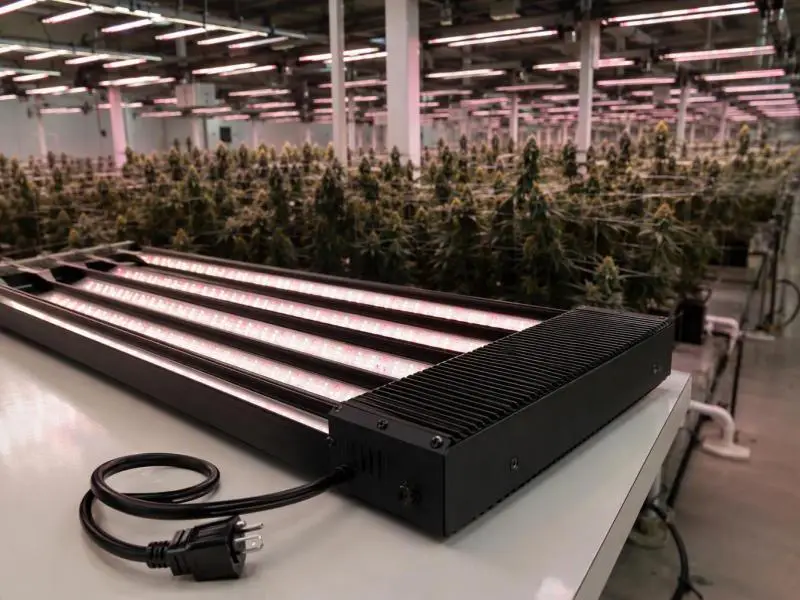
The specification baseline is a fixture listed to ANSI/CAN/UL 8800 by an NRTL and present on the DLC Horticultural QPL at or above 2.5 µmol·J⁻¹, with a power factor of at least 0.90 and harmonic distortion at or below 20% (the DLC Horticultural Technical Requirements V4.0). Linear bar formats suit racked mother rooms because the RII guide notes that continuous runs of linear LED fixtures can improve uniformity compared with grids of traditional HID fixtures (RII). Dimming range and control method should be stated in the submittal, since the DLC requires both to be reported or required depending on product attributes (DLC V4.0).
Integrating with Existing Racks and Controls
Retrofit integration turns on two numbers: the heat load the new fixtures remove and the control protocol they speak. The RII guide advises that retrofitting from HID to LED changes the heat loads of the space, because LED fixtures emit less radiant heat, and suggests considering increased lighting density to offset the reduction so the facility does not need to add heating capacity (RII). On the control side, LED drivers commonly accept a low-voltage signal such as 0–10 V, and the linear relationship between output and PPFD makes dimming a direct DLI lever (Virginia Cooperative Extension).
Commissioning Checklist for Multi-Site Rollout
Standardizing across sites means standardizing the evidence, not only the fixture.
- DLC QPL listing at or above 2.5 µmol·J⁻¹, with the listing date recorded
- NRTL certificate to ANSI/CAN/UL 8800 and the LM-79-19 test report on file
- Photometric file used for the layout model, retained with the as-built drawing
- Point-by-point PPFD map at finished canopy height, on a stated grid, including bench edges
- Mean, minimum, and uniformity ratio recorded per zone, with the ratio definition stated
- Dimmed operating point at which the DLI target is met, recorded per zone
- Connected load per panel and per site, checked against the applicable code threshold
- Remap trigger checklist issued to site operations, with a named owner
Conclusion
The defensible mother-room specification is a DLI target with a stated photoperiod, a PPFD window derived from it by arithmetic, a spectrum setting validated on the operator’s own cultivars, and a commissioning map that proves the installed result at canopy height. The published evidence supports bands rather than setpoints: 10–12 mol·m⁻²·d⁻¹ for stock plants from a research review, a documented vegetative cannabis condition, and a floriculture context range of 2–30 mol·m⁻²·d⁻¹ (RII). Where the evidence stops, it stops plainly: there is no published cannabis mother-room DLI recommendation, no standards-body uniformity ratio, and no kWh-per-cutting benchmark in this source set.
The next step is to convert the targets into a procurement and commissioning package: the DLC and NRTL documentation, the LM-79 report and photometric file, the PPFD map at finished canopy height, and the remap procedure that keeps the map valid as the canopy changes.
FAQ
What PPFD and DLI should a mother room run at 18/6?
Start at the canopy average rather than a single hot spot: roughly 300–400 µmol·m⁻²·s⁻¹, which equals 19.4–25.9 mol·m⁻²·d⁻¹ on an 18-hour photoperiod. That lands between the 10–12 mol·m⁻²·d⁻¹ stock-plant band from the research review and the 27.5 mol·m⁻²·d⁻¹ vegetative condition used in the 2021 indoor cannabis trial. Above that, the extra light buys stem growth and transpiration more than cutting quality, so step up only if your harvest records show a response. Note that no published cannabis-specific mother-room target exists, which is why the operator’s own cultivar trial carries the final call.
How do I convert a PPFD setpoint to DLI on 18/6?
Multiply the average canopy PPFD by 18 and by 0.0036. At 250 µmol·m⁻²·s⁻¹ you get 16.2 mol·m⁻²·d⁻¹; at 425 µmol·m⁻²·s⁻¹ you get 27.5 mol·m⁻²·d⁻¹. The full formula and worked examples are in the Virginia Cooperative Extension DLI guide. Use the canopy average, not a center-point reading, and calculate each dimming period separately if output changes during the day.
Does UL 8800 or a DLC listing tell me the fixture hits my PPFD target?
No. UL 8800 is a safety certification covering electrical construction, photobiological safety, damp and wet locations, and cord-and-plug or flexible wiring arrangements, as described in UL Solutions’ horticultural lighting certification overview. It says nothing about photon output. A DLC listing adds an efficacy floor of 2.5 µmol·J⁻¹ plus power factor and harmonic limits, but the PPFD at your bench depends on mounting height, spacing and layout, and only a point-by-point map at finished canopy height proves the installed result.