Introduction
Multi-site indoor cultivation programs don’t lose money in cloning because they “don’t have enough light.” They lose money because clones root unevenly: some trays take, some stall, and the clone room becomes a daily firefight between wilt risk, disease pressure, and HVAC instability.
The more facilities you operate, the more those small variances turn into measurable downtime: delayed flips, uneven canopy development, and extra labor for sorting, culling, and re-traying.
The thesis of this article is simple: low PPFD and diffused light, highly uniform light reduces stress, improves take rates, and stabilizes climate control—especially in racks and multi-tier propagation rooms.
We’ll stay tightly scoped to what commissioning teams can actually specify and verify:
- PPFD and DLI targets and how to ramp them without shocking unrooted cuttings
- Photoperiod (18–24 h) as a DLI lever
- Spectrum / CCT choices that are predictable and procurement-friendly
- Diffusion and uniformity metrics (min:avg, CV), and how to map them
- Controls and SOP ramps that tie light to RH/VPD progression
- HVAC, safety, ROI, and compliance considerations for US state-legal indoor programs
The evidence base is propagation best practices and photobiology/CEA guidance, with an emphasis on parameters you can measure at the rack and turn into an SOP.
By the end, you’ll have a commissioning checklist and KPIs you can use to standardize clone lighting across sites.
Table of Contents
Propagation light parameters
Commercial Cannabis Cloning PPFD and DLI Targets
In propagation, PPFD is the knob you feel day-to-day—but DLI (daily light integral) is what determines how much light the cutting receives over the full photoperiod. For commercial SOPs, you want both:
- PPFD keeps you from overdriving unrooted cuttings (wilting risk).
- DLI keeps you from running so low that rooting slows and propagation time stretches.
A practical, evidence-backed target band for early cutting propagation is:
- Day 0–3 (stick/callus): keep DLI around 4–5 mol·m⁻²·d⁻¹, and cap peak PPFD around ≤200 µmol·m⁻²·s⁻¹, as summarized in propagation guidance that breaks targets by stage (e.g., the Greenhouse Product News overview: “Managing light during cutting propagation”).
- After first roots: increase toward DLI 6–8 and later 8–12 as the cutting can actually use the photons without paying for them in water stress (same source).
For multi-site operations, the real takeaway isn’t the exact number—it’s the logic:
- Start low and consistent to protect water balance.
- Increase only when rooting capacity increases (you should see it in turgor and root development).
⚠️ Warning: A high average PPFD can hide a tray-level problem. If your average reads “fine” but edge or corner hotspots exceed your max, you can still create wilting and uneven rooting.
Photoperiod Choices (18–24 h)
Most clone rooms run 18–24 hours of light because the goal is steady, non-stressful energy input without triggering flowering.
From a commissioning standpoint, photoperiod is simply a DLI multiplier:
- At a fixed PPFD, 24 h delivers 33% more DLI than 18 h.
- That means 24 h can push you into higher DLI without you realizing it—especially if dimming setpoints drift between sites.
Operationally:
- 18 h is easier to standardize and audit. It also gives you a clear dark period for inspection, sanitation, and worker comfort.
- 24 h can be useful when you need a higher DLI without increasing instantaneous PPFD, but it can also mask over-lighting if your PPFD mapping isn’t tight.
If you run 24 h, treat it like a controlled process change: specify the target DLI and verify it at canopy.
Spectrum and CCT (balanced white)
For propagation, the most procurement-friendly choice is usually balanced white light (a neutral CCT range) instead of narrow-band “recipes” that are hard to compare across vendors.
Balanced white is operationally useful because:
- It supports normal photosynthesis without forcing a morphology change that you then need to “undo” later.
- It is easier to evaluate visually during scouting (leaf color, wilting, chlorosis).
- It reduces the risk of extreme spectral bias becoming a hidden variable in multi-site SOPs.
If you want an easy rule for multi-site cloning: choose a consistent, documented white spectrum and make PPFD/DLI and uniformity your primary levers.
Diffuse Light and Uniformity
Uniformity is where commercial cloning programs win. Diffusion is one of the simplest ways to get it.
Canopy Optics and LUE Gains
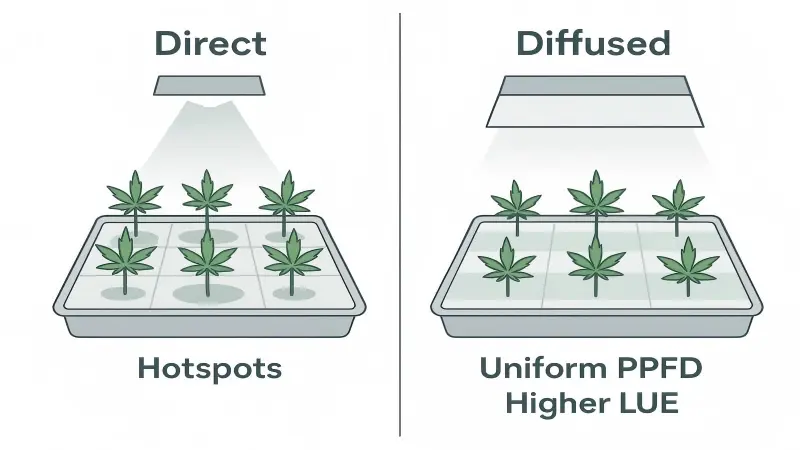
Plants don’t convert photons to biomass linearly. When light is concentrated into hotspots, the “over-lit” leaves saturate while neighboring leaves remain light-limited.
Diffuse light helps because it spreads photons across more leaf area and reduces extreme peaks. A horticultural review on diffuse light notes that diffuse conditions can improve light-use efficiency largely by improving light distribution through the canopy and reducing saturation effects (see “Advantages of diffuse light for horticultural production” (2015)).
In propagation, your canopy is shallow—but your system still behaves like a canopy problem because trays and racks create micro-geometry:
- Edges vs center
- Tray lips and domes
- Tier-to-tier differences
- Fixture overlap valleys
If diffusion improves uniformity, you reduce both stress spikes and development lag across the tray.
Hotspot Control and Min: Avg ≥ 0.8
For multi-tier racks, specify uniformity in a way procurement and commissioning can enforce. A practical metric is min:avg (Emin/Eavg).
- min:avg ≥ 0.8 is a strong commercial target.
- A lower floor means you’ll compensate by turning up the whole tier, which often creates hotspots and more HVAC load.
A key operational point: min:avg protects the weakest zones, which is often what drives re-trays and uneven rooting.
Mapping Grids and CV ≤ 10–15%
Min:avg isn’t enough on its own. You also need a spread metric—CV (coefficient of variation).
- CV ≤ 10–15% is a practical acceptance band for commercial uniformity.
How to map in racks (the commissioning version, not the academic version):
- Map at the actual canopy plane (where leaves sit under domes, not at empty-shelf height).
- Use a repeatable grid aligned to the tray footprint (e.g., a 4×4 grid per tray area; denser at edges if edge falloff is suspected).
- Record avg, min, max, min:avg, and CV for each tier and each rack bay.
- Re-map after any change to fixture height, overlap, or dimming profiles.
Fixture Architecture and Layout
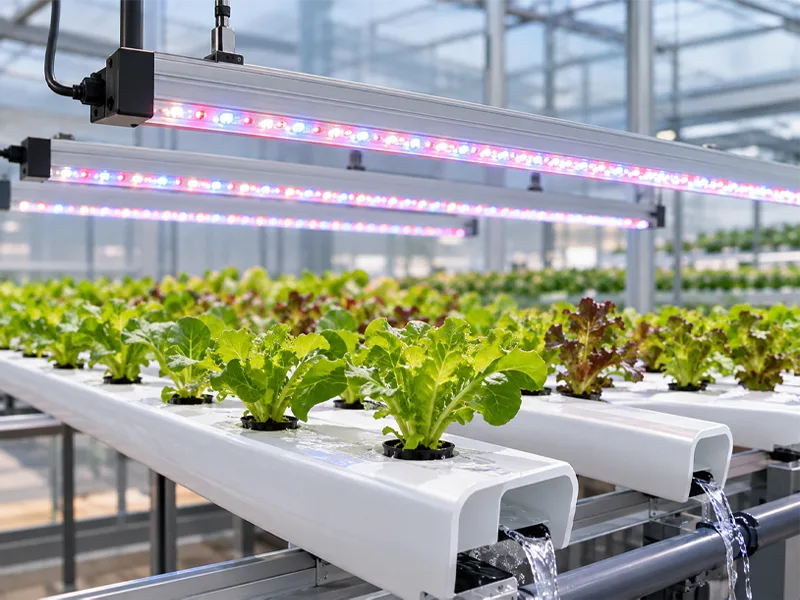
Bar/panel LEDs With Wide Optics
For racks, bar and panel fixtures with wide optics are often easier to commission than point-source fixtures because overlap is predictable.
What matters most:
- Optical distribution that reduces peaks
- Mounting geometry that supports overlap
- Lensing/diffusion that does not create striped patterns on trays
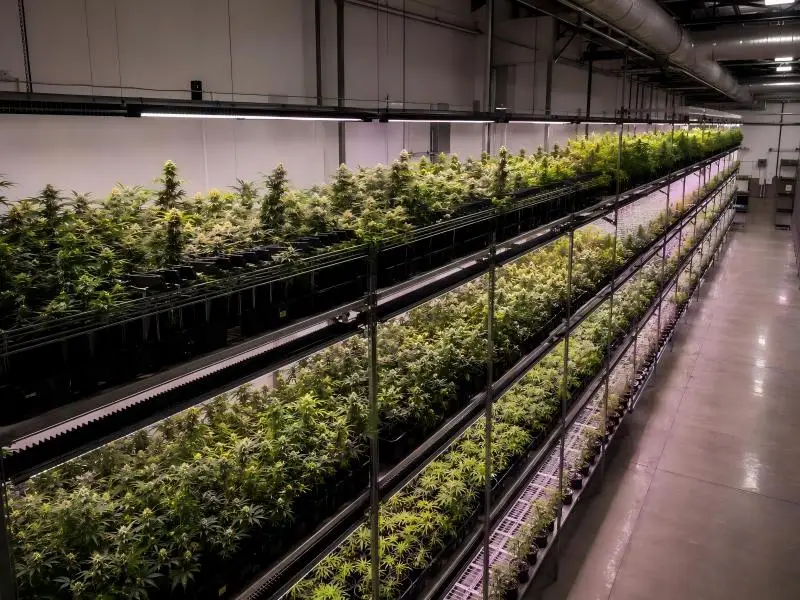
Overlap and Height in Multi-tierRacks
In multi-tier systems, height and overlap are your primary levers:
- Too close → hotspots and striping, plus higher leaf temperature at bright points.
- Too far → photon waste to walls/aisles and poor floor efficiency.
Commissioning practice:
- Set a provisional height and spacing.
- Map PPFD.
- Adjust to hit target average PPFD.
- Then refine for min:avg and CV using overlap changes.
Treat each tier as its own lighting zone unless you’ve verified the geometry is truly identical.
Controls and Dimming for Ramps
Dimming is not optional in propagation if you care about repeatability.
- You need dimming to hit the same DLI across seasons and across sites.
- You need dimming to ramp PPFD safely as rooting progresses.
As a neutral example, SLTMAKS offers bar/panel LED options built with Samsung diodes, with diffused configurations available, typical commercial documentation bundles (e.g., ETL/CE/RoHS depending on model/market), 0–100% dimming, and a 3-year warranty. Use this type of fixture description as a procurement checklist item—not as a performance claim.
If you are writing a spec, the controls section should require:
- Dimming range and control method
- Minimum stable dimming level (no flicker or dropout)
- Per-tier setpoint repeatability (what % output maps to what PPFD)
Commissioning and SOP Ramps
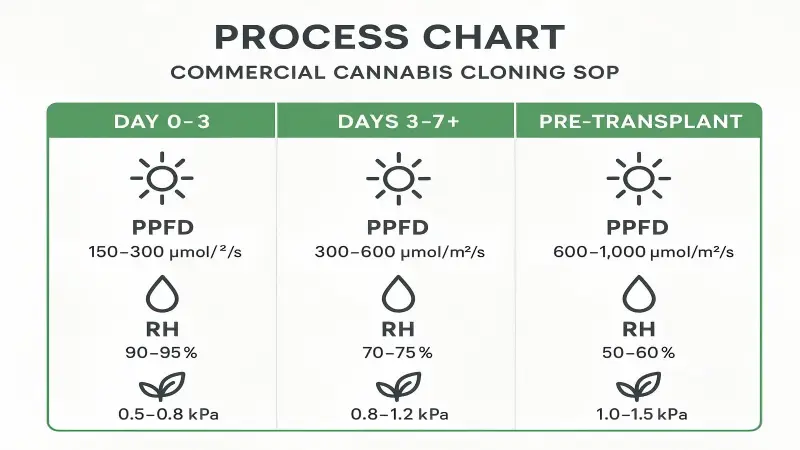
Propagation SOPs fail when light and environment are treated as separate systems. The ramp is the glue.
Day 0–3: Low PPFD, High RH, Gentle Start
For unrooted cuttings, the dominant risk is water loss. Start with:
- Low PPFD / low DLI (see the stage targets summarized in the Greenhouse Product News propagation light management overview)
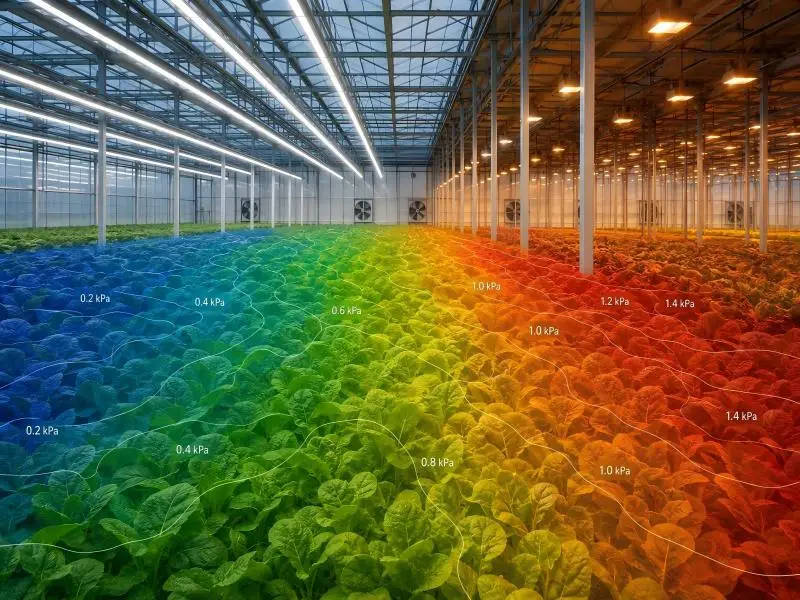
- High RH and low VPD (propagation best practices often target ~0.3–0.4 kPa early)
- Minimal air movement directly on cuttings
Operational checklist (what teams should actually verify):
- PPFD map at canopy (under domes if used)
- RH sensors calibrated and reading consistently across racks
- No “bright lanes” from fixture striping
Days 3–7+: Gradual PPFD Increase
Once cuttings maintain turgor and rooting starts, increase light gradually. The goal is to raise DLI without creating a sudden evaporative demand spike.
A clean SOP pattern:
- Increase PPFD in small steps (daily or every other day)
- Re-check tray-level uniformity after each meaningful change
- Reduce mist/fog only when leaves remain stable under the new light level
Pre-transplant: Stabilize and Harden
Before transplant, you’re preparing clones for a less protected environment. The priorities are:
- Stable transpiration
- Predictable morphology
- Consistent root mass across trays
Increase PPFD to your “ready” setpoint, taper RH, and avoid last-minute recipe changes.
HVAC, Safety, and ROI
Sensible/latent Load Interactions
Clone rooms are humidity-dominant environments. The lighting decision affects HVAC in two ways:
- Sensible heat: lower PPFD and efficient fixtures reduce heat that must be removed.
- Latent control: high RH targets mean the dehumidification strategy (and reheat, if used) can dominate energy.
Why low PPFD + uniformity can stabilize HVAC:
- Fewer hotspots → fewer microclimate swings and less local wilting (which often triggers operators to over-mist)
- Consistent light → consistent transpiration → easier RH control
In multi-site programs, stability is ROI.
Certifications and IP Ratings
US commercial facilities should be inspection-minded from procurement onward.
- NRTL listing: OSHA’s NRTL program defines recognized labs and how certification supports workplace electrical approval (see OSHA’s NRTL program).
- ETL listing: Intertek describes the ETL Listed mark as proof a product was independently tested and certified by an OSHA-recognized NRTL (see Intertek’s ETL Listed mark).
For propagation rooms with washdown, misting, or persistent high humidity, specify an appropriate IP rating and document the cleaning/SOP limits. For a procurement-oriented overview, see SLTMAKS guidance on IP-rated commercial grow lights.
Energy per Rooted Cutting
If you want a KPI that procurement, cultivation, and finance can all understand, use energy per rooted cutting.
Define it simply:
- kWh used by propagation lighting for a room (or tier) over a cycle
- Divided by the number of cuttings that root to your quality standard
Then track it alongside:
- Take rate (%)
- Days-to-transplant
- Uniformity metrics (min:avg, CV)
- HVAC kWh (if you submeter)
When low PPFD and diffused delivery improve take rate and reduce rework, the energy KPI improves even if you keep photoperiod long.
Conclusion
Low PPFD and diffused delivery minimize stress and improve take rates—because the cutting’s first job is water balance, not maximum photosynthesis.
Uniformity is what makes that approach scalable. Min:avg and CV, plus disciplined PPFD mapping, are the controls that turn “good clones” into predictable multi-site output.
Ramp with dimming across stages to align DLI with rooting progress, and treat light + RH/VPD as one coupled SOP.
Plan HVAC around reduced sensible heat and stable high-RH control, and keep your program inspection-ready with NRTL-listed equipment and appropriate IP ratings.
If you’re commissioning or re-commissioning clone lighting across sites, track these KPIs per tier:
- PPFD average + min:avg + CV (mapped at canopy)
- DLI by stage (with documented photoperiod)
- take rate (%) and days-to-transplant
- energy per rooted cutting
For internal reference, you may also want to standardize your mapping protocol and acceptance targets across facilities; SLTMAKS has a practical guide on vertical rack light uniformity and procurement checks for ETL/CE/RoHS documentation.
FAQ
What PPFD should you run for cannabis clones?
For freshly stuck, unrooted cuttings, many propagation guides recommend keeping instantaneous light relatively low to protect water balance—often targeting roughly 50–90 µmol·m⁻²·s⁻¹ (with a higher ceiling once cuttings show stability), then stepping up as roots form. A stage-based reference is Michigan State University’s “Managing light during cutting propagation”.
What DLI should cannabis clones get in the first few days?
A common early-propagation target is about 4–5 mol·m⁻²·d⁻¹ DLI during stick/callus, then increasing as rooting capacity improves. Michigan State University summarizes this staged approach in “Managing light during cutting propagation”.
Is 24/0 better than 18/6 lighting for clones?
Not automatically. Photoperiod is a direct DLI multiplier: at the same PPFD, 24 hours delivers ~33% more DLI than 18 hours. If your goal is “low PPFD + adequate DLI,” 24/0 can help—but it also increases the risk of unintentionally over-lighting if your PPFD mapping and dimming setpoints aren’t tightly controlled.
What does “uniformity” mean in PPFD mapping for clone racks?
Uniformity is how evenly PPFD is distributed across the canopy plane. Common commissioning metrics include min:avg (Emin/Eavg) and CV (coefficient of variation); horticulture lighting guidance discusses using these kinds of measures (and why metric choice matters) in the Illuminating Engineering Society article “Lighting Uniformity in Horticulture”.
What min:avg and CV targets are reasonable for propagation tiers?
Targets vary by facility and risk tolerance, but many commercial teams aim for min:avg ≥ 0.8 and CV ≤ 10–15% at the canopy plane to limit hotspots and edge falloff. For background on uniformity concepts and acceptable intensity variation bands, see the IES discussion in “Lighting Uniformity in Horticulture”.